
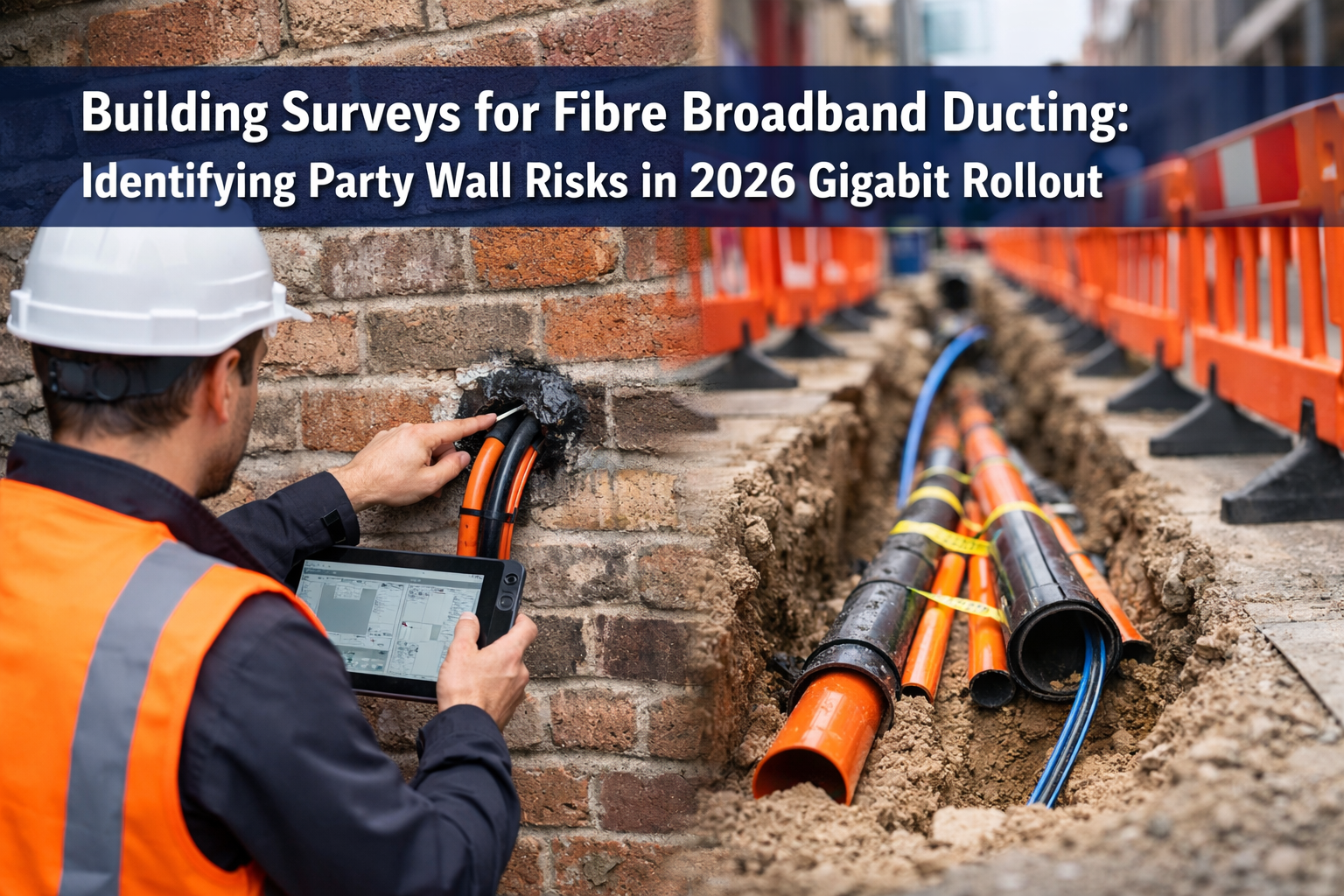
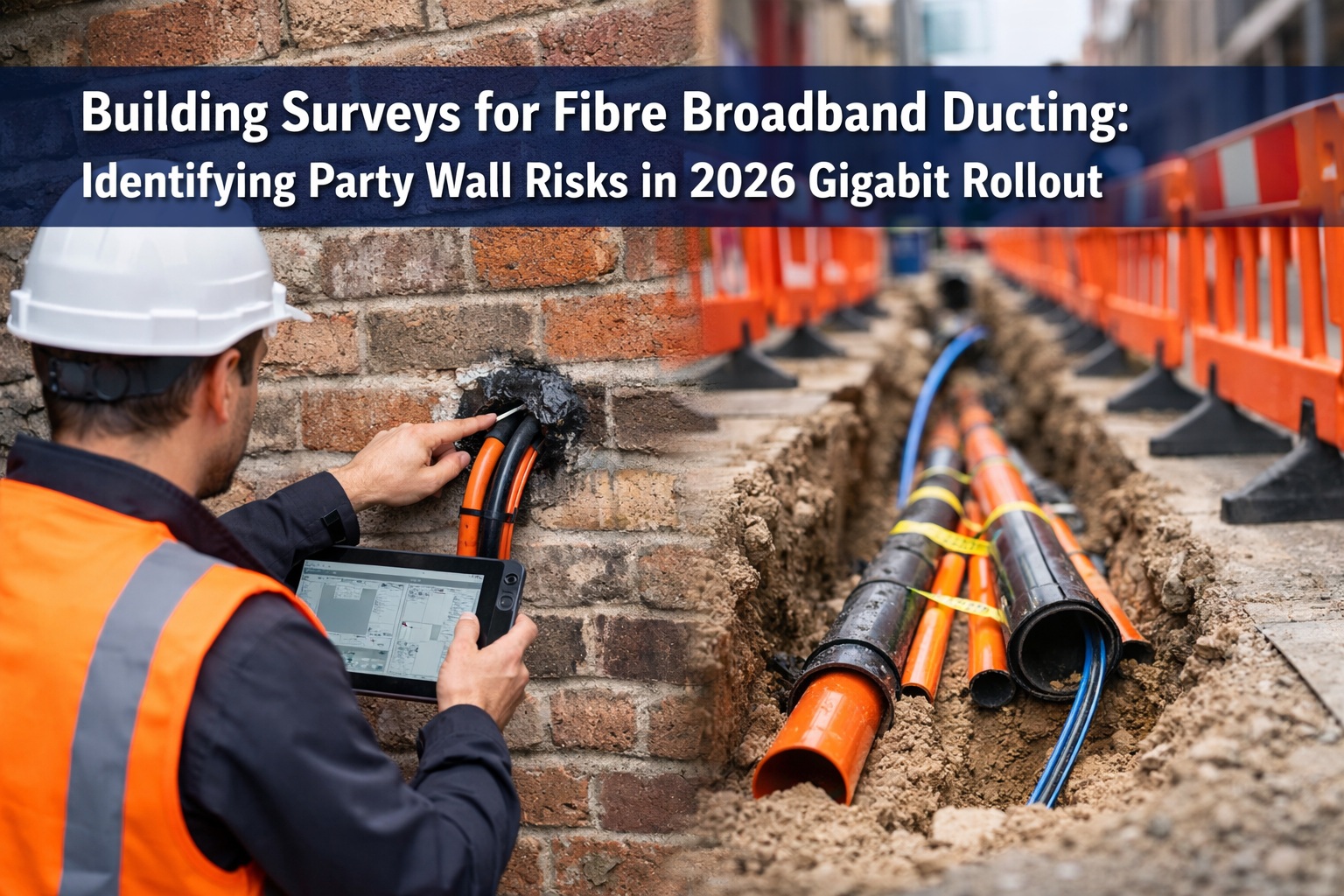
The UK government's 2026 gigabit rollout is accelerating at unprecedented speed, with contractors drilling through party walls and installing underground ducting at rates 40% higher than 2025 levels. Yet behind this digital infrastructure boom lies a hidden challenge: 75-90% of fibre installation costs stem from excavation and structural work[2], creating a surge in party wall disputes and structural damage claims that surveyors must navigate with precision.
Building surveys for fibre broadband ducting have become critical tools for identifying party wall risks before installation crews arrive. As telecommunications companies race to connect properties, the intersection of Party Wall Act 1996 requirements and new building control exemptions demands that surveyors develop specialized expertise in assessing boundary structures, detecting pre-existing defects, and documenting conditions that could trigger legal disputes.
Key Takeaways
- Pre-installation surveys prevent costly party wall disputes by documenting existing structural conditions before fibre ducting work begins
- New regulatory exemptions for drilling fire-resisting walls create compliance gaps that surveyors must address through enhanced inspection protocols
- Underground ducting installations account for 75-90% of project costs, making accurate boundary surveys essential for cost control[2]
- Party Wall Act triggers apply to most fibre installations near shared boundaries, requiring formal notices and agreed surveyor appointments
- Defect checklists must capture foundation vulnerabilities, moisture ingress points, and structural movement indicators before any excavation starts
Understanding Building Surveys for Fibre Broadband Ducting in the 2026 Context
The 2026 construction boom has fundamentally changed how building surveys approach fibre broadband infrastructure. Unlike traditional building surveys that focus on property purchase decisions, fibre ducting surveys serve a dual purpose: protecting property owners from installation damage while ensuring telecommunications providers can meet aggressive rollout targets.
The Scale of the 2026 Gigabit Challenge
Planning authorities and building control departments are processing significantly higher volumes of applications throughout 2026, creating bottlenecks that pressure contractors to accelerate installation schedules[5]. This urgency increases the risk of inadequate pre-work assessments, particularly where ducting routes cross property boundaries or require excavation near party walls.
The Vanderbilt Policy Accelerator's December 2025 report revealed that labour costs dominate fibre installation budgets, with underground work representing the overwhelming majority of project expenses[2]. This economic reality means contractors seek the fastest, most direct routes—often through shared walls or along boundary lines where Party Wall Act compliance becomes mandatory.
Regulatory Changes Affecting Survey Requirements
The UK government has proposed dispensing with procedural building control requirements for drilling small holes through internal fire-resisting walls specifically for fibre-optic cabling[1]. This exemption extends to higher-risk buildings, removing gateway two approvals, site inspections, change control, and gateway three completion inspections that previously required Building Safety Regulator approval[1].
While these changes streamline installations, they transfer responsibility for fire protection assurance to other parties—often the surveyor conducting pre-installation assessments. UK authorities are actively seeking evidence that fire protective measures will be maintained despite regulatory exemptions[1], placing additional scrutiny on survey documentation.
Identifying Party Wall Risks During Building Surveys for Fibre Broadband Ducting
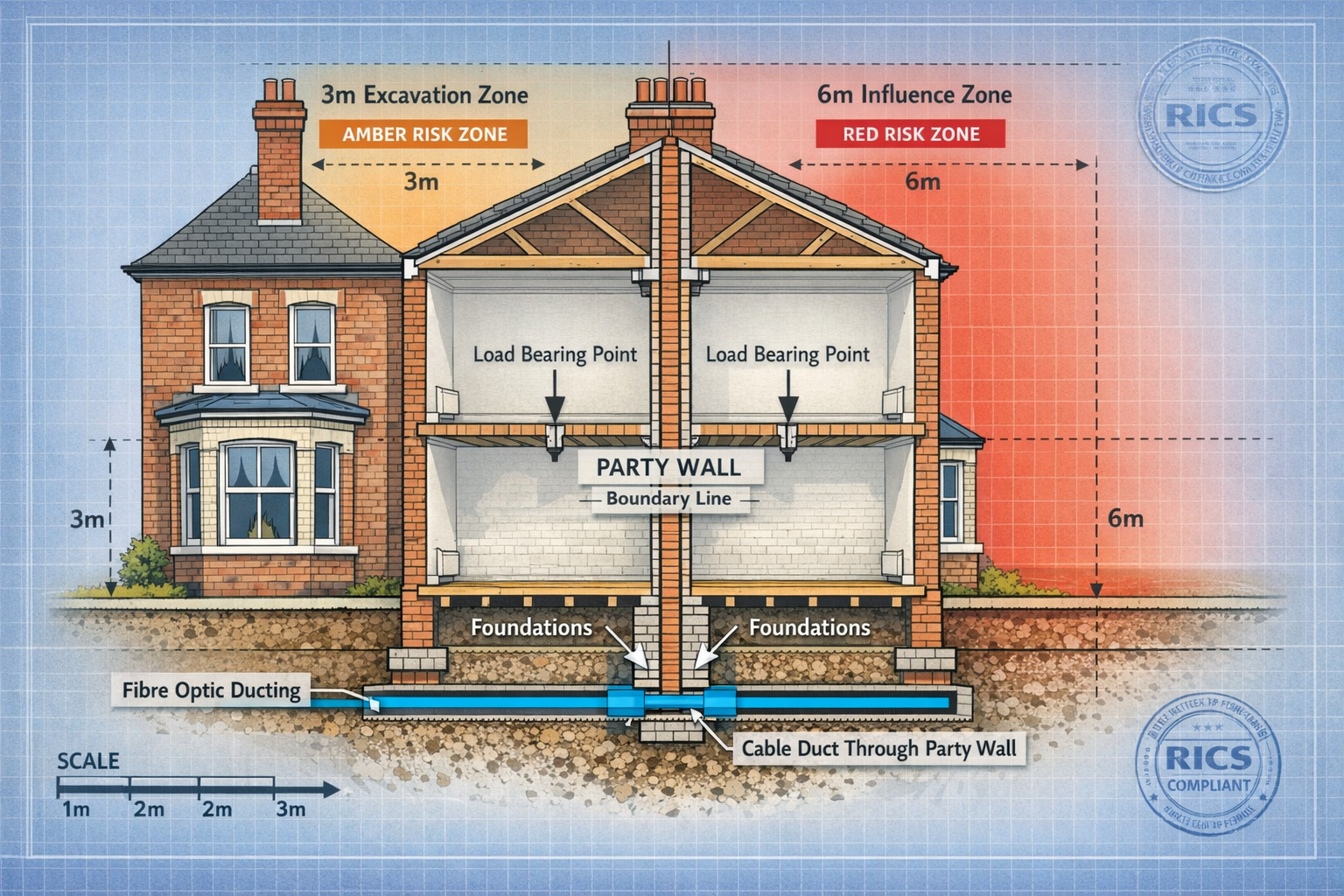
Party wall risks emerge whenever fibre installations affect shared structures or boundary lines. The Party Wall Act 1996 requires specific procedures when work involves building on or near boundaries, excavating near neighbouring foundations, or carrying out work to existing party structures. Understanding these triggers is essential for surveyors conducting pre-installation assessments.
Core Party Wall Act Triggers in Fibre Installations
Section 1 works apply when new walls are built on the line of junction between properties. While less common in fibre installations, this provision affects situations where new support structures or cable housings are constructed directly on boundary lines.
Section 2 works cover repairs, alterations, or modifications to existing party walls. Fibre ducting that penetrates party walls—whether external boundary walls or internal fire-resisting walls in converted properties—falls under this category. Even small penetrations for cable entry require Party Wall Act compliance.
Section 6 works address excavations within three or six metres of neighbouring structures (depending on depth). Underground ducting installations frequently trigger Section 6 requirements, particularly in terraced properties where trenches run parallel to party walls at shallow depths.
Professional party wall surveyors must be appointed when neighbours cannot agree on proposed works. The surveyor's role includes preparing schedules of condition—detailed records of existing defects and structural characteristics that establish baseline conditions before installation begins.
Critical Structural Vulnerabilities to Document
Surveyors conducting fibre ducting assessments must identify and record specific vulnerabilities that increase risk during installation:
Foundation Integrity Issues
Victorian and Edwardian properties often feature shallow brick foundations that lack modern concrete reinforcement. Underpinning indicators such as stepped cracks, differential settlement, or previous repair work signal foundations that may not withstand nearby excavation vibration.
Moisture damage near foundation level weakens structural capacity. Surveyors should use moisture meters to detect elevated readings in brickwork within 500mm of ground level, particularly where ducting trenches will pass within two metres of party walls. Our guide on wall cracking concerns provides additional context for interpreting structural movement indicators.
Boundary Wall Condition Assessment
Party walls showing signs of movement, bulging, or leaning require careful documentation. Tell-tale crack monitoring devices installed during pre-installation surveys provide objective evidence of whether movement accelerates during excavation work.
Render and pointing condition affects water penetration resistance. Ducting installations that disturb ground drainage patterns can redirect water toward party walls, exacerbating existing defects. Surveyors must photograph and measure all cracks wider than 1mm, noting their location relative to proposed cable entry points.
The UK's boundary wall rules establish ownership and maintenance responsibilities that affect liability when installation work causes damage.
Underground Service Conflicts
Existing utility services—gas, water, electricity, drainage—create collision risks for ducting installations. While not strictly party wall issues, service strikes during excavation can cause ground subsidence that affects adjacent properties.
Surveyors should request utility search records and note visible inspection covers, stopcocks, and meter positions within five metres of proposed trenching routes. Ground-penetrating radar surveys provide additional certainty for high-risk installations.
Building Surveys for Fibre Broadband Ducting: Pre-Installation Defect Checklists
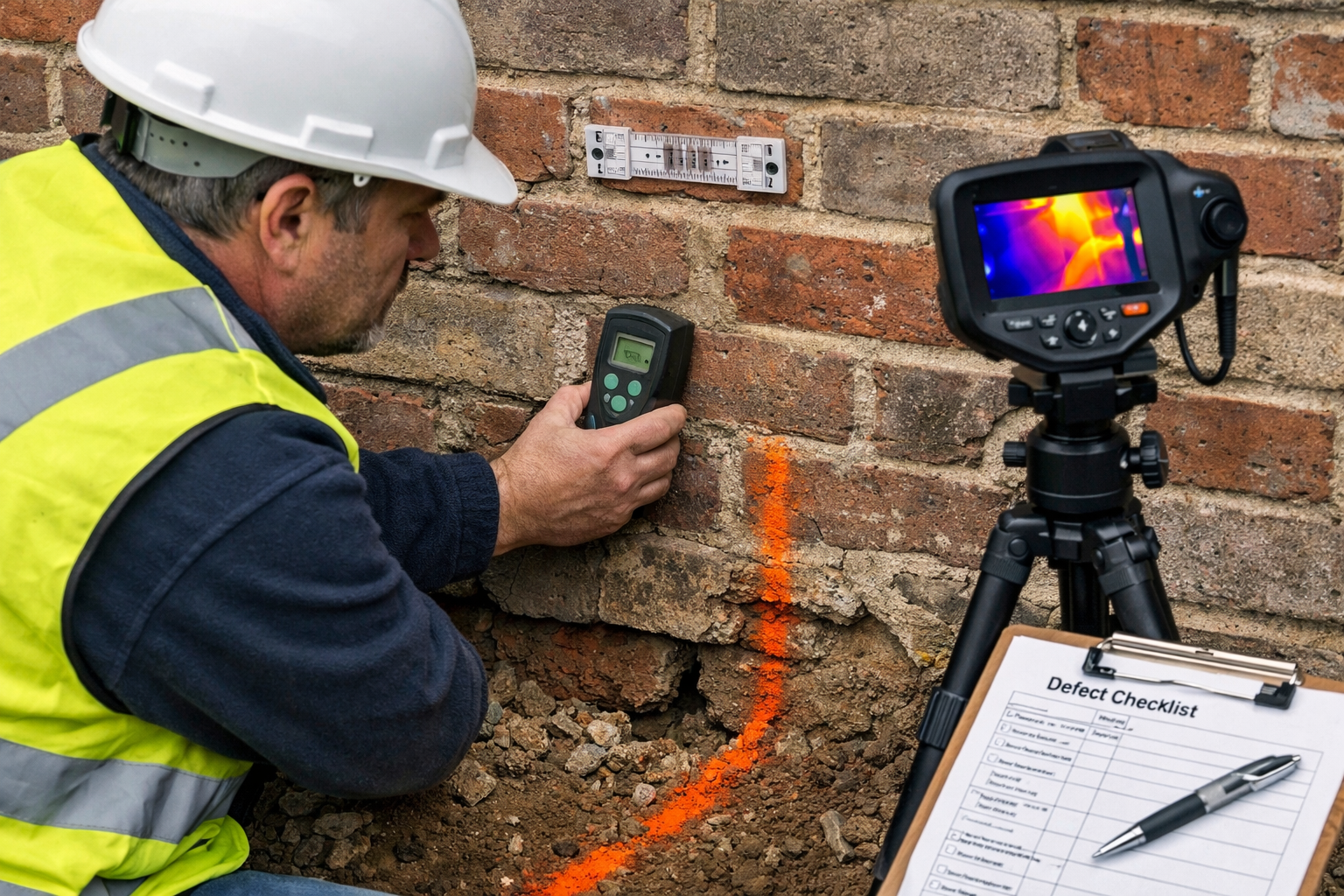
Comprehensive defect checklists form the foundation of effective party wall risk management. These structured assessment tools ensure surveyors capture all relevant baseline conditions before installation work commences, providing defensible evidence if disputes arise.
Essential Checklist Categories
External Envelope Assessment
Wall fabric condition: Record brick or stone condition, noting spalling, frost damage, or biological growth. Photograph all elevations from multiple angles, ensuring images capture the full height from foundation to eaves.
Pointing and render integrity: Test render adhesion by tapping with a surveyor's hammer, listening for hollow sounds that indicate delamination. Note areas of soft or eroded pointing within 2m of proposed ducting entry points.
Damp proof course effectiveness: Identify DPC location and type (slate, bitumen, chemical injection). Check for bridging caused by raised ground levels, render extending below DPC, or accumulated debris against walls.
Drainage systems: Inspect gutters, downpipes, gullies, and surface water drainage. Blocked or damaged drainage increases moisture risk during excavation work that may temporarily disrupt ground water flow.
Structural Movement Indicators
Crack patterns and width: Measure crack widths using crack width gauges, recording measurements on scaled drawings. Distinguish between historic settlement cracks (stable, often filled) and active movement (clean edges, varying width at different levels).
Verticality and alignment: Use a plumb bob or digital level to check wall verticality. Bulging or leaning walls indicate structural stress that excavation work may worsen.
Door and window operation: Test all doors and windows within 5m of proposed works. Sticking or binding indicates frame distortion from structural movement.
Floor level variations: Check floor levels with a spirit level, noting any slopes or dips that suggest differential settlement.
Foundation Zone Evaluation
Ground conditions: Note soil type (clay, sand, chalk) as this affects excavation stability and temporary works requirements. Clay soils are particularly vulnerable to volume changes from moisture fluctuation.
Existing excavations: Document any previous foundation work, underpinning, or basement conversions. These modifications affect load distribution and excavation risk profiles.
Tree proximity: Record species, size, and distance of trees within 15m of proposed works. Tree roots can destabilize trenches, while tree removal affects soil moisture and foundation loads.
Ground level changes: Note any slopes, retaining walls, or level differences between properties. These affect drainage patterns and excavation stability.
Digital Documentation Best Practices
Modern survey practice demands comprehensive digital records that withstand legal scrutiny. Surveyors should employ:
Timestamped photography: Use cameras with GPS and timestamp functions to create verifiable records. Capture wide shots showing context, medium shots showing specific defects, and close-ups with measurement scales.
Video walkthroughs: Record narrated video inspections that capture conditions too numerous or subtle for still photography alone. Video evidence proves particularly valuable in dispute resolution.
3D scanning technology: Laser scanning creates precise dimensional records of existing conditions. While expensive, 3D scans provide unambiguous evidence of pre-existing geometry and defects.
Cloud-based storage: Store all survey data in secure cloud platforms with version control and access logs. This protects against data loss and provides audit trails for professional indemnity purposes.
Professional building condition assessments establish the documentation standards that courts and insurance companies expect when evaluating damage claims.
Cost Implications and Survey Investment Returns
Understanding the financial context of fibre installations helps justify comprehensive survey investment. With underground work consuming 75-90% of installation budgets[2], even small routing optimizations identified during surveys can generate substantial savings.
Survey Costs vs. Dispute Resolution Expenses
A thorough pre-installation survey typically costs £800-£1,500 for a standard residential property, depending on complexity and access requirements. This investment pales compared to party wall dispute resolution costs, which can easily exceed £5,000-£10,000 when surveyors must be appointed for both parties and awards prepared.
Our analysis of party wall surveyor costs demonstrates that proactive assessment delivers significant return on investment by preventing disputes before they escalate.
"Dig Once" Policy Implications for UK Surveyors
International evidence from Utah, which implemented strong "dig once" legislation requiring conduit installation during road construction, shows fibre coverage 62.5% above the national average[2]. The Vanderbilt report argues such policies could reduce installation costs by 70-90%[2] by shifting excavation responsibility to state governments during planned roadwork.
While the UK has not adopted comprehensive "dig once" policies, the principle influences surveyor recommendations. Identifying opportunities to coordinate fibre installations with planned utility work, road maintenance, or adjacent construction projects can dramatically reduce costs and party wall risks.
Surveyors should inquire about upcoming works in the vicinity during pre-installation assessments, noting opportunities for coordination in their reports.
Regulatory Compliance Framework for 2026 Installations
The evolving regulatory landscape demands that surveyors understand both traditional building control requirements and new exemptions specific to telecommunications work.
Building Control Exemptions and Their Limits
The proposed exemptions for drilling fire-resisting walls[1] create a two-tier system where some fibre work proceeds without formal building control oversight, while other installations require full compliance. Surveyors must distinguish between:
Exempt works: Small holes through internal fire-resisting walls for fibre-optic cabling, where procedural requirements including gateway inspections are dispensed with[1].
Non-exempt works: Structural alterations, external wall penetrations, work affecting building stability, or installations in buildings with specific fire safety concerns.
The exemption specifically addresses internal fire-resisting walls, not party walls separating different properties. Party Wall Act requirements remain fully applicable regardless of building control exemptions.
Fire Protection Maintenance Responsibilities
Despite regulatory exemptions, UK authorities emphasize that fire protective measures must be maintained[1]. This responsibility often falls to the installer, but surveyors play a crucial verification role.
Survey reports should explicitly address fire protection considerations:
- Existing fire stopping condition around services passing through party walls
- Proposed penetration locations relative to fire compartmentation strategy
- Intumescent seal requirements for new cable penetrations
- Inspection and certification protocols to verify proper fire stopping installation
Professional building regulations expertise ensures surveyors provide guidance that protects both property owners and installers from compliance failures.
Party Wall Act Procedural Requirements
Regardless of building control exemptions, Party Wall Act procedures remain mandatory for relevant works. The standard process involves:
- Notice service: Building owners must serve notice on adjoining owners at least two months before starting work (one month for Section 6 excavations)
- Consent or dissent: Adjoining owners have 14 days to consent or dissent to proposed works
- Surveyor appointment: If adjoining owners dissent or fail to respond, surveyors must be appointed
- Award preparation: Agreed surveyors prepare a Party Wall Award detailing permitted works, timing, and access arrangements
- Schedule of condition: Detailed condition records establish baseline for assessing any damage claims
Understanding party wall agreement assistance processes helps surveyors guide clients through statutory requirements efficiently.
Practical Survey Methodology for Fibre Ducting Projects
Effective survey methodology balances thoroughness with practical constraints of tight installation schedules. Surveyors must deliver comprehensive assessments within timeframes that don't derail project momentum.
Site Investigation Sequence
Desktop review (2-4 hours): Before site visits, surveyors should review title documents, planning history, previous survey reports, and utility records. This preparation identifies known issues and informs inspection focus areas.
External inspection (1-2 hours): Systematic examination of all elevations, paying particular attention to boundary walls, foundation zones, and proposed cable entry points. Document drainage systems, ground conditions, and adjacent structures.
Internal inspection (1-2 hours): Assess internal wall conditions where cables will penetrate, check floor levels, test door and window operation, and examine roof spaces where overhead cables may route.
Neighbour liaison (30-60 minutes): Where possible, brief inspection of adjoining property provides valuable perspective on shared wall conditions and existing relationships between neighbours.
Utility coordination (ongoing): Liaise with utility companies to obtain service location records and arrange trial holes if underground conflicts seem likely.
Technology-Enhanced Survey Techniques
Modern surveying technology significantly improves assessment accuracy and efficiency:
Thermal imaging: Identifies moisture ingress, insulation defects, and hidden structural elements. Particularly valuable for detecting damp behind finishes near proposed ducting routes.
Moisture meters: Quantify moisture content in walls, providing objective data rather than subjective assessments. Essential for documenting baseline conditions in foundation zones.
Crack monitoring: Install tell-tales or electronic crack monitors on significant cracks to distinguish active movement from historic settlement.
Ground-penetrating radar: Maps underground services, voids, and foundation depths without excavation. Cost-effective for complex sites with multiple utility conflicts.
Drone photography: Captures roof and upper elevation conditions safely and efficiently, particularly valuable for tall terraced properties where access is difficult.
Report Structure and Content Requirements
Survey reports must communicate findings clearly to multiple audiences: property owners, installers, building control officers, and potentially courts if disputes arise.
Executive summary: One-page overview highlighting critical risks, Party Wall Act triggers, and key recommendations.
Site context: Property description, location, construction type, age, and surrounding development.
Methodology statement: Equipment used, inspection limitations, weather conditions, and personnel involved.
Findings by element: Structured presentation of defects and conditions, organized by building element (foundations, walls, drainage, etc.).
Risk assessment: Explicit evaluation of party wall risks, structural vulnerabilities, and installation challenges.
Recommendations: Specific actions required before installation (repairs, Party Wall Act notices, specialist investigations, etc.).
Photographic appendix: Comprehensive images with annotations and scale references.
Drawings: Site plan showing proposed ducting route, party wall locations, and critical features.
Professional specific defect surveys provide templates for focused assessments that complement broader building surveys.
Managing Stakeholder Expectations and Communication
Successful fibre installation projects depend on clear communication between multiple parties with competing priorities. Surveyors serve as crucial intermediaries, translating technical findings into actionable information for diverse audiences.
Property Owner Communication
Property owners often lack construction knowledge and may feel anxious about installations affecting their homes. Surveyors should:
- Explain Party Wall Act rights clearly, avoiding legal jargon while ensuring owners understand their protection under the Act
- Set realistic expectations about timescales, disruption, and potential outcomes
- Provide written summaries in plain English alongside technical reports
- Highlight benefits of proper assessment in preventing future disputes
Installer and Contractor Liaison
Telecommunications contractors face aggressive rollout targets and cost pressures. Surveyors must balance thoroughness with pragmatism:
- Identify alternative routing options that avoid high-risk party wall scenarios
- Prioritize findings by severity, distinguishing critical issues from minor concerns
- Suggest mitigation measures that allow work to proceed safely
- Provide clear go/no-go recommendations with supporting evidence
Regulatory Authority Coordination
Building control officers and planning authorities process high volumes of applications during the 2026 boom[5]. Surveyors can facilitate approvals by:
- Submitting complete documentation that anticipates likely questions
- Referencing relevant exemptions and explaining their applicability
- Proposing monitoring protocols that provide assurance without excessive oversight
- Maintaining professional relationships that build trust over multiple projects
Neighbour Relations Management
Party wall disputes often stem from poor communication rather than genuine technical disagreements. Surveyors can reduce conflict by:
- Facilitating early dialogue between property owners before formal notices
- Explaining works clearly to adjoining owners, addressing concerns proactively
- Offering joint inspections where both parties can see existing conditions together
- Documenting agreements in writing to prevent misunderstandings
Understanding boundary disputes helps surveyors recognize early warning signs of potential conflicts.
Future-Proofing Survey Practice for Ongoing Rollout
The 2026 gigabit rollout represents just one phase of ongoing digital infrastructure expansion. Surveyors who develop specialized expertise in fibre installations position themselves for sustained demand as networks densify and upgrade to future standards.
Emerging Technologies and Survey Implications
5G small cell installations: Require mounting equipment on building facades, creating new party wall scenarios where shared walls support telecommunications infrastructure.
Full-fibre to the premises (FTTP): Demands individual connections to every dwelling unit, multiplying the number of party wall penetrations in multi-occupancy buildings.
Smart city infrastructure: Integrates fibre networks with IoT sensors, requiring more complex routing and additional building penetrations.
Professional Development Priorities
Surveyors should invest in:
- Party Wall Act training from recognized providers, ensuring thorough understanding of statutory procedures
- Building pathology courses focusing on structural movement, foundation failures, and moisture-related defects
- Technology skills including thermal imaging interpretation, 3D scanning, and digital documentation systems
- Telecommunications knowledge covering fibre optic specifications, installation methods, and industry standards
Building Long-Term Client Relationships
Telecommunications providers conducting large-scale rollouts value surveyor partners who deliver consistent quality across multiple projects. Building these relationships requires:
- Standardized processes that ensure reliable service delivery
- Scalable capacity to handle volume fluctuations during peak installation periods
- Geographic coverage across provider service territories
- Technology investment that improves efficiency and reduces turnaround times
Professional membership with organizations like RICS demonstrates commitment to standards that major infrastructure clients expect.
Conclusion
Building surveys for fibre broadband ducting represent a specialized discipline at the intersection of traditional building surveying, party wall expertise, and telecommunications infrastructure knowledge. As the 2026 gigabit rollout accelerates, identifying party wall risks before installation work begins has become essential for protecting property owners, managing contractor risks, and ensuring regulatory compliance.
The economic reality that 75-90% of fibre installation costs stem from underground work[2] makes comprehensive pre-installation surveys a cost-effective investment. By documenting existing conditions, identifying structural vulnerabilities, and facilitating Party Wall Act compliance, surveyors prevent disputes that can cost ten times more than proactive assessment.
New regulatory exemptions for drilling fire-resisting walls[1] streamline installations but transfer responsibility for fire protection assurance to surveyors and installers. This evolving compliance landscape demands that surveyors maintain current knowledge of building control requirements while mastering traditional party wall procedures that remain fully applicable.
Actionable Next Steps
For property owners: Commission a pre-installation survey before agreeing to fibre ducting work that affects party walls or requires excavation near boundaries. Ensure your surveyor has specific party wall expertise and understands telecommunications installation requirements.
For telecommunications providers: Integrate comprehensive building surveys into project planning for all installations affecting party structures. The modest survey cost prevents expensive disputes and project delays that undermine rollout targets.
For surveyors: Develop specialized expertise in fibre installation assessments through targeted training in Party Wall Act procedures, structural pathology, and telecommunications infrastructure. Invest in technology that improves documentation quality and efficiency.
For all stakeholders: Prioritize early communication and proactive risk management. The best party wall outcomes result from identifying issues before work starts, not resolving disputes after damage occurs.
The 2026 gigabit rollout presents both challenges and opportunities for the surveying profession. Those who master the specialized skills required for building surveys addressing fibre broadband ducting and party wall risks will find sustained demand as digital infrastructure continues expanding across the UK.
For expert guidance on party wall matters related to fibre installations, consider consulting professional party wall surveyors who understand both structural assessment and telecommunications infrastructure requirements.
References
[1] Improving Proportionality And Safety Outcomes In Building Control Telecommunications Work – https://www.gov.uk/government/consultations/improving-proportionality-and-safety-outcomes-in-building-control-telecommunications-work/improving-proportionality-and-safety-outcomes-in-building-control-telecommunications-work
[2] Vanderbilt Report Argues For Dig Once Policies To Reduce Fiber Instillation Costs – https://broadbandbreakfast.com/vanderbilt-report-argues-for-dig-once-policies-to-reduce-fiber-instillation-costs/
[3] Planning Next Years Fiber Surge Data Lessons 2026 – https://vitruvisoftware.com/blog/planning-next-years-fiber-surge-data-lessons-2026
[4] Construction – https://www.hubinternational.com/insights/outlook/2026/construction/
[5] Party Wall Surveys Amid 2026 Construction Boom Handling Disputes In High Demand Uk Housing Markets – https://nottinghillsurveyors.com/blog/party-wall-surveys-amid-2026-construction-boom-handling-disputes-in-high-demand-uk-housing-markets