


The buy-to-let market in 2026 is experiencing a dramatic transformation. As amateur landlords exit amid regulatory pressures, institutional investors and professional portfolio managers are stepping in—but they're facing a minefield of hidden risks. Building Surveys for Buy-to-Let Properties: Spotting Risks in 2026's Professional Landlord Wave has never been more critical, as properties change hands at unprecedented rates and regulatory compliance becomes increasingly complex.
With Savills forecasting 22.2% property value growth and banks reassessing investment yields from 6-7% to approximately 10% for multi-unit properties, the stakes have never been higher.[1] Professional landlords cannot afford to overlook structural defects, compliance failures, or yield-impacting issues that could devastate returns. This comprehensive guide provides the defect checklists and risk prioritization frameworks that institutional investors need to navigate 2026's evolving rental landscape.

Key Takeaways
- Regulatory compliance issues now pose the greatest financial risk to buy-to-let investments, with the Renters' Rights Act fundamentally altering the market landscape and forcing foreign investors to exit at significant discounts
- HMO properties deliver the strongest rental yields but require the most rigorous structural and compliance surveying due to stringent regulations and complex financing requirements
- Hidden defects in distressed properties can reduce yields from 7% to 3% or lower, making comprehensive building surveys essential for protecting institutional investment returns
- Single-person household growth to 33% of all households creates strong demand for one-bedroom properties, requiring different survey priorities than traditional family homes
- Development finance pressures at 12% and extended project timelines of 24+ months signal financial stress that surveyors must evaluate when assessing commercial and multi-unit investments
Understanding the 2026 Buy-to-Let Landscape
The private rented sector remains remarkably stable, accounting for 4.7 million households or 19% of all households in England—a percentage that has remained consistent for over a decade despite portfolio exits by some landlords.[2] However, the composition of landlords is changing dramatically.
The Rise of Professional Landlords
Amateur landlords are leaving the market in response to:
- Increased stamp duty surcharge from 3% to 5% for second homes and buy-to-let properties[4]
- Higher Capital Gains Tax substantially raising the cost of portfolio exits
- Renters' Rights Act creating complex compliance requirements that favor professional management
This exodus has created acquisition opportunities for institutional investors who can navigate regulatory complexity and absorb higher transaction costs. Foreign investors in particular have exited at significant discounts to purchase prices, creating a buyer's market for well-capitalized professional landlords.[2]
Market Dynamics Reshaping Investment Strategy
Major banks have fundamentally reassessed property investment valuations, shifting from 6-7% yield expectations to approximately 10% yield for properties with over three units.[3] This recalibration reflects:
- Changed risk assessments in the regulatory environment
- Opportunities for bulk purchasing and title split strategies
- Recognition of compliance costs and void period risks
Understanding these market dynamics is essential when choosing the right survey type for buy-to-let investments.
Building Surveys for Buy-to-Let Properties: Critical Defect Categories
Professional landlords require a different approach to building surveys than residential owner-occupiers. The focus must shift from aesthetic concerns to yield-impacting defects and regulatory compliance risks.
Structural Integrity Assessment
Foundation and subsidence risks represent the most expensive category of defects to remediate. Survey teams should prioritize:
| Risk Category | Inspection Points | Yield Impact |
|---|---|---|
| Foundation movement | Crack patterns, door/window alignment, floor levels | High – can require £15,000-£50,000+ repairs |
| Subsidence indicators | External wall cracks, stepped cracking in brickwork | Severe – may render property unmortgageable |
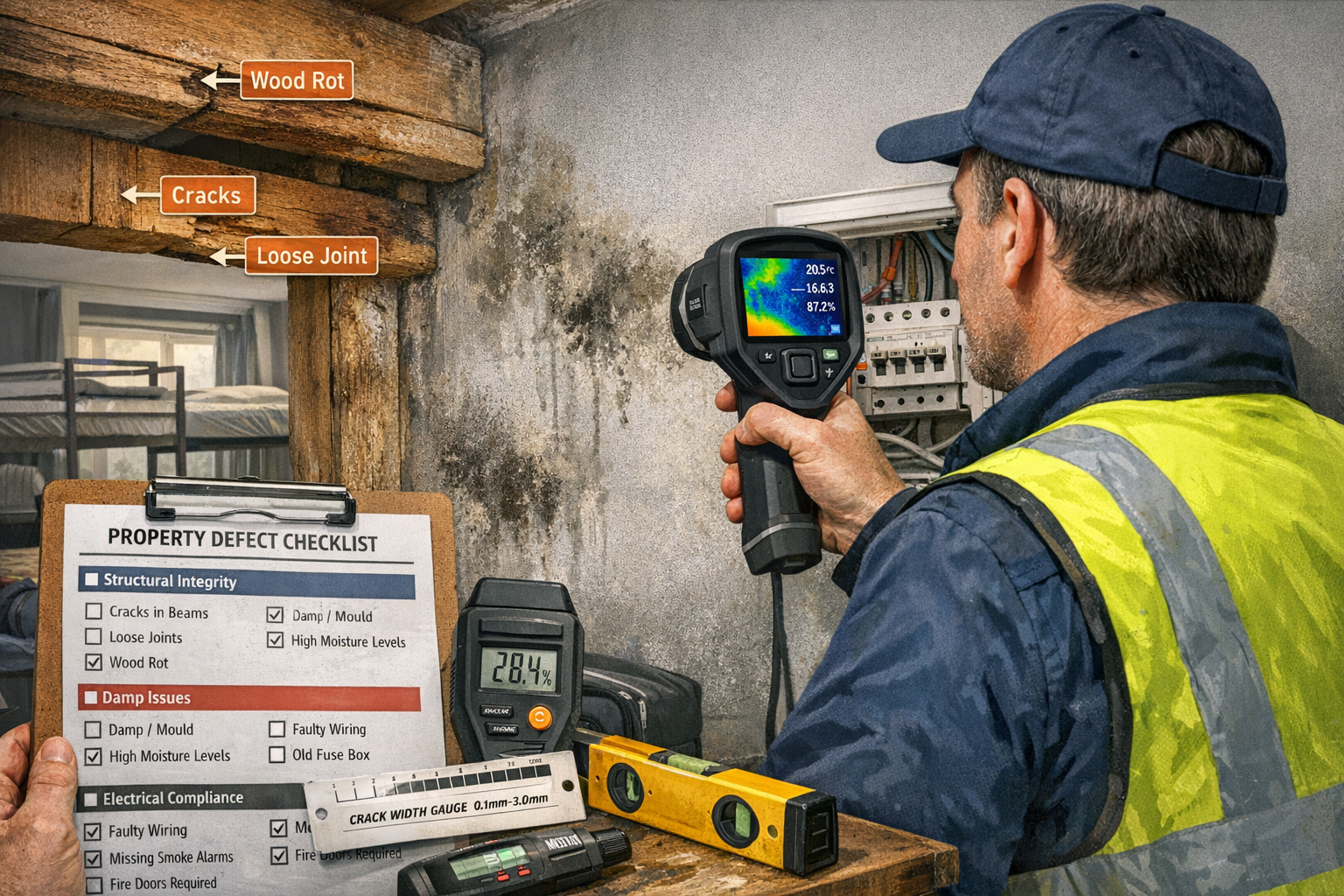
| Structural timber decay | Roof timbers, floor joists, load-bearing beams | High – affects safety certificates and insurance |
| Roof integrity | Tile condition, flashing, valley gutters, sarking felt | Medium – leads to water ingress and secondary damage |
Subsidence issues are particularly problematic for buy-to-let investors because they can trigger mortgage withdrawal and create extended void periods while repairs are completed.
Damp and Water Penetration
Moisture-related defects are the leading cause of tenant complaints and void periods. Comprehensive surveys must identify:
- Rising damp from failed or absent damp-proof courses
- Penetrating damp through external walls, particularly in solid wall construction
- Condensation issues indicating inadequate ventilation
- Plumbing leaks in concealed pipework serving multiple units
Professional surveyors should use thermal imaging cameras and moisture meters to detect hidden water ingress that may not be visible during standard inspections. For detailed moisture assessments, consider a specialized damp and timber report.
Electrical Safety Compliance
The Electrical Safety Standards in the Private Rented Sector (England) Regulations 2020 require landlords to ensure electrical installations are inspected and tested at intervals of no more than five years. Survey teams must verify:
✅ Valid EICR certificate (Electrical Installation Condition Report) dated within five years
✅ Consumer unit compliance with current regulations (no plastic units, RCD protection)
✅ Adequate circuit capacity for modern appliance loads
✅ Proper earthing and bonding throughout the property
✅ Socket and switch condition in all lettable areas
Electrical upgrade costs can range from £2,000-£8,000 for rewiring, significantly impacting investment returns if not identified during pre-purchase surveys.
Regulatory Compliance: The New Priority for Building Surveys for Buy-to-Let Properties
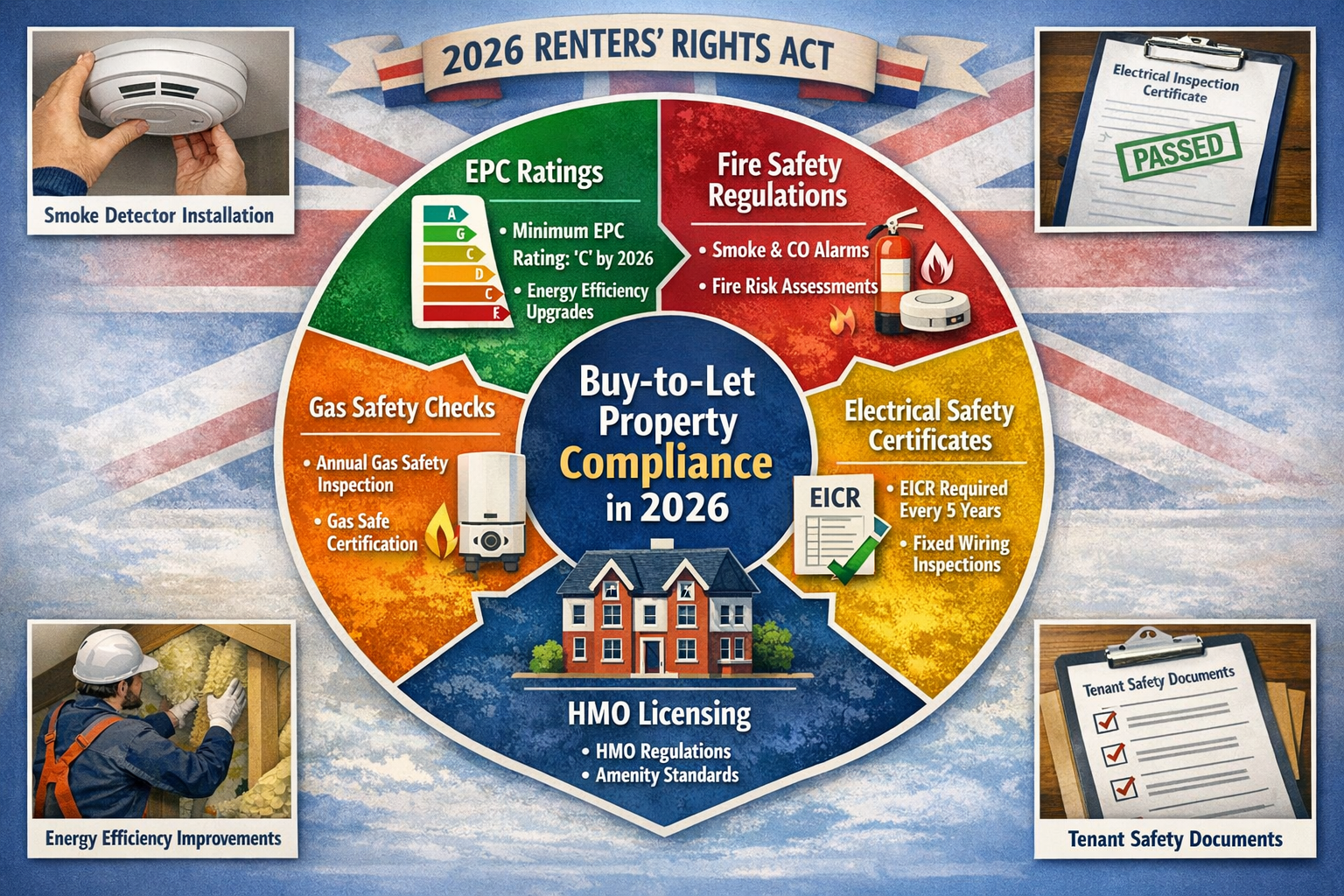
The regulatory landscape in 2026 has fundamentally altered risk profiles for rental properties. Building surveys must now incorporate compliance assessments that directly impact rental viability.
Energy Performance Certificate (EPC) Requirements
Since April 2020, rental properties must achieve a minimum EPC rating of E. However, institutional investors should target higher ratings:
- EPC Rating C or above increasingly expected by quality tenants
- Improvement costs for upgrading from E to C can range from £5,000-£25,000
- Yield premium for energy-efficient properties of 5-8% in competitive markets
Survey teams should identify specific improvements required to achieve target EPC ratings, including:
- Loft and cavity wall insulation deficiencies
- Inefficient heating systems requiring replacement
- Single-glazed windows needing upgrading
- Opportunities for renewable energy installation
Fire Safety Regulations
Fire safety requirements vary significantly based on property type and occupancy:
Standard Buy-to-Let Properties:
- Smoke alarms on each floor
- Carbon monoxide detectors in rooms with solid fuel appliances
- Fire doors to habitable rooms in flats
HMO Properties (Houses in Multiple Occupation):
- Comprehensive fire detection and alarm system
- Emergency lighting in common areas
- Fire doors with self-closers throughout
- Fire blankets and extinguishers
- Clear escape routes with appropriate signage
- Fire risk assessment documentation
HMO properties demonstrate the strongest monthly rental returns of any property type,[2] but fire safety compliance costs can reach £8,000-£15,000 for retrofitting older properties. Surveyors must provide detailed compliance gap analysis to enable accurate investment modeling.
HMO Licensing and Standards
Properties housing three or more tenants forming two or more households require HMO licensing in most local authorities. Survey teams should assess:
| Compliance Area | Minimum Standards | Survey Verification |
|---|---|---|
| Room sizes | Minimum 6.51m² for single occupancy, 10.22m² for double | Measure all bedrooms accurately |
| Kitchen facilities | Adequate cooking and food storage for occupant numbers | Assess capacity and condition |
| Bathroom provision | Minimum ratios based on occupancy | Count and assess condition |
| Amenity standards | Adequate heating, lighting, ventilation | Test and verify functionality |
| Management standards | Proper waste disposal, maintenance systems | Review existing arrangements |
Failure to meet HMO standards can result in licensing refusal, unlimited fines, and rent repayment orders extending back 12 months.
Gas Safety Obligations
Annual gas safety checks are mandatory for all rental properties with gas appliances. Surveys should identify:
- Age and condition of boilers (lifespan typically 10-15 years)
- Adequacy of heating system for property size
- Condition of gas pipework and connections
- Ventilation adequacy for gas appliances
- Presence of carbon monoxide detectors
Boiler replacement costs range from £1,500-£3,500, representing a significant unplanned expense if not identified during pre-purchase surveys.
Defect Prioritization Framework for Institutional Investors
Not all defects carry equal weight for buy-to-let investment returns. Professional landlords need a prioritization framework that focuses on yield impact and regulatory risk.
Critical Priority Defects (Address Immediately)
These defects prevent legal letting or create severe yield reduction:
🚨 Category 1 hazards under Housing Health and Safety Rating System (HHSRS)
🚨 Structural instability requiring immediate remediation
🚨 Electrical safety failures preventing EICR certification
🚨 Fire safety non-compliance in HMO properties
🚨 EPC rating below E making property unlettable
🚨 Active infestations (particularly Japanese knotweed)
If you discover critical issues, understanding what to do after a bad building survey report becomes essential for protecting your investment.
High Priority Defects (Address Within 12 Months)
These defects create tenant dissatisfaction and void risk:
⚠️ Damp and mold issues affecting habitability
⚠️ Heating system inadequacy or inefficiency
⚠️ Roof defects allowing water ingress
⚠️ Drainage problems causing recurring issues
⚠️ Window and door failures affecting security and insulation
Medium Priority Defects (Plan for Replacement Cycle)
These defects require budgeting but don't immediately impact lettability:
📋 Aging kitchen and bathroom fixtures (plan 7-10 year replacement)
📋 External decoration and minor repairs
📋 Flooring wear in high-traffic areas
📋 Garden and boundary maintenance
Yield Impact Calculation
Professional surveyors should provide yield impact assessments for identified defects:
Example Calculation:
- Property purchase price: £250,000
- Expected gross yield at 7%: £17,500 per annum
- Survey identifies: £15,000 electrical rewiring + £8,000 damp remediation
- Extended void period during works: 3 months
- Total impact: £23,000 + £4,375 (lost rent) = £27,375
- Revised yield calculation: (£17,500 – £4,375) ÷ (£250,000 + £23,000) = 4.8%
This 2.2 percentage point yield reduction demonstrates why comprehensive surveys are essential for institutional investors operating on tight margin calculations.
Property Type-Specific Survey Considerations
Different buy-to-let property types require tailored survey approaches in 2026's market.
Single-Bedroom Apartments
With single-person households now representing 33% of all households (up from 28% six years ago),[2] one-bedroom properties offer volume portfolio opportunities despite lower individual yields.
Survey priorities:
- Leasehold terms and service charges – verify ground rent, service charge history, and remaining lease length (minimum 85 years for mortgageability)
- Building insurance adequacy – confirm freeholder maintains appropriate coverage
- Communal area condition – assess lift, entrance, and shared facility maintenance
- Parking and storage – verify allocated spaces and additional value features
- Noise insulation – critical for tenant satisfaction in apartment buildings
Understanding what to check before buying a leasehold property is essential for apartment investors.
HMO Properties (3+ Bedrooms)
HMO properties deliver the strongest rental yields but require the most comprehensive surveying.[2]
Additional survey requirements:
- Licensing compliance assessment against local authority standards
- Fire safety gap analysis with detailed remediation costings
- Room size verification against minimum standards
- Kitchen and bathroom capacity for planned occupancy levels
- Sound insulation between letting rooms
- Separate utility metering feasibility assessment
Multi-Unit Buildings
Banks now value properties with over three units at approximately 10% yield,[3] creating opportunities for bulk purchasing and title split strategies.
Survey focus areas:
- Individual unit condition – comprehensive assessment of each lettable space
- Shared infrastructure – boilers, electrical distribution, water systems
- Title split feasibility – structural independence of units
- Planning compliance – verification of lawful use for multiple occupancy
- Commercial tenant viability – financial stability assessment for commercial units
For commercial tenants, surveyors should alert investors to verify tenant accounts and ability to pay rent, as receivers require only one month's notice to cancel leases on distressed properties, leaving investors exposed to rates obligations if tenants become insolvent.[3]
Distressed Property Opportunities and Risks
A significant inventory of underwater properties remains on the market in 2026, involving receivers and distress sales.[3] These opportunities require heightened survey scrutiny.
Developer Distress Indicators
Small developers are paying 12% development finance costs, with many exceeding their banking mandates and facing extended project timelines of 24+ months instead of anticipated 12-18 month periods.[3] Survey teams should evaluate:
- Incomplete works – assess quality and completion costs
- Planning compliance – verify all works have proper approval
- Building control sign-off – confirm completion certificates
- Warranty coverage – check NHBC or similar structural warranties
- Snagging lists – identify defects requiring developer rectification
Developers exceeding their banking mandates face significant penalty interest and additional fees from bridge lenders and banks,[3] creating pressure for quick sales that may conceal problems.
Receiver Sale Due Diligence
Properties sold by receivers require enhanced survey protocols:
✓ Previous problem investigation – research planning and building control history
✓ Tenant lease review – verify security of income and lease terms
✓ Deferred maintenance assessment – properties in receivership often suffer neglect
✓ Title verification – confirm clear title and absence of charges
✓ Warranty and guarantee transfer – ensure assignability to new owner
Survey Preparation and Execution Best Practices
Maximizing survey value requires proper preparation before the surveyor visits.
Pre-Survey Documentation Gathering
Professional investors should compile:
- Title documents and lease agreements (for leasehold)
- Previous survey reports if available
- EPC certificates and energy assessment reports
- Planning permissions and building regulation approvals
- Electrical, gas, and fire safety certificates
- Service charge accounts (for leasehold and multi-unit)
- Tenant tenancy agreements and rent roll
Understanding what to do before an RICS home survey helps ensure comprehensive assessment.
Choosing the Appropriate Survey Level
RICS offers three survey levels, each suited to different property types and investor needs:
Level 1 (Condition Report):
- Suitable only for new-build or recently constructed properties
- Rarely appropriate for buy-to-let investments
- Provides basic condition assessment without advice
Level 2 (HomeBuyer Report):
- Appropriate for conventional properties in reasonable condition
- Includes market valuation and insurance rebuild cost
- Identifies urgent defects and significant issues
- Cost-effective for standard buy-to-let acquisitions
Level 3 (Building Survey):
- Essential for older properties, HMOs, and multi-unit buildings
- Comprehensive investigation of structure and fabric
- Detailed defect analysis with remediation advice
- Recommended for all institutional buy-to-let investments
For detailed comparison, review our guide on exploring the key differences between Level 2 and Level 3 surveys.
Survey Attendance and Questioning
Professional investors should consider attending surveys to:
- Ask specific questions about rental-relevant issues
- Understand defect severity and remediation urgency
- Discuss compliance requirements and upgrade costs
- Assess surveyor's experience with buy-to-let properties
- Verify access to all areas including lofts, basements, and outbuildings
Post-Survey Action Framework
Receiving the survey report is only the beginning of the risk management process.
Defect Cost Estimation
Professional quantity surveyors can provide detailed remediation cost estimates for identified defects. Typical costs in 2026:
| Defect Type | Cost Range | Timeline |
|---|---|---|
| Full electrical rewiring | £3,000-£8,000 | 2-3 weeks |
| Damp-proof course installation | £2,000-£5,000 | 1-2 weeks |
| Roof replacement | £5,000-£15,000 | 2-4 weeks |
| Boiler replacement | £1,500-£3,500 | 2-3 days |
| HMO fire safety upgrades | £8,000-£15,000 | 3-4 weeks |
| EPC improvement works | £5,000-£25,000 | 4-8 weeks |
Negotiation Strategy
Survey findings provide leverage for price renegotiation:
- Critical defects – seek full cost reduction plus compensation for void period
- High priority defects – negotiate 75-100% of remediation costs
- Medium priority defects – target 50% cost contribution
- Compliance upgrades – request full cost coverage as these are mandatory
Proceeding with Purchase
If proceeding despite identified defects:
- Obtain detailed remediation quotes from qualified contractors
- Schedule works to minimize void periods
- Arrange compliance certifications before first letting
- Update insurance to reflect property condition
- Adjust financial projections to reflect actual yields
- Document all works for future sale or refinancing
The Political and Economic Context for 2026
The property market demonstrates sensitivity to political turbulence and indecision,[3] with commercial tenant viability increasingly dependent on political stability and policy implementation.
Tax Burden Considerations
The stamp duty surcharge increase from 3% to 5% for second homes and buy-to-let properties, combined with increased Capital Gains Tax,[4] substantially raises the cost of portfolio exits and requires investors to model extended holding periods in financial projections.
Example Impact:
- Property purchase price: £300,000
- Previous stamp duty (3% surcharge): £11,500
- Current stamp duty (5% surcharge): £17,500
- Additional cost: £6,000 (52% increase)
This tax burden makes thorough surveying even more critical, as investors cannot easily exit positions without significant tax consequences.
Market Sentiment and Timing
Savills' forecast of 22.2% property value growth over the coming period[1] provides a strong backdrop for institutional landlord investments, though this growth potential is contingent on managing identified risks that could impact property values and rental income continuity.
Professional investors should time acquisitions to:
- Capitalize on distressed seller pressure
- Avoid peak competition periods
- Allow adequate time for pre-letting remediation works
- Align with favorable interest rate environments
Conclusion
Building Surveys for Buy-to-Let Properties: Spotting Risks in 2026's Professional Landlord Wave represents a fundamental shift in property investment due diligence. As the market transitions from amateur to institutional landlords, the survey process must evolve from basic condition assessment to comprehensive risk management encompassing regulatory compliance, yield protection, and long-term portfolio strategy.
The key success factors for professional landlords in 2026 include:
✅ Prioritizing regulatory compliance over cosmetic condition
✅ Conducting Level 3 Building Surveys for all HMO and multi-unit acquisitions
✅ Calculating yield impact of identified defects before finalizing purchases
✅ Budgeting for compliance upgrades including EPC, electrical, and fire safety
✅ Assessing distressed property opportunities with heightened scrutiny
✅ Understanding property type-specific risks from single-bedroom apartments to HMOs
Next Steps for Professional Landlords
- Engage RICS-qualified surveyors with specific buy-to-let experience
- Prepare comprehensive documentation before survey appointments
- Attend surveys to ask rental-specific questions
- Obtain detailed remediation quotes for all identified defects
- Renegotiate purchase prices based on survey findings
- Schedule compliance works before first letting
- Document all improvements for future refinancing and sale
The rental market in 2026 offers substantial opportunities for well-capitalized professional landlords who can navigate regulatory complexity and manage property-specific risks. Comprehensive building surveys provide the foundation for successful buy-to-let investment, protecting yields and ensuring long-term portfolio performance in an increasingly challenging regulatory environment.
With rental demand remaining stable at 4.7 million households and demographic shifts favoring single-person occupancy, the fundamentals support continued investment—but only for those who properly assess and mitigate the risks that have driven amateur landlords from the market. Professional surveying is no longer optional; it's the essential first step in building a resilient, compliant, and profitable buy-to-let portfolio.
References
[1] Surveying The 2026 Buy To Let Boom Building Survey Protocols For Institutional Landlord Investments – https://nottinghillsurveyors.com/blog/surveying-the-2026-buy-to-let-boom-building-survey-protocols-for-institutional-landlord-investments
[2] 2026size Property Investors – https://www.buyassociationgroup.com/en-gb/news/2026size-property-investors/
[3] Watch – https://www.youtube.com/watch?v=IRP-UwClhIE
[4] Post Budget 2026 Valuation Challenges Surveyor Strategies For High Value Properties Over 2 Million – https://nottinghillsurveyors.com/blog/post-budget-2026-valuation-challenges-surveyor-strategies-for-high-value-properties-over-2-million