


{"cover":"Professional landscape format (1536×1024) editorial quality image showing a detailed cross-section view of a traditional UK bungalow during retrofit assessment, with visible structural elements including roof timbers, wall cavities, foundation, and insulation layers being examined by a surveyor with thermal imaging camera and clipboard, warm natural lighting highlighting the building's interior structure, color palette of warm browns, creams, and professional blues, architectural blueprint aesthetic, high contrast, magazine quality composition showing both traditional construction and modern assessment technology, no text overlays","content":["Landscape format (1536×1024) detailed illustration of a professional building surveyor conducting a comprehensive structural assessment inside a 1960s UK bungalow, showing visible signs of common structural risks including damp patches on walls indicated by moisture meter readings, cracked render, sagging ceiling joists, outdated cavity wall construction, and thermal imaging equipment revealing heat loss patterns, natural daylight streaming through windows, color scheme of muted greys, whites, and warning amber highlights, technical documentation visible on tablet device, professional surveying equipment including laser level and moisture detector prominently featured, photorealistic quality with architectural detail focus","Landscape format (1536×1024) professional infographic-style visualization showing the PAS 2035:2023 whole-house retrofit assessment process for bungalows, displaying a cutaway diagram of a typical single-story dwelling with color-coded zones indicating energy efficiency measures including roof insulation, wall insulation, window upgrades, ventilation systems, and heating improvements, technical annotations showing compliance checkpoints, warm color palette transitioning from red (inefficient) to green (efficient) zones, clean architectural drawing style with modern digital aesthetic, professional surveying tools and documentation visible in foreground, high detail technical illustration","Landscape format (1536×1024) comparative visualization showing two UK bungalows side-by-side in high-demand market areas, left side showing pre-retrofit condition with visible structural defects, aging materials, and poor energy performance, right side showing post-retrofit transformation with modern insulation, updated windows, improved roofing, and enhanced structural integrity, suburban UK setting with mature gardens, color palette contrasting dated browns and greys with fresh whites and contemporary finishes, professional property assessment aesthetic, valuation uplift concept illustrated through visual quality improvement, photorealistic architectural photography style with editorial quality lighting"]"}

The UK bungalow market continues to defy expectations in 2026, with RICS feedback highlighting sustained demand across undersupplied regions. As homeowners and investors rush to secure these highly sought-after single-story properties, the need for comprehensive Building Surveys for 2026 UK Bungalow Retrofits: Identifying Structural Risks in High-Demand Markets has never been more critical. With new regulatory frameworks including mandatory PAS 2035:2023 compliance and the updated Decent Homes Standard deadline approaching in 2035, understanding structural vulnerabilities before committing to retrofit projects can mean the difference between a profitable investment and a costly mistake.
This guide explores the essential surveyor checklists, regulatory requirements, and market-specific considerations that define successful bungalow retrofit assessments in today's competitive property landscape.
Key Takeaways
- 🏠 PAS 2035:2023 compliance is now mandatory for all government-funded retrofit work, requiring qualified Retrofit Professionals to assess properties using a whole-house approach
- 📊 Bungalow demand remains strong in 2026 across undersupplied UK regions, creating opportunities for value uplift through strategic retrofits
- ⚠️ Structural risk identification must address damp issues under Awaab's Law, aging foundations, and thermal performance deficiencies specific to single-story construction
- 💰 Professional building surveys can reveal hidden defects that impact retrofit viability and help secure accurate valuations in competitive markets
- 🔍 Comprehensive assessments should evaluate roof structures, cavity walls, ventilation systems, and compliance with updated safety standards before retrofit planning begins
Understanding the 2026 UK Bungalow Market Landscape
Why Bungalows Remain in High Demand
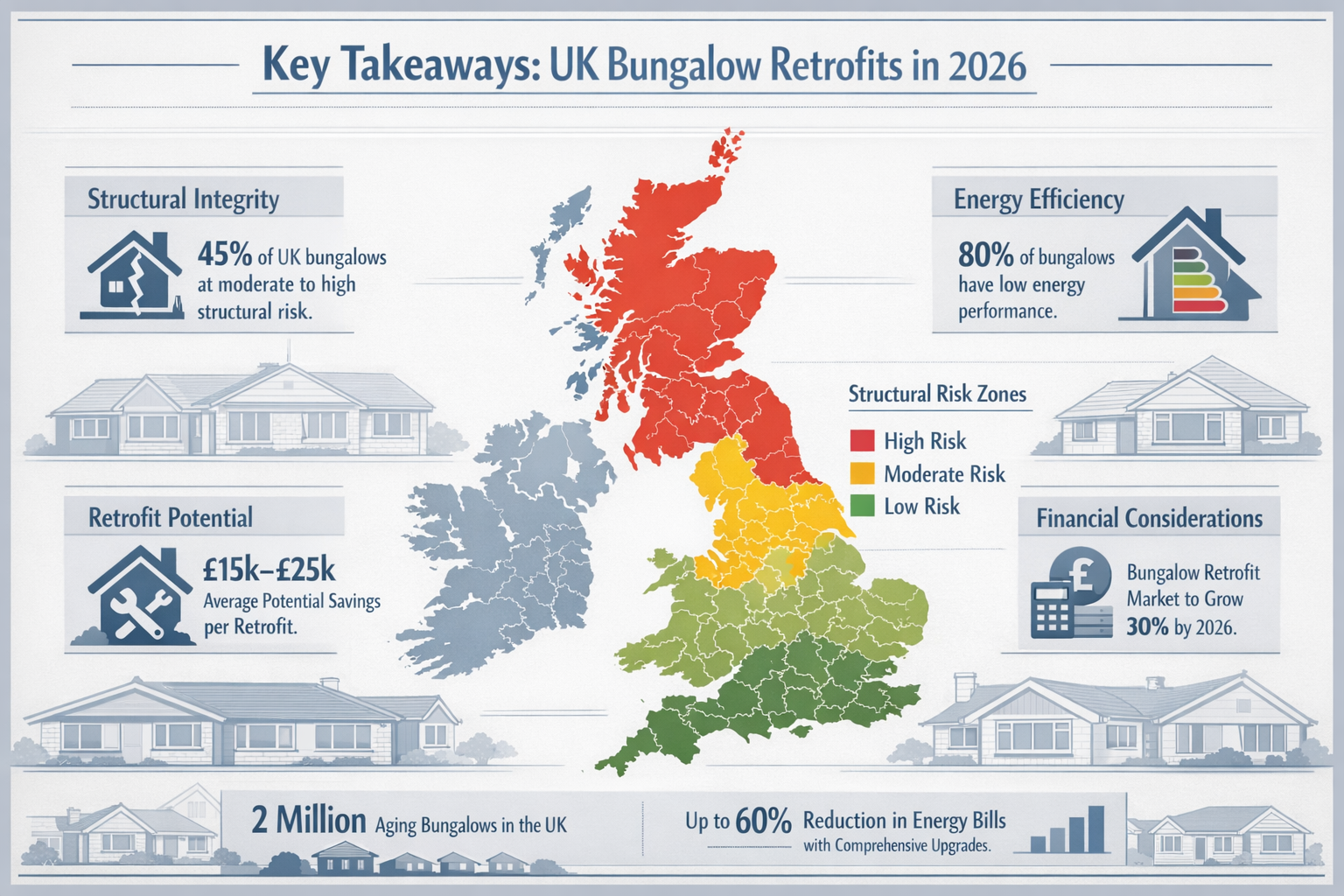
Bungalows represent approximately 9% of the UK housing stock yet command disproportionate market attention. Their single-story design appeals to aging populations, families seeking accessibility, and downsizers looking for manageable living spaces. In 2026, this demand shows no signs of slowing, particularly in regions where new bungalow construction has failed to keep pace with buyer interest.
The scarcity of available bungalows in desirable locations has created a competitive market where properties often sell above asking price. This environment makes thorough building surveys essential for buyers who need to understand the true condition and retrofit potential of these properties before committing significant capital.
Retrofit Opportunities and Regulatory Drivers
The UK government's commitment to achieving net-zero carbon emissions by 2050 has created substantial regulatory pressure and financial incentives for property retrofits. Since March 2025, PAS 2035:2023 compliance has been mandatory for all government-funded retrofit activity[7]. This standard requires a comprehensive "whole-house approach" designed to prevent the isolated implementation of energy efficiency measures that characterized—and often undermined—previous retrofit efforts[3].
The updated Decent Homes Standard further reinforces retrofit requirements by mandating that homes must be free of dangerous hazards, damp and mould, in reasonable repair, and provide adequate thermal comfort[2]. With a final compliance deadline of 2035, property owners face increasing pressure to address structural and energy performance deficiencies.
Essential Components of Building Surveys for 2026 UK Bungalow Retrofits: Identifying Structural Risks
Structural Assessment Priorities
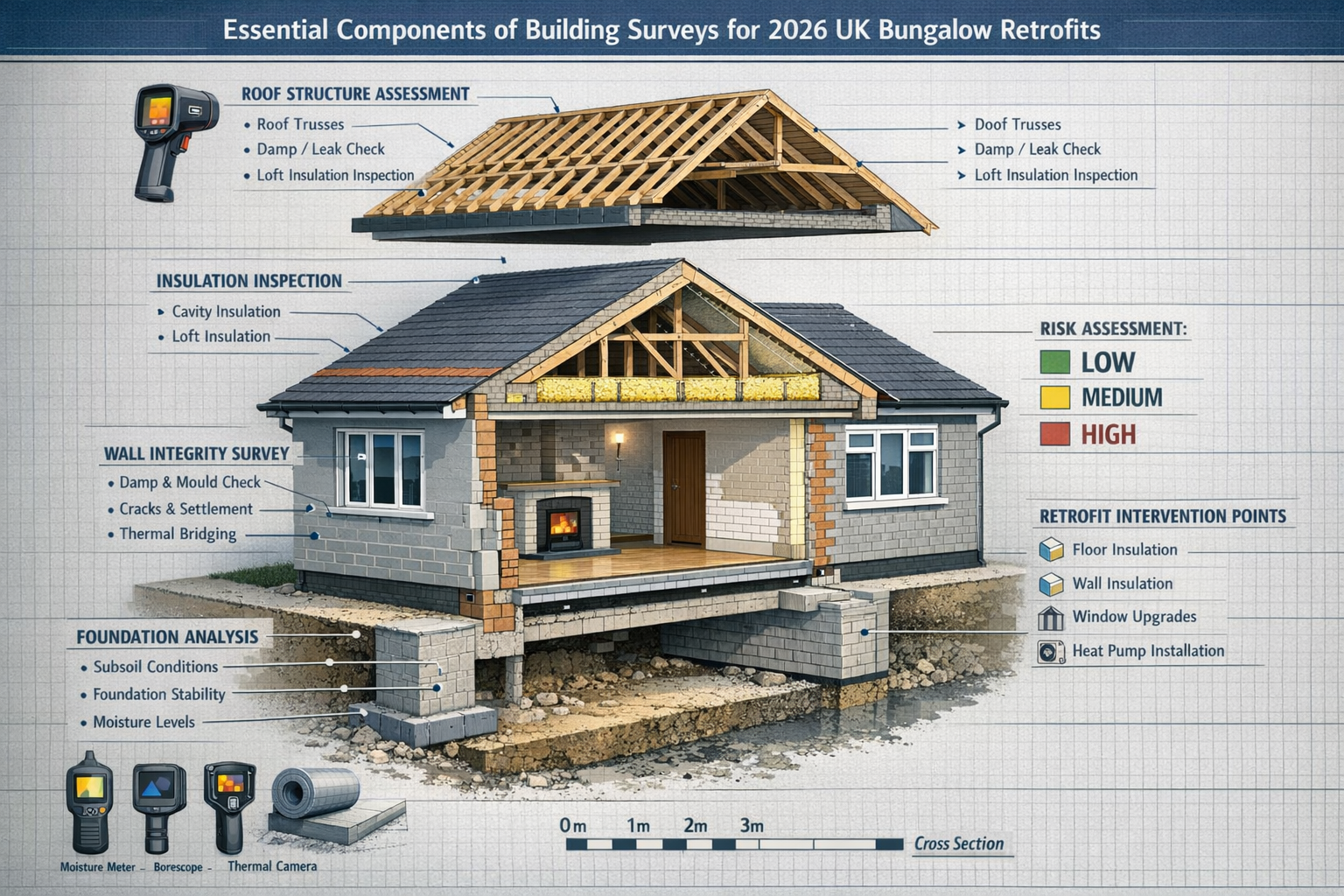
When conducting Building Surveys for 2026 UK Bungalow Retrofits: Identifying Structural Risks in High-Demand Markets, surveyors must prioritize several critical structural elements unique to single-story construction:
Foundation and Subsidence Evaluation 🏗️
Bungalows, particularly those built between the 1950s and 1970s, often feature shallow foundations that may be inadequate for modern loading requirements or susceptible to ground movement. A comprehensive structural survey should include:
- Visual inspection of external walls for cracking patterns indicating settlement
- Level surveys to detect floor slab movement or differential settlement
- Soil investigation where subsidence risk factors exist (clay soils, nearby trees, drainage issues)
- Foundation depth assessment through trial pits or ground-penetrating radar where accessible
Understanding subsidence risks is particularly important for retrofit planning, as additional structural loading from insulation systems or roof modifications may exacerbate existing foundation weaknesses.
Roof Structure and Timber Condition
The roof structure represents one of the most critical elements in bungalow retrofits. Many period bungalows feature traditional cut timber roofs with limited insulation space, creating challenges for achieving modern thermal performance standards.
Key assessment points include:
- Timber condition and evidence of rot, beetle infestation, or structural overloading
- Rafter sizing and spacing adequacy for additional insulation loads
- Ventilation provision and condensation risk assessment
- Existing insulation type, depth, and condition
- Roof covering condition and remaining service life
Damp and Moisture Risk Assessment Under Awaab's Law
The tragic case that led to Awaab's Law has fundamentally changed how the UK addresses damp and mould in residential properties. Building surveys must now rigorously assess moisture-related risks, particularly in bungalows where single-story construction and ground-level living create unique vulnerability.
Common Damp Issues in Bungalows
| Damp Type | Typical Causes in Bungalows | Survey Detection Methods |
|---|---|---|
| Rising Damp | Failed or absent damp-proof course, ground level changes | Moisture meters, visual inspection of wall base |
| Penetrating Damp | Roof defects, failed render, blocked gutters | Thermal imaging, moisture mapping, visual inspection |
| Condensation | Poor ventilation, thermal bridging, inadequate heating | Humidity monitoring, thermal imaging, ventilation assessment |
| Ground Moisture | Solid floor construction without membrane | Calcium carbide testing, visual inspection |
Professional damp surveys should employ multiple diagnostic techniques to accurately identify moisture sources before retrofit work begins. Addressing damp issues is not merely a comfort consideration—it's a legal requirement under updated housing standards[2].
Thermal Performance and Energy Efficiency Baseline
A qualified Retrofit Professional must assess existing energy usage and building characteristics before retrofit work commences[3]. This assessment forms the foundation of the whole-house approach mandated by PAS 2035:2023.
Critical evaluation areas include:
- U-values of existing walls, floors, roofs, and windows
- Air permeability testing to identify infiltration losses
- Thermal bridging assessment at junctions and penetrations
- Heating system efficiency and suitability for retrofit improvements
- Ventilation adequacy and moisture control capacity
Understanding baseline performance allows surveyors to model potential improvements and identify cost-effective retrofit pathways that maximize energy savings while maintaining building fabric health.
Regulatory Compliance Framework for Building Surveys for 2026 UK Bungalow Retrofits
PAS 2035:2023 Mandatory Requirements
The PAS 2035:2023 standard represents the most significant regulatory change affecting retrofit projects in recent years. Mandatory since March 2025 for government-funded work, this framework is increasingly adopted as best practice across the entire retrofit sector[7].
The Whole-House Approach
Previous retrofit failures often resulted from implementing individual measures—such as cavity wall insulation or window replacement—without considering whole-building performance. The whole-house approach requires:
- Comprehensive property assessment by qualified professionals
- Integrated design considering all building elements and their interactions
- Risk evaluation for unintended consequences (condensation, structural loading, ventilation)
- Performance monitoring post-installation to verify outcomes
This methodology is particularly relevant for bungalows, where the compact building envelope and limited ventilation pathways create heightened risk of moisture accumulation if retrofit measures are poorly coordinated[6].
Professional Qualifications and Roles
PAS 2035:2023 establishes specific professional roles with defined responsibilities:
- Retrofit Coordinator: Oversees the entire project, ensuring compliance and quality
- Retrofit Assessor: Conducts initial property evaluation and creates improvement options
- Retrofit Designer: Develops detailed technical specifications for measures
- Retrofit Evaluator: Monitors post-installation performance and outcomes
When commissioning building surveys for renovation projects, property owners should verify that surveyors hold appropriate PAS 2035 qualifications or work alongside qualified retrofit professionals.
Decent Homes Standard Compliance
The updated Decent Homes Standard establishes minimum requirements that all social housing must meet by 2035, with many private landlords and homeowners adopting these standards as quality benchmarks[2].
Four key criteria define compliance:
- ✅ Free from Category 1 hazards under the Housing Health and Safety Rating System (HHSRS)
- ✅ Reasonable state of repair with key building components functioning properly
- ✅ Reasonably modern facilities including kitchens, bathrooms, and heating
- ✅ Reasonable thermal comfort through adequate insulation and efficient heating
Building surveys should explicitly assess compliance against these criteria, identifying deficiencies that require remediation before or during retrofit work.
Building Regulations and Planning Considerations
Retrofit projects must navigate complex building regulations and planning requirements. While many energy efficiency improvements fall under permitted development rights, significant structural alterations or external appearance changes may require planning permission.
Key regulatory touchpoints include:
- Part L (Conservation of fuel and power): Triggered when more than 25% of a building element is renovated
- Part F (Ventilation): Ensures adequate air quality when improving airtightness
- Part C (Resistance to moisture): Addresses damp-proofing and condensation risk
- Part B (Fire safety): Particularly relevant when adding insulation to roof spaces or cavities
Understanding which regulations apply helps surveyors provide accurate guidance on compliance costs and timelines. For properties in conservation areas or with listed status, additional constraints may significantly impact retrofit options.
Surveyor Checklists for Identifying Structural Risks in High-Demand Markets
Pre-Purchase Survey Checklist
For buyers considering bungalows in competitive markets, a thorough pre-purchase survey provides essential negotiating leverage and investment protection. Understanding the difference between survey levels helps buyers select appropriate inspection depth.
Essential Inspection Points
External Elements:
- 🔍 Roof covering condition, age, and remaining service life
- 🔍 Chimney stack stability and pointing condition
- 🔍 Rainwater goods (gutters, downpipes) capacity and condition
- 🔍 External wall render, brickwork, or cladding integrity
- 🔍 Window and door condition, operation, and thermal performance
- 🔍 Boundary walls, fencing, and site drainage
- 🔍 Hard standings, paths, and driveway condition
Internal Elements:
- 🔍 Ceiling and wall surfaces for cracking, staining, or movement
- 🔍 Floor level and condition (solid or suspended timber)
- 🔍 Internal joinery and fitted elements
- 🔍 Heating system type, age, and operational condition
- 🔍 Electrical installation age and safety (consumer unit type)
- 🔍 Plumbing system materials and condition
- 🔍 Ventilation provision and condensation evidence
Structural Concerns:
- 🔍 Foundation adequacy and subsidence indicators
- 🔍 Wall tie condition in cavity construction
- 🔍 Lintels over openings (deflection, cracking, corrosion)
- 🔍 Structural alterations and building control compliance
- 🔍 Roof structure timber condition and loading capacity
Retrofit Viability Assessment Checklist
Beyond standard pre-purchase surveys, retrofit-focused assessments require additional technical evaluation. This specialized approach determines whether a property represents a sound retrofit investment.
Energy Performance Evaluation
- Current EPC rating and identified improvement opportunities
- Heating system efficiency and compatibility with low-temperature systems (heat pumps)
- Insulation levels in walls, floors, and roof spaces
- Glazing type and thermal performance (single, double, or triple glazed)
- Air tightness and draught-proofing condition
- Renewable energy potential (solar PV, solar thermal, ground source heat pump)
Retrofit Constraint Analysis
Certain building characteristics may limit retrofit options or significantly increase costs:
- Cavity wall construction: Allows cost-effective insulation installation
- Solid wall construction: Requires expensive external or internal wall insulation
- Flat roof areas: May limit insulation depth or require replacement
- Listed building status: Restricts external alterations and material choices
- Conservation area location: Requires planning approval for visible changes
- Asbestos presence: Requires specialist removal before retrofit work
- Electrical system age: May require complete rewiring to support modern heating controls
Understanding these constraints early prevents costly surprises during project delivery.
Market-Specific Valuation Considerations
In high-demand markets, retrofit improvements can deliver substantial valuation uplifts. However, realizing this value requires strategic investment aligned with local market expectations.
Factors influencing retrofit ROI:
| Factor | Impact on Value | Survey Considerations |
|---|---|---|
| Location desirability | High demand areas justify premium improvements | Compare local EPC distributions, identify market standards |
| Property scarcity | Limited supply increases value of quality stock | Assess competition, identify differentiation opportunities |
| Buyer demographics | Older buyers prioritize comfort and running costs | Focus on heating efficiency, accessibility, maintenance reduction |
| Local planning constraints | Restrictions limit future supply | Evaluate permitted development opportunities |
| Energy cost trends | Rising costs increase efficiency value | Model savings against improvement costs |
Professional RICS property valuations should account for both current condition and post-retrofit potential when advising on purchase decisions in competitive markets.
Common Structural Defects in UK Bungalows and Retrofit Implications

Period-Specific Construction Issues
UK bungalows span multiple construction eras, each with characteristic defects that impact retrofit planning:
1950s-1960s Bungalows
Common issues:
- Minimal or absent roof insulation
- Single-glazed metal-framed windows
- Solid concrete floors without insulation
- Inadequate electrical installations (fuse wire boards)
- Asbestos-containing materials (ceiling tiles, soffits, insulation)
Retrofit implications: These properties often offer the greatest potential for energy performance improvement but may require substantial investment in multiple building elements simultaneously.
1970s-1980s Bungalows
Common issues:
- Cavity wall construction with minimal or no insulation
- First-generation double glazing reaching end of life
- Concrete roof tiles (heavy loading on timber structure)
- Economy heating systems (electric storage heaters, basic gas boilers)
Retrofit implications: Cavity wall insulation provides cost-effective improvement, but surveyors must verify cavity condition and suitability before installation.
1990s-2000s Bungalows
Common issues:
- Partial insulation compliance (roof insulated, walls and floors often not)
- Inadequate ventilation design causing condensation
- Thermal bridging at junctions and details
- Basic heating controls limiting efficiency
Retrofit implications: These properties often require targeted improvements rather than wholesale renovation, making careful survey assessment essential to avoid over-investment.
Critical Defect Categories
Roof Structure Overloading
Many bungalow roofs were designed for minimal dead loads (lightweight insulation, felt-and-batten covering). Modern retrofit specifications often specify:
- 300mm+ mineral wool insulation (significant additional weight)
- Concrete or composite roof tiles replacing lightweight materials
- Solar PV panels and mounting systems
Surveyors must verify that existing roof structures can accommodate these additional loads or identify required strengthening works. Failure to address structural capacity can lead to progressive deflection, cracking, and potential collapse.
Cavity Wall Tie Corrosion
Bungalows built between 1950 and 1980 typically feature galvanized steel wall ties connecting inner and outer leaves. In exposed locations or where moisture has penetrated, these ties corrode and fail, leading to:
- Horizontal cracking in outer leaf brickwork
- Bulging or bowing of external walls
- Structural instability requiring remedial tie replacement
Before installing cavity wall insulation, surveyors should assess wall tie condition through borescope inspection or sample exposure. Installing insulation over failed ties can accelerate deterioration and create dangerous structural conditions.
Inadequate Ventilation and Condensation Risk
The whole-house approach mandated by PAS 2035:2023 explicitly addresses the risk that improving airtightness without adequate ventilation creates condensation problems[6]. Bungalows are particularly vulnerable because:
- Single-story construction limits natural stack effect ventilation
- Compact layouts concentrate moisture generation
- Cold roof spaces above insulated ceilings create condensation surfaces
- Bathroom and kitchen ventilation often relies on inadequate passive vents
Surveys must evaluate existing ventilation provision and specify mechanical ventilation with heat recovery (MVHR) or other controlled systems where retrofit improvements will significantly reduce air permeability.
Financial Considerations and Funding Opportunities
Government Retrofit Schemes in 2026
While the Great British Insulation Scheme (GBIS) concluded in March 2026 after treating approximately 315,000 homes[3], several funding mechanisms remain available for bungalow retrofits:
Current funding options include:
- ECO4 (Energy Company Obligation): Runs until 2026, targeting low-income and vulnerable households
- Local Authority Delivery (LAD) schemes: Regional programs with varying eligibility criteria
- Home Upgrade Grant (HUG): For off-gas grid properties requiring alternative heating solutions
- Boiler Upgrade Scheme: £5,000-£6,000 grants for heat pump installations
Surveyors should understand funding eligibility criteria to help clients access available support. Many schemes require PAS 2035:2023-compliant assessments and installations, reinforcing the importance of working with qualified professionals.
Cost-Benefit Analysis of Retrofit Investments
Not all retrofit measures deliver equivalent value. Surveys should prioritize interventions based on:
Cost-effectiveness metrics:
- Simple payback period: Years to recover investment through energy savings
- Internal rate of return (IRR): Annualized return considering energy savings and value uplift
- Cost per tonne CO₂ saved: Environmental impact efficiency
- Comfort improvement: Non-financial benefits (warmth, draft reduction, noise)
Typical retrofit measure costs and savings (2026 estimates):
| Measure | Typical Cost | Annual Saving | Payback Period | EPC Impact |
|---|---|---|---|---|
| Loft insulation (0-270mm) | £400-£800 | £200-£350 | 2-4 years | +1-2 bands |
| Cavity wall insulation | £1,000-£2,500 | £150-£300 | 5-8 years | +1 band |
| External wall insulation | £8,000-£15,000 | £300-£500 | 16-30 years | +1-2 bands |
| Window replacement (double to triple) | £5,000-£10,000 | £50-£100 | 50-100 years | +0-1 band |
| Air source heat pump | £8,000-£14,000 | £200-£600 | 13-40 years | +1-2 bands |
These figures demonstrate why comprehensive surveys are essential—they identify the most cost-effective improvement pathway for each specific property rather than applying generic solutions.
Selecting the Right Survey Level for Bungalow Retrofits
RICS Survey Levels Explained
The Royal Institution of Chartered Surveyors (RICS) defines three survey levels with different scopes and purposes:
Level 1: RICS Condition Report
- Scope: Basic condition overview
- Suitability: Modern, well-maintained properties
- Retrofit relevance: Insufficient for retrofit planning
- Cost: £300-£500
Level 2: RICS HomeBuyer Report
- Scope: Detailed condition assessment of visible elements
- Suitability: Conventional properties in reasonable condition
- Retrofit relevance: Adequate for straightforward retrofits
- Cost: £500-£900
Level 3: RICS Building Survey
- Scope: Comprehensive structural and condition analysis
- Suitability: Older properties, complex construction, significant defects
- Retrofit relevance: Essential for major retrofit projects
- Cost: £800-£1,500+
For Building Surveys for 2026 UK Bungalow Retrofits: Identifying Structural Risks in High-Demand Markets, a Level 3 survey typically provides the most value, particularly when:
- The property was built before 1980
- Significant structural alterations are evident
- Damp or movement issues are suspected
- Major retrofit investment is planned
- The property is in a high-demand market where purchase price justifies thorough due diligence
Specialist Supplementary Surveys
Beyond standard RICS surveys, certain conditions warrant specialist investigation:
Additional survey types:
- Thermal imaging survey: Identifies heat loss, thermal bridging, and moisture issues
- Damp and timber survey: Detailed moisture investigation and treatment specification
- Structural engineer's report: Required for significant structural concerns or alterations
- Asbestos survey: Mandatory before disturbing materials in pre-2000 buildings
- Electrical condition report: Assesses installation safety and capacity for retrofit loads
- Drainage survey: CCTV inspection of underground drainage systems
Investing in appropriate specialist surveys before committing to retrofit work prevents costly mid-project discoveries and ensures design solutions address all identified defects.
Regional Market Variations and Retrofit Demand
High-Demand Bungalow Markets in 2026
Bungalow demand varies significantly across UK regions, influenced by demographics, supply constraints, and local market conditions:
Premium bungalow markets:
- South East coastal areas: Retirement destination appeal, limited new supply
- Rural Home Counties: Accessibility combined with village lifestyle
- Market towns: Single-story living without urban density
- Suburban fringe locations: Downsizers seeking manageable properties near family
In these high-demand markets, well-executed retrofits can deliver substantial value uplifts. Surveys should benchmark local market standards to ensure improvement specifications align with buyer expectations.
Undersupplied Regions and Investment Opportunities
Certain regions show particularly acute bungalow supply shortages relative to demand:
- East Anglia: Aging population, limited new development
- South West: Retirement migration, planning constraints
- Outer London suburbs: Downsizers competing with families
- Northern market towns: Growing demand, static supply
These undersupplied markets often justify more extensive retrofit investment because scarcity supports premium pricing for high-quality stock. However, surveys must verify that structural condition supports the planned investment level—overpaying for a property with fundamental defects can eliminate retrofit ROI regardless of market strength.
Case Study: Retrofit Survey Preventing Costly Mistakes
Property: 1960s detached bungalow, South East England
Purchase price: £425,000
Planned retrofit budget: £60,000
Initial assessment:
The buyers planned extensive energy efficiency improvements including external wall insulation, triple glazing, and air source heat pump installation. A basic homebuyer survey identified no significant concerns.
Level 3 building survey findings:
- Cavity wall ties showing early-stage corrosion (15% failure rate on sample inspection)
- Roof structure undersized for planned insulation and solar PV loads
- Solid concrete floor with rising damp evidence (no damp-proof membrane)
- Asbestos-containing ceiling tiles throughout
- Electrical installation requiring complete replacement
Revised project scope:
- Wall tie replacement: £8,000
- Roof structure strengthening: £12,000
- Floor damp-proofing and insulation: £15,000
- Asbestos removal: £6,000
- Electrical rewiring: £8,000
- Total additional costs: £49,000
Outcome:
The comprehensive survey revealed that the property required £49,000 in remedial work before planned retrofit measures could proceed safely. Armed with this information, the buyers renegotiated the purchase price down by £35,000, ultimately delivering their desired retrofit within budget while avoiding potentially dangerous structural failures.
This case illustrates why thorough Building Surveys for 2026 UK Bungalow Retrofits: Identifying Structural Risks in High-Demand Markets represent essential due diligence rather than optional extras.
Working with Qualified Professionals
Finding PAS 2035-Qualified Retrofit Professionals
The TrustMark scheme maintains a register of qualified retrofit professionals meeting PAS 2035:2023 requirements. When commissioning retrofit assessments, verify that professionals hold appropriate credentials:
Essential qualifications:
- Level 5 Diploma in Retrofit Coordination and Risk Management
- Level 4 Diploma in Retrofit Assessment
- Membership of relevant professional bodies (RICS, CABE, CIOB)
- Professional indemnity insurance covering retrofit advice
Many RICS surveyors now offer integrated services combining traditional building surveys with retrofit assessment, providing comprehensive guidance in a single engagement.
Questions to Ask Your Surveyor
Before commissioning surveys for bungalow retrofit projects, ask potential surveyors:
- ❓ What level of survey do you recommend for this property and why?
- ❓ Do you hold PAS 2035 qualifications or work with qualified retrofit professionals?
- ❓ What specialist surveys might this property require?
- ❓ Can you provide retrofit viability assessment alongside structural survey?
- ❓ What is your experience with similar properties in this market?
- ❓ How do you assess compliance with updated Decent Homes Standard?
- ❓ Will your report support funding applications for retrofit grants?
- ❓ What is your typical turnaround time and fee structure?
Selecting experienced professionals familiar with both traditional surveying and modern retrofit requirements ensures comprehensive guidance throughout the project lifecycle.
Conclusion
Building Surveys for 2026 UK Bungalow Retrofits: Identifying Structural Risks in High-Demand Markets represent a critical investment for buyers, investors, and homeowners navigating today's competitive property landscape. With mandatory PAS 2035:2023 compliance, updated Decent Homes Standard requirements, and sustained market demand for single-story properties, thorough structural assessment has never been more important.
Comprehensive surveys identify hidden defects, assess retrofit viability, and provide the technical foundation for cost-effective improvement strategies. From foundation adequacy and roof structure capacity to damp risk assessment and thermal performance evaluation, professional surveyors deliver insights that protect investments and enable informed decision-making.
Actionable Next Steps
- Commission appropriate survey level: Select Level 3 building surveys for pre-1980 bungalows or properties requiring significant retrofit investment
- Verify professional qualifications: Ensure surveyors hold relevant credentials and understand PAS 2035:2023 requirements
- Request specialist surveys: Don't hesitate to commission thermal imaging, damp surveys, or structural engineer reports when recommended
- Evaluate retrofit ROI: Use survey findings to model improvement costs against energy savings and value uplift potential
- Explore funding opportunities: Investigate available grants and schemes that may offset retrofit costs
- Plan whole-house improvements: Avoid isolated measures by adopting the integrated approach mandated by modern standards
- Monitor market conditions: Stay informed about regional demand trends and buyer expectations in your target market
The bungalow retrofit opportunity remains strong in 2026, but success requires rigorous due diligence. By investing in comprehensive building surveys and working with qualified professionals, property owners can navigate structural risks, maximize value uplift, and contribute to the UK's essential housing stock improvement.
For expert guidance on building surveys and retrofit assessments, consult with experienced RICS-qualified surveyors who understand both traditional construction and modern retrofit requirements.
References
[1] What Is Retrofit A Complete Guide To Retrofitting In The Uk – https://www.target-green.com/post/what-is-retrofit-a-complete-guide-to-retrofitting-in-the-uk
[2] Retrofitting For Safety And Comfort How Stone Wool Insulation Can Support The Updated Decent Homes Standard – https://www.rockwool.com/uk/education-and-training/blog/retrofitting-for-safety-and-comfort-how-stone-wool-insulation-can-support-the-updated-decent-homes-standard/
[3] 2025 Retrofit Journey Brochure A5 Digital – https://cms.trustmark.org.uk/media/kdynhrq2/2025-retrofit-journey-brochure-a5-digital.pdf
[4] Future Homes Standard – https://kensa.co.uk/housing-developments/future-homes-standard
[5] Home Retrofit – https://ukgbc.org/our-work/home-retrofit/
[6] What Is The Retrofit Whole House Approach – https://www.ikonic-architecture.co.uk/post/what-is-the-retrofit-whole-house-approach
[7] 7 Best Future Homes Standard Retrofitting Tips – https://ewispecialist.co.uk/7-best-future-homes-standard-retrofitting-tips/
[8] 2026 Guide To Major Policy Changes In Uk Construction – https://www.lizmale.co.uk/blog/2026-guide-to-major-policy-changes-in-uk-construction
[9] Passivhaus Retrofit In The Uk 2nd Edition V1.4 260121 – https://passivhaus.uk/wp-content/uploads/2026/01/Passivhaus-Retrofit-in-the-UK-2nd-edition-v1.4-260121.pdf