
The UK property market is experiencing a seismic shift in 2026. First-time buyers are abandoning overheated Southern markets and heading North, drawn by affordability, stronger price growth, and improved regional connectivity. This Building Survey Risk Assessment for First-Time Buyers in Northern England: Capitalizing on the 2026 South-to-North Migration represents a critical opportunity—but only for those who understand the unique structural risks and survey requirements of Northern properties.
From Victorian terraces in Manchester to converted mills in Leeds and stone cottages in Yorkshire, Northern England's diverse housing stock presents distinct challenges. Unlike newer Southern developments, these properties carry heritage, character, and potential hidden defects that demand specialized survey expertise. For first-time buyers making this migration, understanding building survey risk assessment isn't optional—it's essential protection for what may be their largest financial commitment.
Key Takeaways
- 🏠 Northern property diversity requires specialized surveys: Victorian terraces, industrial conversions, and stone-built cottages each present unique structural risks that standard valuations miss
- 📊 Migration patterns are reshaping survey demand: The 2026 South-to-North movement has increased competition, making thorough risk assessment crucial for confident purchasing decisions
- 💰 Survey investment prevents costly surprises: Comprehensive building surveys typically cost £500-£1,200 but can identify defects worth tens of thousands in repair costs
- 🔍 Regional risks demand local expertise: Subsidence from mining legacy, penetrating damp in stone walls, and radon exposure require surveyors with Northern England experience
- ⚡ Speed and thoroughness must balance: In competitive Northern markets, buyers need rapid yet comprehensive assessments to secure properties while protecting their interests
Understanding the 2026 South-to-North Migration and Its Impact on Property Surveys
The demographic shift transforming England's property landscape in 2026 represents more than simple relocation—it's a fundamental rebalancing of regional opportunity. First-time buyers priced out of London, Bristol, and Brighton are discovering that Northern cities offer not just affordability, but genuine value: larger properties, shorter commutes, and vibrant cultural scenes.
Why First-Time Buyers Are Moving North
Affordability remains the primary driver. Average property prices in Northern England sit 40-60% below Southern equivalents, allowing first-time buyers to access three-bedroom family homes for the price of a Southern one-bedroom flat. Manchester, Leeds, Newcastle, and Liverpool have all experienced double-digit price growth over the past two years, yet remain accessible to buyers with modest deposits.
Remote work flexibility has eliminated traditional barriers. With hybrid working now standard across professional sectors, location-dependent career concerns have diminished. Northern cities offer excellent digital infrastructure, co-working spaces, and increasingly, satellite offices for major employers.
Quality of life considerations are reshaping priorities. First-time buyers in 2026 value green space, community, and housing that accommodates growing families. Northern England delivers these in abundance, with accessible countryside, lower living costs, and stronger community networks.
The Survey Challenge: Different Properties, Different Risks
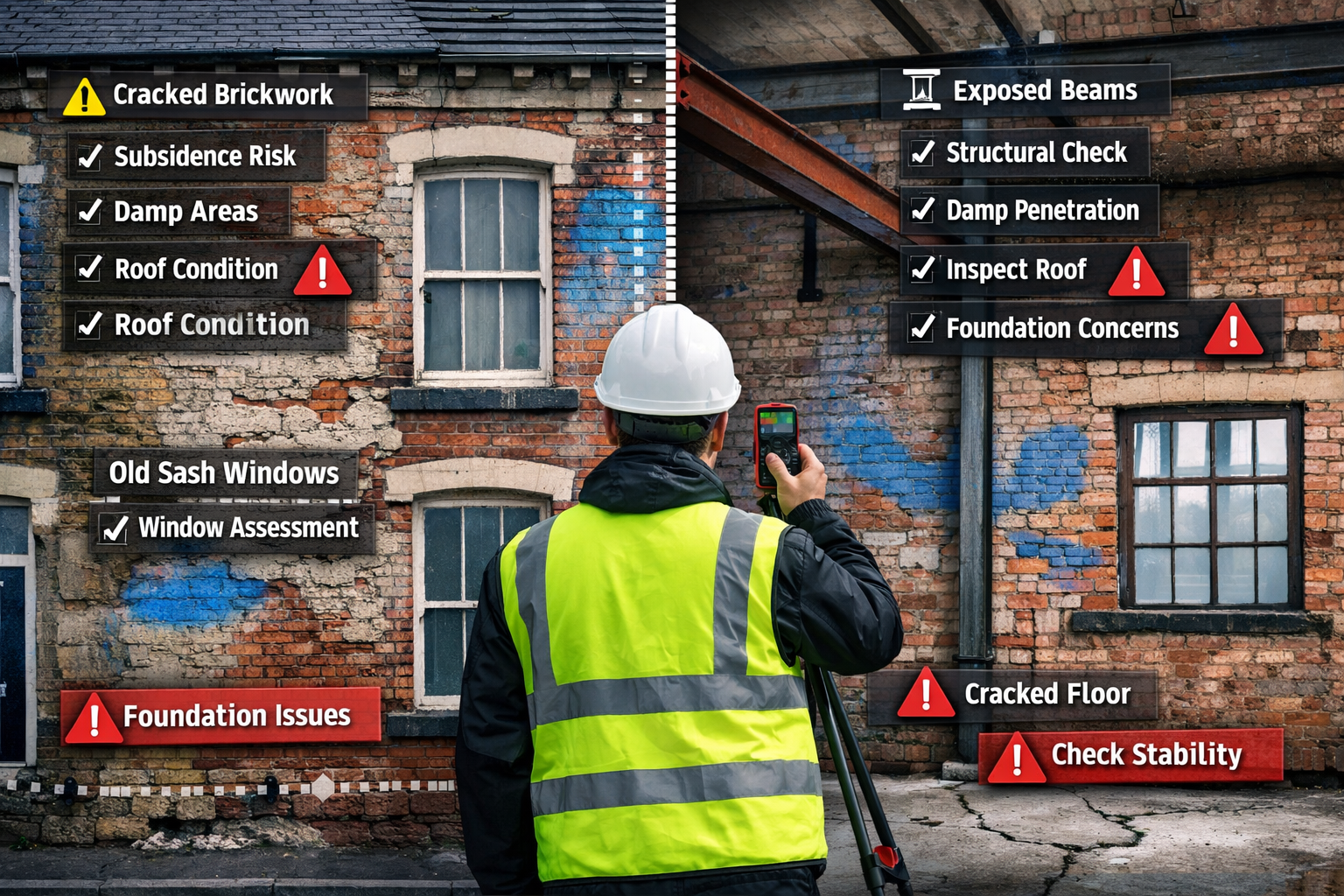
This migration creates a critical knowledge gap. Buyers accustomed to modern Southern developments or purpose-built flats suddenly face Victorian terraces with solid walls, Edwardian semi-detached properties with suspended timber floors, and converted industrial buildings with complex structural histories.
These property types demand different survey approaches. A homebuyers survey or full structural assessment must address region-specific concerns that Southern buyers may never have encountered:
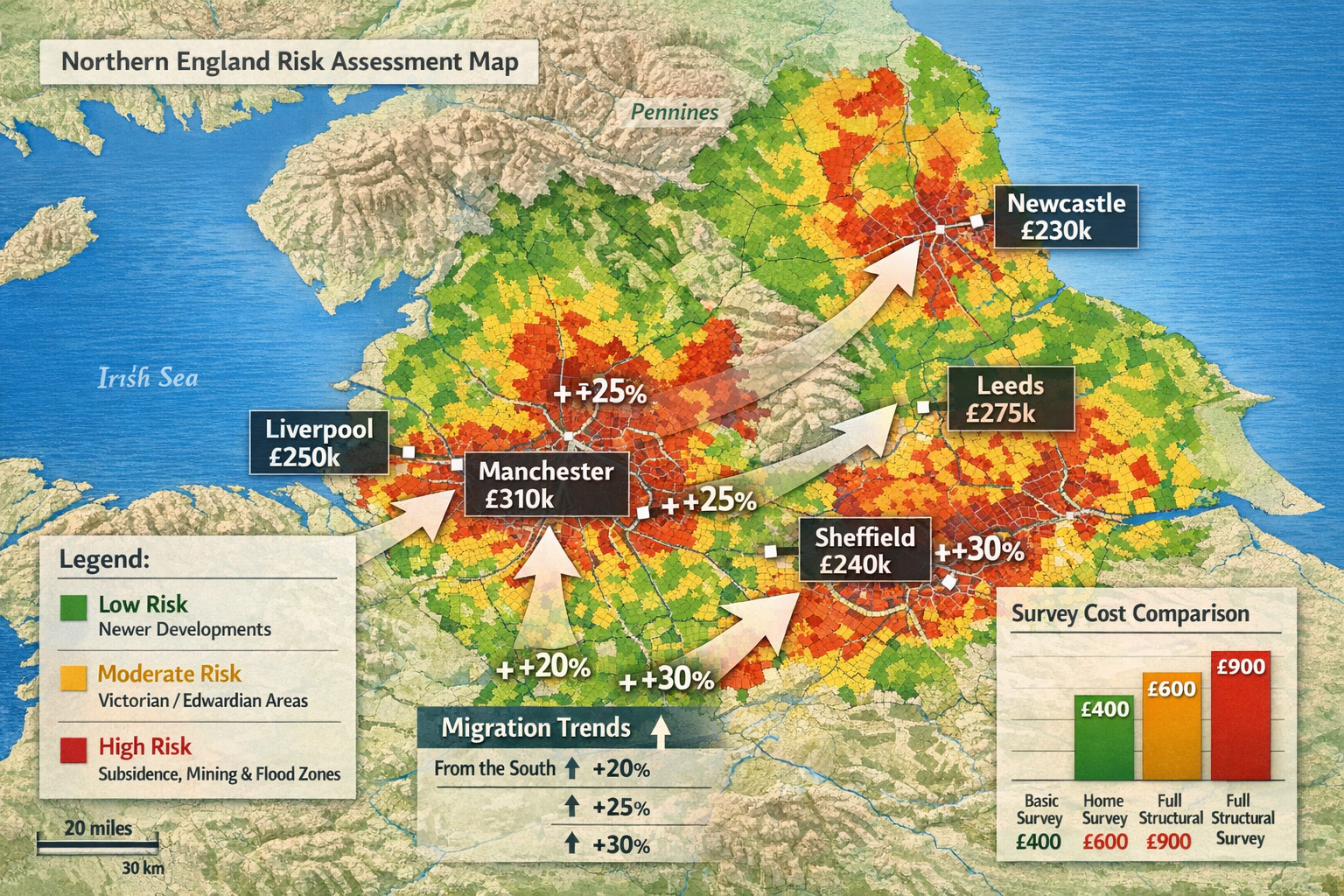
- Coal mining legacy: Subsidence risks in former mining areas across Yorkshire, Durham, and Lancashire
- Stone construction challenges: Penetrating damp in traditional stone-built properties common in Pennine regions
- Industrial conversion complexities: Former mills and warehouses with steel frames, exposed brickwork, and non-standard construction
- Radon exposure: Higher natural radon levels in certain Northern geological areas requiring specific testing
Building Survey Risk Assessment for First-Time Buyers in Northern England: Essential Survey Types
Understanding which survey level provides appropriate protection represents the first critical decision for first-time buyers. The Royal Institution of Chartered Surveyors (RICS) provides standardized survey frameworks, but selecting the right option depends on property age, type, and condition.
RICS Level 2 Survey (HomeBuyer Report)
The RICS Level 2 survey offers a middle-ground option suitable for conventional properties in reasonable condition, typically built within the last 100 years using standard construction methods.
What it covers:
- Visual inspection of accessible areas
- Condition ratings for major elements (roof, walls, floors, services)
- Identification of urgent defects and potential legal issues
- Market valuation (if required)
- Insurance rebuild cost assessment
Ideal for:
- Standard Victorian or Edwardian terraces in good condition
- 1930s-1970s semi-detached and detached houses
- Purpose-built flats in conventional buildings
Limitations:
- No invasive investigation (floorboards remain down, furniture not moved)
- Limited roof space access
- No detailed structural analysis
- May miss hidden defects in walls, floors, or roof structures
Cost range: £400-£800 depending on property value and location
For many first-time buyers targeting standard Northern terraces or semi-detached properties, a comprehensive RICS HomeBuyer Survey provides adequate protection. However, older or non-standard properties demand more thorough investigation.
RICS Level 3 Survey (Building Survey)
The RICS Level 3 survey, formerly called a "Full Structural Survey," represents the most comprehensive assessment available for residential properties. This detailed investigation suits older properties, those in poor condition, or buildings with non-standard construction.
What it covers:
- Detailed inspection of all accessible areas
- In-depth analysis of construction methods and materials
- Comprehensive defect identification with severity ratings
- Detailed advice on repairs, maintenance, and timescales
- Guidance on potential hidden defects requiring specialist investigation
Ideal for:
- Pre-1900 properties with traditional construction
- Buildings showing visible defects or structural concerns
- Properties with extensions, alterations, or unusual features
- Converted industrial buildings or non-standard construction
- Listed buildings or those in conservation areas
- Properties the buyer plans to renovate
Advantages:
- Most thorough inspection available
- Detailed reporting on construction quality and condition
- Specific repair recommendations with priority rankings
- Identifies issues requiring specialist surveys (damp, structural, electrical)
Cost range: £600-£1,500+ depending on property size, age, and complexity
Understanding the key differences between Level 2 and Level 3 surveys helps buyers make informed decisions. For Northern England's older housing stock, the additional investment in a Level 3 survey often proves invaluable.
Specialist Surveys and Additional Investigations
Certain property characteristics or survey findings necessitate specialist follow-up investigations:
Damp and Timber Surveys
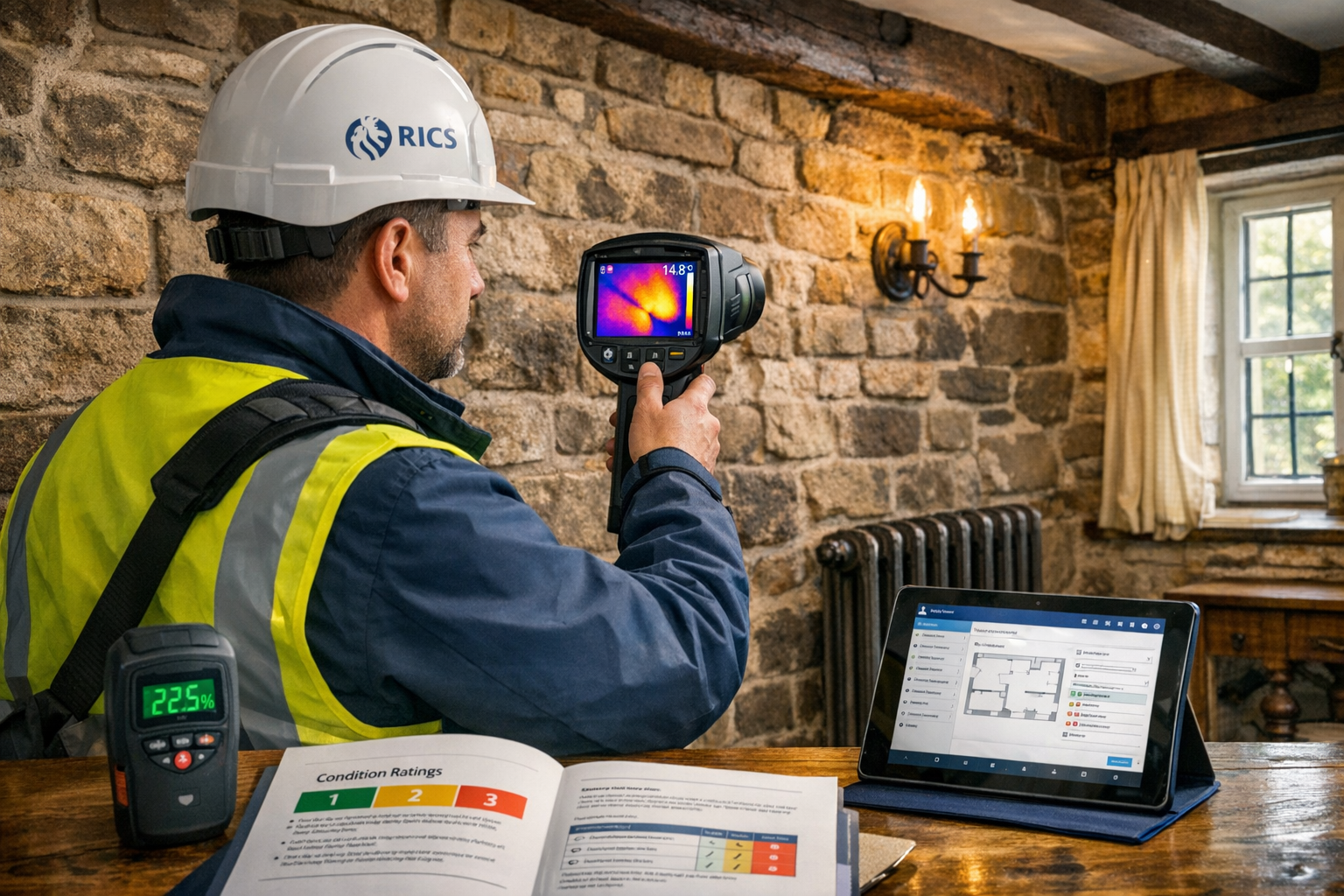
Northern England's climate and traditional construction methods make damp issues particularly prevalent. Stone walls without cavity barriers, solid brick construction, and inadequate ventilation create ideal conditions for moisture penetration. A specialist damp survey uses moisture meters, thermal imaging, and invasive investigation to identify:
- Rising damp from failed or absent damp-proof courses
- Penetrating damp through solid walls or defective pointing
- Condensation issues from inadequate ventilation
- Timber decay in floor joists, roof timbers, or window frames
Structural Engineering Assessments
Properties showing cracking, movement, or structural alterations may require chartered structural engineer input. This proves especially important for:
- Industrial conversions with steel frames or exposed structures
- Properties with visible subsidence or settlement
- Buildings where walls or floors have been removed
- Properties in former mining areas showing movement
Radon Testing
Certain Northern regions, particularly Derbyshire, parts of Yorkshire, and Northumberland, have elevated natural radon levels. This radioactive gas accumulates in poorly ventilated properties, creating long-term health risks. Testing involves placing monitors for 3-12 months, though short-term tests provide preliminary guidance.
Regional Risk Factors in Northern England Property Markets
Building Survey Risk Assessment for First-Time Buyers in Northern England: Capitalizing on the 2026 South-to-North Migration requires understanding location-specific challenges that vary significantly across the region.
Mining Legacy and Subsidence Risks
Extensive coal mining across Yorkshire, Durham, Lancashire, and Nottinghamshire has left a complex underground legacy. While most mining ceased decades ago, subsidence risks persist in certain areas. The Coal Authority maintains comprehensive records of former mine workings, and thorough surveys should include:
- Coal Authority search results
- Evidence of historical movement (cracking patterns, distorted door frames)
- Ground stability assessment
- Recommendations for monitoring or remediation
Properties in affected areas may require specialized insurance, and severe cases might need underpinning or other structural intervention costing £10,000-£50,000+.
Stone Construction and Damp Penetration
Traditional stone construction dominates much of Yorkshire, Cumbria, and rural Northern England. These solid-wall properties lack modern cavity barriers, making them vulnerable to penetrating damp during wet weather. Survey assessment must evaluate:
- Pointing condition: Deteriorated mortar allows water penetration
- Stone quality: Some local stones are porous and absorb moisture
- Internal finishes: Impermeable modern renders trap moisture, causing decay
- Drainage: Inadequate guttering or ground drainage directs water toward walls
Remediation often requires repointing with lime mortar (£40-£100 per square meter), improved drainage, and breathable internal finishes. Inappropriate cement-based repairs can worsen problems by trapping moisture.
Victorian and Edwardian Terraces: Common Defects
The terraced housing that characterizes Northern cities presents predictable defect patterns that experienced surveyors recognize:
Roof issues:
- Original slate roofs nearing end of serviceable life (100-150 years)
- Valley gutter failures causing internal water damage
- Chimney stack deterioration and leaning
Structural concerns:
- Bulging or leaning party walls requiring tie-bar installation
- Suspended timber floor decay from inadequate ventilation
- Lintel failures above windows and doors
Services and modernization:
- Original single-glazed sash windows requiring replacement or refurbishment
- Outdated electrical systems needing rewiring (£3,000-£6,000)
- Inefficient heating and poor insulation
A comprehensive building survey identifies these issues, prioritizes repairs, and provides cost guidance for budgeting.
Industrial Conversions: Unique Assessment Challenges
Former mills, warehouses, and factories converted to residential use offer distinctive character but present complex survey challenges:
- Non-standard construction: Steel frames, exposed brickwork, and large open spans
- Fire safety: Compartmentation, escape routes, and fire-resistant construction
- Building regulations compliance: Conversions may not meet current standards
- Service accessibility: Plumbing and electrical systems in unusual configurations
- Shared facilities: Common areas, heating systems, or structural elements
The UK government has intensified focus on fire safety in residential buildings following recent tragedies. Fire safety remediation surveys have identified significant defects requiring attention, particularly in converted buildings.[1] First-time buyers should ensure their survey specifically addresses fire safety compliance.
Navigating the Survey Process: Practical Steps for First-Time Buyers
Understanding survey theory matters less than executing an effective assessment strategy. First-time buyers capitalizing on the 2026 migration must balance thoroughness with speed in competitive markets.
Step 1: Choose the Right Survey Level
Decision factors:
- Property age: Pre-1900 properties generally warrant Level 3 surveys
- Visible condition: Any signs of defects, movement, or damp justify comprehensive assessment
- Construction type: Non-standard or traditional construction needs detailed investigation
- Purchase price: Higher-value properties justify proportionally greater survey investment
- Renovation plans: Properties requiring work need detailed condition assessment
Cost-benefit analysis:
A £1,000 Level 3 survey identifying £25,000 of hidden defects provides exceptional return on investment. It enables:
- Informed negotiation reducing purchase price
- Accurate budgeting for repairs and improvements
- Confidence to proceed or walk away from problematic properties
- Evidence for mortgage lenders if issues affect property value
Step 2: Select a Qualified Surveyor with Regional Expertise
Not all surveyors possess equal expertise in Northern England's property types and regional risks. Prioritize:
RICS qualification: Only RICS-qualified surveyors provide regulated, insured, professional service with complaint procedures and professional indemnity insurance.
Local experience: Surveyors familiar with Northern construction methods, regional geology, and local property markets provide more nuanced assessments. Ask about:
- Experience with specific property types (Victorian terraces, stone cottages, industrial conversions)
- Knowledge of local issues (mining legacy, radon, regional construction methods)
- Volume of work in the target area
Communication style: First-time buyers benefit from surveyors who explain findings clearly, answer questions patiently, and provide accessible guidance. Request sample reports or references.
Availability and turnaround: Competitive markets demand rapid survey turnaround. Confirm the surveyor can inspect within 5-7 days and deliver reports within 3-5 working days.
Step 3: Prepare for the Survey Inspection
Coordinate access: Ensure the seller or estate agent arranges full property access, including loft spaces, cellars, garages, and outbuildings. Restricted access limits survey effectiveness.
Provide background information: Share any concerns, previous survey reports, or information about alterations, planning permissions, or building regulation approvals.
Utilities connection: Ensure electricity, gas, and water remain connected for testing purposes.
Weather considerations: Heavy rain or snow may prevent safe roof access or obscure defects. Discuss timing with your surveyor.
Step 4: Review and Understand the Survey Report
Survey reports contain technical terminology and detailed observations. Focus on:
Condition ratings: RICS surveys use a traffic-light system:
- Condition 1 (Green): No repair currently needed
- Condition 2 (Amber): Defects requiring repair or replacement, but not urgent
- Condition 3 (Red): Urgent defects requiring immediate attention or further investigation
Priority recommendations: Surveyors typically categorize repairs by urgency and importance. Understand which issues are:
- Safety-critical requiring immediate attention
- Significant defects affecting property value or habitability
- Maintenance items to address within 1-2 years
- Minor issues for long-term consideration
Cost implications: While surveyors don't provide detailed costings, they indicate whether repairs are minor (hundreds), moderate (thousands), or major (tens of thousands). Obtain contractor quotes for significant defects.
Further investigation requirements: Survey reports often recommend specialist follow-up for damp, structural issues, electrical systems, or drainage. Commission these promptly to maintain purchase momentum.
For reference, reviewing a complete example of a homebuyers report helps first-time buyers understand report structure and content before receiving their own.
Step 5: Act on Survey Findings
Survey results inform three potential actions:
Proceed as planned: If the survey reveals only minor issues consistent with property age and price, continue with the purchase confidently.
Renegotiate the price: Significant defects justify price reduction requests. Calculate repair costs, obtain quotes, and present evidence to the seller. Typical negotiations achieve 50-70% of estimated repair costs in price reductions.
Request repairs before completion: For urgent safety issues or defects affecting mortgage approval, request the seller complete repairs before exchange. This approach suits issues like:
- Electrical safety concerns
- Urgent roof repairs
- Structural problems affecting property value
Withdraw from the purchase: Severe structural issues, extensive hidden defects, or problems exceeding your budget may justify withdrawal. Survey costs represent a small price for avoiding disastrous purchases.
Maximizing Survey Value: Questions First-Time Buyers Should Ask
Effective communication with your surveyor enhances survey value and ensures you understand findings fully:
Before the Survey
- "What specific aspects should I highlight given the property type and location?"
- "Will you be able to access all areas, including the roof space and any cellars?"
- "How long will the inspection take, and when can I expect the report?"
- "What additional costs might arise if specialist surveys are recommended?"
After Receiving the Report
- "Which defects are most urgent, and what happens if they're not addressed?"
- "What's a realistic cost range for the repairs you've identified?"
- "Are there any issues that might affect my mortgage approval?"
- "Should I commission any specialist follow-up surveys before proceeding?"
- "How do these findings compare to typical properties of this age and type?"
Regarding Specific Defects
- "Is this cracking cosmetic or indicative of structural movement?"
- "What's causing the damp, and how complex is remediation?"
- "Does this roof need immediate replacement or can it last a few more years?"
- "Are these electrical issues safety-critical or just outdated?"
Don't hesitate to request clarification or a follow-up call. Professional surveyors expect questions and recognize that first-time buyers need additional guidance.
Financial Considerations: Budgeting for Surveys and Repairs
Building Survey Risk Assessment for First-Time Buyers in Northern England: Capitalizing on the 2026 South-to-North Migration requires realistic financial planning beyond the purchase price.
Survey Costs
Budget for:
- RICS Level 2 survey: £400-£800
- RICS Level 3 survey: £600-£1,500
- Specialist damp survey: £200-£500
- Structural engineer assessment: £500-£1,500
- Electrical inspection: £150-£300
- Drainage survey: £300-£600
Total survey costs for a complex property might reach £2,000-£3,000, but this investment prevents far costlier mistakes.
Common Repair Costs in Northern Properties
Understanding typical repair costs helps evaluate survey findings:
| Defect | Typical Cost Range |
|---|---|
| Full roof replacement (terraced house) | £8,000-£15,000 |
| Repointing stone or brick walls | £40-£100 per m² |
| Damp-proof course installation | £1,500-£3,500 |
| Timber floor repairs (suspended) | £2,000-£8,000 |
| Full electrical rewiring | £3,000-£6,000 |
| Central heating system replacement | £3,500-£6,000 |
| Window replacement (full property) | £5,000-£12,000 |
| Underpinning (per meter) | £1,000-£2,000 |
| Chimney stack rebuild | £2,000-£5,000 |
These figures vary by property size, access, and regional labor costs. Always obtain multiple quotes for significant work.
Mortgage Implications
Severe defects may affect mortgage approval. Lenders typically require:
- Properties to be habitable and structurally sound
- No urgent safety issues (electrical, structural, fire safety)
- No defects significantly affecting property value
Mortgage surveyors conduct basic valuations, but these don't replace comprehensive surveys. If your survey identifies issues affecting value, the lender may:
- Reduce the mortgage offer
- Require repairs before completion
- Request retention (withholding funds until repairs complete)
- Decline the mortgage application
Understanding how building surveys can save money by preventing problematic purchases or enabling effective negotiation demonstrates their value as investment rather than cost.
The 2026 Market Context: Speed vs. Thoroughness
The RICS has emphasized the importance of modernizing home buying processes while maintaining consumer protection.[2] For first-time buyers in competitive Northern markets during 2026, this creates tension between moving quickly and conducting thorough due diligence.
Balancing Competing Pressures
Market competition: Strong demand in Northern cities means desirable properties receive multiple offers. Buyers feel pressure to move quickly, potentially skipping or rushing surveys.
Survey timelines: Comprehensive surveys require 2-3 weeks from instruction to final report, including specialist follow-ups. This timeline can disadvantage buyers in competitive situations.
Strategies for managing both priorities:
-
Pre-emptive surveyor engagement: Identify and contact qualified surveyors before finding a property, ensuring rapid mobilization when needed.
-
Rapid initial assessment: Some surveyors offer expedited inspections within 48-72 hours for additional fees, providing preliminary findings while detailed reports follow.
-
Conditional offers: Make offers subject to satisfactory survey, clearly communicating this to sellers and agents. Most reasonable sellers accept this standard protection.
-
Parallel processing: Commission surveys immediately upon offer acceptance rather than waiting for mortgage approval or legal searches.
-
Clear communication: Keep all parties informed of survey progress, demonstrating seriousness while protecting your interests.
When to Walk Away
Survey findings sometimes reveal problems that justify withdrawal:
- Severe structural defects: Extensive subsidence, structural instability, or major movement requiring £30,000+ remediation
- Hidden extensive damp: Widespread rot, timber decay, or damp affecting multiple areas
- Safety hazards: Dangerous electrical systems, gas leaks, or structural collapse risks
- Cost exceeding budget: Repair costs that eliminate financial viability
- Undisclosed alterations: Unauthorized extensions, removed structural walls, or building regulation non-compliance
Walking away feels disappointing after emotional investment, but survey costs represent tiny fractions of the losses from problematic purchases.
Regional Variations Across Northern England
Northern England encompasses diverse property markets with distinct characteristics:
Greater Manchester
Property types: Victorian terraces, 1930s semi-detached, modern apartments, converted mills
Common issues: Subsidence in certain areas, damp in solid-wall properties, fire safety in conversions
Price growth: Strong appreciation in desirable neighborhoods (Didsbury, Chorlton, Northern Quarter)
Survey priorities: Structural stability, damp assessment, building regulation compliance for conversions
Leeds and West Yorkshire
Property types: Back-to-back terraces, through terraces, stone cottages, industrial conversions
Common issues: Roof condition in slate-roofed properties, stone wall damp, mining legacy in some areas
Price growth: Rapid appreciation in Chapel Allerton, Headingley, and city center
Survey priorities: Stone construction assessment, roof condition, subsidence risk in former mining areas
Liverpool and Merseyside
Property types: Victorian terraces, Georgian townhouses, 1930s semi-detached, modern waterfront apartments
Common issues: Damp in older properties, structural issues in terraces, cladding concerns in new builds
Price growth: Strong recovery after years of stagnation, particularly in Baltic Triangle and Georgian Quarter
Survey priorities: Structural condition of older terraces, damp assessment, new build quality
Newcastle and North East
Property types: Tyneside flats, Victorian terraces, stone cottages, modern apartments
Common issues: Flat roof issues in Tyneside flats, mining subsidence, stone construction damp
Price growth: Moderate but steady appreciation, excellent affordability
Survey priorities: Flat roof condition, mining risk assessment, stone wall evaluation
Sheffield and South Yorkshire
Property types: Victorian terraces, 1930s semi-detached, stone cottages in Peak District fringes
Common issues: Mining subsidence, hillside properties with drainage issues, stone construction challenges
Price growth: Strong appreciation in desirable areas (Crookes, Ecclesall, Broomhill)
Survey priorities: Subsidence risk, drainage assessment, stone construction evaluation
Understanding these regional variations helps first-time buyers target appropriate survey expertise and anticipate likely issues.
Future-Proofing Your Purchase: Long-Term Considerations
Beyond immediate defects, comprehensive surveys should inform long-term property strategy:
Energy Efficiency and Sustainability
Northern England's older housing stock typically has poor energy efficiency. Survey reports should note:
- Insulation levels (loft, walls, floors)
- Window and door efficiency
- Heating system age and efficiency
- Potential for improvement (cavity wall insulation, solar panels, heat pumps)
Government energy efficiency requirements are tightening. Properties with poor Energy Performance Certificate (EPC) ratings may face future restrictions on sale or rental, making improvements increasingly important.
Climate Resilience
Climate change increases flood risk, extreme weather, and temperature fluctuations. Surveys should assess:
- Flood risk from rivers, surface water, or groundwater
- Drainage adequacy for increased rainfall intensity
- Roof and wall resilience to severe weather
- Ventilation for warmer summers
Adaptation Potential
First-time buyers often outgrow properties within 5-10 years. Consider:
- Extension potential (planning permission, structural feasibility)
- Loft conversion possibilities
- Basement or cellar development options
- Garden or parking space for future needs
Survey reports may highlight structural limitations or opportunities affecting future adaptation.
Conclusion
Building Survey Risk Assessment for First-Time Buyers in Northern England: Capitalizing on the 2026 South-to-North Migration represents both significant opportunity and considerable risk. The demographic shift transforming England's property landscape offers first-time buyers unprecedented access to spacious, characterful homes in vibrant cities—but only for those who understand and mitigate the structural risks inherent in Northern England's diverse housing stock.
The Victorian terraces, stone cottages, and industrial conversions that define Northern property markets demand specialized survey expertise. Mining legacy, penetrating damp, traditional construction methods, and regional geological factors create risk profiles fundamentally different from modern Southern developments. First-time buyers without this knowledge face potentially catastrophic financial consequences from hidden defects, structural problems, or unforeseen repair costs.
Key Actions for First-Time Buyers
✅ Invest in appropriate surveys: Match survey level to property age, type, and condition. Don't economize on assessment for older or non-standard properties.
✅ Choose qualified, experienced surveyors: Prioritize RICS qualification and regional expertise in Northern construction methods and property types.
✅ Act decisively on findings: Use survey results to negotiate prices, request repairs, or withdraw from problematic purchases. Survey costs represent tiny fractions of potential losses.
✅ Commission specialist follow-ups: Don't ignore recommendations for damp surveys, structural assessments, or other specialist investigations.
✅ Budget realistically: Account for survey costs (£500-£2,000+) and potential repairs (£5,000-£30,000+) when calculating affordability.
✅ Balance speed with thoroughness: Competitive markets demand efficiency, but never skip due diligence. Parallel processing and pre-emptive surveyor engagement maintain momentum while protecting interests.
The Broader Perspective
The 2026 South-to-North migration reflects fundamental shifts in how people live, work, and prioritize quality of life. Northern England offers genuine value, community, and opportunity for first-time buyers willing to embrace regional property markets. However, this opportunity comes with responsibility—responsibility to understand what you're buying, to assess risks appropriately, and to make informed decisions based on professional guidance rather than optimism or pressure.
Building survey risk assessment isn't an obstacle to homeownership; it's the foundation of successful property investment. The comprehensive evaluation provided by qualified surveyors transforms uncertainty into confidence, enabling first-time buyers to proceed with clear understanding of condition, required repairs, and long-term implications.
For those capitalizing on the 2026 migration trend, the message is clear: embrace Northern England's opportunities, but do so with eyes wide open, professional guidance secured, and thorough assessment completed. Your future self—settled into a characterful Northern home, having avoided costly surprises—will thank you for the diligence.
The Northern England property market awaits. Approach it with knowledge, preparation, and appropriate professional support, and it will reward you with homes, communities, and value that Southern markets can no longer provide.
References
[1] Findings From The Fire Safety Remediation Survey 2025 26 Quarter 2 – https://www.gov.uk/government/statistics/fire-safety-remediation-in-social-housing-in-england-2025-26-quarter-2/findings-from-the-fire-safety-remediation-survey-2025-26-quarter-2
[2] Uk Influence And Advocacy Update January 2026 – https://www.rics.org/news-insights/uk-influence-and-advocacy-update-january-2026