

The property surveying profession stands at a pivotal moment in 2026. Government-proposed homebuying reforms are set to fundamentally reshape how property transactions work in England, placing surveyors at the heart of a transformed system. Building Survey Protocols for Retraining Under Homebuying Reforms: Preparing for Mandatory Upfront Assessments represents not just a policy change, but a complete reimagining of professional practice that demands urgent preparation and strategic upskilling.
Under the proposed reforms, sellers and estate agents will be required to commission mandatory property condition assessments before listing properties for sale—a significant departure from current practice where buyers typically arrange surveys after making offers [1]. This shift promises to accelerate transactions by an average of four weeks while reducing the £1.5 billion annual cost the current system imposes on the economy [2]. However, the success of these reforms hinges entirely on whether the surveying profession can rapidly build capacity, enhance digital capabilities, and standardize assessment protocols.
Key Takeaways
✅ 24-Month Implementation Window: RICS has secured a minimum 24-month period for capacity building and surveyor retraining before reforms take effect [3]
✅ Mandatory Upfront Assessments: All properties will require condition assessments tailored to age and type before listing, creating significant demand surge [1]
✅ Enhanced Qualifications Required: New mandatory qualification standards and accreditation systems are anticipated for surveyors conducting upfront assessments [2]
✅ Digital Transformation Essential: Surveyors must adopt real-time data integration, standardized reporting formats, and advanced assessment technologies [1]
✅ Professional Liability Framework Evolving: Questions around reliance letters, indemnity insurance, and seller-commissioned survey liability remain under consultation [2]
Understanding the Homebuying Reform Landscape
The Current System's Shortcomings
The traditional homebuying process in England has long been criticized for its inefficiency and high failure rate. Currently, transactions take an average of five months from sales memorandum to completion, with significant costs accumulating throughout this extended period [1]. Failed transactions—which occur in approximately 30% of cases—cost sellers around £800 each, creating financial uncertainty and emotional stress for all parties involved.
The fundamental problem lies in the timing of information disclosure. Under current practice, critical property condition information typically emerges late in the transaction process, often after buyers have invested substantial sums in legal fees and surveys. This delayed discovery of defects or issues frequently leads to renegotiation, price reductions, or complete transaction collapse.
Proposed Reform Framework
The government's consultation document outlines a comprehensive reform package centered on upfront information provision. The cornerstone of this approach is requiring sellers to commission property condition assessments before marketing begins, ensuring potential buyers have access to standardized, reliable information from the outset [1].
These mandatory assessments will be:
- Tailored to property characteristics: Different assessment protocols for properties based on age, construction type, and complexity
- Standardized in format: Consistent reporting frameworks enabling easy comparison across properties
- Digitally accessible: Integration with online property portals and real-time data sources including HM Land Registry [1]
- Time-limited validity: Standardized periods (such as 6 months) with provisions for free refreshes from search providers
The reforms also propose establishing an accreditation system for professional services, including surveyors, to help consumers identify practitioners adhering to reform principles and quality standards [1].
Building Survey Protocols for Retraining: Implementation Timeline and Capacity Challenges
The Critical 24-Month Window
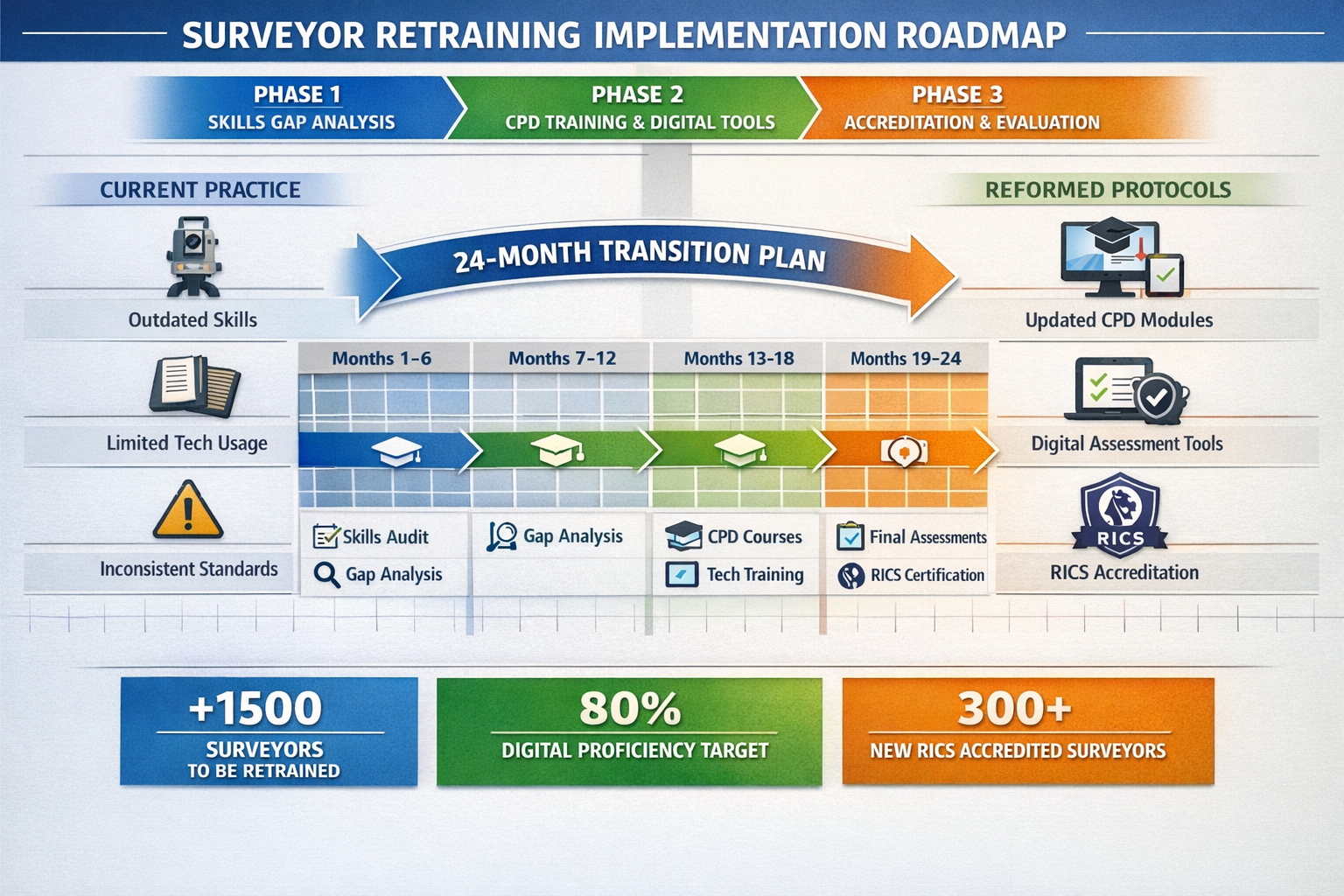
Recognizing the magnitude of change required, RICS has been explicit with government that a minimum 24-month implementation period is essential [3]. This timeline isn't arbitrary—it reflects the substantial work needed across multiple dimensions:
Standards Development (Months 1-8):
- Creating new assessment protocols tailored to different property types
- Establishing standardized reporting formats and digital templates
- Developing quality assurance frameworks and peer review mechanisms
- Defining competency standards for upfront assessment work
Training Infrastructure (Months 6-18):
- Designing CPD modules addressing new protocols and technologies
- Creating assessment materials and certification pathways
- Establishing training delivery partnerships across regions
- Developing digital learning platforms and resources
Capacity Building (Months 12-24):
- Rolling out training programs to practicing surveyors
- Certifying practitioners under new accreditation standards
- Testing protocols through pilot programs
- Refining approaches based on early implementation feedback
For those considering which home survey is right for you, understanding these evolving standards will become increasingly important as reforms take effect.
Addressing Industry Capacity Concerns
The government consultation specifically asks: "What steps should government take to ensure that conveyancing lawyers, estate agents and surveyors have the capacity and capability to implement this change?" [1]. This question acknowledges the significant capacity challenges the profession faces.
Consider the mathematics: if mandatory upfront assessments apply to most residential property sales, and England typically sees 1-1.2 million transactions annually, the surveying profession must be prepared to conduct this volume of assessments before properties list—fundamentally different from the current buyer-driven model.
Key capacity considerations include:
| Challenge Area | Current State | Required Transformation |
|---|---|---|
| Assessment Timing | Buyer-commissioned post-offer | Seller-commissioned pre-listing |
| Volume Management | Distributed across transaction period | Concentrated at listing phase |
| Report Standardization | Variable formats and detail levels | Uniform, digitally-integrated formats |
| Liability Framework | Clear buyer-surveyor relationship | Complex seller-buyer-surveyor triangle |
| Technology Integration | Traditional reporting methods | Real-time data integration required |
RICS has offered to support government with further research to better understand industry capacity and resourcing requirements [3], demonstrating the profession's commitment to evidence-based implementation planning.

Essential Training Resources and Professional Development Requirements
Mandatory Qualification Enhancements
The consultation document Question 10 directly addresses: "What resources and additional training would be needed in order to implement these changes?" [1]. Legal analysts suggest that given the increased responsibilities placed on surveyors, mandatory qualification requirements appear "almost inevitable" [2].
The anticipated qualification framework will likely include:
Core Competency Modules:
- 📚 Standardized Assessment Protocols: Understanding property-type-specific inspection requirements
- 🔍 Defect Recognition and Classification: Enhanced training in identifying and categorizing building conditions
- 💻 Digital Technology Proficiency: Mastering assessment software, data integration tools, and reporting platforms
- ⚖️ Legal and Liability Framework: Understanding the new seller-commissioned survey landscape
- 📊 Risk Assessment and Communication: Effectively conveying findings to multiple stakeholders
Specialized Pathways:
- Historic and heritage property assessment
- New build and contemporary construction evaluation
- Complex structural and subsidence investigation
- Damp and moisture-related condition assessment (relevant for damp surveys)
CPD Requirements Under Reform
The Royal Institution of Chartered Surveyors will play a central role in developing enhanced CPD frameworks aligned with reform requirements. Practicing surveyors should anticipate:
- Mandatory reform-specific CPD hours: Likely 10-20 hours dedicated to upfront assessment protocols
- Technology training modules: Covering digital assessment tools and data integration systems
- Regular competency assessments: Periodic testing to maintain accreditation status
- Peer review participation: Engaging in quality assurance and standards maintenance
For surveyors providing RICS surveys, these enhanced requirements will build upon existing professional standards while introducing reform-specific elements.
Digital Tools and Technology Integration
The reforms envision real-time data integration from sources including HM Land Registry, with standardized validity periods and free refresh provisions [1]. Surveyors must become proficient in:
Assessment Technology:
- Mobile inspection applications with offline capability
- Thermal imaging and moisture detection equipment
- Photographic documentation systems with automated annotation
- Digital measurement and modeling tools
Data Integration Platforms:
- Property information pack systems
- Search provider interfaces
- Land Registry data feeds
- Local authority planning and building control databases
Reporting Systems:
- Standardized digital report templates
- Multi-stakeholder access portals
- Version control and update mechanisms
- Integration with property listing platforms
Understanding the difference between Level 2 and Level 3 surveys provides foundation knowledge that will inform how these assessment levels translate into the reformed framework.
Preparing for Mandatory Upfront Assessments: Practical Steps for Surveyors
Immediate Action Items for 2026
While final reform implementation awaits consultation outcomes, forward-thinking surveyors should begin preparation now:
1. Audit Current Capabilities 🔍
- Assess existing technology infrastructure and identify gaps
- Review current inspection protocols against anticipated standards
- Evaluate capacity for volume increases and timing shifts
- Identify training needs across team members
2. Invest in Technology 💻
- Research and pilot digital assessment platforms
- Upgrade equipment for enhanced documentation requirements
- Implement cloud-based reporting and data management systems
- Establish secure client portals for multi-party access
3. Engage with Professional Development 📚
- Monitor RICS announcements regarding training programs
- Participate in pilot programs and early implementation initiatives
- Attend reform-focused seminars and workshops
- Join professional working groups shaping standards
4. Develop Business Model Adaptations 💼
- Model financial implications of seller-commissioned work
- Establish relationships with estate agents and property platforms
- Design service packages aligned with reform requirements
- Review professional indemnity insurance coverage and requirements
For those working on new build properties, understanding how upfront assessment protocols will apply to newly constructed homes is particularly important.
Understanding the Financial Implications
The reforms will create both costs and opportunities for the surveying profession:
Seller-Side Costs:
Final sellers face approximately £310 in increased upfront costs due to mandatory assessments [1]. However, this investment is offset by:
- Higher transaction completion rates (reducing the £800 average cost of failed sales)
- Faster transaction times (reducing holding costs and uncertainty)
- Greater buyer confidence leading to better price realization
Surveyor Revenue Implications:
- Volume increase: Shift from ~70% of transactions having surveys to potentially 100% having upfront assessments
- Timing concentration: More work front-loaded to listing phase rather than distributed across transaction period
- Standardization pressure: Competitive pricing for standardized assessment products
- Value-added opportunities: Additional services for complex properties or buyer-specific investigations
Insurance and Liability Considerations:
Key questions remain unresolved regarding surveyor liability frameworks, including [2]:
- Whether surveyors will routinely issue reliance letters to buyers
- How professional indemnity insurance will function under seller-commission model
- What role seller-indemnity insurance will play in the system
- How liability is apportioned when defects emerge post-transaction

Regional Considerations and Service Delivery
The reforms will affect surveying practices differently across regions. Practitioners in high-volume markets like London must prepare for significant capacity demands, while those in rural areas may face different challenges around service accessibility.
For surveyors serving specific areas, understanding local market dynamics becomes crucial:
- Urban high-volume markets: Require efficient, scalable assessment processes and strong technology infrastructure
- Historic property concentrations: Demand specialized expertise in period building assessment
- New development areas: Need protocols for contemporary construction and warranty assessment
- Mixed-use and complex properties: Require enhanced competencies in commercial and unusual property types
Whether practicing in Wimbledon, Chiswick, or other London locations, local expertise combined with reformed assessment protocols will differentiate quality practitioners.
Building Survey Protocols for Retraining Under Homebuying Reforms: Quality Assurance and Accreditation
The Proposed Accreditation Framework
The government consultation proposes establishing an accreditation system to help consumers identify professional services abiding by reform principles [1]. For surveyors, this likely means:
Tiered Accreditation Levels:
- Foundation Level: Basic competency in standardized upfront assessments
- Advanced Level: Specialist capabilities for complex or unusual properties
- Expert Level: Peer review, training delivery, and standards development roles
Ongoing Compliance Requirements:
- Annual CPD completion and competency assessment
- Peer review participation and quality audits
- Complaint and dispute resolution engagement
- Technology and standards updates
Consumer-Facing Elements:
- Searchable directories of accredited surveyors
- Transparent qualification and specialization information
- Performance metrics and client feedback systems
- Clear fee structures and service descriptions
Quality Standards and Peer Review
Maintaining consistent quality across thousands of upfront assessments requires robust quality assurance mechanisms:
Report Standardization:
- Mandatory templates ensuring comprehensive coverage
- Standardized terminology and condition ratings
- Consistent photographic documentation requirements
- Clear limitation and exclusion statements
Peer Review Processes:
- Random sampling of completed assessments for technical review
- Feedback loops for continuous improvement
- Identification of training needs and emerging issues
- Dispute resolution and technical arbitration
Technology-Enabled Quality Control:
- Automated completeness checking before report finalization
- Consistency algorithms flagging unusual findings or omissions
- Benchmark comparisons across similar property types
- Data analytics identifying systemic issues or training gaps
For comprehensive property assessments, reviewing homebuyers report examples provides insight into current best practices that will inform reformed standards.
Navigating Liability and Professional Responsibility Changes
The Seller-Commission Paradigm Shift
Perhaps the most significant change for surveyors involves the fundamental shift in who commissions assessments. Currently, buyers commission surveys, creating a clear professional relationship and liability framework. Under reforms, sellers commission upfront assessments that buyers rely upon—creating a more complex liability triangle [2].
Key Liability Questions:
❓ Reliance Letters: Will surveyors routinely issue letters allowing buyers to rely on seller-commissioned assessments, or will buyers still commission their own surveys for major purchases?
❓ Duty of Care: To whom does the surveyor owe primary duty—the seller who commissions and pays, or the buyer who relies on the assessment for purchasing decisions?
❓ Professional Indemnity Insurance: How will PI insurance policies adapt to cover seller-commissioned work with buyer reliance?
❓ Seller Indemnity Products: Will new insurance products emerge protecting sellers against claims arising from assessment deficiencies?
❓ Limitation Periods: What time limits will apply to claims related to upfront assessments, and how will this affect long-tail liability?
Risk Management Strategies
Prudent surveyors should implement robust risk management protocols in preparation for the reformed landscape:
Documentation Excellence:
- Comprehensive photographic records with timestamps and metadata
- Detailed notes of inspection scope, limitations, and access restrictions
- Clear communication records with all parties
- Version control and audit trails for report amendments
Scope Definition:
- Explicit statements of inspection extent and methodology
- Clear identification of areas not inspected and reasons
- Appropriate caveats regarding concealed defects
- Property-type-specific scope variations
Communication Protocols:
- Standardized engagement letters clarifying relationships
- Multi-party communication systems ensuring transparency
- Formal mechanisms for questions and clarifications
- Post-assessment consultation availability
Insurance Review:
- Regular PI policy review ensuring reform-appropriate coverage
- Understanding exclusions and limitations under new models
- Adequate coverage limits reflecting increased exposure
- Run-off coverage considerations for changing practice models
Understanding party wall surveyor responsibilities provides useful context for how specialized surveying roles navigate complex liability frameworks—lessons applicable to upfront assessment work.
Strategic Business Planning for the Reformed Market
Positioning for Success
The reforms create significant opportunities for surveyors who prepare strategically:
Market Positioning Strategies:
🎯 Specialization: Develop expertise in specific property types (historic buildings, new builds, flats, unusual construction) commanding premium fees
🎯 Geographic Focus: Build strong local knowledge and relationships with estate agents in defined service areas
🎯 Technology Leadership: Invest early in digital platforms offering superior client experience and efficiency
🎯 Quality Differentiation: Pursue advanced accreditation levels and build reputation for thoroughness and reliability
🎯 Integrated Services: Offer complementary services (party wall surveys, monitoring, specialist investigations) creating comprehensive client relationships
Partnership Development:
- Estate agent relationships for consistent referral flow
- Property platform integrations for digital service delivery
- Legal practice connections for seamless transaction support
- Specialist consultant networks for complex investigation requirements
For surveyors offering party wall services, the reformed market may create opportunities for bundled service offerings.
Capacity Planning and Resource Allocation
The volume and timing shifts inherent in mandatory upfront assessments require careful capacity planning:
Workforce Considerations:
- Staff recruitment and training pipelines
- Flexible capacity through associate networks
- Technology investments reducing per-assessment time
- Administrative efficiency for increased volume
Scheduling and Workflow:
- Booking systems accommodating pre-listing timelines
- Efficient routing and geographic clustering
- Rapid turnaround capabilities for competitive advantage
- Quality control processes scalable to volume
Financial Modeling:
- Cash flow implications of payment timing changes
- Pricing strategies balancing competitiveness and profitability
- Investment requirements for technology and training
- Revenue forecasting under different reform scenarios
Conclusion: Embracing Change and Leading the Profession Forward
Building Survey Protocols for Retraining Under Homebuying Reforms: Preparing for Mandatory Upfront Assessments represents a defining moment for the property surveying profession in 2026. The proposed reforms—requiring mandatory upfront property condition assessments before listing—promise to transform homebuying into a faster, more transparent, and more efficient process. However, this transformation depends entirely on whether surveyors can rapidly build capacity, enhance skills, and embrace new technologies and protocols.
The 24-month implementation window secured by RICS provides essential time for preparation, but this period will pass quickly [3]. Surveyors must act now to position themselves for success in the reformed market.
Actionable Next Steps
✅ Stay Informed: Monitor RICS communications and government consultation outcomes closely; subscribe to reform updates and participate in industry forums
✅ Assess Readiness: Conduct honest evaluation of current capabilities, technology infrastructure, and training needs; identify gaps requiring immediate attention
✅ Invest in Development: Commit to CPD focused on reform-relevant competencies; pilot digital assessment tools and standardized reporting formats
✅ Build Relationships: Establish connections with estate agents, property platforms, and other stakeholders in the reformed ecosystem
✅ Plan Strategically: Develop business models accounting for volume increases, timing shifts, and competitive dynamics of mandatory assessments
✅ Engage Professionally: Participate in RICS working groups, pilot programs, and standards development initiatives shaping the reformed landscape
✅ Review Risk Management: Ensure professional indemnity insurance coverage is appropriate for seller-commissioned work; implement robust documentation and quality control systems
The reforms promise to elevate the surveying profession's role in property transactions while creating new opportunities for practitioners who prepare effectively. By embracing Building Survey Protocols for Retraining Under Homebuying Reforms: Preparing for Mandatory Upfront Assessments as both challenge and opportunity, surveyors can lead the transformation toward a better homebuying system for all stakeholders.
The future of property transactions is being written now—and surveyors have the opportunity to be authors rather than merely readers of this new chapter. Those who invest in preparation, embrace technology, and commit to professional excellence will thrive in the reformed market, delivering better outcomes for buyers, sellers, and the broader property ecosystem.
References
[1] Home Buying And Selling Reform – https://www.gov.uk/government/consultations/home-buying-and-selling-reform/home-buying-and-selling-reform
[2] Breaking Down The Home Buying Shake Up Key Reforms For Buyers Sellers And Agents – https://www.russell-cooke.co.uk/news-and-insights/news/breaking-down-the-home-buying-shake-up-key-reforms-for-buyers-sellers-and-agents
[3] Home Buying And Selling Reform Hub – https://www.rics.org/news-insights/current-topics-campaigns/home-buying-and-selling-reform-hub