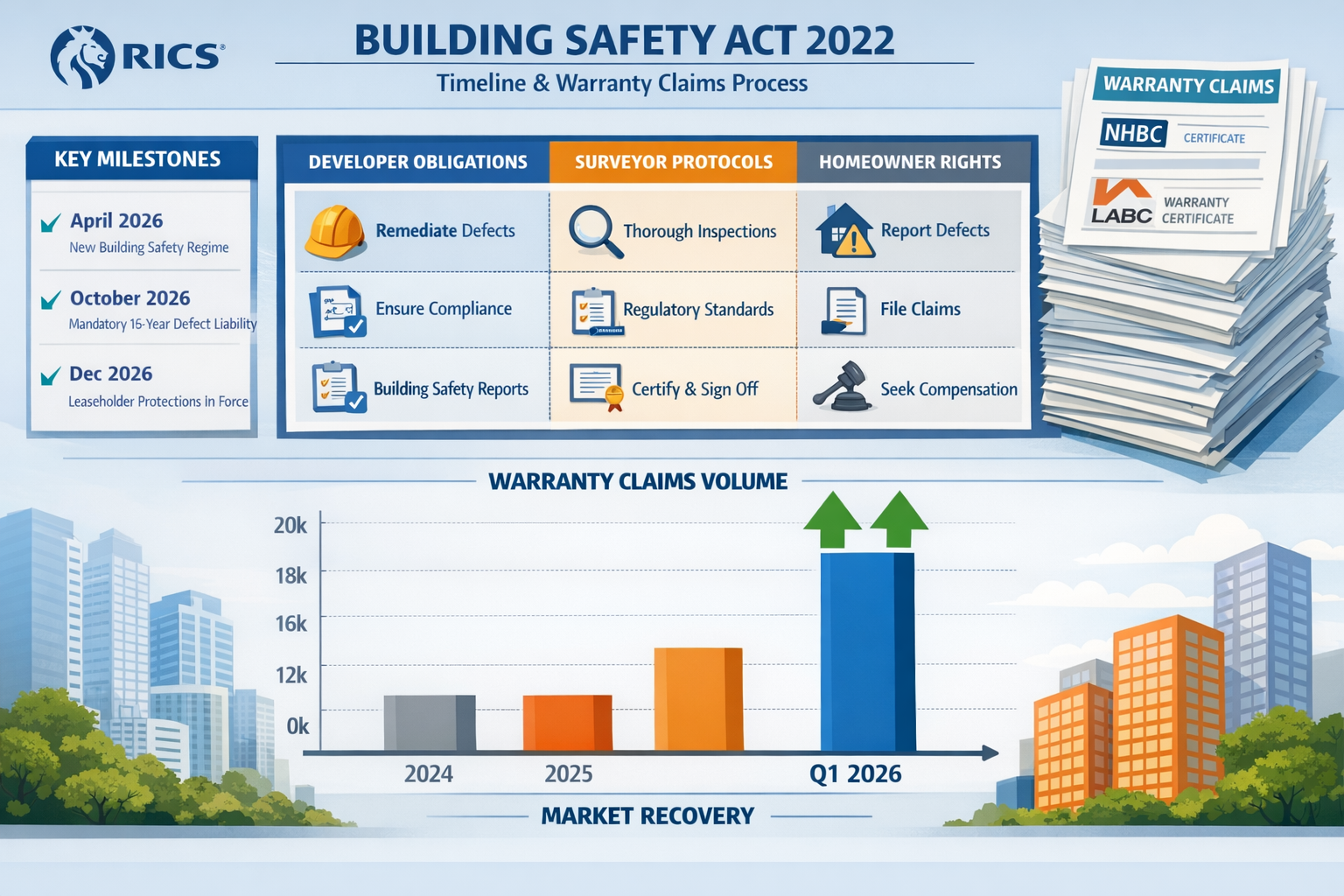
As the UK property market rebounds in 2026, transaction volumes are surging—and so are warranty disputes on new-build properties. With Q1 2026 data revealing a 34% increase in snagging claims compared to the previous year, building survey protocols for new build warranty claims in 2026 market recovery have never been more critical. The Royal Institution of Chartered Surveyors (RICS) has responded with comprehensive updates to their Home Survey Standard, specifically addressing new-build inspections, defect documentation, and warranty claim procedures. For homebuyers, developers, and surveyors alike, understanding these evolving protocols is essential to protecting investments and ensuring quality construction standards.
The convergence of market recovery, updated RICS standards, and the Building Safety Act 2022 has created a perfect storm requiring robust RICS tools for snagging and defects. This guide explores the latest protocols, technological innovations, and practical strategies for managing new-build warranty claims in today's dynamic property landscape.
Key Takeaways
- 📋 RICS Home Survey Standard 2nd Edition (February 2026) now includes dedicated guidance for new-build snagging inspections with enhanced Level 3 protocols specifically designed for warranty claims
- 🏗️ Building Safety Act retrospective liability means developers face extended responsibility for defects, making thorough documentation and evidence preservation critical for all parties
- 🤖 AI and drone technology integration in survey protocols enables more comprehensive defect detection and creates stronger evidence trails for warranty disputes
- 📈 Q1 2026 market recovery has driven warranty claim volumes up 34%, requiring surveyors to adopt more rigorous inspection methodologies and reporting standards
- ⚖️ Proposed RICS regulatory scheme (46% member support) will introduce mandatory audit requirements and enhanced consumer protection for home survey services
Understanding the 2026 New Build Market Context
The UK new-build market has experienced remarkable transformation throughout 2025 and into 2026. Transaction volumes have rebounded significantly, with first-quarter data showing increased activity across all major metropolitan areas. This recovery, however, has exposed a concerning trend: warranty claims and snagging disputes have risen proportionally faster than transaction volumes.
Market Recovery Statistics and Implications
Q1 2026 data reveals several critical trends affecting building survey protocols:
- Transaction volume increases: 28% year-over-year growth in new-build completions
- Warranty claim surge: 34% increase in formal defect claims filed within the first year of occupation
- Average defect count: New builds now average 157 snagging items at pre-completion inspection (up from 134 in 2024)
- Dispute resolution timeframes: Average resolution time has extended to 89 days, creating financial pressure on both buyers and developers
These statistics underscore why building survey services have become indispensable for new-build purchases, even though many buyers historically assumed new properties required minimal inspection.
The Building Safety Act Impact
The Building Safety Act 2022 continues to reshape liability frameworks in 2026. Developers and associated entities now face retrospective liability through remediation contribution orders (RCOs) for historic structural defects[3]. Courts have confirmed that RCOs may include costs incurred before the Act came into force, fundamentally changing risk management strategies for all construction stakeholders.
This legislative backdrop makes comprehensive survey protocols essential, as documentation created today may become critical evidence in disputes years into the future.
RICS Home Survey Standard 2nd Edition: What's New for New Builds
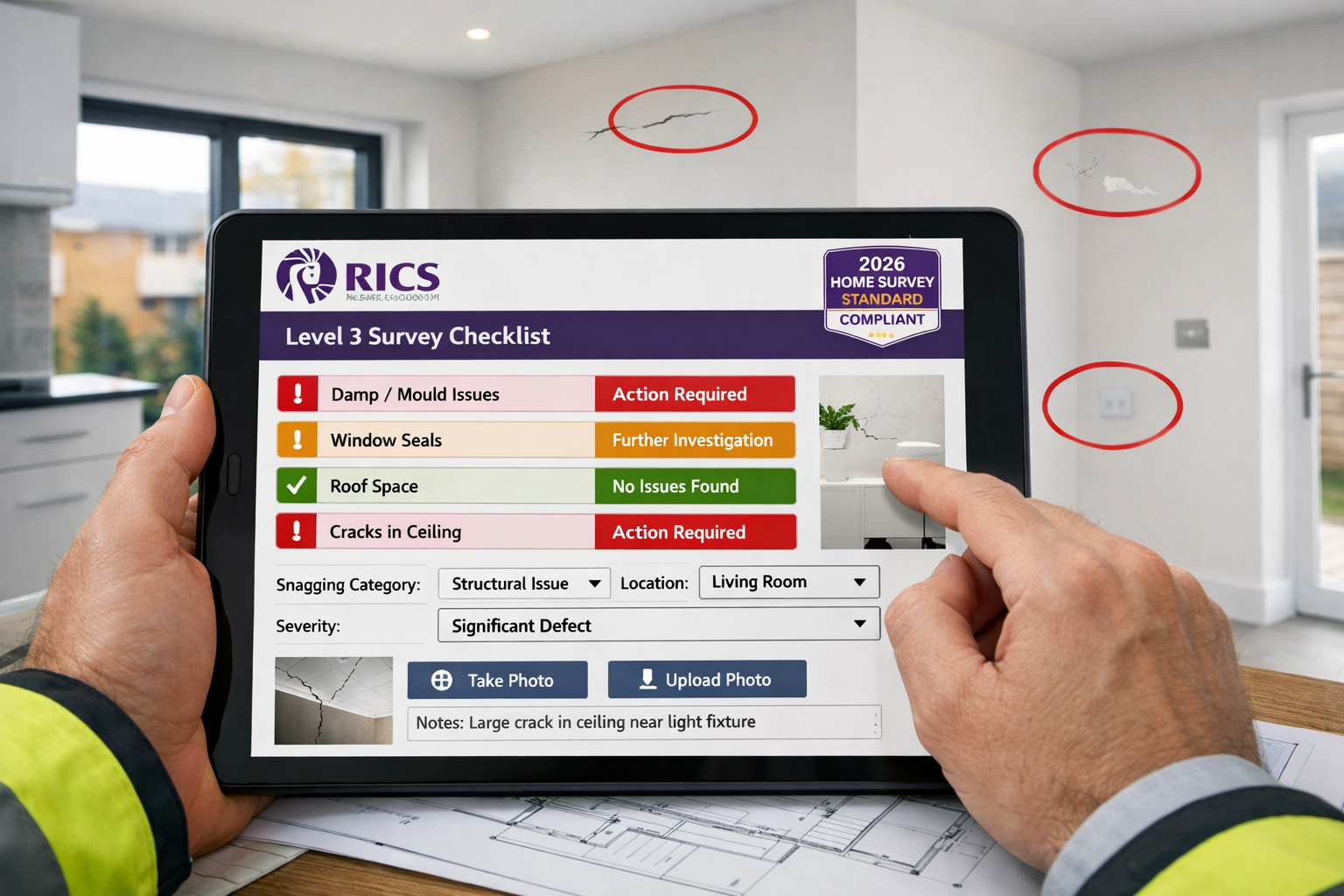
The RICS Standards and Regulation Board provided a progress update on February 10, 2026, announcing the 2nd edition of the Home Survey Standard with final recommendations delivered in Q1 2026[2]. This update represents the most significant evolution in survey methodology in over a decade, with specific provisions addressing the unique challenges of new-build inspections.
Dedicated New-Build Snagging Guidance
For the first time, RICS has incorporated explicit guidance for 'additional risk' dwellings, including new-build snagging alongside historic buildings and retrofit homes[2]. This recognition acknowledges that new properties present distinct inspection challenges requiring specialized protocols.
The updated standard includes:
✅ Enhanced pre-completion inspection frameworks specifically designed for new-build properties
✅ Standardized defect categorization systems aligned with warranty provider requirements
✅ Technology integration guidelines for drone inspections, thermal imaging, and AI-assisted defect detection
✅ Documentation standards ensuring survey reports meet evidential requirements for warranty claims
✅ Post-handover inspection protocols for identifying latent defects within warranty periods
Level 3 Survey Protocols for New Builds
While many buyers historically relied on basic condition reports for new properties, the 2026 standard strongly recommends Level 3 surveys for all new-build purchases. This comprehensive approach provides:
| Protocol Element | Traditional Approach | 2026 Enhanced Protocol |
|---|---|---|
| Inspection Duration | 2-3 hours | 4-6 hours with specialist equipment |
| Defect Documentation | Written notes | Photographic evidence, thermal imaging, measurements |
| Technology Use | Visual inspection only | Drones, moisture meters, thermal cameras, laser levels |
| Report Detail | General observations | Itemized defect list with severity ratings |
| Warranty Alignment | Generic findings | Mapped to specific warranty claim categories |
Understanding the difference between Level 2 and Level 3 surveys helps buyers make informed decisions about appropriate inspection depth for their circumstances.
Technology and AI Integration
The revised standard explicitly cross-references technological advancements, particularly AI, providing updated guidance on drone inspections, thermal imaging analysis, and automated defect detection systems[2]. These tools enable surveyors to:
- 🔍 Identify hidden defects not visible during traditional visual inspections
- 📸 Create comprehensive photographic evidence libraries
- 📊 Generate data-rich reports that strengthen warranty claims
- ⏱️ Reduce inspection time while increasing coverage comprehensiveness
For properties requiring specialized assessment, surveyors may recommend additional services such as damp surveys to investigate moisture-related defects common in new-build properties.
Optional Valuation Services
The 2026 standard introduces optional valuation for all levels of surveying[2], enabling buyers to receive both condition assessment and market valuation in a single engagement. This integration proves particularly valuable when defects discovered during snagging may affect property value and negotiation leverage.
Building Survey Protocols for New Build Warranty Claims: Step-by-Step Process
Implementing effective building survey protocols for new build warranty claims in 2026 market recovery requires systematic methodology from initial instruction through claim resolution. The following framework aligns with updated RICS standards and best practices emerging from recent case law.
Phase 1: Pre-Completion Inspection
The pre-completion snagging inspection represents the most critical intervention point. Conducted before legal completion, this inspection identifies defects while developers retain contractual responsibility for remediation.
Optimal Timing: 7-14 days before scheduled completion date
Key Protocol Elements:
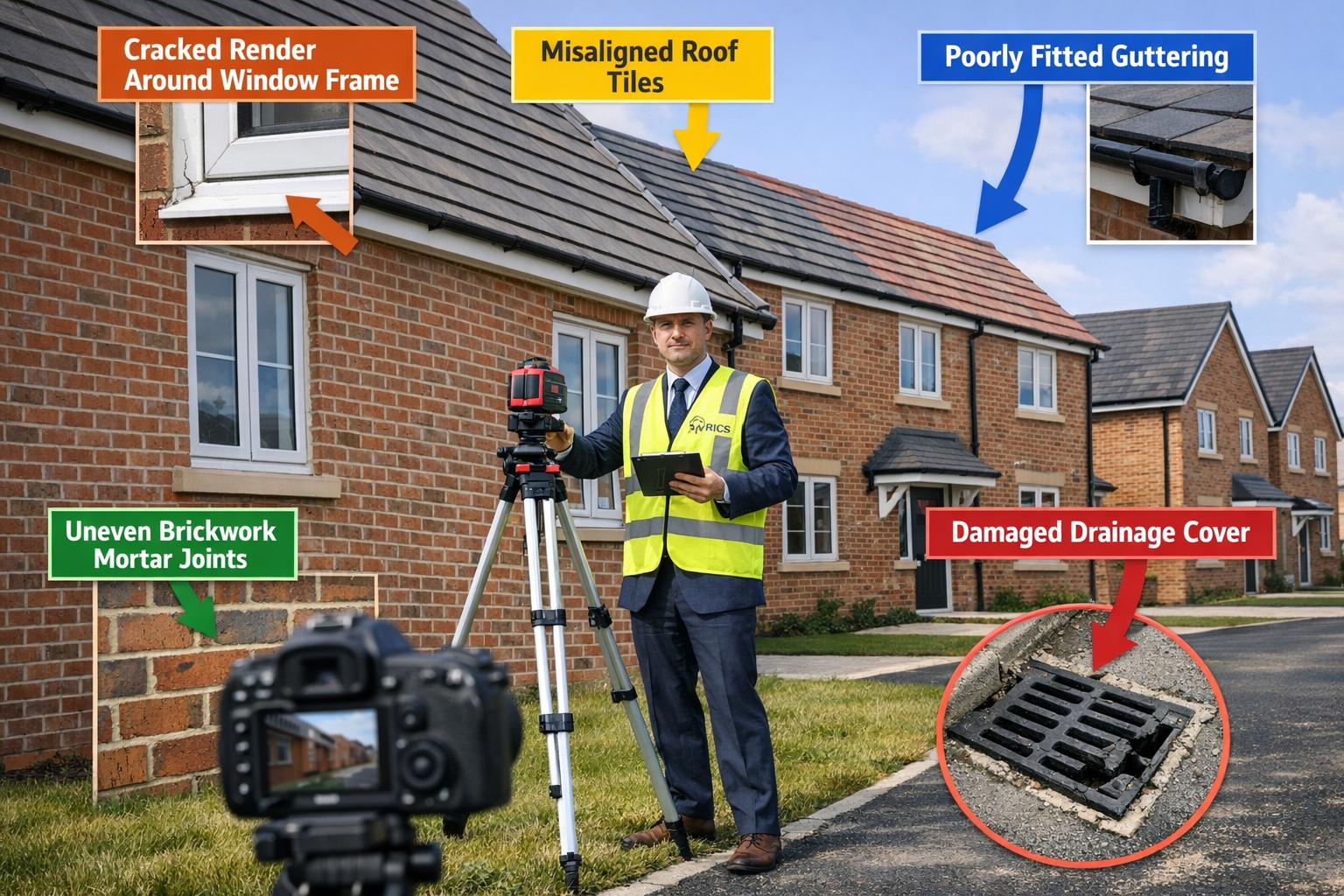
- Comprehensive exterior assessment including roof, walls, windows, doors, drainage, and landscaping
- Internal inspection covering all rooms, fixtures, fittings, finishes, and services
- Mechanical and electrical systems testing where accessible
- Photographic documentation of every identified defect with measurement references
- Categorization using RICS-aligned severity ratings (Critical, Significant, Minor)
For first-time buyers navigating this process, booking a building survey in Wimbledon, London or your local area ensures professional guidance through these critical stages.
Phase 2: Defect Documentation and Reporting
Modern survey protocols demand evidence-quality documentation that can withstand scrutiny in warranty disputes or legal proceedings. The Building Safety Act's retrospective liability provisions mean records created today may be examined years into the future[3].
Documentation Best Practices:
- 📷 High-resolution photography: Minimum 12MP images with clear defect identification
- 📐 Measurements and scale references: Include measuring tape or scale markers in photos
- 🗺️ Location mapping: Floor plans annotated with defect locations
- 📝 Detailed descriptions: Specific, technical language describing each defect
- 🏷️ Warranty clause mapping: Cross-reference defects to relevant warranty coverage sections
Surveyors must assume their records may be scrutinized long after the inspection event, making comprehensive record-keeping central to professional practice[3].
Phase 3: Developer Remediation Tracking
Following defect identification, protocols must address the remediation process itself:
Tracking Framework:
- Initial snagging list submission to developer with response deadline
- Remediation scheduling with agreed timeframes for each defect category
- Post-remediation inspection to verify completion and quality
- Photographic evidence of completed remediation work
- Outstanding defects register for items requiring follow-up
Many buyers discover significant issues during this phase, making it valuable to understand what to do after a bad building survey report to protect their interests.
Phase 4: Post-Handover Warranty Period Monitoring
Latent defects often emerge only after occupation, particularly those related to:
- Settlement and structural movement
- Water ingress and damp penetration
- Heating and ventilation performance
- Drainage and plumbing functionality
Recommended Protocol:
- 📅 6-month post-occupation inspection: Identify emerging issues within warranty period
- 📅 11-month warranty review: Final inspection before standard 12-month builder warranty expires
- 📅 Annual inspections: Throughout extended warranty periods (typically 2-10 years)
This systematic approach ensures defects are identified and documented within warranty coverage periods, maximizing claim success rates.
Common New Build Defects and RICS Classification Systems
Understanding typical new-build defects and their classification under RICS protocols enables buyers and surveyors to prioritize remediation efforts and structure warranty claims effectively.
Critical Defects (Immediate Action Required)
These defects pose safety risks or cause significant property damage:
- ⚠️ Structural instability or significant cracking
- ⚠️ Fire safety non-compliance
- ⚠️ Active water ingress or flooding risk
- ⚠️ Electrical safety hazards
- ⚠️ Gas safety concerns
Warranty Protocol: Immediate notification to developer and warranty provider with photographic evidence. May require emergency remediation and temporary accommodation provisions.
Significant Defects (Urgent Attention)
These issues affect property functionality or will worsen without intervention:
- 🔸 Roof defects allowing minor water penetration
- 🔸 Window and door installation defects affecting weatherproofing
- 🔸 Heating system malfunctions
- 🔸 Drainage problems causing localized flooding
- 🔸 Significant finish defects affecting multiple rooms
Warranty Protocol: Formal written notification within 7 days of discovery with detailed documentation and remediation deadline requests.
Minor Defects (Cosmetic or Finishing Issues)
These defects affect appearance or minor functionality:
- 🔹 Paint and decorating imperfections
- 🔹 Minor tile or flooring defects
- 🔹 Hardware and fixture finishing issues
- 🔹 Minor plasterwork imperfections
- 🔹 Snagging items affecting single locations
Warranty Protocol: Inclusion in comprehensive snagging list with reasonable remediation timeframes (typically 30-60 days).
Benchmarking and Reporting Standards
The 2026 RICS standard updates appendices with enhanced benchmarking of reporting and inspection levels[2], providing clearer guidance on expected defect documentation standards. This standardization helps buyers understand whether their property's defect count falls within normal parameters or indicates systemic quality issues.
Technology Tools for Enhanced Snagging and Defect Detection
The 2026 RICS standard's emphasis on technology integration reflects the profession's evolution toward data-driven inspection methodologies. Modern tools significantly enhance defect detection capabilities while creating stronger evidence trails for warranty claims.
Drone Inspection Technology
Aerial inspection platforms enable comprehensive roof and high-elevation assessment without physical access:
Capabilities:
- 4K video documentation of roof condition
- Thermal imaging overlay for insulation defects
- Gutter and chimney detailed inspection
- Facade assessment for high-rise buildings
Protocol Integration: Drone footage supplements traditional inspection reports, providing visual evidence of inaccessible areas frequently excluded from standard surveys.
Thermal Imaging Cameras
Infrared thermography reveals hidden defects invisible to visual inspection:
Applications:
- Insulation defects and thermal bridging
- Water ingress and moisture penetration
- Heating system distribution problems
- Air leakage and draft identification
Evidence Value: Thermal images provide compelling visual evidence for warranty claims, particularly for energy performance defects affecting heating costs.
AI-Assisted Defect Detection
Machine learning algorithms trained on construction defect databases can identify potential issues from photographic surveys:
Functionality:
- Automated crack detection and measurement
- Pattern recognition for systematic defects
- Comparative analysis against building standards
- Predictive assessment of defect progression
Professional Judgment: While AI tools enhance detection capabilities, the 2026 standard emphasizes that professional surveyor judgment remains essential for interpretation and risk assessment[2].
Digital Documentation Platforms
Cloud-based survey management systems streamline the inspection and reporting process:
Features:
- Mobile inspection apps with offline functionality
- Integrated photography with automatic geotagging
- Template-based reporting aligned with RICS standards
- Client portal access for real-time updates
- Long-term document retention for Building Safety Act compliance
These platforms address the critical need for document retention and evidence preservation given retrospective liability concerns[3].
Warranty Claim Procedures: NHBC, LABC, and Alternative Providers
New-build properties typically carry multiple warranty layers, each with distinct claim procedures and coverage parameters. Understanding these frameworks is essential for successful defect remediation.
NHBC Buildmark Warranty
The National House Building Council remains the UK's largest warranty provider, covering approximately 80% of new builds.
Coverage Structure:
- Years 1-2: Builder's warranty for defects and incomplete work
- Years 3-10: NHBC structural warranty for major defects
Claim Protocol:
- Notify builder in writing within warranty period
- Allow reasonable time for builder remediation
- If unresolved, escalate to NHBC resolution service
- NHBC investigation and determination
- Remediation or compensation award
Key Consideration: NHBC requires defects to be reported within the warranty period, making systematic inspection timing critical.
LABC Warranty
Local Authority Building Control warranties provide alternative coverage with similar structure:
Distinctive Features:
- Direct relationship with building control inspectors
- Emphasis on regulatory compliance
- Structural warranty focus with limited cosmetic coverage
Claim Approach: LABC claims often involve technical assessment of building regulation compliance, making detailed survey documentation particularly valuable.
Premier Guarantee and Alternative Providers
Several alternative warranty providers operate in the market, each with specific terms:
- Premier Guarantee: 10-year structural warranty with deposit protection
- NHBC Accepts: Coverage for non-NHBC registered builders
- Build-Zone: Specialist warranty for custom builds
Protocol Variation: Each provider maintains distinct claim procedures, notification requirements, and coverage definitions. Surveyors must align documentation with specific warranty terms to maximize claim success.
Building Safety Act Compliance and Risk Management
The Building Safety Act 2022 fundamentally altered liability frameworks for building defects, creating new obligations and risks for all construction stakeholders. Understanding these implications is essential for effective warranty claim management.
Retrospective Liability Provisions
Courts have confirmed that remediation contribution orders (RCOs) may include costs incurred before the Act came into force[3], creating unprecedented retrospective liability exposure for:
- Developers and builders
- Design professionals
- Building control bodies
- Material suppliers and manufacturers
Surveyor Implications: Documentation created during new-build inspections may become critical evidence in future RCO proceedings, even years after completion.
Collateral Warranties and Extended Liability
Building surveyors must carefully consider collateral warranty timing and wording, as warranties executed years after completion may revive liability that would otherwise be dormant[3].
Risk Management Protocol:
⚖️ Review warranty terms before execution, particularly limitation period provisions
⚖️ Document inspection scope and limitations explicitly in survey reports
⚖️ Maintain comprehensive records assuming long-term scrutiny
⚖️ Professional indemnity insurance with adequate coverage periods
Document Retention Requirements
The Building Safety Act's retrospective provisions make long-term document retention essential. Best practice protocols include:
- 📁 Minimum 15-year retention for all survey documentation
- 📁 Cloud-based backup systems with redundancy
- 📁 Metadata preservation including dates, times, and equipment used
- 📁 Chain of custody documentation for evidence integrity
Professional surveyors should review their building inspection procedures to ensure compliance with these enhanced documentation standards.
Case Studies: Q1 2026 Warranty Claim Outcomes
Recent warranty disputes from the 2026 market recovery provide valuable insights into effective claim strategies and common pitfalls.
Case Study 1: Systematic Render Defects
Background: 47-unit development in Greater London with widespread render cracking affecting 34 properties within 8 months of completion.
Survey Protocol Applied:
- Comprehensive photographic documentation of all affected properties
- Thermal imaging revealing inadequate substrate preparation
- Comparative analysis demonstrating systematic rather than isolated defects
- Building regulation compliance assessment
Outcome: Developer accepted full remediation responsibility after survey evidence demonstrated systematic construction defects. Total remediation value: £340,000.
Key Success Factor: Coordinated survey approach across multiple properties demonstrated pattern of defects, strengthening warranty claims.
Case Study 2: Latent Drainage Defects
Background: New-build townhouse experiencing recurring drainage problems 14 months post-completion, just beyond builder's warranty period.
Survey Protocol Applied:
- CCTV drainage survey revealing improper gradient installation
- Documentation of initial complaints within warranty period
- Expert witness report for NHBC claim escalation
- Photographic evidence of internal damage from drainage backup
Outcome: NHBC accepted claim under structural warranty despite initial denial. Remediation included complete drainage system replacement and internal damage repair.
Key Success Factor: Contemporaneous documentation of initial complaints within warranty period established claim validity despite delayed diagnosis.
Case Study 3: Energy Performance Defects
Background: Semi-detached new build failing to achieve EPC rating specified in sales documentation, resulting in excessive heating costs.
Survey Protocol Applied:
- Thermal imaging survey identifying multiple insulation defects
- Air tightness testing revealing significant draft issues
- Comparative energy consumption analysis
- Building regulation compliance assessment
Outcome: Developer agreed to remedial insulation works and compensation for excess energy costs during defect period. Total settlement: £18,500.
Key Success Factor: Thermal imaging evidence provided objective proof of defects, overcoming developer's initial denial of performance issues.
Proposed RICS Regulatory Scheme: Future Implications
The proposed home survey regulatory scheme represents a significant evolution in professional oversight, with potential implementation following Q1 2026 consultation responses[2].
Member Support and Consultation Outcomes
Prior consultation revealed 46% of RICS members supported creating a home survey regulatory scheme similar to the Valuer Registration Scheme[2]. The Standards and Regulation Board directed further consultation on this proposal, with final recommendations expected in 2026.
Proposed Regulatory Framework
The scheme would impose additional audit and reporting requirements on members conducting home surveys in the UK[2]:
Key Elements:
- ✓ Mandatory registration for home survey practitioners
- ✓ Dedicated RICS resources for compliance monitoring
- ✓ Regular audit and quality assurance reviews
- ✓ Enhanced consumer protection mechanisms
- ✓ Standardized continuing professional development requirements
Impact on New Build Survey Protocols
If implemented, the regulatory scheme would likely:
- Standardize inspection methodologies across all practitioners
- Enhance consumer confidence in survey quality and reliability
- Improve warranty claim success rates through consistent documentation standards
- Increase professional accountability for survey accuracy and completeness
For buyers considering whether they need a building survey for a new build, enhanced regulatory oversight would provide additional assurance of survey quality and professional standards.
Practical Guidance for Homebuyers and Developers
Successfully navigating building survey protocols for new build warranty claims in 2026 market recovery requires proactive engagement from both buyers and developers.
For Homebuyers: Action Checklist
Pre-Purchase Phase:
- 📋 Commission comprehensive Level 3 survey regardless of new-build status
- 📋 Ensure surveyor uses updated 2026 RICS protocols and technology tools
- 📋 Request detailed snagging list with photographic evidence
- 📋 Review warranty documentation and understand claim procedures
- 📋 Negotiate remediation of critical and significant defects before completion
Post-Purchase Phase:
- 📋 Conduct systematic inspections at 6 and 11 months post-occupation
- 📋 Document all defects with photographs and written descriptions
- 📋 Submit warranty claims promptly within coverage periods
- 📋 Maintain comprehensive records of all communications with developer
- 📋 Consider professional representation for complex warranty disputes
Understanding what to do before an RICS home survey helps buyers prepare effectively for the inspection process.
For Developers: Risk Mitigation Strategies
Quality Assurance Protocols:
- 🏗️ Implement comprehensive pre-handover inspection procedures
- 🏗️ Address snagging items before buyer surveys
- 🏗️ Maintain detailed construction documentation for Building Safety Act compliance
- 🏗️ Establish responsive remediation procedures with clear timeframes
- 🏗️ Consider third-party quality certification schemes
Warranty Claim Management:
- 🏗️ Respond promptly to defect notifications within contractual timeframes
- 🏗️ Maintain constructive dialogue with buyers and surveyors
- 🏗️ Document all remediation work with photographic evidence
- 🏗️ Review warranty provider requirements and align procedures accordingly
For Surveyors: Professional Excellence
Practice Development:
- 🔍 Invest in updated technology tools (drones, thermal imaging, AI platforms)
- 🔍 Complete RICS continuing professional development on 2026 standard updates
- 🔍 Develop specialized expertise in new-build inspection protocols
- 🔍 Implement robust document retention and evidence management systems
- 🔍 Consider professional indemnity insurance enhancement for Building Safety Act exposure
Client Communication:
- 🔍 Clearly explain inspection scope and limitations
- 🔍 Provide actionable recommendations with priority classifications
- 🔍 Offer post-survey support for warranty claim procedures
- 🔍 Maintain professional objectivity in developer disputes
Conclusion
The convergence of market recovery, updated RICS standards, and enhanced regulatory frameworks has transformed building survey protocols for new build warranty claims in 2026 market recovery into a sophisticated, technology-enabled discipline. The February 2026 RICS Home Survey Standard 2nd edition provides comprehensive guidance specifically addressing new-build snagging, while the Building Safety Act creates unprecedented accountability for construction quality.
For homebuyers, the message is clear: comprehensive professional surveys are essential for new-build purchases, despite the property's age. The Q1 2026 data showing 34% increases in warranty claims demonstrates that construction quality issues remain prevalent, and systematic inspection protocols are the only reliable protection mechanism.
Developers benefit from proactive quality assurance and responsive remediation procedures that prevent minor snagging items from escalating into formal warranty disputes. The Building Safety Act's retrospective liability provisions make comprehensive documentation and quality construction more critical than ever.
Surveyors must embrace technological advancement while maintaining professional judgment, implement robust documentation systems that anticipate long-term scrutiny, and develop specialized expertise in new-build inspection protocols aligned with the 2026 RICS standard.
Next Steps
For Buyers:
- Commission a Level 3 survey from an RICS-qualified surveyor using 2026 protocols
- Review warranty documentation thoroughly and understand claim procedures
- Implement systematic post-occupation inspection schedule
- Maintain comprehensive defect documentation throughout warranty periods
For Developers:
- Review quality assurance procedures against 2026 RICS standards
- Enhance pre-handover inspection protocols
- Establish responsive remediation frameworks with clear timeframes
- Invest in comprehensive construction documentation systems
For Surveyors:
- Complete professional development on RICS Home Survey Standard 2nd edition
- Invest in technology tools for enhanced defect detection
- Implement robust document retention systems
- Consider specialization in new-build inspection services
The 2026 market recovery presents both challenges and opportunities. Those who adopt comprehensive survey protocols, embrace technological innovation, and maintain rigorous professional standards will navigate this landscape successfully, protecting investments and ensuring construction quality for years to come.
Whether you're considering a homebuyers report or building survey or need guidance on negotiating property prices based on survey findings, professional expertise aligned with current RICS standards provides the foundation for confident property transactions in the evolving 2026 market.
References
[1] Building Survey Standards Evolution How Rics Quality Strengthening Initiatives Impact Surveyor Practice In 2026 – https://nottinghillsurveyors.com/blog/building-survey-standards-evolution-how-rics-quality-strengthening-initiatives-impact-surveyor-practice-in-2026
[2] Home Survey Standards – https://www.rics.org/profession-standards/rics-standards-and-guidance/sector-standards/building-surveying-standards/home-surveys/home-survey-standards
[3] Building Safety Collateral Warranties Cases Risk Management – https://ww3.rics.org/uk/en/journals/built-environment-journal/building-safety-collateral-warranties-cases-risk-management.html
[4] Building Surveys Under New Homebuying Rules Earlier Inspections And Risk Mitigation In 2026 – https://nottinghillsurveyors.com/blog/building-surveys-under-new-homebuying-rules-earlier-inspections-and-risk-mitigation-in-2026