
The UK rental market in 2026 presents a paradox that savvy buy-to-let investors must navigate carefully. Record-low rental listings meet soaring tenant demand, creating a perfect storm where rental prices climb while landlord exits accelerate[3]. For investors considering entry or expansion into this competitive landscape, comprehensive building survey due diligence has never been more critical to long-term success.
Building Survey Due Diligence for Buy-to-Let Investors: Assessing Rental Market Viability Amid Supply Constraints and Rising Rents in 2026 requires a dual-lens approach—evaluating both the physical condition of properties and their potential to generate sustainable returns in an increasingly challenging regulatory environment. With average private rents reaching £1,350–£1,400 monthly and rising 4-5% annually[1], the financial stakes are high. Yet hidden structural defects, energy inefficiency, or deferred maintenance can quickly erode these promising yields.
This comprehensive guide explores how professional building surveyor services protect buy-to-let investments by identifying risks before purchase, assessing rental market positioning, and ensuring properties meet the evolving demands of today's cost-conscious tenants.
Key Takeaways
✅ Supply crisis drives rental growth: Rental listings have fallen to record lows as landlords exit the market, pushing average rents to £1,350–£1,400 monthly with 4-5% annual increases[1][3]
✅ Comprehensive surveys protect yields: Detailed building inspections identify structural defects, damp issues, and energy inefficiency that could significantly impact long-term rental returns
✅ Energy efficiency determines tenant demand: Properties with strong EPC ratings attract highest tenant interest as energy costs remain a primary concern for renters in 2026[1]
✅ Regulatory pressures reshape the market: The Renters' Rights Act accelerates small landlord exits while portfolio investors consolidate, creating opportunities for well-capitalized buyers[2]
✅ Due diligence extends beyond structure: Successful buy-to-let investments in 2026 require assessing local rental demand, comparable properties, and long-term maintenance costs alongside physical condition
Understanding the 2026 Rental Market Landscape for Buy-to-Let Investors
The rental market in 2026 operates under fundamentally different dynamics than previous years. Strong tenant demand continues unabated, with many tenants who delayed moves during winter now actively searching for properties[1]. This sustained demand meets a deepening supply crisis as rental listings fall to historic lows[3].
Supply Constraints Driving Market Transformation
The private rented sector faces unprecedented supply challenges. Landlords continue exiting the UK market at accelerating rates, particularly smaller portfolio holders unable to manage mounting regulatory burdens[2]. The Renters' Rights Act has become a catalyst for portfolio exits, fundamentally reshaping who participates in the buy-to-let market.
However, this exodus doesn't signal market collapse—rather, it represents consolidation toward professional landlords. Larger portfolio operators absorb properties being sold by smaller landlords, creating opportunities for investors with proper due diligence processes and sufficient capital reserves[2].
Regional Market Variations
London's rental market shows early signs of rebalancing, with tenant competition cooling and rental supply rebounding at the end of 2025[3]. This regional variation underscores the importance of location-specific market analysis as part of comprehensive building survey due diligence.
Investors must understand that national trends don't guarantee local performance. A thorough assessment requires examining:
- Local rental yield averages compared to purchase prices
- Tenant demographic profiles and employment stability
- Comparable property performance in the immediate area
- Future development plans that could affect supply-demand balance
Financing Landscape for Buy-to-Let in 2026
The mortgage market presents mixed signals for buy-to-let investors. Overall gross mortgage lending is forecast to rise 4% in 2026 to £300bn[2], but home purchase lending growth is expected to slow to just 2%[2]. More significantly for buy-to-let investors, forecasts diverge sharply:
- UK Finance expects BTL purchase lending to remain flat at approximately £11bn
- IMLA projects more optimistic gross BTL lending rising from £39bn (2025) to £44bn (2026)[2]
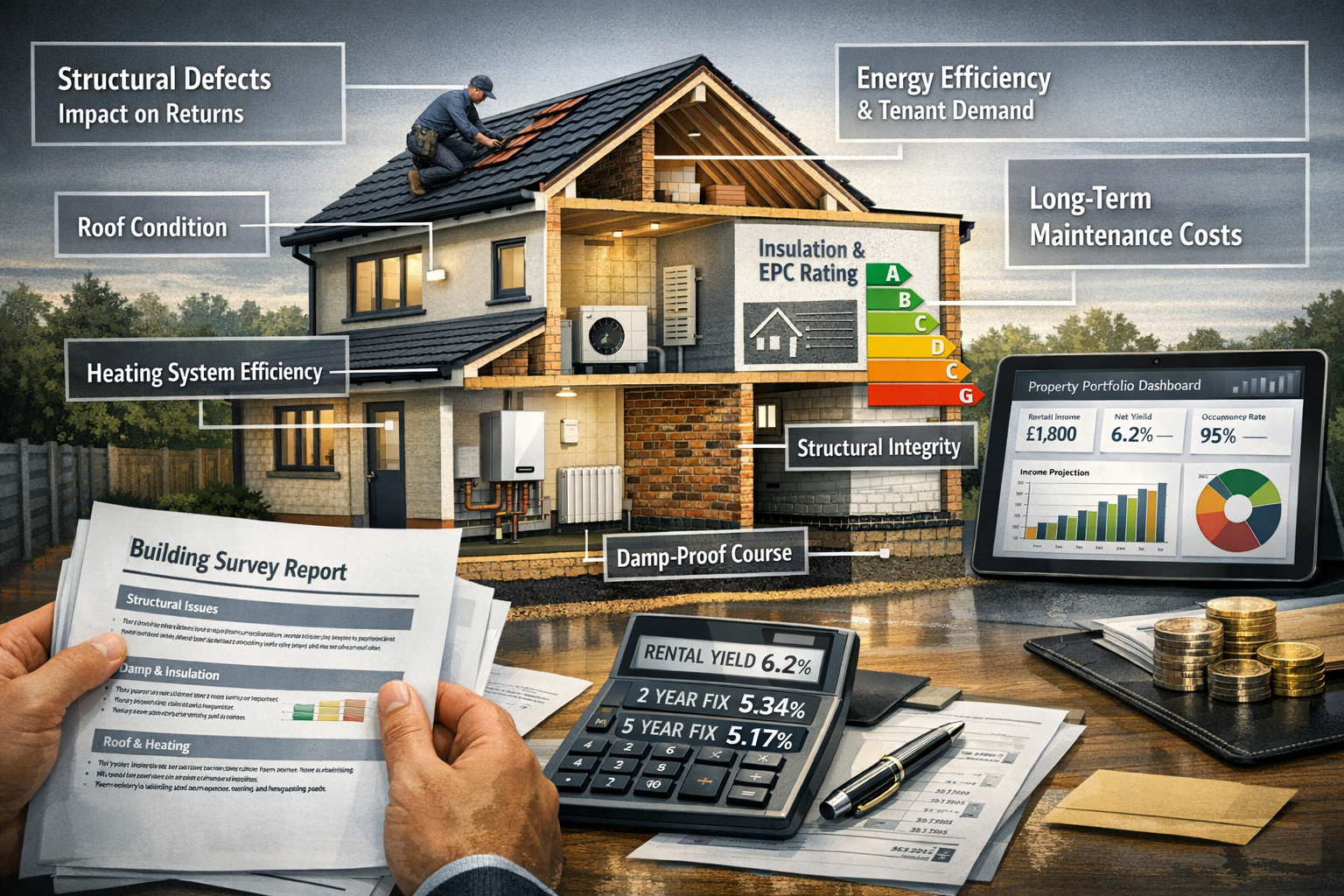
Portfolio landlords currently face two-year fixed rates at 5.34% and five-year fixes at 5.17%[4], making accurate property assessment crucial to ensure rental yields justify these financing costs.
Building Survey Due Diligence for Buy-to-Let Investors: Critical Assessment Areas
Professional building surveys serve as the foundation for sound buy-to-let investment decisions. Unlike standard homebuyer reports, investment property assessments must evaluate both immediate structural condition and long-term maintenance implications that directly impact rental yields.
Structural Integrity and Major Defects
The most critical aspect of any building survey examines structural soundness. Major structural issues can render properties unrentable, require expensive emergency repairs, or dramatically reduce property values.
Key structural elements requiring detailed inspection include:
| Structural Component | Common Issues | Impact on Rental Viability |
|---|---|---|
| Foundation & Subsidence | Settlement cracks, movement, tree root damage | Can make property unmortgageable; expensive repairs (£5,000-£50,000+) |
| Roof Structure | Sagging rafters, missing tiles, water ingress | Tenant complaints, emergency repairs, internal damage |
| Load-Bearing Walls | Cracks, bulging, inadequate support | Safety concerns, potential structural failure |
| Damp-Proof Course | Rising damp, penetrating moisture | Health hazards, decoration damage, tenant turnover |
| Windows & Doors | Rot, poor seals, security issues | Energy loss, security concerns, tenant dissatisfaction |
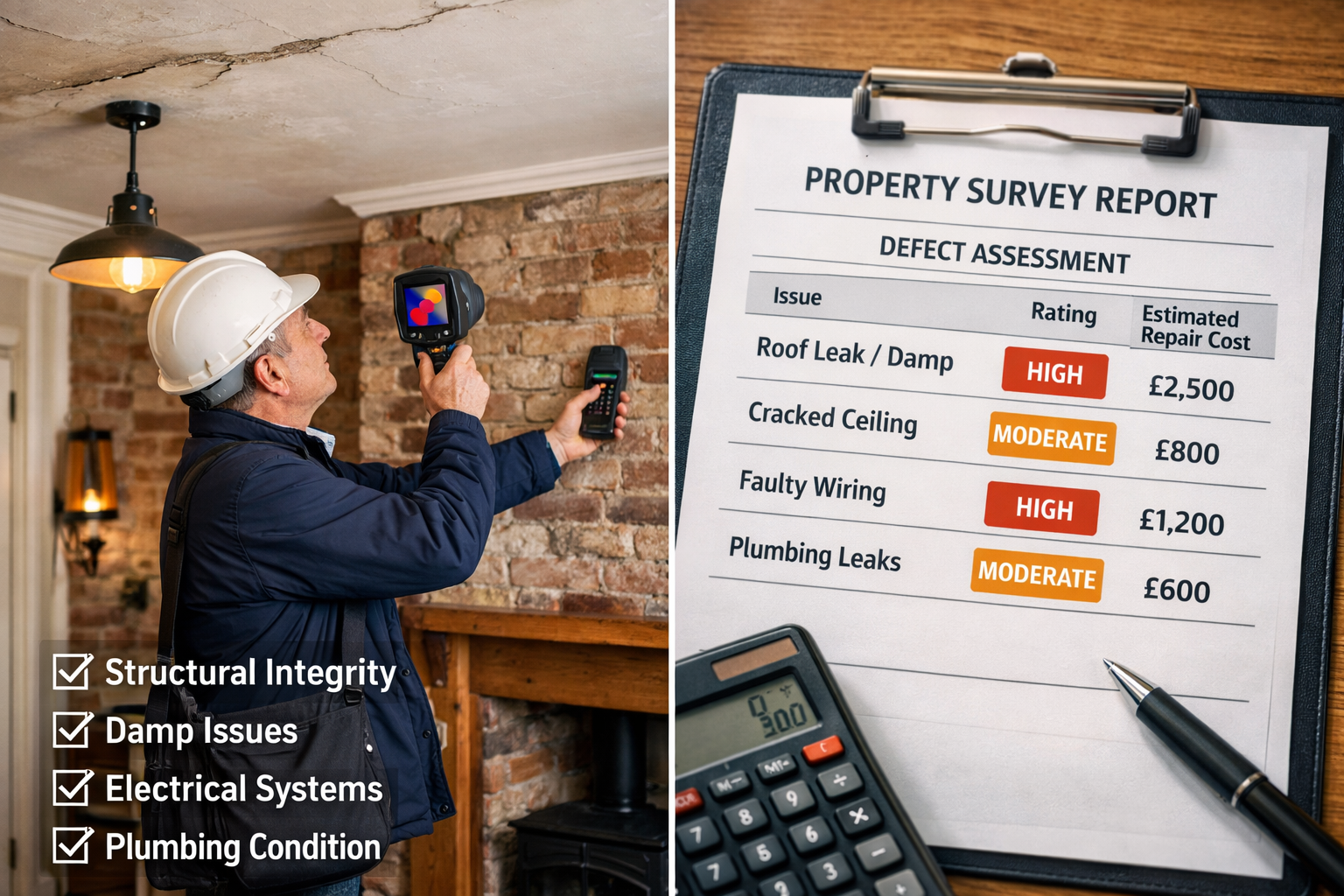
Professional chartered surveyors use specialized equipment including moisture meters, thermal imaging cameras, and structural assessment tools to identify defects not visible during casual viewings.
Understanding whether you can renegotiate after a poor building survey result provides crucial leverage in property negotiations, potentially saving tens of thousands in purchase price or securing seller-funded repairs.
Damp and Moisture Assessment
Damp issues rank among the most common and costly problems in UK rental properties. A comprehensive damp survey identifies moisture sources and assesses remediation costs before purchase.
The three main types of damp affecting rental properties:
- Rising Damp: Ground moisture traveling upward through walls due to failed damp-proof coursing
- Penetrating Damp: External water ingress through walls, roofs, or windows
- Condensation: Moisture from everyday activities causing mold growth in poorly ventilated spaces
Damp problems create multiple investment risks:
- 🏚️ Tenant health concerns leading to complaints and potential legal liability
- 💰 Expensive remediation costs ranging from £500 for minor condensation fixes to £5,000+ for extensive rising damp treatment
- ⏱️ Void periods while repairs are completed
- 📉 Property value reduction if issues remain unaddressed
Energy Efficiency and EPC Ratings
In 2026's rental market, energy efficiency directly correlates with tenant demand and achievable rents. Properties with strong energy efficiency ratings attract the highest tenant interest as renters remain acutely mindful of energy costs[1].
Current regulations require rental properties to achieve minimum EPC rating of E, but market forces push successful landlords toward higher standards:
- EPC ratings C or above command premium rents and lower void periods
- Poor energy efficiency (ratings D-E) faces increasing tenant resistance
- Future regulatory tightening may require rating C minimum, making current D-E properties risky long-term investments
Survey assessments should evaluate:
- Current EPC rating and improvement potential
- Insulation quality in walls, loft, and floors
- Heating system efficiency and age
- Window glazing performance
- Renewable energy installation feasibility
Upgrading from EPC rating E to C typically costs £3,000-£8,000 but can increase rental income by 5-10% while reducing tenant turnover.
Electrical and Plumbing Systems
Modern, safe, and efficient systems are non-negotiable for rental properties. Building surveys must assess:
Electrical Systems:
- Consumer unit (fuse box) compliance with current regulations
- Wiring age and condition
- Earthing and bonding adequacy
- Socket and lighting provision
- Electrical Installation Condition Report (EICR) compliance
Plumbing Systems:
- Boiler age, efficiency, and service history
- Pipe material and condition (lead, copper, plastic)
- Water pressure and flow rates
- Drainage effectiveness
- Bathroom and kitchen fixture condition
Outdated systems create multiple risks: safety hazards, regulatory non-compliance, emergency repair costs, and tenant dissatisfaction. Replacing an entire electrical system costs £3,000-£5,000, while a new boiler installation runs £2,000-£3,500—expenses that significantly impact investment returns if discovered after purchase.
Assessing Rental Market Viability Through Building Survey Insights
Building Survey Due Diligence for Buy-to-Let Investors: Assessing Rental Market Viability Amid Supply Constraints and Rising Rents in 2026 extends beyond identifying defects. The survey findings must inform rental positioning strategy, yield calculations, and long-term investment viability.
Translating Survey Findings into Yield Projections
Every defect identified in a building survey carries financial implications that affect investment returns. Smart investors create detailed financial models incorporating survey findings:
Immediate Repair Costs:
- Emergency repairs required before letting
- Safety-critical issues (electrical, gas, structural)
- Regulatory compliance work (EPC improvements, fire safety)
Deferred Maintenance Schedule:
- Medium-term repairs (1-3 years): roof repairs, window replacement
- Long-term capital expenditure (3-10 years): boiler replacement, rewiring
- Cyclical maintenance: external decoration, gutter cleaning
Impact on Rental Income:
- Rental premium for excellent condition properties
- Rental discount for properties with known issues
- Void period costs during repair work
Example Calculation:
A property priced at £250,000 with projected rental income of £1,400/month (£16,800 annually) appears to offer a 6.72% gross yield. However, survey findings reveal:
- £8,000 immediate damp remediation required
- £4,000 electrical rewiring needed for compliance
- £3,000 boiler replacement within 2 years
- £2,000 external decoration needed
Adjusted investment: £267,000 total outlay
Adjusted gross yield: 6.29% (before mortgage costs, maintenance, void periods)
This more realistic projection helps investors make informed decisions and negotiate appropriate purchase prices.
Property Positioning in Local Rental Markets
Survey findings directly influence how properties compete in local rental markets. Understanding home survey levels and choosing the right option ensures investors obtain appropriate detail for their investment strategy.
Premium Market Positioning (Top 25% of local rents):
- Excellent structural condition
- Modern, efficient systems
- EPC rating B or above
- Contemporary kitchens and bathrooms
- Minimal deferred maintenance
Mid-Market Positioning (Middle 50% of local rents):
- Good overall condition
- Functional systems with reasonable remaining life
- EPC rating C-D
- Standard fixtures and fittings
- Manageable maintenance schedule
Value Market Positioning (Bottom 25% of local rents):
- Acceptable structural condition but dated presentation
- Older systems requiring near-term replacement
- EPC rating D-E
- Basic fixtures requiring updates
- Significant deferred maintenance
The survey helps investors understand which market segment their property naturally fits and what improvements would justify repositioning to higher rental brackets.
Competitive Analysis and Tenant Expectations
In 2026's supply-constrained market, tenant expectations have evolved significantly. Professional building surveys should inform competitive positioning by identifying features that meet or exceed current tenant demands:
🔑 Essential Features (tenant deal-breakers):
- Safe, compliant electrical and gas systems
- Effective heating and hot water
- Secure windows and doors
- Damp-free, mold-free environment
- Adequate storage
⭐ Desirable Features (competitive advantages):
- Energy-efficient heating (lower bills)
- Modern kitchen appliances
- Quality bathroom fixtures
- Outdoor space (garden, balcony)
- Parking provision
- High-speed internet capability
Understanding how survey findings affect these feature sets helps investors prioritize repairs and improvements for maximum rental return.
Long-Term Investment Strategy and Building Survey Due Diligence

Successful buy-to-let investing in 2026 requires strategic thinking beyond immediate returns. Building survey due diligence informs long-term portfolio strategy and risk management.
Portfolio Growth Considerations
For investors building multi-property portfolios, systematic building survey processes create consistency and risk mitigation:
Standardized Assessment Criteria:
- Minimum acceptable structural condition standards
- Maximum acceptable repair cost thresholds
- Required EPC rating minimums
- Preferred property age ranges
- Target maintenance cost ratios
Portfolio Diversification:
- Geographic spread across different rental markets
- Property type variation (houses, flats, HMOs)
- Tenant demographic diversity (professionals, families, students)
- Age and condition profile balance
Professional investors often engage the same building surveyor for all portfolio acquisitions, creating consistent assessment standards and building valuable advisor relationships.
Regulatory Compliance and Future-Proofing
The regulatory landscape for rental properties continues evolving. Building surveys must assess current compliance and future regulatory risks:
Current Regulatory Requirements:
- Electrical Installation Condition Reports (EICR) every 5 years
- Gas Safety Certificates annually
- Energy Performance Certificates valid and minimum rating E
- Smoke and carbon monoxide detector provision
- Deposit protection scheme compliance
Anticipated Future Requirements:
- Minimum EPC rating C (proposed but timing uncertain)
- Enhanced fire safety standards (particularly for flats)
- Stricter damp and mold prevention standards
- Improved accessibility requirements
Properties requiring extensive work to meet future standards represent higher risk investments. Survey findings help investors identify properties that can economically achieve higher compliance standards versus those facing prohibitive upgrade costs.
Exit Strategy Planning
Professional investors consider exit strategies from the moment of purchase. Building survey insights inform long-term value appreciation potential and future sale viability:
Value Enhancement Opportunities:
- Structural improvements adding capital value
- Extensions or conversions increasing lettable space
- Energy efficiency upgrades improving marketability
- Period feature restoration (for older properties)
Resale Considerations:
- Structural issues affecting mortgageability for future buyers
- Major defects requiring disclosure during sale
- Remaining useful life of major components
- Comparable property values in area
Understanding these factors helps investors select properties offering both strong rental yields and capital appreciation potential, maximizing total investment returns.
Risk Mitigation Through Professional Surveys
The relatively modest cost of comprehensive building surveys (£500-£1,500 depending on property size and complexity) provides exceptional value through risk mitigation:
💷 Financial Protection:
- Identifying £10,000+ in hidden defects before purchase
- Negotiating price reductions based on survey findings
- Avoiding properties with structural issues exceeding economic repair
- Planning accurate budgets including all necessary work
⚖️ Legal Protection:
- Documented property condition at purchase
- Evidence for insurance claims if issues worsen
- Support for disputes with sellers over non-disclosed defects
- Compliance verification for regulatory requirements
🎯 Strategic Advantage:
- Confident decision-making based on complete information
- Competitive edge through superior property assessment
- Portfolio consistency through standardized evaluation
- Long-term planning supported by accurate condition data
Investors who view building surveys as optional cost-cutting opportunities often discover expensive mistakes after purchase, when remediation costs significantly exceed survey fees.
Practical Implementation: Conducting Effective Building Survey Due Diligence
Implementing Building Survey Due Diligence for Buy-to-Let Investors: Assessing Rental Market Viability Amid Supply Constraints and Rising Rents in 2026 requires systematic processes and professional partnerships.
Selecting the Right Survey Level
Different survey levels provide varying detail and cost. For buy-to-let investments, the appropriate choice depends on property characteristics:
RICS Home Survey Level 2 (formerly Homebuyer Report):
- Suitable for: Modern properties (post-1990) in good condition
- Coverage: Visual inspection of accessible areas
- Cost: £400-£600 typically
- Best for: Lower-risk investments in newer buildings
RICS Home Survey Level 3 (formerly Building Survey):
- Suitable for: Older properties, unusual construction, visible defects
- Coverage: Comprehensive inspection including accessible roof spaces, floors, and concealed areas
- Cost: £600-£1,500+ depending on property size
- Best for: Most buy-to-let investments, particularly older stock
For detailed comparison, review the key differences between Level 2 and Level 3 surveys to make informed decisions.
Most buy-to-let investors benefit from Level 3 surveys given the investment stakes and need for comprehensive defect identification. The additional cost (typically £200-£400 more than Level 2) provides significantly more detailed information about repair priorities and costs.
Choosing Qualified Building Surveyors
Professional surveyor selection significantly impacts survey quality and investment outcomes:
Essential Qualifications:
- RICS (Royal Institution of Chartered Surveyors) membership
- Relevant professional indemnity insurance
- Specialized experience with rental properties
- Local market knowledge
- Clear, detailed reporting style
Questions to Ask Prospective Surveyors:
- How many rental property surveys do you conduct annually?
- What specific equipment do you use (thermal imaging, moisture meters)?
- Can you provide sample survey reports for review?
- What is your typical turnaround time?
- Do you provide repair cost estimates?
- Are you available for follow-up questions after report delivery?
Establishing relationships with reliable surveyors across your target investment areas creates consistency and efficiency for portfolio growth. Many investors maintain preferred surveyor lists for different regions, ensuring quality assessments regardless of property location.
Integrating Survey Findings into Purchase Decisions
Professional building surveys provide detailed information, but investors must translate findings into actionable decisions:
Decision Framework:
Proceed with Confidence:
- Minor defects only (under £2,000 total repair costs)
- No structural concerns
- Systems in good condition with reasonable remaining life
- Property meets or exceeds local rental market standards
Proceed with Price Negotiation:
- Moderate defects (£2,000-£10,000 repair costs)
- Repairable structural issues
- System replacements needed within 2-5 years
- Property requires improvements to compete effectively
Proceed with Caution:
- Significant defects (£10,000-£25,000 repair costs)
- Structural concerns requiring specialist assessment
- Major system failures requiring immediate replacement
- Regulatory compliance issues
Walk Away:
- Severe structural defects exceeding economic repair
- Repair costs exceeding 15-20% of property value
- Issues making property unmortgageable
- Problems indicating fundamental construction failures
Understanding how to leverage survey results in negotiations can save thousands while ensuring properties meet investment criteria.
Creating Comprehensive Investment Analysis
Building survey findings integrate into broader investment analysis:
Financial Model Components:
-
Acquisition Costs:
- Purchase price (potentially adjusted after survey)
- Survey fees
- Legal fees
- Stamp duty
- Initial repair costs identified in survey
-
Ongoing Costs:
- Mortgage payments (at current rates: 5.17-5.34%)[4]
- Property management (8-12% of rent typically)
- Maintenance reserve (10-15% of rent recommended)
- Insurance
- Safety certificates and compliance
- Void period allowance
-
Income Projections:
- Market rent based on condition and positioning
- Rental growth assumptions (4-5% currently)[1]
- Occupancy rate (95% typical for quality properties)
-
Capital Expenditure Schedule:
- Year 1-2: Survey-identified immediate repairs
- Year 3-5: Medium-term replacements (boiler, windows)
- Year 6-10: Major works (roof, rewiring)
This comprehensive analysis reveals true investment returns and helps identify properties offering genuine value versus those appearing attractive on surface metrics alone.
Conclusion
Building Survey Due Diligence for Buy-to-Let Investors: Assessing Rental Market Viability Amid Supply Constraints and Rising Rents in 2026 represents the cornerstone of successful rental property investment. In a market characterized by record-low supply, rising rents, and increasing regulatory complexity, comprehensive property assessment separates profitable investments from costly mistakes.
The current market dynamics—with average rents reaching £1,350-£1,400 monthly and climbing 4-5% annually[1]—create compelling opportunities for well-prepared investors. However, these opportunities come with significant risks. Landlord exits continue accelerating[3], mortgage rates for portfolio investors remain elevated at 5.17-5.34%[4], and regulatory pressures intensify through measures like the Renters' Rights Act[2].
Professional building surveys provide the detailed intelligence needed to navigate this complex landscape. By identifying structural defects, assessing energy efficiency, evaluating system condition, and estimating repair costs, comprehensive surveys enable investors to:
✅ Make informed purchase decisions based on complete property condition understanding
✅ Negotiate appropriate prices reflecting true property condition and required investment
✅ Plan accurate budgets incorporating all necessary repairs and improvements
✅ Position properties competitively in local rental markets for optimal yields
✅ Mitigate long-term risks through early identification of major defects and compliance issues
Actionable Next Steps
For buy-to-let investors seeking to capitalize on 2026's rental market opportunities:
- Engage qualified building surveyors before making purchase offers on any investment property
- Request Level 3 surveys for comprehensive assessment, particularly for older properties or those with visible defects
- Create standardized evaluation criteria for consistent portfolio assessment across multiple properties
- Develop detailed financial models incorporating survey findings, repair costs, and long-term maintenance schedules
- Build professional relationships with surveyors, contractors, and property managers who understand investment property requirements
- Stay informed about regulatory changes affecting rental property standards and compliance requirements
- Consider energy efficiency upgrades as strategic investments improving tenant demand and future-proofing against regulatory tightening
The supply-constrained rental market of 2026 rewards investors who combine thorough due diligence with strategic property selection. While smaller landlords exit under regulatory pressure, professional investors with robust assessment processes and adequate capital reserves find exceptional opportunities in this consolidating market.
Building survey due diligence isn't merely a procedural step—it's the foundation of sustainable buy-to-let success. In an environment where tenant demand remains strong[1], supply continues constrained[3], and rents climb steadily, properties in excellent condition with efficient systems command premium rents and deliver superior long-term returns.
Invest wisely. Survey comprehensively. Prosper sustainably.
References
[1] 197 February – https://www.fraser-reeves.co.uk/blog/197-february-
[2] Mortgage Market Overview February 2026 – https://www.experiencemi.co.uk/news/mortgage-market-overview-february-2026/
[3] Landlord Press Review February 2026 – https://www.rentila.co.uk/blog/landlord-press-review-february-2026/
[4] Buy To Let Market Update February 2026 – https://www.nrla.org.uk/news/buy-to-let-market-update-february-2026