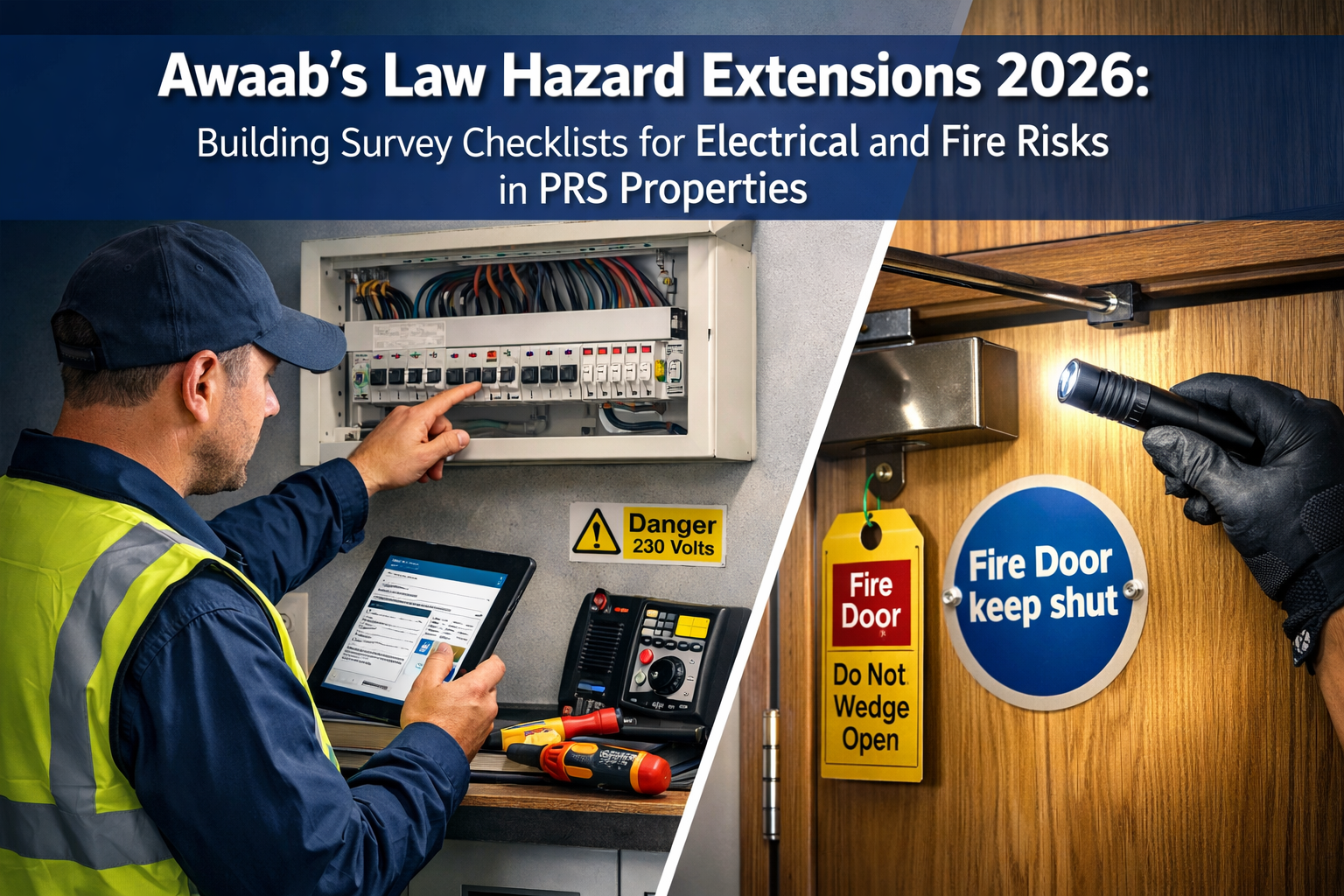
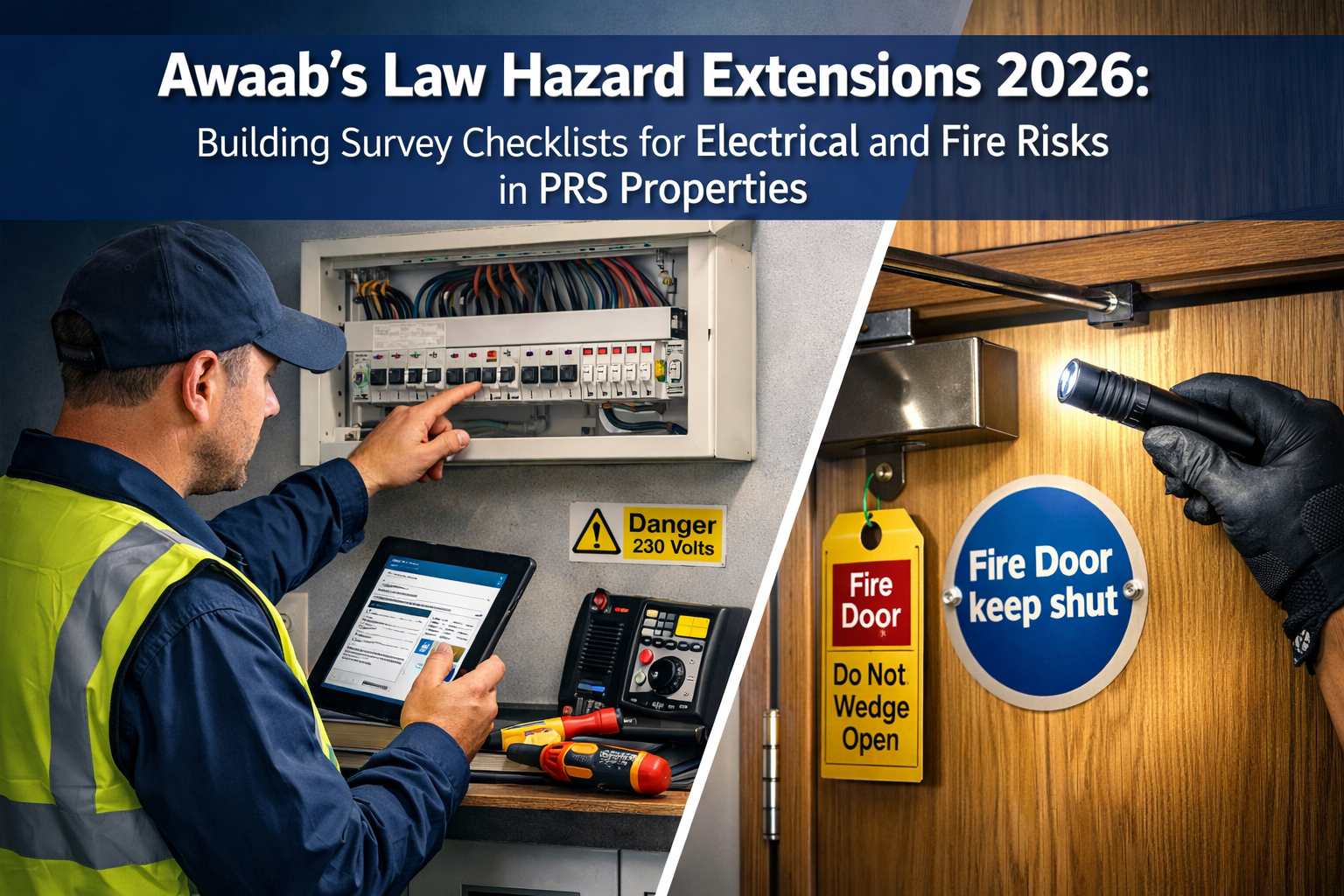
Over 40% of electrical fires in UK rental properties originate from faulty consumer units and outdated wiring systems that landlords failed to identify during routine inspections. As Awaab's Law Phase 2 expands hazard categories in 2026, building surveyors face unprecedented responsibility for detecting electrical faults and fire risks that could trigger 15-day compliance deadlines and potential legal action.
The Awaab's Law Hazard Extensions 2026: Building Survey Checklists for Electrical and Fire Risks in PRS Properties represent a fundamental shift in how private rental sector (PRS) landlords and surveyors approach property safety. While Phase 1 focused exclusively on damp and mould hazards, Phase 2 introduces comprehensive coverage of electrical hazards, fire risks, structural collapse, falls, and temperature extremes.[1][2] For building surveyors, this expansion demands refined inspection protocols, enhanced documentation standards, and preparation for expert witness testimony in enforcement proceedings.
Key Takeaways
- Phase 2 implementation in 2026 expands Awaab's Law to cover electrical hazards, fire risks, falls, structural collapse, and temperature extremes with 15-day response requirements[2][5]
- Fire doors identified as hazards must be replaced within 15 days under new compliance standards, requiring immediate surveyor action protocols[5]
- Building surveyors must develop specialized checklists for electrical safety inspections including consumer unit assessments, circuit testing, and fire safety equipment verification
- Expert witness preparation becomes essential as surveyors may be called to provide testimony on hazard identification and landlord compliance failures
- Documentation standards must meet legal scrutiny with photographic evidence, technical measurements, and detailed hazard classification aligned with Housing Health and Safety Rating System (HHSRS)
Understanding Awaab's Law Phase 2: Expanded Hazard Categories for 2026
Awaab's Law Phase 2 represents a significant expansion of landlord obligations beyond the initial damp and mould focus. Expected to come into force during 2026, Phase 2 introduces five additional hazard categories that building surveyors must systematically assess during property inspections.[1][2]
The New Hazard Categories
The Phase 2 expansion specifically includes:
- Electrical hazards: Faulty wiring, inadequate earthing, overloaded circuits, damaged consumer units
- Fire risks: Non-compliant fire doors, missing smoke alarms, blocked escape routes, combustible materials
- Excess cold and heat: Inadequate heating systems, poor insulation, ventilation failures
- Falls hazards: Unsafe stairs, defective baths, uneven floor surfaces, inadequate lighting
- Structural collapse and explosions: Compromised load-bearing elements, gas safety failures[2][4]
Each category carries a 15-day response timeframe for hazards requiring immediate attention, compared to the 24-hour emergency standard established in Phase 1.[5] This creates distinct inspection urgency levels that surveyors must communicate clearly to landlords and property managers.
Timeline and Compliance Expectations
While Phase 1 took effect on 30 March 2025 for social housing providers, Phase 2's 2026 implementation will extend these requirements across the private rental sector.[1] The staggered rollout allows landlords time to update their governance frameworks, but surveyors should begin implementing enhanced inspection protocols immediately.
Professional building surveyors must understand that Phase 2 compliance isn't merely about identifying hazards—it requires documented evidence that meets legal standards for potential enforcement proceedings. This shifts the surveyor's role from advisory to quasi-forensic, with inspection reports potentially serving as evidence in tenant complaints or regulatory actions.
Integration with Fire Safety Regulations
Phase 2 operates alongside The Fire Safety (Residential Evacuation Plans) (England) Regulations 2025, which take effect on 6 April 2026.[4] These regulations require person-centred fire risk assessments (PEEPs) in specified residential buildings, creating overlapping compliance obligations that surveyors must navigate.
The convergence of Awaab's Law Phase 2 and fire safety regulations means that building inspection protocols must address both general fire hazards under Awaab's Law and specific evacuation planning requirements under separate fire safety legislation. Surveyors conducting comprehensive assessments should coordinate these requirements into unified inspection checklists.
Awaab's Law Hazard Extensions 2026: Building Survey Checklists for Electrical Risks in PRS Properties
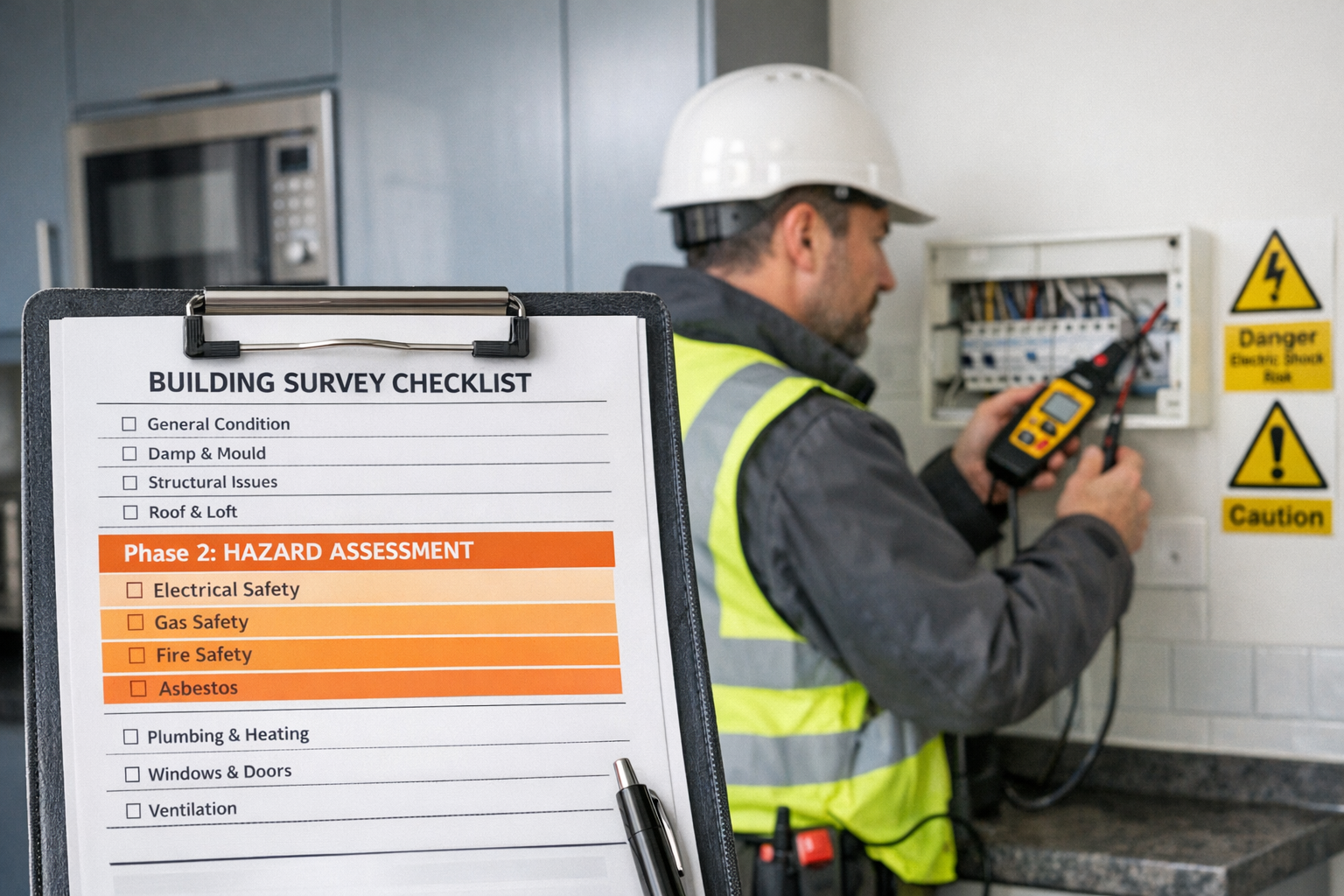
Electrical hazards represent one of the most technically demanding aspects of Phase 2 compliance. Unlike visible structural issues, electrical faults often remain hidden within walls, consumer units, and distribution systems. Building surveyors must develop systematic inspection protocols that identify both obvious defects and latent hazards requiring specialist electrical testing.
Essential Electrical Safety Inspection Checklist
A comprehensive electrical hazard assessment for PRS properties should include:
Consumer Unit Assessment ⚡
- Check for modern RCD (Residual Current Device) protection on all circuits
- Verify consumer unit meets current BS 7671 wiring regulations
- Inspect for signs of overheating, burning, or melted components
- Confirm adequate circuit labelling and documentation
- Assess location compliance (not in bathrooms or under stairs where moisture risk exists)
Visible Wiring Inspection 🔌
- Examine socket outlets for cracks, scorch marks, or loose fittings
- Check light fittings for secure mounting and appropriate IP ratings in wet areas
- Identify extension lead dependency indicating insufficient socket provision
- Assess cable routing for damage risk from doors, furniture, or foot traffic
- Verify appropriate cable types for location (outdoor-rated cables for external use)
Earthing and Bonding Verification 🔧
- Confirm main earthing conductor presence and adequate sizing
- Check supplementary bonding in bathrooms and kitchens
- Verify earth connections at consumer unit and distribution boards
- Assess condition of earth clamps and connections
Electrical Installation Condition Report (EICR) Review 📋
- Verify current EICR exists and remains within 5-year validity period
- Review any C1 (danger present) or C2 (potentially dangerous) observations
- Confirm landlord has addressed previous recommendations
- Check inspection was conducted by qualified electrician with appropriate registration
Identifying Category 1 vs Category 2 Electrical Hazards
Under the Housing Health and Safety Rating System (HHSRS), electrical hazards are classified based on severity and likelihood of harm. Surveyors must distinguish between:
Category 1 Hazards (requiring immediate action):
- Exposed live conductors accessible to occupants
- Consumer units showing signs of fire damage or overheating
- Missing RCD protection on circuits serving sockets and bathrooms
- Damaged cables presenting immediate shock risk
Category 2 Hazards (requiring remedial action within reasonable timeframe):
- Outdated consumer units without adequate circuit protection
- Insufficient socket provision leading to extension lead overuse
- Minor wiring defects not presenting immediate danger
- Missing or inadequate earthing in low-risk areas
The 15-day response timeframe under Phase 2 applies to Category 1 electrical hazards, making accurate classification critical for compliance.[5] Surveyors should document their hazard categorization rationale with photographic evidence and technical justification.
When to Recommend Specialist Electrical Testing
Visual inspection alone cannot identify all electrical hazards. Surveyors should recommend specialist electrical testing when:
- No valid EICR exists or previous report is over 5 years old
- Property has undergone significant electrical alterations without certification
- Visual inspection reveals concerning indicators (frequent circuit breaker trips, flickering lights, burning smells)
- Property contains older wiring systems (rubber-insulated cables, aluminum conductors)
- Landlord cannot provide electrical installation certificates for recent work
Professional expert building evaluation requires surveyors to recognize the limits of their competence. While surveyors can identify obvious electrical defects, comprehensive electrical safety assessment requires qualified electricians with specialized testing equipment.
Documentation Standards for Electrical Hazard Reporting
Electrical hazard documentation must meet legal standards for potential enforcement proceedings. Each identified hazard should include:
- Precise location description (room, circuit, specific outlet or fitting)
- Photographic evidence showing the defect from multiple angles
- Hazard classification (Category 1 or 2 under HHSRS)
- Likelihood and severity assessment explaining potential harm
- Recommended remedial action with specific technical requirements
- Compliance deadline based on hazard category and Phase 2 timeframes
- Reference to relevant standards (BS 7671, EICR recommendations)
This documentation standard ensures that surveyor reports can withstand scrutiny in tenant complaints, local authority enforcement actions, or legal proceedings where the surveyor may serve as expert witness.
Fire Risk Assessment Protocols Under Awaab's Law Hazard Extensions 2026
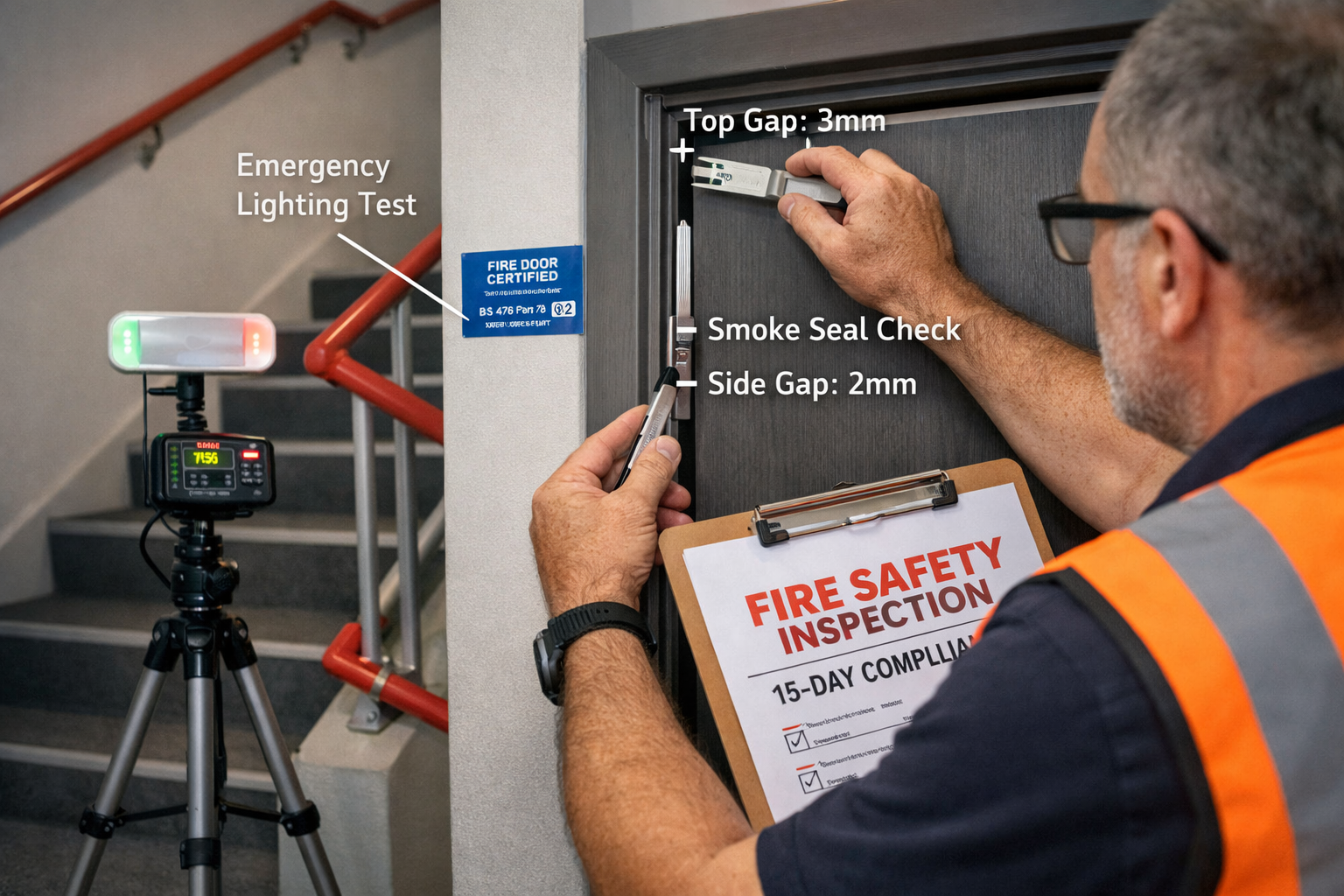
Fire hazards under Phase 2 require distinct assessment protocols that complement but differ from formal Fire Risk Assessments conducted under the Regulatory Reform (Fire Safety) Order 2005. Building surveyors must understand the specific fire hazards covered by Awaab's Law and develop inspection checklists that identify defects triggering the 15-day replacement requirement.[5]
Fire Door Inspection Checklist
Fire doors represent a critical fire safety element explicitly mentioned in Phase 2 guidance. Doors identified as hazards must be replaced within 15 days, making thorough inspection essential.[5]
Fire Door Integrity Assessment 🚪
- Verify fire door certification label presence and legibility (FD30 or FD60 rating)
- Check door leaf condition for cracks, holes, or delamination
- Inspect intumescent strips for completeness and proper installation
- Assess smoke seal condition and continuous coverage around door frame
- Verify door closer functionality with appropriate closing force and latching
- Check gaps around door perimeter (maximum 3mm on sides and top, 8mm at threshold)
- Examine glazing for fire-rated glass with appropriate certification
- Assess frame condition and secure fixing to wall structure
Common Fire Door Defects Triggering Replacement ❌
- Missing or damaged intumescent strips compromising fire resistance
- Excessive gaps allowing smoke passage
- Non-functional door closers preventing proper latching
- Damaged door leaf with structural compromise
- Inappropriate modifications (letter boxes, non-fire-rated glazing)
- Missing or illegible certification labels preventing verification
Surveyors should use gap measurement tools (typically feeler gauges) to objectively document excessive gaps rather than relying on visual estimation. This provides defensible evidence if landlord disputes replacement necessity.
Smoke and Carbon Monoxide Alarm Verification
While smoke alarm requirements exist under separate regulations (Smoke and Carbon Monoxide Alarm (England) Regulations 2015), Phase 2 fire hazard assessment should verify:
- Smoke alarm presence in every floor level including basements
- Carbon monoxide alarm installation in rooms with solid fuel burning appliances
- Alarm functionality through test button operation
- Appropriate alarm positioning (ceiling-mounted, away from corners and air vents)
- Alarm age and replacement date (typically 10-year lifespan for modern alarms)
- Interconnection between alarms where required in larger properties
Deficient alarm provision constitutes a fire hazard under Phase 2, though typically classified as Category 2 unless combined with other fire safety defects creating imminent risk.
Escape Route Assessment
Fire escape route evaluation forms part of comprehensive fire hazard assessment:
Internal Escape Routes 🏃
- Verify clear, unobstructed paths from all habitable rooms to final exits
- Assess travel distances against guidance (typically 18m for flats with single escape route)
- Check corridor and stairwell width adequacy (minimum 750mm)
- Verify emergency lighting provision in common areas without natural light
- Inspect floor surface condition for trip hazards along escape routes
- Confirm final exit doors open in direction of escape and operate without keys
External Considerations 🔥
- Assess external wall construction materials for combustibility concerns
- Check for combustible materials stored near escape routes or building exterior
- Verify external escape routes remain clear and accessible
- Examine balconies and external stairs for structural integrity
Properties with complex layouts or multiple occupation may require formal Fire Risk Assessment by competent fire safety professionals. Surveyors should recognize when fire hazard complexity exceeds their scope and recommend specialist assessment.
Fire Safety Equipment and Installations
Beyond doors and alarms, fire hazard assessment should include:
- Fire blanket provision in kitchens (though not mandatory, absence may constitute hazard in high-risk properties)
- Fire extinguisher presence and maintenance in common areas of HMOs
- Electrical installation fire safety (covered under electrical hazard assessment but relevant to fire risk)
- Gas appliance safety with current Gas Safety Certificate verification
- Combustible material storage particularly in common areas and escape routes
Coordinating with Fire Safety (Residential Evacuation Plans) Regulations
The Fire Safety (Residential Evacuation Plans) (England) Regulations 2025 take effect on 6 April 2026, requiring person-centred evacuation plans in specified residential buildings.[4] While these regulations apply to buildings with specific characteristics (typically higher-risk residential buildings), surveyors should understand the overlap:
- Awaab's Law Phase 2 addresses physical fire hazards in the property
- PEEP regulations address evacuation planning for vulnerable residents
Buildings requiring PEEPs will need both physical hazard remediation under Awaab's Law and documented evacuation procedures under fire safety regulations. Surveyors conducting assessments in potentially affected buildings should flag this dual compliance requirement to landlords.
Fire Hazard Documentation Requirements
Fire hazard reporting must include:
- Specific defect identification with precise location and nature of hazard
- Photographic evidence showing fire door gaps, missing seals, blocked escape routes
- Measurement data for door gaps, travel distances, corridor widths
- Hazard severity classification explaining fire spread or escape impediment risk
- Regulatory reference citing relevant fire safety standards and Awaab's Law requirements
- Remedial specification detailing required repairs or replacements
- Compliance deadline (15 days for fire door replacement, appropriate timeframe for other hazards)[5]
This documentation standard ensures landlords understand their obligations and provides evidence for enforcement if compliance fails.
Developing Comprehensive PRS Property Survey Protocols for Phase 2 Compliance
The expansion of Awaab's Law hazard categories requires building surveyors to develop enhanced inspection protocols that systematically address all Phase 2 hazards while maintaining efficiency and commercial viability. Professional surveyors must balance thoroughness with practical time constraints, creating standardized checklists that ensure consistent hazard identification across diverse property types.
Integrated Survey Approach
Rather than conducting separate inspections for each hazard category, efficient surveyors develop integrated protocols that address multiple hazard types during single property visits:
Pre-Inspection Preparation 📝
- Review property documentation (previous survey reports, EICRs, Gas Safety Certificates)
- Identify property characteristics affecting hazard likelihood (age, construction type, previous issues)
- Prepare specialized equipment (gap gauges, moisture meters, electrical testing indicators)
- Confirm inspection scope with client (comprehensive Phase 2 assessment vs. targeted inspection)
Systematic Room-by-Room Inspection Sequence 🏠
- External assessment: Structural condition, fire safety, access/egress
- Common areas: Escape routes, fire doors, lighting, structural elements
- Individual rooms: Electrical installations, heating provision, fall hazards, fire safety
- Service areas: Consumer units, boilers, water systems, ventilation
This systematic approach ensures no areas are overlooked while minimizing duplicate visits to the same spaces.
Hazard Classification and Prioritization
Surveyors must apply consistent HHSRS methodology to classify identified hazards:
| Hazard Category | Likelihood Assessment | Severity Assessment | Response Timeframe |
|---|---|---|---|
| Category 1 | High probability of harm | Serious harm or death | 15 days (Phase 2)[5] |
| Category 2 | Lower probability | Moderate harm | Reasonable timeframe |
| Emergency | Imminent danger | Immediate serious harm | 24 hours (Phase 1 standard) |
The 15-day response requirement for Phase 2 Category 1 hazards creates clear compliance deadlines that surveyors must communicate explicitly in their reports.[5]
Technology Integration for Enhanced Documentation
Modern surveying practice increasingly incorporates technology to improve documentation quality and efficiency:
- Digital inspection apps with pre-loaded Phase 2 checklists ensuring consistent coverage
- Photographic annotation tools allowing on-site hazard marking and measurement overlay
- Cloud-based reporting systems enabling real-time report generation and client access
- Thermal imaging cameras identifying electrical hotspots and insulation defects
- Moisture meters providing objective damp measurements beyond visual assessment
These technologies enhance documentation defensibility, particularly important given potential expert witness requirements in enforcement proceedings.
Quality Assurance and Peer Review
Given the legal implications of Phase 2 hazard identification, professional surveying practices should implement quality assurance protocols:
- Standardized checklist templates ensuring consistent hazard coverage across different surveyors
- Peer review processes for complex or high-value assessments
- Continuing professional development on Phase 2 requirements and hazard identification methodology
- Professional indemnity insurance review ensuring adequate coverage for expanded hazard assessment scope
Surveyors operating through professional practices should consult resources on what surveyors do to ensure their service offerings align with current regulatory expectations.
Expert Witness Preparation: Surveyors' Role in Awaab's Law Enforcement
As Awaab's Law Phase 2 enforcement begins, building surveyors will increasingly serve as expert witnesses in proceedings involving landlord non-compliance, tenant complaints, and local authority enforcement actions. This role requires distinct preparation beyond standard inspection competence, demanding rigorous documentation standards and ability to defend professional opinions under cross-examination.
Understanding the Expert Witness Role
Expert witnesses provide independent professional opinion to assist courts or tribunals in understanding technical matters beyond lay knowledge. For Awaab's Law cases, surveyors may be called to provide evidence on:
- Hazard identification and classification: Whether observed conditions constitute Category 1 or 2 hazards
- Landlord compliance: Whether remedial actions met required standards and timeframes
- Causation: Whether identified hazards caused or contributed to tenant harm
- Remedial specifications: What actions were reasonably required to address hazards
- Industry standards: What competent landlords and surveyors should have identified and addressed
The expert witness owes primary duty to the court or tribunal rather than the instructing party, requiring objectivity even when engaged by landlords or tenants.
Documentation Standards for Expert Witness Testimony
Survey reports potentially serving as evidence must meet enhanced documentation standards:
Comprehensive Photographic Evidence 📸
- Multiple angles of each identified hazard
- Scale references (measuring tape, coins) for size context
- Wide shots showing hazard location within room/property
- Close-ups showing specific defects (door gaps, damaged wiring, structural cracks)
- Metadata preservation showing date, time, and location of photographs
Detailed Written Descriptions ✍️
- Precise measurements using calibrated equipment
- Technical terminology with explanations accessible to non-specialists
- Reference to relevant standards and regulations
- Clear distinction between observed facts and professional opinion
- Explanation of methodology used for hazard assessment
Audit Trail Documentation 📋
- Records of inspection date, time, duration, and attendees
- Weather conditions affecting inspection (relevant for damp, ventilation assessments)
- Access limitations or areas not inspected
- Information sources (landlord statements, previous reports, tenant complaints)
- Qualifications and experience of surveyor conducting assessment
This documentation standard ensures survey reports withstand legal scrutiny and provide foundation for expert testimony.
Preparing Expert Witness Reports
When engaged as expert witness, surveyors must prepare formal expert reports complying with Civil Procedure Rules (CPR Part 35) or equivalent tribunal requirements:
Essential Report Components:
- Surveyor qualifications and experience demonstrating competence in relevant hazard assessment
- Instructions received explaining scope of expert engagement
- Inspection details documenting site visits and information reviewed
- Factual findings describing observed conditions objectively
- Professional opinion on hazard classification, compliance, and causation
- Regulatory context explaining applicable standards and requirements
- Expert declaration confirming duty to court and opinion basis
- Statement of truth certifying report accuracy
Expert reports differ from standard survey reports in formality, structure, and explicit separation of fact from opinion. Surveyors transitioning to expert witness work should seek specialized training in expert report preparation and court procedures.
Courtroom Testimony Preparation
Expert witnesses may be required to provide oral testimony, defending their written reports under cross-examination. Effective preparation includes:
- Report familiarity: Thorough knowledge of all report content and supporting documentation
- Site visit recollection: Ability to recall specific inspection details months or years after assessment
- Standards knowledge: Comprehensive understanding of HHSRS, Phase 2 requirements, and relevant technical standards
- Alternative interpretations: Consideration of different professional opinions on hazard classification
- Communication skills: Ability to explain technical matters clearly to non-specialist audiences
Surveyors should anticipate challenges to their methodology, qualifications, and opinions, preparing reasoned responses that demonstrate professional competence without defensiveness.
Professional Indemnity and Expert Witness Work
Expert witness work carries distinct liability considerations from standard surveying services. Surveyors should:
- Verify professional indemnity coverage includes expert witness activities
- Maintain detailed contemporaneous records of all expert engagements
- Ensure compliance with professional body guidance (RICS Practice Statement on expert witness work)
- Consider separate terms of engagement for expert witness instructions
- Maintain independence from commercial pressures affecting opinion formation
The expert witness role represents natural evolution of professional surveying practice as Awaab's Law enforcement intensifies. Surveyors developing expertise in Phase 2 hazard assessment position themselves as valuable resources for legal proceedings while contributing to improved rental sector safety standards.
For surveyors seeking to understand broader property evaluation contexts, integrating Phase 2 compliance into comprehensive assessment frameworks enhances service value and professional standing.
Regional Considerations and Local Authority Enforcement Approaches
Awaab's Law enforcement occurs through local authority environmental health departments, creating potential regional variation in interpretation and enforcement priorities. Building surveyors operating across multiple jurisdictions should understand these variations while maintaining consistent professional standards.
Local Authority Enforcement Powers
Under Phase 2, local authorities can:
- Issue improvement notices requiring hazard remediation within specified timeframes
- Impose prohibition orders preventing property use until hazards are addressed
- Prosecute landlords for non-compliance with improvement notices
- Conduct inspections following tenant complaints or proactive enforcement programs
- Require documentation demonstrating hazard assessment and remediation
Surveyors should understand that their inspection reports may trigger or inform local authority enforcement actions, particularly when tenants submit survey evidence supporting complaints.
Regional Housing Market Variations
Different regional markets present distinct Phase 2 compliance challenges:
London and Southeast 🏙️
- Older housing stock with higher prevalence of outdated electrical systems
- Higher proportion of HMOs requiring enhanced fire safety measures
- Greater tenant awareness and complaint likelihood
- Higher property values affecting remediation cost-benefit calculations
Areas like Hammersmith, Chelsea, and Battersea demonstrate these characteristics with significant PRS sectors requiring Phase 2 compliance.
Suburban and Outer London 🏘️
- Mix of older and newer housing stock
- Growing PRS sector with varied landlord sophistication
- Increasing local authority enforcement capacity
Locations including Wembley, Croydon, and Enfield represent these mixed markets.
Essex and Outer Metropolitan Areas 🌳
- Significant PRS growth in commuter towns
- Varied property ages and construction types
- Emerging enforcement frameworks
Areas like Brentwood, Loughton, and Upminster demonstrate these characteristics.
Surveyors should adapt their communication and recommendations to reflect regional market conditions while maintaining consistent hazard identification standards.
Building Relationships with Local Authority Teams
Professional surveyors benefit from constructive relationships with local authority environmental health teams:
- Understanding local interpretation of Phase 2 requirements and enforcement priorities
- Clarifying borderline cases where hazard classification remains uncertain
- Coordinating on complex properties requiring multiple specialist assessments
- Contributing to local guidance development through professional body engagement
These relationships enhance surveyor effectiveness while supporting consistent enforcement approaches benefiting tenants and responsible landlords.
Practical Implementation: Landlord Obligations and Surveyor Advisory Role
Building surveyors serve critical advisory roles helping landlords understand and implement Phase 2 compliance requirements. This extends beyond hazard identification to include remediation planning, contractor coordination, and ongoing compliance monitoring.
Landlord Compliance Framework
Social landlords must update internal governance frameworks before Phase 2 implementation, establishing documented workflows for hazard notifications, investigations, and repair actions.[3] While private landlords face less prescriptive governance requirements, surveyors should recommend similar systematic approaches:
Hazard Management Workflow 🔄
- Hazard reporting mechanism: Clear process for tenants to report concerns
- Initial assessment protocol: Surveyor inspection within defined timeframe
- Hazard classification: HHSRS-based categorization determining response urgency
- Remediation planning: Contractor engagement and repair specification
- Completion verification: Post-repair inspection confirming hazard elimination
- Documentation retention: Comprehensive records demonstrating compliance
Surveyors advising landlords should emphasize that documented compliance processes provide defense against enforcement actions, demonstrating reasonable diligence even if hazards occasionally arise.
Remediation Specification and Contractor Coordination
Identifying hazards represents only the first step—surveyors often provide remediation specifications ensuring repairs meet required standards:
Electrical Hazard Remediation ⚡
- Specification of required electrical work (consumer unit replacement, circuit upgrades, earthing improvements)
- Qualification requirements for contractors (NICEIC or equivalent registration)
- Certification requirements (Electrical Installation Certificate for new work, Minor Works Certificate for alterations)
- Post-completion verification inspection
Fire Hazard Remediation 🔥
- Fire door replacement specifications (FD30 or FD60 rating, complete intumescent strip installation)
- Smoke alarm system design (interconnected alarms, appropriate positioning)
- Escape route modifications (door swing direction, emergency lighting installation)
- Certification requirements (fire door installation certificates, alarm commissioning records)
Surveyors providing remediation specifications should ensure recommendations are proportionate to identified hazards, avoiding gold-plating while ensuring genuine compliance.
Ongoing Compliance Monitoring
Phase 2 compliance isn't one-time activity—surveyors should advise landlords on ongoing monitoring:
- Annual electrical safety inspections supplementing 5-yearly EICR requirements
- Six-monthly fire safety checks verifying door condition, alarm functionality, escape route clarity
- Tenant move-in/move-out inspections identifying new hazards or tenant-caused damage
- Post-repair verification confirming remediation effectiveness
This proactive approach minimizes enforcement risk while protecting tenant safety—the fundamental purpose of Awaab's Law.
For landlords considering property acquisitions, understanding Phase 2 implications affects investment decisions. Resources on renegotiating after poor survey results become increasingly relevant as Phase 2 hazards affect property values and transaction negotiations.
Integration with Broader Property Assessment Frameworks
Awaab's Law Phase 2 compliance integrates with broader property assessment frameworks that building surveyors already employ. Understanding these connections enhances service value and ensures comprehensive property evaluation.
RICS Survey Standards and Phase 2 Hazards
Royal Institution of Chartered Surveyors (RICS) survey levels incorporate hazard identification:
- RICS Level 2 (HomeBuyer Report): Identifies visible defects and potential hazards requiring further investigation
- RICS Level 3 (Building Survey): Comprehensive assessment including detailed hazard analysis
- Condition surveys: Focus on building element condition with hazard implications
Surveyors conducting RICS surveys should explicitly address Phase 2 hazard categories, ensuring clients understand compliance implications. Those seeking to understand why to choose RICS surveyors should recognize that professional standards increasingly incorporate regulatory compliance assessment.
Damp and Timber Surveys
Phase 1's damp and mould focus created overlap with traditional damp and timber surveys. Phase 2 electrical and fire hazard assessment similarly connects with specialist surveys:
- Electrical condition reports: Detailed electrical safety assessment complementing visual inspection
- Fire risk assessments: Formal fire safety evaluation for complex or high-risk properties
- Structural surveys: Comprehensive evaluation including collapse and explosion hazards
Surveyors should coordinate these specialist assessments, ensuring comprehensive hazard coverage without unnecessary duplication. Resources on damp survey costs and damp and timber report pricing remain relevant as landlords seek cost-effective compliance solutions.
Leasehold Property Considerations
Leasehold properties present distinct Phase 2 compliance challenges regarding responsibility allocation:
- Common area hazards: Typically freeholder/management company responsibility
- Individual flat hazards: Typically leaseholder responsibility (though landlord obligations apply if property is let)
- Shared systems: Electrical distribution, fire safety systems requiring coordinated approach
Surveyors assessing leasehold properties should clearly identify responsibility for each hazard, referencing lease terms and statutory obligations. Those examining what to check before buying leasehold property should incorporate Phase 2 compliance into their evaluation framework.
Commercial Property and Mixed-Use Buildings
While Awaab's Law primarily targets residential properties, mixed-use buildings require careful assessment of which areas fall under Phase 2 requirements:
- Residential elements: Full Phase 2 compliance required
- Commercial elements: Subject to different regulatory frameworks (Workplace regulations, Fire Safety Order)
- Common areas: Compliance requirements depend on building use and occupancy
Surveyors working on mixed-use properties should clearly delineate applicable regulatory frameworks for different building areas, ensuring landlords understand their varied obligations.
Conclusion: Preparing for the Phase 2 Compliance Landscape
The Awaab's Law Hazard Extensions 2026 represent a fundamental shift in private rental sector safety standards, expanding beyond damp and mould to encompass electrical hazards, fire risks, structural concerns, and temperature extremes. For building surveyors, this expansion demands enhanced inspection protocols, rigorous documentation standards, and preparation for expert witness roles in enforcement proceedings.
Key implementation priorities for surveyors include:
✅ Develop comprehensive Phase 2 checklists integrating electrical, fire, falls, structural, and temperature hazard assessment into systematic inspection protocols
✅ Enhance documentation standards with detailed photographic evidence, precise measurements, and clear hazard classification supporting potential legal scrutiny
✅ Establish specialist coordination frameworks recognizing when electrical testing, fire risk assessment, or structural evaluation requires qualified specialists beyond surveyor competence
✅ Prepare for expert witness roles through enhanced report writing, evidence preservation, and professional development in legal testimony procedures
✅ Advise landlords proactively on compliance frameworks, remediation specifications, and ongoing monitoring protocols minimizing enforcement risk
✅ Integrate Phase 2 requirements into existing RICS survey standards, specialist assessments, and property transaction advice
The 15-day response timeframe for Category 1 hazards creates urgency that surveyors must communicate clearly to landlords and property managers.[5] Fire doors identified as hazards must be replaced within this compressed timeline, demanding immediate action protocols and contractor coordination.[5]
As Phase 2 implementation approaches during 2026, surveyors who develop specialized expertise in electrical and fire hazard assessment position themselves as essential advisors in the evolving rental sector landscape. This expertise extends beyond technical competence to include regulatory knowledge, documentation rigor, and ability to support landlords through complex compliance challenges.
The ultimate goal of Awaab's Law—preventing tragic deaths like Awaab Ishak's from hazardous housing conditions—depends on professional surveyors identifying risks that landlords might overlook or minimize. By embracing enhanced assessment protocols and expert witness responsibilities, building surveyors contribute directly to improved tenant safety while building professional practices aligned with 2026's regulatory landscape.
Next Steps for Building Surveyors
- Review and update inspection checklists incorporating all Phase 2 hazard categories with specific assessment criteria
- Invest in specialized equipment including gap gauges, thermal imaging cameras, and electrical testing indicators
- Pursue continuing professional development on HHSRS methodology, Phase 2 requirements, and expert witness procedures
- Establish specialist networks with qualified electricians, fire safety consultants, and structural engineers for complex assessments
- Review professional indemnity insurance ensuring adequate coverage for expanded hazard assessment scope and expert witness work
- Develop client communication materials explaining Phase 2 implications, compliance timeframes, and remediation requirements
For professional surveying services incorporating Awaab's Law Phase 2 compliance assessment, contact experienced building surveyors who understand the evolving regulatory landscape and can provide comprehensive hazard evaluation meeting legal standards.
References
[1] Awaabs Law Timeline – https://www.glplaw.com/2026/01/23/awaabs-law-timeline/
[2] Awaabs Law Is Here The Surveyors Guide For Compliance – https://www.surventrix.com/blog/awaabs-law-is-here-the-surveyors-guide-for-compliance
[3] Awaabs Law Explained – https://firntec.com/blog/awaabs-law-explained
[4] Awaabs Law Comes Into Force What Does It Mean For Construction – https://www.trowers.com/insights/2025/november/awaabs-law-comes-into-force-what-does-it-mean-for-construction
[5] The Key Changes In 2026 That You Need To Be Aware Of – https://selo.global/the-key-changes-in-2026-that-you-need-to-be-aware-of/
[6] Awaabs Law Phase 2 What It Covers And What Housing Providers Should Be Doing Now – https://www.madetech.com/blog/awaabs-law-phase-2-what-it-covers-and-what-housing-providers-should-be-doing-now/