The tragic death of two-year-old Awaab Ishak from prolonged mould exposure in 2020 sparked legislative change that now extends far beyond damp and mould. As of 2026, approximately 4.6 million privately rented homes across England face sweeping new obligations under the expanded Awaab's Law framework, with fire and electrical hazards joining the list of critical safety concerns that landlords must address within strict timelines.[4] This expansion represents the most significant shift in private rental sector (PRS) compliance requirements in decades, demanding robust building survey protocols to identify and document hazards before they become emergencies.
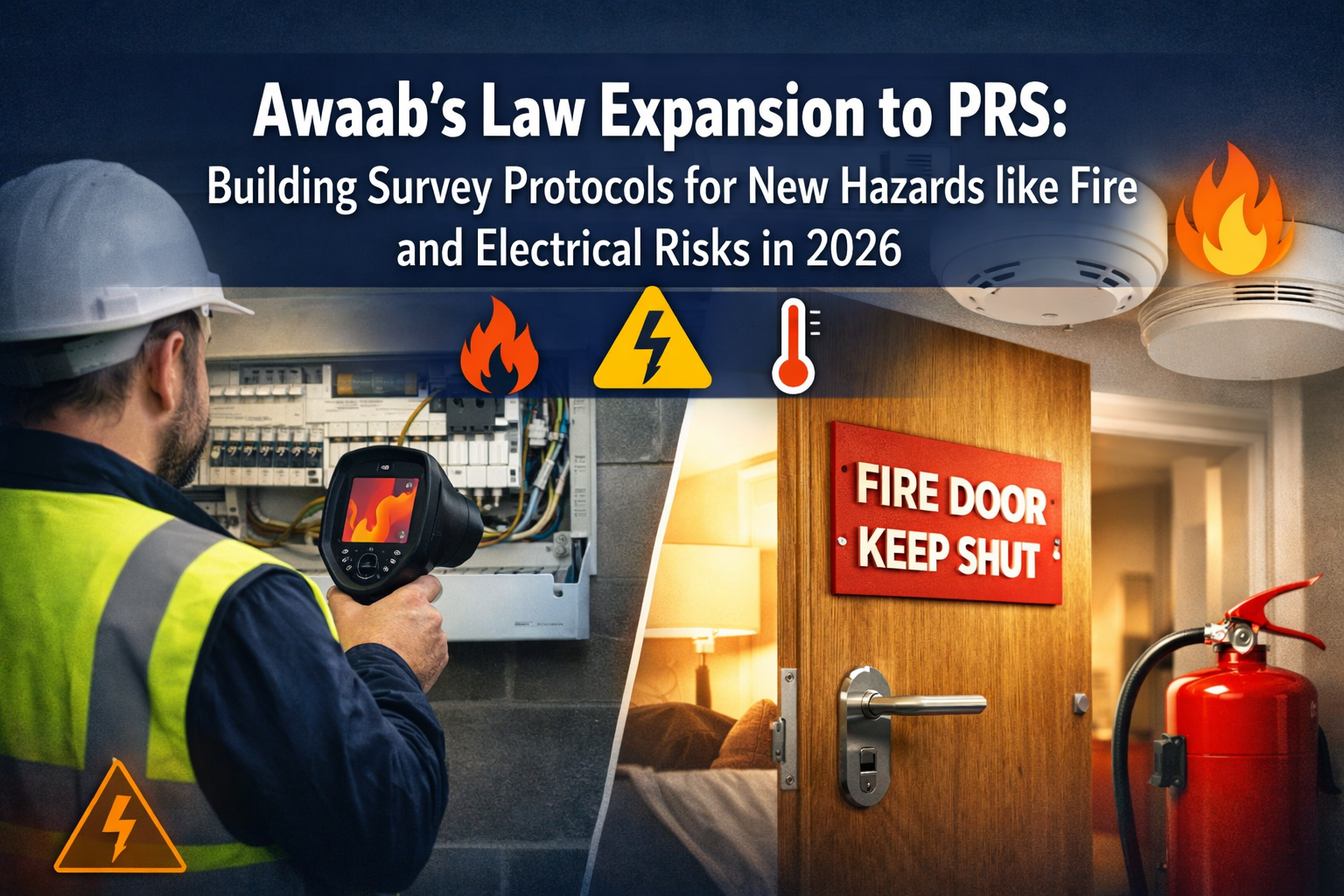
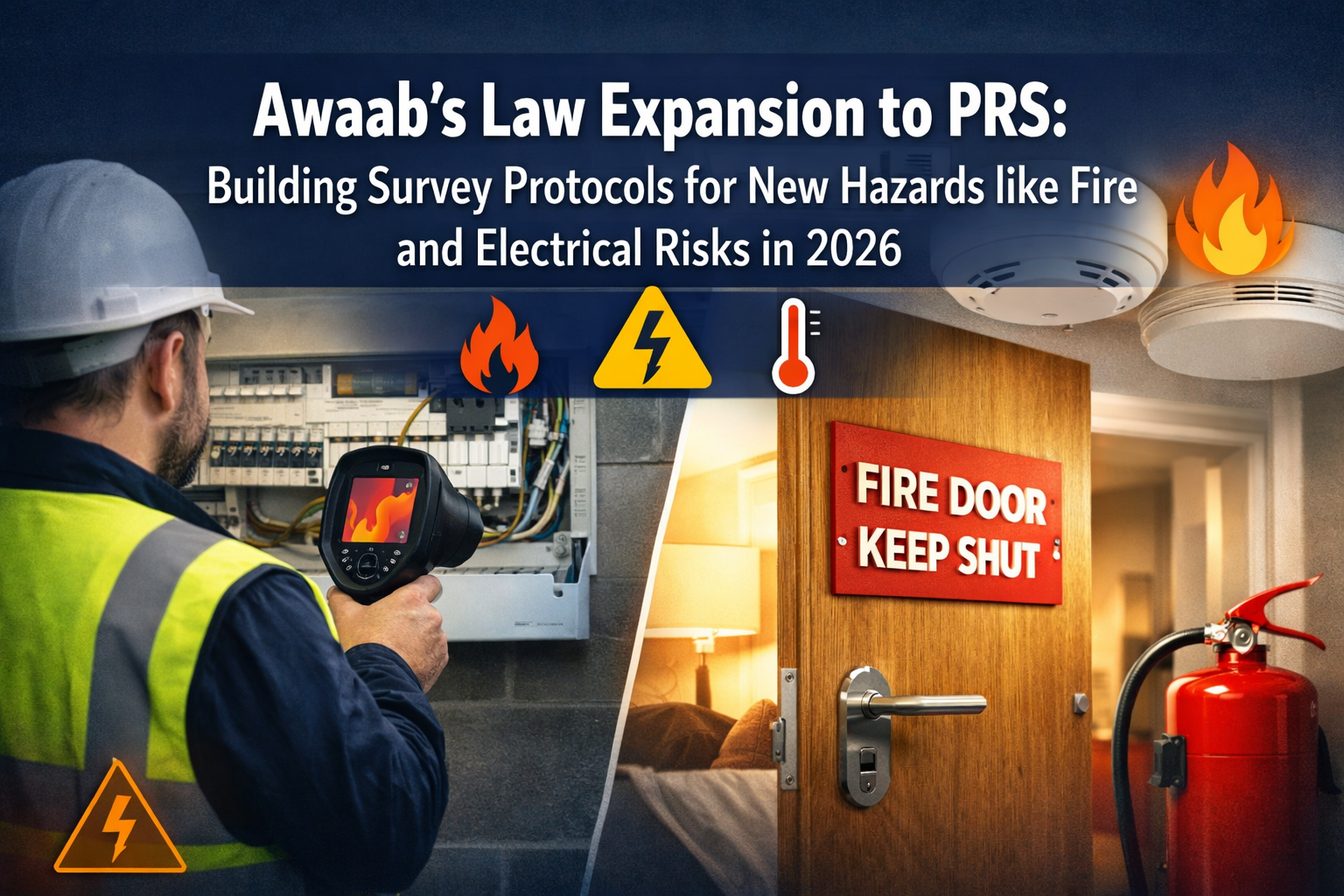
Understanding Awaab's Law Expansion to PRS: Building Survey Protocols for New Hazards like Fire and Electrical Risks in 2026 is essential for landlords, property managers, and building surveyors navigating this regulatory landscape. The legislation now mandates emergency repairs within 24 hours for life-threatening hazards, fundamentally changing how rental properties must be assessed, monitored, and maintained.[1]
Key Takeaways
✅ Phase 3 implementation extends Awaab's Law to all private rental properties from October 2026, covering fire, electrical, temperature, and structural hazards
⚡ Emergency repair timeline requires landlords to complete critical repairs within 24 hours of investigation completion, with initial investigations due within 10 working days
🔍 Comprehensive survey protocols must now assess seven hazard categories including unsafe wiring, fire door failures, excess cold/heat, and structural collapse risks
📋 Level 3 surveys provide the detailed assessment framework necessary for landlords to identify compliance gaps and prioritize remedial works
🏠 4.6 million private rental homes will be subject to these enhanced safety standards, requiring systematic inspection approaches
Understanding the Expanded Scope of Awaab's Law in 2026
From Damp and Mould to Comprehensive Hazard Management
Awaab's Law initially focused on damp and mould hazards when it came into force for social housing in 2023. However, the 2026 expansion represents a fundamental shift in scope and ambition. Phase 2, which began in early 2026 for social housing landlords, introduced six additional hazard categories that now fall under the same strict repair timelines.[1][4]
The expanded hazards include:
- Fire hazards 🔥 – Non-compliant fire doors, inadequate detection systems, blocked escape routes
- Electrical hazards ⚡ – Unsafe wiring, faulty circuits, non-compliant installations
- Excess cold ❄️ – Inadequate heating systems, poor insulation, thermal deficiencies
- Excess heat 🌡️ – Insufficient ventilation, overheating risks, inadequate cooling
- Structural collapse risks 🏚️ – Foundation issues, load-bearing defects, deterioration
- Falls on stairs and surfaces 🪜 – Unsafe staircases, trip hazards, inadequate handrails
- Domestic hygiene issues 🧹 – Pest infestations, sewage problems, sanitation failures
This comprehensive approach recognizes that tenant safety extends far beyond moisture-related problems. For building surveyors, this expansion necessitates a more holistic assessment methodology that evaluates multiple interconnected systems within rental properties.
The Timeline: From Social Housing to Private Rentals
The phased implementation of Awaab's Law follows a deliberate progression:
| Phase | Sector | Implementation Date | Hazards Covered |
|---|---|---|---|
| Phase 1 | Social Housing | 2023 | Damp and mould only |
| Phase 2 | Social Housing | Early 2026 | All seven hazard categories |
| Phase 3 | Private Rental Sector | October 2026 | All seven hazard categories |
Phase 3, scheduled for October 2026, will bring private landlords under the same regulatory framework that currently applies to social housing providers.[4] This represents a seismic shift for the PRS, where enforcement has historically been less rigorous than in the social housing sector.
The Renters' Rights Act 2025 provides the legislative foundation for this extension, though secondary legislation is still required to formalize the specific obligations for private landlords.[2] Industry experts anticipate detailed guidance will be published in the months leading up to the October implementation date.
Fire and Electrical Hazards: Defining the New Assessment Standards
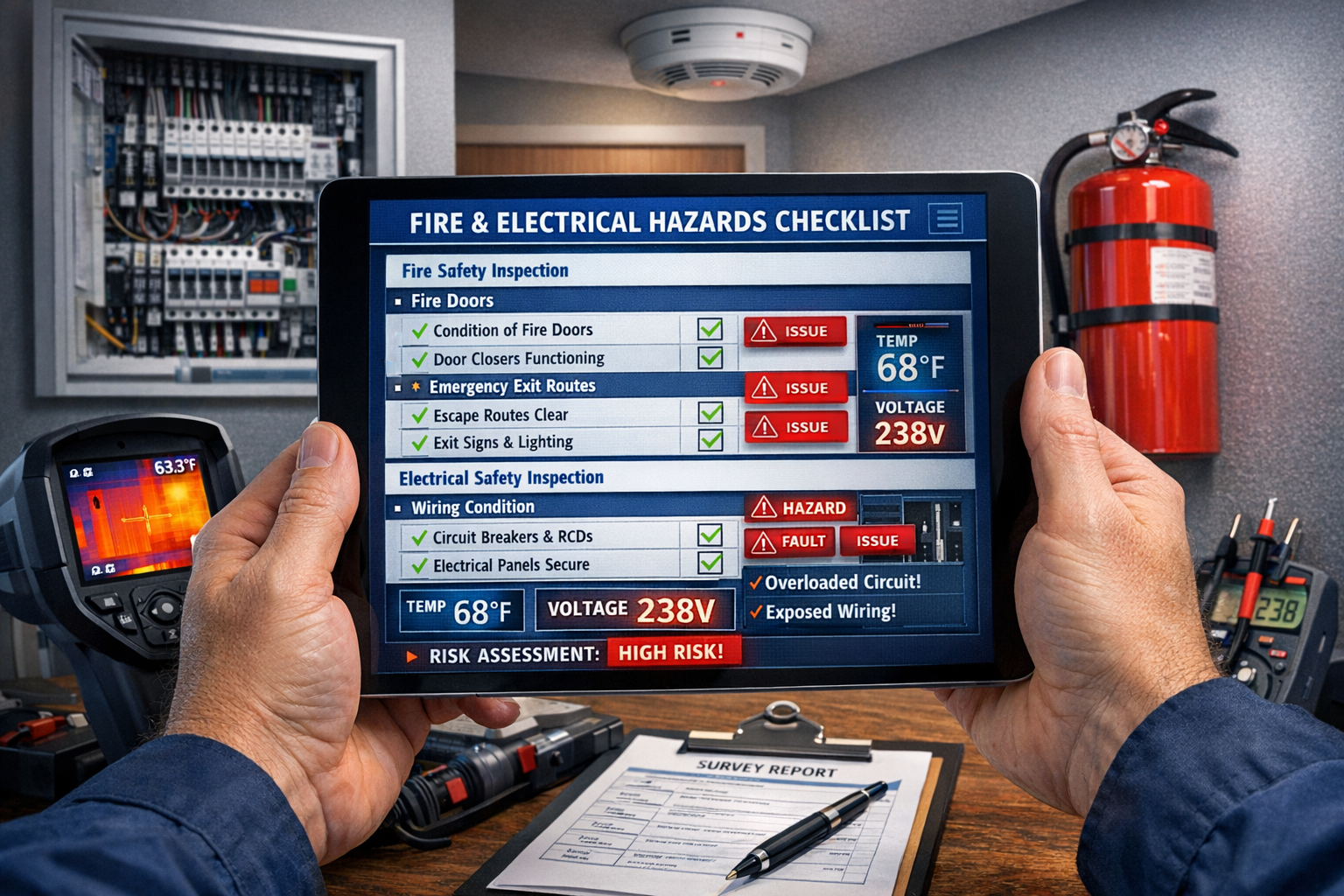
Fire Safety Requirements Under Awaab's Law Expansion to PRS
Fire hazards represent one of the most critical additions to the Awaab's Law framework. The expanded legislation requires landlords to address fire safety deficiencies that could endanger tenant lives within the strict 24-hour emergency repair window.[1]
Key fire hazards that surveyors must assess include:
Fire Detection Systems 🔔
- Absence of smoke detectors in required locations
- Non-functional or expired detection equipment
- Inadequate coverage for property size and layout
- Missing carbon monoxide detectors near fuel-burning appliances
Fire Door Compliance 🚪
- Fire doors that fail to self-close properly
- Damaged or missing intumescent strips
- Compromised fire door integrity (holes, gaps, modifications)
- Incorrect or missing fire door certification
Escape Route Safety 🏃
- Blocked or obstructed escape routes
- Inadequate emergency lighting
- Locked or difficult-to-operate exit mechanisms
- Insufficient escape route signage
Fire Separation and Compartmentation 🧱
- Breaches in fire-resistant walls or ceilings
- Unsealed penetrations for pipes or cables
- Compromised fire barriers in converted properties
- Missing fire-stopping materials
For building surveyor services providers, these requirements demand familiarity with current fire safety regulations, including the Regulatory Reform (Fire Safety) Order 2005 and building regulations Part B. Surveyors must be able to identify deficiencies that create immediate risk versus those requiring longer-term remediation.
Electrical Hazard Assessment Protocols
Electrical hazards pose significant risks of fire, shock, and electrocution. The Awaab's Law Expansion to PRS: Building Survey Protocols for New Hazards like Fire and Electrical Risks in 2026 places particular emphasis on electrical safety, requiring comprehensive assessment of wiring systems and installations.[6]
Critical electrical hazards include:
Wiring and Circuit Issues ⚡
- Outdated wiring systems (pre-1960s rubber or fabric-insulated cables)
- Overloaded circuits and inadequate capacity
- Evidence of overheating (discolored outlets, burning smells)
- Exposed or damaged wiring
Consumer Unit and Protection Devices 🔌
- Non-compliant fuse boxes lacking RCD protection
- Obsolete consumer units with ceramic fuses
- Missing or incorrect circuit labeling
- Inadequate earthing and bonding
Fixed Electrical Installations 💡
- Non-compliant socket outlets and switches
- Unsafe outdoor electrical installations
- Bathroom electrical installations violating zone requirements
- DIY electrical work without certification
Electrical Safety Certification 📋
- Absence of valid Electrical Installation Condition Report (EICR)
- EICR recommendations marked as urgent (C1 or C2) unresolved
- Expired electrical safety certificates
- No evidence of five-yearly testing regime
Surveyors conducting assessments must understand that while they can identify obvious electrical deficiencies, comprehensive electrical testing requires a qualified electrician. However, visual inspection can reveal many hazards that trigger the need for immediate specialist assessment.
When conducting expert building evaluation, surveyors should document the age and condition of electrical installations, note any visible defects, and recommend specialist testing where systems appear outdated or show signs of deterioration.
Building Survey Protocols for Awaab's Law Compliance in the PRS
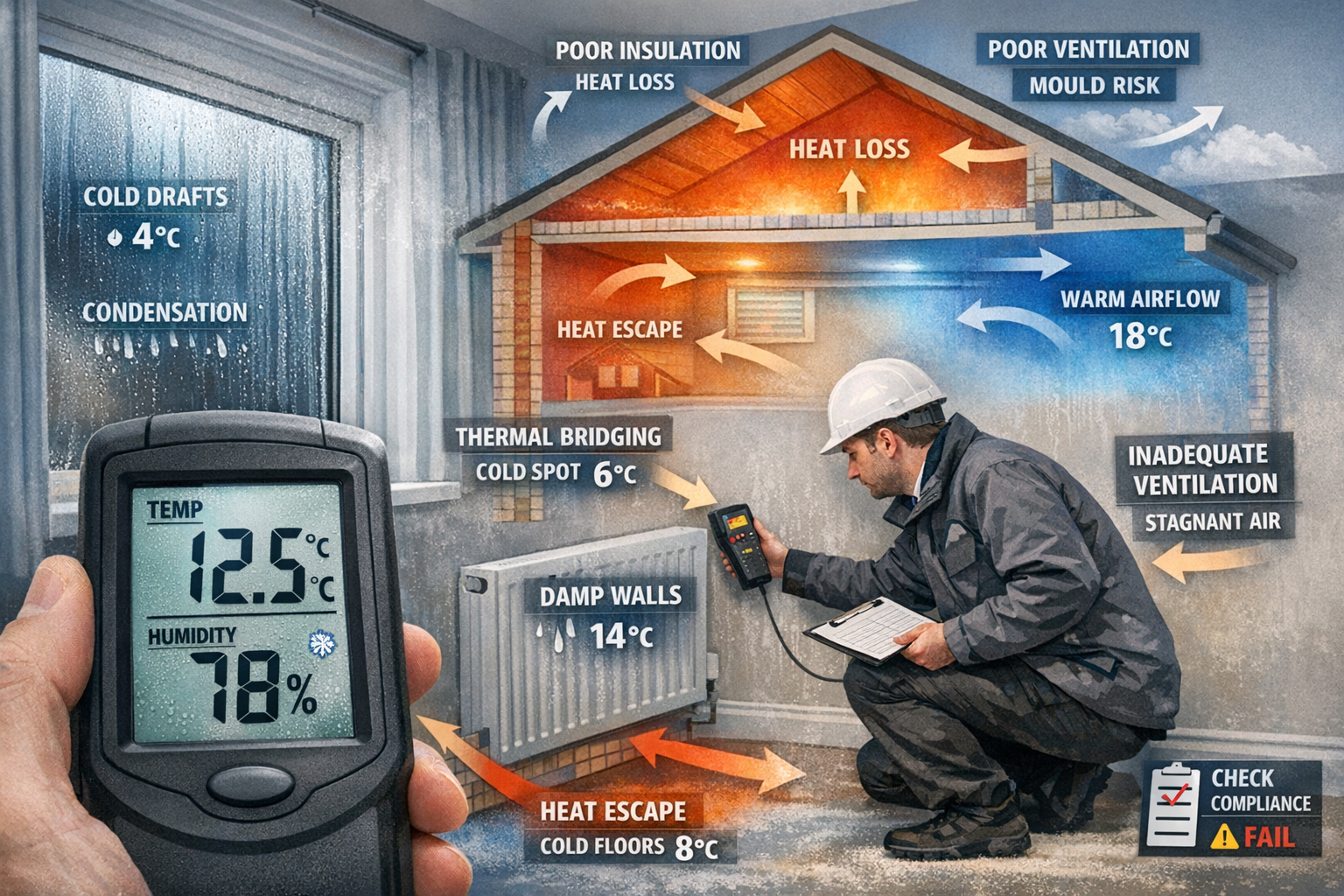
Level 3 Survey Methodology for Hazard Identification
The Awaab's Law Expansion to PRS: Building Survey Protocols for New Hazards like Fire and Electrical Risks in 2026 requires a systematic approach to property assessment that goes beyond standard homebuyer surveys. A Level 3 survey provides the comprehensive inspection framework necessary to identify all seven hazard categories.
Essential components of an Awaab's Law compliance survey:
Pre-Survey Preparation 📝
- Review property history and previous survey reports
- Obtain electrical safety certificates and gas safety records
- Identify property age, construction type, and previous modifications
- Prepare hazard-specific checklists for each category
Systematic Room-by-Room Assessment 🏠
- Document condition of fire doors and escape routes
- Test smoke and carbon monoxide detectors
- Inspect electrical outlets, switches, and visible wiring
- Assess heating system functionality and distribution
- Measure temperature and humidity levels
- Identify structural defects and deterioration
- Evaluate staircase safety and handrail integrity
- Note hygiene issues and pest evidence
Specialist Equipment Requirements 🔧
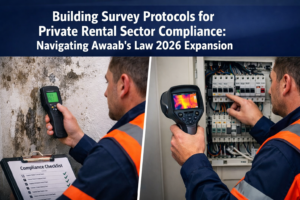
- Thermal imaging camera for temperature assessment
- Moisture meters for damp detection
- Electrical socket testers for basic circuit checks
- Smoke detector testing equipment
- Digital thermometer and hygrometer
- Photography equipment for documentation
Documentation Standards 📸
- Photographic evidence of all identified hazards
- Detailed location plans showing defect positions
- Risk classification (emergency, urgent, routine)
- Estimated repair timelines and costs
- Recommendations for specialist investigations
For properties requiring damp survey assessments, surveyors should integrate moisture investigation with the broader hazard assessment to provide landlords with a complete compliance picture.
Temperature Control Assessment: Excess Cold and Heat
Temperature-related hazards represent a significant addition to Awaab's Law requirements. Both excess cold and excess heat can cause serious health problems for tenants, particularly vulnerable populations including children, elderly residents, and those with chronic health conditions.
Excess Cold Assessment Criteria ❄️
Surveyors must evaluate whether properties can maintain adequate temperatures during winter months:
- Heating system capacity – Is the system sized appropriately for the property?
- Heating distribution – Do all habitable rooms have adequate heating provision?
- Insulation standards – Are walls, roofs, and floors adequately insulated?
- Thermal bridging – Are there cold spots caused by structural thermal bridges?
- Draught proofing – Are windows and doors properly sealed?
- Glazing performance – Is double glazing present and functioning correctly?
Properties failing to maintain 18°C in bedrooms and 21°C in living areas during normal heating operation may constitute an excess cold hazard requiring immediate remediation.[6]
Excess Heat Assessment Criteria 🌡️
Overheating has become an increasing concern, particularly in modern well-insulated properties and urban areas:
- Ventilation provision – Are there adequate openable windows and ventilation systems?
- Solar gain management – Is there appropriate shading for south-facing glazing?
- Roof insulation and ventilation – Can heat escape from upper floors?
- Mechanical cooling – Is cooling provision necessary and adequate?
- Temperature monitoring – Do summer temperatures exceed safe thresholds?
Properties regularly exceeding 26°C in bedrooms during summer months may require ventilation improvements or other cooling interventions.
Structural and Falls Hazard Protocols
Structural integrity and falls prevention complete the seven-hazard framework under the expanded legislation.
Structural Collapse Risk Assessment 🏚️
Surveyors must identify defects that could lead to structural failure:
- Foundation movement and subsidence indicators
- Load-bearing wall and beam deterioration
- Roof structure defects and sagging
- Floor joist failure or excessive deflection
- Masonry cracking patterns indicating instability
- Timber decay in structural elements
- Previous structural modifications lacking certification
For properties showing signs of subsidence or structural movement, immediate specialist structural engineer assessment is essential.
Falls Hazard Identification 🪜
Falls on stairs and surfaces cause significant tenant injuries annually:
- Staircase pitch and riser/tread dimensions
- Handrail presence, height, and security
- Balustrade spacing and integrity
- Surface conditions creating trip hazards
- Inadequate lighting on staircases
- Uneven floor surfaces and level changes
- Unsafe external steps and pathways
These assessments require careful measurement and comparison against building regulations standards to determine compliance gaps.
Emergency Repair Timelines and Landlord Obligations
The 24-Hour Emergency Repair Requirement
The most demanding aspect of Awaab's Law Expansion to PRS: Building Survey Protocols for New Hazards like Fire and Electrical Risks in 2026 is the 24-hour emergency repair timeline for life-threatening hazards.[1][5]
This timeline operates in two stages:
Stage 1: Initial Investigation (10 working days) 🔍
- Landlord must investigate reported hazards within 10 working days
- Investigation must determine the nature and severity of the hazard
- Landlord must communicate findings and proposed actions to tenant
Stage 2: Emergency Repair Completion (24 hours) ⏰
- Once investigation confirms an emergency hazard, repairs must be completed within 24 hours
- The 24-hour clock starts from investigation completion, not initial report
- If repair is impossible within 24 hours, landlord must provide alternative accommodation
Hazards classified as emergencies include:
- ⚠️ Complete heating system failure during winter
- ⚠️ Exposed live electrical wiring
- ⚠️ Non-functional fire doors in means of escape
- ⚠️ Blocked fire escape routes
- ⚠️ Imminent structural collapse risk
- ⚠️ Unsafe staircases with missing handrails
- ⚠️ Sewage flooding or major sanitation failure
For less critical hazards, longer repair timelines apply, but landlords must still act within reasonable timeframes to prevent hazards from escalating.
Documentation and Compliance Records
Landlords must maintain comprehensive records demonstrating compliance with Awaab's Law requirements. This documentation burden makes professional survey reports essential for PRS landlords.
Required documentation includes:
📄 Initial Property Assessment Reports
- Comprehensive survey identifying all potential hazards
- Risk classification and prioritization
- Recommended remedial works with timelines
- Specialist reports (electrical, structural, damp)
📄 Ongoing Monitoring Records
- Regular inspection schedules and findings
- Tenant hazard reports and response timelines
- Investigation records and conclusions
- Repair completion certificates
📄 Compliance Certificates
- Current EICR (renewed every five years)
- Gas safety certificates (annual)
- Fire safety risk assessments
- Energy Performance Certificates
📄 Communication Records
- Tenant hazard notifications
- Investigation timeline communications
- Repair scheduling and completion notices
- Alternative accommodation arrangements (if applicable)
Understanding what to do after receiving a building survey report becomes critical for landlords facing multiple identified hazards requiring prioritization and action planning.
Implementing Survey Protocols: Practical Guidance for Landlords and Surveyors
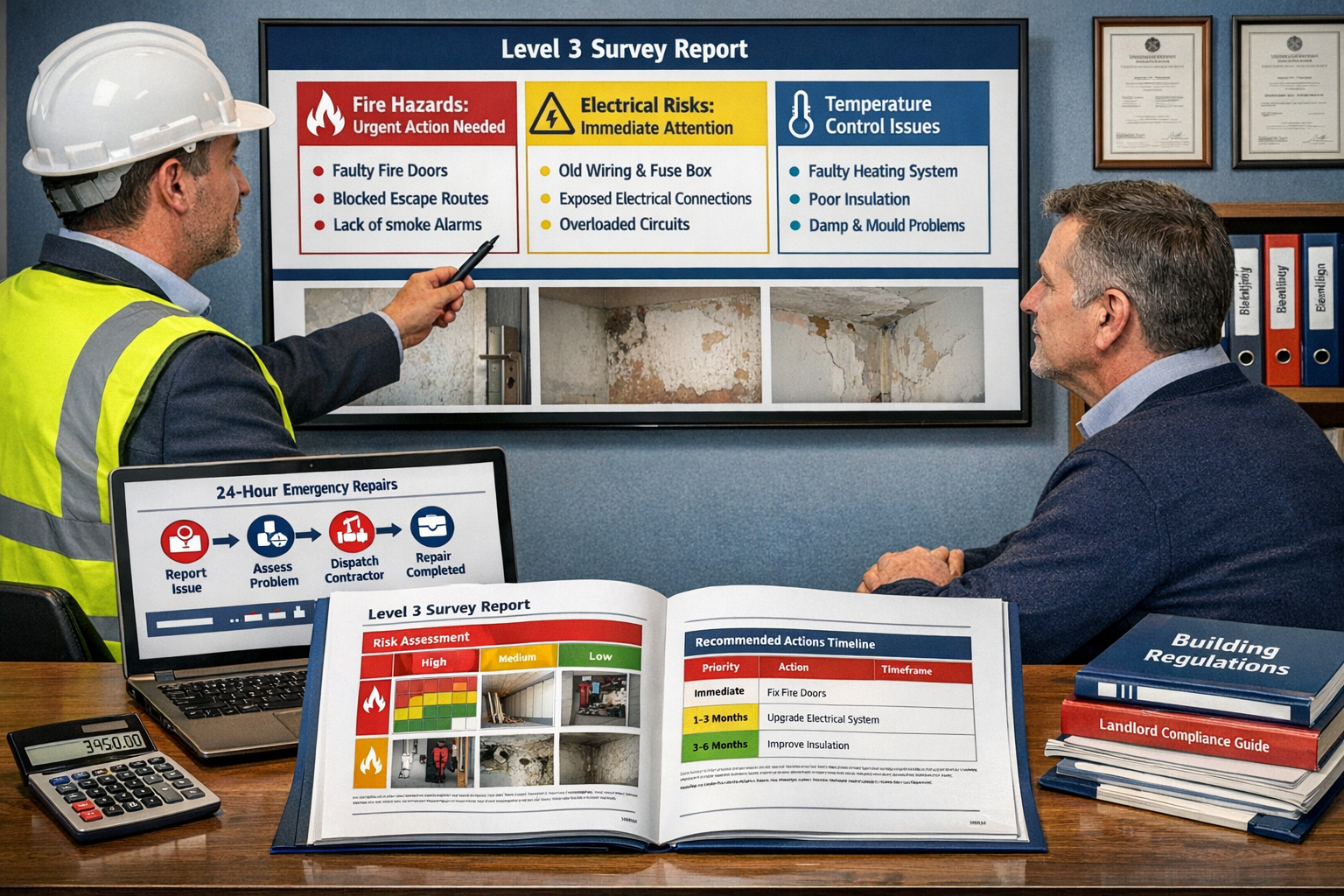
Developing a Compliance Survey Checklist
The Awaab's Law Expansion to PRS: Building Survey Protocols for New Hazards like Fire and Electrical Risks in 2026 requires surveyors to adopt structured checklists that ensure comprehensive coverage of all seven hazard categories.
Comprehensive Awaab's Law Survey Checklist:
🔥 Fire Hazards Section
- Smoke detectors present in all required locations (hallways, landings, living rooms)
- Carbon monoxide detectors near fuel-burning appliances
- All detectors functional and within expiry date
- Fire doors present where required (flats, HMOs)
- Fire doors self-closing with intact seals
- Escape routes clear and unobstructed
- Emergency lighting functional (if required)
- Fire separation maintained (no breaches)
- Fire extinguishers present and serviced (if required)
⚡ Electrical Hazards Section
- Consumer unit type and age documented
- RCD protection present for all circuits
- Circuit labeling clear and accurate
- No visible damaged wiring or outlets
- Outdoor electrical installations weatherproof
- Bathroom electrical installations compliant
- Valid EICR present (dated within 5 years)
- All C1/C2 recommendations from EICR resolved
- Earthing and bonding adequate
❄️ Excess Cold Section
- Heating system functional in all habitable rooms
- Heating capacity adequate for property size
- Thermostatic controls present and working
- Insulation adequate (loft, walls, floors)
- Windows and doors draught-proofed
- Double glazing present and sealed
- No significant thermal bridging
- Property can maintain 18°C bedrooms, 21°C living areas
🌡️ Excess Heat Section
- Adequate ventilation in all rooms
- Openable windows sufficient for cross-ventilation
- Mechanical ventilation functional (if present)
- Solar shading adequate for south-facing glazing
- Roof space ventilation adequate
- Summer temperatures within safe limits
🏚️ Structural Collapse Section
- No significant foundation movement or subsidence
- Load-bearing walls and beams sound
- Roof structure adequate with no sagging
- Floor joists sound with acceptable deflection
- No structural cracking indicating instability
- Previous structural works certified
- No significant timber decay in structural elements
🪜 Falls Hazards Section
- Staircases compliant pitch and dimensions
- Handrails present and secure on all staircases
- Balustrades adequate spacing (100mm max)
- Staircase lighting adequate
- Floor surfaces level with no trip hazards
- External steps safe with handrails if needed
🧹 Domestic Hygiene Section
- No evidence of pest infestation
- Sewage and drainage systems functional
- Kitchen and bathroom sanitation adequate
- Waste disposal facilities adequate
- No accumulation of refuse
This comprehensive approach ensures surveyors capture all required information during a single site visit, minimizing the need for return inspections.
Cost Implications and Budgeting for Compliance
Private landlords face significant costs to achieve full compliance with the expanded Awaab's Law requirements. Understanding these cost implications is essential for financial planning.
Typical Compliance Cost Ranges:
| Compliance Activity | Estimated Cost Range |
|---|---|
| Level 3 Compliance Survey | £800 – £1,500 |
| EICR Testing | £150 – £300 |
| Fire Door Replacement (per door) | £300 – £800 |
| Smoke/CO Detector Installation | £50 – £150 per unit |
| Heating System Upgrade | £3,000 – £8,000 |
| Electrical Consumer Unit Replacement | £500 – £1,200 |
| Insulation Improvements | £1,000 – £5,000 |
| Structural Repairs | £2,000 – £20,000+ |
| Handrail Installation | £200 – £600 |
Total compliance costs for a typical private rental property with multiple deficiencies can range from £5,000 to £15,000, with older properties potentially requiring significantly more investment.
Landlords should prioritize expenditure based on:
- Emergency hazards requiring 24-hour response
- Urgent hazards posing significant risk
- Routine maintenance to prevent hazard development
Professional survey reports help landlords understand which investments are legally mandated versus those that improve property condition but aren't immediately required.
Regional Considerations and Local Authority Enforcement
Enforcement of Awaab's Law in the PRS will vary by local authority, with some regions taking more proactive approaches than others.
Regional factors affecting compliance:
Urban vs. Rural Properties 🏙️🌾
- Urban properties face higher scrutiny due to tenant density
- Rural properties may have limited access to specialist contractors
- Urban areas typically have more enforcement resources
Property Age and Type 🏘️
- Victorian and Edwardian properties face greater challenges
- Purpose-built flats have different fire safety requirements
- Houses in Multiple Occupation (HMOs) face enhanced standards
Local Authority Priorities 🏛️
- Some councils prioritize electrical safety enforcement
- Others focus on temperature and energy efficiency
- Tenant complaint volumes drive enforcement activity
Landlords operating across multiple regions should work with surveyors familiar with local enforcement patterns and priorities. Property surveyors with regional expertise can provide valuable insights into local authority expectations.
Technology and Tools for Hazard Assessment
Digital Survey Tools and Reporting Systems
Modern survey technology significantly enhances the efficiency and accuracy of Awaab's Law compliance assessments.
Essential digital tools include:
Thermal Imaging Cameras 📷
- Identify cold spots and thermal bridging
- Detect hidden moisture problems
- Assess heating system performance
- Document temperature distribution visually
Moisture Meters 💧
- Measure surface and subsurface moisture levels
- Distinguish between different damp types
- Provide quantitative data for reports
- Track moisture levels over time
Electrical Testing Equipment 🔌
- Socket testers for basic circuit checks
- RCD testing devices
- Voltage detectors for safety
- Thermal imaging for overheating circuits
Digital Reporting Platforms 💻
- Cloud-based survey report generation
- Photo annotation and labeling tools
- Automated compliance checklist systems
- Client portal access for landlords
These technologies enable surveyors to provide more comprehensive, evidence-based reports that clearly document hazards and support landlord compliance efforts.
Predictive Maintenance and Monitoring Systems
Forward-thinking landlords are implementing continuous monitoring systems to identify hazards before they become emergencies.
Smart property monitoring solutions include:
- Temperature sensors tracking heating performance
- Humidity monitors detecting moisture accumulation
- Smoke detector interconnection with remote alerts
- Water leak detection systems preventing flooding
- Electrical consumption monitoring identifying circuit issues
These systems provide early warning of developing problems, allowing landlords to address issues proactively rather than reactively, potentially avoiding the strict 24-hour emergency repair requirements.
Preparing for October 2026: Action Steps for PRS Landlords
Immediate Actions (Q2-Q3 2026)
With Phase 3 implementation scheduled for October 2026, private landlords should take immediate action to ensure compliance.
Priority actions for landlords:
1. Commission Comprehensive Property Surveys 📋
- Engage qualified building surveyors for Level 3 assessments
- Request specific Awaab's Law compliance reporting
- Obtain specialist electrical and structural reports where needed
- Document current property condition comprehensively
2. Review Existing Certificates and Reports 📄
- Verify EICR currency (must be within 5 years)
- Check gas safety certificate validity
- Review previous survey findings for unresolved issues
- Gather Energy Performance Certificate data
3. Prioritize Identified Hazards ⚠️
- Classify hazards by emergency/urgent/routine categories
- Develop remedial works schedule with contractors
- Budget for compliance expenditure
- Establish emergency repair contractor relationships
4. Update Tenant Communication Procedures 📞
- Create hazard reporting systems for tenants
- Establish investigation response protocols
- Document communication procedures
- Train property management staff on requirements
5. Review Insurance Coverage 🛡️
- Verify landlord insurance includes compliance coverage
- Consider legal expenses insurance for potential disputes
- Review liability coverage limits
- Discuss Awaab's Law implications with insurers
Long-Term Compliance Strategy
Beyond immediate compliance, landlords should develop sustainable approaches to ongoing hazard management.
Strategic considerations:
Portfolio-Wide Assessment Programs 🏘️
- Implement rolling inspection schedules
- Standardize survey protocols across properties
- Develop property-specific maintenance plans
- Track compliance status systematically
Contractor Relationship Development 🔧
- Establish preferred contractor lists for each hazard type
- Negotiate framework agreements for emergency repairs
- Verify contractor insurance and qualifications
- Create 24-hour emergency response protocols
Financial Planning 💰
- Budget for ongoing compliance costs
- Consider rent adjustments to fund improvements
- Explore energy efficiency grants and funding
- Plan capital expenditure for major upgrades
Professional Advisory Support 👥
- Maintain relationships with qualified surveyors
- Engage property management specialists
- Consult legal advisors on compliance obligations
- Join landlord associations for guidance updates
Landlords should recognize that Awaab's Law compliance isn't a one-time exercise but an ongoing obligation requiring systematic approaches and professional support.
Conclusion
The Awaab's Law Expansion to PRS: Building Survey Protocols for New Hazards like Fire and Electrical Risks in 2026 represents a fundamental transformation in private rental sector safety standards. With Phase 3 implementation scheduled for October 2026, approximately 4.6 million privately rented homes will become subject to comprehensive hazard assessment and emergency repair obligations that extend far beyond traditional landlord responsibilities.[4]
The expansion from damp and mould to seven distinct hazard categories—including fire, electrical, temperature, structural, falls, and hygiene issues—demands systematic survey protocols that identify risks before they endanger tenant safety. The strict 24-hour emergency repair timeline creates significant compliance pressure, making proactive hazard assessment essential rather than optional.[1][5]
Key implementation priorities for landlords include:
✅ Commission comprehensive Level 3 surveys that specifically assess all seven Awaab's Law hazard categories using structured checklists and modern assessment tools
✅ Establish emergency response protocols with qualified contractors capable of delivering 24-hour repair completion for life-threatening hazards
✅ Implement systematic documentation of property condition, hazard investigations, repair completions, and tenant communications to demonstrate compliance
✅ Budget appropriately for compliance costs ranging from £5,000 to £15,000+ per property, prioritizing emergency and urgent hazards first
✅ Develop ongoing monitoring systems that identify developing hazards early, preventing emergency situations and supporting proactive maintenance
The legislation recognizes that tenant safety requires comprehensive approaches addressing multiple interconnected building systems. Fire safety depends on electrical integrity; temperature control requires structural soundness; falls prevention needs adequate lighting. Professional building surveyor services provide the holistic assessment framework necessary to evaluate these complex relationships.
For landlords uncertain about their properties' compliance status, the time to act is now. Waiting until October 2026 risks facing emergency repair obligations without adequate preparation, potentially exposing landlords to enforcement action and significant financial penalties.
Take action today:
- Schedule a comprehensive property survey with qualified surveyors experienced in Awaab's Law compliance assessment
- Review and update all safety certificates ensuring electrical, gas, and fire safety documentation is current
- Establish contractor relationships for emergency repairs across all hazard categories
- Develop tenant communication systems that facilitate hazard reporting and investigation
- Create compliance budgets that account for both immediate remedial works and ongoing maintenance obligations
The expanded Awaab's Law framework ultimately aims to ensure that all rental properties—social and private—provide safe, healthy homes for tenants. While compliance requires significant investment and systematic approaches, the alternative—continuing to expose tenants to preventable hazards—is neither legally acceptable nor morally defensible.
Landlords who embrace these enhanced standards proactively will not only meet their legal obligations but will also maintain properties that attract and retain quality tenants, reduce void periods, and preserve long-term property values. Professional survey protocols provide the foundation for this compliance journey, transforming regulatory requirements into opportunities for property improvement and tenant satisfaction.
References
[1] Awaabs Law 2026 A Complete Guide – https://prbge.co.uk/awaabs-law-2026-a-complete-guide/
[2] Awaabs Law Comes Into Force What Does It Mean For Construction – https://www.trowers.com/insights/2025/november/awaabs-law-comes-into-force-what-does-it-mean-for-construction
[4] Housing Law A Look At The Year Ahead – https://www.wardhadaway.com/insights/social-housing-speed-read/housing-law-a-look-at-the-year-ahead/
[5] Awaabs Law Guidance For Social Landlords Timeframes For Repairs In The Social Rented Sector – https://www.gov.uk/government/publications/awaabs-law-guidance-for-social-landlords/awaabs-law-guidance-for-social-landlords-timeframes-for-repairs-in-the-social-rented-sector
[6] Awaabs Law 2026 Social Landlords Housing Associations – https://www.villageheating.co.uk/awaabs-law-2026-social-landlords-housing-associations/