

Roughly half of all homes in England were built before 1965, a period when asbestos-containing materials (ACMs) were woven into the fabric of British construction. For anyone buying, selling, or renovating a pre-2000 property, understanding asbestos in older UK properties and what surveyors look for in a building survey is not a box-ticking exercise. It is a genuine health and financial safeguard.
This guide explains where asbestos hides in older homes, how RICS-qualified surveyors approach suspected ACMs during a building survey, when specialist testing becomes essential, and what the legal framework means for homeowners, landlords, and buyers in 2026.
Key Takeaways
- Any UK property built, extended, or refurbished before the 1999 asbestos ban may contain ACMs, and surveyors treat pre-2000 homes as potentially affected.
- Standard RICS Level 2 and Level 3 building surveys provide a visual check only, they do not include intrusive sampling or laboratory analysis of suspected materials. [1][3]
- Surveyors must flag visible suspected ACMs in their reports and recommend a specialist asbestos survey when appropriate. [1]
- The legal duty to manage asbestos does not apply to owner-occupied domestic premises but does apply to common parts of multi-occupancy buildings such as blocks of flats. [4]
- Specialist asbestos surveys for residential properties should be carried out by UKAS-accredited organisations following HSE guidance HSG264. [7]
Why Asbestos Remains a Concern in 2026
Asbestos was not banned from use in UK construction until 1999. Before that date, it appeared in hundreds of building products because of its fire resistance, durability, and low cost. The three main types, chrysotile (white), amosite (brown), and crocidolite (blue), were all widely used, with crocidolite considered the most hazardous. [9]
The health risks are well established. Inhaling asbestos fibres can cause mesothelioma, asbestosis, and lung cancer, with symptoms often not appearing until decades after exposure. The Health and Safety Executive (HSE) continues to treat asbestos as the single greatest cause of work-related deaths in the UK. [9]
For property professionals, RICS guidance on asbestos, updated within its building surveying standards, sets clear expectations about how surveyors must handle suspected ACMs when carrying out inspections of older buildings. [1][2] Understanding this framework helps buyers and owners know exactly what a building survey will and will not tell them.
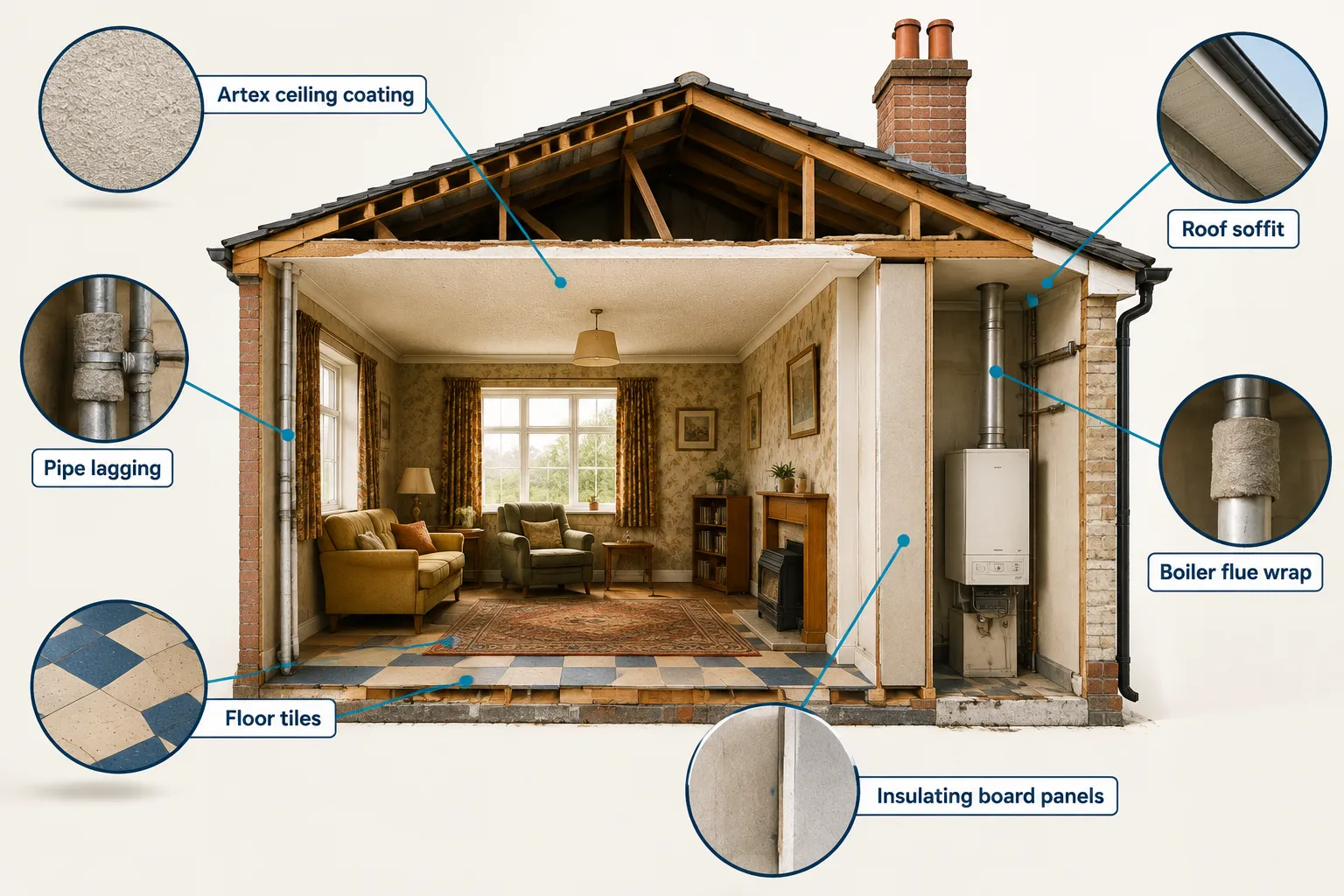
Where Asbestos Is Commonly Found in Older UK Properties
Textured Coatings and Ceilings
One of the most widespread ACMs in domestic properties is textured ceiling coating, commonly known by the brand name Artex. Applied extensively from the 1960s through to the late 1980s, these coatings frequently contained chrysotile fibres. They are generally considered low-risk when intact and undisturbed, but sanding, scraping, or drilling through them releases fibres into the air. [3]
Insulating Board and Partition Walls
Asbestos insulating board (AIB) was used in ceiling tiles, partition walls, fire doors, and soffit boards. AIB is more friable than textured coatings, meaning it breaks apart more easily and releases fibres with less disturbance. Surveyors pay close attention to any board-based materials in older properties, particularly in 1960s and 1970s system-built homes. [1]
Pipe and Boiler Lagging
Thermal insulation wrapped around pipes, boilers, and hot water cylinders was a common application for asbestos. This lagging is often found in loft spaces, airing cupboards, and behind bath panels. Damaged or deteriorating lagging is considered high-risk because fibres can shed during normal occupation. [3]
Floor and Ceiling Tiles
Vinyl floor tiles manufactured before the mid-1980s frequently contained asbestos as a binding agent. Similarly, suspended ceiling tiles in older commercial conversions and pre-1980 residential properties may contain ACMs. These are typically low-risk when in good condition but become hazardous if cut, broken, or removed without precaution. [3]
Roofing, Guttering, and External Panels
Corrugated asbestos cement sheeting was widely used for garage roofs, outbuildings, and flat roof coverings. Asbestos cement was also used in guttering, downpipes, and external cladding panels. Although asbestos cement is considered a lower-risk material, weathering and mechanical damage can release fibres over time. [1][3]
Other Common Locations
The table below summarises the most frequently encountered ACMs in pre-2000 UK homes:
| Location | Common ACM Type | Typical Risk Level |
|---|---|---|
| Textured ceiling coatings | Chrysotile in Artex | Low (if undisturbed) |
| Insulating board panels | Amosite AIB | Medium to High |
| Pipe and boiler lagging | Chrysotile / Amosite | High (if damaged) |
| Vinyl floor tiles | Chrysotile binder | Low (if intact) |
| Roof sheets and soffits | Asbestos cement | Low to Medium |
| Fire doors (core filling) | Amosite AIB | Medium |
| Electrical equipment boards | Chrysotile | Low to Medium |
How Surveyors Approach Asbestos in Older UK Properties During a Building Survey
Understanding asbestos in older UK properties and what surveyors look for in a building survey requires clarity about the scope and limits of standard RICS inspections.
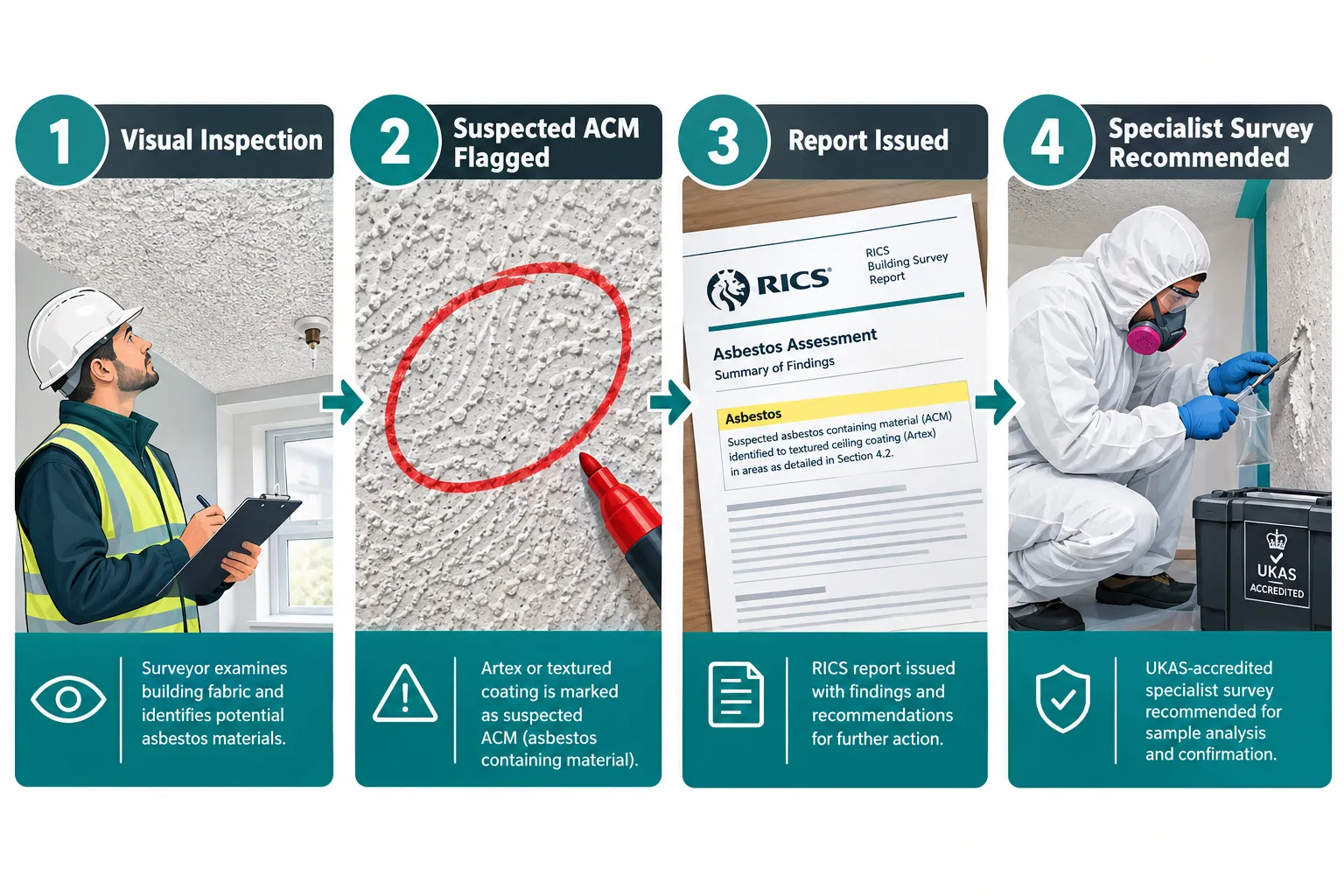
What a Level 2 or Level 3 Survey Covers
RICS Home Survey Standard guidance confirms that neither a Level 2 (Homebuyer Report) nor a Level 3 (Building Survey) constitutes an asbestos inspection under the Control of Asbestos Regulations 2012. [1][3] Surveyors are not required to take samples, carry out laboratory analysis, or produce an asbestos register as part of these reports.
What they are required to do is:
- Visually identify materials that are reasonably suspected to contain asbestos based on their appearance, location, age, and condition.
- Flag those materials clearly in the survey report, including a description of where they were found and their apparent condition.
- Recommend specialist investigation where suspected ACMs are present or where the property's age and construction type make ACMs likely. [1][3]
"Standard RICS surveys provide a visual check only. Surveyors will signpost suspected ACMs and advise separate accredited sampling, they will not undertake intrusive investigations or material testing."
For buyers considering a pre-1980 property, this distinction matters enormously. A building survey report that notes "suspected asbestos-containing materials in ceiling coatings and soffit boards" is not confirmation that asbestos is present, it is a professional signal that further investigation is warranted before exchange of contracts or any renovation work begins.
If you are unsure which level of survey is appropriate for an older property, the comparison of Homebuyers Survey or Full Structural: What You Need to Know provides a useful starting point.
What Surveyors Look for Specifically
When assessing asbestos in older UK properties, a qualified surveyor applies a structured visual methodology informed by HSE guidance HSG264 and RICS professional standards. Key indicators include:
- Age of the property: Any building constructed, extended, or refurbished before 2000 is treated as potentially containing ACMs. [3]
- Construction type: System-built, prefabricated, and non-traditional construction from the 1950s to 1970s carries a particularly high likelihood of ACM use.
- Material condition: Damaged, friable, or deteriorating materials are flagged as higher priority than intact ones.
- Accessibility: Surveyors note areas they cannot inspect, such as voids, roof spaces with restricted access, or areas concealed by finishes, and caveat their findings accordingly.
- Previous works: Evidence of DIY alterations, removed ceilings, or disturbed insulation increases the likelihood that ACMs have already been disturbed.
For first-time buyers navigating this process, the First-Time Buyer Building Surveys guide explains how to interpret survey findings and what questions to ask.
The Surveyor's Reporting Obligation
RICS guidance is clear that surveyors must not simply ignore suspected ACMs because sampling is outside their remit. [1] The professional obligation is to report what is visible, describe the risk, and direct clients towards appropriate next steps. Failing to flag a visually obvious suspected ACM, such as heavily damaged pipe lagging in a loft, would constitute a professional failing.
For clients who discover asbestos-related concerns after receiving a survey report, understanding the average price reduction after survey can help with purchase price negotiations where specialist remediation work is likely to be required.
When Specialist Asbestos Surveys Are Required
Types of Specialist Survey
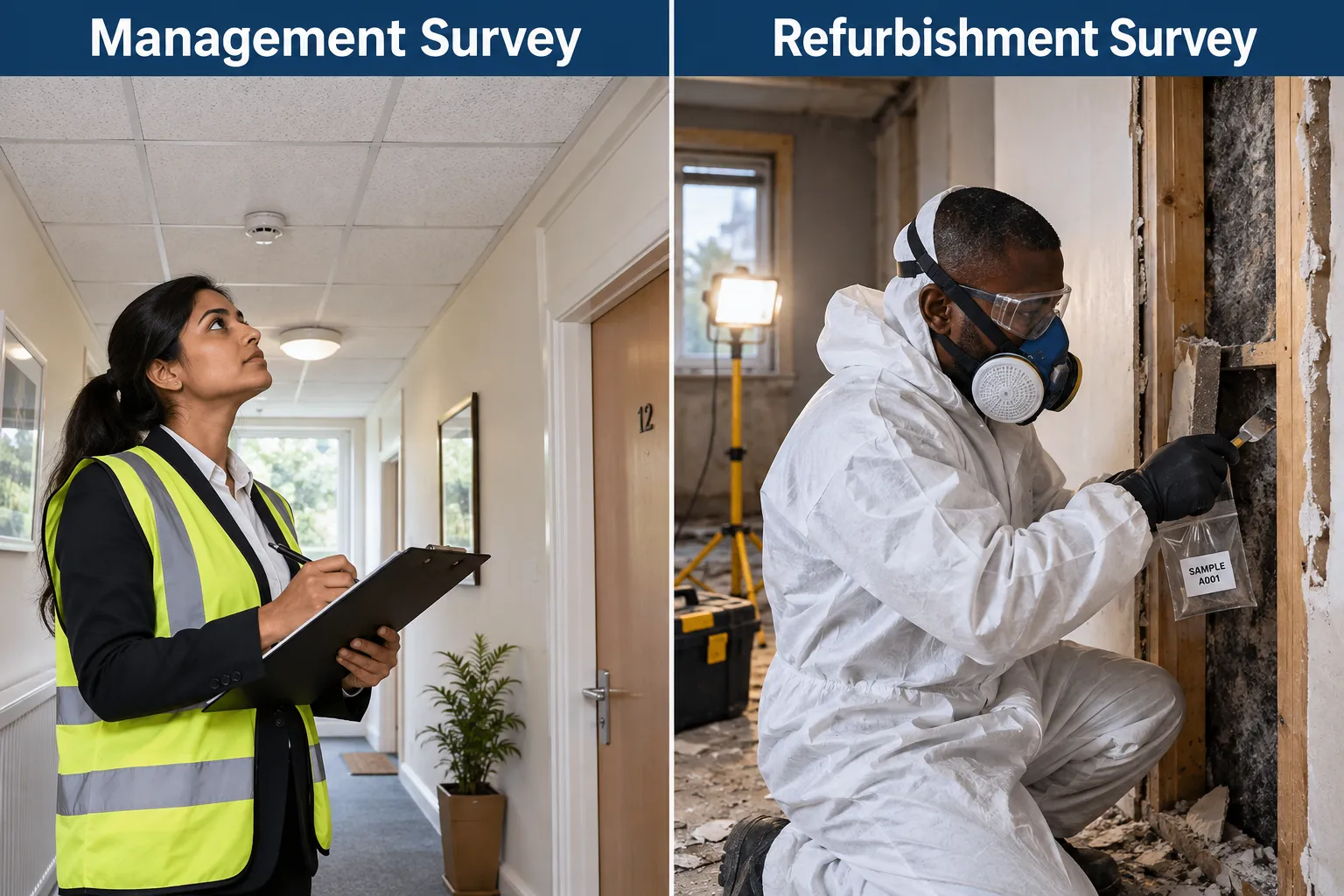
HSE guidance distinguishes between two main types of specialist asbestos survey, each suited to different circumstances: [7]
Management Survey
A non-intrusive inspection designed to locate ACMs that could be disturbed during normal occupation or routine maintenance. This is the standard survey type for occupied residential properties and is typically what landlords and housing associations commission for their stock. It results in an asbestos register and management plan. [4][7]
Refurbishment and Demolition Survey
A more invasive investigation required before any significant structural or refurbishment work begins. This type of survey involves destructive inspection of building fabric to identify all ACMs that could be disturbed during planned works. It is mandatory before notifiable demolition or major refurbishment under the Control of Asbestos Regulations 2012. [7]
Who Should Carry Out Specialist Surveys
HSE strongly recommends, and many local authority housing policies now explicitly require, that asbestos surveys are carried out only by organisations accredited by the United Kingdom Accreditation Service (UKAS). [7] UKAS is the sole recognised accreditation body for asbestos inspection in Great Britain. Surveyors carrying out sampling should hold a P402 qualification (or equivalent) under the relevant British Occupational Hygiene Society scheme.
For social housing and residential blocks, the duty to manage asbestos under Regulation 4 of the Control of Asbestos Regulations 2012 applies to the common parts, stairwells, corridors, plant rooms, and communal areas, but not to individual privately owned flats. [4][6] Dutyholders in these settings must:
- Identify ACMs in common areas.
- Maintain an up-to-date asbestos register.
- Assess the risk from identified ACMs.
- Implement and review a written management plan at least every 12 months.
- Provide information to anyone who may disturb those materials. [4][6]
Typical Costs in 2026
A basic domestic management asbestos survey on a typical 2-3 bedroom property generally costs approximately £150-£350 plus VAT, with an average around £250. Specialist homebuyer or refurbishment surveys for larger or more complex properties can range from roughly £200 to £600 or more. Individual laboratory sample analysis is commonly priced at £50-£100 per sample. [3]
These costs are modest relative to the potential expense of unplanned asbestos removal, which can run into thousands of pounds for significant quantities of ACMs, particularly licensed materials such as AIB or pipe lagging.
For a broader view of survey costs and how they deliver value, the Save Money with a Building Survey resource outlines how early identification of defects, including asbestos, protects buyers financially.
Legal Framework and Practical Implications for Property Owners
The Control of Asbestos Regulations 2012
The Control of Asbestos Regulations 2012 is the primary legislation governing asbestos management in the UK. Key points for property owners include:
- The duty to manage asbestos (Regulation 4) does not apply to owner-occupied domestic premises. [4]
- It does apply to non-domestic premises and to the common parts of multi-occupancy residential buildings. [4][6]
- Any licensable asbestos removal work, covering most work with AIB, sprayed coatings, and lagging, must be carried out by a licensed contractor notified to the HSE. [9]
Practical Rules of Thumb for Pre-2000 Properties
Industry guidance and housing association policies consistently advise treating any property built before 2000 as potentially containing ACMs. Post-2001 properties are generally considered reasonably asbestos-free, though this is not an absolute rule given that some materials with residual asbestos content may have been used in the very early 2000s. [3]
For owners of older properties, the practical implications are straightforward:
- Do not disturb suspected materials without first obtaining a specialist survey.
- Commission a management survey before undertaking any renovation, extension, or maintenance work on a pre-2000 property.
- Commission a refurbishment or demolition survey before any significant structural alteration or demolition.
- Keep records of any asbestos surveys, registers, and management plans, these are valuable for future sales and for contractors. [4][7]
The Exploring the Key Difference Between Level 2 and Level 3 Survey article provides further context on how survey depth affects what is reported about materials like asbestos.
Asbestos and Property Transactions
Asbestos findings do not automatically prevent a property sale. Many older homes contain ACMs that are in good condition and pose minimal risk when left undisturbed. What matters is that buyers are properly informed, that any management obligations are clear, and that the cost of future remediation is factored into the purchase price.
A surveyor's report that identifies suspected ACMs is a negotiating tool as much as a warning. Buyers who understand this are better placed to make informed decisions, or to walk away from a property where the asbestos burden is disproportionate to the price.
Conclusion
Asbestos in older UK properties remains one of the most significant material risks that surveyors encounter during a building survey. The combination of widespread historical use, a long latency period for related diseases, and the sheer volume of pre-2000 housing stock in the UK means this is not a legacy issue, it is an active concern for every buyer, owner, and landlord dealing with older buildings in 2026.
Actionable next steps for buyers and owners:
- Commission the right survey level. For any pre-2000 property, a Level 3 Building Survey provides the most thorough visual assessment. Use the Homebuyers Report or Building Survey guide to choose the appropriate option.
- Take surveyor flags seriously. If a building survey report identifies suspected ACMs, commission a specialist management survey from a UKAS-accredited organisation before exchange of contracts or any works.
- Plan ahead for refurbishment. Any renovation of a pre-2000 property requires a refurbishment or demolition survey before work begins, not after.
- Understand your legal position. Owner-occupiers of houses have no statutory duty to manage asbestos, but landlords of flats with common areas do. Know which category applies.
- Use findings to negotiate. Confirmed or suspected ACMs can justify a price reduction. Work with your surveyor to understand the likely remediation costs involved.
Working with a qualified, RICS-accredited surveyor who understands asbestos risk is the single most effective step any buyer or property owner can take to protect both their health and their investment.
References
[1] Asbestos Legal Requirements And Best Practice For Property Professionals And Clients – rics.org
[2] Building Surveying Standards – rics.org
[3] Asbestos Survey – surveyorlocal.co.uk
[4] Index – hse.gov.uk
[6] Actions – hse.gov.uk
[7] Arrange Asbestos Survey – hse.gov.uk
[8] Health Safety Executive Hse – arca.org.uk
[9] Asbestos – hse.gov.uk