As of 1 May 2026, every assured shorthold tenancy in England automatically converted to a periodic assured tenancy, and landlords lost the right to issue a Section 21 "no-fault" eviction notice forever [1][2]. That single legislative shift — the centrepiece of the Renters' Rights Act 2025 — has forced lenders, investors, and professional surveyors to fundamentally rethink how tenanted residential property is assessed, priced, and inspected. Understanding how the new Renters' Rights Act and abolition of Section 21 are reshaping residential valuations and landlord building surveys is no longer optional for anyone with skin in the private rented sector.
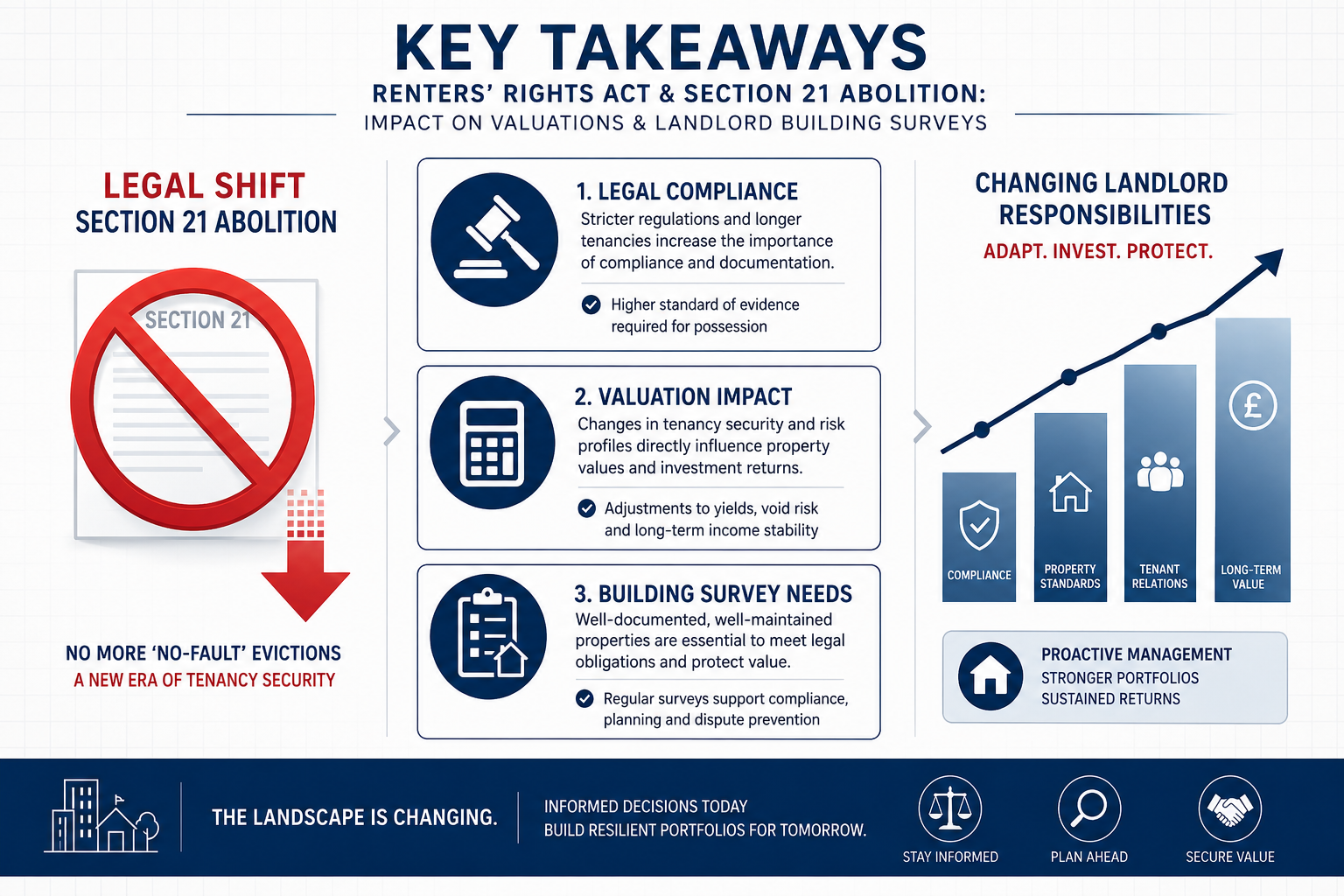
Key Takeaways
- Section 21 "no-fault" evictions were abolished on 1 May 2026; all possession claims must now proceed under Section 8 of the Housing Act 1988.
- All existing assured shorthold tenancies converted automatically to periodic tenancies on the same date, removing fixed-term certainty for landlords.
- Institutional investors are re-pricing tenanted residential portfolios downward by 6-10% to reflect increased risk and reduced flexibility.
- Professional landlords face average compliance costs of approximately £31,411, which surveyors are now factoring into open-market valuations.
- Building surveys for rental properties are evolving into dual-purpose documents: condition reports and legal compliance evidence.
The Legal Shift: What the Renters' Rights Act Actually Changed
End of Section 21 and the Move to Periodic Tenancies
Before examining how the new Renters' Rights Act and abolition of Section 21 are reshaping residential valuations and landlord building surveys, it is worth being precise about what the law now requires.
From 1 May 2026, landlords in England can no longer serve a Section 21 notice to recover possession of a property without stating a reason [1]. Every possession claim must now be brought under Section 8 of the Housing Act 1988, which requires the landlord to cite a specific statutory ground. The Act introduces important new grounds alongside existing ones:
- Ground 1A — the landlord intends to sell the property
- Ground 1B — the landlord or a close family member intends to move in
- Both grounds carry mandatory notice periods and conditions that must be met before a court will grant possession [6]
Simultaneously, fixed-term tenancies have been abolished entirely. All tenancies are now periodic, meaning a tenant may give two months' notice to leave at any point after the first six months [2]. This removes the income-certainty that fixed terms previously offered.
Rent Increase Restrictions
The Act also caps rent increases at once per year, with no increase permitted within the first 12 months of a tenancy. All increases must follow the formal Section 13 process under the Housing Act 1988, and tenants retain the right to challenge any increase they consider unreasonable at a First-tier Tribunal [2]. For landlords relying on rental income growth to offset rising costs, this restriction has a direct bearing on yield calculations.
Enhanced Tenant Rights
Additional tenant protections include the right to request permission to keep a pet — a request landlords cannot unreasonably refuse — and restrictions on demanding large rent payments in advance [7]. While individually modest, these provisions collectively shift the balance of power in tenancy relationships and add compliance obligations that carry financial consequences.
How the New Renters' Rights Act and Abolition of Section 21 Are Reshaping Residential Valuations

The Valuation Discount on Tenanted Properties
The removal of Section 21 has materially increased the risk profile of tenanted residential property. Where a landlord previously had a reliable, relatively swift route to vacant possession, that certainty has gone. Surveyors are responding by applying specific discounts to tenanted properties, particularly in high-demand urban markets [3].
Institutional investors have already begun re-pricing residential portfolios downward by 6-10% to reflect the increased risks and reduced operational flexibility that the new framework creates [9]. For individual landlords, the impact may be felt more acutely at the point of sale, where a sitting tenant now represents a greater pricing obstacle than before.
The key valuation adjustments now being made include:
| Factor | Pre-Act Position | Post-Act Position |
|---|---|---|
| Vacant possession premium | Achievable via S21 within ~2 months | Requires S8 grounds; timeline uncertain |
| Fixed-term income certainty | Contractually guaranteed | Abolished; periodic tenancies only |
| Rent increase flexibility | Negotiable at renewal | Capped at once per year; tribunal risk |
| Investor exit strategy | Relatively straightforward | Constrained by new possession grounds |
Compliance Costs Feeding Into Capital Values
Research indicates that professional landlords face average compliance costs of £31,411 under the new rules [4]. These costs — covering items such as electrical installation condition reports, gas safety certificates, licensing fees, and remediation works — do not disappear; they are capitalised into the asset's value when surveyors assess open-market worth.
When compliance costs are high relative to rental income, net yields compress. Compressed yields, in turn, reduce the price a rational investor will pay. This creates a feedback loop: properties requiring significant remediation work before they meet the Act's implied standards are doubly penalised — once for the cost of works and again for the reduced flexibility landlords now have in managing their tenancies.
For landlords considering a sale, understanding how an RICS survey can help negotiate the price of your property has become more important than ever, since buyers will increasingly use survey findings to justify downward price adjustments on tenanted stock.
Lender Risk Appetite and Mortgage Valuations
The impact extends beyond sale valuations. Lenders are reassessing the risk of buy-to-let mortgage books in light of the Act's changes [1]. Where a lender's security previously included a relatively predictable route to vacant possession in default scenarios, that route is now more complex. Some lenders have begun tightening buy-to-let lending criteria, particularly for properties in higher-risk categories such as HMOs and multi-let conversions.
Surveyors instructed to carry out mortgage valuations on tenanted properties must now explicitly consider:
- The strength of the landlord's grounds for possession under Section 8
- The likely void period risk if possession is contested
- The condition of the property relative to the Act's implied habitability standards
- Whether compliance costs have been factored into the asking price
Landlord Building Surveys: A New Purpose in 2026

From Condition Reports to Compliance Evidence
The traditional purpose of a building survey was to identify defects and inform a buyer's negotiating position. That purpose has not changed, but it has been substantially expanded. Under the Renters' Rights Act framework, a detailed building survey now serves a second critical function: creating a contemporaneous record of a property's condition that can be used as evidence in possession proceedings or tribunal hearings.
Surveyors are now being asked to produce reports that go beyond the standard condition rating system. Landlords need documentation that demonstrates:
- The property met the implied fitness-for-habitation standard at the start of a tenancy
- Any deterioration during a tenancy was caused by the tenant rather than pre-existing disrepair
- Remediation works were carried out to a proper standard
This is particularly relevant when a landlord seeks possession under Section 8 grounds relating to property damage or breach of tenancy conditions. A well-evidenced survey report can be the difference between a successful possession claim and a contested one.
When choosing between survey types, landlords and buyers of tenanted stock should understand the differences between a Level 2 and Level 3 home survey carefully. For older rental properties with complex defect histories, a Level 3 building survey is almost always the appropriate choice.
Damp, Disrepair, and the Decent Homes Standard
The Renters' Rights Act operates alongside the existing Decent Homes Standard and the Homes (Fitness for Human Habitation) Act 2018. Together, these create a framework in which landlords have a proactive duty to maintain properties in a habitable condition. Damp and mould — historically a grey area in terms of landlord liability — are now treated with far greater regulatory seriousness following the Awaab Ishak case.
A professional damp survey and report has therefore become a standard pre-tenancy and mid-tenancy tool for prudent landlords. Identifying and resolving damp issues before a tenancy begins protects landlords from disrepair claims and strengthens their position if a possession dispute arises.
Survey Findings and Price Renegotiation
For buyers acquiring tenanted investment properties, the survey findings carry additional weight in 2026. Where a survey identifies significant defects — structural movement, roof failure, outdated electrical systems — the buyer's ability to remedy those defects quickly is constrained by the presence of a sitting tenant and the new possession framework.
This means that renegotiating after a poor building survey result is not merely a buyer's tactic; it is a rational response to a changed legal environment in which the cost and timeline of remediation have both increased. Sellers of tenanted properties should expect more robust price challenges on the back of survey findings than was typical before the Act.
It is also worth noting that what to do after a bad building survey report now involves a more complex decision tree for landlord-buyers, who must weigh remediation costs against reduced rental flexibility and a potentially lower resale value.
The Enforcement Gap
A Freedom of Information investigation in March 2026 found that of 20 major councils surveyed, only five confirmed operational readiness to enforce the Act from its 1 May 2026 commencement date [8]. This enforcement gap creates a short-term uncertainty: landlords in areas with under-resourced councils may face less immediate pressure, while those in well-resourced boroughs may find themselves subject to proactive inspections.
For surveyors, this inconsistency means that the compliance baseline varies by geography. A building inspection carried out in a proactively enforcing borough needs to be held to a higher evidentiary standard than one in an area where enforcement capacity is limited.
Practical Steps for Landlords and Property Professionals in 2026
How the new Renters' Rights Act and abolition of Section 21 are reshaping residential valuations and landlord building surveys is not an abstract regulatory question — it has direct, practical implications for every decision in the landlord lifecycle.
For existing landlords:
- Commission a full Level 3 building survey on any property that has not been professionally inspected in the last three years
- Ensure all compliance certificates (gas safety, electrical installation condition, EPC) are current and filed
- Review rent levels against the new Section 13 process requirements to avoid tribunal exposure
- Seek legal advice on which Section 8 grounds are available for each property in the portfolio
For buyers of tenanted investment properties:
- Instruct a RICS-regulated surveyor to carry out a full condition survey before exchange, not just a mortgage valuation
- Factor compliance costs into the offer price; use survey findings as the basis for price renegotiation
- Assess the strength of available Section 8 grounds before committing to a purchase where vacant possession is part of the business plan
- Consider the average price reduction achievable after a survey as a realistic negotiating tool in the current market
For surveyors and valuers:
- Update valuation methodology to reflect the 6-10% discount range being applied to tenanted stock [9]
- Ensure survey reports include a clear condition baseline section suitable for use as legal evidence
- Advise landlord clients on the interaction between survey findings and their obligations under the Homes (Fitness for Human Habitation) Act
Conclusion
The Renters' Rights Act 2025 and the abolition of Section 21 from 1 May 2026 represent the most significant restructuring of the private rented sector in a generation. The consequences for residential valuations are already visible: tenanted properties are being discounted, compliance costs are being capitalised into asset values, and lenders are tightening criteria. For building surveyors, the role has expanded from condition reporting into compliance evidence gathering — a shift that demands more rigorous, more detailed, and more legally aware survey practice.
Actionable next steps:
- Landlords should commission a professional building survey immediately if one has not been carried out recently, using it both to identify remediation priorities and to establish a defensible condition baseline.
- Buyers of tenanted stock should treat survey findings as a primary negotiating tool and price compliance costs explicitly into their offers.
- Valuers should ensure their methodologies reflect the post-Act risk adjustments now standard in institutional markets.
- All parties should seek qualified legal and surveying advice specific to their property and portfolio circumstances, rather than relying on general guidance.
The private rented sector has entered a new era. Those who adapt their approach to surveys, valuations, and compliance will be best placed to protect asset values and manage risk in the years ahead.
References
[1] Renters Rights Act New Landscape Lenders Insolvency Officeholders – https://www.addleshawgoddard.com/en/insights/insights-briefings/2026/restructuring/renters-rights-act-new-landscape-lenders-insolvency-officeholders/?utm_source=openai
[2] Renters Rights Act 2025 Prs Tenancy Reform Round Up – https://www.dentons.com/en/insights/articles/2026/april/24/renters-rights-act-2025-prs-tenancy-reform-round-up?utm_source=openai
[3] Valuing Rental Properties Under The Renters Rights Act 2026 Surveyor Adjustments For Section 21 Abolition – https://www.canterburysurveyors.com/blog/valuing-rental-properties-under-the-renters-rights-act-2026-surveyor-adjustments-for-section-21-abolition/?utm_source=openai
[4] Renters Rights Act 2026 Implications For Property Valuation Assessing Landlord Compliance Costs And Market Impact – https://manchestersurveyors.com/renters-rights-act-2026-implications-for-property-valuation-assessing-landlord-compliance-costs-and-market-impact/?utm_source=openai
[5] Renters Rights Act 2026 Implications For Condition Surveys Landlord Valuations And Dispute Evidence – https://www.canterburysurveyors.com/blog/renters-rights-act-2026-implications-for-condition-surveys-landlord-valuations-and-dispute-evidence/?utm_source=openai
[6] Section 21 Abolition 2026 – https://rpjproperty.com/guides/section-21-abolition-2026/?utm_source=openai
[7] Uksiem 20260421 En 001 – https://www.legislation.gov.uk/uksi/2026/421/pdfs/uksiem_20260421_en_001.pdf?utm_source=openai
[8] Renters' Rights Act 2025 – https://en.wikipedia.org/wiki/Renters%27_Rights_Act_2025?utm_source=openai
[9] Valuation Methodology For Renters Rights Act 2026 Properties Adjusting Assessments When Section 21 Abolition And Periodic Tenancies Reduce Investor Appeal – https://nottinghillsurveyors.com/blog/valuation-methodology-for-renters-rights-act-2026-properties-adjusting-assessments-when-section-21-abolition-and-periodic-tenancies-reduce-investor-appeal?utm_source=openai