
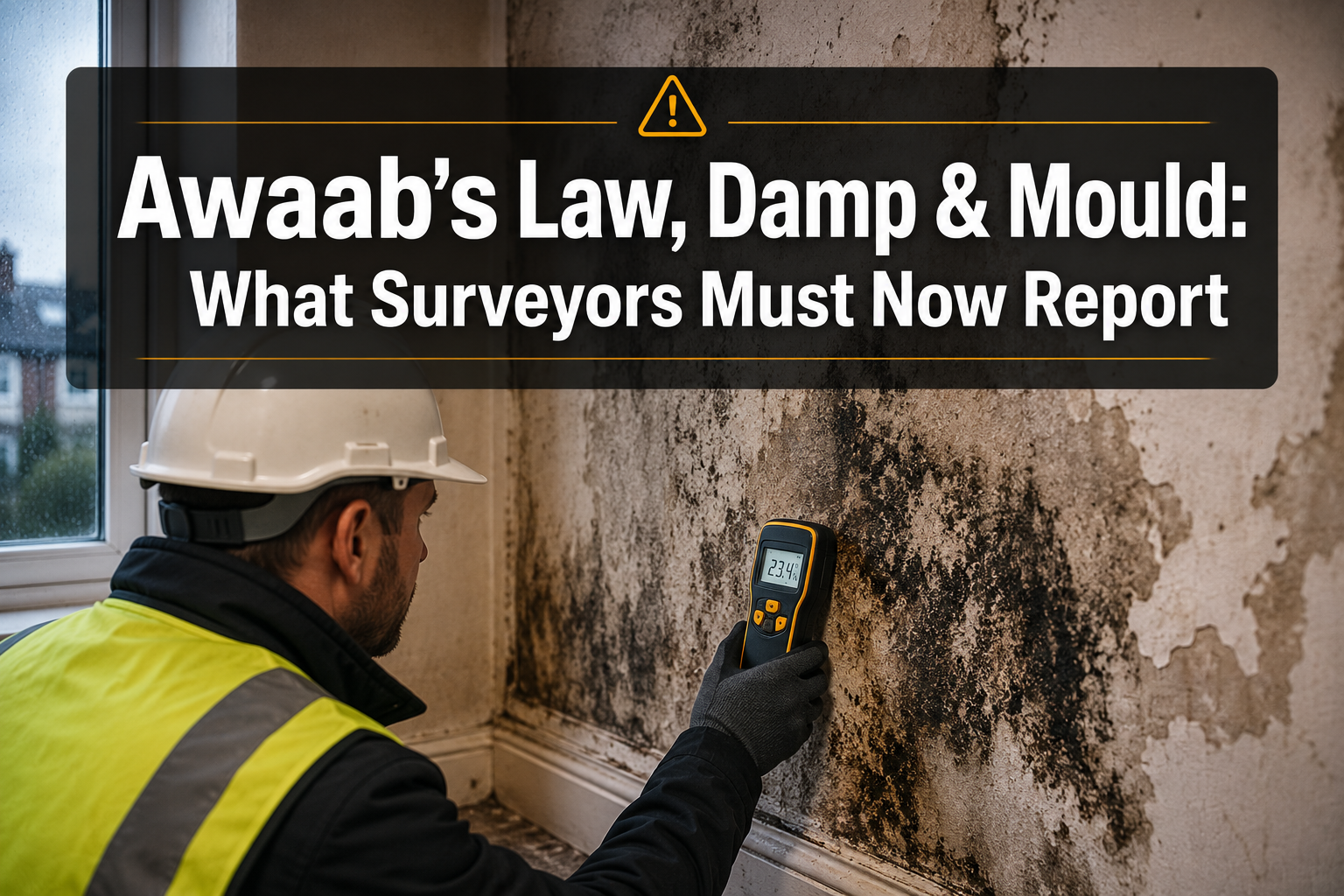
Awaab's Law has rapidly become one of the most significant shifts in housing legislation in a generation, placing surveyors at the centre of compliance, litigation, and tenant safety. Since its implementation on 27 October 2025, the law has driven a sharp increase in demand for structured defect reporting on damp and mould, and for credible expert witness input in housing disrepair claims [1][7]. For surveyors operating across residential and social housing sectors in 2026, understanding the full scope of Awaab's Law, damp and mould: what surveyors must now report in building surveys and as expert witnesses is no longer optional — it is a professional and legal necessity.
Key Takeaways
- Awaab's Law, effective from 27 October 2025, legally requires social landlords to investigate significant damp and mould hazards within 10 working days and make properties safe within 5 working days of completing the investigation.
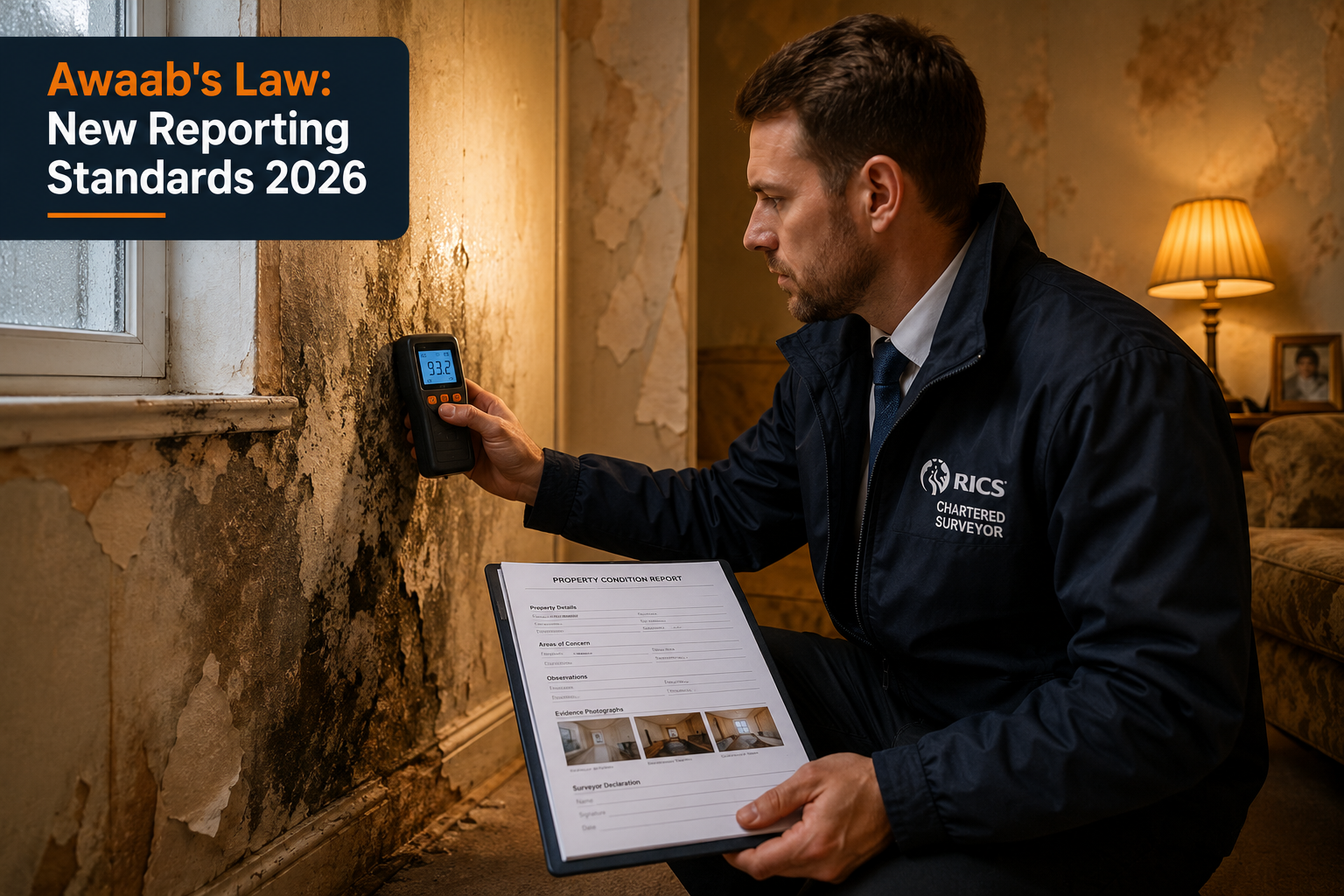
- Surveyors conducting building surveys must now produce detailed, evidence-based reports that include moisture mapping, root-cause analysis, and time-stamped photographic records.
- As of April 2026, the law's scope has expanded beyond damp and mould to include electrical safety, fire risks, and excess heat — broadening the surveyor's assessment obligations.
- Expert witnesses in housing disrepair cases face heightened scrutiny, with courts demanding RICS accreditation, specialist building pathology knowledge, and meticulous documentation.
- Continuing professional development (CPD) focused on housing legislation is now essential for any surveyor involved in Awaab's Law compliance or litigation.
The Background: Why Awaab's Law Changed Everything
The law takes its name from Awaab Ishak, a two-year-old boy who died in December 2020 as a result of prolonged exposure to black mould in a social housing property in Rochdale. The subsequent inquest and Housing Ombudsman investigation exposed systemic failures by landlords to act on repeated damp and mould complaints. Parliament responded through the Social Housing (Regulation) Act 2023, which gave ministers the power to set mandatory repair timescales — powers that became operative in October 2025 [6][8].
The legal framework now holds social landlords directly accountable for timely remediation. Failure to comply carries serious penalties, including potential court action by tenants and regulatory enforcement by the Regulator of Social Housing [6]. This accountability chain places surveyors in a pivotal role: their reports and testimony directly determine whether a landlord is found to have met or breached its legal duties.
What the law requires in practice:
| Trigger | Required Action | Timeframe |
|---|---|---|
| Tenant reports significant damp or mould | Landlord must investigate | Within 10 working days |
| Investigation concludes | Landlord must make property safe | Within 5 working days |
| Emergency hazard identified | Immediate action required | 24 hours |
These timescales are not guidelines — they are legally enforceable obligations [1].
Awaab's Law, Damp and Mould: What Surveyors Must Now Report in Building Surveys
The practical impact of Awaab's Law on building survey methodology has been substantial. A standard condition note about "some dampness observed" is no longer adequate. Surveyors are now expected to produce structured, evidence-rich assessments that can withstand regulatory and legal scrutiny.
Core Reporting Requirements for Damp and Mould Surveys
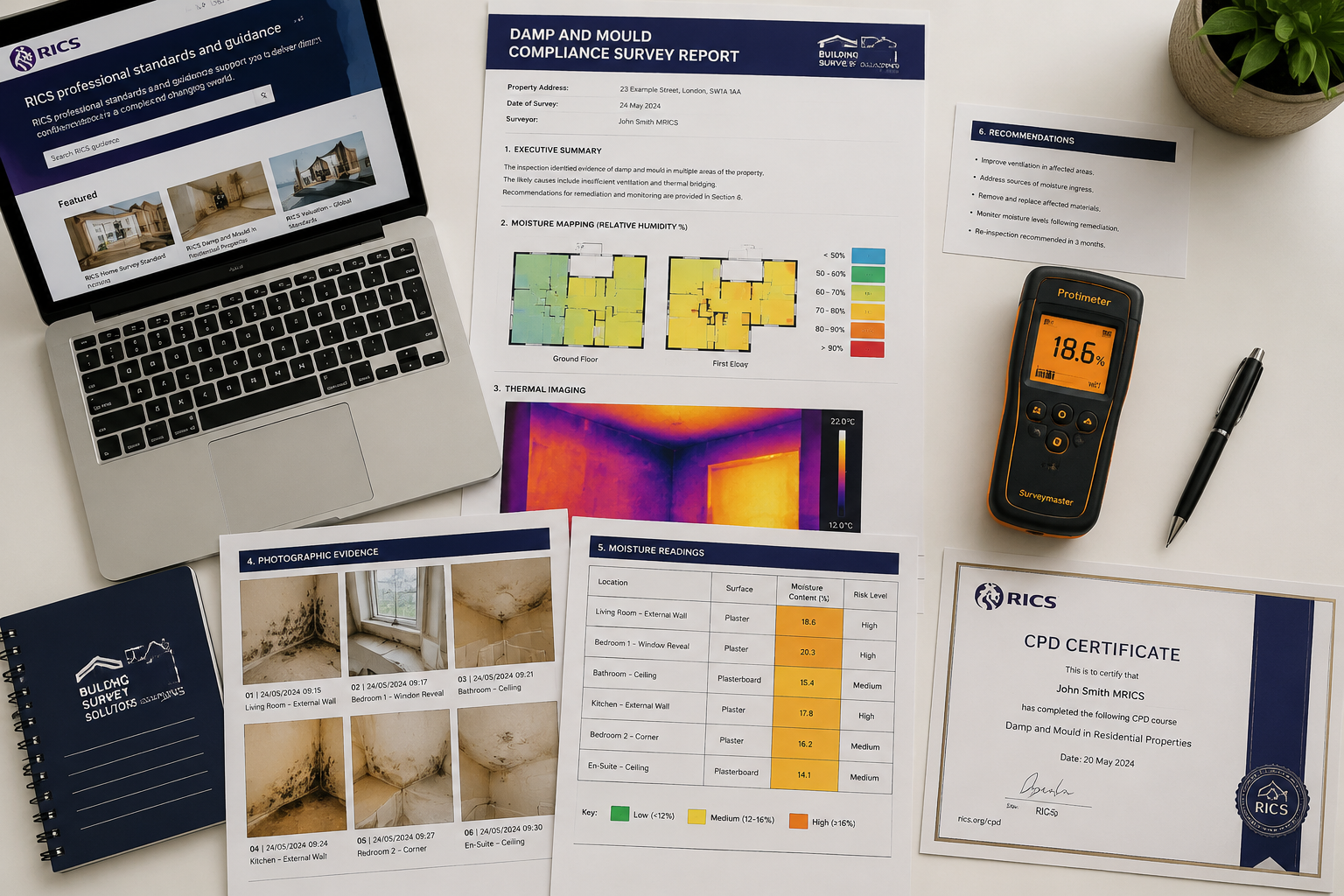
A compliant damp and mould survey in 2026 must go well beyond visual inspection. Professional surveys now require detailed assessments that include moisture mapping and root-cause analysis to comply with Awaab's Law and provide evidence suitable for legal proceedings [4].
A compliant survey report should include:
- Moisture mapping — systematic readings across all affected surfaces using calibrated instruments, recorded on a floor-plan overlay
- Root-cause analysis — distinguishing between condensation, rising damp, penetrating damp, and plumbing failures, each of which has different remediation requirements and different implications for landlord liability
- Time-stamped photographic evidence — images must be date-stamped and clearly labelled by location within the property
- Thermal imaging data — where cold bridging or hidden moisture is suspected, infrared thermography provides objective evidence
- Health risk assessment — an evaluation of the likely health impact of identified mould species, particularly for vulnerable occupants
- Remediation recommendations — specific, costed, and prioritised actions rather than generic advice
To understand what a fully structured damp assessment document looks like in practice, the damp survey London report: what it contains and how to get one provides a useful reference point for both surveyors and property owners.
Surveyors should also be aware that standardised reporting formats are now being adopted across the profession, incorporating detailed moisture maps, time-stamped photos, and clear recommendations as a baseline expectation rather than best practice [4].
The Expanded Hazard Categories from April 2026
A critical development that many surveyors have not yet fully absorbed is the expansion of Awaab's Law scope. As of April 2026, the legislation has been extended to include additional hazards beyond damp and mould, specifically electrical safety, fire risks, and excess heat [3]. This significantly broadens the assessment obligations for surveyors conducting compliance surveys.
The Housing Ombudsman's March 2026 report identified a clear training gap in relation to these new hazard categories, with many surveyors lacking the specific knowledge required to assess and report on excess cold, falls risk, and fire hazards to the standard the law now demands [5].
Surveyors must now assess and report on:
- Damp, condensation, and mould growth (original scope)
- Rising and penetrating damp
- Electrical installation safety hazards
- Fire risk factors including blocked escape routes and inadequate fire separation
- Excess heat and inadequate ventilation
- Excess cold and thermal efficiency failures
For surveyors considering the full scope of what a condition survey report must now cover under current legislation, the expanded hazard list represents a material change to survey scope and fee structures.
Awaab's Law, Damp and Mould: What Surveyors Must Demonstrate as Expert Witnesses
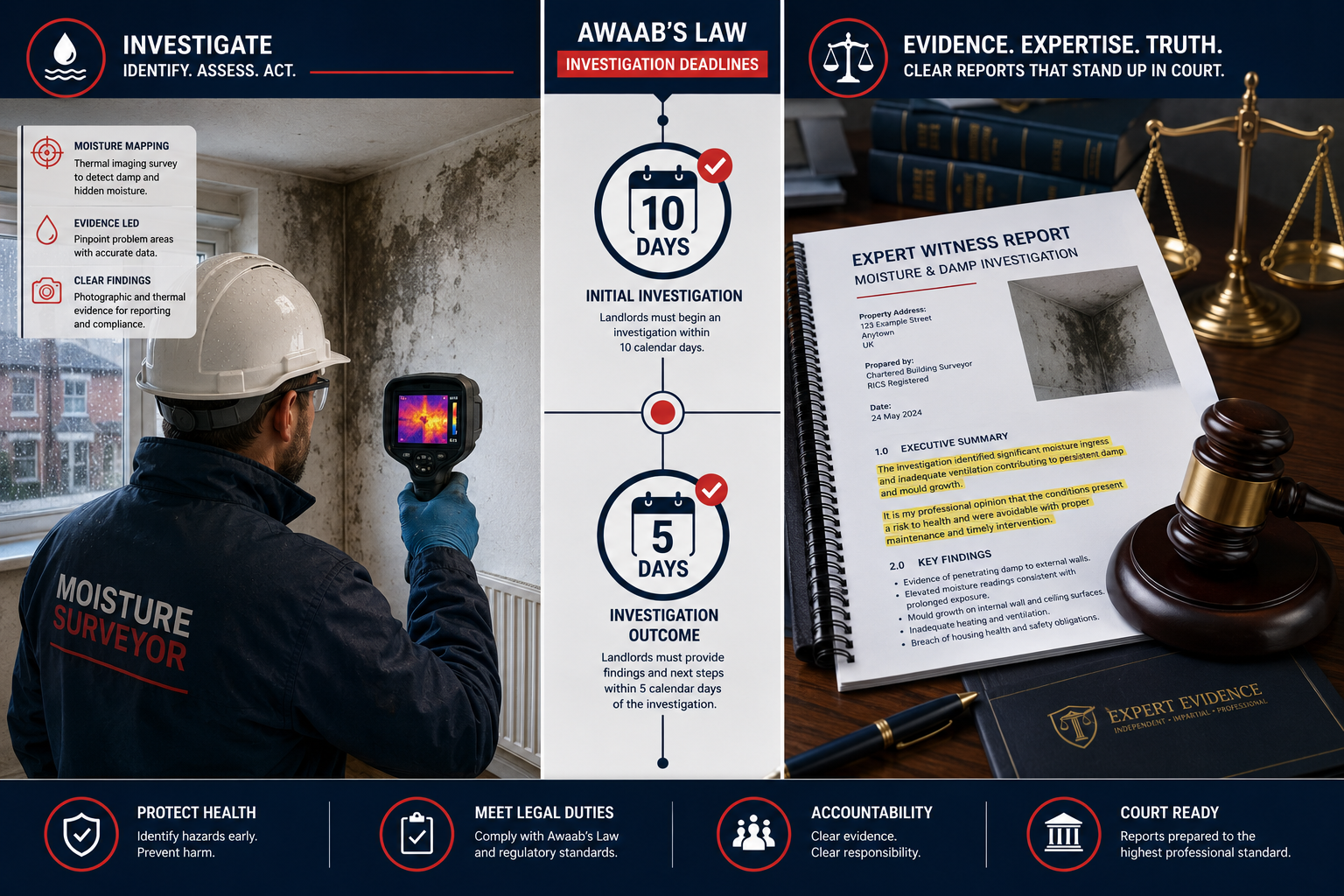
The second major dimension of Awaab's Law for surveyors is the expert witness role. Housing disrepair claims are increasing sharply in 2026, and courts are placing greater reliance on surveyor testimony to determine whether landlords have met their statutory obligations. The standards expected of expert witnesses in these cases have risen considerably.
Professional Qualifications and Credibility
Courts now demand that expert witnesses possess rigorous professional qualifications, including RICS accreditation and specialised knowledge in building pathology, to ensure credible testimony in housing disrepair cases [2]. An expert witness who cannot demonstrate current, relevant expertise risks having their evidence dismissed or given reduced weight.
Minimum credibility thresholds expected by courts in 2026:
- Full RICS membership with a relevant specialism (typically Building Surveying)
- Demonstrable experience in damp and mould investigations
- Knowledge of the RICS Damp in Buildings guidance and the Housing Health and Safety Rating System (HHSRS)
- Familiarity with the specific timescales and obligations under Awaab's Law
- No conflict of interest with either party
The increased demand for qualified surveyors with specialised expertise in damp, mould, and the newly included hazard categories reflects how significantly the legal landscape has shifted [3]. Surveyors who have historically offered expert witness services in general disrepair cases now need to demonstrate specific competence in the expanded hazard categories.
Evidence Standards: The Documentation Problem
One of the most significant findings from recent litigation analysis is the sheer volume of errors in expert witness submissions. Over 250 errors have been identified in recent expert witness report submissions in housing disrepair cases, highlighting the critical need for meticulous documentation [3].
Common errors include:
- Moisture readings taken without instrument calibration records
- Photographs without location references or timestamps
- Root-cause conclusions not supported by the evidence presented
- Failure to distinguish between pre-existing and new damage
- Recommendations that do not align with the identified cause
"An expert witness report that cannot be independently verified through its own evidence trail will be challenged — and in Awaab's Law cases, the consequences of a weak report fall on vulnerable tenants."
Surveyors preparing expert witness reports must treat every element of their documentation as potentially subject to cross-examination. This means maintaining a clear audit trail from initial inspection through to final conclusions.
The Duty to the Court vs. The Duty to the Client
Expert witnesses owe their primary duty to the court, not to the party that instructed them. In Awaab's Law cases, this principle is particularly important. A surveyor instructed by a social landlord to defend a disrepair claim must still report findings objectively, even where those findings are adverse to the instructing party. Equally, a surveyor instructed by a tenant must not overstate the severity of defects.
This independence requirement is non-negotiable under Civil Procedure Rules Part 35 and the accompanying Practice Direction. Surveyors who allow their conclusions to be shaped by client pressure risk professional sanctions from RICS and adverse judicial comment.
CPD, Training, and Staying Current in 2026
The professional obligations created by Awaab's Law do not end with completing a survey or filing a report. Surveyors acting as expert witnesses must engage in ongoing CPD to stay updated on evolving standards, including annual hours focused on housing legislation updates and participation in RICS working groups [2].
Recommended CPD priorities for surveyors in 2026:
- RICS-accredited training on the expanded Awaab's Law hazard categories
- Updated HHSRS assessment methodology
- Thermal imaging and moisture measurement instrument training
- Expert witness report writing workshops
- Housing Ombudsman case study reviews
The damp and timber report: pricing and what to expect resource is also useful for surveyors advising clients on the cost implications of comprehensive compliance surveys, which have increased in scope and therefore in cost since October 2025.
For surveyors who want to understand the broader context of why RICS accreditation matters in this environment, the why choose RICS surveyors page outlines the professional standards that underpin credibility in both survey and expert witness contexts.
Practical Implications for Surveyors Across Different Instruction Types
The obligations under Awaab's Law, damp and mould: what surveyors must now report in building surveys and as expert witnesses differ depending on the type of instruction received.
Pre-Purchase Building Surveys
Surveyors conducting Level 2 and Level 3 building surveys for prospective buyers are not directly bound by Awaab's Law, which applies to social landlords. However, the law has raised the general standard of expectation for damp reporting across the profession. Buyers and their solicitors are increasingly aware of what a thorough damp assessment should contain, and surveyors who produce inadequate reports face greater professional liability exposure.
For buyers uncertain about what a survey should cover before instructing one, what to do before an RICS home survey provides practical preparation guidance.
Social Housing Compliance Surveys
This is the primary arena in which Awaab's Law applies directly. Surveyors instructed by registered providers to conduct compliance surveys must produce reports that satisfy the investigation timescale requirements — a 10-working-day window from the date of tenant report to completed investigation [1]. Reports must be structured to support immediate decision-making by the landlord's repairs team.
The damp survey cost: average prices of a damp surveyor in London resource helps landlords and tenants understand the investment required for a compliant survey, which has grown in scope since the legislation took effect.
Expert Witness Instructions in Disrepair Claims
Surveyors acting as expert witnesses must ensure their reports are structured to meet Civil Procedure Rules requirements as well as the evidential standards now expected in Awaab's Law cases. The report must be self-contained, clearly reasoned, and supported by objective evidence gathered during the inspection [2][4].
Conclusion: Actionable Steps for Surveyors in 2026
Awaab's Law has fundamentally reshaped what is expected of surveyors in both building survey practice and expert witness roles. The law is not a temporary regulatory moment — it reflects a permanent shift in how housing hazards, particularly damp and mould, are treated under English law.
Surveyors should take the following steps without delay:
- Audit current survey templates against the reporting requirements outlined in this article and update them to include moisture mapping, root-cause analysis, and standardised photographic protocols.
- Review CPD records and identify gaps in training on the April 2026 expanded hazard categories, particularly electrical safety, fire risk, and excess heat.
- Obtain or renew RICS accreditation in building surveying with a focus on building pathology if acting or intending to act as an expert witness.
- Establish a clear audit trail for all damp and mould inspections, including instrument calibration records, site notes, and timestamped evidence.
- Understand the duty to the court — expert witnesses must be prepared to give independent, objective evidence regardless of who has instructed them.
- Stay informed on Housing Ombudsman case decisions and RICS guidance updates, both of which are shaping the practical application of Awaab's Law in 2026.
The surveyors who will serve their clients best — and protect themselves professionally — are those who treat the obligations created by Awaab's Law not as a compliance burden but as a framework for genuinely higher-quality practice.
References
[1] Awaabs Law Guidance For Tenants In Social Housing – https://www.gov.uk/government/publications/awaabs-law-guidance-for-tenants-in-social-housing/awaabs-law-guidance-for-tenants-in-social-housing?utm_source=openai
[2] Expert Witness Roles In Awaabs Law Disputes Evidence Standards For Damp Mould And New Hazards In 2026 – https://kingstonsurveyors.com/expert-witness-roles-in-awaabs-law-disputes-evidence-standards-for-damp-mould-and-new-hazards-in-2026/?utm_source=openai
[3] Expert Witness Challenges In Awaabs Law 2026 Disputes Testifying On Expanded Hazards In Rental Valuations – https://manchestersurveyors.com/expert-witness-challenges-in-awaabs-law-2026-disputes-testifying-on-expanded-hazards-in-rental-valuations/?utm_source=openai
[4] Mould Surveys – https://www.idealresponse.co.uk/awaabs-law/mould-surveys/?utm_source=openai
[5] Expert Witness Challenges In Awaabs Law 2026 Hazard Extensions Evidence Standards For Excess Cold Falls And Fire Risks – https://wimbledonsurveyors.com/expert-witness-challenges-in-awaabs-law-2026-hazard-extensions-evidence-standards-for-excess-cold-falls-and-fire-risks/?utm_source=openai
[6] Awaabs Law – https://www.rpclegal.com/thinking/construction/awaabs-law/?utm_source=openai
[7] Damp Mould Compliance Surveys – https://www.dampsafe.co.uk/damp-mould-compliance-surveys?utm_source=openai
[8] awaabs-law – https://awaabs-law.com/?utm_source=openai