
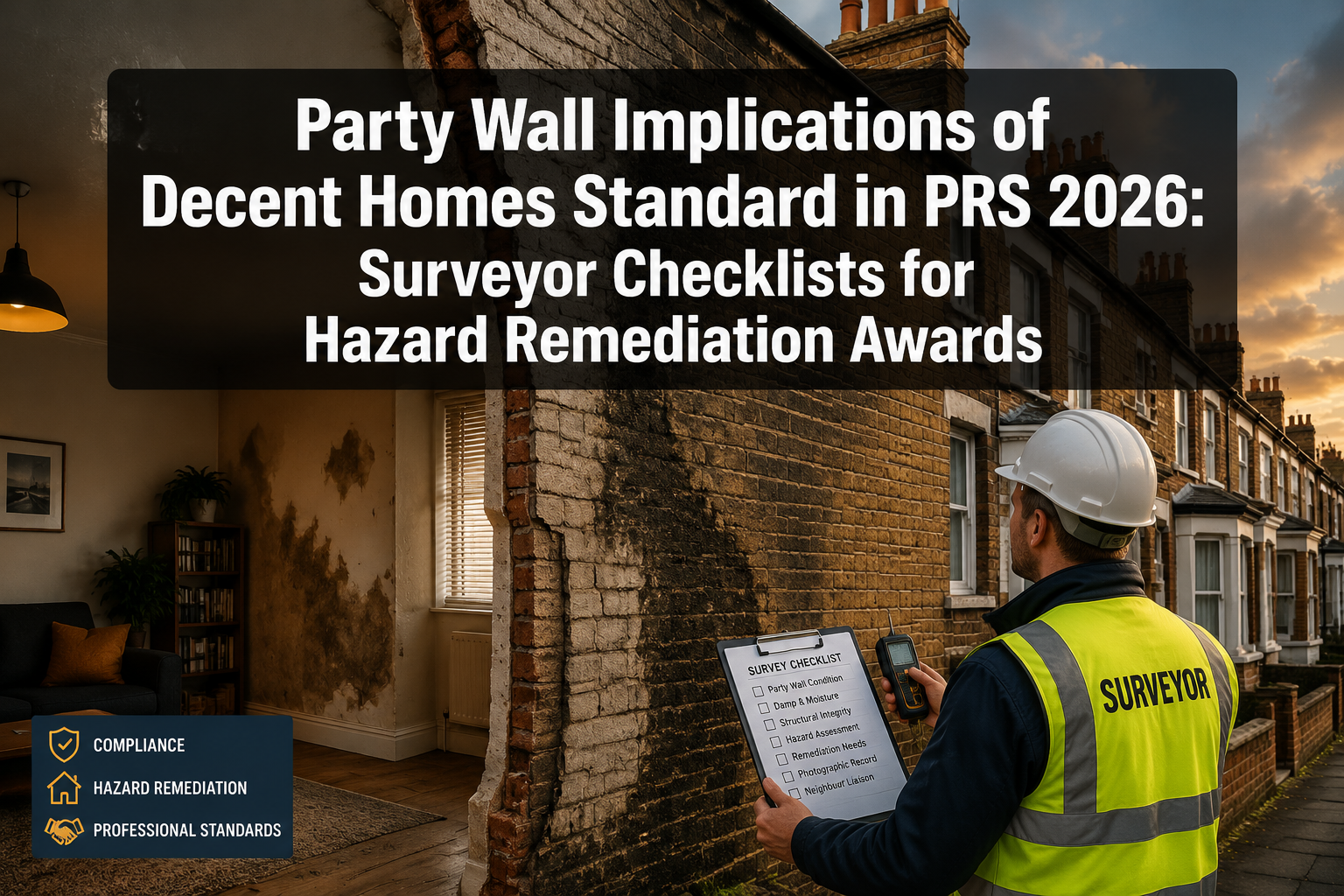
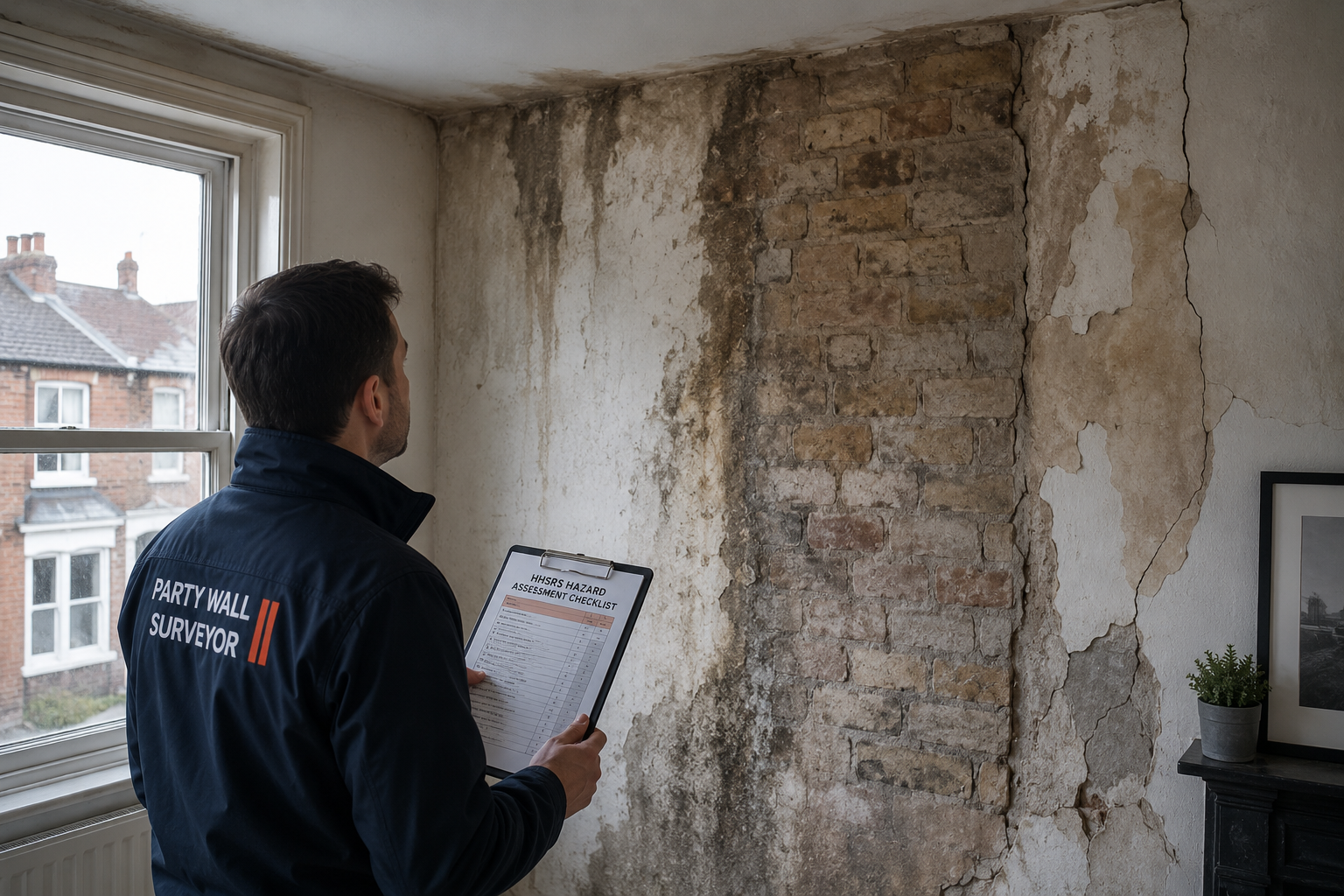
Roughly 4.6 million households in England rent privately, and a significant proportion of those homes share a party wall with a neighbouring property. When the government extended the Decent Homes Standard (DHS) to the private rented sector, it did not simply create a new landlord compliance checklist — it created a structural obligation that runs directly through the fabric of shared walls, floors, and foundations. Understanding the Party Wall Implications of Decent Homes Standard in PRS 2026: Surveyor Checklists for Hazard Remediation Awards is now essential for any surveyor drafting a party wall award where a rental property is undergoing hazard remediation work.
This guide addresses the intersection of two powerful regulatory frameworks: the Party Wall etc. Act 1996 and the reformed DHS. It covers how surveyors should draft awards when Awaab's Law-integrated upgrades are required, what timelines apply to electrical and hygiene fixes, and how adjoining owners must be protected throughout.
Key Takeaways
- The Decent Homes Standard now applies to all private rented properties in England, with full enforcement phased through to 2035 and energy standards required by 2030.
- Category 1 hazards under the Housing Health and Safety Rating System (HHSRS) — including damp, mould, and electrical defects — must be remediated within strict timescales under Awaab's Law provisions.
- Hazard remediation work in terraced or semi-detached PRS properties frequently triggers the Party Wall etc. Act 1996, requiring a formal party wall award before work begins.
- Surveyors drafting awards must incorporate DHS compliance timelines, adjoining owner protections, and a structured hazard remediation checklist.
- Non-compliance with the DHS can result in civil penalties of up to £40,000, making proactive surveyor engagement financially critical for landlords.
Why the Decent Homes Standard Creates Party Wall Obligations
The DHS was previously confined to social housing. Its extension to the private rented sector marks one of the most significant shifts in English housing regulation in decades [1]. A property now qualifies as "decent" only if it meets four cumulative criteria: it must be free from Category 1 hazards under the HHSRS; it must be in a reasonable state of repair; it must offer reasonably modern facilities; and it must provide a reasonable degree of thermal comfort [2].
The critical point for surveyors is that many of the works required to meet these criteria — damp-proofing, electrical rewiring, structural repairs, insulation installation — are precisely the type of works that affect or are carried out near party walls. Under the Party Wall etc. Act 1996, any work that involves cutting into, building on, or otherwise affecting a party wall or structure requires a party wall notice and, where the adjoining owner does not consent, a formal award issued by an agreed or appointed surveyor.
The overlap is not incidental. A landlord ordered to remediate a Category 1 damp hazard in a mid-terrace rental property may need to:
- Hack off plaster from a party wall to treat rising damp
- Install a new damp-proof course that penetrates the party wall
- Replace joists bearing on a party wall
- Upgrade electrical wiring running through a party wall cavity
Each of these activities can engage Section 2 of the Party Wall etc. Act 1996. Surveyors must therefore approach DHS-driven remediation with a dual-framework mindset. For a clear overview of what this role entails in practice, see this guide on what a party wall surveyor does and their duties to homeowners.
Awaab's Law and Its Remediation Timescales
Awaab's Law — named after Awaab Ishak, the two-year-old who died in 2020 from prolonged exposure to mould in a social housing property — has been integrated into the DHS framework. Under the reformed standard, landlords must investigate hazard complaints within 14 days, begin repairs within a further 7 days if a health risk is identified, and complete emergency repairs within 24 hours where an immediate danger exists [5].
These timescales are legally binding and enforceable. They create a direct tension with the Party Wall etc. Act 1996, which requires a minimum one-month notice period before most notifiable works can begin. Surveyors drafting awards in this context must understand how to reconcile urgent remediation obligations with the procedural requirements of party wall law.
Surveyor Checklists for Hazard Remediation Awards Under the DHS
The Party Wall Implications of Decent Homes Standard in PRS 2026: Surveyor Checklists for Hazard Remediation Awards framework requires surveyors to be systematic. A well-drafted award in this context must do more than record the scope of works — it must actively protect the adjoining owner while facilitating the landlord's compliance with statutory remediation deadlines.
Pre-Award Assessment Checklist
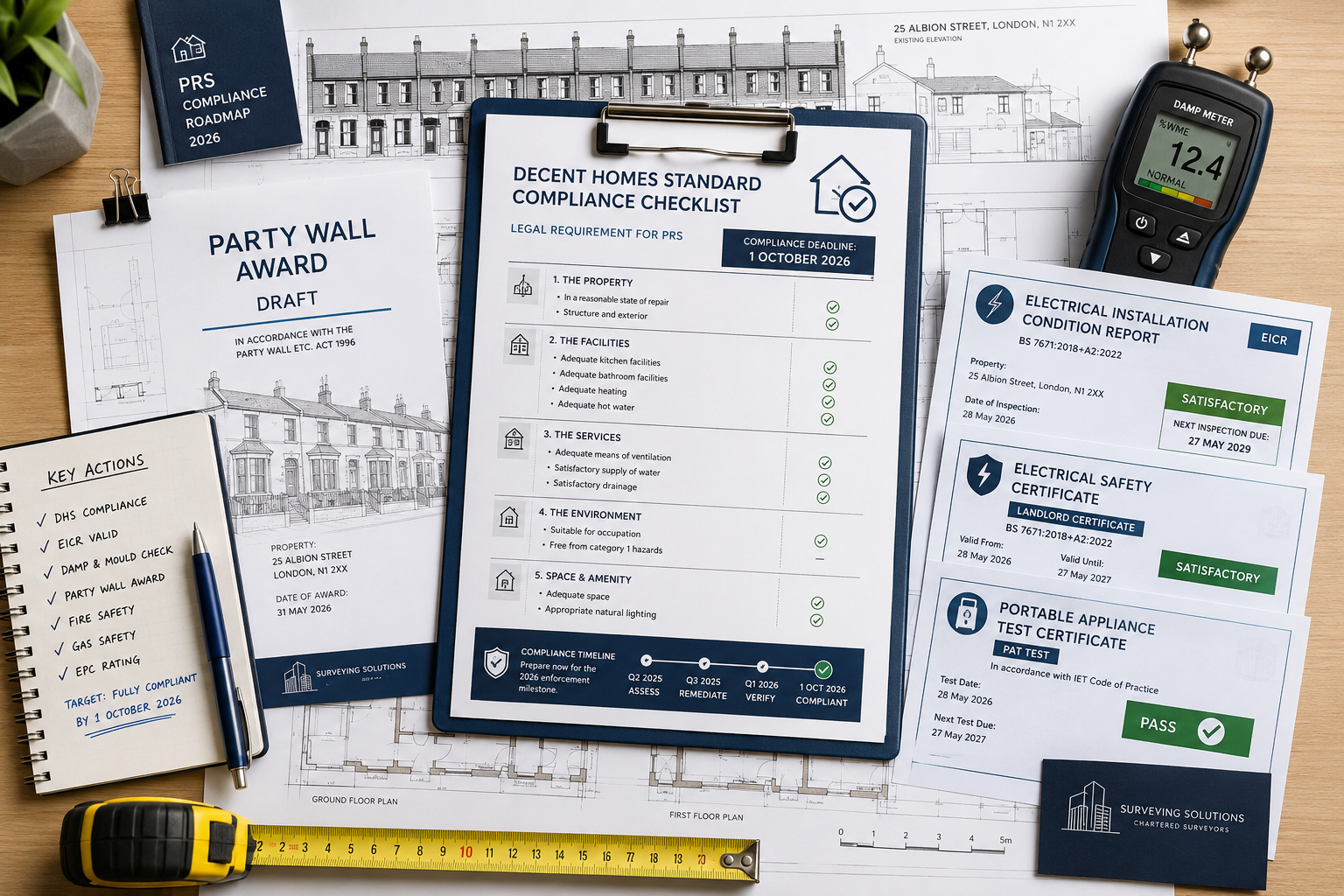
Before drafting an award, the surveyor should complete the following assessment steps:
| Assessment Area | Key Questions | Relevant DHS Criterion |
|---|---|---|
| Structural condition of party wall | Cracks, movement, defects? | Reasonable state of repair |
| Damp and mould presence | Category 1 HHSRS hazard? | Free from Category 1 hazards |
| Electrical installations | Age, condition, compliance? | Reasonably modern facilities |
| Thermal performance | Insulation, heating system? | Thermal comfort |
| Adjoining property condition | Risk of damage from works? | Adjoining owner protection |
Structural integrity is the starting point. The surveyor must record the existing condition of the party wall with a schedule of condition before any DHS-driven works begin. This protects both the building owner (the landlord) and the adjoining owner from disputed claims about damage caused during remediation.
Hazard identification must be documented using the HHSRS scoring system. Category 1 hazards carry the highest risk ratings and trigger mandatory remediation obligations. Common Category 1 hazards found in PRS properties include damp and mould growth, excess cold, electrical hazards, and structural collapse risk [6]. A thorough damp survey is often an essential precursor to any party wall award in this context.
Drafting the Award: Core Components
A party wall award for DHS hazard remediation work should contain the following elements:
-
Identification of notifiable works: Specify precisely which works engage the Party Wall etc. Act 1996 and which are being carried out solely to meet DHS obligations.
-
Schedule of condition: A photographic and written record of the party wall and adjoining property before works begin.
-
Method statement: How works will be carried out, including sequencing, materials, and dust/noise mitigation measures.
-
DHS compliance timeline: The award should acknowledge the statutory remediation deadlines imposed by Awaab's Law and the DHS, and where possible, the agreed programme should reflect these.
-
Adjoining owner protections: Hours of working, notification requirements, access arrangements, and reinstatement obligations.
-
Security for expenses: Where significant structural work is involved, the award may require the building owner to provide security for the adjoining owner's potential losses.
-
Dispute resolution mechanism: A clear process for raising concerns during the works.
Key principle: A party wall award is not merely procedural. In the context of DHS remediation, it is the primary legal instrument protecting an adjoining owner from the consequences of urgent works they had no role in triggering.
For a broader understanding of what these agreements involve and how costs are structured, the guide to party wall agreements and the costs involved provides useful background.
Electrical and Hygiene Fix Timelines: Navigating the Tension
The 14-day investigation and 7-day repair commencement requirements under Awaab's Law create genuine procedural challenges when party wall notices are required. The Party Wall etc. Act 1996 does not contain an emergency bypass provision for regulatory compliance.
Surveyors and landlords must therefore act early. The recommended approach is:
- Serve party wall notices at the first sign of a hazard complaint, not after the HHSRS assessment is complete.
- Seek adjoining owner consent (a "party wall agreement by consent") to eliminate the statutory notice period entirely. A consenting adjoining owner allows works to begin immediately.
- Where consent is refused, appoint surveyors promptly so that an award can be issued within the shortest possible timeframe. In straightforward cases, an award can be issued within two to three weeks of surveyor appointment.
- Document the regulatory context in the award itself, noting that the works are required to comply with the DHS and Awaab's Law obligations.
This proactive approach also reduces the landlord's exposure to the significant financial penalties that apply under the DHS. Local authorities can impose fines of up to £40,000 for serious non-compliance and immediate civil penalties of up to £7,000 for failures to act within prescribed timescales [5].
Protecting Adjoining Owners: The Surveyor's Duty in PRS Remediation Cases
The Party Wall Implications of Decent Homes Standard in PRS 2026: Surveyor Checklists for Hazard Remediation Awards framework places the surveyor in a unique position. Unlike a standard party wall dispute arising from an extension or loft conversion, DHS-driven remediation cases involve a landlord who is legally compelled to act. The adjoining owner — who may also be a private tenant or an owner-occupier — has no obligation under the DHS and yet faces disruption and potential damage to their property.

The appointed surveyor's duty is to both parties. This means:
- Not allowing urgency to override the adjoining owner's rights. Even where Awaab's Law timescales are pressing, the award must still provide adequate protection.
- Ensuring reinstatement is fully specified. If a party wall is opened up to treat damp or replace wiring, the award must specify exactly how and when it will be made good.
- Considering consequential impacts. DHS works in one property can affect thermal performance, acoustic insulation, or structural behaviour in the adjoining property. The award should address these risks explicitly.
Surveyors working across London's high-density rental stock — particularly in areas such as Islington, Battersea, and Ealing — will encounter these scenarios with increasing frequency as the DHS enforcement regime matures.
The RPC's 'Red' Rating: What It Means for Surveyors
On 18 February 2026, the Regulatory Policy Committee issued a 'red' rating for the government's impact assessment of the DHS, indicating that the supporting evidence and analysis were considered "not fit for purpose" [3]. This rating does not affect the legal force of the DHS itself, but it does signal that the policy's cost implications — particularly for landlords of older stock — may be more significant than the government's own modelling suggests [8].
For surveyors, this matters because it increases the likelihood of disputes about the scope and cost of remediation works. Awards that are clearly drafted, well-evidenced, and grounded in the HHSRS framework will be harder to challenge and will better protect all parties.
Compliance Timeline Summary
| Requirement | Deadline |
|---|---|
| Full DHS compliance (PRS) | 2035 |
| Minimum Energy Efficiency Standards (EPC Band C) | 2030 |
| Awaab's Law: hazard investigation | 14 days from complaint |
| Awaab's Law: repair commencement | 7 days after investigation |
| Awaab's Law: emergency repairs | 24 hours |
| Party wall notice period (standard) | 1 month (Section 2 works) |
| Party wall notice period (new wall on boundary) | 1 month |
| Party wall notice period (excavation) | 1 or 2 months |
Sources: [2], [4], [5]
For surveyors who want to understand how to approach the broader survey process before party wall work begins, the resource on what to do before an RICS home survey offers practical preparation guidance.
Practical Steps for Surveyors Drafting DHS-Integrated Awards
The following checklist consolidates best practice for surveyors handling party wall awards in PRS properties undergoing DHS hazard remediation in 2026.
Before the award is drafted:
- Confirm which works are notifiable under the Party Wall etc. Act 1996
- Obtain a copy of the HHSRS hazard assessment and any local authority enforcement notice
- Carry out a schedule of condition of the party wall and adjoining property
- Confirm whether Awaab's Law timescales apply and document them
- Seek adjoining owner consent to expedite the process
In the award:
- Reference the DHS and HHSRS framework explicitly
- Include the full method statement for hazard remediation works
- Set out a realistic programme that acknowledges statutory deadlines
- Specify reinstatement obligations in detail
- Include access provisions for post-works inspection
- Address security for expenses where appropriate
After the award is issued:
- Monitor works for compliance with the award
- Conduct a post-works inspection of the party wall
- Issue any supplementary award if unforeseen works become necessary
- Retain records for a minimum of six years
For surveyors who are new to this area or who want to benchmark their fees, the cost of party wall surveyor services in London provides a useful reference point. A deeper look at the full range of party wall surveyor services is also available at Wimbledon Surveyors' party wall services page.
Conclusion
The extension of the Decent Homes Standard to the private rented sector has created a new and complex intersection between housing quality regulation and party wall law. For surveyors, the Party Wall Implications of Decent Homes Standard in PRS 2026: Surveyor Checklists for Hazard Remediation Awards framework is not a theoretical concern — it is an active practice challenge that will intensify as enforcement ramps up toward the 2035 compliance deadline.
Actionable next steps for surveyors:
- Update standard award templates to include DHS and HHSRS references and Awaab's Law timescale provisions.
- Develop a pre-award checklist that specifically addresses Category 1 hazard remediation scenarios.
- Build relationships with local authority environmental health officers to receive early notification of enforcement actions in properties with party walls.
- Advise landlord clients to serve party wall notices at the earliest possible stage — ideally as soon as a hazard complaint is received.
- Ensure schedules of condition are comprehensive and photographic, given the increased likelihood of disputes in urgent remediation cases.
- Stay current with RPC guidance and any revisions to the DHS impact assessment, as the policy framework may be refined before full enforcement begins.
The surveyor who understands both frameworks — and drafts awards that actively serve the interests of all parties while facilitating lawful compliance — will be indispensable in the evolving PRS landscape of 2026 and beyond.
References
[1] The New Decent Homes Standard Policy Statement – https://www.gov.uk/government/consultations/consultation-on-a-reformed-decent-homes-standard-for-social-and-privately-rented-homes/outcome/the-new-decent-homes-standard-policy-statement
[2] Decent Homes Standard PRS 2026 Landlord Guide – https://letcompliance.com/blog/decent-homes-standard-prs-2026-landlord-guide
[3] RPC Opinion: Decent Homes Standard Impact Assessment – https://www.gov.uk/government/publications/rpc-opinion-decent-homes-standard-impact-assessment
[4] An Updated Decent Homes Standard – https://homeless.org.uk/areas-of-expertise/improving-homelessness-services/regulation-of-homelessness-services/an-updated-decent-homes-standard/
[5] The New Decent Homes Standard: What Landlords and Tenants Need to Know – https://gowlingwlg.com/en-gb/insights-resources/articles/2026/the-new-decent-homes-standard-what-landlords-and-tenants-need-to-know
[6] Decent Homes Standard PRS Landlord Compliance Checklist – https://www.propertytaxpartners.co.uk/blog/landlord-tax-essentials/decent-homes-standard-prs-landlord-compliance-checklist
[7] Decent Homes Standard Landlord Guide – https://selflandlord.com/guides/decent-homes-standard-landlord/
[8] Decent Homes Standard Rated Not Fit For Purpose – https://blog.goodlord.co/decent-homes-standard-rated-not-fit-for-purpose