
Across England and Wales, a significant wave of ex-rental properties is entering the sales market in 2026. Landlords exiting the private rented sector — driven by higher mortgage costs, tightened energy performance requirements, and regulatory pressure — are listing stock that has often endured years of intensive occupation with minimal capital investment. For buyers, these properties can represent genuine value. But the gap between asking price and true cost can be substantial, and only rigorous building survey protocols for 2026 ex-rental properties can close that gap reliably.
This article sets out what buyers, investors, and their advisors need to know when assessing repurposed rental stock: the hidden defects to anticipate, the survey levels that apply, and the protocols that separate a sound purchase from a costly mistake.
Key Takeaways
- Ex-rental properties entering the 2026 sales market frequently carry deferred maintenance, compliance gaps, and wear patterns that standard visual inspections miss.
- A RICS Level 3 building survey is the recommended assessment tool for most ex-rental stock, particularly older, non-standard, or converted properties.
- Non-standard construction types — including PRC systems and RAAC panels — require specialist identification before mortgage applications proceed.
- Interior inspections must follow a systematic, room-by-room protocol covering damp, electrics, heating, ventilation, and structural movement.
- Defect schedules produced by a qualified surveyor provide negotiating leverage and help buyers avoid post-completion financial surprises.

Why Ex-Rental Stock Demands a Different Survey Approach
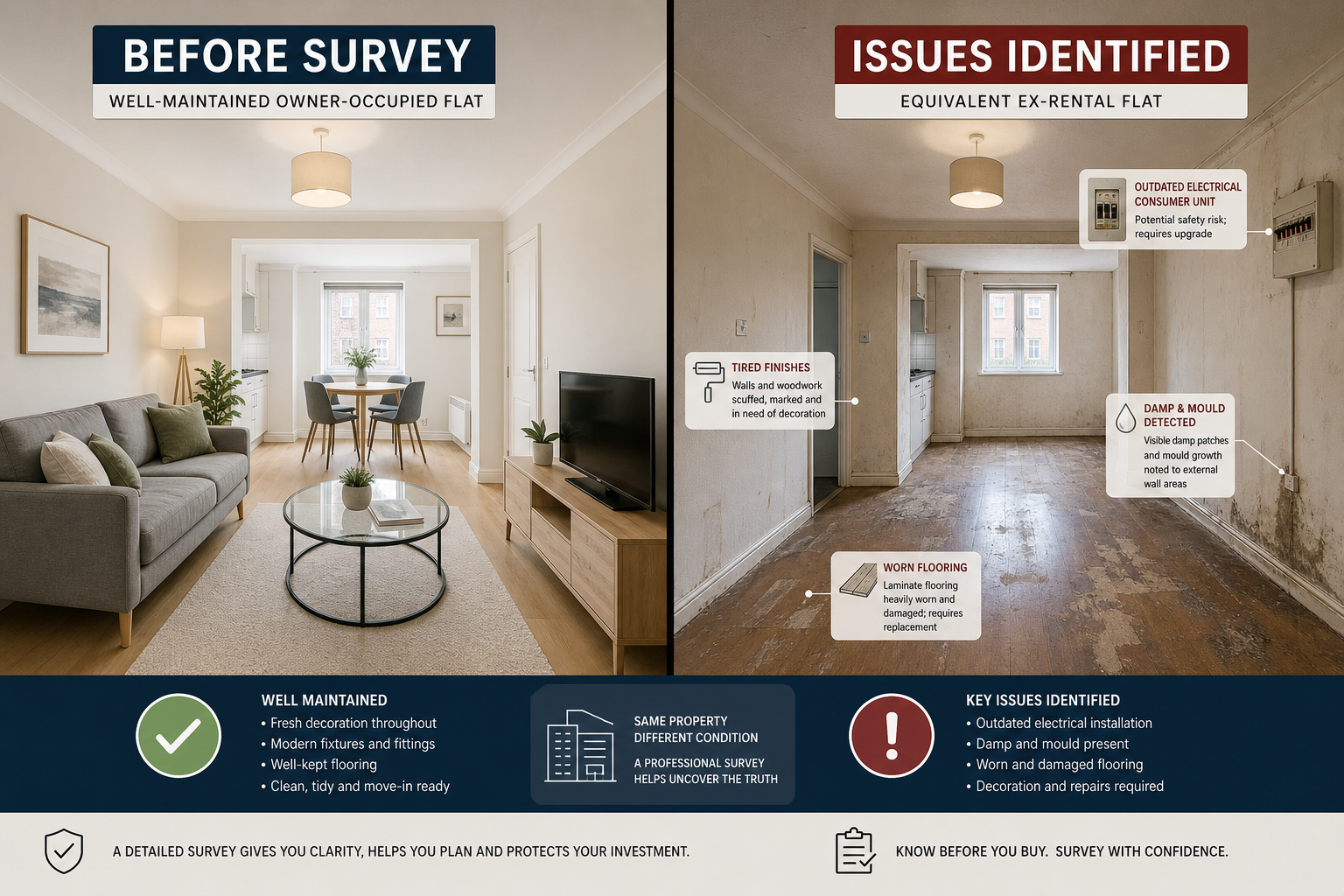
Not all properties carry the same risk profile. An owner-occupied home where the same family has lived for twenty years tends to show a different pattern of wear than a flat that has cycled through multiple tenancies over the same period. Ex-rental properties present a distinct set of challenges that standard homebuyer surveys are not always calibrated to catch.
Deferred maintenance is the most consistent feature of rental stock entering the market. Landlords operating on thin margins often prioritise cosmetic upkeep — fresh paint, new carpets — over structural or mechanical investment. This means that behind a presentable surface, surveyors routinely find:
- Aging electrical consumer units that do not meet current standards
- Boiler systems beyond their serviceable lifespan
- Unresolved damp penetration masked by recent redecoration
- Roof coverings and rainwater goods that have not been maintained
The building survey protocols for 2026 ex-rental properties must therefore go deeper than a visual walkthrough. Surveyors need to probe beneath surface finishes, test moisture levels systematically, and assess mechanical systems against current compliance benchmarks.
Compliance gaps add another layer of complexity. Rental properties were subject to landlord-specific regulations — gas safety certificates, electrical installation condition reports, and energy performance requirements — but these do not guarantee that underlying defects were remedied rather than simply managed. A gas safety certificate confirms the boiler was tested; it does not confirm the flue is in good condition or that the heating system is fit for long-term use.
For buyers considering ex-council properties specifically, the risks extend further. Properties built using Prefabricated Reinforced Concrete (PRC) systems are typically unmortgageable without a structural repair certificate from an approved repair scheme [1]. Identifying the construction type at the earliest possible stage is essential, because it directly affects mortgage availability and insurance terms.
Properties constructed with Reinforced Autoclaved Aerated Concrete (RAAC) panels present a separate but equally serious concern. Government-mandated remediation timelines are now in effect, and any property suspected of containing RAAC requires a specialist structural assessment before purchase proceeds [8].
Understanding what a building surveyor does in these scenarios — and why their expertise goes beyond a simple inspection — is the first step toward making an informed decision.
Choosing the Right Survey Level for Repurposed Rental Stock
The survey level selected will determine how much information a buyer receives and, ultimately, how well-protected they are. For ex-rental properties, the choice is rarely straightforward.
RICS Level 2 vs Level 3: Understanding the Difference
A RICS Level 2 Homebuyer Survey provides a condition rating for visible elements and flags significant defects, but it does not include a detailed analysis of construction methods, latent defects, or costed repair schedules. For a well-maintained, modern property in standard construction, this level may be adequate.
For most ex-rental stock — particularly properties built before 1980, those with non-standard construction, or those that have been converted from another use — a RICS Level 3 building survey is the appropriate choice. This level provides:
- A comprehensive analysis of structural integrity
- Identification of latent defects not visible to the naked eye
- Specific advice on construction methods and materials
- A costed schedule of repairs where defects are found
- Guidance on further specialist investigations required
For properties with potential structural risks, a Level 3 survey is strongly recommended to provide a comprehensive analysis and identify latent defects [3]. In post-recession and recovery markets, these surveys also function as risk-management tools, with costed defect schedules supporting price negotiation and due diligence [10].
Buyers who are uncertain about which level applies to their target property can use a guide to choosing the right home survey as a starting point before engaging a surveyor directly.
When a Specialist Report Is Also Needed
A building survey, even at Level 3, operates within defined scope. Where specific risks are identified or suspected, additional specialist reports are often necessary:
| Risk Identified | Specialist Report Required |
|---|---|
| Suspected PRC construction | Structural engineer with PRC scheme approval |
| RAAC panel presence | Structural engineer with RAAC experience |
| Active damp or timber decay | Specialist damp and timber survey |
| Electrical system concerns | NICEIC-registered electrician's report |
| Drainage issues | CCTV drainage survey |
| Asbestos-containing materials | Asbestos management survey |
Older properties present particular challenges. Solid wall construction, lime mortar, and historic ventilation systems require specific repair approaches to prevent condensation and dampness from worsening [4]. A surveyor unfamiliar with traditional materials may miss the significance of what they observe.
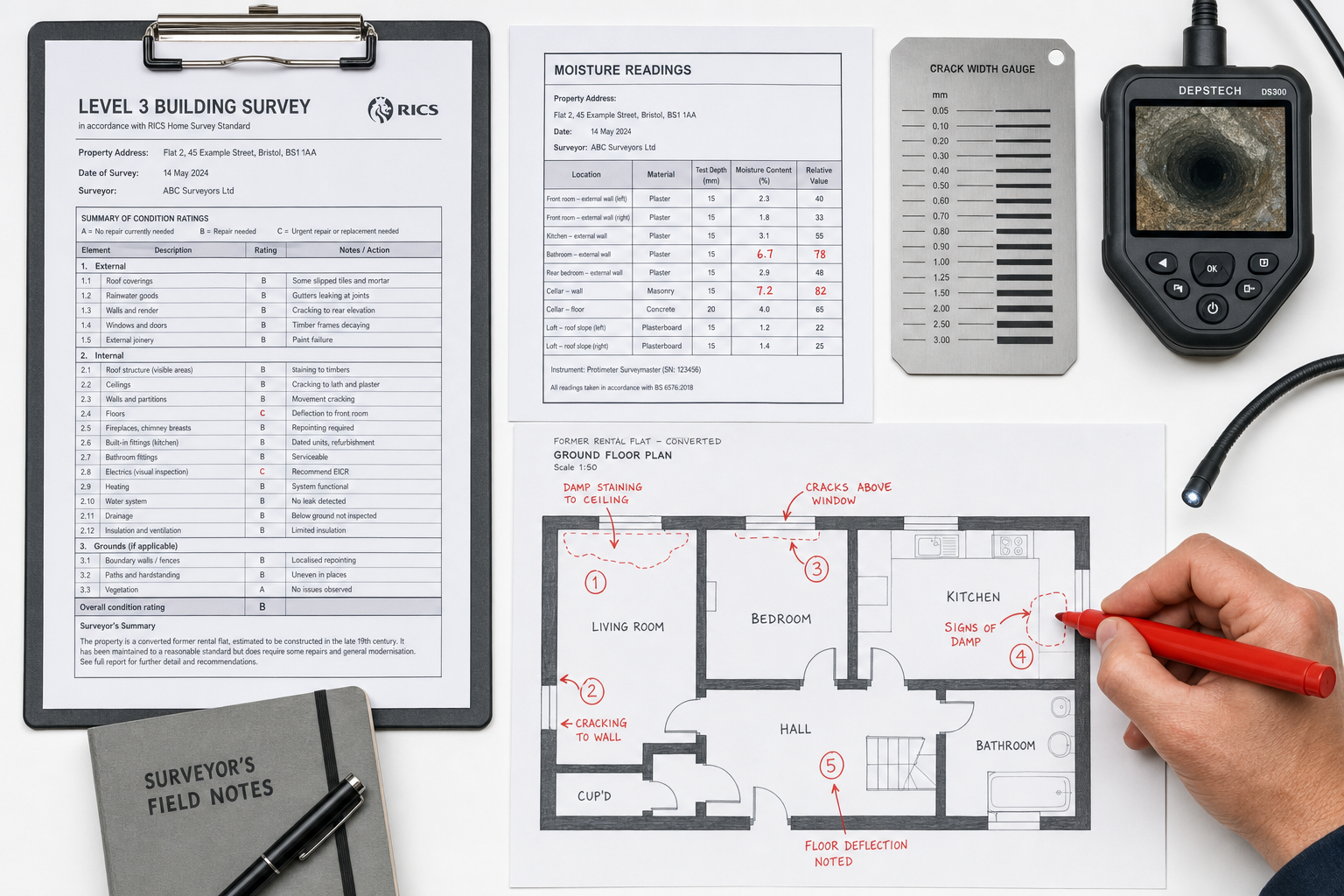
Core Building Survey Protocols for 2026 Ex-Rental Properties: The Inspection Framework
Effective building survey protocols for 2026 ex-rental properties follow a structured sequence. The framework below reflects best practice for assessing repurposed rental stock systematically and thoroughly.
Exterior Assessment Protocol
The exterior inspection establishes the property's first line of defence against water ingress and structural movement. Surveyors should assess the following in sequence:
Roof covering and structure
- Condition of tiles, slates, or flat roof membrane
- Ridge and hip tiles, verge details, and flashings
- Chimney stacks, pots, and pointing
- Evidence of sagging, deflection, or previous repairs
Roof defects are among the most common and costly findings in ex-rental stock. A detailed roof inspection checklist provides useful context for what surveyors look for at this stage.
Rainwater goods
- Gutters, downpipes, and hoppers for blockage, corrosion, or displacement
- Evidence of overflowing water at wall junctions
- Condition of soakaways or connections to drainage
External walls
- Masonry condition, pointing, and any evidence of spalling
- Render adhesion and crack patterns
- Evidence of movement, bulging, or bowing
- Damp-proof course condition and ground levels
Ground drainage and external environment
- Condition of paths, drives, and boundary structures
- Evidence of subsidence or ground movement
- Proximity of trees to foundations
A thorough inspection should include assessments of the roof, rainwater goods, walls, openings, and ground drainage to identify potential issues such as water ingress and structural defects [2].
Interior Room-by-Room Protocol
Internal inspections must be systematic. Working from top to bottom — loft space first, then floor by floor — the surveyor should assess each room against a consistent checklist.
Loft and roof space
- Structural timbers for decay, insect attack, or inadequate sizing
- Insulation levels and condition
- Evidence of water ingress at roof penetrations
- Ventilation adequacy
Each habitable room
- Ceilings: staining, cracking, sagging, or evidence of previous leaks
- Walls: cracking patterns (distinguish between settlement and structural movement), damp staining, and evidence of condensation
- Floors: deflection, squeaking, or soft spots indicating decay beneath
- Windows and doors: condition, draught-proofing, and compliance with current fire escape requirements
- Joinery: condition of skirting boards, architraves, and built-in storage
Services and mechanical systems
- Heating: boiler age, condition, and flue integrity
- Electrical: consumer unit type, visible wiring condition, and socket provision
- Ventilation: extractor fans in kitchens and bathrooms, and evidence of chronic condensation
Internal inspections should systematically evaluate ceilings, walls, floors, windows, doors, joinery, heating, ventilation, and visible electrical components to detect defects and maintenance needs [2].
"The difference between a thorough survey and a superficial one is most visible in ex-rental properties. Deferred maintenance hides behind fresh decoration, and only systematic probing reveals what lies beneath."
Damp and Timber: The Hidden Risk Category
Damp and timber defects are disproportionately common in ex-rental stock. The reasons are straightforward: ventilation is often inadequate in densely occupied properties, maintenance of gutters and drainage is frequently neglected, and damp-proof courses can be bridged by raised ground levels or accumulated debris.
Surveyors should use calibrated moisture meters at all vulnerable locations — below windows, at ground-floor wall bases, around chimney breasts, and at any location showing staining or discolouration. Where elevated moisture readings are found, further investigation is essential before any remediation cost estimates can be provided.
Timber elements — floor joists, roof timbers, window frames, and door frames — should be probed for softness indicating decay. In properties with suspended timber ground floors, access to the sub-floor void should be sought to assess joist condition and ventilation.
For buyers who receive a report flagging damp or timber issues, understanding what to do after a bad building survey report is the critical next step.
Valuation Discounts, Negotiation, and the Financial Case for Thorough Surveys
The financial case for commissioning a comprehensive survey on ex-rental stock is compelling. The cost of a Level 3 building survey is modest relative to the potential repair costs it can identify — and relative to the negotiating leverage a costed defect schedule provides.
Typical Defect Categories and Cost Ranges
| Defect Category | Typical Repair Cost Range |
|---|---|
| Roof re-covering (mid-terrace) | £5,000 – £15,000 |
| Rewiring (2-bed flat) | £3,500 – £6,000 |
| Boiler replacement | £2,000 – £4,500 |
| Damp-proof course injection | £1,500 – £4,000 |
| Window replacement (per unit) | £500 – £1,500 |
| Structural crack investigation and repair | £2,000 – £20,000+ |
A survey that identifies £15,000 of necessary repairs provides a clear basis for renegotiating the purchase price — or for walking away from a transaction that does not stack up financially. Buyers who proceed without a survey have no such leverage and absorb all costs post-completion.
For properties sold at auction — a common route for ex-rental stock in poor condition — conducting a pre-auction survey is critical to assess risks, repair costs, and determine the property's value [5]. Auction purchases are typically unconditional, meaning there is no opportunity to renegotiate after the hammer falls.
The Cost of Not Surveying
The argument that surveys are an unnecessary expense does not withstand scrutiny when applied to ex-rental stock. Properties that have been let for extended periods without capital investment routinely carry defects that cost multiples of the survey fee to remedy.
Saving money with building surveys is not a theoretical proposition — it is a documented outcome for buyers who use survey findings to negotiate, plan remediation budgets, or avoid unsuitable purchases altogether.
Special Considerations for Converted and Non-Standard Ex-Rental Stock
Not all ex-rental properties are straightforward residential units. A growing proportion of 2026 sales stock includes properties that were originally built for other purposes or constructed using non-standard methods.
Office-to-Residential Conversions
The conversion of commercial buildings to residential use has accelerated in recent years. These properties present specific survey challenges: deep floor plates that restrict natural light and ventilation, structural systems designed for commercial loads rather than residential use, and mechanical and electrical systems that may have been partially adapted rather than fully replaced [6].
Survey protocols for converted properties should include assessment of:
- Structural frame condition and adequacy for residential loads
- Ventilation strategy, particularly for units without external-facing windows
- Fire compartmentation and means of escape
- Acoustic separation between units
- Adequacy of natural light to all habitable rooms
Ex-Council Properties and Right to Buy Stock
Ex-council properties purchased under Right to Buy schemes and subsequently let carry a particular combination of risks: original construction methods that may include PRC or other non-standard systems, concrete deterioration, and outdated services [7]. A Level 3 building survey is the minimum appropriate assessment for this category of property.
Where PRC construction is confirmed, the property is typically unmortgageable without a structural repair certificate from an approved scheme [1]. Buyers should establish construction type before progressing a purchase, as this affects both finance and insurability.
Pre-Exchange Surveys to Reduce Transaction Risk
Conducting a Level 3 survey before exchanging contracts allows buyers to identify structural issues, make informed decisions, and reduce the risk of transaction failure [9]. In a cautious 2026 buyer market, this approach has become increasingly standard practice among experienced purchasers of ex-rental and repurposed stock.
Buyers in London and surrounding areas can access qualified local building surveyors with specific experience of the property types common in their target area.
Conclusion
The building survey protocols for 2026 ex-rental properties outlined in this article reflect a straightforward reality: repurposed rental stock carries a higher-than-average risk of deferred maintenance, compliance gaps, and hidden defects. Buyers who approach these properties with the same level of due diligence applied to well-maintained owner-occupied homes are taking an unnecessary risk.
Actionable next steps for buyers considering ex-rental stock:
- Establish construction type before commissioning a survey — non-standard construction affects mortgage availability and survey scope.
- Commission a RICS Level 3 building survey for any ex-rental property built before 1980, of non-standard construction, or showing visible signs of deferred maintenance.
- Request a costed defect schedule as part of the survey output — this is the basis for price negotiation.
- Follow up with specialist reports wherever the building surveyor identifies areas requiring further investigation.
- For auction purchases, arrange a pre-auction survey before bidding — unconditional contracts leave no room for post-purchase renegotiation.
- Use the survey findings to plan a realistic remediation budget, not just to negotiate price.
The cost of a thorough survey is always proportionate to the risk it mitigates. In a market where ex-rental properties are entering sales stock in significant volume, the protocols set out here represent the minimum standard of due diligence for any serious buyer.
References
[1] Survey Ex Council House Selling – https://getpine.co.uk/guides/survey-ex-council-house-selling?utm_source=openai
[2] Landlord Property Inspection Checklist – https://www.surveymerchant.com/blog/landlord-property-inspection-checklist?utm_source=openai
[3] Building Survey Protocols For Structural Collapse Risks Awaabs Law 2026 Extensions And High Risk Property Assessments – https://nottinghillsurveyors.com/blog/building-survey-protocols-for-structural-collapse-risks-awaabs-law-2026-extensions-and-high-risk-property-assessments?utm_source=openai
[4] Building Surveys For Stricter Rental Compliance Awaabs Law Checklists For 2026 Landlord Portfolios – https://www.canterburysurveyors.com/blog/building-surveys-for-stricter-rental-compliance-awaabs-law-checklists-for-2026-landlord-portfolios/
[5] Auction Property Survey Checklist – https://www.dunhamhale.co.uk/post/auction-property-survey-checklist?utm_source=openai
[6] Building Survey Protocols For Office To Resi Conversions Retrofit Risks In Londons 2026 Revivals – https://www.canterburysurveyors.com/blog/building-survey-protocols-for-office-to-resi-conversions-retrofit-risks-in-londons-2026-revivals/
[7] Building Surveys For 2026 Right To Buy Revivals Assessing Council Homes For Structural And Valuation Risks – https://wimbledonsurveyors.com/building-surveys-for-2026-right-to-buy-revivals-assessing-council-homes-for-structural-and-valuation-risks/
[8] Building Survey Protocols For Raac Remediation In 2026 Level 3 Insights Post Reform – https://manchestersurveyors.com/building-survey-protocols-for-raac-remediation-in-2026-level-3-insights-post-reform/
[9] Fall Through Risk Mitigation Via Pre Exchange Building Surveys Level 3 Protocols For 2026s Cautious Buyer Market – https://nottinghillsurveyors.com/blog/fall-through-risk-mitigation-via-pre-exchange-building-surveys-level-3-protocols-for-2026s-cautious-buyer-market
[10] Building Survey Certainty In 2026 Transactions Protocols For Risk Mitigation In Recovery Markets – https://nottinghillsurveyors.com/blog/building-survey-certainty-in-2026-transactions-protocols-for-risk-mitigation-in-recovery-markets