

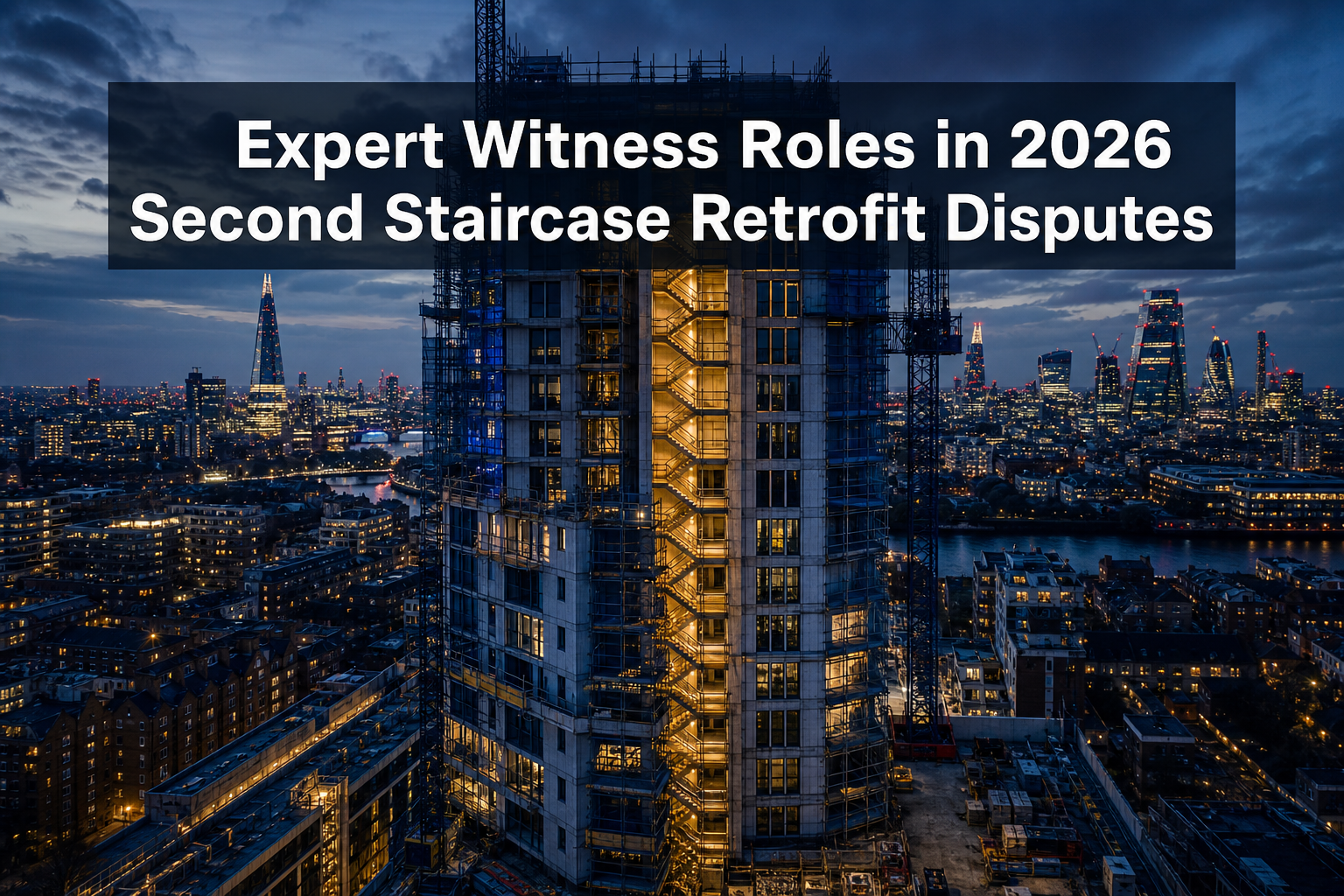
Retrofitting a second staircase into an existing residential tower can erase between 7% and 10% of usable floor space overnight — a loss that translates directly into disputed asset values worth millions of pounds. Since April 2026, UK building regulations have made second staircases mandatory in all new residential buildings exceeding 18 metres, and the ripple effects are now reaching tribunals, arbitration panels, and the courts [1]. For owners, developers, lenders, and leaseholders of multi-occupancy buildings, the central question is no longer whether compliance is required — it is who bears the financial cost, and how that cost is measured. Expert Witness Roles in 2026 Second Staircase Retrofit Disputes: Valuation Impacts for Multi-Occupancy Buildings have therefore become one of the most consequential and technically demanding areas of property litigation in the current market.
Key Takeaways
- Second staircase mandates effective from April 2026 can reduce a building's lettable floor plate by 3% to 10%, creating measurable and disputed valuation losses.
- Expert witnesses in these disputes must satisfy both RICS Red Book standards and Civil Procedure Rules Part 35 duties of impartiality.
- Valuation methodology — whether income capitalisation, residual, or comparable sales — is itself a point of dispute that expert testimony must address head-on.
- Design strategy choices (twin-core, enlarged single-core, or performance-based solutions) produce materially different cost and value impacts that experts must quantify separately.
- Early instruction of a qualified surveyor with fire safety and high-rise experience is critical to building court-ready evidence before a dispute crystallises.
Why Second Staircase Mandates Are Generating Valuation Disputes in 2026
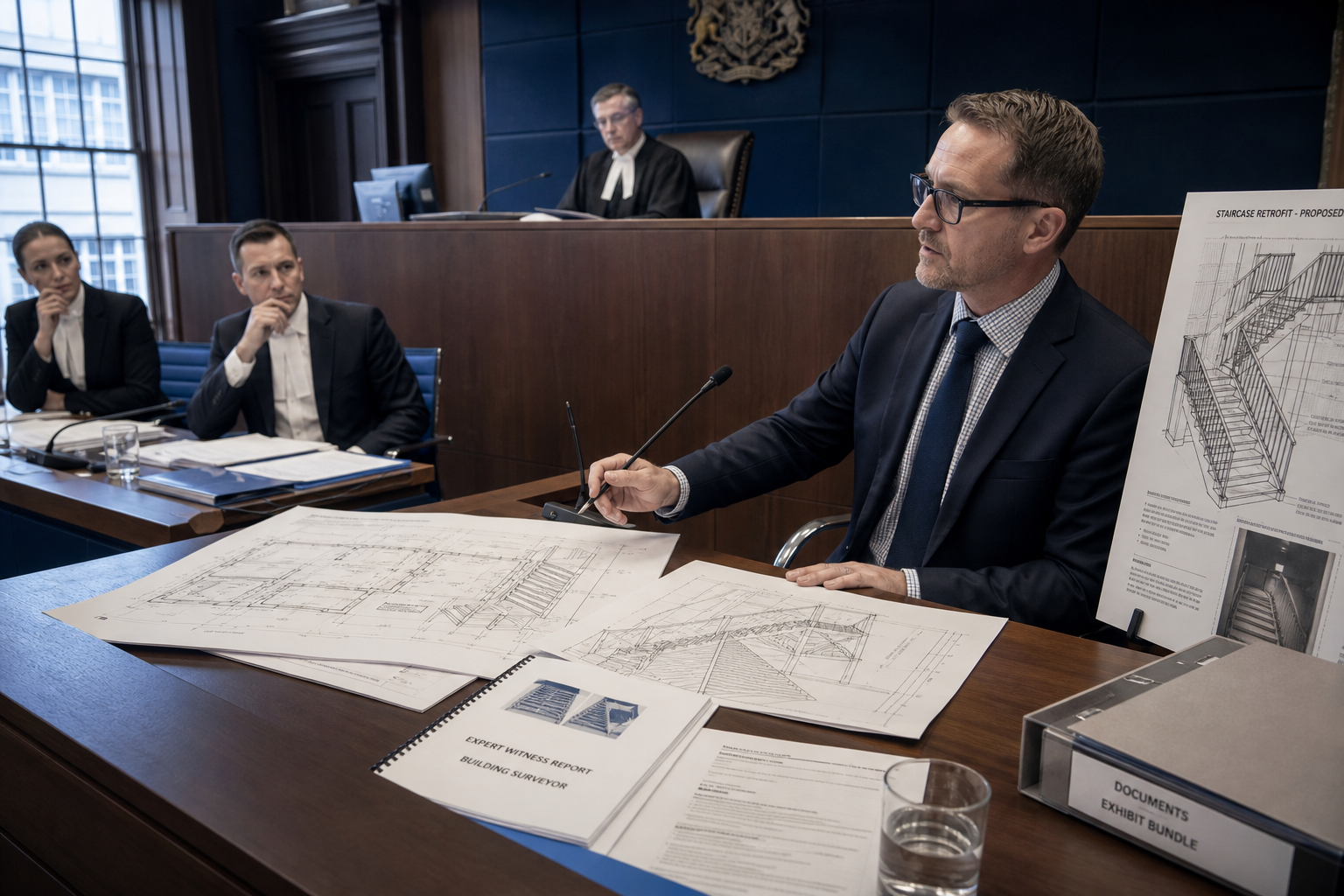
The Building Safety Act 2022 set the legislative framework, but it was the April 2026 implementation date that turned policy into practice — and practice into conflict [1]. Developers who had already committed to single-staircase designs on the basis of earlier guidance found themselves facing redesign costs, programme delays, and reduced net saleable or lettable areas. Many of those costs were not anticipated in original appraisals, loan agreements, or sales contracts, creating fertile ground for disputes between:
- Developers and contractors over who bears the cost of design changes
- Lenders and borrowers over whether collateral values remain adequate
- Freeholders and leaseholders over service charge contributions to retrofit works
- Vendors and purchasers where contracts were exchanged before the mandate crystallised
The financial stakes are substantial. A mid-rise block of 60 units in London, losing 8% of its gross internal area to a new staircase core, may see its gross development value fall by several million pounds. That figure is not self-evident — it requires expert analysis to establish, defend, and withstand cross-examination [3].
The Four Design Strategies and Their Value Impacts
Understanding how different compliance approaches affect floor area is essential context for any valuation expert. Research across live projects identifies four principal strategies [1] [2]:
| Design Strategy | Market Adoption | Floor Plate Impact |
|---|---|---|
| Twin-core (separate second stair) | 40% of projects | 3-4% reduction |
| Enlarged single core | 30% of projects | 5-7% reduction |
| Dual-aspect core | 20% of projects | 7-10% reduction |
| Performance-based engineered solution | 10% of projects | Minimal (retained single stair with enhanced fire protection) |
Each strategy carries a different capital cost profile and a different impact on income-producing capacity. A twin-core solution on a constrained urban site may require demolishing existing amenity space, while a performance-based engineered solution may face lender resistance due to perceived residual risk. Expert witnesses must understand these distinctions at a technical level before they can translate them into credible valuation adjustments [4].
Expert Witness Roles in 2026 Second Staircase Retrofit Disputes: Valuation Impacts for Multi-Occupancy Buildings — Core Duties and Standards
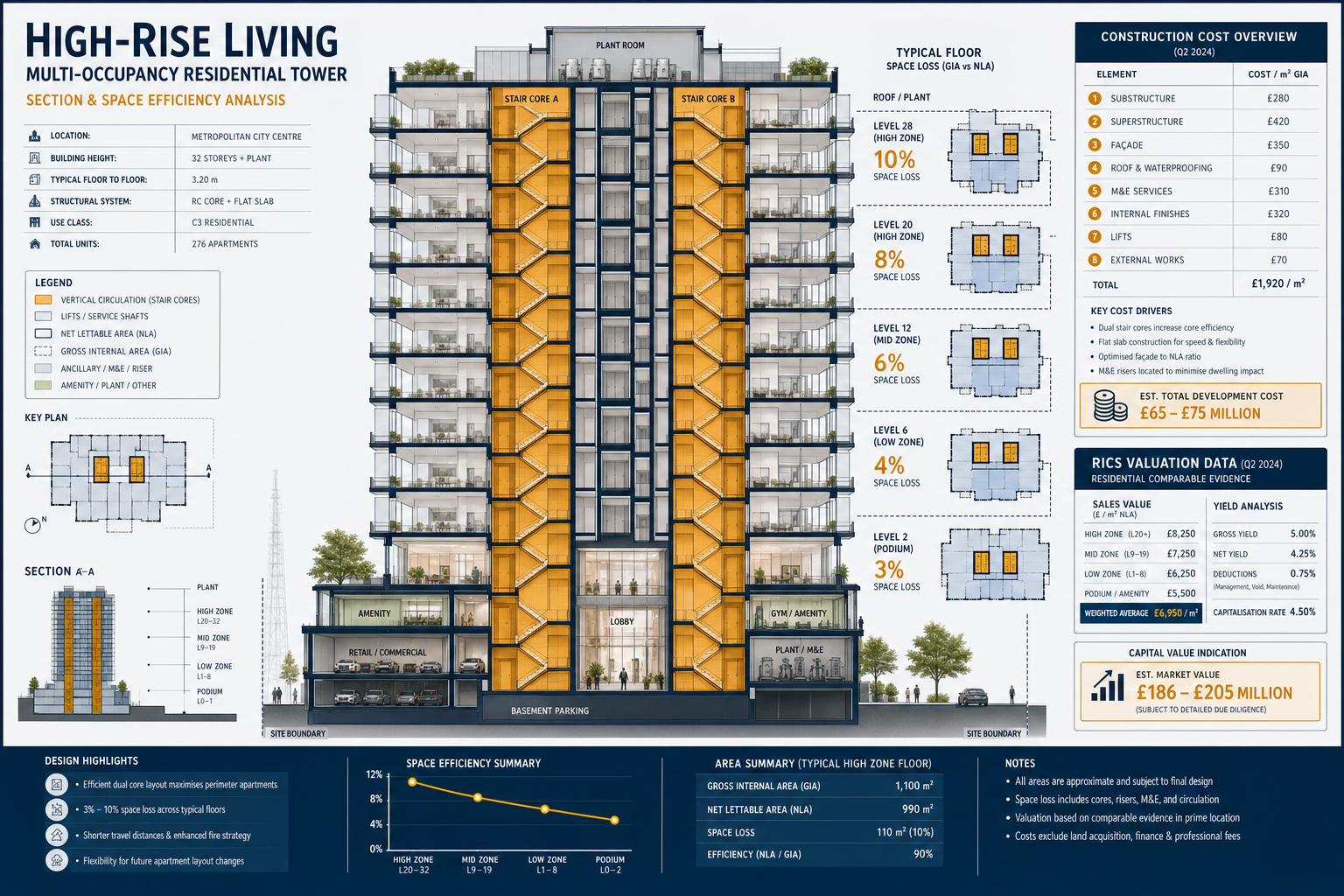
The role of an expert witness in property disputes is governed by a dual framework: the professional standards of the Royal Institution of Chartered Surveyors (RICS) and the procedural requirements of the courts. In 2026, both sets of obligations have sharpened considerably in response to high-profile disputes arising from the Building Safety Act landscape [3] [7].
The RICS Red Book and Impartiality
RICS Valuation — Global Standards (the Red Book) requires that any valuation prepared for use in litigation or dispute resolution must be independent, objective, and free from any instruction that compromises the valuer's judgment. This is not a formality. Courts have excluded expert evidence where the report was found to reflect the instructing party's preferred outcome rather than an honest professional opinion [7].
For second staircase retrofit disputes, the Red Book obligation means the expert must:
- Disclose any prior relationship with the instructing party
- State clearly the basis and date of valuation
- Identify all assumptions, including which design strategy has been adopted
- Provide a reasoned explanation for any adjustments to comparable evidence
- Acknowledge material uncertainty where the market for affected assets remains thin
A RICS property valuation prepared to Red Book standards carries significantly greater evidential weight than an informal desktop estimate, and tribunals increasingly distinguish between the two when assessing competing expert reports.
Civil Procedure Rules Part 35 Obligations
Under CPR Part 35, an expert witness owes their primary duty to the court, not to the party that instructs them. This principle is straightforward in theory but frequently tested in practice. In second staircase disputes, the temptation to shade a valuation in favour of the instructing party is real — the financial consequences of the expert's opinion can be enormous.
Key Part 35 requirements include:
- A signed statement that the expert understands and has complied with their duty to the court
- A summary of the range of opinion on contested valuation issues, not merely the expert's own view
- Identification of any matters that fall outside the expert's expertise
Experts who fail these requirements risk having their evidence given little or no weight — or being ordered to pay costs personally [8].
"The expert's function is to inform the tribunal, not to advocate. In retrofit valuation disputes, where the numbers are large and the technical issues complex, that distinction is the foundation of credible testimony."
Joint Statements and Hot-Tubbing
In 2026, courts are increasingly directing expert witnesses in building safety disputes to produce a joint statement identifying agreed and disputed issues before trial. This process — sometimes followed by concurrent expert evidence or "hot-tubbing" — requires each expert to engage directly with the opposing report and to justify any departure from the other expert's methodology [4].
For valuation experts in second staircase cases, the joint statement typically addresses:
- Agreed facts: the extent of floor area lost, the cost of works, the programme impact
- Disputed methodology: whether income capitalisation or comparable sales is the appropriate valuation approach
- Disputed quantum: the size of any valuation adjustment attributable to the staircase requirement
Preparation for this process requires thorough knowledge of building surveyor services and an ability to engage with structural and fire safety evidence that sits outside pure valuation.
Quantifying Valuation Impacts: Methodology, Evidence, and Common Disputes
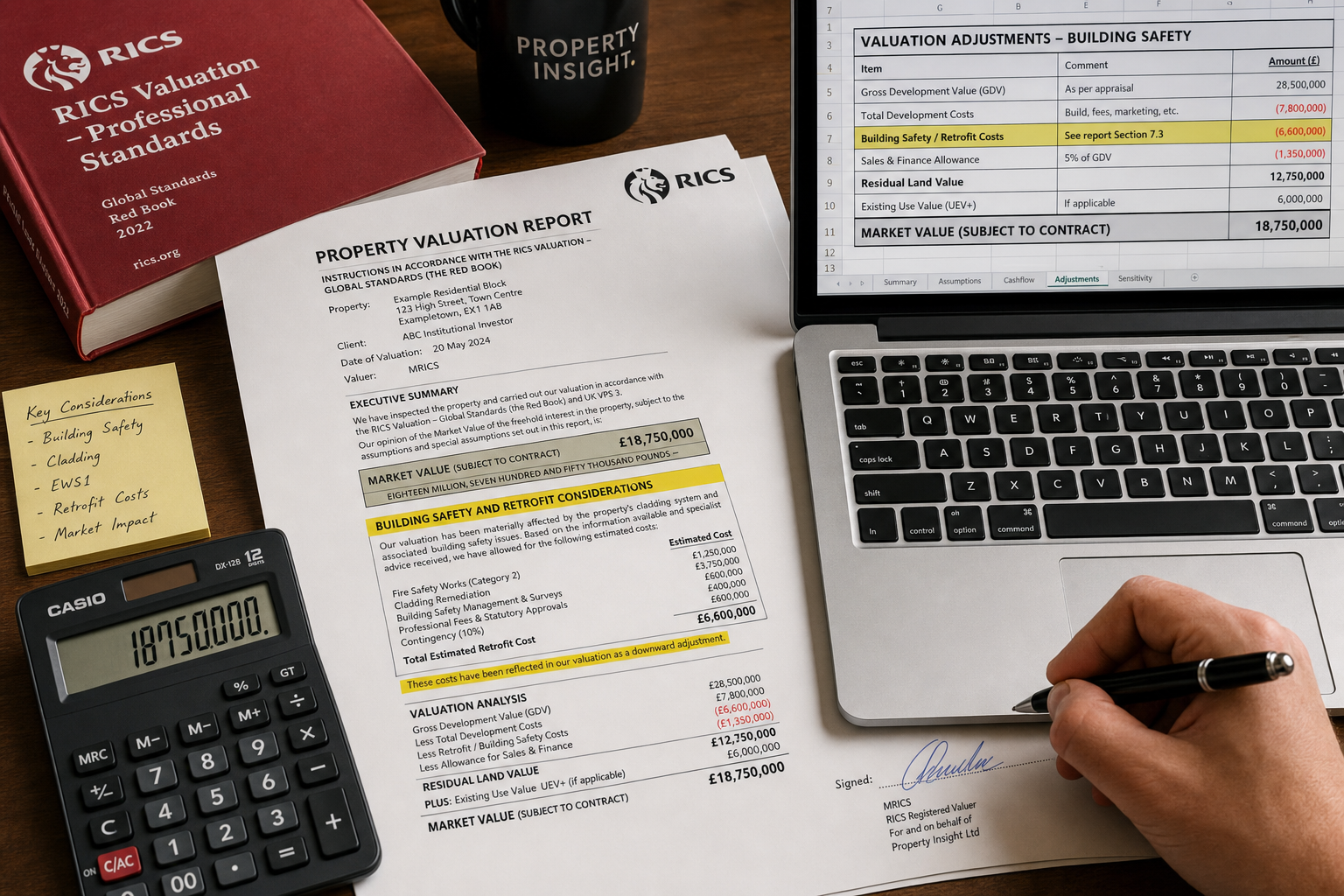
The central technical challenge in Expert Witness Roles in 2026 Second Staircase Retrofit Disputes: Valuation Impacts for Multi-Occupancy Buildings is translating physical changes to a building into defensible monetary figures. Three valuation methodologies are most commonly deployed, and the choice between them is itself a point of expert disagreement [5] [9].
Income Capitalisation
For income-producing multi-occupancy buildings — purpose-built rental blocks, student accommodation, or mixed-use schemes — the income capitalisation method values the property by reference to its net operating income divided by an appropriate yield. A second staircase retrofit affects this calculation in two ways:
- Reduced lettable area lowers gross rental income
- Increased service charges and insurance costs reduce net operating income further
The expert must establish the pre-retrofit and post-retrofit income streams, select an appropriate yield (which may itself shift if the building's safety profile improves), and capitalise the difference. Comparable yield evidence from the market is essential, and in 2026 that evidence base remains limited for buildings that have undergone retrofit [9].
Residual Valuation
Where the dispute involves a development site or a building mid-construction, the residual method is often more appropriate. The expert calculates the gross development value of the completed scheme, deducts all costs (including the additional staircase cost), and arrives at a residual land or asset value. The difference between the pre-mandate and post-mandate residuals represents the valuation impact [2].
This approach is highly sensitive to input assumptions. A 1% change in the assumed exit yield, or a 5% change in assumed build costs, can move the residual by millions of pounds. Expert witnesses must be prepared to defend every input under cross-examination, and to demonstrate that their assumptions are grounded in market evidence rather than instruction.
Comparable Sales Analysis
For owner-occupied or recently sold units within affected blocks, comparable sales analysis provides a market-based check on the other methods. The expert identifies sales of comparable units in buildings with and without second staircase compliance, adjusts for location, specification, and timing, and derives an implied value adjustment.
The difficulty in 2026 is that the market has not yet fully absorbed the second staircase requirement. Comparable evidence is thin, and the adjustments required are often large relative to the available data. Expert witnesses should be transparent about this limitation rather than presenting spurious precision [7].
Building Regulations and Structural Evidence
Valuation experts rarely work in isolation in these disputes. They typically rely on evidence from building surveyor professionals and structural engineers who can confirm the physical extent of works required, the programme implications, and the cost of compliance. Where that underlying technical evidence is disputed, the valuation evidence built upon it is also at risk.
A RICS building survey of the affected property, carried out before and after retrofit works, provides a documented baseline that strengthens the valuation expert's position. Similarly, a specific defect survey can isolate the structural implications of different staircase design strategies, giving the valuation expert a firmer technical foundation.
For disputes involving building regulations compliance and the interaction between staircase requirements and other fire safety obligations, expert witnesses must understand the full regulatory context — including the relationship between the second staircase mandate and existing sprinkler, alarm, and compartmentation requirements.
Preparing Court-Ready Expert Evidence: Practical Steps for 2026 Disputes
The quality of expert evidence in second staircase retrofit disputes is determined long before the hearing. Preparation begins at instruction and requires a disciplined approach to data gathering, methodology selection, and report drafting [8] [10].
Early Instruction and Site Access
Expert witnesses should be instructed as early as possible — ideally before proceedings are issued. Early instruction allows the expert to:
- Inspect the property and document its pre-dispute condition
- Review original design drawings, planning consents, and building regulations approvals
- Obtain cost estimates from quantity surveyors for the proposed retrofit works
- Assess the market evidence available at the relevant valuation date
Delay in instruction risks the loss of contemporaneous evidence and weakens the expert's ability to establish a reliable baseline.
Documentation and Data Standards
Courts expect expert evidence to be reproducible. Every comparable used in a valuation must be identified, sourced, and adjusted in a manner that another expert could verify independently. For second staircase disputes, this means maintaining a clear record of:
- Floor area schedules before and after retrofit
- Rental and yield evidence from comparable properties
- Cost estimates and programme schedules from construction professionals
- Any correspondence or reports from the developer, contractor, or building control authority that bear on the valuation
A Red Book valuation prepared to these standards provides the evidential backbone for expert testimony and is far more resistant to challenge than an informal opinion letter.
Addressing Uncertainty Transparently
One of the most common weaknesses in expert valuation reports in 2026 is the failure to acknowledge material uncertainty. Where the market evidence is limited — as it frequently is for buildings affected by second staircase requirements — the expert must state this clearly and explain how they have addressed it. Overstating confidence in a valuation figure invites damaging cross-examination and reduces the tribunal's trust in the expert overall [7].
Understanding Legal Disputes Context
Expert witnesses who understand the broader legal disputes landscape in which their evidence will be used are better equipped to present it effectively. This includes familiarity with the specific forum — whether the First-tier Tribunal (Property Chamber), the Technology and Construction Court, or arbitration — and the procedural rules that apply in each [10].
Conclusion
The mandatory second staircase requirement that came into force in April 2026 has created a new category of complex, high-value property disputes in which expert witness evidence is the decisive factor. Expert Witness Roles in 2026 Second Staircase Retrofit Disputes: Valuation Impacts for Multi-Occupancy Buildings demand a rare combination of technical building knowledge, rigorous valuation methodology, and strict adherence to RICS and CPR standards of impartiality.
Actionable next steps for those involved in or anticipating these disputes:
- Instruct a qualified expert early — before proceedings are issued, to preserve evidence and establish a reliable baseline valuation.
- Commission a Red Book-compliant valuation that explicitly addresses the design strategy adopted and its measured impact on floor area and income.
- Engage building surveyors and structural engineers to provide the technical foundation on which the valuation expert can safely rely.
- Prepare for the joint statement process by ensuring the expert's methodology is fully documented and defensible against an opposing report.
- Acknowledge uncertainty transparently — courts reward honest, calibrated expert evidence and penalise overconfident opinions that cannot be sustained under cross-examination.
Parties who invest in rigorous, well-prepared expert evidence at the outset are far better positioned to achieve a favourable outcome — whether at trial, in mediation, or through early settlement.
References
[1] Second Staircases Now Mandatory Design Cost And Programme Impacts – https://goldcastacademy.com/article/second-staircases-now-mandatory-design-cost-and-programme-impacts/?utm_source=openai
[2] Second Staircase Requirement 2026 Design Implications Developers – https://magnus-opifex.co.uk/blog/second-staircase-requirement-2026-design-implications-developers?utm_source=openai
[3] Building Safety Act 2022 Updates Expert Witness Protocols For Fire Safety And Retrofit Valuations In 2026 – https://princesurveyors.co.uk/blog/building-safety-act-2022-updates-expert-witness-protocols-for-fire-safety-and-retrofit-valuations-in-2026/?utm_source=openai
[4] Expert Witness Roles In 2026 Building Safety Act Disputes Evidence Standards For Mid Rise Residential Blocks – https://nottinghillsurveyors.com/blog/expert-witness-roles-in-2026-building-safety-act-disputes-evidence-standards-for-mid-rise-residential-blocks?utm_source=openai
[5] Expert Witness Valuations In 2026 Permitted Development Rights Disputes Rics Protocols For Pdr Expansions – https://wimbledonsurveyors.com/expert-witness-valuations-in-2026-permitted-development-rights-disputes-rics-protocols-for-pdr-expansions/?utm_source=openai
[6] Second Staircase Regulations – https://www.trowers.com/insights/2023/june/second-staircase-regulations?utm_source=openai
[7] Expert Witness Preparation For 2026 Uk Valuation Disputes Rics Standards In A Recovering Market – https://www.canterburysurveyors.com/blog/expert-witness-preparation-for-2026-uk-valuation-disputes-rics-standards-in-a-recovering-market/?utm_source=openai
[8] Expert Witness Valuations In Defective Building Works Building Court Ready Evidence For 2026 Disputes – https://www.canterburysurveyors.com/blog/expert-witness-valuations-in-defective-building-works-building-court-ready-evidence-for-2026-disputes/?utm_source=openai
[9] Rics Sustainability Report 2025 In Expert Witness Valuations Auditing Net Zero Claims For 2026 Disputes – https://kingstonsurveyors.com/rics-sustainability-report-2025-in-expert-witness-valuations-auditing-net-zero-claims-for-2026-disputes/?utm_source=openai
[10] Expert Witness Roles In 2026 Leasehold Reform Disputes Valuation Evidence For Commonhold Transitions – https://wimbledonsurveyors.com/expert-witness-roles-in-2026-leasehold-reform-disputes-valuation-evidence-for-commonhold-transitions/?utm_source=openai