


Fewer than one in ten homes listed for sale in Scotland and Northern Ireland at any given time is a bungalow — yet demand for single-storey properties has surged to its highest point in a decade. That mismatch between supply and buyer appetite is creating a dangerous dynamic: purchasers are making competitive offers on scarce stock without fully understanding the age-related defects that are almost guaranteed to be present. Building surveys for 2026 bungalow demand in Scotland and Northern Ireland: defect spotting in scarce stock has become one of the most pressing topics for RICS-registered surveyors operating in both regions, precisely because the cost of missing a structural problem in a fast-moving market can run into tens of thousands of pounds.
This article examines why bungalows are in such short supply, what defects surveyors consistently flag in this property type, and how a rigorous RICS Level 3 Building Survey can protect buyers — and even unlock negotiating leverage — in a market where sellers hold most of the cards.
Key Takeaways
- Bungalow stock in Scotland and Northern Ireland is critically scarce in 2026, driving buyers to move quickly and sometimes skip thorough surveys.
- Most bungalows on the market were built between the 1930s and 1980s, making age-related defects — damp, timber decay, roof spread, and outdated services — highly predictable.
- A RICS Level 3 Building Survey is the appropriate survey level for bungalows of this age and construction type.
- Survey findings routinely support price renegotiations, meaning the cost of a survey is almost always recovered through negotiated discounts.
- Northern Ireland's housing stress figures and Scotland's persistent undersupply make professional defect assessment more important, not less, in a competitive market.
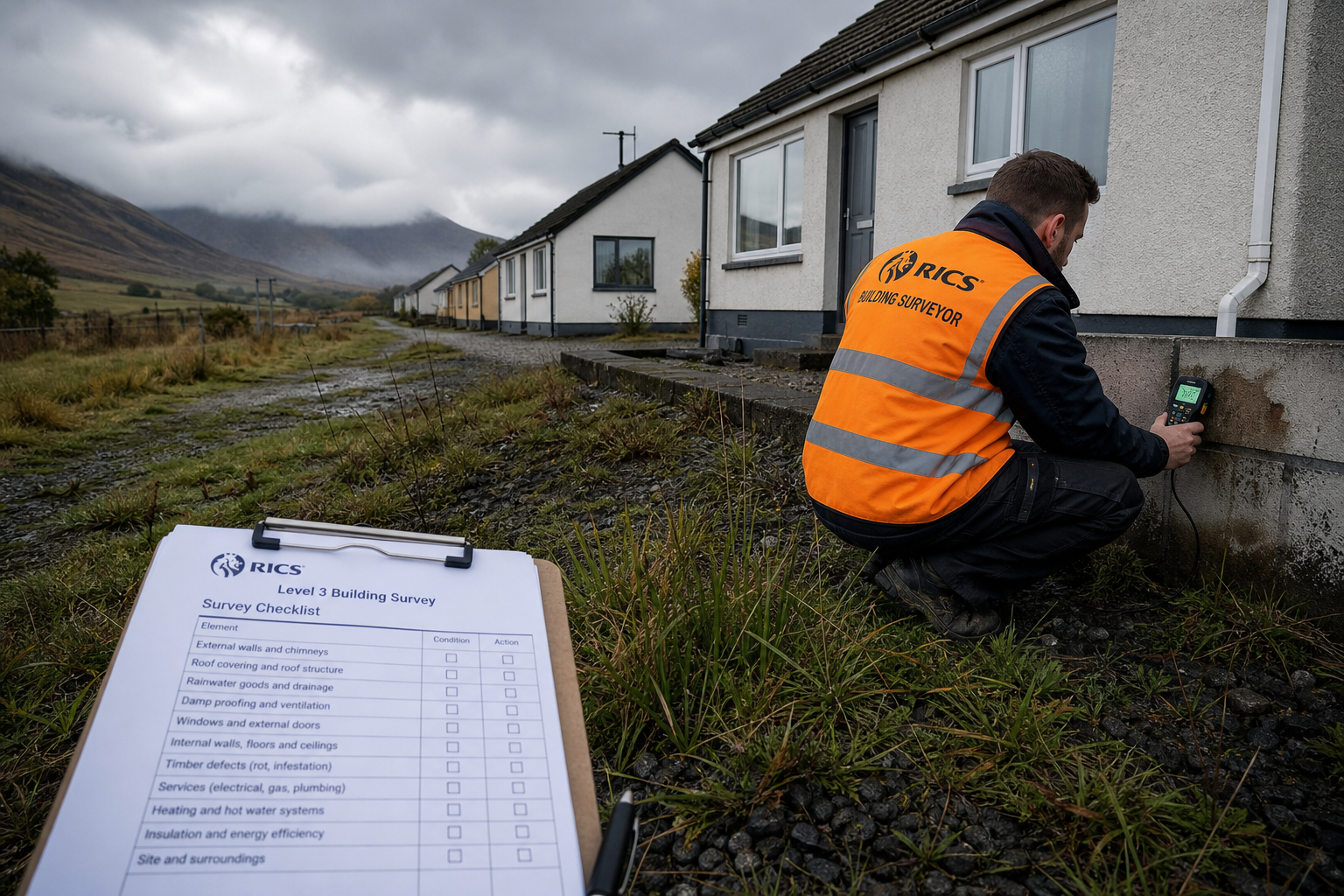
Why Bungalow Demand Is Outpacing Supply in 2026
The structural undersupply of bungalows across Scotland and Northern Ireland is not a new problem, but 2026 data makes the scale of pressure unmistakable. In Northern Ireland, as of March 31, 2026, there were 50,381 applicants on the Northern Ireland Housing Executive waiting list without existing tenancies, with 39,008 of those households classified as being in housing stress [1]. That level of unmet housing need pushes buyers toward any available single-storey option — particularly older bungalows that may have been sitting in the same family for decades.
Average property prices in Northern Ireland reached £224,607 in Q1 2026, a 5.2% increase compared to the same period in 2025 [2]. Rising prices compress the window buyers feel they have to conduct thorough due diligence. Meanwhile, social housing completions — just 676 between January and March 2026 — are nowhere near sufficient to ease pressure on private stock [1].
In Scotland, the picture is similarly constrained. Planning restrictions, land availability challenges, and the sheer cost of building new single-storey properties mean that bungalow completions represent a tiny fraction of annual housing delivery. Buyers who want a bungalow — typically older purchasers, those with mobility considerations, or families seeking accessible layouts — are competing for a pool of properties that is largely made up of mid-twentieth-century stock.
The result is predictable: buyers feel pressure to offer quickly, waive conditions, or accept survey findings without renegotiating. This is precisely the environment in which a professional building survey delivers the greatest return on investment.
The Age Profile of Bungalow Stock and Its Defect Implications
The majority of bungalows available for purchase in Scotland and Northern Ireland were constructed between the 1930s and the early 1980s. This age profile is not incidental — it directly determines the categories of defect a surveyor should expect to find and document.
Roof Structure and Covering
Bungalows built before 1970 frequently used cut-timber roof construction rather than modern trussed rafters. Over decades, these roofs can develop spread — a condition where the outward thrust of the rafters pushes the top of the external walls outward. Surveyors look for tell-tale signs including cracking at the junction between the ceiling and walls, bowing of the external wall face, and visible deflection in the ridge line.
Roof coverings on properties of this age are commonly beyond their design life. Clay or concrete tiles may be porous, ridge mortar is often cracked or missing, and lead flashings around chimneys and dormers deteriorate significantly after 40-50 years. Replacement costs for a full bungalow roof covering can range from £8,000 to £20,000 depending on size and specification.
Damp and Timber Decay
Bungalows are particularly susceptible to damp because their ground-floor construction is in direct contact with the ground. Properties built before 1965 may lack a functioning damp-proof course (DPC), or the original DPC may have been bridged by subsequent landscaping, render, or raised external ground levels.
Rising damp creates ideal conditions for timber decay, particularly in suspended timber ground floors — a construction method common in bungalows of this era. Wet rot and dry rot can spread extensively before becoming visible, and remediation costs are significant. A specific defect survey targeting damp and timber issues is sometimes commissioned alongside a full building survey when initial investigations suggest a more serious problem. Understanding the diagnosis of damp and timber issues is a core competency for any surveyor working on pre-war or early post-war bungalow stock.
Services and Electrical Systems
Wiring installed before 1970 may still be in situ in properties that have not been substantially renovated. Older rubber-insulated or aluminium wiring presents a fire risk and will require full rewiring — a cost that can reach £6,000 to £12,000 for a typical three-bedroom bungalow. Heating systems, drainage runs, and water supply pipework of similar age carry comparable risks.
Structural Movement
Bungalows on clay soils — present across parts of Northern Ireland and central Scotland — are vulnerable to subsidence driven by seasonal shrinkage and swelling of the ground. Tree proximity is a major factor. Surveyors examine crack patterns carefully: diagonal cracks tapering from window or door corners, differential movement between extensions and original structure, and distorted door or window frames all warrant further investigation.
| Defect Category | Typical Cost Range | Likelihood in Pre-1980 Bungalows |
|---|---|---|
| Roof covering replacement | £8,000 – £20,000 | High |
| DPC installation or remediation | £2,500 – £8,000 | Medium-High |
| Timber floor treatment and repair | £3,000 – £15,000 | Medium |
| Full rewiring | £6,000 – £12,000 | Medium |
| Structural movement investigation | £1,500 – £5,000+ | Low-Medium |
Building Surveys for 2026 Bungalow Demand: The RICS Level 3 Checklist
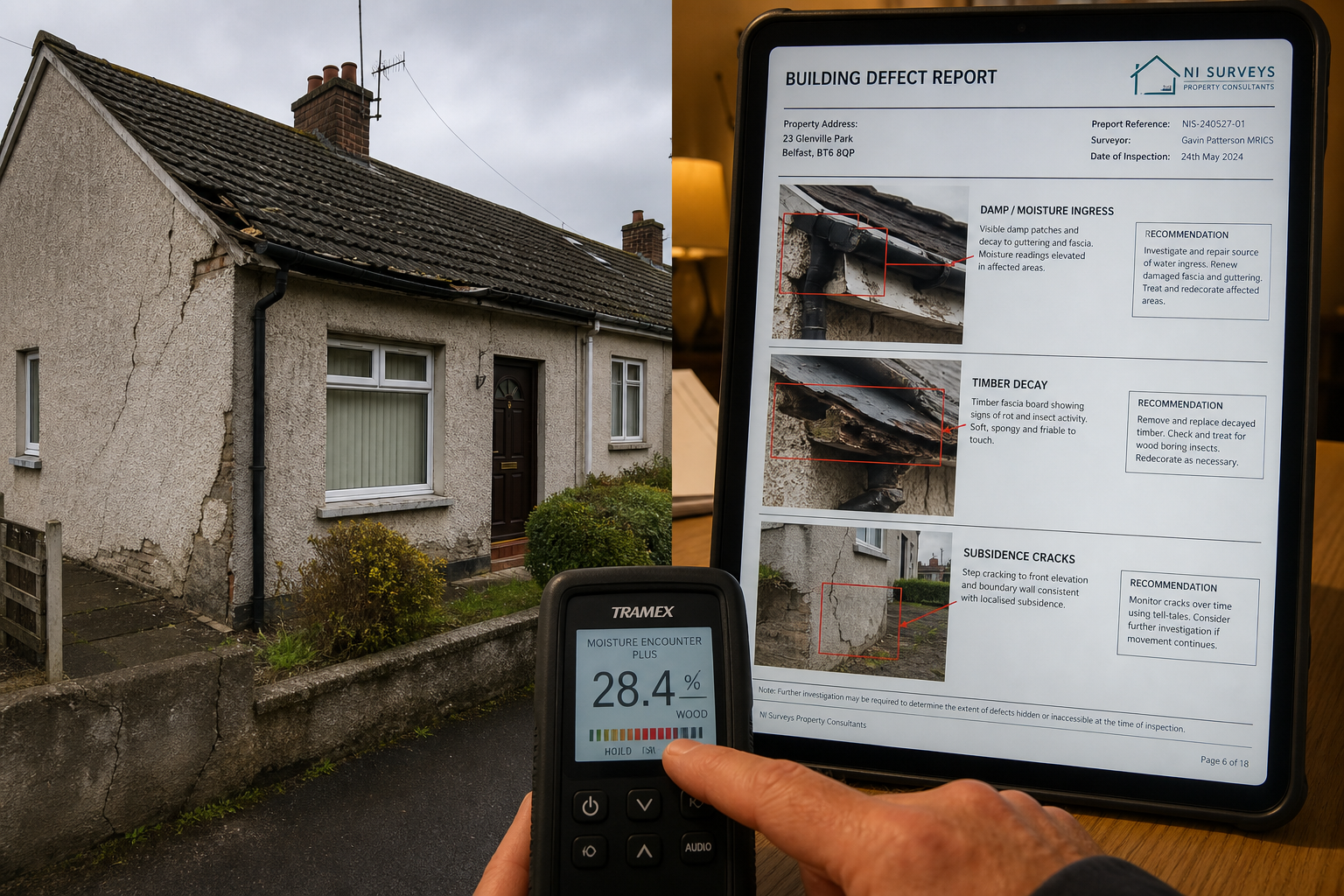
When it comes to building surveys for 2026 bungalow demand in Scotland and Northern Ireland: defect spotting in scarce stock, the RICS Level 3 Building Survey is the appropriate product for properties of this age, construction type, and condition. A RICS Building Survey provides a comprehensive assessment of the property's construction, condition, and defects, going significantly further than a Level 2 HomeBuyer Report in its scope and detail.
"A RICS Level 3 Building Survey is not a luxury for older bungalows — it is the minimum standard of due diligence that buyers should accept."
RICS guidance emphasises that surveyors conducting Level 3 assessments on bungalows should address the following areas systematically:
External Inspection Checklist
- Roof covering: Condition of tiles, slates, ridge, verge, and valley details
- Chimneys: Pointing, flashing, and structural integrity of stacks
- Rainwater goods: Gutters, downpipes, and their connection to drainage
- External walls: Render condition, pointing, signs of movement or bulging
- DPC level: Relationship between DPC, external ground level, and any bridging
- Windows and doors: Frame condition, glazing specification, and draught sealing
- Outbuildings and garages: Structural condition and asbestos risk in roofing sheets
Internal Inspection Checklist
- Roof space: Insulation depth, ventilation, signs of water ingress, timber condition
- Ceilings and walls: Cracking patterns, staining, and evidence of damp
- Ground floor construction: Solid or suspended; condition of boards or screed
- Damp readings: Moisture meter readings at all external walls at low level
- Electrical consumer unit: Age, type, and presence of RCD protection
- Heating system: Age of boiler, condition of radiators and pipework
- Drainage inspection: Manhole covers lifted and drainage flow observed where accessible
Surveyors operating in Northern Ireland can draw on building pathology services that specifically focus on diagnosing structural movement, damp ingress, and material failure [4]. In Scotland, firms providing building surveys for various property types including bungalows offer structured advice on structural integrity and potential defects [6].
Many buyers are also unaware of common misconceptions about what surveys cover — reading through common myths about a property survey before commissioning a report helps set realistic expectations about scope and limitations.
Value Uplift and Negotiation
One of the most practical outcomes of a thorough building survey is the platform it creates for price negotiation. Survey findings that identify significant defects — particularly those with quantifiable remediation costs — give buyers a documented, professional basis for renegotiating the agreed price. Research consistently shows that buyers who commission surveys and use the findings in negotiation recover the survey fee many times over.
Understanding the average price reduction after a survey is useful context before entering negotiations. In a market where bungalow prices have risen sharply, a well-evidenced reduction of even 2-3% on a £224,000 property represents a saving of £4,500 to £6,700 — far exceeding the cost of the survey itself.
Defect Spotting in Scarce Stock: Practical Guidance for Buyers
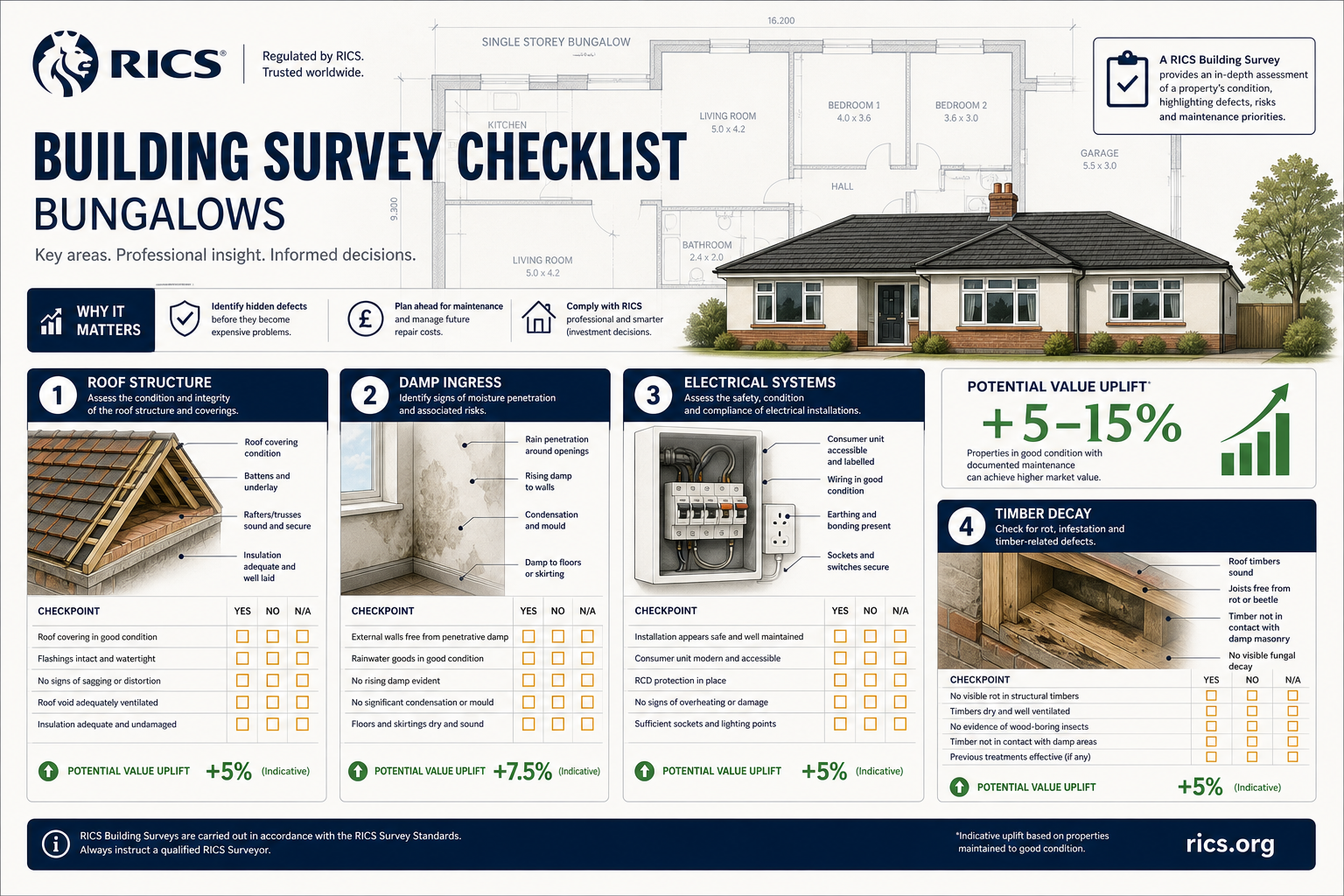
The competitive nature of the 2026 bungalow market in Scotland and Northern Ireland creates pressure on buyers to act fast. That pressure is real, but it should not translate into skipping or downgrading the survey. The following practical steps help buyers protect themselves without losing out on a property.
Commission the Survey Early
In Scotland, the Home Report system means that a basic survey is already available to buyers before they make an offer. However, the Home Report's single survey is a Level 2 equivalent and does not provide the depth of investigation appropriate for an older bungalow. Buyers should commission an independent RICS Level 3 survey as a condition of their offer or immediately after an offer is accepted.
In Northern Ireland, there is no mandatory Home Report equivalent, making independent survey commissioning even more critical. Services such as RICS Level 2 HomeBuyer Surveys and Level 3 Building Surveys are available from qualified firms operating across the region [3]. Keystone Building Surveying, for example, offers Home Buyer Reports, Full Building Surveys, and Specific Defect Investigations providing detailed assessments of property conditions [9].
Prioritise Damp Investigation
Given the age profile of bungalow stock, damp is the single most important defect category to investigate thoroughly. A damp survey conducted as part of or alongside the building survey provides detailed moisture readings, identifies the source of any ingress, and quantifies the extent of any associated timber damage. Buyers who skip damp investigation on a pre-1970 bungalow are taking a significant financial risk.
Use the Survey Report as a Negotiation Tool
A detailed RICS Level 3 report provides condition ratings (1, 2, or 3) for each element of the property. Any element rated Condition 3 — requiring urgent attention — should be costed by a specialist contractor and used as the basis for a price reduction request. Sellers in a market where bungalows are scarce may resist, but documented evidence of significant remediation costs is difficult to argue against.
Consider Specialist Follow-Up Surveys
Where the building survey identifies potential structural movement, a specialist structural engineer's report may be warranted. Where timber decay is suspected, a specialist damp and timber report provides the granular detail needed to cost remediation accurately. These follow-up investigations add cost but substantially reduce the risk of purchasing a property with hidden, expensive problems.
For buyers navigating the homebuying process for the first time, or those returning to the market after a long gap, understanding the full range of survey options — and when each is appropriate — is an essential first step before making any offer on older bungalow stock.
Regional Considerations: Scotland vs Northern Ireland
While the core defect categories are consistent across both regions, there are meaningful differences in building traditions, regulatory frameworks, and market conditions that affect how surveys should be approached.
Scotland has a strong tradition of stone construction, and many bungalows in rural and suburban areas feature solid stone or brick walls without cavity insulation. These walls perform differently from cavity-wall construction in terms of damp management, thermal performance, and structural behaviour. Surveyors must assess whether any cavity wall insulation has been retrofitted — and if so, whether it has caused interstitial condensation problems.
Northern Ireland has a higher proportion of bungalows built using non-traditional construction methods, including no-fines concrete and timber-frame systems that were popular in the post-war period. These construction types carry specific defect risks and require surveyors with appropriate knowledge of their behaviour over time.
Pre-completion inspections and post-completion snagging surveys are also available in Scotland for new-build bungalows, assessing build standards and finish quality before contract exchange [7]. While new-build bungalows represent a small fraction of the market, buyers of recently completed properties should not assume that new construction is defect-free.
Insurance-related defect detection — including hidden leak identification — is another service area relevant to bungalow owners in both regions, particularly where older properties have experienced water damage that may not be immediately visible during a standard survey inspection [8].
Conclusion
The combination of scarce bungalow stock, rising prices, and competitive buyer behaviour in Scotland and Northern Ireland makes 2026 a particularly high-risk environment for purchasers who do not commission a thorough professional survey. Building surveys for 2026 bungalow demand in Scotland and Northern Ireland: defect spotting in scarce stock is not an abstract concern — it is a practical, financially significant issue that affects every buyer making an offer on a pre-1980 single-storey property in either region.
Actionable next steps for buyers:
- Always commission a RICS Level 3 Building Survey — not a Level 2 HomeBuyer Report — for any bungalow built before 1985.
- Ensure the survey includes damp meter readings at all external walls and a roof space inspection.
- Request specialist follow-up investigations for any Condition 3 findings before proceeding to exchange.
- Use the survey report and contractor quotes to negotiate a price reduction that reflects the cost of necessary remediation.
- Do not allow market pressure to shorten the survey process — the financial risk of buying a defective bungalow in a rising market far outweighs the risk of losing a particular property.
For buyers and their advisers, a building survey commissioned from a qualified RICS-registered professional remains the single most effective tool for protecting capital in a market where the supply of good-quality bungalow stock shows no sign of improving.
References
[1] Northern Ireland Housing Bulletin January March 2026 – https://datavis.nisra.gov.uk/communities/northern-ireland-housing-bulletin-january-march-2026.html?utm_source=openai
[2] Northern Ireland Housing Market Remains Stable With Modest Price Growth – https://www.ulster.ac.uk/news/2026/may/northern-ireland-housing-market-remains-stable-with-modest-price-growth?utm_source=openai
[3] RICS Residential Surveys – https://www.nisurveys.co.uk/rics-residential-surveys/?utm_source=openai
[4] Building Pathology – https://www.nisurveys.co.uk/commercial/building-pathology/?utm_source=openai
[6] Building Surveys – https://www.smithandgarratt.com/surveys-valuations/building-surveys/?utm_source=openai
[7] Northern Survey – https://www.northernsurvey.net/?utm_source=openai
[8] PCLA – https://pcla.co.uk/?utm_source=openai
[9] Services – https://www.keystonebuildingsurveying.co.uk/services/?utm_source=openai