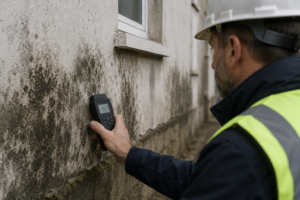


From 1 May 2026, England's private rented sector entered a new legal era. The Renters' Rights Act 2026 abolished Section 21 "no-fault" evictions, extended the Decent Homes Standard to private landlords, and introduced strict timelines for responding to damp and mould complaints. For landlords, tenants, and the surveyors who assess their properties, these changes are not administrative footnotes — they represent a fundamental shift in how rental properties must be maintained, assessed, and valued. Understanding how the Renters' Rights Act 2026 is reshaping building surveys and rental valuations in England is now essential knowledge for anyone with a stake in the private rented sector [1][2].
Key Takeaways
- The abolition of Section 21 evictions alters the risk profile of buy-to-let properties and requires surveyors to adjust valuation methodologies accordingly.
- The Decent Homes Standard now applies to private rentals, making thorough building surveys a legal necessity rather than an optional precaution.
- Awaab's Law mandates investigation of damp and mould within 10 days, directly influencing how surveyors report on moisture-related defects.
- Rent increases are capped at once per year with two months' notice, affecting rental income projections used in investment valuations.
- Local authorities now hold enhanced enforcement powers, with fines reaching up to £40,000 for repeated non-compliance.

The Core Legislative Changes Every Surveyor Must Understand
Before examining the practical effects on surveys and valuations, it is worth mapping the key provisions of the Act that directly affect property condition and financial assessment.
Abolition of Section 21 and the Shift to Periodic Tenancies
The most widely discussed change is the removal of Section 21 evictions. Landlords can no longer serve a "no-fault" notice to recover possession. Instead, they must rely on specific grounds — such as significant rent arrears, the landlord's intention to sell, or the landlord or a close family member needing to move in [1].
Simultaneously, all assured shorthold tenancies have converted to rolling periodic tenancies with no fixed end date. This means tenants have greater security of tenure, but landlords face a more complex legal process if they need to recover a property. For surveyors, this changes the risk profile of any rental property they are asked to value [3].
The Decent Homes Standard Comes to Private Rentals
Previously confined to social housing, the Decent Homes Standard now applies across the private rented sector. Properties must meet defined benchmarks covering structural safety, heating systems, freedom from serious hazards, and general maintenance. Failure to comply can result in fines of up to £7,000 for individual breaches [2].
This single provision has the most direct impact on building survey practice. A surveyor assessing a rental property can no longer treat condition defects as merely advisory observations — those defects may now represent active legal liabilities for the landlord.
Awaab's Law: Damp and Mould on a Legal Timetable
Named after Awaab Ishak, a two-year-old who died in 2020 due to prolonged exposure to mould in a rented property, Awaab's Law introduces mandatory response timelines. Landlords must investigate reports of damp and mould within 10 days and provide a written action plan. Remedial works must follow promptly [2].
This provision has immediate consequences for how surveyors document moisture-related defects. A damp survey finding that might previously have been reported as a "monitor and review" issue now carries legal urgency. For detailed guidance on identifying and reporting damp in residential properties, the damp survey London resources provide useful context on best practice.
Rent Controls, Bidding Bans, and Anti-Discrimination Rules
The Act restricts rent increases to once per year, with a minimum of two months' notice to the tenant. Tenants retain the right to challenge increases they consider unjustified through a First-tier Tribunal [5]. Alongside this, the practice of encouraging competing rent bids from prospective tenants — so-called "bidding wars" — is now prohibited [5].
Landlords are also prohibited from discriminating against applicants on the basis of benefits status or family circumstances. Tenants now have a qualified right to keep pets, which landlords can only refuse on reasonable grounds [1].
How the Renters' Rights Act 2026 is Reshaping Building Surveys and Rental Valuations in England: The Surveyor's New Landscape

The legislative changes described above do not exist in isolation. They cascade directly into the way building surveyors approach inspections and the way valuers model rental income and investment risk.
Building Surveys: From Advisory to Compliance-Critical
Under the previous framework, a landlord commissioning a building survey was primarily seeking to understand the physical condition of a property before purchase or at a point of concern. The survey findings were informative but rarely carried immediate legal consequences.
That calculus has changed. With the Decent Homes Standard now enforceable in the private rented sector, a building survey effectively functions as a compliance audit. Surveyors must now consider whether identified defects constitute breaches of the standard, and they should communicate this clearly in their reports.
The following table illustrates how common survey findings now map to potential legal exposure under the Act:
| Survey Finding | Pre-Act Status | Post-Act Status |
|---|---|---|
| Category 1 HHSRS hazard | Reportable, advisory | Potential fine up to £7,000 |
| Active damp or mould | Monitor and review | Awaab's Law response required within 10 days |
| Inadequate heating system | Condition note | Decent Homes Standard breach |
| Structural defect | Priority repair | Grounds for tenant complaint and enforcement |
| Cosmetic disrepair | Low priority | May contribute to Decent Homes failure |
Surveyors are increasingly expected to flag not just what is wrong, but what the legal implications are. This is particularly relevant for landlords who are new to the sector or who have inherited older stock that has not been recently assessed. A RICS-standard survey provides the structured framework needed to meet this heightened duty of care.
The Rise of Pre-Tenancy and Mid-Tenancy Surveys
One practical consequence of the Act is a notable increase in demand for pre-tenancy surveys and mid-tenancy condition inspections. Landlords who previously relied on informal check-in inventories are now seeking formal survey reports that can demonstrate compliance with the Decent Homes Standard at the point a tenancy begins.
Mid-tenancy surveys are also becoming more common as landlords seek to create documented evidence that they are proactively managing property condition — a defence that can be valuable if a tenant makes a complaint to the local authority.
For landlords uncertain about which type of assessment best suits their property, a comparison of homebuyers report versus building survey options can help clarify the appropriate level of inspection.
"The Renters' Rights Act has effectively transformed the building survey from a buyer's due diligence tool into a landlord's compliance instrument."
Dilapidations Reports and End-of-Tenancy Disputes
With tenants now holding rolling periodic tenancies and greater security of tenure, the end-of-tenancy process has become more legally complex. Dilapidations disputes — disagreements about the condition of a property at the end of a tenancy — are likely to increase as tenants remain in properties for longer periods.
A formal dilapidations survey establishes a clear baseline of condition and provides defensible documentation for both landlords and tenants. Given that rent repayment orders can now cover up to two years' rent — double the previous maximum — the financial stakes of a poorly documented tenancy are considerably higher [1].
How the Renters' Rights Act 2026 is Reshaping Building Surveys and Rental Valuations in England: Investment Yield and Risk Recalibration

Beyond the physical inspection of properties, the Act has significant implications for how rental properties are valued as investment assets. Understanding how the Renters' Rights Act 2026 is reshaping building surveys and rental valuations in England requires examining both the income side and the risk side of the investment equation.
Valuation Methodology Under Pressure
The abolition of Section 21 changes the risk profile of buy-to-let investments in a measurable way. Under the previous regime, a landlord who needed to sell a property with a sitting tenant could serve a Section 21 notice and recover vacant possession within a predictable timeframe. That option no longer exists.
Surveyors and valuers must now factor in the possibility that recovering possession could take considerably longer, particularly if a tenant contests the grounds for eviction. This uncertainty has two effects on valuation:
- Vacant possession premium: Properties that can be sold with vacant possession may command a premium over equivalent tenanted properties, as buyers are not exposed to the possession risk.
- Tenanted property discount: Investment valuations for tenanted properties may need to apply a discount to reflect the additional legal complexity and time cost of recovering possession if required [3].
The scale of any discount will depend on factors including the tenant's payment history, the length of the tenancy, and the condition of the property. A property with a long-standing, reliable tenant in good condition may attract minimal discount. A property with a problematic tenancy history and deferred maintenance could see a more significant adjustment.
Rental Income Projections and the Bidding Ban
The prohibition on rental bidding wars removes a mechanism that had, in some high-demand urban markets, allowed landlords to achieve rents above the initial asking price. For valuation purposes, surveyors must now base rental income projections on the advertised asking rent rather than any premium that competitive bidding might have generated [5].
Combined with the restriction on rent increases to once per year, this means that rental income growth projections for investment properties in England need to be modelled more conservatively. A property in a high-demand area like central London may still achieve strong rental growth, but that growth is now subject to a structured annual review process rather than market-driven renegotiation.
Enhanced Enforcement and the Cost of Non-Compliance
Local authorities now hold significantly enhanced enforcement powers. Fines for non-compliance can reach £7,000 for initial breaches and up to £40,000 for repeated offences [2]. For a landlord with a portfolio of properties, the cumulative financial exposure from enforcement action could materially affect the investment case for individual assets.
Valuers assessing rental properties must consider whether the current condition of a property creates meaningful enforcement risk. A property with known defects that have not been remediated is not just a maintenance liability — it is a potential source of regulatory fines that should be reflected in the valuation.
This is particularly relevant for older housing stock, which makes up a significant proportion of England's private rented sector. Properties built before 1919 are statistically more likely to present damp, structural, and heating deficiencies that could trigger enforcement action under the new regime. Surveyors working in areas with a high proportion of period properties — such as those covered by building surveyors in Knightsbridge — will be especially aware of this challenge.
What Surveyors Should Flag in Rental Valuation Reports
Given the changes introduced by the Act, a well-structured rental valuation report in 2026 should address the following:
- Possession risk assessment: An evaluation of the ease or difficulty of recovering vacant possession given the current tenancy arrangements.
- Decent Homes compliance status: A clear statement of whether the property meets the standard or what remedial works would be required.
- Damp and mould risk: Specific reference to any moisture-related defects and the Awaab's Law implications.
- Enforcement exposure: An estimate of potential fine liability if known defects are not addressed.
- Rent review cycle: Commentary on the current rent relative to market rates and the implications of the annual review restriction.
- Yield adjustment: A reasoned explanation of any discount applied to reflect possession risk or compliance costs.
For landlords who receive a survey report identifying significant issues, understanding what to do after a bad building survey report is an important next step in managing both the property condition and the investment risk.
Practical Steps for Landlords and Investors in 2026
The Act creates a clear hierarchy of priorities for landlords who want to protect both their tenants and their investment:
Immediate actions:
- Commission a full building survey or condition report to establish a compliance baseline against the Decent Homes Standard.
- Review all existing tenancy agreements to confirm they reflect the transition to periodic tenancies.
- Ensure the official government information sheet has been provided to all tenants — failure to do so by 31 May 2026 can result in a fine of up to £7,000 [4].
- Establish a documented process for responding to damp and mould reports within the 10-day Awaab's Law window.
Medium-term actions:
- Budget for any remedial works identified in the survey to bring the property to Decent Homes compliance.
- Review rental income projections in light of the annual rent increase restriction.
- Obtain a formal dilapidations report for any tenancy approaching its end to protect against future disputes.
- Reassess the investment case for any properties where possession risk or compliance costs materially affect yield.
For landlords with properties across multiple London boroughs, working with a surveyor who understands local housing stock characteristics — whether in Hackney, Islington, or Chelsea — will ensure that survey findings are contextualised within the specific challenges of each area's housing stock.
Conclusion
The Renters' Rights Act 2026 has moved the goalposts for everyone involved in England's private rented sector. For building surveyors, the shift means that condition reports must now carry a compliance lens — identifying not just defects but their legal and financial consequences under the new framework. For valuers, the abolition of Section 21 and the restrictions on rent increases require a recalibration of risk models and income projections. For landlords, the message is unambiguous: proactive investment in professional surveys and timely maintenance is no longer a best practice recommendation — it is a legal and financial imperative.
Actionable next steps:
- Commission a professional building survey to assess Decent Homes Standard compliance before the next tenancy begins or renews.
- Ensure all tenants have received the official government information sheet as required by the Act.
- Establish a written maintenance response protocol that meets Awaab's Law timelines for damp and mould reports.
- Request that any rental valuation report explicitly addresses possession risk, enforcement exposure, and yield adjustments under the new legislative framework.
- Consult a qualified RICS surveyor to understand how the Act affects the specific properties in your portfolio.
The landlords and investors who treat these changes as an opportunity to professionalise their approach — rather than a burden to be minimised — will be best positioned to protect both their tenants and their long-term returns.
References
[1] Renters Rights Act An Overview For Landlords – https://www.gov.uk/guidance/renters-rights-act-an-overview-for-landlords
[2] Renters Rights Act 2026 And Building Surveys What Property Surveyors Need To Know About Landlord Liability – https://wimbledonsurveyors.com/renters-rights-act-2026-and-building-surveys-what-property-surveyors-need-to-know-about-landlord-liability/
[3] Valuing Rental Properties Under The Renters Rights Act 2026 Surveyor Adjustments For Section 21 Abolition – https://www.canterburysurveyors.com/blog/valuing-rental-properties-under-the-renters-rights-act-2026-surveyor-adjustments-for-section-21-abolition/
[4] The Renters Rights Act Information Sheet 2026 – https://www.gov.uk/government/publications/the-renters-rights-act-information-sheet-2026
[5] Things Renters Need To Know About Renters Rights Act – https://www.idealhome.co.uk/house-manual/owning-renting/things-renters-need-to-know-about-renters-rights-act