A net balance of +43% of UK surveyors now expect house prices to rise over the next 12 months — the highest reading since February 2025 and a figure that carries real consequences for building surveyors and party wall practitioners across the country. The Housing Market Recovery Signals from RICS January 2026 Survey: Implications for Building Surveyors and Party Wall Demand are becoming impossible to ignore, and professionals who act on these early indicators now will be best positioned when activity accelerates.
Key Takeaways 📌
- The RICS January 2026 residential survey shows three consecutive months of improvement across house prices, buyer enquiries, and agreed sales.
- A net balance of +43% of surveyors anticipate price rises over the next 12 months — the strongest reading since February 2025.
- Agreed sales posted their least negative reading since June 2025, signalling a meaningful uptick in buyer-seller activity.
- Increased transaction volumes historically drive higher demand for party wall agreements, building surveys, and schedule of condition reports.
- The recovery is described as gradual, meaning surveyors have a window to prepare capacity and marketing before peak demand arrives.
What the RICS January 2026 Survey Actually Shows
The Royal Institution of Chartered Surveyors (RICS) publishes its UK Residential Market Survey monthly, polling chartered surveyors across England, Scotland, Wales, and Northern Ireland. The January 2026 edition delivered a cluster of improving signals that, taken together, paint a picture of cautious but genuine momentum [3].
House Prices: Third Consecutive Monthly Improvement
The net balance for house prices moved to -10% in January 2026, up from -14% in December 2025. Crucially, this beat market expectations of -11% and represents the strongest reading since June 2025 [2]. A negative net balance still means more surveyors reported falling prices than rising ones — but the direction of travel has clearly shifted.
Buyer Enquiries: Diminishing Negativity
New buyer enquiries recorded a net balance of -15% in January 2026, improving from -21% in December and -29% in November [3]. Three consecutive months of improvement in enquiry levels is a reliable leading indicator. When more buyers start asking questions, agreed sales and renovation activity tend to follow within one to two quarters.
Agreed Sales: Least Negative Since June
Agreed sales posted a net balance of -9% in January 2026, compared to -19% in December 2025 — the least negative reading since June 2025 [1]. This is arguably the most operationally significant figure for building surveyors, because agreed sales directly generate instructions for homebuyer surveys, structural assessments, and RICS surveys.
12-Month Outlook: Growing Conviction
| Metric | November 2025 | December 2025 | January 2026 |
|---|---|---|---|
| New Buyer Enquiries (net balance) | -29% | -21% | -15% |
| Agreed Sales (net balance) | N/A | -19% | -9% |
| House Price Balance | N/A | -14% | -10% |
| 12-Month Price Expectations | N/A | +35% | +43% |
| 12-Month Sales Expectations | N/A | N/A | +35% |
A net balance of +35% of survey participants anticipate an increase in sales activity over the next 12 months, representing the strongest reading since December 2024 [3]. Near-term expectations remain cautious at just +4%, but the medium-term conviction is building fast.
💬 "There are early signs that market conditions may be improving after a challenging period, although activity levels are still subdued, meaning any recovery is likely to be gradual." — Simon Rubinsohn, RICS Chief Economist [2]
Housing Market Recovery Signals from RICS January 2026 Survey: Implications for Building Surveyors and Party Wall Demand
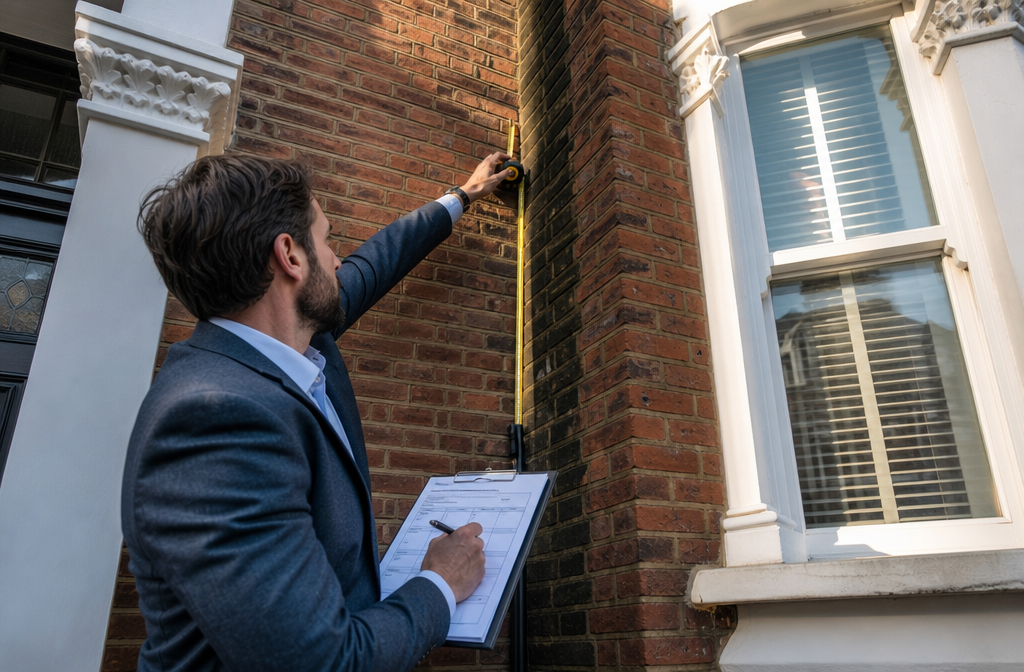
The connection between improving market sentiment and surveying workload is direct and well-established. As agreed sales rise, so does the volume of instructions across the full spectrum of building surveyor services. But the party wall dimension deserves particular attention in 2026.
Why Recovering Markets Drive Party Wall Activity
When house prices stabilise or begin to rise, homeowners who have been deferring renovation projects tend to move forward. Extensions, loft conversions, basement excavations, and structural alterations — all of which frequently trigger obligations under the Party Wall etc. Act 1996 — become financially viable again.
The sequence typically runs as follows:
- Buyer confidence improves → more sales agreed
- New homeowners invest in extensions and improvements
- Existing owners who held off during uncertainty restart deferred projects
- Party wall notices are served on neighbours
- Demand for party wall surveyors rises sharply
For anyone unfamiliar with the process, understanding when you need a party wall agreement is the essential first step. The Party Wall etc. Act 1996 requires building owners to notify adjoining owners before carrying out certain works — and with activity levels rising, the volume of notices being served is set to increase significantly.
Schedule of Condition Reports: The Unsung Beneficiary
One often-overlooked consequence of increased party wall activity is the surge in demand for schedule of condition surveys. Before any notifiable works begin, a schedule of condition documents the existing state of a neighbouring property. This protects both parties if damage claims arise later.
As more homeowners pursue extensions and renovations in a recovering market, the number of schedule of condition instructions rises in direct proportion. Surveyors who build capacity in this area now will be well-placed to meet demand through 2026 and into 2027.
Valuation Instructions and the RICS Survey Effect
Improving buyer sentiment also means more homebuyers seeking professional valuations and structural assessments before committing to purchases. An RICS survey can help buyers negotiate property prices — a function that becomes especially valuable when price expectations are rising and buyers want independent confirmation of value.
The January 2026 data suggests this type of instruction is likely to increase through Q2 and Q3 2026, particularly in London and the South East where price sensitivity is highest.
The Lettings Market: A Parallel Signal for Surveyors
The RICS January 2026 survey also covered the lettings sector, and the signals there reinforce the broader recovery narrative.
- Tenant demand recorded a net balance of +13% (quarterly, seasonally adjusted), ending two consecutive quarters of flat or negative readings [3].
- Rental price expectations jumped to a net balance of +28%, up sharply from +16% in the previous report [3].
For building surveyors, a tightening lettings market matters because landlords facing higher rental income expectations tend to invest in property improvements to justify premium rents. This generates demand for condition surveys, damp assessments, and specific defect surveys across the residential portfolio.
Housing Market Recovery Signals from RICS January 2026 Survey: Regional Implications for Party Wall Demand
The Housing Market Recovery Signals from RICS January 2026 Survey carry different weight depending on geography. London and its surrounding areas — where terraced and semi-detached housing stock is dense and party wall situations are most common — stand to see the sharpest uptick in party wall demand.
London: The Party Wall Hotspot
London's housing typology makes it uniquely sensitive to party wall demand cycles. The city's stock of Victorian and Edwardian terraced houses means that almost any extension, loft conversion, or basement project will involve a shared wall. As buyer activity recovers across London property markets, the volume of party wall notices is likely to accelerate faster than the national average.
Key London boroughs and districts to watch include:
- Fulham — high density of period terraces undergoing renovation (Fulham property surveyors)
- Chiswick — active extension and loft conversion market (Chiswick property surveyors)
- Hackney — strong buyer demand in recovering inner-London market (Hackney property surveyors)
- Camden — high-value properties driving premium renovation spend (Camden property surveyors)
- Hammersmith — consistent party wall instruction volumes (Hammersmith property surveyors)
What Surveyors Should Do Now
The RICS data points to a gradual recovery — not an overnight surge. This gives building surveyors and party wall practitioners a valuable preparation window. Key actions to consider:
📋 Operational readiness:
- Review capacity for party wall instructions and schedule of condition reports
- Ensure party wall notice procedures are up to date with current legislation
- Build relationships with local estate agents now, before the instruction surge
📣 Client education:
- Proactively inform homeowner clients about what to do when they receive a party wall notice
- Publish clear guidance on the party wall process to capture organic search traffic from homeowners beginning renovation planning
💼 Service diversification:
- Consider expanding into monitoring surveys for clients undertaking phased construction projects
- Offer bundled services combining party wall agreements with schedule of condition documentation
What Major Lenders and Forecasters Are Saying
The RICS survey data does not exist in isolation. Major lenders and estate agencies have independently forecast modest but positive house price growth for 2026 [6]:
- Hamptons: 2.5% growth by Q4 2026
- Halifax: 1–3% growth across 2026
- Savills: 2% growth for 2026
- Nationwide: 2–4% growth forecast for 2026
These forecasts align closely with the RICS January 2026 sentiment data, suggesting that the professional surveying community and the broader lending market are reading the same signals. A 2–3% price growth environment is not a boom — but it is the kind of stable, improving backdrop that encourages homeowners to invest in their properties rather than sit tight.
💡 Key insight: Modest price growth combined with improving sales volumes is historically the most productive environment for building surveyor and party wall instruction volumes. Boom markets can actually slow renovation activity as buyers compete for stock; stable recovery markets give homeowners the confidence to improve what they already own.
Risks and Caveats
Balanced analysis requires acknowledging that the January 2026 RICS data, while encouraging, comes with important caveats.
⚠️ Near-term sales expectations remain cautious at just +4%, suggesting that the recovery has not yet translated into a sustained surge in completions [3].
⚠️ Mortgage affordability remains a constraint for many buyers, and any adverse movement in Bank of England base rate policy could dampen the recovery trajectory.
⚠️ Stamp duty changes — specifically the end of the temporary nil-rate threshold for first-time buyers in April 2026 — may create a short-term distortion in Q1 activity followed by a temporary dip.
⚠️ Regional variation is significant. The recovery signals are not uniform across all UK markets, and surveyors in some areas may see the improvement later than others.
Conclusion: Preparing for the Party Wall Surge
The Housing Market Recovery Signals from RICS January 2026 Survey are clear: buyer enquiries are improving for the third consecutive month, agreed sales are at their least negative since June 2025, and professional confidence in a 12-month price recovery has reached its highest point in nearly a year [1][2][3]. For building surveyors and party wall practitioners, these are not abstract statistics — they are leading indicators of a workload increase that is likely to materialise through mid-to-late 2026.
Actionable Next Steps for Surveyors 🎯
- Audit current capacity for party wall instructions, schedule of condition reports, and homebuyer surveys — and identify gaps before demand peaks.
- Engage with local estate agents in recovering micro-markets to position your practice as the go-to surveyor for new instructions.
- Update client-facing content to explain the party wall process clearly — homeowners beginning renovation planning are actively searching for this information right now.
- Monitor RICS monthly data closely through Q1 and Q2 2026 to track whether near-term sales expectations (+4%) begin to converge with the stronger 12-month outlook (+35%).
- Consider geographic expansion into high-activity London boroughs and suburban markets where the period housing stock makes party wall demand structurally high.
The recovery is gradual — and that is precisely the opportunity. Surveyors who prepare now, rather than waiting for the surge to arrive, will capture the most instructions, build the strongest client relationships, and be best placed to serve a market that is, slowly but unmistakably, turning a corner.
References
[1] UK Residential Housing Market Shows Signs Of Recovery – https://global.morningstar.com/en-gb/news/alliance-news/1770865507395385800/uk-residential-housing-market-shows-signs-of-recovery
[2] Trading Economics – UK RICS House Price Balance News – https://tradingeconomics.com/united-kingdom/rics-house-price-balance/news/525158
[3] UK Residential Market Survey January 2026 – https://www.rics.org/content/dam/ricsglobal/documents/market-surveys/uk-residential-market-survey/UK-Residential-Market-Survey_January-2026.pdf
[4] RICS Hails Early Signs of Housing Market Improvement – https://www.housingtoday.co.uk/news/rics-hails-early-signs-of-housing-market-improvement-in-latest-survey/5140683.article
[5] Valuation Strategies Amid January 2026 RICS Residential Survey – https://nottinghillsurveyors.com/blog/valuation-strategies-amid-january-2026-rics-residential-survey-spotting-early-market-recovery-signals
[6] UK Property Market 2026 House Price Forecast – https://www.robinsonandhallauctions.co.uk/uk-property-market-2026-house-price-forecast/