Over 40% of neighbour disputes linked to construction work escalate because hidden defects — damp, voids, thermal bridges — are missed during the initial schedule of condition. The integration of thermal imaging applications in party wall surveys is changing that reality, and the RICS 8th Edition consultation launched in 2026 is formalising exactly how surveyors should deploy this technology.
This article breaks down the step-by-step process of embedding thermal imaging into pre-excavation party wall schedules of condition, explains what the updated RICS protocols mean in practice, and shows how this non-invasive approach resolves disputes before they become costly legal battles.
Key Takeaways 📌
- Thermal imaging detects hidden defects — damp, voids, heat loss, and structural anomalies — without any invasive drilling or cutting.
- RICS 8th Edition guidance (currently under consultation in 2026) is expected to formally recognise thermal imaging as a best-practice tool in party wall procedures [3].
- Pre-excavation schedules of condition are the most critical moment to deploy thermal imaging, creating an undeniable baseline record before works begin.
- Listed buildings and occupied homes benefit most from thermal imaging due to its zero-damage, low-disruption approach [2].
- Early defect detection dramatically reduces the risk of neighbour disputes escalating to formal arbitration or court proceedings.
Why Thermal Imaging Is Reshaping Party Wall Surveys in 2026
The traditional party wall survey relied heavily on visual inspection, moisture meters, and — where necessary — invasive probing. These methods are effective but limited. A damp patch behind a freshly plastered wall, a void in a Victorian chimney breast, or a failing cavity wall tie simply cannot be seen with the naked eye.
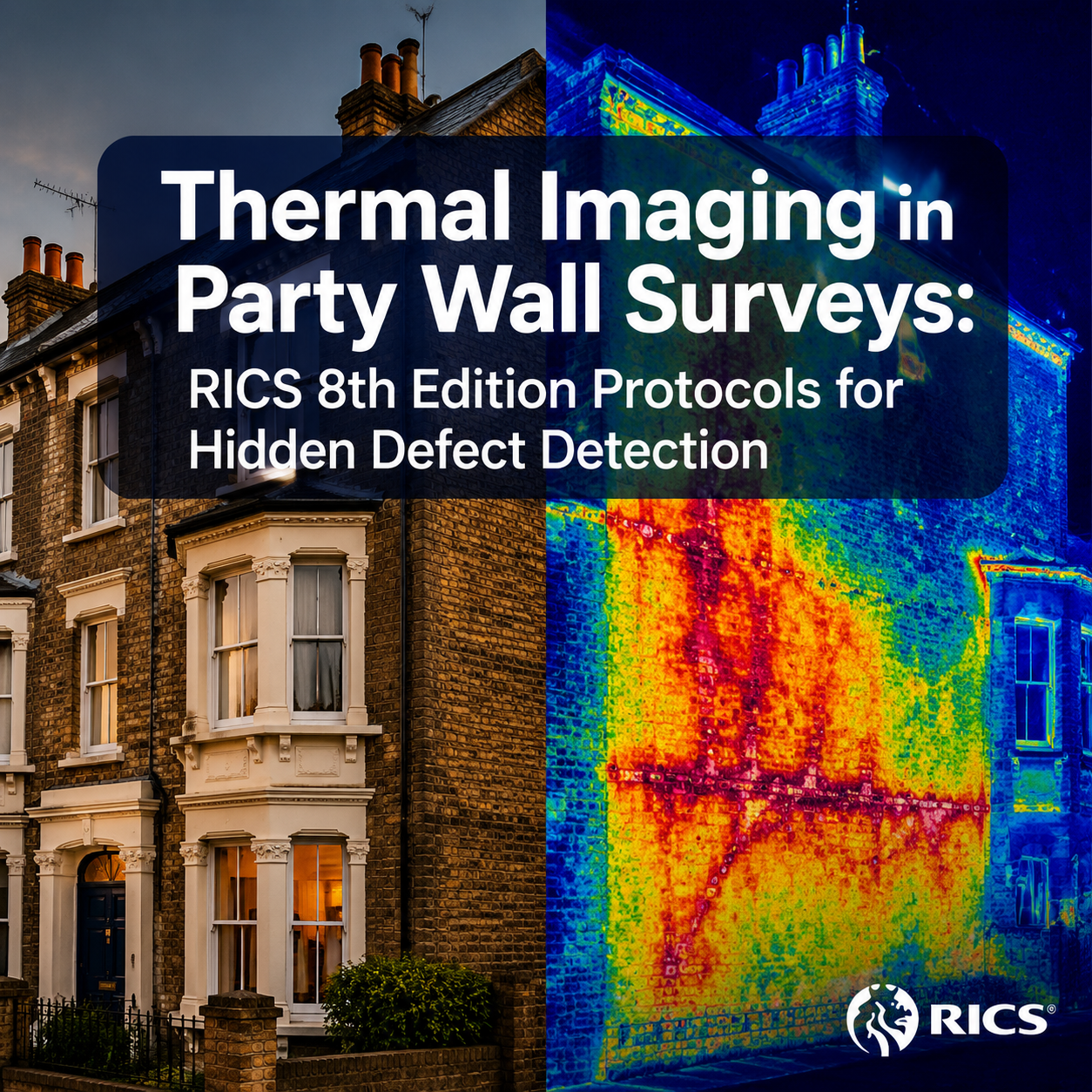
Thermal imaging cameras detect infrared radiation emitted by surfaces, translating temperature differences into vivid false-colour images called thermograms. In a party wall context, these temperature variations reveal:
- 🌊 Moisture ingress and damp — wet materials conduct heat differently from dry ones
- 🧱 Structural voids and gaps — air pockets show as cold spots
- 🔥 Thermal bridges — areas where heat escapes through the wall structure
- ⚡ Electrical hotspots — overloaded circuits behind walls
- 🏗️ Poorly bonded render or plaster — delamination creates distinct thermal signatures
"Thermal imaging has been established as a non-invasive and fast inspection method, making it particularly suitable for party wall surveys in occupied homes where minimal disruption is required." [2]
This matters enormously in the party wall context. Under the Party Wall Act 1996, a building owner undertaking excavation or structural works adjacent to a neighbour's property has a legal duty to record the condition of that property beforehand. If defects are missed at this stage and damage occurs later, disputes become almost inevitable.
The RICS 8th Edition Consultation: What's Changing?
In April and May 2026, the Royal Institution of Chartered Surveyors launched a formal eight-week consultation on the draft 8th edition of Party Wall Legislation and Procedure [3][4]. The consultation specifically invited feedback from surveyors, legal professionals, dispute resolution practitioners, and other stakeholders to ensure competence and consistency across party wall practice [3].
While the final 8th Edition guidance had not yet been published at the time of writing, the direction of travel is clear: technology-assisted inspection methods, including thermal imaging, are expected to be formally recognised within updated protocols. The consultation signals RICS's commitment to modernising party wall practice to reflect advances in surveying technology [4].
For professionals already working under RICS standards, this is an important moment to understand how thermal imaging fits into compliant party wall procedures — both now and under the incoming 8th Edition framework.
Step-by-Step: Integrating Thermal Imaging into Pre-Excavation Schedules of Condition
The schedule of condition is the document that records the state of an adjoining owner's property before any notifiable works begin. It is the single most important protective tool in a party wall dispute — and thermal imaging makes it dramatically more powerful.
Here is how a properly structured thermal imaging survey integrates into the pre-excavation party wall process:
Step 1: Pre-Survey Preparation and Thermal Calibration ⚙️
Effective thermography requires the right environmental conditions. Surveyors must:
| Requirement | Detail |
|---|---|
| Temperature differential | Minimum 10°C difference between inside and outside for reliable results |
| Survey timing | Early morning or evening avoids solar gain distorting readings |
| Equipment calibration | Camera emissivity settings adjusted for wall material (brick, plaster, concrete) |
| Baseline documentation | Photographs and written notes taken simultaneously |
This preparation stage is non-negotiable. A thermogram taken in poor conditions can misrepresent the wall's actual thermal profile, potentially undermining the schedule of condition's evidential value.
Step 2: Systematic Wall-by-Wall Scanning 🔍
The surveyor works methodically through each wall, floor, and ceiling that falls within the party wall award's scope. The thermal camera captures:
- Full-elevation scans of each party wall face
- Close-up images of any anomalies detected
- Junction scans at floor-ceiling interfaces, window reveals, and chimney breasts
- Basement and sub-floor areas where excavation works will have the greatest impact
Every image is geo-tagged and time-stamped, creating an unambiguous record tied to a specific date and location. This is critical for party wall agreement purposes — it proves the condition at a precise moment in time.
Step 3: Defect Identification and Classification 🏷️
Not every thermal anomaly represents a defect. A trained surveyor interprets thermograms in context, classifying findings into:
- Pre-existing defects — damp, voids, or cracks present before works began (critical for establishing liability)
- Thermal bridges — inherent in the building's construction, not caused by works
- Suspected active moisture — requires follow-up with a moisture meter or damp survey
- Inconclusive anomalies — flagged for monitoring or further investigation
Pro tip: Thermal imaging does not replace a moisture meter — it directs the moisture meter to exactly the right spot, saving time and reducing unnecessary wall penetration.
Step 4: Integration with the Written Schedule of Condition 📋
The thermograms are embedded directly into the schedule of condition report alongside conventional photographs and written descriptions. A well-structured RICS-compliant schedule will include:
- Location plan identifying the property and affected walls
- Conventional photographs showing visible condition
- Annotated thermograms with temperature scale and anomaly markers
- Written description of each defect or anomaly
- Classification of each finding (pre-existing / inconclusive / thermal bridge)
- Surveyor's professional opinion on significance
This multi-layered evidence base is far more robust than a visual-only schedule. If a dispute arises after excavation works, the thermal record provides objective, scientific evidence of what existed before works began.
Step 5: Post-Works Comparison Survey 🔄
Where works are extensive — particularly deep excavations that can cause ground movement and wall cracking — a follow-up thermal survey after completion allows direct comparison with the pre-works baseline. Any new thermal anomalies that appear post-works can be attributed to the construction activity with a high degree of confidence.
This before-and-after approach is becoming the gold standard in party wall practice, particularly for building works on or near property lines in dense urban environments like London.
Thermal Imaging Applications in Party Wall Surveys: RICS 8th Edition Protocols for Hidden Defect Detection in Specialist Contexts
The protocols emerging under the RICS 8th Edition framework are not one-size-fits-all. Thermal imaging applications in party wall surveys vary significantly depending on the building type, the nature of the proposed works, and the sensitivity of the adjoining property.
Listed Buildings and Historic Structures 🏛️
Thermal imaging is particularly valuable in listed buildings where invasive inspection methods are simply not permissible. Drilling into a Grade II listed party wall to probe for damp or structural defects risks damaging irreplaceable historic fabric — and may require listed building consent in its own right.
Thermal imaging sidesteps this problem entirely. The camera captures the wall's thermal profile without touching it [2]. For surveyors working in areas with high concentrations of listed properties — such as Kensington or Islington — this capability is not a luxury; it is a professional necessity.
Basement and Excavation Projects 🏗️
London's ongoing appetite for basement extensions makes pre-excavation thermal surveys especially important. Deep excavations can cause:
- Ground heave or settlement affecting party walls
- Water table disruption leading to new damp ingress
- Vibration-induced cracking in adjacent masonry
A thermal baseline survey conducted before excavation begins provides the clearest possible evidence of the wall's pre-works condition. This protects both the building owner (from unfounded claims) and the adjoining owner (from undetected damage going uncompensated).
Occupied Properties and Minimal Disruption Requirements 🏠
One of the most practical advantages of thermal imaging in party wall surveys is the speed and non-intrusiveness of the process. A full thermal survey of a typical London terraced house party wall can be completed in under two hours with zero damage to décor, finishes, or structure [2].
This matters enormously when the adjoining owner is a residential tenant or an elderly occupant who cannot tolerate lengthy or disruptive inspections. The Party Wall Act 1996 requires reasonable access for schedule of condition surveys — thermal imaging makes that access as brief and painless as possible.
Dispute Resolution: Thermal Evidence in Action ⚖️
When disputes do arise — and they do, even with the best preparation — thermal imaging evidence carries significant weight. Consider a scenario where a neighbour claims that excavation works caused a new damp problem in their party wall. Without a pre-works thermal baseline, it is one party's word against the other's.
With a dated, geo-tagged thermogram showing the same thermal anomaly existed before works began, the dispute resolves quickly. The objective, scientific nature of thermal data is difficult to challenge and often prevents cases from reaching formal arbitration or the courts.
For anyone navigating a complex party wall situation, understanding what a building survey covers and how thermal evidence integrates with formal survey reports is essential groundwork.
Practical Considerations: Equipment, Qualifications, and Limitations
Equipment Standards
Not all thermal cameras are equal. For party wall survey purposes, the camera should meet minimum specifications:
| Specification | Recommended Minimum |
|---|---|
| Thermal sensitivity | ≤0.05°C (NETD) |
| Resolution | 320 × 240 pixels or higher |
| Temperature range | -20°C to +120°C |
| Emissivity adjustment | Adjustable (not fixed) |
Consumer-grade thermal cameras — including smartphone attachments — do not meet these standards and should not be used for evidential party wall surveys.
Surveyor Qualifications
Thermal imaging is a specialist skill. The RICS 8th Edition consultation is expected to reinforce the principle that thermography in party wall surveys should be conducted by appropriately trained and qualified professionals [3]. Relevant qualifications include:
- ITC Level 1 or 2 Thermography Certification (or equivalent)
- RICS membership with party wall competency
- Demonstrated experience in building pathology
A qualified RICS surveyor who also holds thermography certification represents the gold standard for this type of work.
Limitations to Acknowledge Honestly ⚠️
Thermal imaging is powerful but not infallible. Responsible surveyors must acknowledge:
- It cannot see through thick masonry — it reads surface temperatures only
- Solar gain can mask or create false anomalies — survey timing is critical
- Some defects are thermally invisible — hairline cracks without moisture ingress may not register
- Interpretation requires expertise — a thermogram is only as useful as the person reading it
These limitations do not diminish the technology's value — they simply underline why it must be deployed by trained professionals within a structured, RICS-compliant methodology.
Conclusion: Actionable Next Steps for Surveyors and Property Owners
Thermal imaging applications in party wall surveys represent one of the most significant advances in party wall practice in a generation. The RICS 8th Edition protocols for hidden defect detection are formalising what leading practitioners have known for years: a thermogram is worth a thousand words — and potentially thousands of pounds in avoided dispute costs.
Here are the actionable steps to take right now:
-
✅ If you are a building owner planning excavation or structural works, instruct a party wall surveyor who holds both RICS membership and thermography certification. Insist on a thermal imaging baseline as part of the pre-works schedule of condition.
-
✅ If you are an adjoining owner who has received a party wall notice, request that the agreed surveyor uses thermal imaging in the schedule of condition. This protects your property rights with objective evidence.
-
✅ If you are a party wall surveyor, review the RICS 8th Edition consultation materials and invest in appropriate thermography training and equipment now — before the new guidance becomes mandatory.
-
✅ If a dispute has already arisen, commission a retrospective thermal survey immediately. Even post-works thermograms can reveal patterns that help establish causation.
-
✅ For listed buildings or complex urban sites, engage specialists with specific experience in heritage thermography and dense-urban party wall practice.
The convergence of advanced thermal imaging technology and updated RICS 8th Edition protocols is creating a new standard of care in party wall surveying. Those who embrace it early will be better equipped to protect their clients, resolve disputes efficiently, and deliver surveys that stand up to scrutiny.
References
[1] Thermal Imaging Party Wall Surveys – https://nottinghillsurveyors.com/blog/tag/thermal-imaging-party-wall-surveys
[2] Thermal Imaging In Party Wall Surveys Detecting Hidden Defects And Resolving Neighbour Disputes Under Rics 8th Edition – https://nottinghillsurveyors.com/blog/thermal-imaging-in-party-wall-surveys-detecting-hidden-defects-and-resolving-neighbour-disputes-under-rics-8th-edition
[3] Rics Launches Consultation On Updated Party Wall Practice Guidance – https://www.rics.org/news-insights/rics-launches-consultation-on-updated-party-wall-practice-guidance
[4] Rics Launches Consultation On Party Wall Guidance – https://thenegotiator.co.uk/news/regulation-law-news/rics-launches-consultation-on-party-wall-guidance/
[5] Rics Standards – https://www.isurv.com/downloads/176/rics_standards