

Up to 46% of property sales in England and Wales fail or experience significant delays due to issues uncovered during buyer-commissioned surveys — issues that sellers could have identified and resolved weeks or months earlier. In a market where 98% of buyers and sellers expect challenges ahead [2], and where subdued buyer enquiries continue to define RICS sentiment data for early 2026, the case for sellers surveys has never been more compelling. Sellers Surveys in Cautious 2026 Markets: Reducing Fall-Through Risks and Accelerating Completions for Property Owners is no longer a niche strategy — it is rapidly becoming a competitive necessity.
Key Takeaways 📋
- Fall-throughs are preventable: Proactive sellers surveys identify defects before buyers do, removing the most common trigger for renegotiation or withdrawal.
- Valuation certainty matters: In a market where 83% of sellers expect asking price or above [3], a pre-sale survey grounds expectations in reality and protects against late-stage price chipping.
- Speed is a competitive advantage: Properties with transparent condition reports move through conveyancing faster, reducing the window during which buyers can get cold feet.
- Concessions are rising: 39% of sellers now expect to make concessions [3] — a sellers survey helps control what those concessions are, rather than leaving them to buyer surveyors to dictate.
- Market conditions are uneven: Regional dynamics in 2026 vary significantly, meaning sellers need property-specific intelligence rather than broad market optimism.
The 2026 Property Market: Why Caution Is the New Normal
The property market entering 2026 is not in freefall — but it is not forgiving either. J.P. Morgan Global Research predicts house prices will remain broadly flat this year, with demand only marginally improving [1]. Meanwhile, 40% of Americans planning to buy or sell worry about a potential real estate market crash [2], and similar anxiety is palpable among UK homeowners navigating rising inventory and stretched affordability.
The expectation gap is stark. A full 83% of potential sellers expect to achieve their asking price or more, with 46% expecting their exact asking price and 37% expecting above it [3]. Yet only 12% anticipate receiving less. This optimism collides with a market reality where agents are considerably more pessimistic: 30% of agents expect prices to fall in 2026, compared to just 16% of buyers and sellers [2].
"The biggest mistake sellers make is overpricing their homes." — HomeLight survey findings [1]
Regional variation adds further complexity. In the South and West, rising inventory is shifting power toward buyers. In the Northeast, tight supply continues to favour sellers. For UK property owners, similar dynamics apply across London commuter belts, regional cities, and rural markets. A one-size-fits-all pricing strategy is a liability.
What does this mean for sellers? It means the transaction environment is fragile. Buyers are cautious, mortgage approvals are scrutinised, and any uncertainty about a property's condition gives buyers — and their solicitors — grounds to delay, renegotiate, or walk away entirely.
How Sellers Surveys in Cautious 2026 Markets Reduce Fall-Through Risks
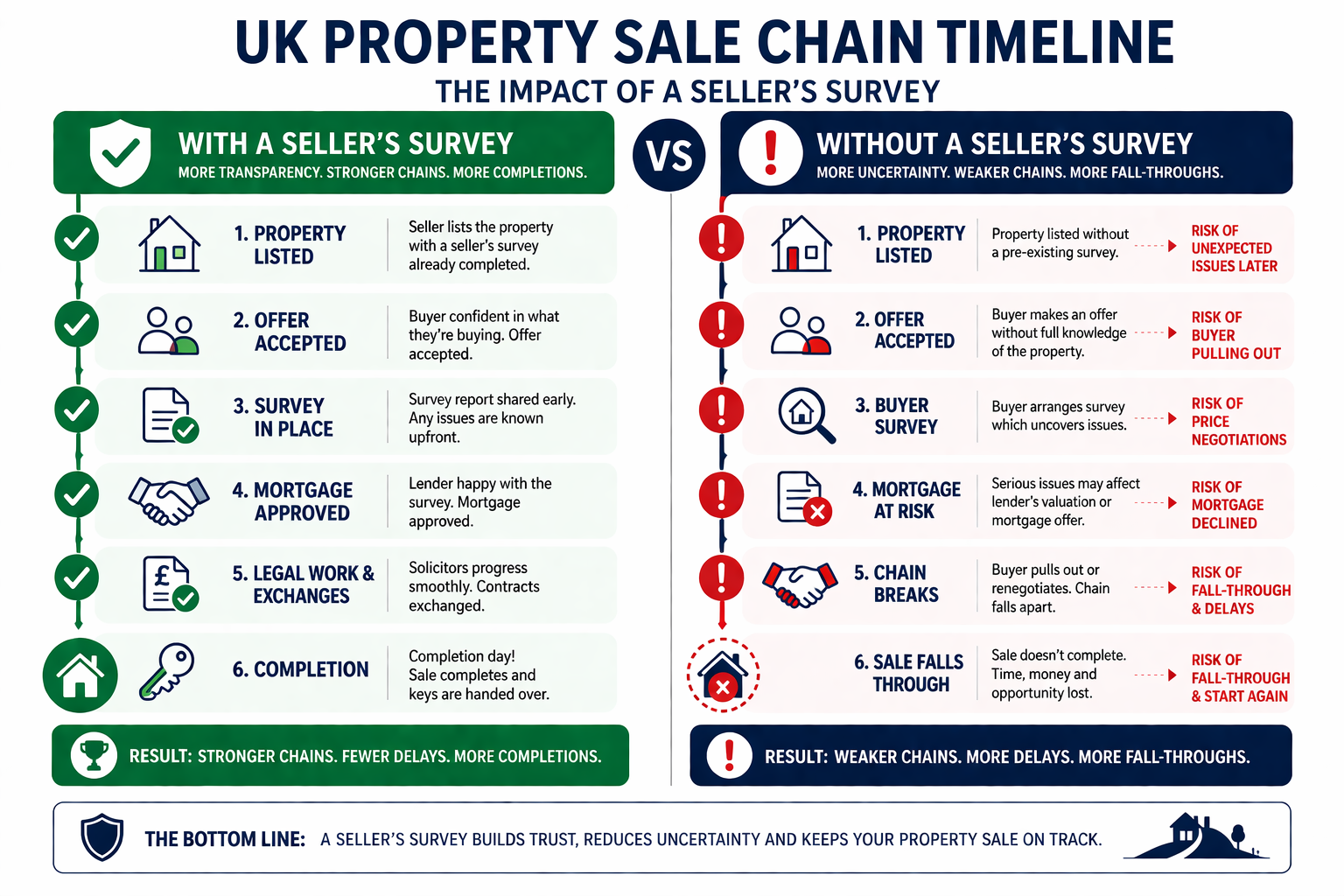
The mechanics of a fall-through are almost always the same: a buyer commissions a survey, defects are identified, and the buyer either demands a price reduction, requests repairs, or withdraws. Each of these outcomes costs the seller time, money, and momentum.
Sellers surveys interrupt this cycle at the source.
By commissioning a RICS building survey or RICS Homebuyer Survey before listing, sellers gain:
1. 🔍 Early Defect Identification
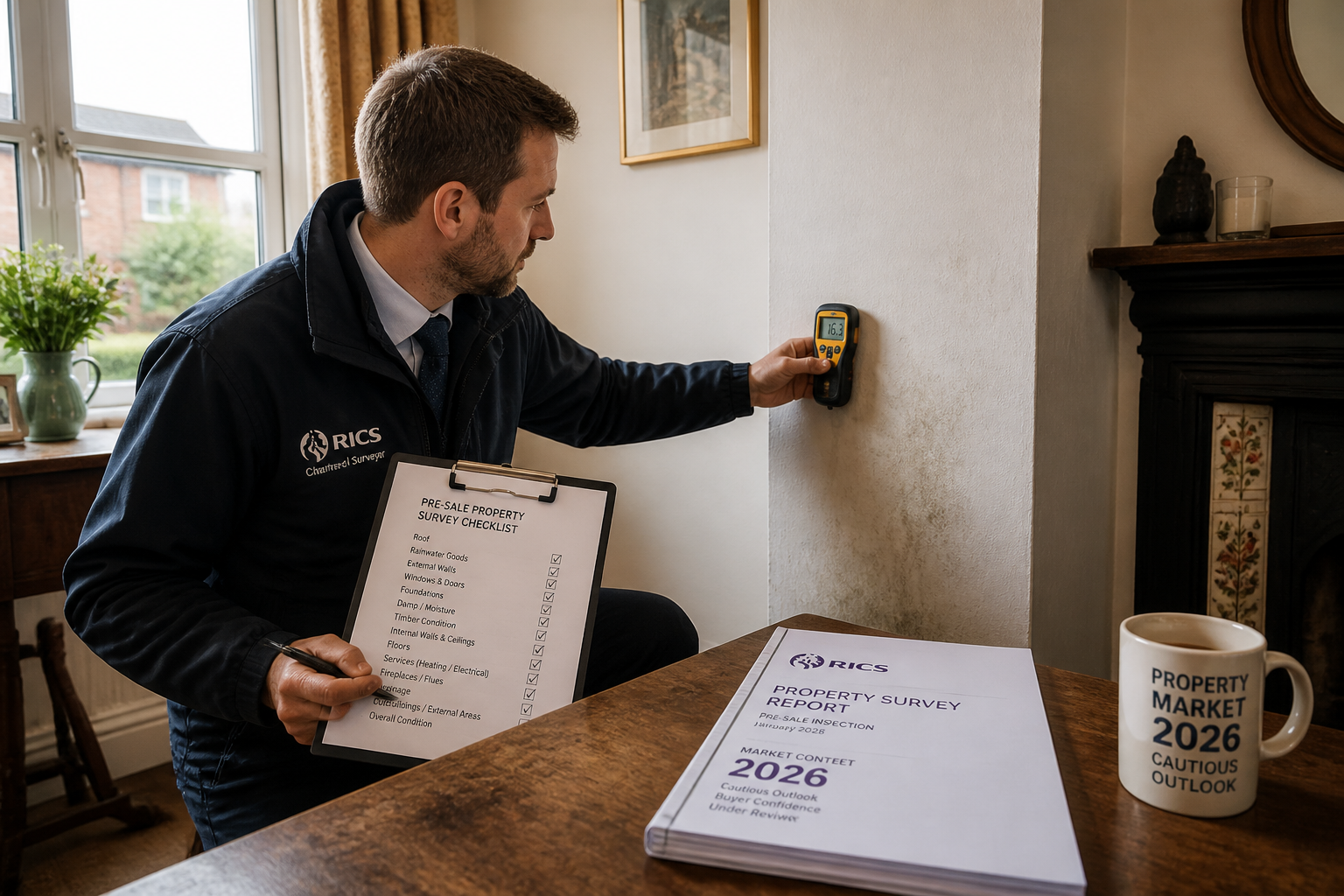
A pre-sale survey reveals structural issues, damp, roofing problems, and other defects while the seller still has time to act. Repairs completed before listing remove the buyer's negotiating leverage entirely.
Common defects uncovered in pre-sale surveys include:
| Defect Type | Impact on Sale if Undisclosed | Seller Action Available |
|---|---|---|
| Rising or penetrating damp | Buyer renegotiation or withdrawal | Remediation + damp survey report |
| Roof deterioration | Price chip of 5–15% | Repair or transparent pricing |
| Structural movement | Mortgage refusal by lender | Specialist report + underpinning if needed |
| Electrical/plumbing issues | Delayed exchange | Certification before listing |
| Japanese knotweed | Mortgage refusal | Specialist assessment and treatment plan |
2. 📊 Valuation Certainty and Pricing Confidence
One of the most damaging dynamics in 2026 is late-stage price chipping — where a buyer uses survey findings to demand a reduction after the seller has already mentally spent the proceeds. A sellers survey allows the asking price to be set with full knowledge of the property's condition, making it defensible and less likely to collapse under scrutiny.
This is particularly important given that 39% of sellers now expect to make concessions [3], up from 30% in 2025. A pre-sale survey puts the seller in control of which concessions are offered and when — rather than reacting to a buyer's surveyor's report under pressure.
3. ⚡ Faster Conveyancing Timelines
When a sellers survey is shared with buyers upfront, conveyancing solicitors have fewer unknowns to resolve. The buyer's surveyor may still conduct their own inspection, but a transparent condition report reduces the likelihood of prolonged back-and-forth on defect queries. This directly accelerates completions — a critical advantage when buyers are nervous and chains are fragile.
For sellers considering what to do after a bad building survey result, acting proactively before listing is almost always less costly than reacting after a buyer's survey lands.
Choosing the Right Survey Type for Your Property
Not all sellers surveys are equal. The appropriate survey depends on the property's age, construction type, and condition. Selecting the wrong level of inspection can leave defects undiscovered — defeating the purpose entirely.
RICS Level 2: Homebuyer Survey
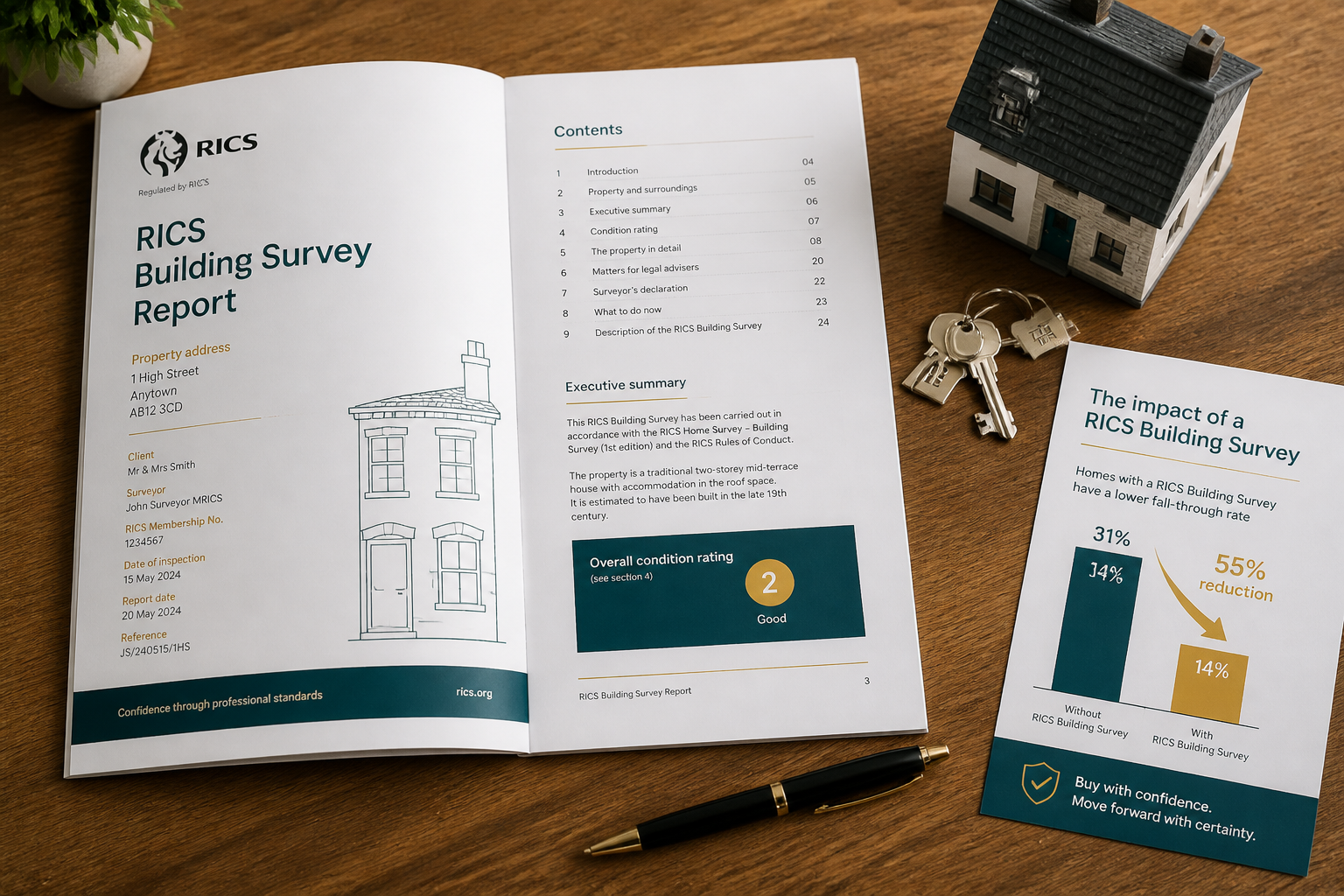
Best suited to conventional properties in reasonable condition, typically post-1930s construction with no significant alterations. This survey provides a condition rating for each element of the property and highlights urgent defects. It is the most commonly commissioned pre-sale report and is well understood by buyers and their solicitors.
👉 Explore what a homebuyers report contains and how it supports a pre-sale strategy.
RICS Level 3: Building Survey
The most comprehensive option, recommended for:
- Properties built before 1900
- Listed buildings or those with unusual construction
- Properties that have undergone significant extension or conversion
- Any property where the seller suspects structural issues
A full structural survey provides detailed analysis of every accessible element, including hidden defects behind finishes. For sellers of older or complex properties, this level of scrutiny is essential — both for their own knowledge and to pre-empt buyer concerns.
Condition Survey (Level 1)
A basic overview suitable for new-build or near-new properties in excellent condition. It provides a snapshot of condition without detailed analysis. Less commonly used as a sellers survey but appropriate in specific circumstances.
For guidance on choosing between a homebuyers report and a building survey, the decision should be based on the property's age and complexity rather than cost alone.
The Financial Case: Survey Costs vs. Fall-Through Losses
A sellers survey typically costs between £400 and £1,500 depending on property size and survey level. A fall-through, by contrast, costs the average UK seller between £2,500 and £5,000 in wasted legal fees, survey fees, and relisting costs — before accounting for the emotional toll and market timing losses.
Consider the mathematics:
One prevented fall-through pays for 3–10 sellers surveys.
Beyond direct costs, there is the issue of market timing. Properties that fall through and relist often attract a stigma discount — buyers assume something is wrong, and offers come in lower. In a cautious 2026 market where 35% of sellers whose homes don't sell on their desired timeline plan to reduce their asking price [3], a fall-through can trigger a price reduction that dwarfs the cost of a pre-sale survey.
For sellers thinking carefully about property survey expenses and return on investment, the numbers consistently favour proactive action.
Sellers Surveys in Cautious 2026 Markets: Practical Steps for Property Owners
Implementing a sellers survey strategy is straightforward. The following process maximises the benefits:
Step 1: Commission the Survey Early
Book a RICS-accredited surveyor as soon as the decision to sell is made — ideally 8–12 weeks before the planned listing date. This allows time to address findings before marketing begins.
Step 2: Review Findings Honestly
Resist the temptation to dismiss concerns flagged in the report. Each unresolved issue is a potential fall-through trigger. Prioritise repairs that affect structural integrity, moisture ingress, or mortgage lender requirements.
Step 3: Obtain Remediation Evidence
For any repairs carried out, retain contractor invoices, guarantees, and before/after photographs. These documents transform a potential negative into a positive — demonstrating that the seller has been responsible and transparent.
Step 4: Share the Report Strategically
Discuss with the estate agent how and when to share the survey with prospective buyers. In many cases, making the report available during the offer stage — rather than after — signals confidence and reduces the likelihood of post-offer renegotiation.
Step 5: Price Accordingly
Use the survey findings to set a price that reflects the property's actual condition. A price grounded in evidence is far more defensible than one based on optimism alone.
Step 6: Prepare for Buyer Surveys
Even with a sellers survey in place, buyers will typically commission their own inspection. Understanding what happens after a poor building survey result — and having already addressed the major issues — puts sellers in a strong negotiating position.
Regional Considerations for 2026 UK Sellers
Market conditions in 2026 are not uniform. Sellers in different regions face different buyer pools, different inventory levels, and different lender attitudes. A sellers survey strategy should reflect these local dynamics.
- London and South East: High-value transactions with sophisticated buyers. Buyers' solicitors are rigorous. A comprehensive RICS building survey is strongly recommended, particularly for Victorian and Edwardian stock.
- Regional cities (Manchester, Birmingham, Bristol): Rising inventory is shifting bargaining power toward buyers. Sellers surveys provide a clear differentiator in competitive listing environments.
- Rural and coastal markets: Older properties with potential damp, structural, or access issues. Damp surveys are particularly valuable here given the prevalence of penetrating damp in exposed locations.
For sellers in specific London areas, local expertise matters. Chartered surveyors covering Richmond, Hounslow, and surrounding areas bring granular knowledge of local construction types, planning histories, and common defects — intelligence that a generic national survey provider simply cannot replicate.
Addressing the FSBO Risk in 2026
One of the more striking trends in 2026 is the surge in for-sale-by-owner (FSBO) consideration. Nearly 45% of sellers are considering selling without an agent [2], up sharply from 33% the previous year. While this approach can reduce commission costs, it significantly increases the risk of procedural errors, disclosure failures, and — critically — survey-related fall-throughs.
FSBO sellers who skip a pre-sale survey are particularly exposed. Without professional guidance, they may be unaware of defects that a buyer's surveyor will immediately flag, and without an agent to manage the negotiation, a post-survey renegotiation can quickly derail a sale entirely.
For FSBO sellers, a sellers survey is not optional — it is the primary professional safeguard available to them.
Conclusion: Proactive Sellers Win in Cautious Markets
The data from 2026 paints a consistent picture: the property market rewards sellers who prepare and penalises those who assume. With 93% of buyers and sellers bracing for financial challenges [2], and with buyer caution at levels not seen since the post-pandemic correction, the margin for error in a property transaction has narrowed significantly.
Sellers Surveys in Cautious 2026 Markets: Reducing Fall-Through Risks and Accelerating Completions for Property Owners is not a defensive strategy — it is an offensive one. It puts the seller in control of the narrative, the timeline, and the negotiation.
Actionable Next Steps for Property Owners in 2026:
- ✅ Book a RICS-accredited surveyor at least 8 weeks before your planned listing date.
- ✅ Address priority defects identified in the report before marketing begins.
- ✅ Set a price grounded in evidence, not optimism — the market will test it.
- ✅ Share the survey report with serious buyers to build trust and reduce post-offer renegotiation.
- ✅ Seek local expertise — a surveyor who knows your specific area and property type is worth the investment.
- ✅ Document all remediation work to demonstrate transparency and protect against late-stage challenges.
The sellers who complete successfully in 2026 will not be the most optimistic — they will be the most prepared.
References
[1] Article315278253 – https://www.sacbee.com/news/business/article315278253.html
[2] 40 Of Home Buyers And Sellers Fear A Real Estate Market Crash In 2026 – https://mecktimes.com/news/2026/01/29/40-of-home-buyers-and-sellers-fear-a-real-estate-market-crash-in-2026/
[3] Realtorcom Survey Finds Sellers Are Optimistic Heading 2026 Spring Market – https://athensceo.com/news/2026/04/realtorcom-survey-finds-sellers-are-optimistic-heading-2026-spring-market/