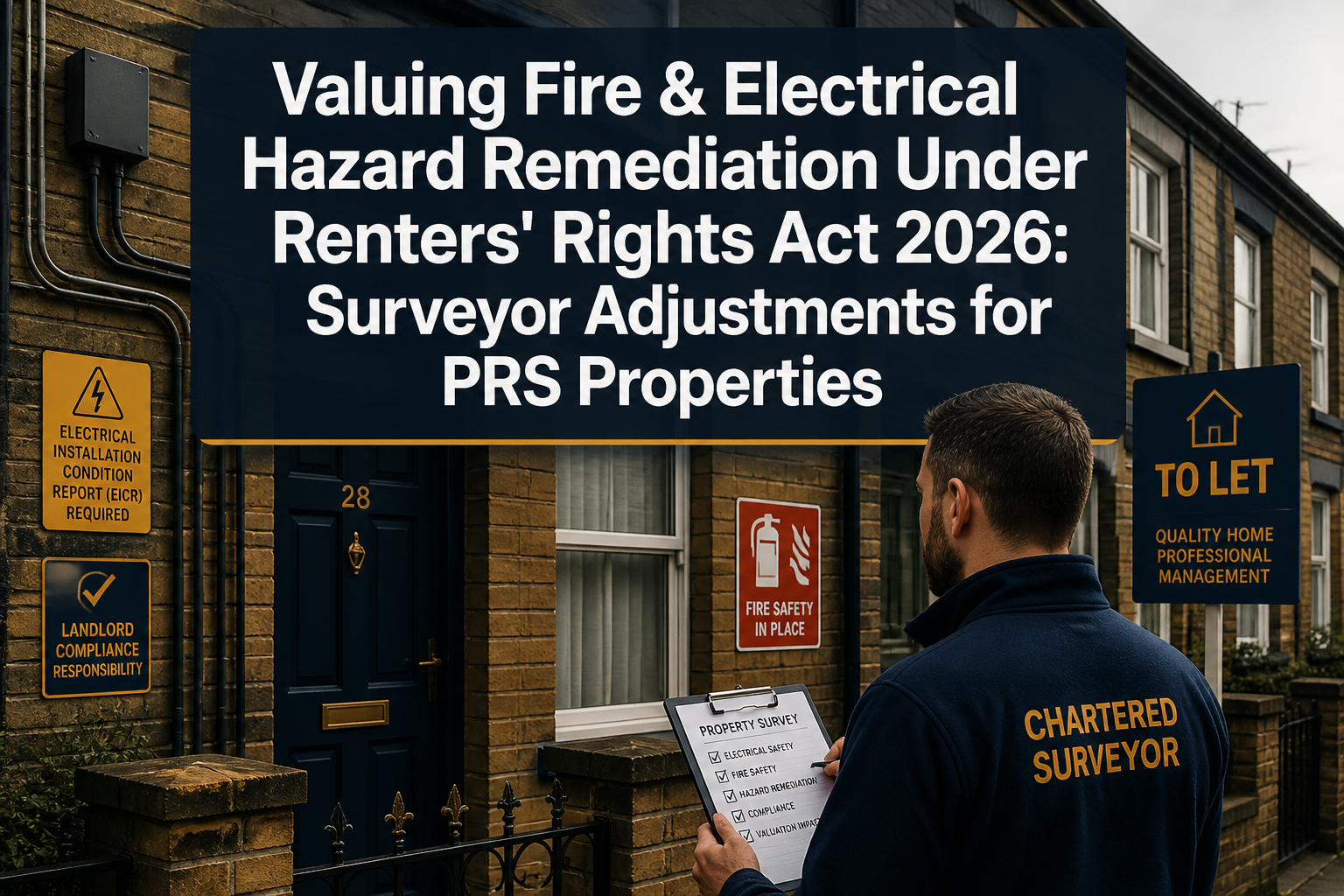
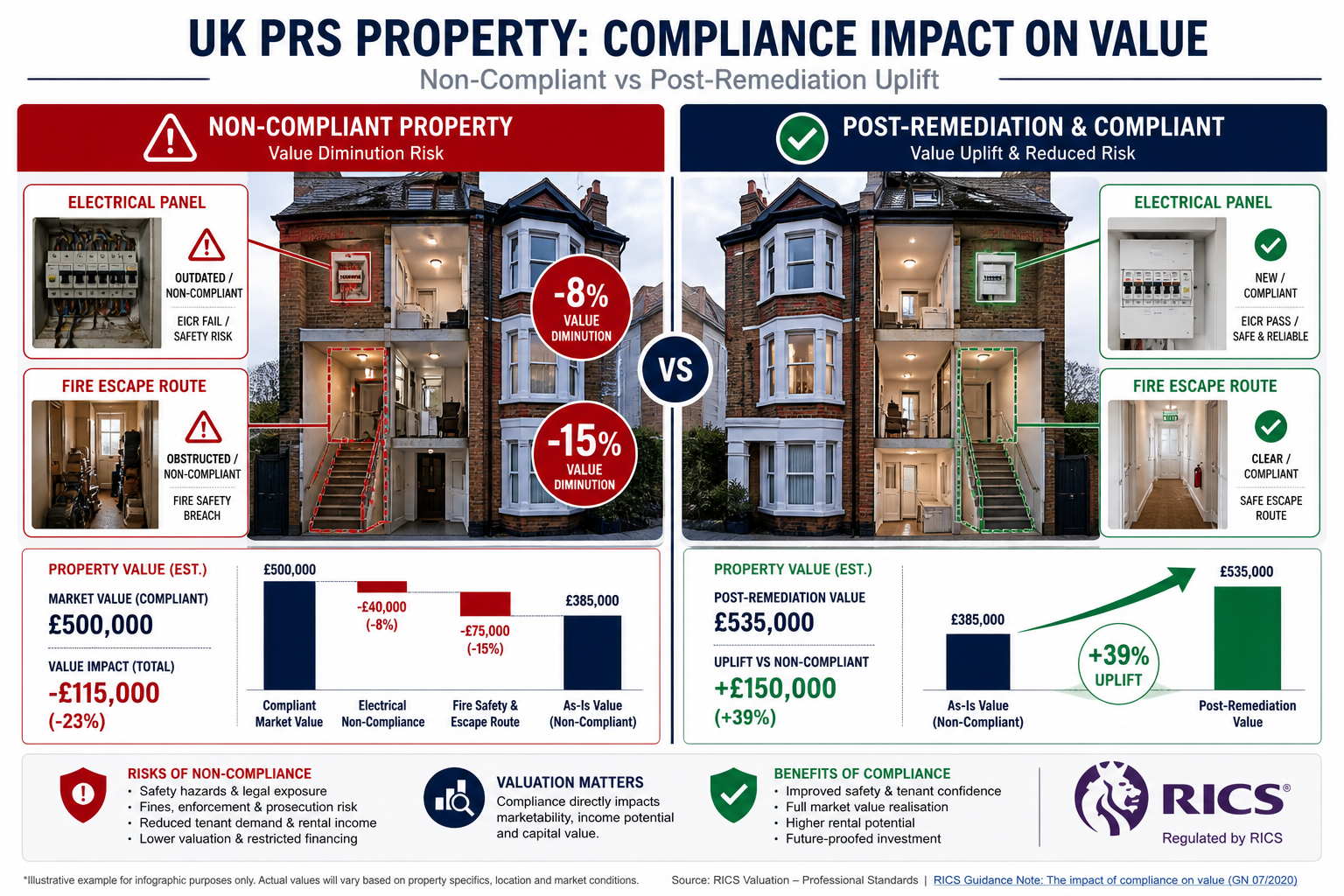
Non-compliant fire and electrical hazards in private rented sector (PRS) properties can slash assessed market values by 8–18% — and under the new legislative landscape of 2026, that figure is no longer a theoretical risk. It is a measurable, enforceable reality that every landlord, investor, and surveyor must now price into their calculations.
Valuing fire and electrical hazard remediation under Renters' Rights Act 2026: surveyor adjustments for PRS properties has become one of the most technically demanding disciplines in UK residential surveying. The Act introduces strengthened tenant protections, stricter enforcement timelines, and clear obligations that directly affect how chartered surveyors assess, discount, and uplift property values across landlord portfolios.
This guide breaks down the valuation mechanics — from quantifying diminution caused by non-compliant hazards to modelling post-remediation uplifts — giving landlords, investors, and their advisors a clear framework for 2026 and beyond.
Key Takeaways 📌
- Non-compliant fire and electrical hazards can reduce a PRS property's assessed value by 8–18%, depending on severity and location.
- The Renters' Rights Act 2026 imposes stricter enforcement timelines, making hazard remediation a financial priority, not just a legal one.
- Surveyors must now apply structured adjustment methodologies — including cost-to-cure, income capitalisation, and risk-weighted discounts — when valuing affected PRS stock.
- Post-remediation valuation uplifts of 5–12% are achievable for properties brought into full compliance, with additional yield improvements for landlords.
- Proactive portfolio audits using qualified building surveyors are the most cost-effective way to protect asset values in 2026.
The Legislative Backdrop: What the Renters' Rights Act 2026 Changes for PRS Valuations
The Renters' Rights Act 2026 represents the most significant overhaul of the private rented sector in a generation. Building on the foundations of the Homes (Fitness for Human Habitation) Act 2018 and the Housing Health and Safety Rating System (HHSRS), the new Act sharpens both landlord obligations and tenant remedies — with direct consequences for property valuations.
Strengthened Hazard Categories Under the Act
The Act formally elevates Category 1 hazards under HHSRS — including excess cold, electrical hazards, and fire risks — to priority enforcement status. Local housing authorities now face statutory duties (not merely powers) to act on complaints within defined windows. For surveyors, this means:
- Electrical hazards (faulty wiring, overloaded circuits, absence of RCD protection) must be flagged as material valuation factors
- Fire safety deficiencies (missing smoke alarms, inadequate means of escape, non-compliant fire doors) trigger mandatory disclosure requirements
- Awaab's Law extensions — originally applied to social housing — now reach into the PRS, imposing remediation timelines that affect rental income projections [4]
💬 "The shift from discretionary enforcement to statutory duty fundamentally changes the risk calculus for PRS asset valuations. Surveyors can no longer treat hazard remediation as a footnote — it must be central to the valuation narrative."
Enforcement Timelines and Their Valuation Implications
Under the 2026 framework, landlords face:
| Hazard Type | Inspection Trigger | Remediation Deadline |
|---|---|---|
| Category 1 Electrical | Tenant complaint or EICR failure | 28 days (emergency) / 6 weeks (standard) |
| Fire Safety (alarms/escape) | Inspection or complaint | 24 hours (alarms) / 4 weeks (structural) |
| Category 2 Electrical | Periodic EICR review | 12 weeks |
| Damp/Fire Door Defects | HHSRS assessment | 8 weeks |
These timelines create income risk windows — periods during which rental income may be suspended or reduced — that surveyors must now factor into investment valuations and yield calculations.
For landlords managing larger portfolios, understanding surveyor responsibilities in this context is essential to avoid being caught off-guard by enforcement action.
Quantifying Diminution in Value: How Surveyors Price Non-Compliant Hazards
The core challenge in valuing fire and electrical hazard remediation under Renters' Rights Act 2026: surveyor adjustments for PRS properties lies in translating physical defects into defensible financial adjustments. Three primary methodologies are now used by RICS-accredited practitioners.
1. Cost-to-Cure Methodology
The most straightforward approach deducts the full remediation cost from the property's hypothetical compliant value. This is appropriate where:
- Defects are clearly scoped (e.g., full rewire, fire door replacement)
- Costs can be reliably estimated from current contractor schedules
- The property is otherwise in good condition
Typical remediation cost ranges (2026 market rates):
| Remediation Work | Estimated Cost Range |
|---|---|
| Full electrical rewire (2-bed flat) | £3,500 – £6,500 |
| Consumer unit upgrade with RCD | £400 – £900 |
| Fire door replacement (per door) | £350 – £750 |
| Interlinked smoke/heat alarm system | £250 – £600 |
| Emergency lighting installation | £800 – £2,000 |
| Fire risk assessment + remediation | £500 – £3,000+ |
These figures feed directly into the cost-to-cure deduction. However, surveyors must add a purchaser's risk premium — typically 10–15% on top of raw costs — to reflect the uncertainty of contractor pricing and project overruns.
2. Income Capitalisation Adjustment
For investment properties, the more relevant methodology capitalises the income risk created by non-compliance. The formula is:
Diminution = (Potential rental void period × Monthly rent) + (Enforcement cost risk) ÷ Capitalisation rate
For example, a property with a £1,800/month rent, facing a potential 3-month enforcement void and £5,000 in remediation costs, at a 5% capitalisation rate, might show a diminution of:
- Void income loss: £5,400
- Remediation cost (with 12% premium): £5,600
- Total diminution: ~£11,000 on a £280,000 property (≈ 3.9%)
In higher-risk cases — where enforcement action is already underway or hazards are severe — surveyors apply risk-weighted multipliers that can push total diminution to 12–18% of open market value.
3. Comparable Evidence Adjustment
Where sufficient transactional data exists, surveyors use paired sales analysis — comparing sale prices of compliant versus non-compliant properties in the same street or postcode. This approach is increasingly viable in 2026 as enforcement activity generates a growing body of evidence.
📊 Industry data from 2026 suggests that PRS properties with outstanding EICR failures sell at an average discount of 9.3% compared to compliant equivalents in the same postcode.
For property valuation professionals working across London and the South East, comparable evidence is now sufficiently robust to support this methodology in most urban markets.
The Role of Structural Surveys in Hazard Identification
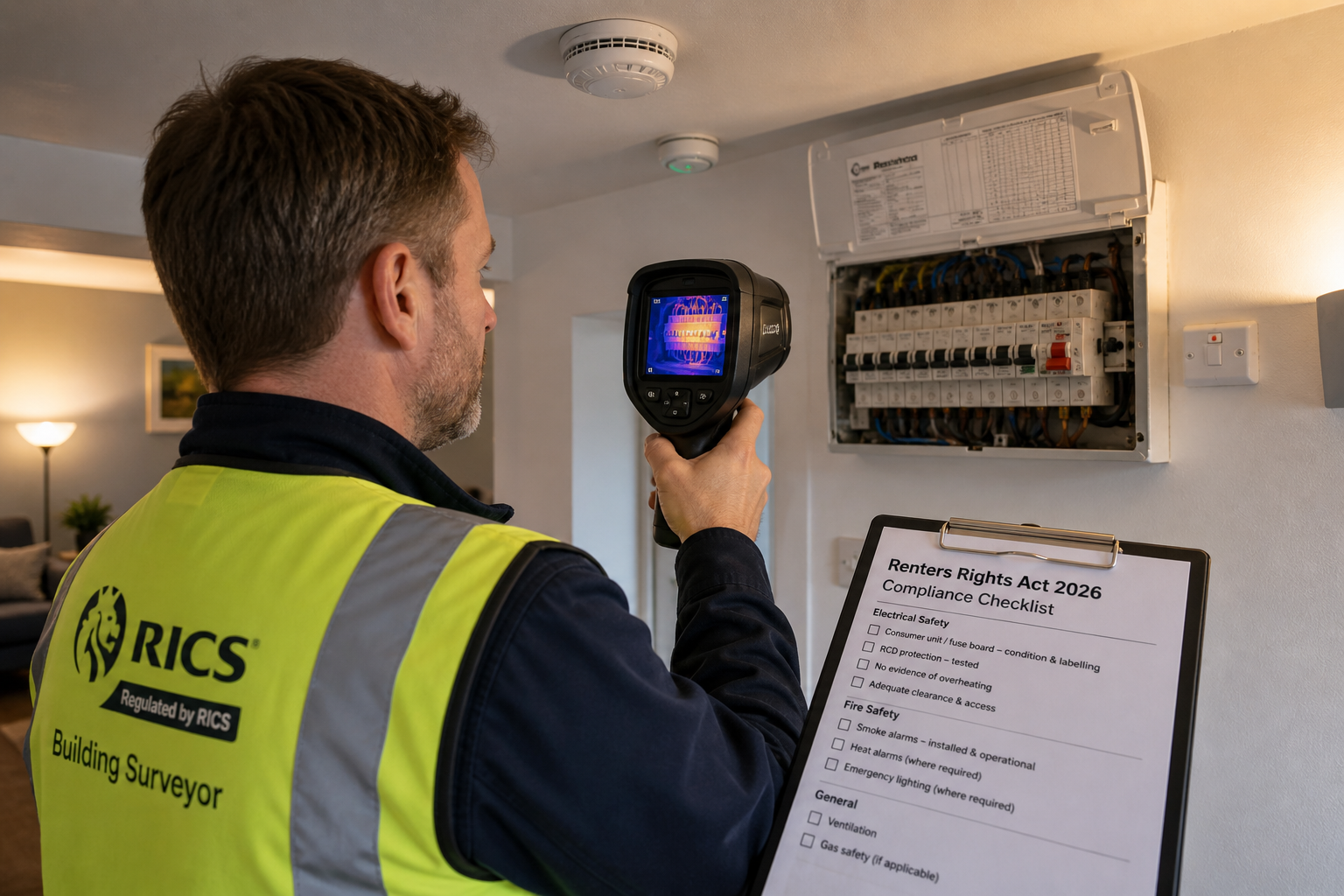
Before any valuation adjustment can be made, the hazards must be identified and scoped. A full structural inspection is the appropriate vehicle for this — going beyond a standard homebuyer's report to assess electrical installation condition, fire compartmentation integrity, and means of escape adequacy.
Surveyors conducting building surveyor assessments on PRS stock should now routinely include:
- ✅ Review of the most recent Electrical Installation Condition Report (EICR)
- ✅ Visual inspection of consumer units, wiring, and socket condition
- ✅ Fire door gap testing and intumescent strip checks
- ✅ Smoke and heat detector placement and interlink verification
- ✅ Assessment of means of escape from upper floors
Post-Remediation Valuation Uplifts: Rebuilding Portfolio Value After Compliance

The valuation story does not end with diminution. Valuing fire and electrical hazard remediation under Renters' Rights Act 2026: surveyor adjustments for PRS properties must also address the upside — the measurable value recovery that follows successful remediation.
Quantifying the Uplift
Post-remediation uplifts are not simply the mirror image of the diminution. They reflect:
- Removal of the compliance discount (the most direct uplift)
- Improved rental yield from reduced void risk and tenant retention
- Enhanced marketability — compliant properties attract higher-quality tenants and better mortgage terms
- Reduced enforcement liability — eliminating the risk of rent repayment orders and civil penalties
In practice, surveyors are recording net uplifts of 5–12% on properties brought into full compliance, with the higher end of that range applying to properties in high-demand urban markets such as London, Bristol, and Manchester.
Landlord Portfolio Modelling: A Practical Framework
For landlords managing multiple PRS properties, a portfolio-level remediation strategy — rather than reactive property-by-property fixes — delivers the strongest valuation outcomes. The recommended approach:
Step 1: Portfolio Hazard Audit 🔍
Commission a building surveyor to conduct a standardised hazard audit across all properties, producing a risk-ranked schedule of works.
Step 2: Prioritise by Diminution Impact
Focus first on properties where non-compliance creates the largest valuation drag — typically those with outstanding EICR failures or absent fire detection systems.
Step 3: Batch Remediation for Cost Efficiency
Negotiating block contracts with electrical and fire safety contractors typically reduces per-property costs by 15–25% compared to individual commissions.
Step 4: Post-Remediation Survey and Certification
After works are complete, commission updated EICRs and a condition survey to formally document compliance. This creates the evidential basis for the surveyor's uplifted valuation.
Step 5: Portfolio Revaluation
Submit updated valuations to lenders and investors, incorporating the post-remediation uplift. For portfolios with mortgage finance, this can unlock improved loan-to-value ratios and better refinancing terms.
Awaab's Law Extensions and Their Specific Impact on Fire/Electrical Valuations
The 2026 extension of Awaab's Law principles to the PRS introduces strict timescale obligations for hazard investigation and remediation that carry direct financial penalties for non-compliance [4]. For surveyors, this creates a new layer of valuation risk:
- Properties where landlords have failed to investigate within the statutory window face potential rent repayment orders covering up to 12 months of rent
- This liability must be disclosed in valuations and can represent a significant additional diminution beyond the physical cost of remediation
- Surveyors are now expected to flag any evidence of outstanding tenant complaints or enforcement notices as material valuation factors [4]
Understanding legal liabilities for tenants and landlords alike is critical context for any surveyor operating in this space.
Surveyor Methodology and Professional Standards in 2026
RICS Guidance and Valuation Adjustments
The Royal Institution of Chartered Surveyors (RICS) has updated its guidance for residential valuations to reflect the 2026 legislative environment. Key professional standards now include:
- Mandatory disclosure of known HHSRS Category 1 and 2 hazards in valuation reports
- Explicit adjustment methodology — surveyors must state which of the three methodologies (cost-to-cure, income capitalisation, or comparable evidence) has been applied and why
- Proportionality principle — adjustments must be proportionate to the actual risk, not merely precautionary
- Ongoing monitoring — for properties under enforcement action, surveyors may need to revisit valuations as circumstances change
For landlords seeking surveyor recommendations in this specialist area, it is important to engage practitioners with demonstrable experience in PRS compliance valuations, not just general residential work.
Practical Surveyor Adjustments: A Summary Table
| Scenario | Methodology | Typical Adjustment |
|---|---|---|
| Outstanding EICR failure, no enforcement | Cost-to-cure + risk premium | -5% to -9% |
| Active enforcement notice, electrical | Income capitalisation | -10% to -15% |
| Missing fire alarms + no means of escape | Cost-to-cure + comparable | -8% to -14% |
| Post-remediation, full compliance achieved | Removal of discount + uplift | +5% to +12% |
| Portfolio with mixed compliance status | Blended methodology | Case-specific |
Geographic Variations in Adjustment Levels
Valuation adjustments for fire and electrical hazards are not uniform across the UK. In high-demand urban markets — particularly inner London boroughs — the income capitalisation methodology tends to produce larger adjustments because rental values (and therefore void income losses) are higher.
Surveyors operating in areas such as Westminster, Chelsea, and Notting Hill will typically apply larger absolute adjustments than colleagues working in lower-value markets, even where the physical hazard is identical. This reflects the higher financial stakes of enforcement action in premium rental markets.
In outer London and commuter belt locations — such as Enfield and Brentwood — cost-to-cure methodology tends to dominate, as comparable evidence is more readily available and rental voids carry lower absolute financial risk.
Practical Steps for Landlords: Protecting and Rebuilding Portfolio Value in 2026
The financial case for proactive compliance is now unambiguous. Here is a concise action plan for PRS landlords in 2026:
Immediate Actions (Within 30 Days) ⚡
- Audit all EICRs — ensure every property has a valid, in-date Electrical Installation Condition Report (required every 5 years or at change of tenancy)
- Check fire detection — verify that interlinked smoke and heat alarms are installed on every floor and tested within the last 12 months
- Review fire doors — inspect all fire doors for correct gaps, intumescent strips, and self-closing mechanisms
- Document everything — create a compliance file for each property, including certificates, inspection dates, and contractor invoices
Medium-Term Actions (30–90 Days) 🔧
- Commission a professional property assessment for any properties where compliance status is uncertain
- Obtain contractor quotes for all identified remediation works
- Prioritise remediation based on enforcement risk and valuation impact
- Notify lenders of any material changes to property compliance status
Longer-Term Portfolio Strategy (90 Days+) 📈
- Commission post-remediation valuations to capture uplifts in the formal valuation record
- Consider whether non-compliant properties in the portfolio represent a strategic disposal opportunity rather than a remediation investment
- Review portfolio insurance to ensure cover reflects current compliance status and legislative requirements
Conclusion: Compliance Is Now a Valuation Imperative
The era of treating fire and electrical hazards as minor footnotes in PRS property valuations is firmly over. Valuing fire and electrical hazard remediation under Renters' Rights Act 2026: surveyor adjustments for PRS properties demands a structured, evidence-based approach that quantifies both the downside risk of non-compliance and the upside potential of remediation.
For landlords, the message is clear: non-compliant hazards are not just a legal liability — they are a measurable drag on portfolio value that compounds over time as enforcement activity intensifies. Conversely, properties brought into full compliance in 2026 stand to benefit from valuation uplifts of 5–12%, improved rental yields, and stronger refinancing positions.
Actionable next steps:
- ✅ Engage a RICS-accredited building surveyor to audit your portfolio against 2026 compliance standards
- ✅ Prioritise remediation works based on their valuation impact, not just their legal urgency
- ✅ Document all remediation works and commission updated valuations post-completion
- ✅ Use the post-remediation valuation uplift to strengthen your portfolio's financial position with lenders and investors
The Renters' Rights Act 2026 has changed the rules. Landlords and surveyors who adapt quickly will protect — and grow — their asset values. Those who do not will face both enforcement action and a steadily widening valuation discount.
References
[1] Maryland Renters Rights For Repairs – https://ipropertymanagement.com/laws/maryland-renters-rights-for-repairs
[2] Maryland Hb 1221 Str Safety Law Requirements 2026 – https://staystra.com/maryland-hb-1221-str-safety-law-requirements-2026/
[3] Renterssafetyact – https://benfrederick.com/renterssafetyact/
[4] Electrical Hazards And Fire Risk Assessment In Building Surveys Awaabs Law 2026 Extensions And Surveyor Liability – https://nottinghillsurveyors.com/blog/electrical-hazards-and-fire-risk-assessment-in-building-surveys-awaabs-law-2026-extensions-and-surveyor-liability
[5] Maryland Tenant Landlord Law – https://www.hemlane.com/resources/maryland-tenant-landlord-law/
[6] Baltimore City Rental And Housing Laws – https://www.peoples-law.org/baltimore-city-rental-and-housing-laws
[7] 1lfxxcf Aqglw4qcybwhb5wabxw72ts Z – https://mgaleg.maryland.gov/cmte_testimony/2026/ecm/1lFxXCF-aqglw4QcYbWHb5wAbxw72Ts-Z.pdf