
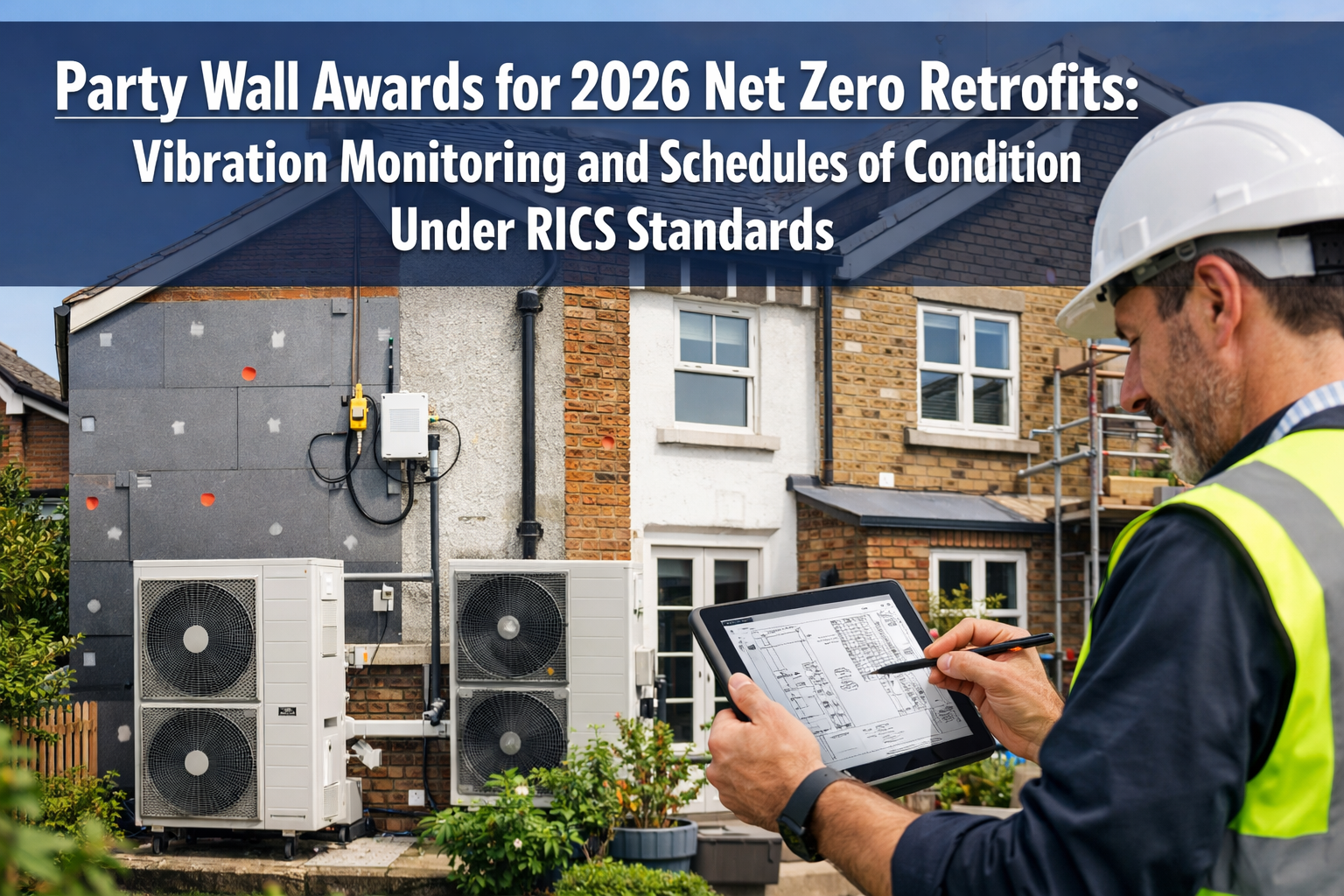
The UK's private rental sector faces a seismic shift: by 2030, all rental properties must achieve a minimum Energy Performance Certificate (EPC) rating of C, with interim enforcement tightening throughout 2026. This regulatory pressure is driving an unprecedented wave of retrofit installations—heat pumps, external wall insulation, and cavity wall improvements—many of which trigger Party Wall Act obligations. Yet most property owners remain unaware that inadequate party wall awards can expose them to thousands in damage claims when retrofit work causes structural movement or vibration damage to adjoining properties.
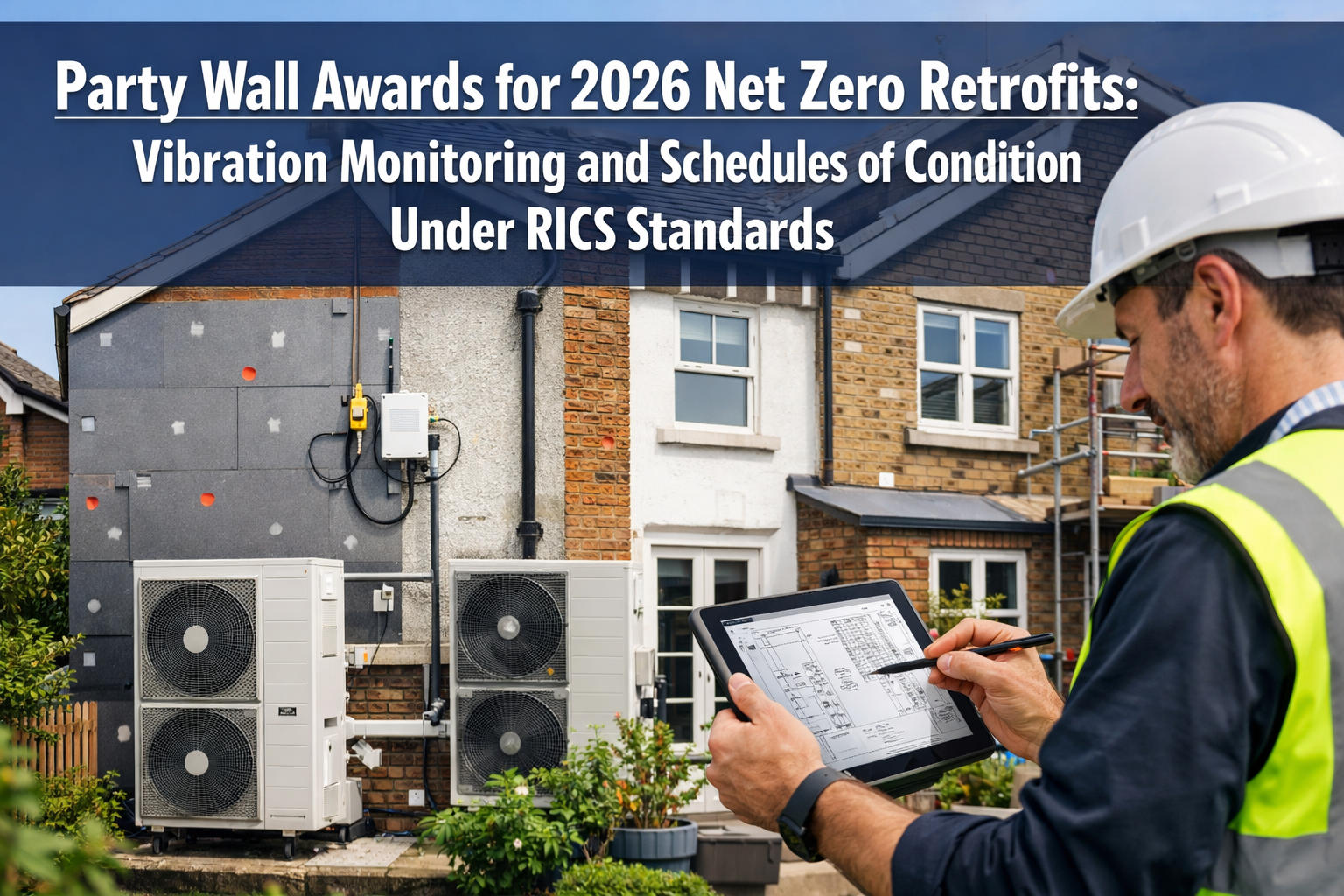
Party Wall Awards for 2026 Net Zero Retrofits: Vibration Monitoring and Schedules of Condition Under RICS Standards have become essential protective mechanisms as sustainability mandates collide with property law. The Royal Institution of Chartered Surveyors (RICS) has responded to this convergence by emphasizing quality controls and robust monitoring systems in retrofit projects, particularly where shared structures are involved [3]. Understanding how to structure party wall awards that incorporate modern vibration monitoring protocols and comprehensive schedules of condition is no longer optional—it's a legal and financial necessity.
Key Takeaways
- EPC mandates drive retrofit activity: Tightening energy efficiency requirements in 2026 are triggering thousands of party wall-notifiable retrofit projects across the UK, requiring proper legal frameworks.
- Vibration monitoring protects all parties: Modern digital monitoring equipment provides objective evidence of compliance with safe vibration thresholds during invasive retrofit installations.
- Schedules of condition are essential: Comprehensive pre-work documentation protects both building and adjoining owners from disputed damage claims post-retrofit.
- RICS standards ensure quality: Following RICS guidance on retrofit competence and monitoring systems reduces legal disputes and ensures professional accountability [3].
- Award clauses must be specific: Generic party wall awards fail to address retrofit-specific risks; detailed clauses covering monitoring protocols and sustainability equipment are crucial.
Understanding Party Wall Obligations in Net Zero Retrofit Projects
What Triggers Party Wall Act Requirements in Retrofits?
The Party Wall etc. Act 1996 applies to various building works, but retrofit projects introduce unique complications. External wall insulation (EWI) frequently requires drilling into or through party walls to secure fixing systems. Heat pump installations may necessitate structural modifications to shared walls for pipe penetrations or equipment mounting. Even cavity wall insulation can trigger notifications if injection points affect the party wall structure.
According to expert party wall advice, three main sections of the Act apply to retrofit work:
- Section 1: New building on or at the boundary line
- Section 2: Work directly to an existing party wall or structure (most common for retrofits)
- Section 6: Excavation within specified distances of adjoining structures
The critical distinction in 2026 is that sustainability-driven retrofits often combine multiple notifiable works simultaneously. A comprehensive energy upgrade might involve EWI installation, heat pump mounting, and structural reinforcement—each potentially triggering separate party wall obligations.
The 2026 Retrofit Landscape and EPC Mandates
The urgency surrounding Party Wall Awards for 2026 Net Zero Retrofits stems directly from regulatory pressure. The government's commitment to achieving net zero by 2050 has translated into increasingly stringent energy efficiency requirements [1]. For landlords, the timeline is particularly compressed: properties with EPC ratings below C face rental restrictions that become progressively more severe through 2026 and beyond [6].
This regulatory environment has created a retrofit boom. RICS and Retrofit Academy's Quality in Retrofit Summit in January 2026 highlighted the sector's rapid expansion and the corresponding need for professional competence among retrofit assessors [3]. However, this acceleration increases the risk of poorly planned projects that neglect party wall obligations—a costly oversight when adjoining owners later discover structural damage or excessive vibration exposure.
Vibration Monitoring Protocols for Party Wall Awards in Retrofit Projects
Why Vibration Monitoring Matters in Net Zero Retrofits
Traditional building works like extensions or loft conversions involve predictable vibration sources: excavation equipment, concrete drilling, and structural alterations. Retrofit projects introduce different vibration profiles that party wall awards must specifically address.
External wall insulation installation requires extensive drilling into masonry to secure mechanical fixings—often hundreds of penetrations across a shared wall elevation. Ground source heat pump installations may involve percussive drilling for ground loops near party wall foundations. Structural upgrades to accommodate additional insulation weight can require concrete cutting or steel beam installation, all generating sustained vibration.
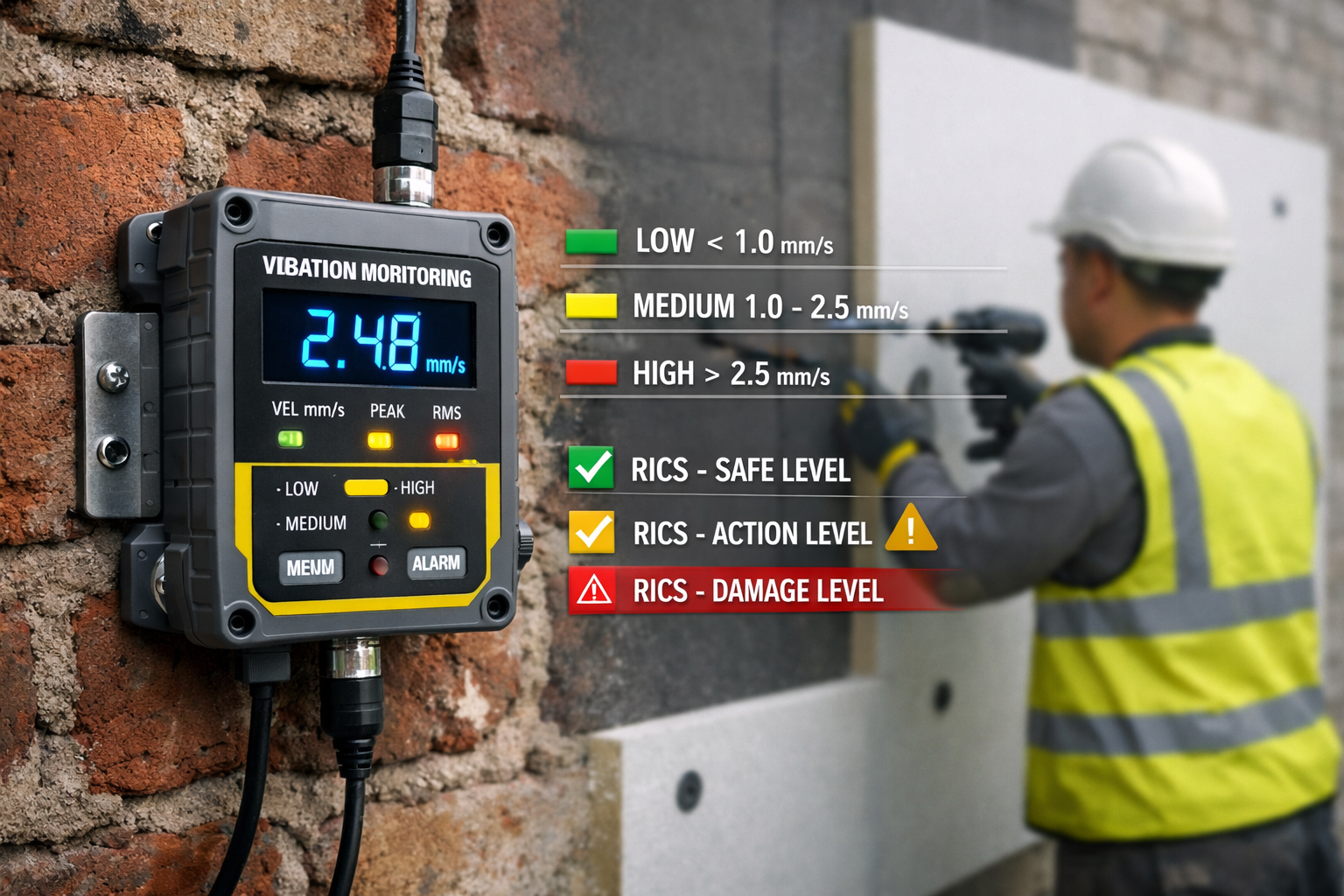
The risk isn't merely cosmetic cracking. Excessive vibration can:
- Compromise existing structural repairs in adjoining properties 🏚️
- Damage historic plasterwork and decorative features
- Affect sensitive equipment in commercial adjoining properties
- Trigger subsidence concerns in properties with existing movement issues
RICS-Compliant Vibration Monitoring Standards
Party Wall Awards for 2026 Net Zero Retrofits: Vibration Monitoring and Schedules of Condition Under RICS Standards must incorporate specific monitoring protocols. While RICS doesn't mandate particular vibration limits in party wall contexts, professional surveyors typically reference BS 7385-2:1993 for structural damage thresholds and BS 5228-2:2009 for human comfort criteria.
Recommended vibration monitoring clauses for party wall awards should include:
| Award Component | Specification Details |
|---|---|
| Monitoring Equipment | Triaxial accelerometers with data logging capability, minimum 1Hz-80Hz frequency range |
| Placement Locations | Minimum two sensors: one on party wall at closest point to works, one in adjoining owner's most sensitive room |
| Threshold Levels | Peak particle velocity (PPV) limits: 10mm/s for structural safety, 1mm/s for cosmetic damage prevention in vulnerable structures |
| Monitoring Duration | Continuous monitoring during all percussive or vibratory work phases |
| Reporting Requirements | Daily summary reports to both surveyors; immediate alert if 80% of threshold reached |
| Calibration Standards | Annual calibration certificates for all monitoring equipment |
The building owner must typically bear the cost of vibration monitoring, but this investment provides crucial protection. When disputes arise, objective vibration data often resolves claims quickly, avoiding expensive litigation. As detailed in our guide on party wall agreement costs, monitoring expenses are modest compared to potential damage claim settlements.
Implementing Real-Time Vibration Monitoring Systems
Modern digital monitoring systems offer significant advantages over traditional methods. Cloud-connected sensors provide real-time data access for both party wall surveyors, creating transparency and early warning capabilities. When vibration levels approach predetermined thresholds, automatic alerts allow immediate work cessation before damage occurs.
Best practice for Party Wall Awards for 2026 Net Zero Retrofits includes:
✅ Pre-work baseline testing: Establish ambient vibration levels before retrofit work commences
✅ Calibrated equipment: Use professionally maintained sensors with traceable calibration
✅ Multiple measurement points: Monitor both the party wall and adjoining owner's interior spaces
✅ Continuous data logging: Capture complete vibration profiles, not just peak readings
✅ Accessible reporting: Provide both surveyors with secure online access to live data
The RICS emphasis on robust monitoring systems in retrofit projects [3] reflects growing recognition that technology-enabled oversight protects all stakeholders while enabling ambitious sustainability improvements.
Schedules of Condition: Essential Documentation for Retrofit Party Wall Awards
The Critical Role of Pre-Work Condition Surveys
A schedule of condition represents the single most important protective document in any party wall award. This comprehensive photographic and written record establishes the precise state of the adjoining owner's property before retrofit work begins, creating an objective baseline for evaluating any subsequent damage claims.
For Party Wall Awards for 2026 Net Zero Retrofits, schedules of condition must be exceptionally thorough. Retrofit projects often span months, involve multiple contractors, and create sustained vibration and movement risks. Without detailed pre-work documentation, distinguishing retrofit-caused damage from pre-existing defects becomes nearly impossible—typically resulting in costly disputes that favor the adjoining owner.
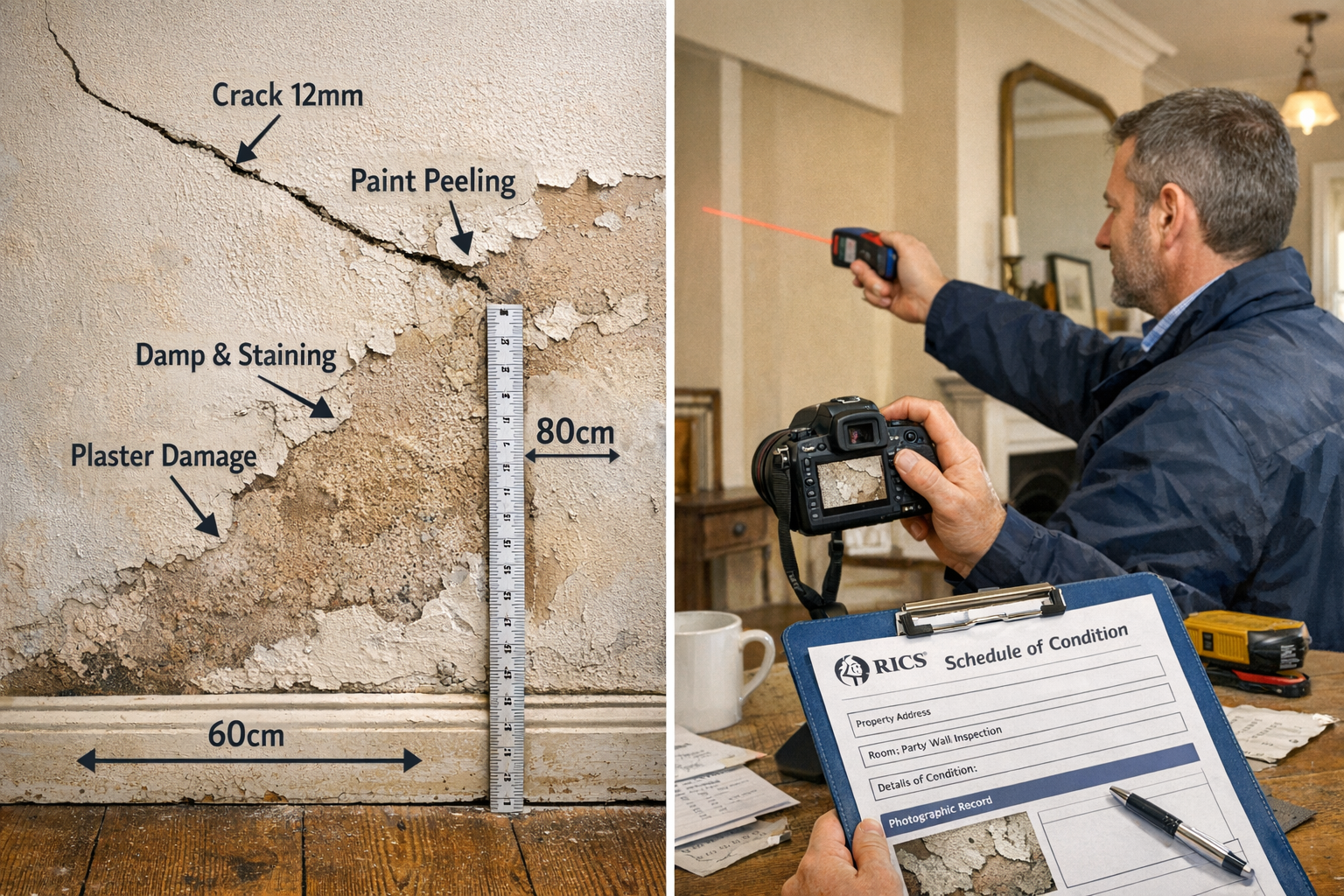
A retrofit-specific schedule of condition should document:
- All existing cracks: Location, length, width (measured with crack width gauge), orientation, and photographic evidence with scale references
- Plasterwork condition: Areas of previous repair, loose plaster, bulging, or dampness
- Decorative features: Condition of cornicing, ceiling roses, picture rails, and period details
- Floor levels: Laser level measurements to detect any pre-existing structural movement
- External walls: Condition of brickwork, render, pointing, and any existing movement cracks
- Services and fixtures: Condition of pipework, radiators, electrical fixtures that might be affected by vibration
- Sensitive items: Location of valuable artwork, antiques, or equipment vulnerable to vibration
RICS Standards for Schedule of Condition Preparation
Professional surveyors preparing schedules of condition for retrofit projects should follow RICS guidance on building condition assessment best practices. The documentation must be sufficiently detailed to withstand legal scrutiny if disputes arise months or years after project completion.
Key RICS-aligned principles include:
📋 Comprehensive photographic records: High-resolution images with date stamps, location annotations, and scale references (typically a surveyor's staff or measuring tape in frame)
📋 Written descriptions: Detailed narrative descriptions accompanying each photograph, avoiding ambiguous terms like "fair condition"
📋 Measured data: Quantified information (crack widths in millimeters, areas of defects in square meters) rather than subjective assessments
📋 Independent preparation: The agreed surveyor or adjoining owner's surveyor should prepare the schedule to ensure impartiality
📋 Mutual agreement: Both surveyors must review and approve the schedule before work commences, with signed acknowledgment
The cost of preparing a thorough schedule of condition typically ranges from £500-£1,500 depending on property size and complexity—a modest investment given that disputed damage claims frequently exceed £10,000. Understanding what a party wall surveyor does helps property owners appreciate the value of this professional documentation.
Digital Enhancement of Condition Records
Technology has transformed schedule of condition preparation. Laser scanning and photogrammetry create three-dimensional records of spaces, capturing spatial relationships and surface conditions with millimeter accuracy. Thermal imaging reveals hidden defects like damp penetration or insulation gaps that might be exacerbated by retrofit work.
For high-value properties or particularly contentious situations, these advanced techniques provide unassailable evidence. The digital files can be revisited years later to verify exact pre-work conditions, eliminating the "he said, she said" disputes that plague party wall cases relying solely on written descriptions.
Drafting Effective Party Wall Awards for Retrofit Projects
Essential Clauses for Net Zero Retrofit Awards
Generic party wall awards—often based on templates designed for traditional extensions—fail to address retrofit-specific risks. Party Wall Awards for 2026 Net Zero Retrofits: Vibration Monitoring and Schedules of Condition Under RICS Standards require bespoke clauses that anticipate the unique challenges of sustainability improvements.
Critical award provisions for retrofit projects:
1. Detailed Work Description
The award must precisely specify all retrofit works, including:
- External wall insulation system type, thickness, and fixing methodology
- Heat pump specifications, mounting locations, and structural modifications required
- Any party wall penetrations for pipework, electrical services, or ventilation
- Structural reinforcement works necessitated by additional loading
2. Vibration and Noise Limits
Explicit thresholds and monitoring requirements:
- Peak particle velocity (PPV) limits at party wall and within adjoining property
- Permissible working hours (typically more restrictive than planning regulations)
- Noise level limits during different work phases
- Mandatory vibration monitoring with specified equipment and reporting protocols
3. Schedule of Condition Requirements
Mandatory documentation provisions:
- Comprehensive pre-work schedule prepared by agreed/adjoining owner's surveyor
- Interim inspections at specified project milestones
- Post-completion inspection within defined timeframe (typically 1-3 months after practical completion)
- Procedure for documenting and addressing any identified damage
4. Access Provisions
Specific access rights for monitoring and inspection:
- Building owner's right to access adjoining property for monitoring equipment installation
- Surveyors' rights to access both properties for inspections
- Notice periods for different access types (emergency vs. routine)
- Compensation provisions if access causes disruption to adjoining owner
5. Insurance and Indemnity
Financial protection mechanisms:
- Minimum insurance coverage levels for building owner's contractors
- Indemnity provisions protecting adjoining owner from retrofit-related damage
- Procedure for damage claims and dispute resolution
- Security for expenses provisions (particularly important for extensive retrofits)
Addressing Sustainability Equipment in Party Wall Awards
Retrofit projects introduce permanent equipment that may affect the adjoining owner's amenity long after construction completes. Party wall awards must address these ongoing considerations.
Heat pump noise and vibration: Awards should specify maximum operational noise levels at the party wall and within the adjoining property, measured according to recognized standards. If levels exceed thresholds, the building owner must implement additional acoustic mitigation.
Thermal bridging and condensation risks: External insulation systems alter the thermal performance of party walls. Awards should require thermal modeling to demonstrate that retrofit works won't create condensation risks or cold spots in the adjoining property.
Maintenance access: Sustainability equipment requires periodic maintenance. Awards should establish protocols for accessing equipment mounted on or near party walls, including notice periods and permitted hours.
Future modifications: As technology evolves, building owners may wish to upgrade sustainability equipment. Awards can include provisions allowing future modifications subject to surveyor approval, avoiding the need for entirely new party wall procedures.
Cost Implications and Fee Structures for Retrofit Party Wall Awards
Understanding Party Wall Surveyor Fees in 2026
Party wall surveyor fees for retrofit projects typically exceed those for conventional building works due to the additional complexity and monitoring requirements. Building owners should budget appropriately to avoid financial surprises.
Typical fee structures for retrofit party wall awards:
| Service Component | Typical Cost Range | Notes |
|---|---|---|
| Building Owner's Surveyor | £800-£1,500 + VAT | Initial award preparation, site visits, liaison |
| Adjoining Owner's Surveyor | £800-£1,500 + VAT | Review, negotiation, adjoining owner protection |
| Schedule of Condition | £500-£1,500 + VAT | Depends on property size and detail required |
| Vibration Monitoring | £1,000-£3,000 + VAT | Equipment rental, installation, reporting for 2-6 month project |
| Dispute Resolution | £1,500-£5,000+ + VAT | If required; varies significantly with complexity |
The building owner bears all reasonable costs associated with the party wall process, including the adjoining owner's surveyor fees. For extensive retrofit projects affecting multiple adjoining properties, total party wall costs can reach £10,000-£20,000 or more.
However, these costs must be viewed in context. Retrofit projects themselves typically cost £20,000-£100,000+ depending on scope. Party wall expenses represent 5-15% of total project costs—a reasonable investment for legal compliance and dispute prevention. More details on party wall costs help building owners plan budgets effectively.
Security for Expenses: Protecting Adjoining Owners
In large-scale retrofit projects, adjoining owners may request that the building owner provide security for expenses—a deposit or bond ensuring funds are available to address any damage discovered during or after the works. This provision is particularly relevant for Party Wall Awards for 2026 Net Zero Retrofits where work duration and vibration exposure are significant.
RICS standards support reasonable security provisions where:
- The building owner has limited financial resources relative to project scope
- The retrofit work is particularly invasive or high-risk
- Multiple adjoining properties are affected simultaneously
- The building owner has a history of disputed building projects
Security amounts typically range from £5,000-£25,000 depending on project value and perceived risk. The funds are held by the agreed surveyor or in a designated account, released upon satisfactory project completion and post-work inspection confirming no damage occurred.
Dispute Resolution and Enforcement Under RICS Standards
Common Disputes in Retrofit Party Wall Cases
Despite careful planning, disputes arise in retrofit party wall contexts. Understanding common conflict points helps surveyors draft awards that minimize disagreement risk.
Typical dispute scenarios:
⚠️ Damage attribution: Distinguishing retrofit-caused damage from pre-existing defects or natural settlement—highlighting the critical importance of thorough schedules of condition
⚠️ Excessive vibration: Adjoining owners claiming that vibration levels exceeded award thresholds, particularly when monitoring data is incomplete or disputed
⚠️ Work scope creep: Building owners expanding retrofit scope beyond what the original award authorized, requiring supplementary notices and awards
⚠️ Ongoing noise/vibration: Heat pumps or ventilation equipment generating operational noise that affects adjoining owner amenity post-completion
⚠️ Access disputes: Disagreements over surveyor or contractor access to adjoining property for monitoring or inspection purposes
The RICS focus on professional competence and quality controls in retrofit projects [3] aims to reduce such disputes through better planning and documentation. When conflicts do arise, the Party Wall Act provides a clear resolution pathway through the Third Surveyor mechanism.
The Role of the Third Surveyor
When the building owner's surveyor and adjoining owner's surveyor cannot agree on award terms or dispute resolution, either party may refer the matter to a Third Surveyor. This independent professional makes a binding determination on the disputed issues.
For Party Wall Awards for 2026 Net Zero Retrofits, Third Surveyor involvement most commonly addresses:
- Appropriate vibration monitoring protocols and threshold levels
- Damage assessment and remediation cost allocation
- Whether proposed retrofit methods adequately protect the adjoining owner
- Interpretation of technical standards (RICS, BS, etc.) in the retrofit context
Third Surveyor determinations are binding and enforceable through county court proceedings if necessary. However, their involvement adds significant cost and delay—typically £2,000-£5,000+ in additional fees and several weeks of project suspension. Well-drafted awards that anticipate retrofit-specific issues minimize Third Surveyor referrals.
Practical Implementation: Step-by-Step Process for Retrofit Party Wall Awards
Timeline and Critical Milestones
Successful Party Wall Awards for 2026 Net Zero Retrofits require careful sequencing. Building owners should initiate the party wall process well before planned retrofit commencement.
Recommended timeline:
8-12 weeks before retrofit start:
- Engage qualified party wall surveyor to review retrofit plans
- Identify all notifiable works under the Party Wall Act
- Prepare detailed work descriptions and technical specifications
6-8 weeks before retrofit start:
4. Serve party wall notices on all affected adjoining owners
5. Allow 14-day response period for adjoining owners
4-6 weeks before retrofit start:
6. Appoint surveyors (agreed surveyor or separate surveyors for each party)
7. Conduct initial site inspections and prepare schedules of condition
8. Draft party wall award with retrofit-specific clauses
2-4 weeks before retrofit start:
9. Finalize and serve party wall award on all parties
10. Install vibration monitoring equipment
11. Conduct pre-work baseline vibration testing
During retrofit works:
12. Continuous vibration monitoring with regular reporting
13. Interim inspections at key project milestones
14. Immediate investigation of any damage reports or threshold exceedances
Post-completion:
15. Final inspection comparing property condition to pre-work schedule
16. Address any identified damage through remediation or compensation
17. Remove monitoring equipment and prepare final report
This timeline assumes cooperative adjoining owners. If disputes arise or Third Surveyor involvement becomes necessary, add 4-8 weeks to the process. Building owners should never commence notifiable works before the party wall award is finalized—doing so constitutes a breach of the Act and may result in injunctions or damages claims.
Selecting Qualified Surveyors for Retrofit Projects
Not all party wall surveyors possess the specialized knowledge required for net zero retrofit projects. The intersection of sustainability technology, building physics, and party wall law demands specific competencies.
When selecting surveyors, prioritize:
✓ RICS membership: Ensures adherence to professional standards and continuing professional development requirements
✓ Retrofit experience: Demonstrated experience with EWI, heat pump installations, and energy efficiency projects
✓ Technical knowledge: Understanding of building physics, thermal performance, and sustainability technologies
✓ Vibration monitoring expertise: Familiarity with monitoring equipment, threshold standards, and data interpretation
✓ Local knowledge: Experience with property types and construction methods in your area
Our party wall agreement surveyor services specialize in retrofit projects, combining traditional party wall expertise with contemporary sustainability knowledge. This dual competency ensures awards that protect all parties while enabling ambitious net zero improvements.
Future-Proofing Party Wall Awards for Evolving Retrofit Standards
Anticipating Regulatory Changes Beyond 2026
The retrofit regulatory landscape continues evolving rapidly. Party wall awards drafted in 2026 should anticipate future tightening of energy efficiency standards and emerging sustainability technologies.
Emerging considerations include:
🔮 Deeper retrofits: As EPC requirements potentially move toward B or even A ratings post-2030, more invasive retrofit measures may become necessary
🔮 Novel technologies: Emerging solutions like hydrogen-ready boilers, advanced battery storage, or building-integrated photovoltaics may require party wall consideration
🔮 Circular economy requirements: Future regulations may mandate material reuse or recyclability, affecting retrofit methodologies and party wall implications
🔮 Climate adaptation: Increasing focus on overheating prevention and flood resilience may drive additional retrofit works affecting party walls
Awards can include "future modification" clauses allowing building owners to upgrade or modify sustainability equipment subject to surveyor approval, avoiding entirely new party wall procedures for incremental improvements.
The RICS Role in Standardizing Retrofit Party Wall Practice
RICS has recognized the need for specialized guidance addressing the retrofit-party wall intersection. The organization's launch of new standards to improve retrofitting practices [7] and emphasis on professional trust in retrofit [2] signal growing attention to this area.
Professional surveyors should monitor RICS publications for emerging guidance on:
- Standardized vibration monitoring protocols for retrofit contexts
- Schedule of condition best practices for energy efficiency projects
- Model award clauses addressing common retrofit scenarios
- Competency frameworks for surveyors working on net zero projects
As the retrofit sector matures, standardization will reduce disputes and create more predictable outcomes for all parties. Building owners benefit from clearer expectations, while adjoining owners gain confidence that their interests receive proper protection.
Conclusion: Protecting All Parties in the Net Zero Transition
Party Wall Awards for 2026 Net Zero Retrofits: Vibration Monitoring and Schedules of Condition Under RICS Standards represent the essential legal framework enabling the UK's sustainability transition while protecting property rights. As EPC mandates drive unprecedented retrofit activity, the collision between energy efficiency imperatives and party wall obligations will only intensify.
The key to successful retrofit party wall management lies in:
- Early engagement: Initiate party wall processes 8-12 weeks before planned retrofit commencement
- Comprehensive documentation: Invest in thorough schedules of condition that establish objective pre-work baselines
- Robust monitoring: Implement continuous vibration monitoring with clear thresholds and reporting protocols
- Specialized expertise: Engage RICS-qualified surveyors with specific retrofit experience and technical knowledge
- Bespoke awards: Reject generic templates in favor of detailed awards addressing retrofit-specific risks and technologies
The costs associated with proper party wall procedures—typically £5,000-£15,000 for comprehensive retrofit projects—pale in comparison to the potential expenses of disputed damage claims, project delays, or legal proceedings. Building owners who view party wall compliance as an investment in project success rather than a bureaucratic burden achieve better outcomes and maintain positive neighbor relationships.
For adjoining owners, insisting on rigorous party wall procedures provides essential protection. The combination of detailed schedules of condition and continuous vibration monitoring creates objective evidence that either confirms the building owner's careful execution or substantiates legitimate damage claims.
Next Steps for Building Owners Planning Retrofits
If you're planning net zero retrofit works that may affect party walls:
- Assess your obligations: Review retrofit plans with a qualified party wall surveyor to identify all notifiable works
- Budget appropriately: Include £5,000-£20,000+ for party wall costs in your project budget
- Start early: Begin the party wall process at least 8-12 weeks before planned commencement
- Prioritize documentation: Invest in comprehensive schedules of condition and vibration monitoring
- Engage specialists: Select surveyors with specific retrofit experience and RICS qualifications
The net zero transition presents both opportunities and challenges. With proper planning, professional guidance, and adherence to RICS standards, building owners can achieve ambitious sustainability improvements while maintaining legal compliance and neighborly relationships. The party wall framework, when properly applied to retrofit contexts, protects all stakeholders and enables the building stock improvements essential to meeting the UK's climate commitments.
For expert assistance with party wall awards for your retrofit project, consult our comprehensive resources on party wall procedures or contact qualified professionals who understand both the legal requirements and technical complexities of net zero improvements.
References
[1] Modus By Rics January 2026 – https://www.rics.org/content/dam/ricsglobal/documents/to-be-sorted/MODUS-by-RICS-January-2026.pdf
[2] Sparks Of 2026 9 Rics And The Return Of Professional Trust In Retrofit – https://www.refurbandretrofit.com/sparks-of-2026-9-rics-and-the-return-of-professional-trust-in-retrofit/
[3] Quality In Retrofit Summit 2026 – https://retrofitacademy.org/quality-in-retrofit-summit-2026/
[6] Epc Mandates 2026 – https://nottinghillsurveyors.com/blog/tag/epc-mandates-2026
[7] Rics Launch New Standard To Improve Retrofitting Practices – https://propertyindustryeye.com/rics-launch-new-standard-to-improve-retrofitting-practices/