

{"cover":"Professional landscape format (1536×1024) magazine cover hero image featuring bold text overlay 'Building Survey Certainty in Cautious 2026 Markets' in extra large 70pt white sans-serif font with dark gradient shadow, positioned in upper third center. Background shows split-screen composition: left side displays RICS-qualified surveyor with tablet examining Victorian brick property facade with detailed architectural elements, right side shows abstract digital interface with AVM algorithmic data streams and property valuation graphs. Color scheme: deep navy blue, professional grey, gold RICS accents, high contrast. Editorial quality, financial publication aesthetic, rule of thirds composition, sharp focus on professional expertise versus technology debate","content":["Detailed landscape format (1536×1024) editorial image showing professional RICS surveyor conducting thorough building inspection inside period property, examining structural wall with moisture meter and thermal imaging camera, clipboard with detailed checklist visible, cross-section architectural diagram overlay showing hidden defects (subsidence cracks, damp penetration, timber decay), warm natural lighting through Georgian windows, professional navy suit, RICS badge prominent, contrasted with faded transparent AVM computer screen in background showing basic property data, emphasizing human expertise depth versus automated surface analysis, documentary photography style, sharp detail on inspection tools and building fabric","Comprehensive landscape format (1536×1024) infographic-style image displaying resilient property types for 2026 investment, featuring architectural elevation drawings of four property categories: institutional buildings (schools, hospitals), infrastructure facilities (data centers, utilities), period conversions (Victorian terraces, Georgian townhouses), and modern sustainable developments. Each category shown with performance metrics overlay (transaction stability bars, value retention percentages, demand indicators), color-coded risk assessment (green for high resilience, amber for moderate), UK regional heat map showing strongest markets, professional architectural blueprint aesthetic with clean typography, data visualization elements, editorial quality suitable for property investment publication","Detailed landscape format (1536×1024) comparative decision-making image showing professional desk scene with two assessment reports side-by-side: left shows comprehensive RICS Building Survey document (thick bound report, detailed photographs of defects, technical drawings, condition ratings, repair cost schedules, red flags highlighted), right shows single-page AVM valuation printout (basic property data, comparable sales, automated value estimate, minimal detail). Hands of property buyer reviewing documents with magnifying glass over survey findings, calculator showing renegotiation figures, cautionary sticky notes, coffee cup, UK property market newspaper headline visible mentioning 2026 uncertainty, overhead lighting, professional advisory atmosphere, photojournalistic style emphasizing informed decision-making contrast"]"}
Twenty-two percent of UK firms never measure productivity—the highest rate globally—while automated valuation models (AVMs) continue processing property data with zero accountability for hidden structural defects.[2] This measurement crisis arrives precisely when the 2026 UK residential market faces prolonged uncertainty, fewer discretionary movers, and longer decision-making cycles that demand forensic due diligence rather than algorithmic guesswork.[1]
Building Survey Certainty in Cautious 2026 Markets: RICS Insights vs AVMs for Resilient Property Types represents the critical choice facing every property buyer, investor, and lender navigating subdued transaction levels without the safety net of rising prices to mask poor purchasing decisions. When market momentum stalls, professional surveying insight becomes the primary risk management tool—yet industry fragmentation threatens to undermine the very standards that protect stakeholders.
Key Takeaways
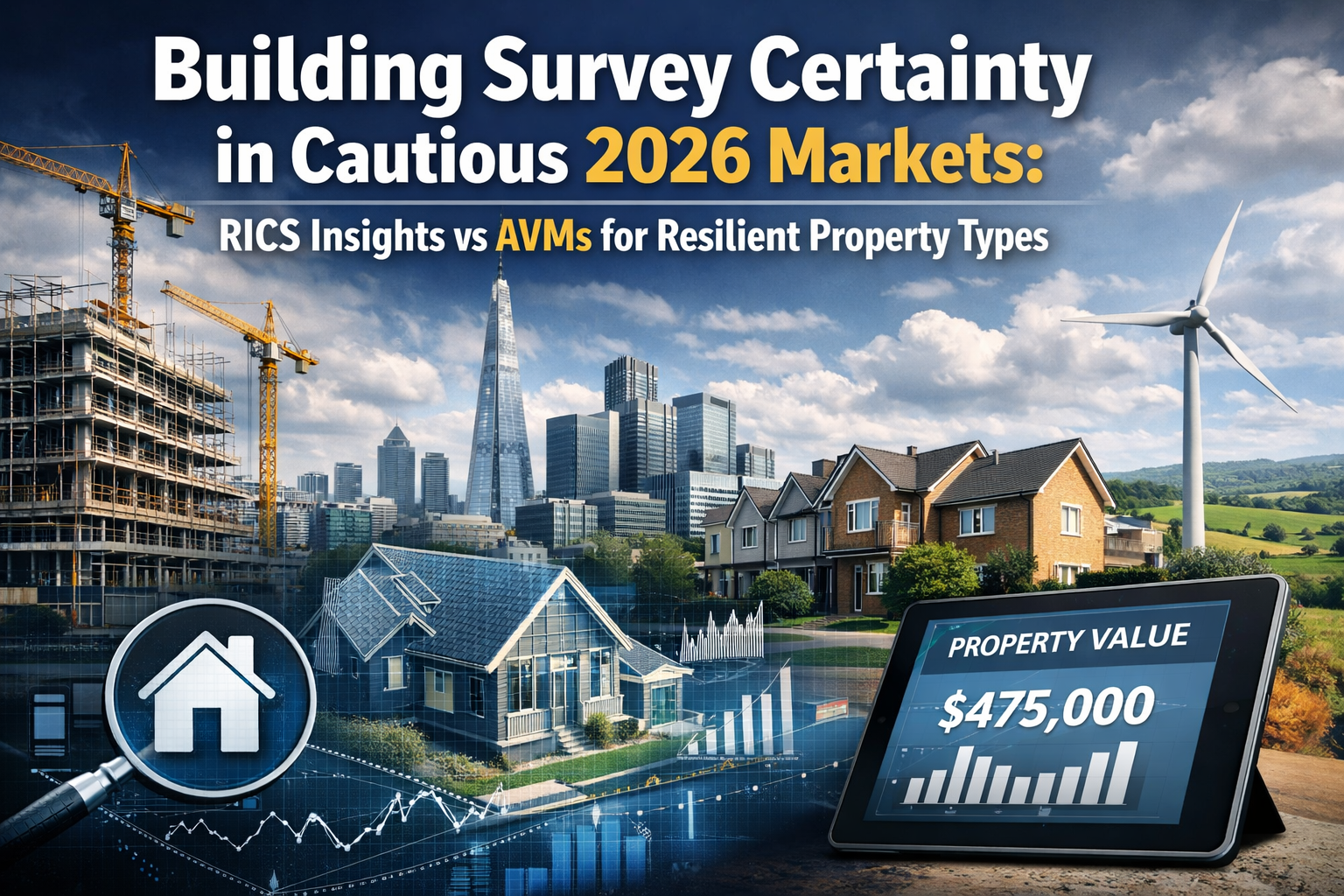
- 🏗️ RICS-qualified building surveys provide comprehensive structural analysis, defect identification, and repair cost forecasting that AVMs cannot replicate in uncertain markets
- 📊 UK productivity measurement fragmentation reveals that no single definition commands even 30% adoption, undermining standardization when valuation rigor matters most[2]
- 🏢 Resilient property types for 2026 include institutional facilities, infrastructure projects, and data centers—assets requiring specialist surveying expertise beyond automated algorithms[3]
- 💡 Workforce skills outrank technology as the primary productivity driver across all RICS global regions, contradicting assumptions about AVM superiority[2]
- ⚖️ Cautious market conditions amplify the value gap between comprehensive building surveys and surface-level automated valuations
Understanding the 2026 UK Property Market Landscape
Market Uncertainty Without Crisis
The UK residential property market in 2026 operates in a peculiar state: uncertain but not crisis-driven.[1] Early signals point toward fewer discretionary movers, extended decision-making cycles, and stable yet subdued transaction levels. This environment differs fundamentally from correction-driven downturns where prices collapse rapidly.
Instead, 2026 presents potential slight price softening in certain regions rather than broad declines.[1] For property professionals, this creates a challenging scenario where traditional market momentum cannot compensate for inadequate due diligence. Every transaction requires heightened scrutiny because:
- Buyers cannot rely on rapid appreciation to offset overpayment
- Sellers face longer marketing periods demanding realistic pricing
- Lenders require robust valuation practices to manage portfolio risk
- Hidden defects become deal-breakers rather than negotiation points
The Valuation Practice Imperative
Sound valuation practice and close monitoring have emerged as key differentiators in 2026, alongside clear borrower support strategies.[1] This shift elevates the importance of professional surveying standards precisely when industry measurement practices reveal alarming inconsistency.
The contrast between comprehensive building surveyor services and automated alternatives becomes starkest during cautious markets. When transaction volumes decline, each individual purchase decision carries magnified consequences—making the choice between RICS-qualified expertise and algorithmic approximation a critical risk management decision.
Building Survey Certainty in Cautious 2026 Markets: RICS Standards vs AVM Limitations
What RICS-Qualified Surveys Deliver
Royal Institution of Chartered Surveyors (RICS) standards represent the gold standard for property assessment, providing comprehensive analysis that extends far beyond simple valuation figures. A qualified building survey examines:
Structural Integrity Assessment
- Foundation condition including subsidence risk analysis
- Load-bearing walls and structural movement indicators
- Roof structure integrity, covering, and drainage systems
- Floor construction including timber condition and damp penetration
- External walls with detailed defect identification
Hidden Defect Detection
Professional surveyors identify issues invisible to automated systems:
- Concealed damp and timber decay requiring specialist diagnosis
- Historical alterations compromising structural integrity
- Building regulation non-compliance risks
- Boundary disputes and property line issues
- Environmental factors like subsidence from garden trees
Repair Cost Forecasting
Unlike AVMs that provide single-point valuations, RICS surveys include:
- Itemized repair schedules with estimated costs
- Priority rankings for urgent versus deferred maintenance
- Long-term maintenance planning guidance
- Renegotiation leverage based on documented defects
The ability to renegotiate after a poor building survey result becomes particularly valuable in 2026's cautious market, where buyers hold increased negotiating power during extended transaction cycles.
AVM Limitations in Complex Property Assessment
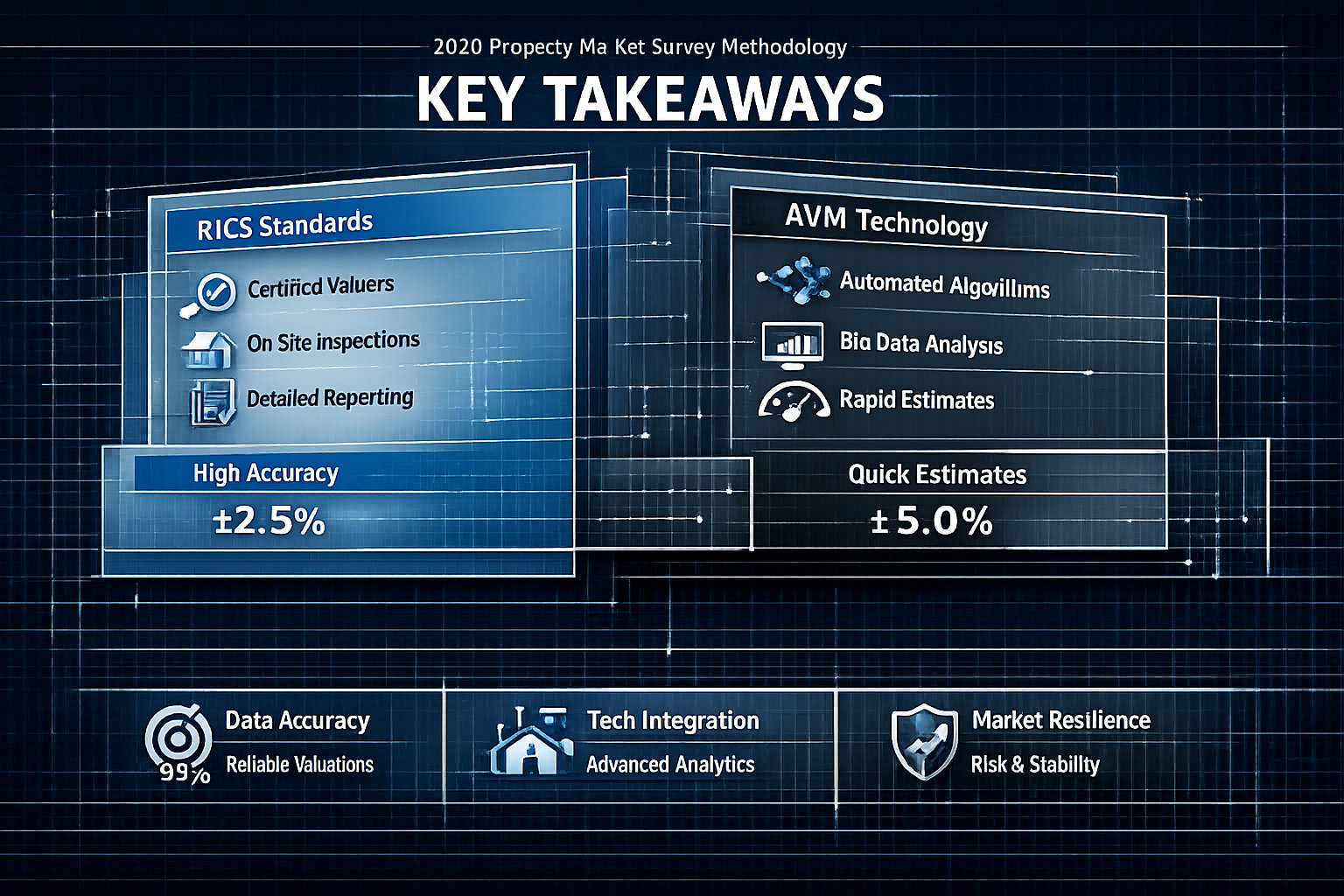
Automated Valuation Models rely on algorithmic analysis of comparable sales data, property characteristics, and market trends. While useful for high-level portfolio analysis, AVMs demonstrate critical limitations:
Surface-Level Data Processing
AVMs analyze:
- Historical transaction prices
- Basic property attributes (bedrooms, square footage, location)
- Market trend extrapolation
- Comparable property adjustments
What AVMs cannot assess:
- Actual structural condition
- Hidden defects requiring physical inspection
- Building quality variations within comparable properties
- Unique property characteristics affecting value
- Repair cost implications
The Measurement Fragmentation Crisis
RICS's 2026 Construction Productivity Report reveals alarming industry inconsistency that undermines confidence in standardized assessment methodologies.[2] Key findings include:
| Metric | Finding | Implication |
|---|---|---|
| Definition Adoption | No single productivity definition commands 30% adoption in any region | Lack of industry-wide standards |
| Benchmark Usage | Extremely low at 5-16% across regions | Inconsistent performance measurement |
| UK Non-Measurement | 22% of UK firms never measure productivity | Highest global rate of professional inconsistency |
| Regional Comparison | Only 9% in Middle East/Africa never measure | UK lags international standards |
This fragmentation directly impacts valuation reliability. When 22% of UK firms never measure productivity—the highest rate globally—it signals systemic issues with professional standards that extend beyond construction into property assessment practices.[2]
Workforce Skills vs Technology: The RICS Evidence
Contradicting assumptions about technology-first solutions, RICS research demonstrates that workforce skills—not technology—remain the primary driver of productivity improvement across all global regions.[2] This finding carries profound implications for the RICS vs AVM debate:
Human Expertise Advantages:
- ✅ Contextual judgment based on experience
- ✅ Adaptive problem-solving for unique property conditions
- ✅ Professional accountability and liability
- ✅ Detailed explanatory reporting
- ✅ Client consultation and guidance
Technology Limitations:
- ⚠️ Pattern recognition without understanding
- ⚠️ Inability to adapt to unprecedented conditions
- ⚠️ No accountability for incorrect assessments
- ⚠️ Limited explanatory capability
- ⚠️ Generic output without customization
The RICS MODUS report from January 2026 addresses building surveying professionals' engagement with AI potential while emphasizing an evidence-based approach to fact-finding.[8] This balanced perspective acknowledges technology's role while maintaining primacy of qualified human expertise.
Identifying Resilient Property Types for 2026 Investment
Building Survey Certainty in Cautious 2026 Markets: Which Properties Outperform
Not all property types demonstrate equal resilience during cautious market conditions. Analysis of construction spending projections and contractor confidence indicators reveals which asset classes warrant investment attention—and which demand especially rigorous surveying due diligence.

Institutional and Infrastructure Projects
Non-residential construction spending is projected to grow by a modest 2.0% in 2026, with institutional, infrastructure, and data center projects leading activity.[3] These property types demonstrate resilience because:
Publicly Funded Stability
- Government-backed institutional facilities (schools, hospitals, civic buildings)
- Long-term infrastructure investment programs
- Counter-cyclical public spending during private sector caution
Essential Services Demand
- Healthcare facilities maintaining consistent occupancy
- Educational institutions with demographic-driven demand
- Utility infrastructure requiring ongoing investment
Specialist Surveying Requirements
These property types demand specialist surveying expertise beyond standard residential assessment:
- Complex mechanical and electrical systems evaluation
- Compliance with stringent building regulations
- Accessibility and safety standard verification
- Long-term maintenance cost modeling
- Specialist construction surveying capabilities
Automated valuation models prove particularly inadequate for institutional properties where value derives from functional suitability rather than comparable residential sales data.
Data Center and Technology Infrastructure
Data center projects represent a growth category positioned to outperform residential and manufacturing segments in 2026.[3] This specialized property type requires:
- Power infrastructure assessment (backup systems, capacity, redundancy)
- Cooling system evaluation (HVAC, specialized cooling technology)
- Security and access control verification
- Connectivity infrastructure (fiber, network capacity)
- Environmental controls (temperature, humidity, contamination)
No AVM can assess these critical value drivers. Only qualified surveyors with specialist technology infrastructure knowledge can properly evaluate data center properties—making RICS expertise non-negotiable for this resilient asset class.
Period Properties and Conversion Opportunities
UK period properties (Victorian, Georgian, Edwardian) present unique opportunities during cautious markets because:
Scarcity Value
- Limited supply of authentic period architecture
- Protected status preventing new competition
- Heritage appeal maintaining demand
Conversion Potential
- Adaptation to modern use requirements
- Value-add opportunities through sensitive renovation
- Planning permission advantages for existing structures
Critical Survey Requirements
Period properties demand the most comprehensive building condition assessment because:
- Historical construction methods differ fundamentally from modern standards
- Hidden defects accumulate over decades without proper maintenance
- Specialist repair techniques required for authentic restoration
- Conservation restrictions limiting intervention options
- Structural movement common in older buildings
Common myths about property surveys often lead buyers to underestimate the complexity of period property assessment. The assumption that "old buildings have survived this long, so they must be sound" ignores the reality that deferred maintenance compounds exponentially.
Regional Resilience Variations
Property resilience varies significantly by UK region, with certain areas demonstrating stronger fundamentals during 2026's cautious conditions:
London Submarkets:
- Westminster property maintains institutional and commercial strength
- Camden benefits from transport connectivity and regeneration
- Hammersmith offers relative affordability with good infrastructure
Outer London Growth Areas:
- Brentwood attracts commuter demand with value positioning
- Chelmsford benefits from employment growth and transport improvements
- Enfield provides affordable family housing with London connectivity
Essex Corridor:
- Romford and Hornchurch offer value with Crossrail access
- Ilford benefits from regeneration investment
- Southend-on-Sea attracts lifestyle migration
Each regional market requires local surveyor knowledge to properly assess property-specific risks and opportunities that generic AVMs cannot capture.
Contractor Confidence and Construction Market Indicators
Backlog Analysis as Market Signal
US contractors reported backlogs of 8.5 months (September 2025) and 8.4 months (October 2025), with confidence indices for sales, profit margins, and staffing remaining above 50.[3] These metrics provide valuable context for UK property assessment:
Healthy Backlog Indicators:
- Sustained demand for construction services
- Contractor selectivity enabling quality focus
- Reduced pressure for rushed completion
- Better availability for thorough property inspection work
Implications for Building Surveys:
- More time available for comprehensive assessment
- Reduced pressure to compromise survey thoroughness
- Better contractor availability for remedial work quotations
- Opportunity for detailed building evaluation processes
Softening in Residential and Manufacturing
While institutional and infrastructure projects demonstrate resilience, residential and manufacturing sectors show softening in contractor confidence.[3] This divergence creates important strategic considerations:
For Residential Buyers:
- 💰 Increased negotiating leverage during extended marketing periods
- 🔍 Greater importance of thorough survey findings in price negotiation
- ⏱️ Time advantage for comprehensive due diligence
- 📉 Reduced competition allowing selective purchasing
For Investors:
- 🎯 Focus on resilient property types with counter-cyclical demand
- 🏗️ Opportunity to acquire distressed assets at discount with proper survey assessment
- 📊 Emphasis on properties with demonstrable income resilience
- 🔧 Value-add potential through renovation of surveyed defects
Practical Checklist: Building Survey Certainty in Cautious 2026 Markets
Pre-Purchase Survey Planning
Step 1: Define Survey Scope Requirements
Match survey level to property complexity and risk tolerance:
| Property Type | Recommended Survey | Key Focus Areas |
|---|---|---|
| Modern (post-2000) | RICS Level 2 (HomeBuyer) | Systems, finishes, minor defects |
| Period (pre-1945) | RICS Level 3 (Building Survey) | Structure, damp, historic alterations |
| Listed/Conservation | Specialist Building Survey | Heritage compliance, specialist materials |
| Commercial/Institutional | Full Building Survey + M&E | Systems, compliance, operational suitability |
| Renovation Project | Structural Survey + Specialist Reports | Feasibility, cost modeling, building regulations |
Step 2: Engage Qualified RICS Professionals
When finding a surveyor, verify:
- ✅ Current RICS membership and professional indemnity insurance
- ✅ Relevant specialist expertise for property type
- ✅ Local market knowledge and comparable experience
- ✅ Clear fee structure and deliverable specification
- ✅ Professional references and track record
Step 3: Request Comprehensive Reporting
Ensure survey deliverables include:
- 📋 Detailed defect schedule with photographic evidence
- 💷 Repair cost estimates with priority rankings
- 🏗️ Long-term maintenance planning guidance
- ⚖️ Legal and regulatory compliance assessment
- 📊 Market context and value considerations
Post-Survey Negotiation Strategy
Leveraging Survey Findings:
-
Quantify Financial Impact
- Calculate total repair costs from surveyor's estimates
- Prioritize urgent vs. deferred maintenance
- Model long-term ownership costs
-
Develop Negotiation Position
- Request price reduction equivalent to urgent repair costs
- Negotiate retention pending remedial work completion
- Seek vendor contribution to specific defect remediation
- Consider walking away if defects exceed risk tolerance
-
Document Everything
- Maintain comprehensive survey report records
- Photograph all identified defects
- Obtain multiple contractor quotations
- Create paper trail for future reference
The ability to renegotiate after a poor building survey result becomes particularly powerful in 2026's extended transaction cycles where buyers hold increased leverage.
Specialist Survey Additions
When to Commission Additional Reports:
Damp and Timber Survey
- Period properties with visible moisture issues
- Properties with history of water ingress
- Basements and below-ground spaces
- Comprehensive damp survey pricing and expectations
Structural Engineer Assessment
- Visible cracking or movement
- Planned structural alterations
- Foundation concerns
- Load-bearing wall modifications
Environmental Surveys
- Contaminated land risk
- Flood risk assessment
- Radon testing
- Asbestos survey (pre-2000 properties)
Party Wall Matters
- Planned building works affecting neighbors
- Shared boundary structures
- London party wall agreement requirements
- Dispute prevention and resolution
Technology Integration: AI and Building Surveying
The RICS Perspective on AI Integration
The RICS MODUS report from January 2026 addresses building surveying professionals' engagement with AI potential while emphasizing evidence-based approaches.[8] This balanced perspective recognizes that:
AI Can Enhance:
- 📊 Data analysis and pattern recognition
- 📸 Image processing for defect identification support
- 📝 Report generation efficiency
- 🗂️ Historical data comparison and benchmarking
AI Cannot Replace:
- 🧠 Professional judgment and contextual interpretation
- 👁️ Physical inspection and tactile assessment
- 💼 Accountability and professional liability
- 🤝 Client consultation and explanatory guidance
Optimism Bias and Technology Limitations
RICS research reveals that forward-looking net balances consistently outstrip recent performance across all regions, with the APAC region showing the largest gap at 30 percentage points.[2] This optimism bias suggests industry expectations may not align with delivery capabilities—a critical consideration when evaluating AVM and AI claims.
Red Flags in Technology Valuation:
- 🚩 Claims of "human-equivalent" assessment accuracy
- 🚩 Lack of transparency in algorithmic methodology
- 🚩 Absence of professional liability coverage
- 🚩 Generic outputs without property-specific analysis
- 🚩 No mechanism for challenging or appealing results
Professional Survey Advantages:
- ✅ Named professional accountability
- ✅ Professional indemnity insurance coverage
- ✅ Detailed explanatory reporting
- ✅ Opportunity for clarification and follow-up
- ✅ Regulatory oversight and standards compliance
Risk Management in Uncertain Markets
The Cost of Inadequate Due Diligence
In 2026's cautious market environment, the financial consequences of inadequate property assessment multiply:
Direct Financial Risks:
- Unexpected repair costs exceeding purchase price savings
- Inability to secure financing due to undisclosed defects
- Reduced resale value from documented condition issues
- Legal liability from non-disclosure to future buyers
Opportunity Costs:
- Capital tied up in problematic asset
- Lost investment returns from better alternatives
- Time and stress managing remediation
- Relationship strain from property disputes
Market Timing Risks:
- Extended ownership period during price softening
- Difficulty selling property with known defects
- Reduced negotiating position as distressed seller
- Missed opportunities during market recovery
Insurance and Liability Considerations
Professional Survey Benefits:
RICS-qualified surveyors provide:
- Professional Indemnity Insurance covering negligent advice
- Regulatory oversight through RICS disciplinary procedures
- Professional standards ensuring minimum quality thresholds
- Recourse mechanisms for inadequate service
AVM Limitations:
Automated valuations typically include:
- ⚠️ Disclaimer clauses limiting liability
- ⚠️ No professional insurance coverage
- ⚠️ No regulatory oversight or accountability
- ⚠️ Limited recourse for inaccurate assessments
The risk transfer value of professional surveying becomes particularly important during uncertain markets where every transaction carries heightened consequences.
Future-Proofing Property Investment Decisions
Long-Term Value Protection
Building Survey Certainty in Cautious 2026 Markets: RICS Insights vs AVMs for Resilient Property Types extends beyond immediate purchase decisions to long-term asset management:
Documentation Benefits:
- 📚 Baseline condition record for future reference
- 🔄 Maintenance planning roadmap
- 💡 Value-add opportunity identification
- 🛡️ Legal protection through comprehensive records
Strategic Advantages:
- 🎯 Informed renovation prioritization
- 📈 Value enhancement through targeted improvements
- ⏰ Optimal timing for major maintenance interventions
- 💰 Budget planning for ownership lifecycle
Sustainable Property Investment
Resilient property types for 2026 increasingly emphasize sustainability and energy efficiency:
Survey Assessment Areas:
- Energy Performance Certificate (EPC) ratings and improvement potential
- Insulation quality and thermal efficiency
- Heating system efficiency and upgrade options
- Renewable energy integration opportunities
- Water efficiency and drainage adequacy
Future Regulatory Compliance:
- Anticipated EPC minimum standards for rental properties
- Building regulation evolution for existing properties
- Climate adaptation requirements (flood resilience, overheating)
- Heritage property exemptions and alternatives
Professional surveyors can assess both current compliance and future-proofing requirements—analysis impossible for backward-looking AVMs relying on historical comparable data.
Conclusion
The 2026 UK property market's cautious uncertainty creates a decisive moment where Building Survey Certainty in Cautious 2026 Markets: RICS Insights vs AVMs for Resilient Property Types transforms from academic comparison to practical necessity. With 22% of UK firms never measuring productivity—the highest rate globally—and no single productivity definition commanding even 30% adoption in any region, the industry faces a measurement fragmentation crisis precisely when valuation rigor matters most.[2]
RICS-qualified building surveys deliver comprehensive structural analysis, hidden defect identification, repair cost forecasting, and professional accountability that automated valuation models fundamentally cannot replicate. As workforce skills continue to outrank technology as the primary productivity driver across all global regions, the human expertise embodied in qualified surveyors remains irreplaceable.[2]
Resilient property types for 2026—institutional facilities, infrastructure projects, data centers, and well-maintained period properties—demand specialist surveying expertise that extends far beyond algorithmic pattern recognition. With non-residential construction projected to grow by just 2.0% and residential sectors showing softening, selective property acquisition based on thorough due diligence becomes the primary risk management strategy.[3]
Actionable Next Steps
For Property Buyers:
- Commission RICS Level 3 Building Surveys for all period and complex properties
- Engage local surveyors with specialist expertise matching property type
- Leverage comprehensive survey findings for price renegotiation
- Maintain detailed documentation for long-term asset management
For Property Investors:
- Focus acquisition strategy on resilient property types with counter-cyclical demand
- Budget for comprehensive surveying as essential due diligence investment
- Develop relationships with qualified RICS professionals for ongoing portfolio assessment
- Implement systematic building condition assessment programs
For Industry Professionals:
- Prioritize workforce skills development over technology-first solutions
- Advocate for standardized productivity measurement and benchmarking
- Maintain professional standards through continuing education and RICS compliance
- Educate clients on the value gap between professional surveys and automated alternatives
In markets built on uncertainty, the certainty provided by qualified professional surveying expertise becomes the foundation for resilient property investment decisions. The choice between comprehensive RICS insights and limited AVM approximations will determine which market participants navigate 2026's cautious conditions successfully—and which discover hidden risks too late to mitigate them effectively.
References
[1] Navigating A Cautious Uk Housing Market In 2026 And Why Surveying Insight Matters More Than Ever Ison – https://www.mortgagesolutions.co.uk/better-business/business-skills/2026/04/15/navigating-a-cautious-uk-housing-market-in-2026-and-why-surveying-insight-matters-more-than-ever-ison/
[2] Rics Construction Productivity Report 2026 – https://www.rics.org/news-insights/rics-construction-productivity-report-2026
[3] Construction Market Outlook 2026 – https://www.gallagherbassett.com/-/media/files/gallagher-bassett/us/news-and-insights/construction-market-outlook-2026.pdf
[8] Modus By Rics January 2026 – https://www.rics.org/content/dam/ricsglobal/documents/to-be-sorted/MODUS-by-RICS-January-2026.pdf