

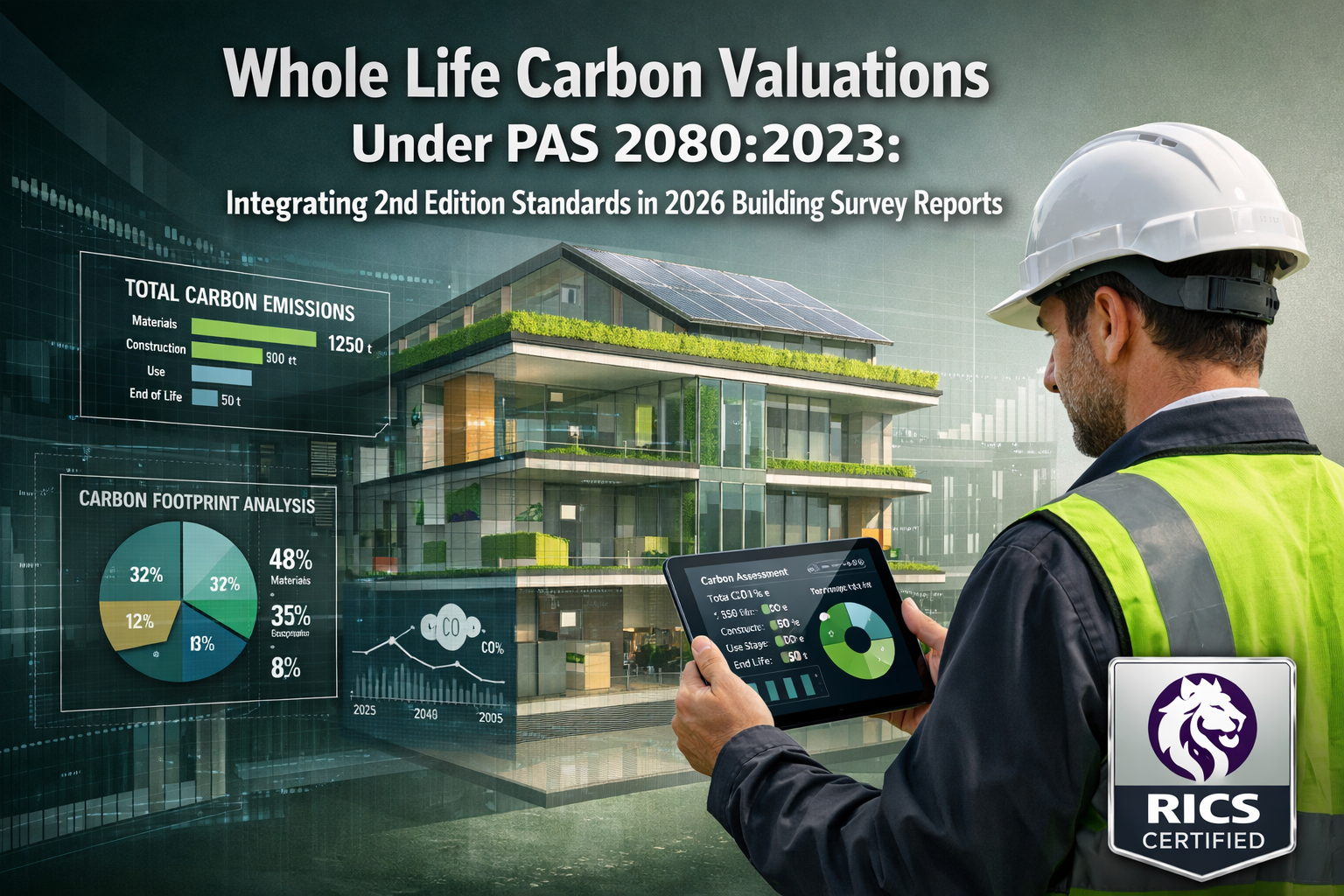
The construction sector generates approximately 39% of global carbon emissions, yet until recently, property valuations rarely accounted for a building's carbon footprint. As 2026 unfolds, this oversight has become professionally untenable. The convergence of PAS 2080:2023's second edition with RICS Whole Life Carbon Assessment guidelines now mandates that chartered surveyors integrate carbon audits into building valuations—fundamentally reshaping how properties are assessed, financed, and traded in sustainability-focused markets.
Whole Life Carbon Valuations Under PAS 2080:2023: Integrating 2nd Edition Standards in 2026 Building Survey Reports represents a paradigm shift in building surveyor services. This integration addresses the urgent need to align property assessments with net-zero targets while providing lenders, buyers, and developers with transparent carbon risk data that directly impacts asset value and marketability.
Key Takeaways
- PAS 2080:2023 expands carbon management from infrastructure-only to encompass all buildings, requiring whole-life carbon assessment across construction, operation, maintenance, and end-of-life phases
- RICS 2nd Edition standards mandate that chartered surveyors incorporate carbon valuations into property reports, affecting lending decisions and sale negotiations in 2026
- Carbon hierarchy principles (Avoid, Switch, Improve) now guide survey recommendations, prioritizing building less and building cleverly over traditional repair-focused advice
- Property valuations increasingly reflect carbon performance, with high-carbon buildings facing depreciation risks and sustainability-compliant properties commanding premium pricing
- Integration requires new competencies including lifecycle assessment methodologies (BS EN 15978), carbon quantification tools, and understanding of control versus influence emissions
Understanding PAS 2080:2023: The Second Edition Framework for Carbon Management
What Is PAS 2080:2023?
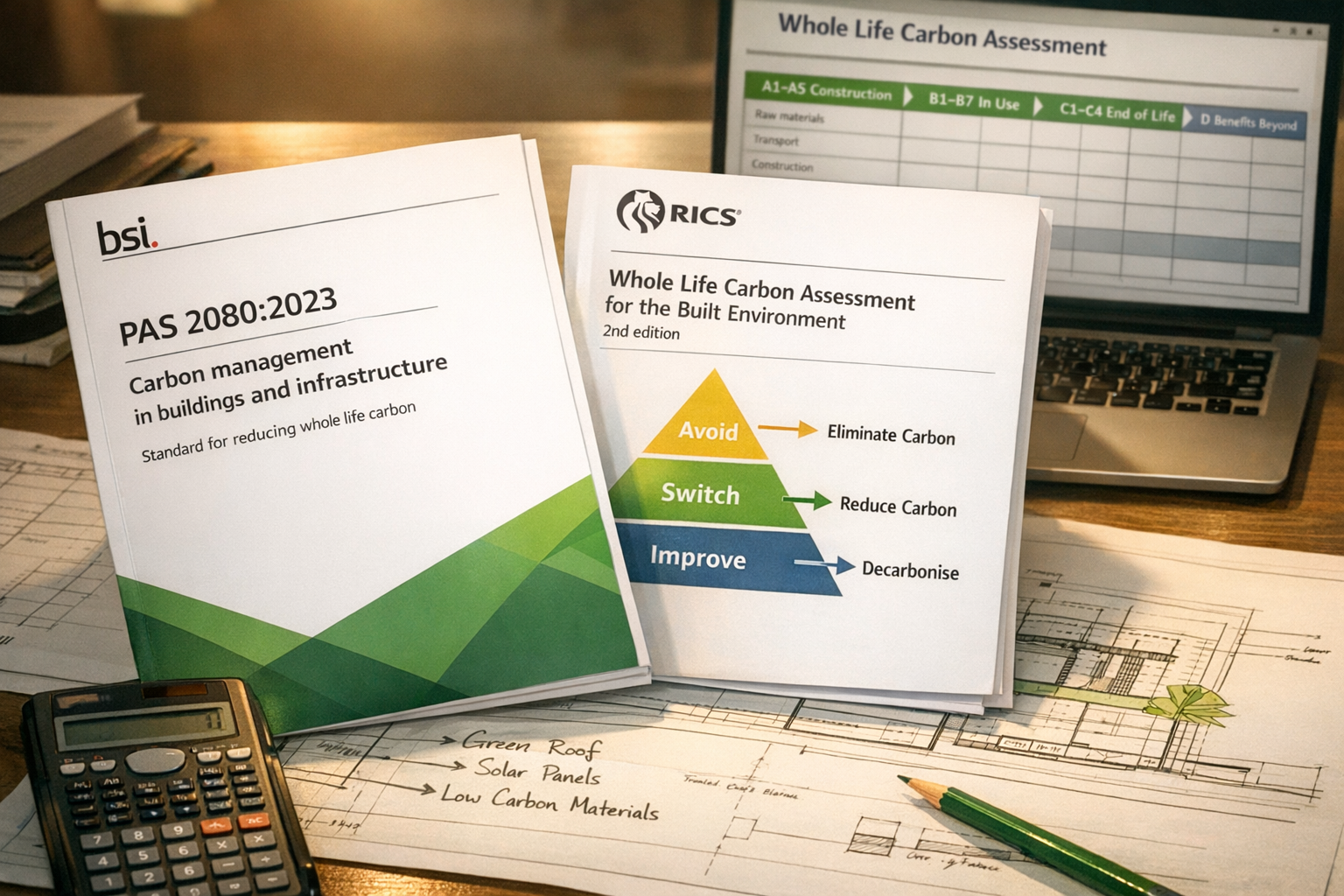
PAS 2080:2023, titled "Carbon Management in Buildings and Infrastructure," is a Publicly Available Specification developed by BSI that establishes requirements for managing whole-life carbon across the built environment [1]. The second edition, released in 2023, represents a significant expansion from the original 2016 version, which focused exclusively on infrastructure projects following the 2013 Infrastructure Carbon Review [2].
The 2023 revision addresses the climate emergency with greater urgency, extending coverage to all building types while introducing enhanced clarity on emissions that value chain members can directly control versus those they can influence [2]. This distinction proves crucial for surveyors conducting assessments, as it determines responsibility boundaries and reporting requirements.
Core Components of the Standard
PAS 2080:2023 contains 12 main sections covering [5]:
- Scope and normative references
- Terms and definitions
- Decarbonisation principles
- Leadership and governance
- Carbon management integration
- Whole-life assessment principles
- Target setting and baselining
- Monitoring and reporting
- Procurement and supply chain management
- Continual improvement
- Conformity claims
The standard functions as a framework with requirements and guidance rather than a quantification methodology [5]. For actual carbon calculations, it references complementary standards including BS EN 15978 (sustainability assessment of buildings), BS EN 17472 (sustainability of construction works), and BS EN 15804 (environmental product declarations) [5].
The Carbon Hierarchy: Avoid, Switch, Improve
Central to PAS 2080:2023 is the Carbon Hierarchy approach [5]:
- Avoid: Build nothing—challenge the need for new construction
- Switch: Build less—optimize design to reduce material quantities
- Improve: Build cleverly—select low-carbon materials and methods
- Improve: Build efficiently—optimize construction processes
This hierarchy fundamentally changes how surveyors approach RICS property valuations. Rather than simply identifying defects and recommending repairs, surveyors must now evaluate whether proposed interventions align with carbon reduction principles—sometimes advising against carbon-intensive renovations that traditional surveys would recommend.
Whole-Life Carbon Emphasis
The 2023 revision introduces greater emphasis on whole-life carbon—the sum of all emissions through a project's lifetime including construction (embodied carbon), maintenance, operational use, and end-of-life phases [2]. This comprehensive approach prevents "burden shifting," where mitigation efforts in one phase inadvertently increase emissions elsewhere.
For building surveyors, this means assessments must extend beyond immediate structural concerns to evaluate:
- Embodied carbon in existing materials
- Operational carbon from heating, cooling, and power systems
- Maintenance carbon from future repairs and replacements
- End-of-life carbon from demolition and material disposal
Whole Life Carbon Valuations Under PAS 2080:2023: Practical Application in Building Surveys
RICS Whole Life Carbon Assessment Integration
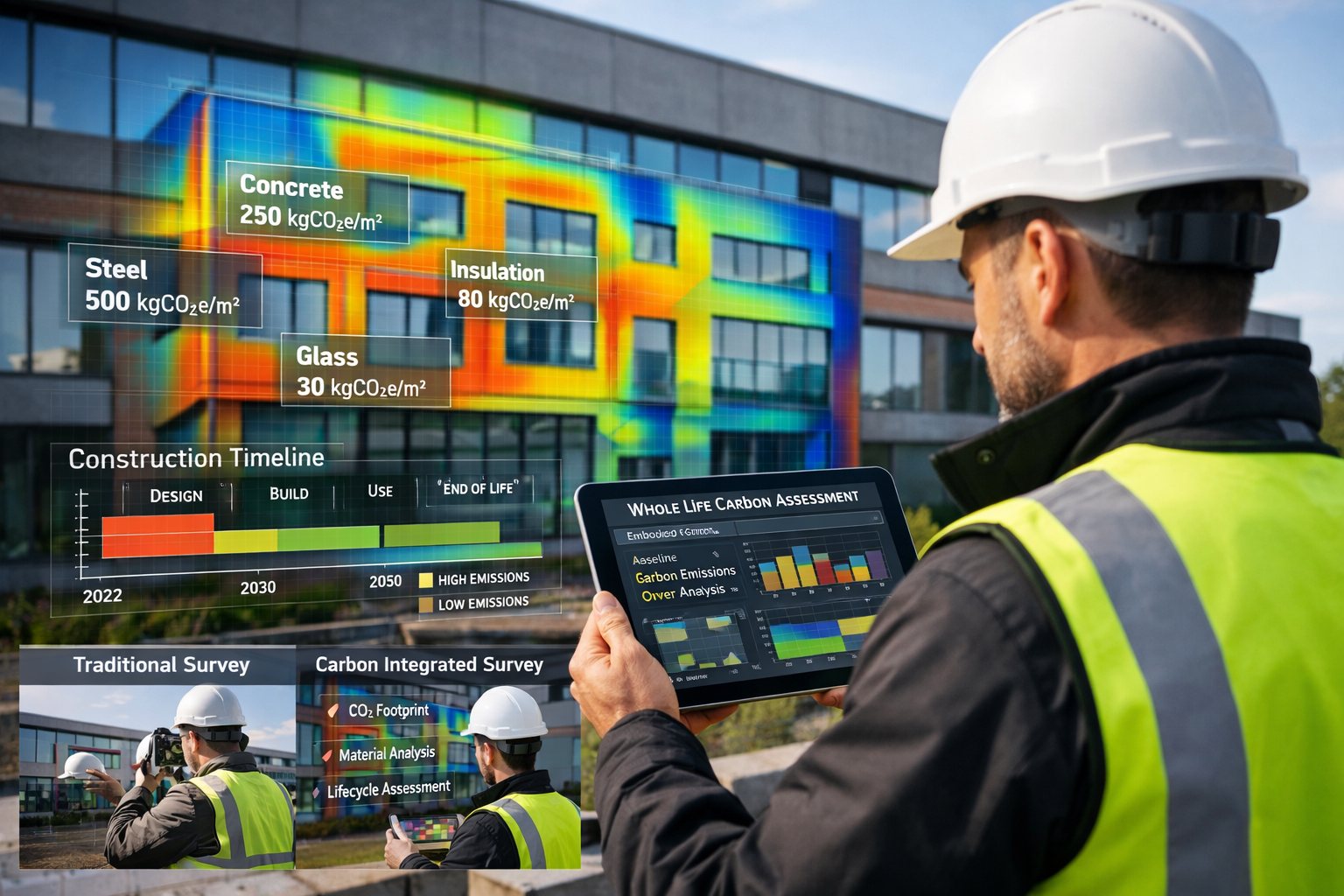
The RICS Whole Life Carbon Assessment professional statement (2nd Edition) establishes mandatory requirements for members conducting carbon assessments [6]. When combined with PAS 2080:2023 principles, this creates a comprehensive framework that surveyors must apply when preparing 2026 building reports.
The integration affects multiple survey types:
- RICS Homebuyer Surveys now include carbon performance indicators
- Specific Defect Surveys evaluate carbon implications of remediation options
- Stock Condition Surveys incorporate lifecycle carbon assessments for portfolio management
Control vs. Influence: Defining Surveyor Responsibilities
PAS 2080:2023 provides greater clarity distinguishing between emissions that value chain members can directly control versus influence [2]. For building surveyors, this distinction determines reporting obligations:
| Control Emissions | Influence Emissions |
|---|---|
| Survey methodology choices | Client's renovation decisions |
| Transport to site visits | Material selection by contractors |
| Equipment used during inspections | Building operational practices |
| Report production and distribution | Future maintenance approaches |
Surveyors must quantify controlled emissions and provide recommendations to reduce influenced emissions, encouraging clients to consider wider benefits rather than minimizing only directly controlled factors [2].
Systems-Thinking Approach in Property Assessment
The revised PAS 2080 implements a paradigm shift toward systems-thinking to ensure alignment with net-zero carbon transition at asset, network, and system levels [4]. For surveyors, this means evaluating buildings not as isolated structures but as components within broader systems:
- Urban context: How does the building contribute to neighborhood carbon performance?
- Infrastructure connections: What are the carbon implications of utilities and transport links?
- Portfolio effects: For multi-property assessments, how do individual buildings interact?
This systems perspective particularly impacts chartered surveyors conducting commercial property assessments, where portfolio-level carbon strategies increasingly influence individual asset valuations.
Quantification Methodologies and Tools
While PAS 2080:2023 doesn't provide its own carbon quantification methodology, it references BS EN 15978 as the primary standard for Life Cycle Assessment of buildings [5]. Surveyors must become proficient with:
- Embodied carbon databases (e.g., ICE Database, EPD libraries)
- Lifecycle assessment software (e.g., One Click LCA, eTool)
- Energy modeling tools for operational carbon projections
- Carbon intensity factors for materials and processes
The Institution of Civil Engineers (ICE) has curated an official Guidance Document elaborating on whole-life carbon management principles with practical examples and case studies [4], providing surveyors with implementation roadmaps.
Implementation Benefits for Surveying Practices
Organizations implementing PAS 2080 can achieve lower project costs, reduced emissions, and enhanced tender competitiveness while demonstrating commitment to decarbonizing the built environment [1]. For surveying firms, benefits include:
✅ Competitive advantage in sustainability-focused markets
✅ Enhanced client relationships through value-added carbon insights
✅ Risk mitigation by identifying carbon-related depreciation factors
✅ Professional development aligning with RICS competency requirements
✅ Market positioning for green finance and ESG-driven transactions
Integrating 2nd Edition Standards in 2026 Building Survey Reports: Practical Requirements
Mandatory Report Components for 2026
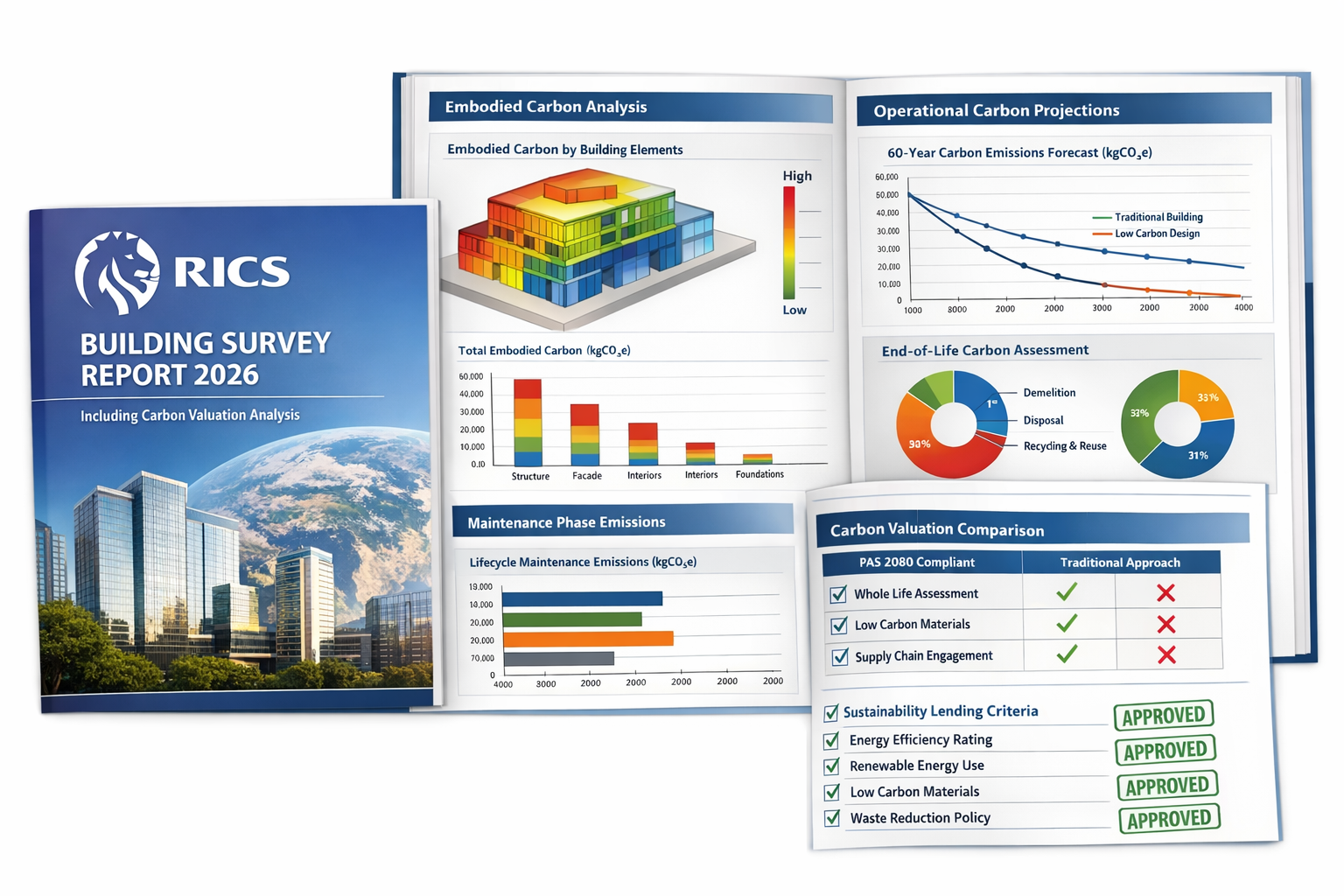
Building survey reports in 2026 must incorporate whole-life carbon valuations to meet RICS standards and client expectations. Essential components include:
1. Carbon Baseline Assessment
Establish the building's current carbon footprint across:
- Embodied carbon (kgCO2e/m²) in existing structure and materials
- Operational carbon (kgCO2e/year) from energy consumption
- Maintenance carbon projections over typical assessment periods (30-60 years)
- End-of-life carbon estimates for eventual demolition or deconstruction
2. Carbon Hierarchy Application
Evaluate proposed interventions using the Avoid-Switch-Improve framework [5]:
- Challenge necessity: Is the repair/renovation essential?
- Optimize scope: Can the intervention be reduced or phased?
- Material selection: What are lower-carbon alternatives?
- Process efficiency: How can implementation minimize carbon?
3. Comparative Carbon Analysis
Provide clients with carbon-informed options for identified defects:
| Intervention | Traditional Approach | Low-Carbon Alternative | Carbon Saving |
|---|---|---|---|
| Roof replacement | New concrete tiles | Reclaimed slate | 45% reduction |
| Wall insulation | Spray foam | Natural fiber batts | 62% reduction |
| Window replacement | New uPVC | Refurbish existing timber | 78% reduction |
4. Valuation Impact Assessment
Quantify how carbon performance affects property value:
- Premium pricing for high-performance buildings (typically 5-15% above comparable properties)
- Depreciation risk for high-carbon assets facing future regulatory penalties
- Financing implications for sustainability-linked lending products
- Marketability factors in ESG-conscious buyer segments
Sustainability-Focused Lending Integration
Financial institutions increasingly incorporate carbon performance into lending decisions. Surveyors must understand how carbon valuations affect:
- Loan-to-value ratios: High-carbon buildings may receive reduced lending percentages
- Interest rate adjustments: Sustainability-linked loans offer rate reductions for carbon improvements
- Covenant requirements: Lenders may mandate carbon reduction targets as loan conditions
- Default risk assessment: Carbon-intensive properties face higher regulatory and obsolescence risks
When preparing reports for property valuations supporting mortgage applications, surveyors should explicitly address these financing considerations.
Sales and Marketing Implications
Carbon valuations directly impact property marketability in 2026:
🏡 Residential markets: Buyers increasingly prioritize low running costs and environmental credentials
🏢 Commercial markets: Tenants demand high-performance spaces meeting corporate ESG commitments
🏗️ Development sites: Planning authorities favor low-carbon proposals, affecting site valuations
📊 Portfolio management: Institutional investors divest high-carbon assets to meet net-zero pledges
Surveyors should provide marketing-ready carbon credentials that sellers can leverage, including:
- Energy Performance Certificate (EPC) ratings with carbon context
- Whole-life carbon certifications (e.g., NABERS UK, BREEAM)
- Comparative performance against local/national benchmarks
- Carbon payback periods for recent improvements
Professional Competency Requirements
Integrating PAS 2080:2023 standards requires surveyors to develop new competencies:
- Technical knowledge: Understanding lifecycle assessment methodologies and carbon quantification
- Software proficiency: Operating carbon calculation tools and databases
- Standards literacy: Interpreting PAS 2080, RICS guidance, and complementary standards
- Strategic thinking: Applying systems-thinking and carbon hierarchy principles
- Communication skills: Translating technical carbon data into client-actionable insights
Finding a surveyor with these competencies becomes crucial for clients requiring comprehensive carbon-integrated assessments in 2026.
Regional Variations and Local Requirements
While PAS 2080:2023 provides national standards, regional authorities may impose additional requirements:
- London boroughs: Enhanced carbon reporting for planning applications
- Conservation areas: Balancing heritage preservation with carbon reduction
- New development zones: Mandatory whole-life carbon assessments for all new builds
- Flood risk areas: Combined carbon and climate adaptation assessments
Surveyors operating across multiple regions, such as those offering London property surveyor services, must maintain awareness of local variations affecting carbon valuation requirements.
Case Study: Carbon-Integrated Survey Impact
Scenario: Victorian terrace house in Wimbledon requiring roof repairs
Traditional Survey Approach:
- Recommendation: Complete roof replacement with new concrete tiles
- Estimated cost: £15,000
- Carbon impact: Not assessed
PAS 2080:2023-Compliant Approach:
- Assessment: 60% of roof structure sound; tiles repairable
- Recommendation: Selective tile replacement with reclaimed materials
- Estimated cost: £8,500
- Carbon saving: 4.2 tonnes CO2e
- Value impact: Enhanced marketability to sustainability-conscious buyers
This example demonstrates how carbon-integrated assessments deliver financial and environmental benefits while meeting 2026 professional standards.
Challenges and Future Developments in Carbon Valuation Integration
Current Implementation Challenges
Despite clear standards, surveyors face practical obstacles integrating carbon valuations:
⚠️ Data availability: Limited embodied carbon data for older building materials
⚠️ Software costs: Professional carbon assessment tools require significant investment
⚠️ Time constraints: Carbon assessments increase survey duration and complexity
⚠️ Client education: Many clients don't yet understand carbon valuation importance
⚠️ Valuation uncertainty: Carbon's impact on property values continues evolving
Emerging Technologies and Solutions
Innovation is addressing these challenges through:
- AI-powered assessment tools: Automated carbon calculations from building photographs and specifications
- Blockchain verification: Transparent, immutable carbon credentials for properties
- Digital twins: Real-time carbon monitoring and predictive modeling
- Material passports: Comprehensive embodied carbon documentation for building components
Regulatory Trajectory
The regulatory environment continues tightening carbon requirements:
- 2027: Anticipated mandatory whole-life carbon assessments for all commercial transactions over £1M
- 2030: Expected integration of carbon performance into Council Tax/Business Rates
- 2035: Projected carbon-based building depreciation in accounting standards
- 2050: Net-zero deadline driving comprehensive carbon accountability
Surveyors must anticipate these developments when providing long-term property advice and valuations.
Professional Development Pathways
RICS and related professional bodies are developing enhanced training programs:
- Specialist carbon assessment certifications
- Continuing Professional Development (CPD) modules on PAS 2080:2023
- Cross-disciplinary collaboration with sustainability consultants
- International harmonization with global carbon standards
Surveyors should prioritize these development opportunities to maintain professional competitiveness and regulatory compliance.
Conclusion
Whole Life Carbon Valuations Under PAS 2080:2023: Integrating 2nd Edition Standards in 2026 Building Survey Reports represents far more than a technical compliance requirement—it signals a fundamental transformation in how the property sector values, finances, and trades buildings. The convergence of PAS 2080:2023's comprehensive carbon management framework with RICS 2nd Edition standards has created a new professional paradigm where carbon performance directly influences asset value.
For chartered surveyors, this integration demands new competencies, tools, and approaches. The Carbon Hierarchy principles of Avoid-Switch-Improve must now guide survey recommendations, while whole-life carbon assessments spanning construction, operation, maintenance, and end-of-life phases become standard practice. The distinction between controlled and influenced emissions clarifies professional responsibilities, while systems-thinking approaches ensure building assessments align with broader net-zero transition goals.
The practical implications extend across all market segments. Sustainability-focused lenders increasingly incorporate carbon performance into financing decisions, affecting loan-to-value ratios and interest rates. Property buyers prioritize low-carbon buildings for both environmental credentials and reduced operating costs. Sellers leverage carbon valuations as marketing differentiators. Developers face planning authorities demanding carbon-optimized proposals.
Actionable Next Steps
For Surveyors:
- Invest in carbon assessment training and certification programs
- Acquire lifecycle assessment software and embodied carbon databases
- Develop standardized carbon valuation report templates
- Establish partnerships with sustainability consultants for complex assessments
- Communicate carbon integration value to clients through case studies
For Property Owners:
- Commission carbon-integrated surveys when considering renovations or sales
- Request comparative carbon analysis for proposed interventions
- Understand how carbon performance affects property value and marketability
- Prioritize low-carbon improvements with favorable payback periods
- Maintain carbon credentials documentation for future transactions
For Buyers and Investors:
- Require whole-life carbon assessments as part of due diligence
- Evaluate carbon-related depreciation risks in high-emission properties
- Consider sustainability-linked financing products offering rate advantages
- Factor carbon performance into long-term value projections
- Prioritize properties with comprehensive carbon documentation
The transition to carbon-integrated building surveys is not optional—it's the professional standard for 2026 and beyond. Organizations that embrace this transformation position themselves at the forefront of the property sector's net-zero journey, delivering enhanced value to clients while contributing meaningfully to climate change mitigation. The question is no longer whether to integrate carbon valuations, but how quickly and comprehensively to implement these essential practices.
References
[1] Carbon Management In Buildings And Infrastructure – https://www.bsigroup.com/en-GB/insights-and-media/insights/brochures/carbon-management-in-buildings-and-infrastructure/
[2] Pas 2080 – https://www.sweco.co.uk/blog/pas-2080/
[3] Watch – https://www.youtube.com/watch?v=bd-RunfwgGI
[4] Pas 2080 2023 Guidance Document For Pas 2800 – https://www.scribd.com/document/780163397/PAS-2080-2023-Guidance-Document-for-PAS-2800
[5] Nqa Webinar Pas 2080 Introduction 15 03 24 – https://www.nqa.com/getmedia/3511e234-657f-4e7b-9ab2-d7a2eb531440/NQA-Webinar-PAS-2080-Introduction-15-03-24.pdf
[6] Whole Life Carbon Assessment – https://www.rics.org/profession-standards/rics-standards-and-guidance/sector-standards/construction-standards/whole-life-carbon-assessment
[7] Help Infrastructure Reduce Carbon Through Standards – https://www.ice.org.uk/news-views-insights/inside-infrastructure/help-infrastructure-reduce-carbon-through-standards