


{"cover":"Professional landscape format (1536×1024) editorial hero image featuring bold text overlay 'Party Wall Notices for Renters' Rights Act Section 8 Evictions: Surveyor Protocols Amid Periodic Tenancy Shifts' in extra large 70pt white sans-serif font with dark shadow and semi-transparent navy overlay box, positioned in upper third center. Background shows dramatic split-scene composition: left side displays modern London terraced houses with shared party wall, right side shows professional surveyor in hard hat examining wall with clipboard and laser measuring device. Foreground includes overlaid legal documents with Section 8 notice forms and party wall agreement papers, partially transparent. Color palette: deep navy blue, crisp white, warm terracotta brick tones, professional grey accents. High contrast, magazine cover quality, architectural photography style with sharp focus on party wall junction between properties. Includes subtle calendar graphic showing May 2026 date marker. Editorial quality lighting, rule of thirds composition, visually commanding and authoritative aesthetic suitable for professional property law publication.","content":["Detailed landscape format (1536×1024) infographic showing timeline comparison chart for Section 8 eviction grounds versus party wall notice periods. Visual displays horizontal timeline bars in contrasting colors: burgundy bars showing mandatory Ground 6 eviction notice periods (two months minimum), teal bars showing Party Wall Act notice requirements (one to two months depending on work type), and overlapping amber zones highlighting critical compliance windows. Left side features calendar icons with specific dates marked, center shows clock symbols indicating countdown periods, right side displays checklist icons for surveyor documentation requirements. Includes annotated arrows pointing to key decision points where surveyor awards must align with tenancy termination dates. Background shows faded architectural blueprint texture with party wall cross-section diagram. Professional color scheme with clear data visualization, clean sans-serif typography for labels, and percentage indicators showing compliance success rates. Chart includes legend explaining periodic tenancy versus fixed-term implications under 2026 Renters' Rights Act framework.","Detailed landscape format (1536×1024) conceptual illustration depicting surveyor protocol workflow for party wall notices during Section 8 eviction proceedings. Central focus shows professional chartered surveyor at modern desk with dual computer monitors displaying digital party wall notice templates and PRS database interface. Surrounding the surveyor are floating semi-transparent document panels showing: party wall notice form with highlighted sections, Section 8 notice template with Ground 6 annotations, tenant rights information sheet, and surveyor award document with timeline stamps. Left side of composition features 3D rendered cross-section of terraced house party wall showing proposed excavation or loft conversion work with measurement annotations. Right side displays flowchart diagram with decision tree nodes indicating when party wall works trigger Section 8 considerations. Color scheme uses professional blues, greys, and accent orange for important callout boxes. Includes iconography for legal compliance checkmarks, warning triangles for non-compliance risks, and calendar symbols. Modern, clean corporate aesthetic with architectural precision and legal documentation clarity.","Detailed landscape format (1536×1024) realistic scene showing tenant consultation meeting for party wall works under new legislative framework. Composition features round conference table in modern property management office with three key participants: landlord representative in business attire reviewing documents, professional party wall surveyor in smart casual presenting wall construction diagrams on tablet device, and tenant reviewing rights documentation with focused expression. Table surface displays spread of materials including: laminated party wall notice with clear typography, Section 8 grounds explanation sheet, tenant rights under Renters' Rights Act 2026 booklet with prominent cover, site access schedule calendar, and surveyor contact information cards. Background shows large window overlooking London residential street with Victorian terraced houses, and wall-mounted display showing 'Tenant Rights 2026' poster with key legislative changes highlighted. Warm, professional lighting creates collaborative atmosphere. Color palette emphasizes trust and transparency: warm wood tones, soft grey walls, navy document folders, and green accent highlighting tenant protection provisions. Photorealistic quality with attention to document legibility and professional office environment details."]
The abolition of Section 21 "no-fault" evictions effective May 1, 2026, fundamentally transforms how landlords navigate party wall works when tenants occupy adjoining properties. With Section 8 grounds-based notices now the sole pathway to possession, party wall surveyors must recalibrate their protocols to ensure compliance with both the Party Wall Act 1996 and the stringent requirements of the Renters' Rights Act 2026. This legislative convergence creates unprecedented complexity for landlords planning structural improvements, extensions, or repairs that trigger party wall procedures during active tenancies.
Understanding Party Wall Notices for Renters' Rights Act Section 8 Evictions: Surveyor Protocols Amid Periodic Tenancy Shifts becomes essential for property professionals navigating this new landscape. The intersection of party wall law and tenancy regulations demands precise timing, meticulous documentation, and strategic coordination between surveyors, landlords, and legal advisors.

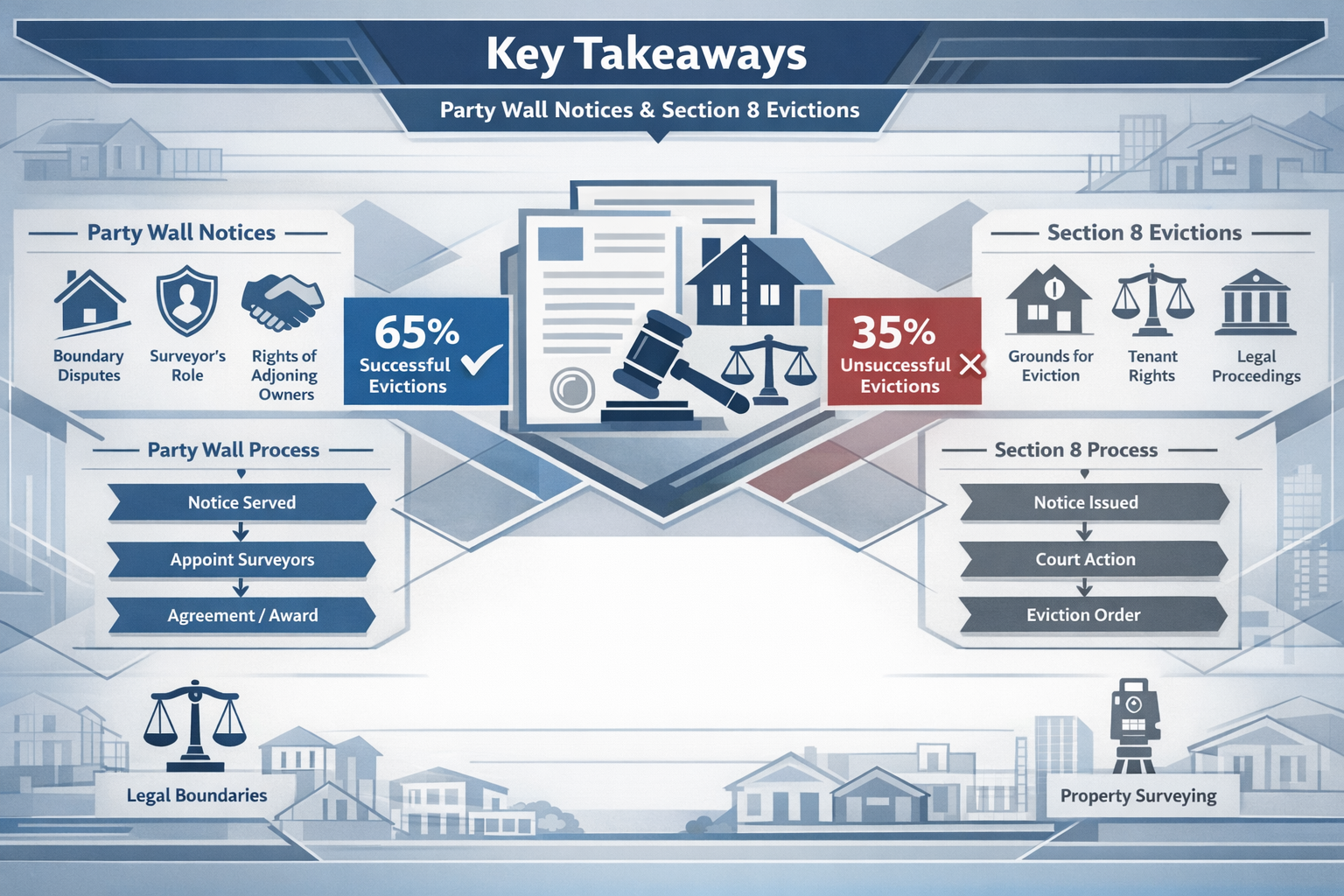
Key Takeaways
- Section 21 abolition from May 1, 2026 makes Section 8 grounds the only eviction route, requiring landlords to justify possession for party wall works through specific grounds like Ground 6 (intention to sell) [2]
- Party wall notice timing must now align precisely with Section 8 notice periods, creating critical compliance windows where surveyor awards and tenancy termination dates intersect
- Surveyor protocols require complete recalibration to place tenant rights at the center of every notice, with enhanced documentation standards for PRS database compliance [4]
- Periodic tenancy shifts introduce variable notice requirements that surveyors must account for when scheduling party wall works and issuing awards
- Ground 6 applicability emerges as the most relevant Section 8 ground for party wall scenarios, though it carries additional burden-of-proof requirements under the new framework [4]
Understanding the Legislative Framework: Renters' Rights Act 2026 and Section 8 Grounds
The Renters' Rights Act 2026 represents the most significant overhaul of residential tenancy law in decades. By eliminating Section 21 evictions, the legislation removes the landlord's ability to reclaim possession without providing specific grounds [2]. This fundamental shift means that landlords planning party wall works—whether basement excavations, loft conversions, or structural repairs—can no longer simply issue a Section 21 notice to regain possession before commencing construction.
Section 8 Grounds Relevant to Party Wall Works
Section 8 of the Housing Act 1988 provides 17 distinct grounds for possession, divided into mandatory and discretionary categories. For party wall scenarios, several grounds merit consideration:
Ground 6 (Intention to Demolish, Reconstruct, or Carry Out Substantial Works) emerges as the primary ground for landlords planning party wall works. However, the Renters' Rights Act 2026 introduces stricter evidential requirements. Landlords must now demonstrate:
- Genuine intention to undertake the works ✅
- Works cannot reasonably be carried out with the tenant in situ 📋
- Necessary planning permissions and party wall agreements are in place 🏗️
- Timeline documentation showing project commencement dates 📅
Ground 1 (Landlord Requires Property as Principal Home) may apply in limited circumstances where the landlord intends to occupy the property after completing party wall works, though this ground carries specific notice requirements.
The critical distinction under the 2026 framework is that all Section 8 grounds now require court proceedings [2]. Unlike the previous Section 21 process, landlords cannot automatically regain possession—they must prove their case before a judge, making comprehensive surveyor documentation absolutely essential.
Mandatory vs. Discretionary Grounds
Understanding the distinction between mandatory and discretionary grounds proves crucial for Party Wall Notices for Renters' Rights Act Section 8 Evictions: Surveyor Protocols Amid Periodic Tenancy Shifts:
| Ground Type | Court Requirement | Party Wall Relevance | Notice Period |
|---|---|---|---|
| Mandatory | Court must grant possession if proven | Ground 6 (with conditions met) | Two months minimum [2] |
| Discretionary | Court may grant if reasonable | Limited applicability | Two weeks to two months [2] |
For party wall works, surveyors should advise landlords to pursue mandatory grounds wherever possible, as discretionary grounds introduce uncertainty that can derail construction timelines and contractor schedules.
Party Wall Act 1996 Requirements and Notice Procedures
The Party Wall Act 1996 establishes the statutory framework governing building works on or near party walls, boundary walls, and excavations near neighboring properties. Under this legislation, building owners must serve party wall notices on adjoining owners before commencing specific types of work.
Types of Party Wall Notices
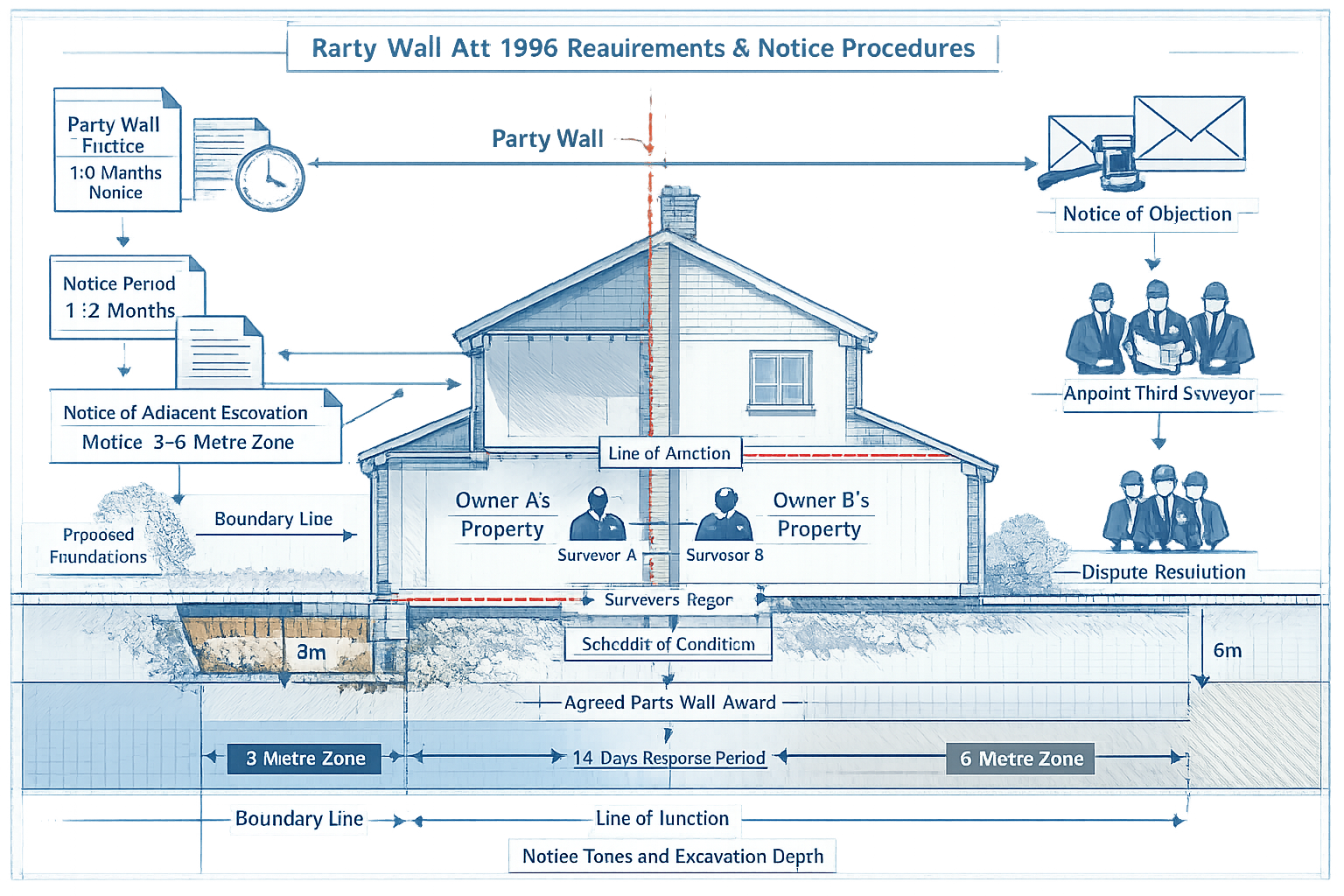
Three primary notice types exist under the Act:
Party Structure Notice (Section 1): Required for works directly to an existing party wall or party structure, including:
- Cutting into the wall to insert beams or damp-proof courses 🔨
- Raising, underpinning, or rebuilding the party wall
- Demolishing and rebuilding the party structure
- Notice period: Two months minimum
Line of Junction Notice (Section 1): Required when building a new wall astride the boundary line
- Notice period: One month minimum
Notice of Adjacent Excavation (Section 6): Required for excavations within three to six meters of a neighboring building's foundation
- Notice period: One month minimum
Standard Party Wall Timeline
Traditional party wall procedures follow this sequence:
- Building owner serves notice → Adjoining owner has 14 days to consent or dissent
- If consent: Works may proceed after notice period expires
- If dissent or no response: Party wall dispute arises, triggering surveyor appointment
- Surveyors prepare award: Typically 2-4 weeks, though complex cases may extend longer
- Works commence: Only after award is finalized and notice period expires
This timeline becomes significantly complicated when overlaid with Section 8 eviction procedures, particularly for periodic tenancy shifts where notice requirements vary based on tenancy type and payment frequency.
Surveyor Protocols for Party Wall Notices During Section 8 Evictions
The convergence of party wall procedures and Section 8 eviction grounds demands a complete recalibration of surveyor protocols. Professional surveyors must now navigate dual regulatory frameworks simultaneously, ensuring compliance with both the Party Wall Act 1996 and the Renters' Rights Act 2026.
Critical Timeline Coordination
Party Wall Notices for Renters' Rights Act Section 8 Evictions: Surveyor Protocols Amid Periodic Tenancy Shifts require meticulous timeline coordination:
Step 1: Initial Assessment and Tenancy Analysis
Before serving any party wall notice, surveyors should conduct a comprehensive tenancy analysis:
- Confirm tenancy type (periodic vs. fixed-term) 📝
- Identify applicable Section 8 ground (typically Ground 6 for party wall works)
- Calculate minimum notice periods under both frameworks
- Determine whether works can proceed with tenant in occupation
Step 2: Synchronized Notice Service
When possession is required for party wall works, surveyors should advise landlords to serve notices in this sequence:
- Section 8 Notice: Serve first, establishing the earliest possible possession date (minimum two months for Ground 6) [2]
- Party Wall Notice: Serve concurrently or shortly after, ensuring the party wall notice period expires around the anticipated possession date
- Court Proceedings: If tenant contests Section 8 notice, initiate court proceedings immediately to avoid construction delays
This synchronized approach prevents the common pitfall of completing party wall procedures only to discover that possession cannot be obtained in time for scheduled construction.
Step 3: Enhanced Documentation Standards
Under the 2026 framework, surveyors must maintain enhanced documentation to support potential court proceedings:
- ✅ Detailed condition surveys of the party wall and adjoining properties
- ✅ Photographic evidence with timestamps
- ✅ Professional engineer reports justifying why works cannot proceed with tenant in situ
- ✅ Contractor quotes and construction schedules demonstrating project timeline
- ✅ Planning permission documentation and building control approvals
- ✅ Evidence of attempts to accommodate tenant during works (if applicable)
This documentation serves dual purposes: supporting the party wall award and providing evidence for Section 8 court proceedings.
Periodic Tenancy Considerations
Periodic tenancies—those that continue on a rolling basis after a fixed term expires—introduce additional complexity for party wall protocols. The notice period required for Section 8 evictions varies based on the tenancy payment frequency:
- Monthly periodic tenancies: Two months' notice minimum [2]
- Weekly periodic tenancies: Two months' notice minimum (standardized under 2026 Act)
- Quarterly periodic tenancies: Two months' notice minimum
Critically, periodic tenancies can only be terminated on the last day of a tenancy period. For example, if rent is due on the 1st of each month, the Section 8 notice must expire on the last day of a rental period (e.g., the 30th or 31st).
Surveyors coordinating party wall works must account for this constraint when scheduling construction commencement. A party wall notice expiring mid-month becomes worthless if the tenancy cannot legally terminate until month-end.
The Role of Party Wall Surveyors in Section 8 Compliance
Professional party wall surveyors increasingly find themselves advising on tenancy matters, even though this traditionally falls outside their core competency. The 2026 legislative changes necessitate collaboration with legal advisors specializing in landlord-tenant law.
Surveyors should consider these best practices:
🔍 Pre-Work Legal Review: Before accepting instructions for party wall works involving occupied rental properties, recommend that landlords obtain legal advice on Section 8 compliance and viability.
📊 PRS Database Registration: Ensure landlords have registered with the Private Rented Sector (PRS) database, as non-registration may invalidate Section 8 notices [4]. This database requirement, introduced alongside the Renters' Rights Act, creates an additional compliance hurdle that surveyors must verify.
⚖️ Impartiality Maintenance: When appointed as agreed surveyor or third surveyor, maintain strict impartiality regarding tenancy disputes while focusing on party wall matters. However, ensure the award timeline accommodates realistic possession dates.
💼 Professional Indemnity Considerations: Review professional indemnity insurance to confirm coverage extends to advice given regarding the intersection of party wall procedures and tenancy law.
For comprehensive guidance on when party wall agreements become necessary, consult our resource on when you need a party wall agreement.
Ground 6 Applicability and Burden of Proof Requirements
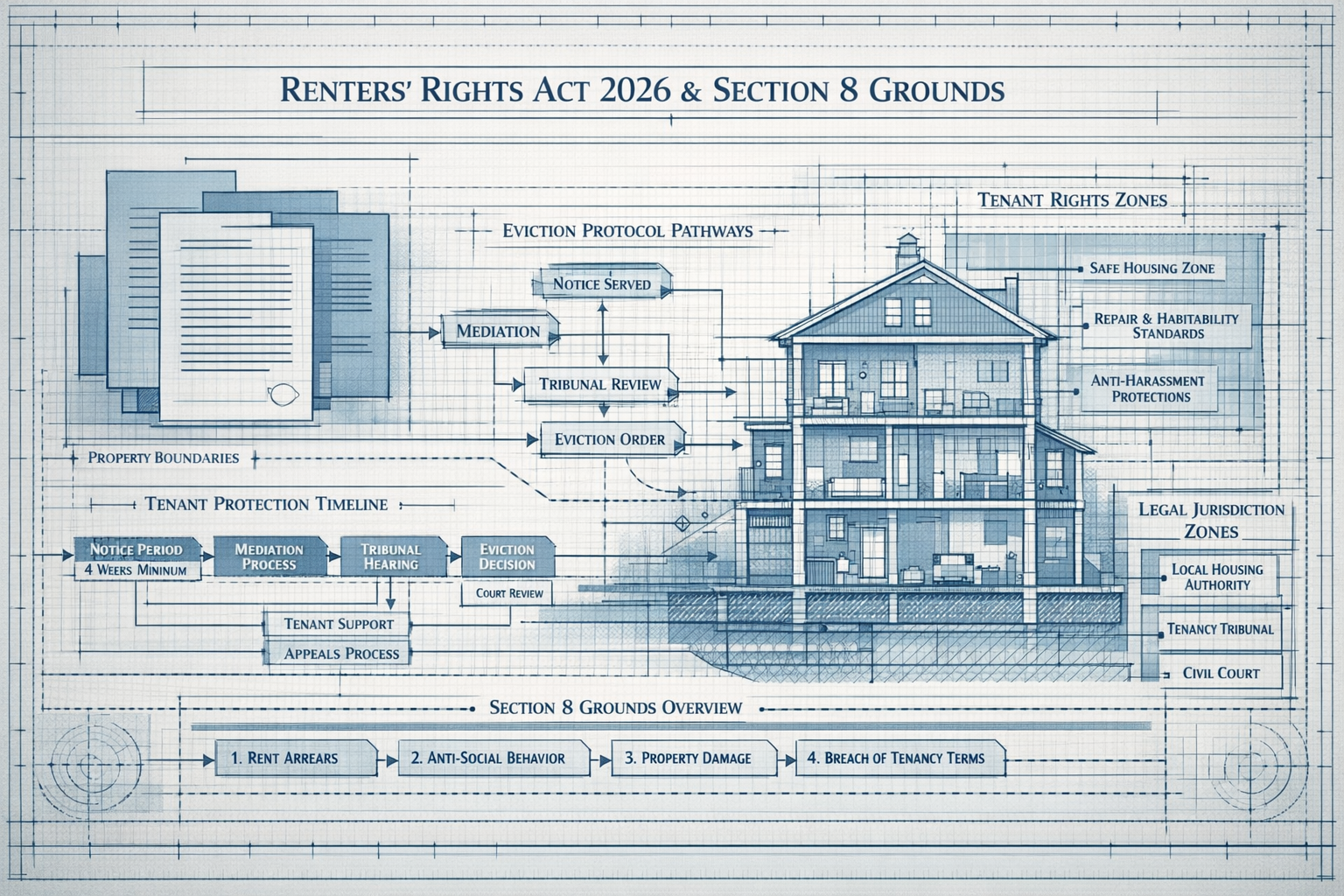
Ground 6 of the Housing Act 1988 provides the most direct route for landlords seeking possession to undertake party wall works. This ground allows possession where the landlord intends to demolish, reconstruct, or carry out substantial works that cannot reasonably be carried out with the tenant remaining in the property.
Establishing Ground 6 for Party Wall Works
To successfully rely on Ground 6 in the context of Party Wall Notices for Renters' Rights Act Section 8 Evictions: Surveyor Protocols Amid Periodic Tenancy Shifts, landlords must satisfy several criteria:
1. Genuine Intention to Undertake Works
Courts scrutinize whether the landlord genuinely intends to proceed with the works or is using Ground 6 as a pretext for eviction. Supporting evidence includes:
- Finalized architectural plans and engineering drawings
- Obtained or applied-for planning permissions
- Completed party wall awards with detailed specifications
- Contractor quotes and signed construction contracts
- Financing arrangements demonstrating project viability
2. Works Cannot Reasonably Be Carried Out With Tenant in Situ
This represents the most contentious element of Ground 6 claims. Landlords must demonstrate that:
- The scope of works makes continued occupation unsafe or impractical
- Access requirements would substantially interfere with tenant's quiet enjoyment
- Construction noise, dust, or disruption exceeds reasonable tolerance levels
- Temporary accommodation alternatives are not feasible
For party wall works, surveyors can support this requirement by providing professional opinions on:
- Health and safety risks associated with occupied construction sites
- Duration and intensity of works
- Structural exposure periods requiring property evacuation
- Compliance with CDM (Construction Design and Management) Regulations
3. Enhanced Burden of Proof Under 2026 Framework
The Renters' Rights Act 2026 introduces heightened scrutiny for Ground 6 claims [4]. Courts now require:
- Documentary evidence trail showing project progression from initial concept through planning and party wall stages
- Professional certifications from chartered surveyors, structural engineers, or architects confirming necessity of vacant possession
- Timeline justification explaining why works cannot be phased to accommodate continued tenancy
- Alternative accommodation evidence demonstrating landlord's efforts to minimize tenant displacement
Party Wall Awards as Supporting Evidence
A properly prepared party wall award significantly strengthens Ground 6 applications. The award should include:
Detailed Scope of Works: Comprehensive description of all party wall works, including:
- Structural alterations and their extent
- Excavation depths and proximity to foundations
- Duration estimates for each phase of work
- Access requirements and site logistics
Condition Schedule: Thorough documentation of pre-work property condition, establishing baseline for any subsequent damage claims and demonstrating professional due diligence.
Health and Safety Provisions: Explicit safety measures that may be incompatible with continued occupation, such as:
- Temporary structural supports requiring internal access
- Hazardous material removal (asbestos, lead paint)
- Prolonged periods of external wall exposure
- Scaffolding configurations blocking egress routes
Professional Opinions: Where the appointed surveyor holds relevant qualifications (RICS, CABE), their professional opinion on occupation feasibility carries significant weight in court proceedings.
For landlords seeking expert party wall advice, engaging experienced surveyors early in the process proves essential for building a robust Ground 6 case.
Coordinating Party Wall Surveys with Tenancy Termination Timelines
The practical challenge of Party Wall Notices for Renters' Rights Act Section 8 Evictions: Surveyor Protocols Amid Periodic Tenancy Shifts lies in synchronizing multiple legal timelines that operate independently yet must converge for successful project execution.
Scenario Analysis: Basement Excavation Project
Consider a typical scenario illustrating the coordination challenges:
Project: Basement excavation requiring party wall notice under Section 6 (adjacent excavation within 3 meters of neighbor's foundation)
Tenancy Status: Monthly periodic tenancy, rent due on the 15th of each month
Timeline Construction:
Day 1 (January 15, 2026):
- Landlord serves Section 8 notice citing Ground 6
- Minimum two-month notice period begins
- Earliest possession date: March 15, 2026 (end of February tenancy period)
Day 1-7 (January 15-22, 2026):
- Landlord serves party wall notice (Section 6 notice)
- One-month notice period begins
- Adjoining owner has 14 days to respond (until February 5)
Day 22 (February 5, 2026):
- Adjoining owner dissents or fails to respond
- Party wall dispute arises
- Surveyors appointed (building owner's surveyor and adjoining owner's surveyor)
Day 22-50 (February 5 – March 5, 2026):
- Surveyors conduct inspections and prepare award
- Award finalized by March 5 (allowing 4 weeks for surveyor process)
- Party wall notice period expires March 15
Day 60 (March 15, 2026):
- Section 8 notice period expires
- Tenancy terminates (assuming tenant vacates voluntarily)
- Party wall award in place and notice period satisfied
- ✅ Construction can commence March 16
This idealized timeline demonstrates successful coordination. However, complications frequently arise:
Common Coordination Failures
❌ Tenant Contests Section 8 Notice
If the tenant refuses to vacate, landlord must initiate court proceedings, adding 8-12 weeks to the timeline. The completed party wall award becomes stale, and surveyors may need to update condition surveys before work commences.
❌ Party Wall Dispute Extends Beyond Expected Timeline
Complex party wall disputes can require 8-12 weeks or longer for award preparation, particularly if third surveyor appointment becomes necessary or if technical disagreements arise regarding methodology or compensation.
❌ Planning Permission Delays
If planning approval remains pending when serving Section 8 notice, courts may question the landlord's genuine intention under Ground 6, potentially refusing the possession order.
❌ Periodic Tenancy Date Misalignment
Failing to account for tenancy period end dates can result in possession dates falling mid-period, requiring an additional month's delay and invalidating carefully coordinated party wall timelines.
Surveyor Recommendations for Timeline Management
Professional surveyors should implement these protocols:
🎯 Backward Planning Methodology
Start with the desired construction commencement date and work backward:
- Identify required construction start date
- Add party wall notice period (1-2 months depending on notice type)
- Add surveyor award preparation time (4-8 weeks for disputed cases)
- Add Section 8 notice period (minimum 2 months)
- Add court proceedings buffer (8-12 weeks if contested)
- Result: Minimum 6-9 months advance planning required
📋 Milestone Tracking System
Implement formal tracking for all critical dates:
- Section 8 notice service date and expiry date
- Party wall notice service date and expiry date
- Surveyor appointment dates
- Award target completion date
- Court hearing dates (if applicable)
- Planning permission decision dates
- Contractor mobilization dates
⚠️ Contingency Planning
Develop contingency protocols for common delays:
- Alternative contractor availability if timelines extend
- Interim party wall award updates if substantial delays occur
- Phased work strategies allowing partial commencement
- Temporary accommodation options if tenant negotiates delayed departure
Understanding London party wall surveyor costs helps landlords budget appropriately for extended surveyor engagement that may be necessary when coordinating with Section 8 procedures.
Tenant Rights and Communication Protocols Under the 2026 Framework
The Renters' Rights Act 2026 fundamentally reorients the landlord-tenant relationship, placing tenant rights at the center of every notice [6]. For party wall procedures intersecting with Section 8 evictions, this philosophical shift demands enhanced communication protocols and transparency.
Mandatory Tenant Notifications
When party wall works necessitate possession under Section 8 grounds, landlords and their surveyors must provide tenants with comprehensive information:
📄 Section 8 Notice Contents
The Section 8 notice must specify:
- The specific ground(s) for possession (e.g., Ground 6)
- Detailed particulars explaining why the ground applies
- Date by which tenant must vacate (minimum two months) [2]
- Tenant's right to challenge the notice in court
- Information about accessing legal advice and housing assistance
📄 Party Wall Information Package
While not legally required, best practice dictates providing tenants with:
- Copy of the party wall notice served on adjoining owners
- Plain-language explanation of proposed works
- Expected duration and intensity of construction
- Contact information for appointed surveyor(s)
- Process for reporting concerns about works affecting their property
📄 Tenant Rights Documentation
Under the 2026 framework, landlords should provide:
- Written explanation of tenant's right to contest the Section 8 notice
- Information about local authority housing assistance programs
- Reasonable timeline for finding alternative accommodation
- Details of any compensation or relocation assistance offered
Communication Best Practices for Surveyors
Party wall surveyors increasingly find themselves in direct communication with tenants, particularly when conducting pre-work condition surveys. Professional protocols include:
🤝 Respectful Access Arrangements
- Provide minimum 7 days' notice for inspection appointments
- Offer flexible scheduling to accommodate tenant availability
- Conduct inspections efficiently to minimize disruption
- Explain the purpose and scope of the inspection clearly
📸 Transparent Documentation Process
- Inform tenants about photographic documentation purposes
- Explain how condition records protect both landlord and tenant interests
- Provide copies of condition schedules upon request
- Address tenant concerns about privacy and security
⚖️ Impartial Professional Stance
- Maintain neutrality regarding the Section 8 eviction proceedings
- Focus communications strictly on party wall matters
- Avoid providing legal advice about tenancy rights (refer to qualified solicitors)
- Document all tenant interactions for potential court proceedings
🔔 Ongoing Updates
- Notify tenants of award completion and work commencement dates
- Provide updated timelines if delays occur
- Establish clear channels for reporting construction-related concerns
- Coordinate with contractors to minimize tenant impact during any overlap period
Tenant Cooperation and Non-Cooperation Scenarios
Scenario 1: Cooperative Tenant
When tenants cooperate with inspection access and understand the necessity of works, surveyors should:
- Acknowledge their cooperation in award documentation
- Facilitate smooth handover between tenancy termination and construction commencement
- Ensure final condition inspection occurs before tenant departure
- Provide clear documentation protecting tenant's deposit and interests
Scenario 2: Non-Cooperative Tenant
When tenants refuse inspection access or contest the Section 8 proceedings:
- Document all access refusals with dates and circumstances
- Serve formal access requests in writing with statutory notice periods
- Coordinate with landlord's legal team regarding court applications for access
- Prepare alternative inspection methodologies (external-only surveys where possible)
- Include access limitations in party wall award, noting potential risks
Non-cooperation may strengthen the landlord's Ground 6 case by demonstrating tenant obstruction of legitimate property improvements, though courts scrutinize such claims carefully to ensure landlords haven't manufactured disputes.
For properties requiring comprehensive assessment, consider our RICS building survey services which provide detailed condition analysis supporting both party wall awards and Section 8 evidence requirements.
PRS Database Registration and Section 8 Notice Validity
A critical yet often overlooked aspect of Party Wall Notices for Renters' Rights Act Section 8 Evictions: Surveyor Protocols Amid Periodic Tenancy Shifts involves the new Private Rented Sector (PRS) database requirement introduced alongside the Renters' Rights Act 2026.
PRS Database Compliance Requirements
The PRS database mandates that all private landlords register their rental properties with detailed information including:
- Property address and type
- Landlord contact information
- Tenancy start dates and rent amounts
- Safety certificate compliance status (gas, electrical, EPC)
- Any ongoing possession proceedings
Critical compliance rule: Section 8 notices served by unregistered landlords may be deemed invalid [4], potentially rendering the entire eviction process void and delaying party wall works indefinitely.
Surveyor Due Diligence Protocols
Party wall surveyors should implement verification procedures:
✅ Pre-Instruction Verification
Before accepting party wall instructions involving occupied rental properties:
- Request evidence of PRS database registration
- Verify landlord's registration status through the database portal
- Document registration number and date in surveyor's file
- Flag non-compliance issues for landlord's immediate attention
✅ Award Documentation
Include PRS registration verification in party wall award documentation:
- Reference registration number in award preamble
- Note verification date and method
- Create audit trail demonstrating due diligence
✅ Timeline Adjustments
If landlord lacks PRS registration:
- Add 4-6 weeks to project timeline for registration completion
- Delay Section 8 notice service until registration confirmed
- Adjust party wall notice timing accordingly
Interaction with Section 8 Validity
Courts increasingly scrutinize landlord compliance with all statutory obligations when assessing Section 8 possession claims. Non-compliance with PRS registration requirements may lead to:
- Automatic dismissal of Section 8 possession claim
- Cost orders against landlord for wasted court time
- Rent repayment orders if non-compliance is substantial
- Delayed party wall works while compliance is rectified
For surveyors coordinating complex projects, verifying PRS registration represents a simple yet essential step preventing catastrophic timeline failures.
Regional Variations and Local Authority Considerations
While the Renters' Rights Act 2026 establishes national standards, regional variations in enforcement and local authority practices affect Party Wall Notices for Renters' Rights Act Section 8 Evictions: Surveyor Protocols Amid Periodic Tenancy Shifts.
London-Specific Considerations
London's property market presents unique challenges:
Higher Tenant Protections: Many London boroughs maintain tenant advocacy programs providing free legal representation for Section 8 challenges, increasing the likelihood of contested proceedings.
Selective Licensing Schemes: Numerous London boroughs operate selective licensing schemes with additional landlord obligations beyond PRS database registration. Non-compliance may invalidate Section 8 notices.
Planning Permission Complexity: London planning authorities often impose stringent conditions on basement excavations and extensions, requiring party wall surveyors to coordinate with planning consultants.
Property Values and Damages: Higher property values in London increase potential party wall damages awards, making thorough condition surveys and professional surveyor appointments even more critical.
For London property surveyors familiar with regional nuances, understanding these local factors proves essential for successful project coordination.
Suburban and Regional Variations
Outside London, different considerations apply:
🏘️ Lower Tenant Advocacy Resources: Fewer free legal services may result in lower rates of contested Section 8 proceedings, potentially simplifying timelines.
🏗️ Relaxed Planning Regimes: Some regional authorities impose less stringent planning requirements, though party wall obligations remain unchanged.
💷 Cost Considerations: Lower party wall surveyor quotes in regional markets may make professional surveyor appointment more accessible for smaller projects.
⏱️ Court Processing Times: Regional county courts often process possession claims faster than London courts, potentially reducing timeline buffers required for contested proceedings.
Risk Management and Professional Liability Considerations
The intersection of party wall law and tenancy regulations creates novel professional liability exposures for surveyors. Comprehensive risk management protocols become essential.
Professional Indemnity Insurance Review
Surveyors should review PI insurance policies to ensure coverage extends to:
📋 Tenancy-Related Advice: Confirm that advice regarding the timing and coordination of party wall notices with Section 8 proceedings falls within covered activities.
⚖️ Court Proceedings Support: Verify coverage for time spent providing expert evidence in possession proceedings related to Ground 6 claims.
💰 Extended Liability Periods: Consider that party wall awards may be challenged years after issuance, particularly if construction delays result in stale awards being implemented.
🔍 Due Diligence Failures: Ensure coverage for claims arising from failure to verify PRS registration or other landlord compliance matters.
Documentation and Record-Keeping Standards
Enhanced documentation standards protect surveyors from liability:
Comprehensive File Notes: Maintain detailed records of:
- All client communications regarding tenancy status and Section 8 proceedings
- Advice given regarding timeline coordination
- Warnings provided about potential delays or complications
- Verification steps taken for PRS registration and landlord compliance
Engagement Letter Clarity: Ensure engagement letters explicitly define:
- Scope of surveyor's role (party wall matters only)
- Limitations on tenancy advice (recommend separate legal counsel)
- Assumptions regarding landlord's compliance with tenancy law
- Timeline estimates and factors outside surveyor's control
Third-Party Communications: Document all communications with:
- Tenants (inspection arrangements, access requests)
- Landlord's legal advisors (timeline coordination)
- Adjoining owners and their surveyors (standard party wall matters)
- Contractors (work scheduling and possession date dependencies)
Client Expectation Management
Clear communication with landlord clients prevents disputes:
⚠️ Timeline Uncertainty: Explicitly warn clients that Section 8 proceedings introduce substantial timeline uncertainty, with contested cases adding 3-6 months to project schedules.
💷 Cost Implications: Explain that extended timelines may result in:
- Additional surveyor fees for award updates
- Contractor rescheduling costs
- Lost rental income during extended vacancy periods
- Legal fees for contested possession proceedings
🎯 Success Probability: Provide realistic assessments of Ground 6 success probability based on:
- Strength of evidence regarding works necessity
- Tenant cooperation likelihood
- Local court precedents
- Completeness of supporting documentation
For comprehensive building surveyor services that integrate party wall, structural, and regulatory compliance expertise, engaging experienced professionals proves essential.
Case Studies: Successful and Failed Coordination Scenarios
Case Study 1: Successful Coordination – Loft Conversion with Periodic Tenancy ✅
Project: Two-story loft conversion requiring party wall notice under Section 1 (works to party wall) and Section 6 (excavation for new foundations)
Tenancy: Monthly periodic tenancy, rent due 1st of month
Timeline Execution:
- October 1, 2025: Landlord obtains planning permission and engages party wall surveyor
- October 15, 2025: Surveyor conducts preliminary assessment, confirms Ground 6 viability
- November 1, 2025: Landlord serves Section 8 notice citing Ground 6 (possession required by February 1, 2026)
- November 5, 2025: Landlord serves party wall notices (Section 1 and Section 6)
- November 19, 2025: Adjoining owner dissents; surveyors appointed
- December 20, 2025: Party wall award completed and served
- January 5, 2026: Party wall notice periods expire
- January 15, 2026: Tenant voluntarily vacates early (negotiated one-month rent concession)
- January 20, 2026: Final condition survey completed
- January 27, 2026: Construction commences
Success Factors:
- Early planning permission secured before notices served
- Coordinated notice timing ensured simultaneous expiry
- Tenant incentive facilitated early departure
- Professional surveyor coordination with landlord's legal team
- Comprehensive documentation supporting Ground 6 claim
Case Study 2: Failed Coordination – Basement Excavation with Contested Eviction ❌
Project: Basement excavation requiring Section 6 party wall notice
Tenancy: Monthly periodic tenancy, rent due 15th of month
Timeline Failures:
- January 15, 2026: Landlord serves Section 8 notice without PRS database registration
- January 20, 2026: Landlord serves party wall notice
- February 5, 2026: Adjoining owner dissents; surveyors appointed
- March 10, 2026: Party wall award completed
- March 15, 2026: Tenant refuses to vacate, contests Section 8 notice
- March 20, 2026: Court identifies PRS registration failure; dismisses possession claim
- April 1, 2026: Landlord completes PRS registration
- April 15, 2026: Landlord serves new Section 8 notice (possession required by June 15, 2026)
- May 1, 2026: Renters' Rights Act comes into force with enhanced tenant protections
- June 15, 2026: Tenant again contests; court proceedings initiated
- August 20, 2026: Court grants possession order (effective September 30, 2026)
- September 30, 2026: Tenant finally vacates
- October 1, 2026: Party wall award now 7 months old; condition survey update required
- October 15, 2026: Updated award served
- November 1, 2026: Construction finally commences (10 months behind schedule)
Failure Factors:
- PRS registration oversight invalidated initial Section 8 notice
- Timing placed new notice service after May 1, 2026 legislative changes
- Party wall award became stale during extended proceedings
- Contractor rescheduling costs exceeded £15,000
- Lost rental income during extended vacancy period
- Additional surveyor fees for award updates
These case studies illustrate the critical importance of comprehensive compliance verification and professional coordination for Party Wall Notices for Renters' Rights Act Section 8 Evictions: Surveyor Protocols Amid Periodic Tenancy Shifts.
Future Outlook: Anticipated Regulatory Developments
The Renters' Rights Act 2026 represents the first phase of ongoing tenancy law reform. Surveyors should anticipate further developments:
Proposed Amendments and Consultations
Decent Homes Standard: Government consultations propose mandatory property condition standards for private rentals, potentially affecting party wall works that improve properties to meet these standards. Enhanced standards may strengthen Ground 6 claims where works bring properties into compliance.
Rent Control Mechanisms: Proposed rent stabilization measures may affect landlord economics for party wall improvement projects, potentially reducing the volume of works requiring Section 8 coordination.
Tenant Relocation Assistance: Draft proposals suggest mandatory relocation assistance payments for Section 8 evictions, adding cost considerations to party wall project budgets.
Technology and Digital Processes
Digital Notice Service: Pilot programs testing electronic service of Section 8 and party wall notices may streamline processes, though legal validity questions remain under current frameworks.
PRS Database Integration: Enhanced database functionality may eventually link party wall registrations with tenancy records, creating automated compliance verification.
Court Digitalization: Continued digitalization of possession proceedings may reduce court processing times, potentially shortening timeline buffers required for contested cases.
Professional Practice Evolution
Party wall surveying practice continues evolving in response to legislative changes:
🎓 Enhanced Training: Professional bodies increasingly offer specialized training on tenancy law implications for party wall surveyors.
🤝 Multidisciplinary Collaboration: Growing trend toward integrated teams combining party wall surveyors, tenancy law solicitors, and planning consultants.
📊 Data-Driven Risk Assessment: Development of databases tracking Section 8 success rates by ground, region, and case characteristics, enabling more accurate timeline predictions.
For surveyors seeking to stay current with evolving London party wall agreement practices, ongoing professional development becomes essential.
Conclusion
The abolition of Section 21 evictions effective May 1, 2026 fundamentally transforms how landlords and surveyors approach party wall works in occupied rental properties. Party Wall Notices for Renters' Rights Act Section 8 Evictions: Surveyor Protocols Amid Periodic Tenancy Shifts demands comprehensive recalibration of traditional surveying practices, placing tenant rights and regulatory compliance at the center of every project.
Success in this new landscape requires:
✅ Meticulous timeline coordination synchronizing Section 8 notice periods, party wall notice requirements, and court proceeding contingencies
✅ Enhanced documentation standards supporting both party wall awards and Ground 6 possession claims with professional evidence
✅ Comprehensive compliance verification including PRS database registration, planning permissions, and all statutory obligations
✅ Professional collaboration between party wall surveyors, tenancy law solicitors, and construction professionals
✅ Realistic client expectation management regarding timelines, costs, and success probabilities
✅ Proactive risk management through robust professional indemnity coverage and thorough record-keeping
For landlords planning party wall works, early engagement with experienced surveyors proves essential—ideally 6-9 months before desired construction commencement. For surveyors, developing expertise in the intersection of party wall law and tenancy regulations creates competitive advantage in an increasingly complex regulatory environment.
Actionable Next Steps
For Landlords Planning Party Wall Works:
- Verify PRS database registration before initiating any possession proceedings
- Engage party wall surveyor and tenancy solicitor simultaneously for coordinated advice
- Secure planning permissions before serving Section 8 notices to strengthen Ground 6 claims
- Document genuine intention to undertake works through contractor quotes and financing arrangements
- Consider tenant incentives for voluntary early departure to avoid contested proceedings
For Party Wall Surveyors:
- Implement PRS verification protocols as standard pre-instruction due diligence
- Review professional indemnity coverage to ensure tenancy-related advice is covered
- Develop timeline coordination templates accounting for Section 8 and party wall notice periods
- Establish referral relationships with tenancy law specialists for client referrals
- Enhance documentation standards to support potential court proceedings
For Tenants Receiving Notices:
- Seek legal advice immediately when receiving Section 8 notices citing party wall works
- Verify landlord PRS registration through the database portal
- Document all communications regarding works and possession proceedings
- Cooperate with surveyor inspections while preserving legal rights
- Explore negotiated solutions including temporary relocation with guaranteed return rights
The convergence of party wall law and the Renters' Rights Act 2026 creates complexity, but also opportunity for professionals who master the integrated protocols required for successful project delivery in this new regulatory landscape.
References
[1] Section 8 Housing Eviction – https://www.leaserunner.com/blog/section-8-housing-eviction
[2] Section 8 Notices – https://osborneslaw.com/blog/section-8-notices/
[3] Timely Eviction Notices – https://massunion.org/timely-eviction-notices/
[4] Party Wall Implications Of Renters Rights Act 2026 Survey Protocols For Prs Database And Section 8 Notice Compliance – https://nottinghillsurveyors.com/blog/party-wall-implications-of-renters-rights-act-2026-survey-protocols-for-prs-database-and-section-8-notice-compliance
[5] Watch – https://www.youtube.com/watch?v=AYxkhKjY7Qs
[6] Party Wall Surveys Under Renters Rights Act 2026 Protocols For Landlord Improvements Without Section 21 Evictions – https://nottinghillsurveyors.com/blog/party-wall-surveys-under-renters-rights-act-2026-protocols-for-landlord-improvements-without-section-21-evictions
[7] The Attorney Generals Guide To Landlord And Tenant Rights – https://www.mass.gov/guides/the-attorney-generals-guide-to-landlord-and-tenant-rights
[8] Part 982 – https://www.ecfr.gov/current/title-24/subtitle-B/chapter-IX/part-982