

Landlords who fail to register on the new Private Rented Sector (PRS) Database in 2026 will be legally barred from serving Section 8 eviction notices—a seismic shift that transforms building surveys from optional due diligence into mandatory compliance tools. With Awaab's Law extending to private rentals this year and the Decent Homes Standard now applying beyond social housing, Building Survey Protocols for PRS Database Compliance: Integrating Awaab's Law and Renters' Rights Act Checks in 2026 Rental Valuations have become the cornerstone of transaction certainty and regulatory adherence.
The convergence of these legislative frameworks demands that surveyors, landlords, and letting agents fundamentally redesign their property assessment methodologies. Traditional reactive maintenance approaches no longer satisfy regulatory requirements. Instead, the new compliance landscape requires evidence-led documentation, real-time hazard detection, and digital audit trails that connect every inspection, decision, and remedial action into a cohesive "golden thread" of data.[4]
This comprehensive guide provides step-by-step protocols for integrating Awaab's Law emergency response requirements, PRS Database registration elements, and Renters' Rights Act standards into building survey workflows—ensuring rental valuations reflect true compliance status and protecting stakeholders from enforcement penalties.
Key Takeaways
- 📋 PRS Database registration becomes mandatory in 2026, requiring landlords to upload compliance documents (EPC, Gas Safety, EICR) and obtain unique property identifiers before serving Section 8 notices
- ⏱️ Awaab's Law imposes strict timelines: 24-hour response for Category 1 emergencies, 10 working days for damp/mould investigations, and 5 working days to begin remedial works
- 🏠 Decent Homes Standard now applies to private rentals, creating minimum legal benchmarks for safety, repair, and thermal comfort previously limited to social housing
- 📱 Digital field capture systems are essential, enabling surveyors to log RAG-status hazards, GPS coordinates, photographic evidence, and contractor assignments in real-time
- 🔗 Ombudsman registration is linked to database compliance, with landlords unable to legally let properties without dual registration and annual fee payment
Understanding the 2026 PRS Database Registration Framework
The Private Rented Sector Database represents the most comprehensive landlord accountability system ever introduced in the UK rental market. Unlike previous voluntary schemes, this mandatory registration framework creates an enforceable link between property compliance and legal remedies available to landlords.[2]
Core Registration Requirements
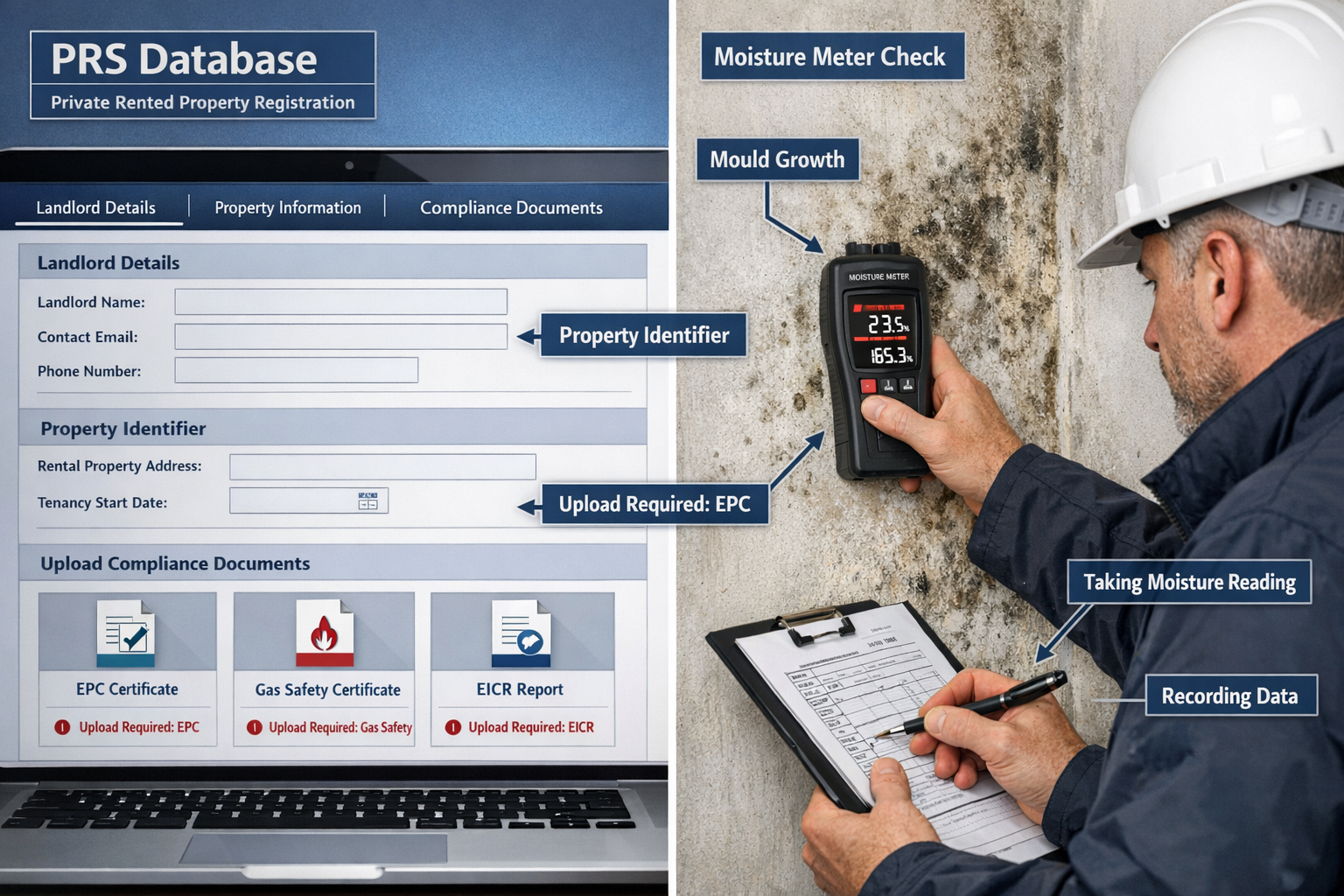
Every private landlord must register the following information for each rental property:
Mandatory Data Elements:
- Landlord identity and contact details
- Property address and property type classification
- Letting agent information (if applicable)
- Unique property identifier (assigned by database)
- Energy Performance Certificate (EPC) reference
- Gas Safety Certificate documentation
- Electrical Installation Condition Report (EICR) compliance evidence
The database assigns each registered property a unique identifier that may need to be included in property advertisements and tenancy agreements.[2] This identifier creates a permanent compliance record that follows the property through ownership changes and tenancy transitions.
The Section 8 Notice Connection
The most significant enforcement mechanism lies in the requirement that landlords cannot serve Section 8 eviction notices without current database registration.[1] This provision fundamentally shifts the power dynamic in landlord-tenant disputes, as non-compliant landlords lose access to possession proceedings even when legitimate grounds exist.
For building surveyors, this creates a new valuation consideration: properties with unresolved compliance issues effectively become un-lettable until remedial works are completed and documented in the database. Professional surveyor services must now assess not just physical condition, but regulatory compliance status as a material factor in rental value.
Linked Ombudsman Scheme Requirements
Database registration alone is insufficient. Landlords must simultaneously register with the mandatory Private Rented Sector Ombudsman Scheme, paying a "small annual fee per property" to fund the dispute resolution service.[2] This dual registration creates a comprehensive oversight framework where:
✅ Database tracks property compliance documentation
✅ Ombudsman provides tenant dispute resolution pathway
✅ Non-compliance with either system blocks Section 8 proceedings
Building surveys conducted for property assessment purposes in 2026 must therefore verify both database registration status and Ombudsman membership as part of standard due diligence protocols.
Awaab's Law Timeline Compliance in Building Survey Protocols for PRS Database Compliance
Awaab's Law, which came into force for social housing in October 2025, extends to the Private Rented Sector throughout 2026.[3] The legislation establishes statutory time limits for investigating and repairing damp and mould hazards—creating unprecedented urgency requirements that building surveys must anticipate and document.
Emergency Response Protocol: 24-Hour Requirement
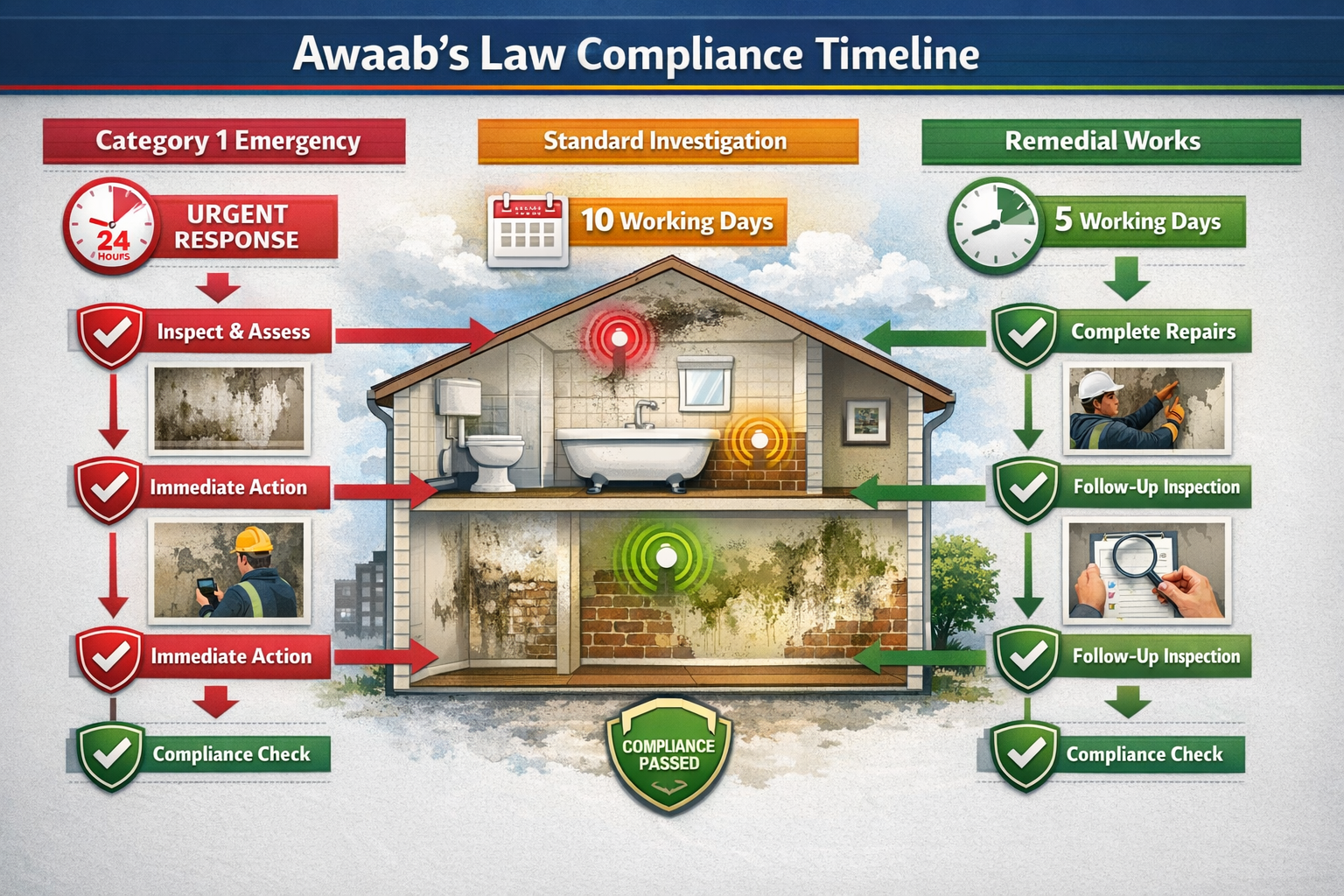
Category 1 emergencies demand both investigation and remedial work within 24 hours, or tenants must be rehoused if the hazard cannot be immediately controlled.[4] For building surveyors, this creates a critical assessment obligation:
Category 1 Hazard Indicators:
- 🚨 Severe mould growth covering large surface areas
- 💧 Active water ingress causing immediate structural damage
- 🌡️ Complete heating system failure in winter months
- ⚡ Electrical hazards combined with moisture presence
When conducting building surveys, surveyors must explicitly flag potential Category 1 hazards using clear visual markers in reports. The RAG (Red-Amber-Green) status system provides an effective classification framework:
| RAG Status | Response Timeline | Survey Documentation Required |
|---|---|---|
| 🔴 Red | 24 hours (Category 1) | Immediate notification to landlord, photographic evidence, emergency contractor contact details |
| 🟠 Amber | 10 working days investigation | Detailed moisture readings, extent mapping, ventilation assessment |
| 🟢 Green | Standard maintenance | Routine monitoring recommendations, preventive measures |
Standard Investigation Timeline: 10 Working Days
For non-emergency damp and mould complaints, landlords must complete investigations within 10 working days of tenant notification.[4] This compressed timeline requires surveyors to provide actionable intelligence that enables rapid decision-making.
Essential Survey Elements for 10-Day Compliance:
- Moisture Source Identification: Distinguish between condensation, penetrating damp, and rising damp using calibrated moisture meters
- Extent Mapping: Document affected areas with measurements and photographs linked to floor plans
- Ventilation Assessment: Evaluate existing ventilation provision against Building Regulations requirements
- Structural Causation Analysis: Identify building defects contributing to moisture accumulation (failed DPC, roof leaks, defective guttering)
Surveyors conducting damp surveys must structure reports to enable landlords to immediately commission specialist contractors with clear scopes of work, avoiding delays that breach the 10-day investigation window.
Remedial Works Timeline: 5 Working Days
For serious cases identified during investigation, landlords must begin remedial works or implement temporary safety measures within 5 working days.[4] This requirement fundamentally changes how building survey recommendations are structured.
Traditional Survey Approach:
"Recommend further investigation by specialist contractor"
2026 Compliant Approach:
"Category 1 hazard identified. Immediate actions required within 24 hours: [specific remedial steps]. Specialist contractor briefing document attached. Estimated completion timeline: [specific dates]."
The shift from advisory to prescriptive recommendations reflects the legal obligations now imposed on landlords. Surveyors who provide vague guidance expose their clients to enforcement action and potential Ombudsman complaints.
Contractor Engagement Requirements
Surveyors and damp specialists must be briefed on strict Awaab's Law timelines, understanding both the 24-hour emergency response requirement and the 10-day investigation limit.[2] This necessitates:
- Pre-qualified contractor databases with verified response capabilities
- Emergency contact protocols for out-of-hours Category 1 hazards
- Standardized briefing documents that communicate timeline obligations
- Digital work order systems that create compliance audit trails
When selecting building surveyor services, landlords should verify that firms have established contractor networks capable of meeting Awaab's Law response timelines.
Integrating Decent Homes Standard Requirements into Building Survey Protocols for PRS Database Compliance
The extension of the Decent Homes Standard (DHS) from social housing to the Private Rented Sector creates a statutory minimum quality threshold that building surveys must explicitly assess.[2] Previously, DHS compliance was voluntary for private landlords; in 2026, it becomes a legal requirement with enforcement consequences.
The Four Core DHS Criteria
Every rental property must meet these minimum standards:
1. Category 1 Hazards (HHSRS)
The property must be free from serious hazards as defined by the Housing Health and Safety Rating System. This overlaps with Awaab's Law requirements but extends beyond damp and mould to include:
- Excess cold (inadequate heating and insulation)
- Falls on stairs and level surfaces
- Fire safety deficiencies
- Electrical hazards
- Food safety issues
2. Reasonable State of Repair
Building elements must be in reasonable repair, considering age, character, and prospective life. Key assessment areas include:
- External walls, roof structure, and coverings
- Windows and external doors
- Chimneys, guttering, and downpipes
- Internal walls, floors, and ceilings
- Kitchen and bathroom fixtures
3. Reasonably Modern Facilities
Properties must provide:
- Kitchen with adequate space and layout (less than 20 years old)
- Kitchen with adequate facilities for food preparation, cooking, and storage
- Bathroom with bath or shower, wash basin, and WC (less than 30 years old)
- Appropriate heating and hot water provision
4. Thermal Comfort
Efficient heating and effective insulation must be present. This criterion increasingly aligns with Energy Performance Certificate (EPC) requirements, with expectations that rental properties will need minimum EPC ratings (currently EPC E, moving toward EPC C in future years).
Survey Protocol Modifications for DHS Compliance
Traditional building survey methodologies must be enhanced to explicitly address each DHS criterion:
Enhanced Survey Checklist:
✅ HHSRS Assessment Module
- Systematic evaluation of all 29 hazard categories
- Scoring methodology to determine Category 1 vs Category 2 classification
- Photographic evidence of identified hazards
- Remedial cost estimates for hazard elimination
✅ Repair Standard Documentation
- Element-by-element condition assessment using standardized terminology
- Remaining useful life estimates for major components
- Prioritized repair schedules with cost ranges
- Comparison against "reasonable repair" benchmarks for property age/type
✅ Facilities Age Verification
- Kitchen installation date verification (target: less than 20 years)
- Bathroom installation date verification (target: less than 30 years)
- Photographic documentation of existing facilities
- Upgrade recommendations where age limits exceeded
✅ Thermal Performance Evaluation
- Heating system capacity assessment (adequate for property size)
- Insulation presence verification (loft, cavity wall, floor)
- EPC rating confirmation and improvement pathway
- Energy efficiency recommendations with payback calculations
Digital Documentation Requirements
The "golden thread" principle from the Building Safety Act now extends to rental property compliance.[4] Building surveys must create connected digital records that:
- Link inspection findings to specific property locations (GPS-tagged)
- Associate photographic evidence with hazard classifications
- Track remedial work completion against original survey recommendations
- Enable compliance verification for PRS Database submissions
Surveyors should implement digital field capture systems that enable real-time data entry, eliminating transcription errors and accelerating report delivery. Modern survey design incorporates mobile applications that guide inspectors through standardized checklists while automatically generating compliance documentation.
Evidence-Led Maintenance Documentation and Digital Field Capture Standards
The regulatory framework introduced in 2026 demands a fundamental shift from reactive maintenance to evidence-led property management.[4] Building surveys are no longer isolated assessments but become foundational documents in ongoing compliance monitoring systems.
Digital Field Capture Requirements
Modern building survey protocols must enable field teams to log comprehensive details directly into digital forms during property inspections:
Mandatory Data Capture Elements:
📍 Location Tagging
- GPS coordinates for property location
- Room-by-room location coding
- Elevation/floor level identification
- Specific building element identification (e.g., "North-facing bedroom, external wall, upper section")
🏷️ Issue Type Classification
- Standardized hazard taxonomy (aligned with HHSRS categories)
- Awaab's Law specific tags (damp, mould, condensation)
- DHS criterion mapping (repair, facilities, thermal comfort)
- Defect severity scoring
🎨 RAG Status Assignment
- Red: Category 1 hazards requiring 24-hour response
- Amber: Serious issues requiring 10-day investigation
- Green: Minor defects for routine maintenance scheduling
👷 Contractor Assignment
- Responsible trade identification (plumber, electrician, damp specialist)
- Estimated response timeline
- Pre-qualified contractor selection from approved database
- Work order generation capability
📸 Photographic and Video Evidence
- High-resolution images with embedded metadata (date, time, location)
- Annotated photographs highlighting specific defects
- Before/after comparison capability for remedial works tracking
- Video walkthroughs for complex issues
Real-Time Sensor Integration
Level 3 building surveys increasingly incorporate real-time sensors to detect Awaab's Law hazards proactively before mandatory compliance requirements create enforcement actions.[3] Advanced survey protocols now include:
Sensor Technology Applications:
🌡️ Temperature and Humidity Monitoring
- Continuous measurement of indoor conditions
- Condensation risk assessment through dew point calculations
- Seasonal variation tracking
- Heating system performance verification
💧 Moisture Detection Systems
- Non-invasive moisture mapping using infrared thermography
- Embedded moisture sensors for hidden cavity detection
- Alert thresholds triggering automatic notifications
- Trend analysis identifying deteriorating conditions
🌬️ Ventilation Performance Measurement
- Air change rate quantification
- Extract fan effectiveness testing
- Natural ventilation adequacy assessment
- Indoor air quality monitoring (CO₂, VOCs)
This sensor-enhanced approach transforms building surveys from point-in-time assessments to continuous monitoring systems that provide early warning of developing hazards. For landlords managing multiple properties, centralized dashboards can aggregate sensor data across portfolios, enabling proactive maintenance scheduling before tenant complaints arise.
Creating Compliance Audit Trails
The linked requirements of PRS Database registration, Ombudsman membership, and Awaab's Law compliance create a need for comprehensive audit trails that demonstrate regulatory adherence.[4] Building survey documentation must support this by:
Audit Trail Components:
- Initial Condition Assessment: Baseline building survey establishing property condition at acquisition or tenancy commencement
- Periodic Inspection Records: Scheduled inspections documenting ongoing condition (recommended annually minimum)
- Tenant Complaint Logs: Documented responses to maintenance requests with investigation timelines
- Remedial Work Orders: Contractor instructions, completion certificates, and photographic evidence
- Compliance Verification: Updated assessments confirming hazard elimination and DHS standard achievement
This connected documentation approach mirrors the regulatory expectations established for social housing and provides defensible evidence in Ombudsman disputes or enforcement proceedings.
Software Platform Selection Criteria
Landlords and surveyors should evaluate digital field capture platforms against these essential capabilities:
| Feature | Compliance Benefit | Implementation Priority |
|---|---|---|
| Mobile offline capability | Field data capture in properties with poor connectivity | 🔴 Critical |
| Automated RAG status assignment | Consistent hazard classification across inspectors | 🔴 Critical |
| Photographic evidence linking | Visual proof connected to specific defects | 🔴 Critical |
| Contractor database integration | Rapid response mobilization for Awaab's Law timelines | 🟠 High |
| PRS Database export functionality | Streamlined compliance documentation submission | 🟠 High |
| Sensor data integration | Proactive hazard detection and trend analysis | 🟢 Medium |
| Portfolio dashboard reporting | Multi-property compliance monitoring | 🟢 Medium |
Investing in appropriate technology infrastructure enables surveyors to deliver property inspection services that meet 2026 regulatory expectations while improving operational efficiency.
Rental Valuation Adjustments for Compliance Status
Building Survey Protocols for PRS Database Compliance fundamentally alter rental valuation methodologies. Properties with unresolved compliance issues face material value impairments that must be reflected in professional valuations.
Compliance Risk Factors Affecting Rental Value
Immediate Value Impairments:
❌ No PRS Database Registration: Property cannot be legally let; rental value = £0 until registration completed
❌ Category 1 Hazards Present: Immediate remediation costs reduce net rental yield
❌ DHS Non-Compliance: Enforcement action risk creates uncertainty premium
❌ Missing Compliance Certificates: EPC, Gas Safety, or EICR deficiencies block database registration
Moderate Value Adjustments:
⚠️ Amber RAG Status Issues: Remediation costs within 10-day timeline reduce short-term returns
⚠️ Aging Facilities: Kitchen/bathroom approaching DHS age limits require planned capital expenditure
⚠️ Suboptimal EPC Rating: Properties below EPC C face future compliance costs as standards tighten
Positive Value Factors:
✅ Full Compliance Documentation: Premium positioning in competitive rental market
✅ Sensor-Enhanced Monitoring: Reduced maintenance costs and tenant complaint frequency
✅ Recent DHS Upgrades: Extended capital expenditure cycle and tenant appeal
Valuation Report Compliance Sections
Rental valuations conducted in 2026 should include dedicated compliance assessment sections:
Recommended Report Structure:
Section 1: PRS Database Compliance Status
- Current registration verification
- Unique property identifier confirmation
- Ombudsman membership verification
- Compliance certificate currency review
Section 2: Awaab's Law Hazard Assessment
- Category 1 hazard screening results
- Damp and mould risk evaluation
- Emergency response capability assessment
- Remediation cost estimates
Section 3: Decent Homes Standard Evaluation
- HHSRS assessment summary
- Repair standard compliance confirmation
- Facilities age verification
- Thermal comfort performance rating
Section 4: Compliance-Adjusted Valuation
- Market rental value (fully compliant property)
- Compliance cost deductions (remediation required)
- Timeline adjustments (registration/repair delays)
- Net rental value conclusion
This structured approach ensures that rental valuations reflect the true economic position of properties in the 2026 regulatory environment, protecting purchasers and lenders from compliance-related value erosion.
Practical Implementation: Step-by-Step Survey Protocol
Building Survey Protocols for PRS Database Compliance require systematic implementation across property acquisition, ongoing management, and disposition phases.
Phase 1: Pre-Acquisition Due Diligence
Step 1: Commission Enhanced Building Survey
Engage surveyors with demonstrated expertise in building evaluation that explicitly includes:
- Awaab's Law hazard screening
- DHS compliance assessment
- PRS Database readiness review
- Compliance cost estimation
Step 2: Review Existing Documentation
Obtain and verify:
- Current EPC with rating confirmation
- Valid Gas Safety Certificate (annual requirement)
- EICR within required validity period (5 years maximum)
- Previous tenant complaint records
- Maintenance history documentation
Step 3: Assess Compliance Gap
Calculate total cost to achieve full compliance:
- Category 1 hazard remediation
- DHS standard upgrades (kitchen, bathroom, heating)
- Missing certificate procurement
- PRS Database registration fees
Step 4: Adjust Offer Price
Reflect compliance costs in purchase negotiations, recognizing that non-compliant properties carry material value impairments until remediation completed.
Phase 2: Property Onboarding and Registration
Step 5: Complete Remedial Works
Address all identified compliance gaps before tenant placement:
- Eliminate Category 1 hazards
- Upgrade substandard facilities
- Install/repair heating and insulation systems
- Obtain all required certificates
Step 6: Register on PRS Database
Submit required documentation:
- Landlord identity and contact details
- Property address and classification
- Compliance certificate references
- Letting agent information (if applicable)
Step 7: Register with Ombudsman Scheme
Complete linked registration and pay annual fee per property.
Step 8: Implement Monitoring Systems
Install sensor technology where beneficial:
- Temperature and humidity monitors in high-risk areas
- Moisture detection in historically problematic locations
- Automated alert systems for threshold breaches
Phase 3: Ongoing Compliance Maintenance
Step 9: Schedule Annual Inspections
Commission periodic building surveys to:
- Verify continued DHS compliance
- Identify emerging hazards before tenant complaints
- Update compliance documentation
- Plan preventive maintenance
Step 10: Respond to Tenant Complaints
Implement Awaab's Law timeline protocols:
- Acknowledge complaints within 24 hours
- Categorize hazard severity (Red/Amber/Green)
- Commission investigations within 10 working days
- Begin remedial works within 5 working days (serious cases)
Step 11: Maintain Digital Audit Trail
Document all compliance activities:
- Inspection reports with photographic evidence
- Contractor work orders and completion certificates
- Tenant communication records
- Certificate renewal documentation
Step 12: Update PRS Database
Submit updated compliance documentation as certificates renewed or remedial works completed.
Phase 4: Disposition and Transfer
Step 13: Prepare Compliance Package
Assemble comprehensive documentation for prospective purchasers:
- Complete building survey history
- All compliance certificates (current)
- PRS Database registration confirmation
- Maintenance and repair records
- Sensor data history (if applicable)
Step 14: Market Compliance Premium
Highlight full compliance status in marketing materials, positioning property as turnkey investment with minimal regulatory risk.
This systematic approach ensures that Building Survey Protocols for PRS Database Compliance are embedded throughout the property lifecycle, maximizing value and minimizing enforcement risk.
Professional Surveyor Selection and Engagement
The specialized requirements of 2026 compliance demand careful surveyor selection. Not all building survey providers have adapted their methodologies to address Awaab's Law timelines, DHS standards, and PRS Database requirements.
Essential Surveyor Qualifications
When engaging professional surveyor services, verify:
Technical Competencies:
- ✅ RICS membership (Chartered Surveyor status)
- ✅ Demonstrated HHSRS assessment experience
- ✅ Damp and mould investigation expertise
- ✅ Thermal performance evaluation capability
- ✅ Digital field capture system utilization
Regulatory Knowledge:
- ✅ Current understanding of Awaab's Law timelines
- ✅ Decent Homes Standard assessment methodology
- ✅ PRS Database registration requirements
- ✅ Renters' Rights Act implications
- ✅ Ombudsman dispute resolution processes
Operational Capabilities:
- ✅ Rapid turnaround for emergency assessments (24-hour capability)
- ✅ Contractor network for remediation mobilization
- ✅ Digital reporting with compliance-ready documentation
- ✅ Portfolio management services for multi-property landlords
Survey Scope Definition
Clearly define survey scope in engagement terms:
Minimum Scope for 2026 Compliance:
- Full structural survey (Level 3 equivalent)
- HHSRS assessment covering all 29 hazard categories
- Awaab's Law specific damp and mould evaluation
- DHS compliance verification against four core criteria
- Thermal performance assessment and EPC review
- Compliance certificate verification (EPC, Gas, EICR)
- PRS Database readiness assessment
- Remediation cost estimates with contractor recommendations
- RAG status hazard classification
- Digital report with photographic evidence and GPS tagging
Understanding Survey Limitations
Even comprehensive building surveys have inherent limitations that must be understood:
Standard Exclusions:
- Non-visible defects (concealed within walls, floors, under fixtures)
- Areas not accessible without specialist equipment
- Services testing beyond visual inspection (full electrical testing requires separate EICR)
- Asbestos identification (requires separate specialist survey)
- Environmental contamination assessment
Surveyors should clearly document these limitations in reports, recommending additional specialist investigations where indicated. For properties with suspected hidden defects, consider commissioning supplementary monitoring surveys to track developing issues over time.
Cost Considerations and Value Delivery
Building Survey Protocols for PRS Database Compliance represent more comprehensive assessments than traditional surveys, typically commanding premium fees. However, the value delivered far exceeds incremental cost:
Cost-Benefit Analysis:
Traditional Survey Cost: £500-£800
Enhanced Compliance Survey Cost: £800-£1,200
Incremental Investment: £300-£400
Potential Savings from Enhanced Survey:
- Avoided enforcement penalties: £5,000-£30,000
- Early hazard detection preventing emergency repairs: £2,000-£10,000
- Accurate purchase price negotiations: £5,000-£20,000
- Reduced tenant disputes and Ombudsman complaints: £1,000-£5,000
- Accelerated PRS Database registration (avoiding letting delays): £1,000-£3,000
The return on investment for comprehensive compliance-focused surveys typically exceeds 10:1, making them essential rather than optional in the 2026 regulatory environment.
Conclusion
Building Survey Protocols for PRS Database Compliance represent the new standard for professional property assessment in the UK rental market. The convergence of Awaab's Law emergency response requirements, mandatory PRS Database registration, linked Ombudsman membership, and extended Decent Homes Standard creates an unprecedented compliance framework that fundamentally alters rental property valuation and management.
Landlords, surveyors, and letting agents who adapt their practices to this new reality will gain competitive advantages through reduced enforcement risk, accelerated tenant placement, and premium positioning in an increasingly quality-conscious market. Those who continue with outdated reactive maintenance approaches face material financial penalties, legal restrictions on possession proceedings, and value erosion as compliance gaps compound.
The practical implementation pathway is clear:
🎯 Immediate Actions:
- Commission enhanced building surveys incorporating Awaab's Law, DHS, and PRS Database assessments
- Register all rental properties on PRS Database and Ombudsman Scheme
- Remediate identified Category 1 hazards within statutory timelines
- Implement digital field capture systems for evidence-led maintenance
🎯 Ongoing Commitments:
- Schedule annual compliance inspections to identify emerging hazards
- Maintain comprehensive audit trails linking inspections, complaints, and remedial works
- Update PRS Database documentation as certificates renewed
- Invest in sensor technology for proactive hazard detection in high-risk properties
🎯 Strategic Positioning:
- Market full compliance status as premium differentiator
- Build relationships with surveyors and contractors capable of meeting emergency timelines
- Develop portfolio-wide compliance monitoring dashboards
- Integrate compliance costs into acquisition underwriting and rental pricing
The 2026 regulatory environment rewards professionalism, transparency, and proactive property management. By embedding Building Survey Protocols for PRS Database Compliance into standard operating procedures, property professionals can navigate this complex landscape with confidence, protecting tenant welfare while optimizing investment returns.
For landlords seeking expert guidance on compliance-focused building assessments, partnering with experienced building surveyor services ensures access to the specialized expertise required in this transformed regulatory environment. The investment in professional survey protocols delivers measurable returns through reduced risk, enhanced property values, and sustainable rental business models built on quality and compliance.
References
[1] Party Wall Implications Of Renters Rights Act 2026 Survey Protocols For Prs Database And Section 8 Notice Compliance – https://nottinghillsurveyors.com/blog/party-wall-implications-of-renters-rights-act-2026-survey-protocols-for-prs-database-and-section-8-notice-compliance
[2] Part 2 – https://www.augustapp.com/renters-rights/part-2
[3] Real Time Sensors In Level 3 Building Surveys Detecting Awaabs Law Hazards Before 2026 Mandates Hit Rentals – https://nottinghillsurveyors.com/blog/real-time-sensors-in-level-3-building-surveys-detecting-awaabs-law-hazards-before-2026-mandates-hit-rentals
[4] How Digital Tools Help Social Landlords Meet Awaabs Law – https://www.trimble.com/blog/construction/en-US/article/how-digital-tools-help-social-landlords-meet-awaabs-law
[5] Renters Rights Act 2026 Building Survey Checklists For Section 8 Evictions And Ombudsman Disputes – https://nottinghillsurveyors.com/blog/renters-rights-act-2026-building-survey-checklists-for-section-8-evictions-and-ombudsman-disputes









