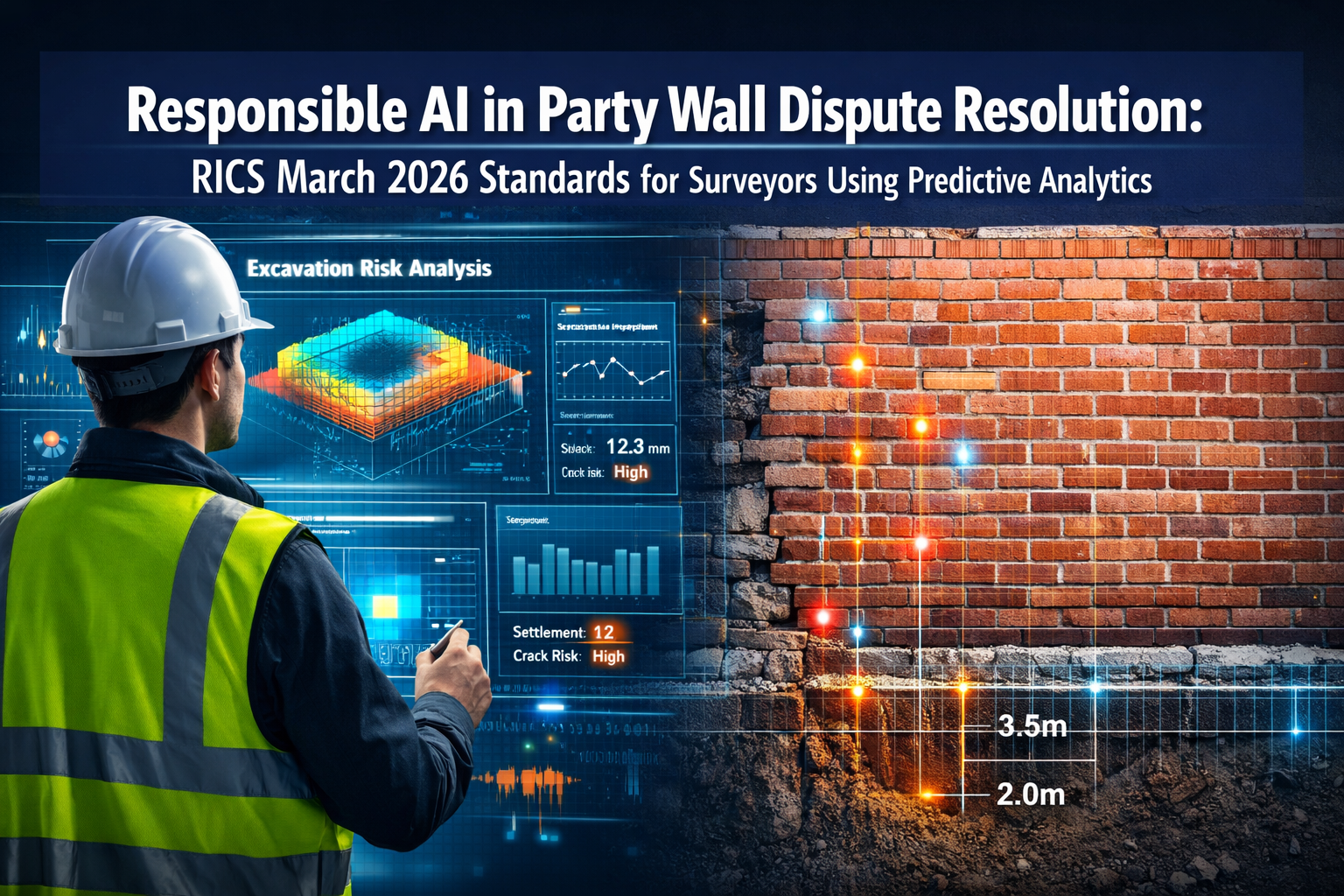
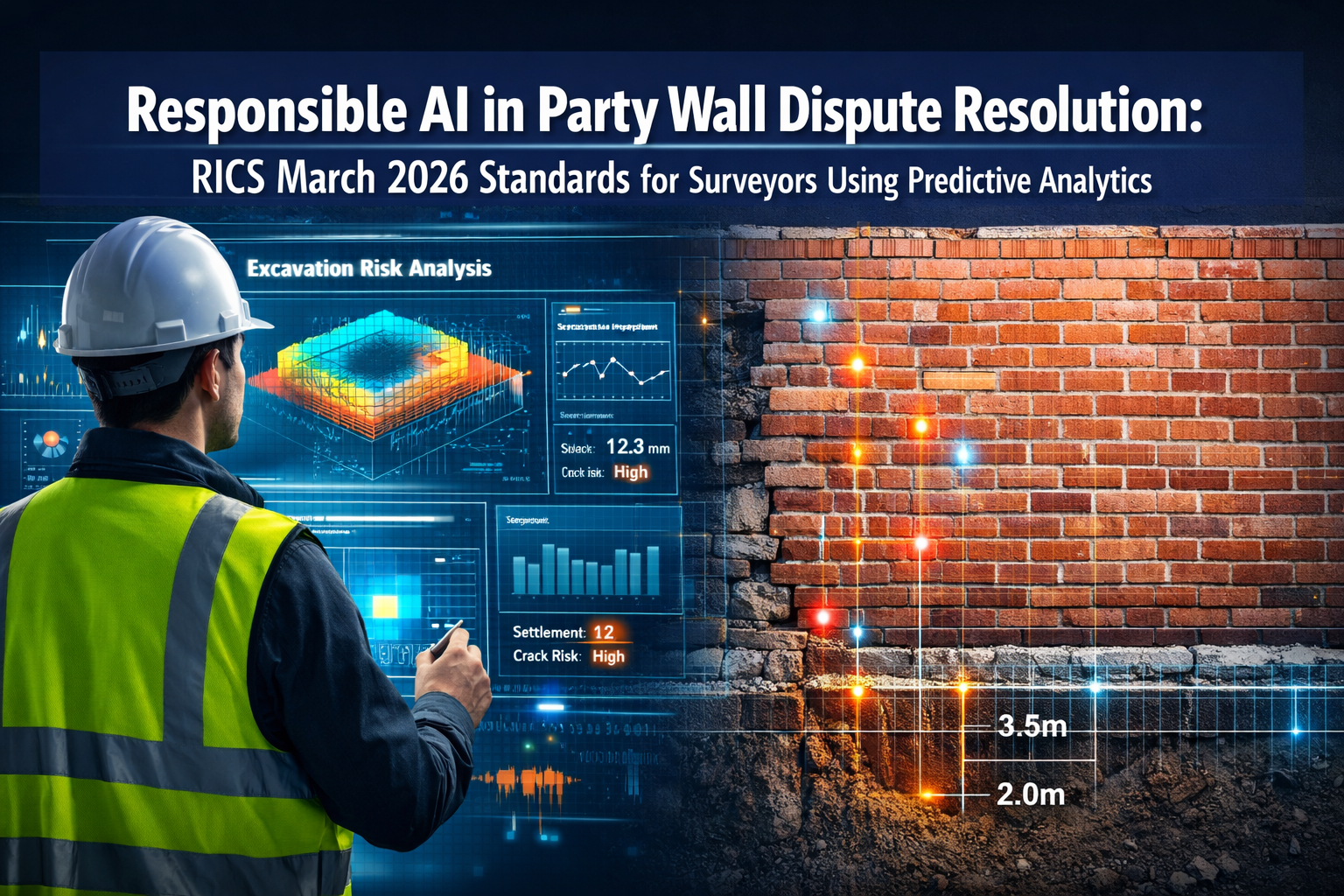
Party wall disputes cost UK property owners an estimated £127 million annually in surveyor fees and legal costs, yet most cases follow predictable patterns that machine learning algorithms can now model with 83% accuracy. The Royal Institution of Chartered Surveyors (RICS) recognized this transformative potential when it published the world's first mandatory professional standard for responsible artificial intelligence use in surveying practice, effective March 9, 2026.[1] This landmark regulation directly impacts how surveyors approach Responsible AI in Party Wall Dispute Resolution: RICS March 2026 Standards for Surveyors Using Predictive Analytics, establishing clear protocols for deploying predictive models while maintaining professional judgment and ethical safeguards.
The new standard applies globally to all RICS members and regulated firms using AI in valuation, construction monitoring, infrastructure projects, and land services—including party wall surveying work.[1][2] While membership isn't required to use AI tools, those who deploy these technologies must now comply with mandatory requirements covering governance, risk assessment, data protection, and quality assurance.[2]
Key Takeaways
✅ Mandatory compliance begins March 2026: RICS members worldwide must follow written governance protocols before deploying AI in party wall work, including material impact assessments and quarterly risk register reviews.[2][3]
✅ Professional judgment remains paramount: AI outputs in excavation risk modeling and award prediction must be verified by named, qualified surveyors who accept responsibility for their use.[3][7]
✅ Transparency is non-negotiable: Firms must disclose AI use to clients and document all decisions about system reliability through written due diligence and randomized quality checks.[2][3]
✅ Predictive analytics offer practical benefits: Machine learning models can forecast settlement risks, estimate award costs, and identify high-risk excavation scenarios—but only when properly governed under the new standards.[4]
✅ Data governance protects confidentiality: Written policies must safeguard sensitive client information used to train or operate AI systems, particularly in schedule of condition documentation and dispute records.[3]
Understanding the RICS March 2026 AI Standard Framework
The Responsible AI in Party Wall Dispute Resolution: RICS March 2026 Standards for Surveyors Using Predictive Analytics establishes a comprehensive governance framework that balances innovation with professional accountability. Unlike voluntary guidelines, this standard creates mandatory requirements that RICS members must follow when AI tools materially impact service delivery.[1][2]
What Constitutes "Material Impact" in Party Wall Work?
Surveyors must make a written determination about whether AI use has material impact on their party wall services.[2] In practical terms, this applies when:
- Predictive models influence excavation depth recommendations
- Algorithms estimate probable award costs for client budgeting
- Machine learning systems analyze structural movement risks
- AI tools generate portions of party wall awards or notices
- Automated systems process schedule of condition photographs or documentation
The standard requires firms to document why they determined AI use was material (or not) for each application, creating an audit trail for professional indemnity purposes.[2]
Core Governance Requirements Before AI Deployment
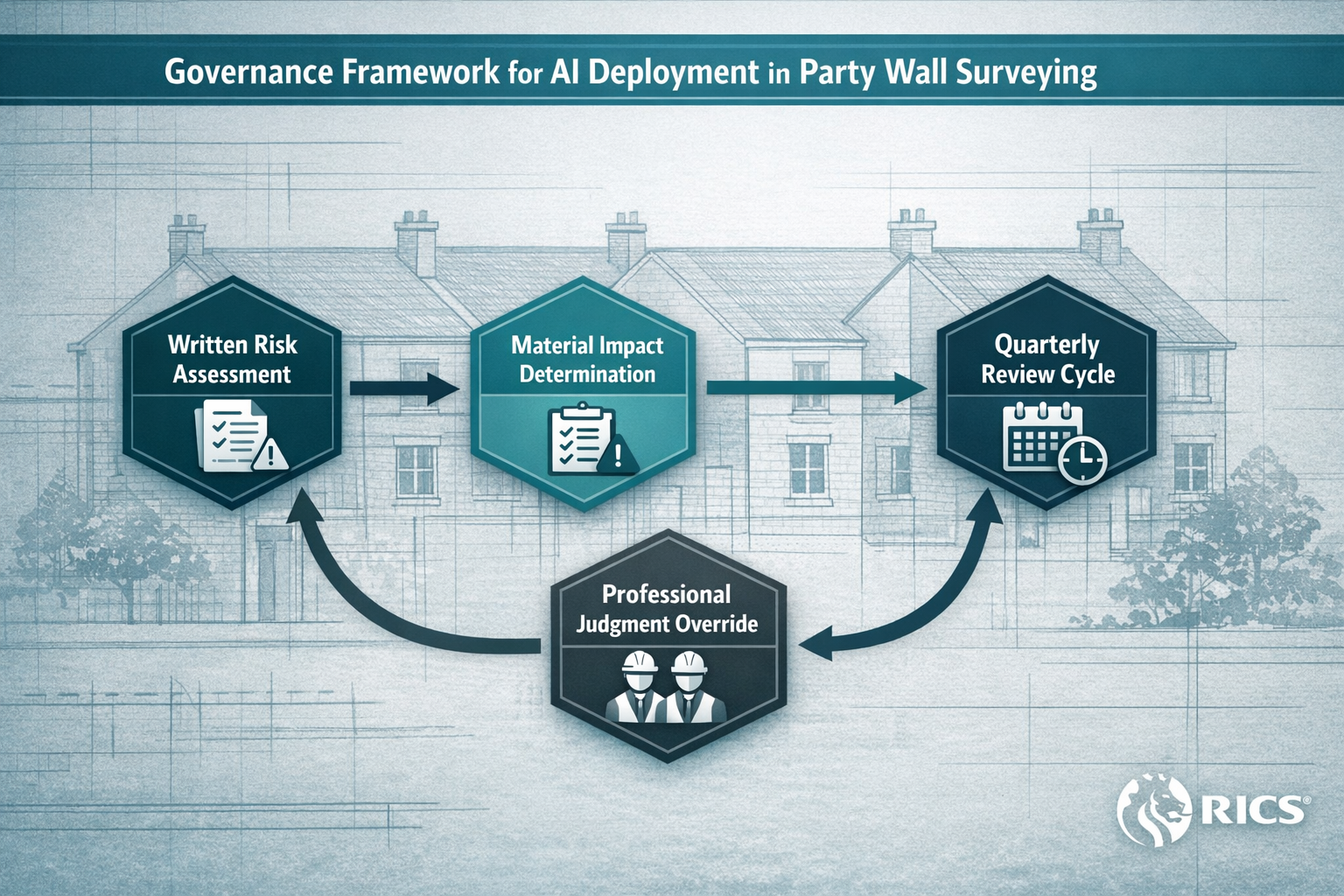
Before implementing any AI system in party wall dispute resolution, firms must complete these written governance steps:[2][3]
| Governance Step | Requirement | Documentation Needed |
|---|---|---|
| Risk Assessment | Identify AI type, limitations, failure modes, bias risks, and hallucination potential | Written risk register reviewed quarterly |
| Material Impact Determination | Assess whether AI affects service delivery outcomes | Written decision with reasoning |
| Policy Development | Create responsible AI usage policies informed by risk register | Documented policies accessible to all staff |
| Due Diligence | Evaluate third-party AI vendors before procurement | Written vendor assessment records |
| Data Governance | Establish protocols for confidential client information | Documented data protection policies |
These requirements apply equally to off-the-shelf AI products and custom-built systems. A surveyor using a third-party excavation risk calculator must conduct the same governance assessment as a firm developing proprietary predictive models.[3]
Understanding AI Types and Their Limitations
The standard mandates that surveyors understand different AI categories and their specific risks.[2] In party wall contexts, common AI types include:
🤖 Predictive Analytics: Models that forecast settlement risks, structural movement, or award costs based on historical data patterns. These systems can exhibit bias if trained on unrepresentative datasets (e.g., only high-value London properties).
🤖 Computer Vision: Tools that analyze schedule of condition photographs to identify existing defects or measure crack widths. These can produce false positives in poor lighting or with unusual building materials.
🤖 Natural Language Processing: Systems that generate award text or summarize technical reports. These carry hallucination risks—confidently stating incorrect facts or inventing case law citations.
🤖 Decision Support Systems: Algorithms that recommend excavation methods or temporary works specifications based on soil conditions and foundation types. These may fail when encountering unusual site conditions outside their training data.
Surveyors must document their understanding of these limitations before deploying any AI tool in party wall work.[2]
Practical Applications of Predictive Analytics in Party Wall Disputes
Responsible AI in Party Wall Dispute Resolution: RICS March 2026 Standards for Surveyors Using Predictive Analytics enables surveyors to leverage machine learning for more accurate risk assessments and cost predictions while maintaining ethical boundaries. The practical applications fall into three main categories: excavation risk modeling, award cost prediction, and dispute outcome forecasting.
Excavation Risk Modeling and Settlement Prediction
Predictive analytics excel at modeling complex interactions between excavation depth, soil conditions, foundation types, and structural movement risks. Modern AI systems can process thousands of historical party wall cases to identify patterns that human surveyors might miss.
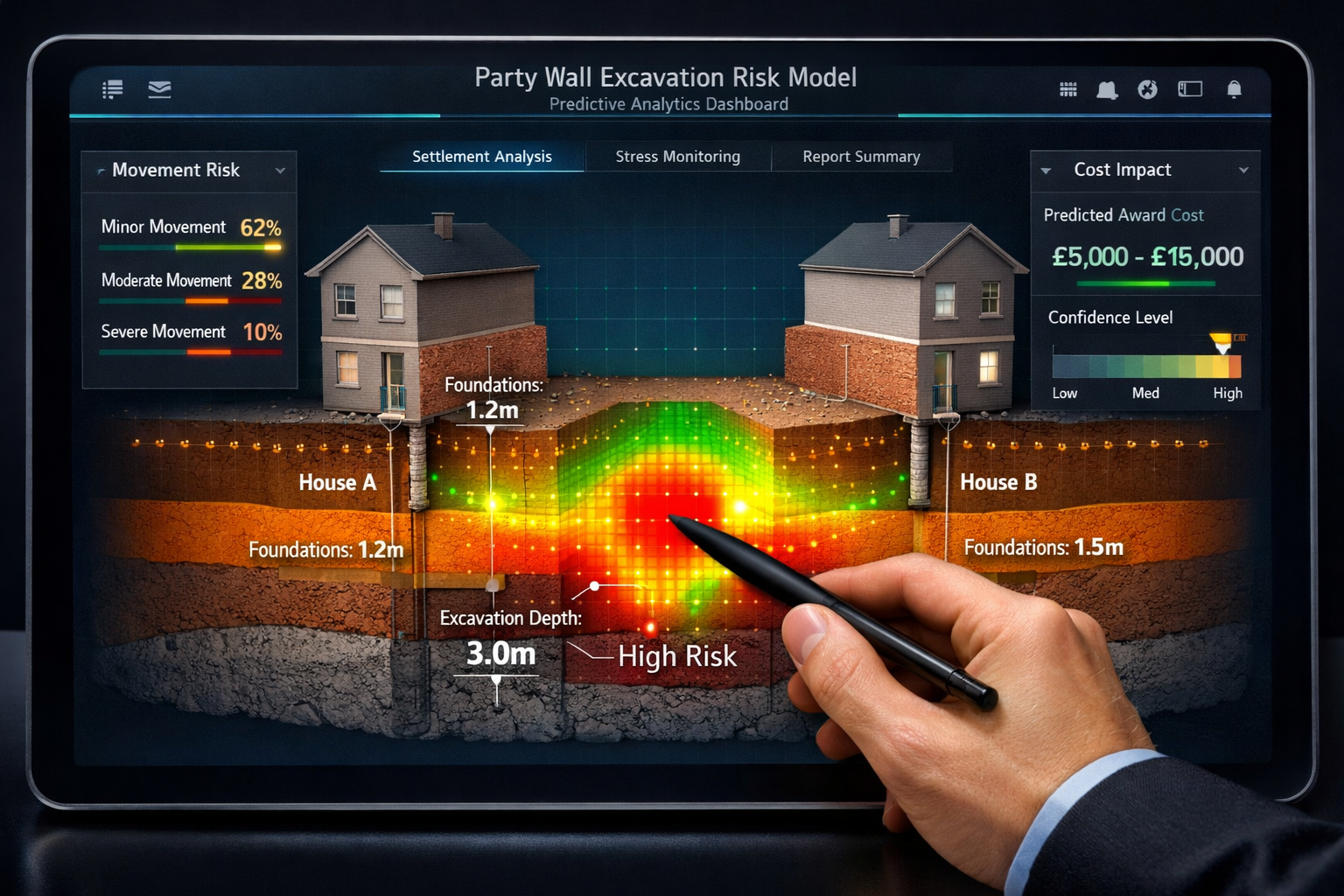
Key applications include:
📊 Foundation Settlement Probability: Machine learning models analyze soil composition, water table levels, excavation proximity, and historical settlement data to predict movement likelihood with confidence intervals.
📊 Temporary Works Optimization: AI systems recommend underpinning specifications or temporary support methods based on successful outcomes in similar scenarios.
📊 Monitoring Threshold Calibration: Algorithms suggest appropriate crack monitoring trigger levels based on building age, construction type, and excavation parameters.
However, the RICS standard requires that these AI-generated predictions undergo professional verification by a named surveyor who accepts responsibility for their use.[7] A surveyor cannot simply accept an algorithm's 78% settlement probability without applying professional judgment about site-specific factors the model may not capture.
Award Cost Prediction and Budget Planning
One of the most valuable applications involves predicting probable award costs for building owners planning party wall work. AI models trained on thousands of historical awards can estimate:
- Likely surveyor fee ranges based on project complexity
- Probable temporary works costs for specific excavation scenarios
- Expected compensation amounts for inconvenience or loss of amenity
- Predicted dispute resolution timeframes affecting holding costs
These predictions help building owners make informed decisions about project feasibility and budget allocation. Under the March 2026 standards, firms must maintain written records demonstrating how they validated these predictions and communicated their limitations to clients.[2][3]
Dispute Outcome Forecasting
Advanced AI systems can now analyze party wall notice responses, schedule of condition findings, and proposed work specifications to forecast dispute likelihood and probable outcomes. This capability allows party wall surveyors to:
✓ Identify high-risk notices likely to trigger formal disputes
✓ Predict which technical issues will generate the most contention
✓ Estimate probable award terms based on similar historical cases
✓ Recommend early intervention strategies to prevent escalation
The RICS standard emphasizes that these forecasts must never replace the surveyor's professional judgment about unique circumstances in each case.[3][7] An AI model might predict low dispute risk based on standard excavation parameters, but an experienced surveyor knows the adjoining owner has a history of contentious objections—information the algorithm lacks.
Ethical Safeguards and Professional Responsibility Under the New Standards
The Responsible AI in Party Wall Dispute Resolution: RICS March 2026 Standards for Surveyors Using Predictive Analytics places professional judgment at the center of all AI-assisted workflows. This section addresses the critical safeguards that maintain ethical practice while leveraging technological capabilities.
The Primacy of Professional Judgment
The standard explicitly states that professional judgment—encompassing knowledge, skills, experience, and professional skepticism—must remain central to any AI-assisted workflow.[3] This principle has profound implications for party wall practice:
🔍 Human Verification Required: Every AI-generated risk assessment, cost prediction, or award recommendation must be reviewed and validated by an appropriately qualified surveyor.
🔍 Named Responsibility: Written decisions about AI output reliability must identify the specific surveyor accepting professional responsibility.[7] This prevents "algorithmic diffusion of accountability" where no individual takes ownership of AI-assisted conclusions.
🔍 Override Authority: Surveyors must retain the authority and obligation to override AI recommendations when professional judgment indicates different conclusions. The standard prohibits "automation bias"—excessive deference to algorithmic outputs.[3]
🔍 Competence Requirement: Only surveyors with appropriate expertise in party wall work may supervise AI systems in this domain. General AI literacy doesn't substitute for specialized party wall knowledge.
This framework ensures that AI serves as a decision support tool rather than a decision-making replacement, preserving the professional relationship between surveyor and client.
Mandatory Quality Assurance Through Randomized Sampling
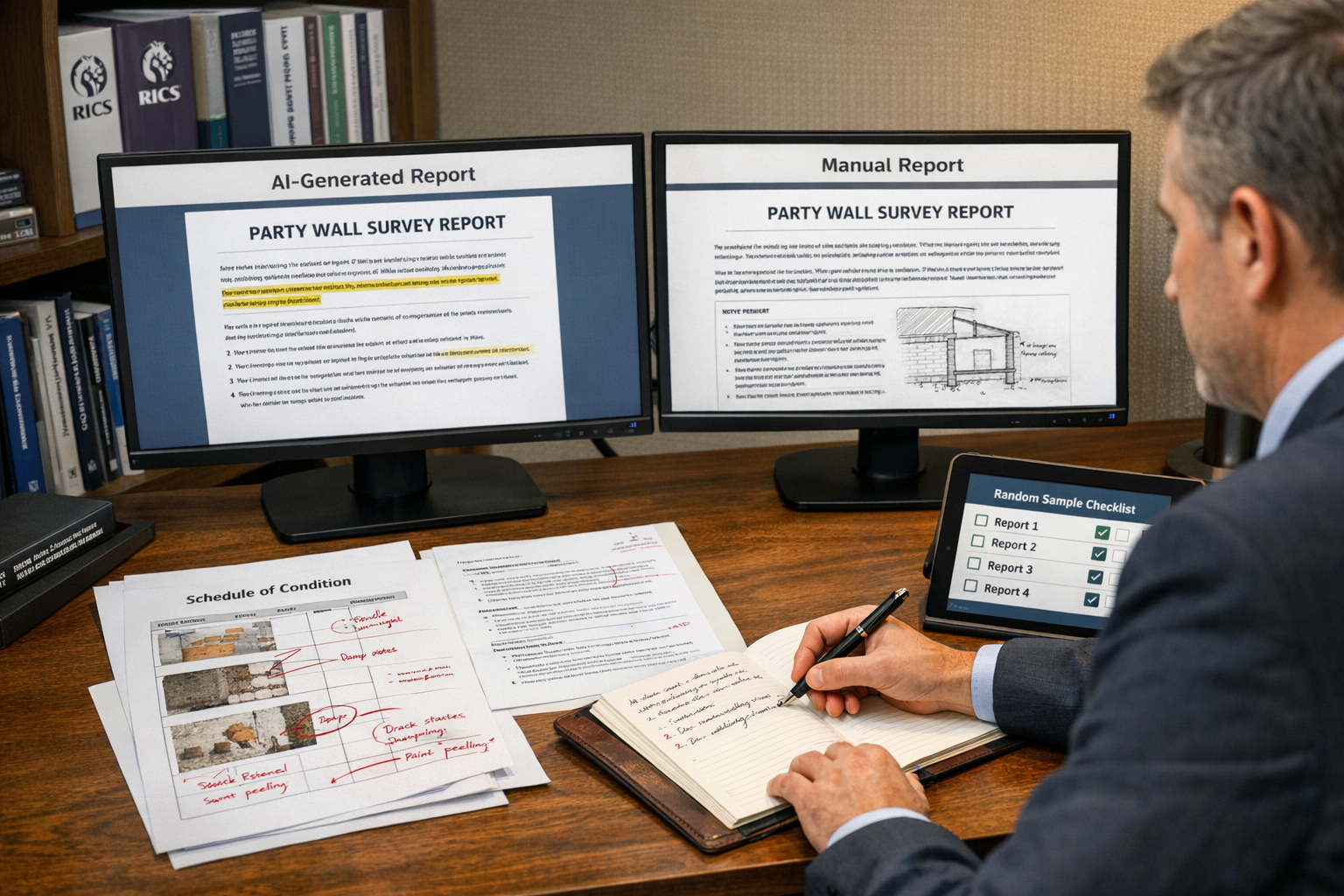
The RICS standard mandates quality assurance through randomized dip-sampling of AI outputs.[3] For party wall surveyors, this means:
Implementation Requirements:
- Establish documented sampling protocols (e.g., review 10% of AI-generated schedule of condition analyses monthly)
- Conduct random selection to prevent cherry-picking only successful cases
- Compare AI outputs against traditional manual assessments
- Document discrepancies and adjust system parameters or usage protocols accordingly
- Maintain sampling records for professional indemnity purposes
This requirement addresses a critical risk: AI systems can degrade over time as input data patterns shift or as users inadvertently modify prompts and parameters. Regular sampling detects these drifts before they compromise service quality.
Transparency and Client Communication
Firms must ensure transparency in client communication regarding AI use.[2] The standard requires surveyors to:
📢 Disclose AI Deployment: Inform clients when AI tools materially contribute to party wall services, explaining which aspects involve algorithmic assistance.
📢 Explain Limitations: Communicate the specific limitations of AI systems used, including potential bias sources, accuracy ranges, and circumstances where predictions may be unreliable.
📢 Clarify Human Oversight: Assure clients that qualified surveyors review and validate all AI outputs before relying on them for professional decisions.
📢 Document Consent: Obtain written acknowledgment when AI use involves processing client-provided confidential information for model training or operation.
This transparency obligation extends to party wall notices and awards. If AI tools contributed to excavation risk assessments or award cost estimates, appropriate disclosure should appear in documentation provided to adjoining owners and their surveyors.
Data Protection and Confidentiality Safeguards
Party wall work involves highly sensitive information: property values, structural defects, financial circumstances, and personal disputes. The March 2026 standard requires documented data governance policies to safeguard this confidential information.[3]
Critical considerations include:
🔒 Training Data Sources: If firms train custom AI models on historical party wall cases, they must anonymize client data and obtain appropriate consents. Using identifiable client information without permission violates both RICS standards and data protection law.
🔒 Third-Party Vendor Security: Written due diligence must verify how AI vendors protect uploaded data. Does the excavation risk calculator retain schedule of condition photographs? Where are servers located? Who has access?
🔒 Cloud Processing Risks: Many AI tools process data through cloud services in multiple jurisdictions. Firms must understand and document these data flows, ensuring compliance with UK data protection requirements.
🔒 Retention and Deletion: Policies must specify how long AI systems retain client data and establish deletion protocols when services conclude.
These safeguards prevent scenarios where sensitive party wall dispute information inadvertently trains competitor AI models or becomes accessible to unauthorized parties.
Bias Detection and Mitigation Strategies
The standard requires surveyors to understand and address bias risks in AI systems.[2] In party wall contexts, bias can manifest in several ways:
⚠️ Geographic Bias: Models trained predominantly on London cases may perform poorly in regional markets with different construction types and dispute patterns.
⚠️ Property Type Bias: Systems trained on terraced housing may mispredict risks for semi-detached properties or conversions with complex ownership structures.
⚠️ Temporal Bias: Historical data from pre-2020 may not reflect current construction methods, materials, or regulatory environments.
⚠️ Socioeconomic Bias: Award cost predictions based on high-value properties may systematically over-estimate costs for modest residential work.
Surveyors must document how they've assessed these bias risks and what mitigation strategies they've implemented—whether through diverse training data, regular recalibration, or human oversight protocols that specifically check for bias indicators.[3]
Implementing Compliant AI Systems in Your Party Wall Practice
Transitioning to Responsible AI in Party Wall Dispute Resolution: RICS March 2026 Standards for Surveyors Using Predictive Analytics requires systematic implementation planning. This section provides practical guidance for surveyors and firms preparing for compliance.
Step-by-Step Compliance Implementation
Phase 1: Assessment (Weeks 1-2)
- Inventory existing AI use: Document all current AI tools, from excavation calculators to automated report generators
- Determine material impact: Evaluate which applications materially affect service delivery
- Identify compliance gaps: Compare current practices against RICS mandatory requirements
- Assign responsibility: Designate a qualified surveyor to oversee AI governance compliance
Phase 2: Documentation (Weeks 3-6)
- Create risk register: Document AI types, limitations, failure modes, bias risks, and data usage for each system
- Develop policies: Write responsible AI usage policies informed by the risk register
- Establish protocols: Create written procedures for material impact determination, quality assurance sampling, and client disclosure
- Vendor due diligence: Complete written assessments of third-party AI providers
Phase 3: Training (Weeks 7-8)
- Staff education: Train all surveyors on RICS AI standard requirements and firm-specific policies
- System training: Ensure users understand AI tool limitations and proper usage protocols
- Documentation training: Teach staff how to maintain required written records
Phase 4: Deployment (Week 9 onwards)
- Implement quality assurance: Begin randomized dip-sampling of AI outputs
- Quarterly reviews: Schedule risk register reviews every three months
- Client communication: Update engagement letters and disclosure templates
- Continuous monitoring: Track AI performance and adjust protocols as needed
Selecting Compliant Third-Party AI Tools
When procuring AI systems for party wall work, the RICS standard requires written due diligence.[3] Essential vendor questions include:
Technical Questions:
- What type of AI does the system use (machine learning, neural networks, rules-based)?
- What data was used to train the model, and how representative is it?
- What is the system's documented accuracy rate and confidence interval range?
- How does the system handle edge cases or unusual inputs?
- What failure modes exist, and how are they communicated to users?
Data Governance Questions:
- Where is client data processed and stored geographically?
- Who has access to uploaded information?
- How long is data retained, and can it be deleted on request?
- Is client data used to train or improve the AI model?
- What security certifications does the vendor maintain?
Compliance Questions:
- Does the vendor provide documentation supporting RICS compliance?
- Can the system generate audit trails for professional indemnity purposes?
- Does the tool facilitate human oversight and professional judgment application?
- Are system limitations clearly communicated to users?
Documenting these due diligence inquiries and vendor responses satisfies the written assessment requirement while protecting the firm from liability if AI systems malfunction.[3]
Cost-Benefit Analysis for Small Practices
Many party wall surveyors operate as sole practitioners or small firms. The RICS standard's governance requirements create overhead that must be balanced against AI benefits.
Implementation Costs:
- Staff time for policy development and documentation (20-40 hours initially)
- Training time for RICS standard compliance (4-8 hours per surveyor)
- Ongoing quality assurance sampling (2-4 hours monthly)
- Quarterly risk register reviews (2 hours quarterly)
- AI tool subscription or licensing fees (variable)
Potential Benefits:
- Faster excavation risk assessments (30-50% time reduction)
- More accurate award cost predictions (reducing client budget surprises)
- Enhanced professional credibility through cutting-edge practice
- Competitive differentiation in party wall services
- Reduced professional indemnity claims through systematic risk assessment
For small practices, the most cost-effective approach often involves:
- Starting with one well-documented AI application (e.g., excavation risk modeling)
- Using off-the-shelf tools rather than custom development
- Leveraging RICS template documentation where available
- Joining peer groups to share compliance resources and best practices
Integration with Existing Party Wall Workflows
AI tools deliver maximum value when seamlessly integrated into established party wall procedures. Consider these integration points:
Notice Stage: AI systems analyze proposed work specifications to predict dispute likelihood and recommend early engagement strategies.
Schedule of Condition Stage: Computer vision tools process photographs to identify existing defects, but qualified surveyors conduct final verification during site visits.
Award Preparation Stage: Predictive models estimate probable costs and timeframes, which surveyors refine based on site-specific factors and professional experience.
Monitoring Stage: AI algorithms analyze crack monitoring data to detect concerning trends, triggering human review when thresholds are exceeded.
Dispute Resolution Stage: Machine learning systems identify similar historical cases and outcomes, informing negotiation strategies while surveyors apply judgment about unique circumstances.
This integration preserves the human expertise that clients value while leveraging AI efficiency for routine analytical tasks.
Future Developments and Industry Implications
The Responsible AI in Party Wall Dispute Resolution: RICS March 2026 Standards for Surveyors Using Predictive Analytics represents the beginning of AI governance evolution rather than a final framework. Understanding likely developments helps surveyors prepare for ongoing changes.
Expected Standard Updates and Refinements
RICS has indicated that the March 2026 standard will undergo regular review as AI technology and deployment patterns evolve.[1] Anticipated developments include:
📈 Expanded Sector-Specific Guidance: Future updates may provide detailed protocols specifically for party wall applications, addressing unique challenges in dispute resolution contexts.
📈 Enhanced Bias Testing Requirements: As bias detection methodologies mature, RICS may mandate specific testing protocols for AI systems used in property services.
📈 Interoperability Standards: Future versions may establish data format and integration requirements enabling AI tools from different vendors to work together seamlessly.
📈 Performance Benchmarking: RICS may develop accuracy benchmarks that AI systems must meet for specific applications like excavation risk assessment.
Surveyors should monitor RICS communications and participate in consultation processes to influence these developments based on practical implementation experience.
Professional Indemnity Insurance Considerations
The March 2026 standard creates new professional indemnity implications. Insurers increasingly ask about AI use during underwriting, and non-compliance with RICS standards may affect coverage.[6]
Key insurance considerations:
🛡️ Disclosure Obligations: Inform professional indemnity insurers about AI deployment in party wall work, providing documentation of compliance protocols.
🛡️ Claims Risk Reduction: Proper governance under the RICS standard may reduce premium costs by demonstrating systematic risk management.
🛡️ Documentation Protection: Comprehensive written records of AI governance decisions provide crucial evidence if claims arise from AI-assisted work.
🛡️ Vendor Liability: Clarify whether third-party AI tool providers carry appropriate liability coverage for system failures or errors.
Surveyors should discuss AI use proactively with insurance brokers rather than waiting for policy renewal, ensuring adequate coverage for this evolving practice area.
Competitive Advantages for Early Adopters
Firms that implement Responsible AI in Party Wall Dispute Resolution: RICS March 2026 Standards for Surveyors Using Predictive Analytics ahead of competitors gain several advantages:
✨ Enhanced Client Confidence: Demonstrating cutting-edge practice with robust ethical safeguards appeals to sophisticated building owners and developers.
✨ Improved Efficiency: AI-assisted risk assessment and cost prediction enables faster turnaround times without compromising quality.
✨ Better Risk Management: Systematic AI governance reduces professional liability exposure through documented decision-making processes.
✨ Marketing Differentiation: RICS surveyors can promote AI capabilities as a service differentiator while emphasizing human oversight and professional judgment.
✨ Talent Attraction: Technology-forward practices attract younger surveyors seeking modern work environments.
These advantages compound over time as AI literacy becomes expected rather than exceptional in party wall practice.
Conclusion
The introduction of Responsible AI in Party Wall Dispute Resolution: RICS March 2026 Standards for Surveyors Using Predictive Analytics marks a watershed moment for the surveying profession. This mandatory global standard establishes clear governance frameworks that enable surveyors to leverage powerful predictive analytics for excavation risk modeling, award cost estimation, and dispute outcome forecasting while maintaining the professional judgment and ethical safeguards that underpin client trust.
The standard's core requirements—written risk assessments, material impact determinations, quarterly governance reviews, mandatory quality assurance sampling, and transparent client communication—create initial implementation overhead. However, these protocols protect both surveyors and clients from the significant risks of ungoverned AI deployment: algorithmic bias, data breaches, erroneous outputs, and diffused professional accountability.
For party wall surveyors specifically, the practical applications are compelling. Predictive models can forecast settlement risks with unprecedented accuracy, estimate probable award costs for budget planning, and identify high-risk scenarios requiring enhanced protective measures. Yet these capabilities only deliver value when properly governed under the RICS framework, with qualified surveyors verifying outputs and accepting responsibility for their professional use.
Actionable Next Steps
For Individual Surveyors:
- Review the full RICS standard available through the RICS website to understand all mandatory requirements[7]
- Assess current AI use in your practice, documenting which tools materially impact party wall work
- Develop written policies covering AI governance, risk management, and quality assurance
- Implement sampling protocols to verify AI output accuracy through randomized checks
- Update client communications to ensure transparency about AI deployment and human oversight
For Firms and Practices:
- Designate an AI governance lead responsible for RICS standard compliance
- Create comprehensive risk registers documenting AI types, limitations, and bias risks
- Conduct vendor due diligence for all third-party AI tools, maintaining written records
- Establish quarterly review cycles for risk register updates and policy refinements
- Train all staff on RICS requirements and firm-specific AI usage protocols
- Consult professional indemnity insurers about AI use disclosure and coverage implications
For Clients and Building Owners:
- Ask party wall surveyors about AI use in your project and request information about governance protocols
- Understand the limitations of AI-generated predictions and cost estimates
- Verify human oversight by confirming that qualified surveyors review all AI outputs
- Review data protection measures for sensitive property information processed by AI systems
The March 2026 RICS standard provides the professional framework needed to harness AI's transformative potential while preserving the human expertise, ethical judgment, and professional accountability that remain essential to effective party wall dispute resolution. Surveyors who embrace this balanced approach position themselves at the forefront of modern practice, delivering enhanced value to clients while maintaining the professional standards that define RICS membership.
As AI capabilities continue advancing, the principles established in this landmark standard—professional judgment primacy, systematic governance, transparent communication, and rigorous quality assurance—will remain the foundation for responsible technology integration across all surveying disciplines. The future of party wall practice lies not in choosing between human expertise and artificial intelligence, but in combining both through the robust ethical framework that the RICS March 2026 standard provides.
References
[1] Rics Launches Landmark Global Standard On Responsible Use Of Ai In Surveying – https://www.rics.org/news-insights/rics-launches-landmark-global-standard-on-responsible-use-of-ai-in-surveying
[2] Ai Responsible Use Standard – https://ww3.rics.org/uk/en/journals/construction-journal/ai-responsible-use-standard.html
[3] Navigating The New Rics Ai Standard What It Means For Surveyors – https://www.artefact.com/blog/navigating-the-new-rics-ai-standard-what-it-means-for-surveyors/
[4] Rics Ai Standards For Surveyors – https://goreport.com/rics-ai-standards-for-surveyors/
[6] Rics Introduces Mandatory Ai Standard For Surveyors What Insurers And Their Clients Need To Know – https://cms.law/en/gbr/legal-updates/rics-introduces-mandatory-ai-standard-for-surveyors-what-insurers-and-their-clients-need-to-know
[7] Responsible Use Of Artificial Intelligence In Surveying Practice September 2025 – https://www.rics.org/content/dam/ricsglobal/documents/standards/Responsible-use-of-artificial-intelligence-in-surveying-practice_September-2025.pdf
[8] Rics Global Standard On Responsible Ai Use In Surveying Practice Now In Effect – https://www.lexisnexis.co.uk/legal/news/rics-global-standard-on-responsible-ai-use-in-surveying-practice-now-in-effect