

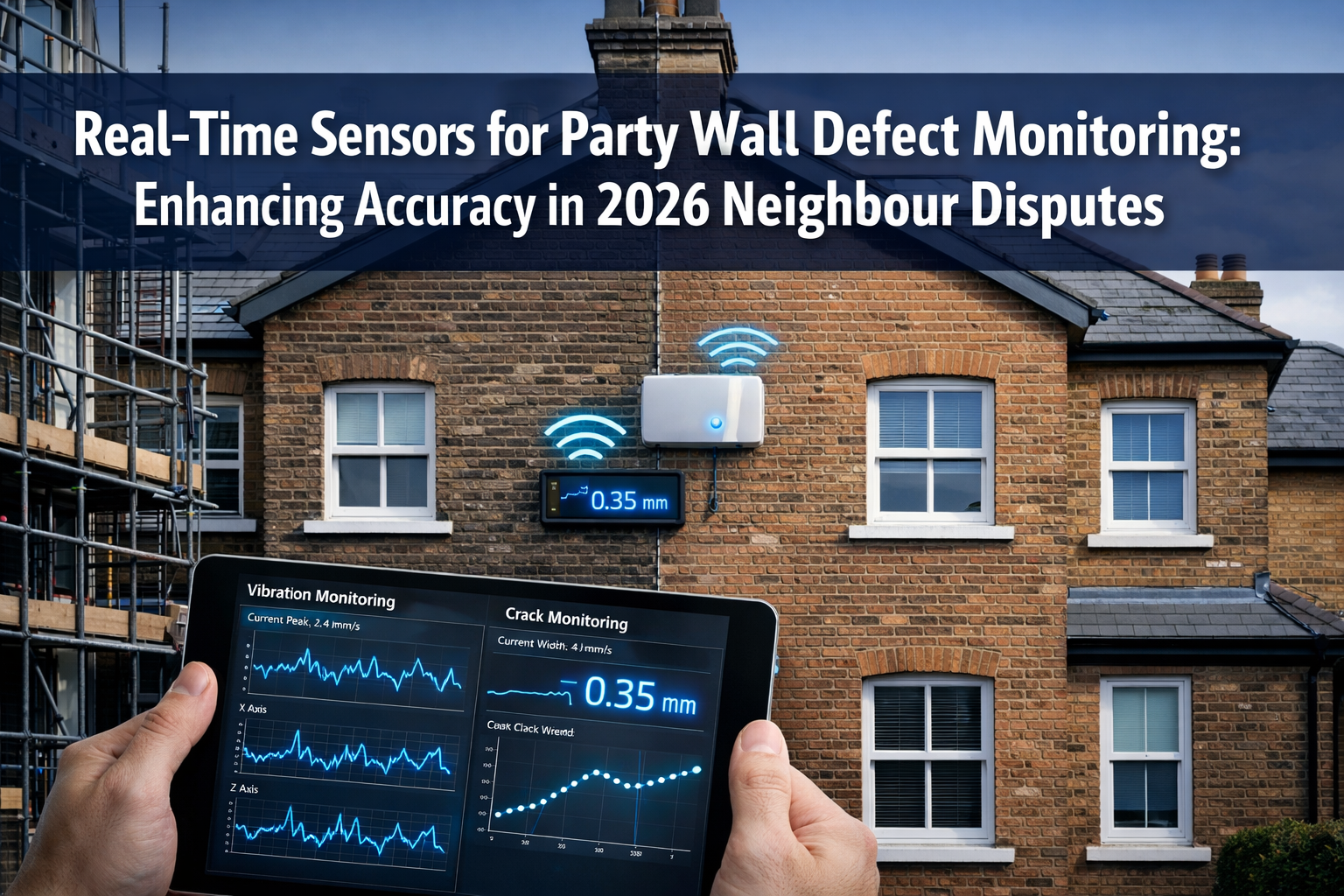
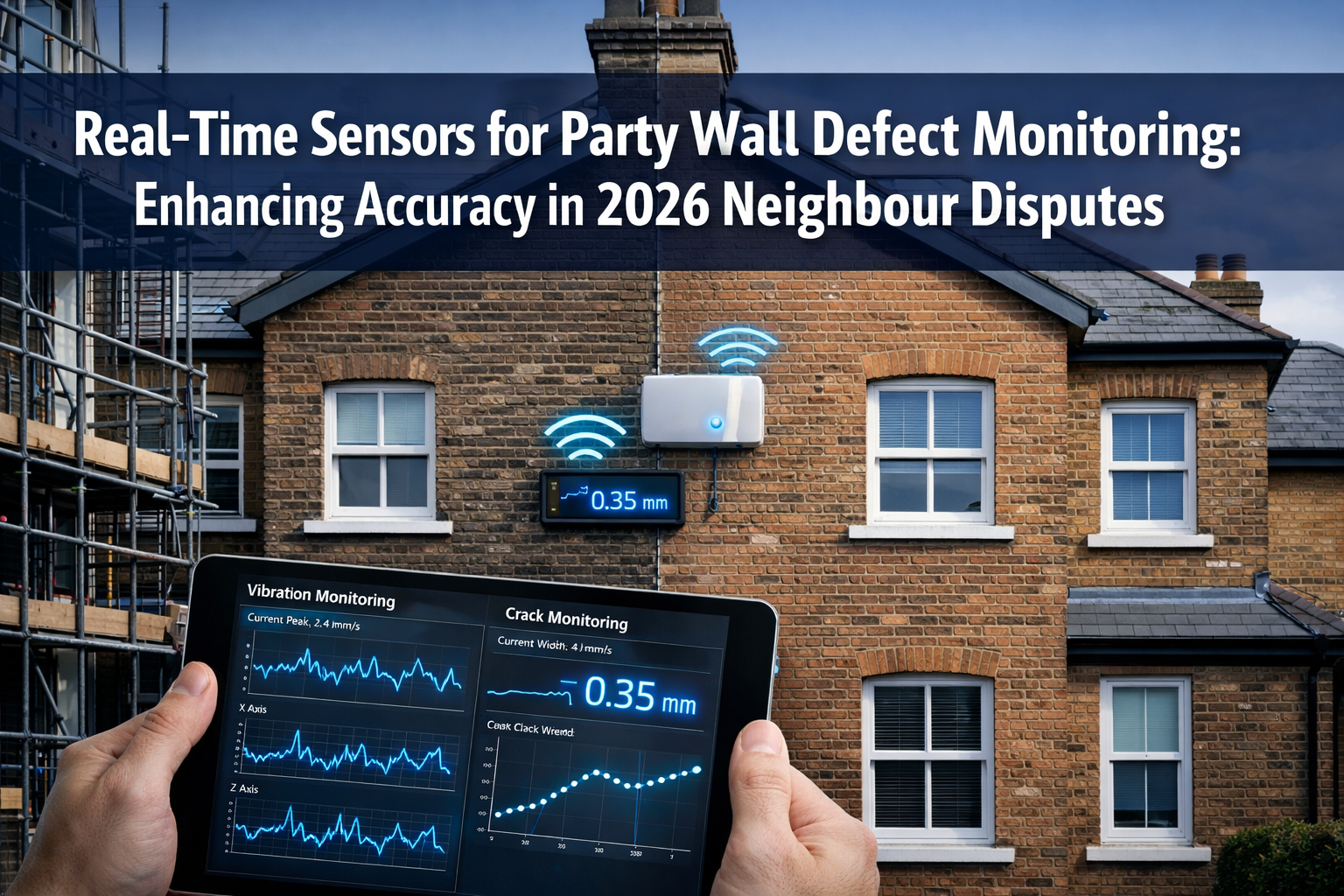
Over 60% of party wall disputes in London now involve contested evidence about when and how structural damage occurred—a problem that real-time sensor technology is finally solving. As of 2026, Real-Time Sensors for Party Wall Defect Monitoring: Enhancing Accuracy in 2026 Neighbour Disputes has transformed from an experimental concept into an operational necessity for property surveyors and homeowners alike.
The traditional approach to party wall monitoring—periodic visual inspections with photographs and manual measurements—leaves dangerous gaps in the evidence chain. When cracks appear or settlement occurs, determining causation becomes a battle of conflicting testimonies. Real-time monitoring systems eliminate this uncertainty by providing continuous, timestamped data that tracks every vibration, structural shift, and environmental change throughout construction projects.
This comprehensive guide examines how sensor technology strengthens party wall agreements through RICS-compliant protocols, explores the specific technologies available in 2026, and provides practical implementation strategies for surveyors and property owners.
Key Takeaways
- Real-time sensors provide continuous monitoring of vibrations, cracks, and structural movements during party wall works, creating indisputable evidence chains for dispute resolution
- RICS-compliant sensor protocols strengthen party wall awards and surveyor reports with objective, timestamped data that courts and tribunals readily accept
- Multi-parameter monitoring systems track temperature, humidity, tilt, and stress simultaneously, detecting defects before they become costly disputes
- Automated alert systems notify all parties immediately when threshold values are exceeded, enabling rapid intervention and damage prevention
- Cost-effective implementation in 2026 makes sensor technology accessible for residential projects, with typical installations ranging from £800-£3,500 depending on complexity
Understanding Real-Time Sensors for Party Wall Defect Monitoring: Enhancing Accuracy in 2026 Neighbour Disputes
Real-time monitoring has become an operational necessity rather than a forward-looking concept as of March 2026 [2]. The technology addresses a fundamental weakness in traditional party wall procedures: the inability to capture the precise moment and magnitude of structural changes as they occur.
What Are Real-Time Party Wall Sensors?
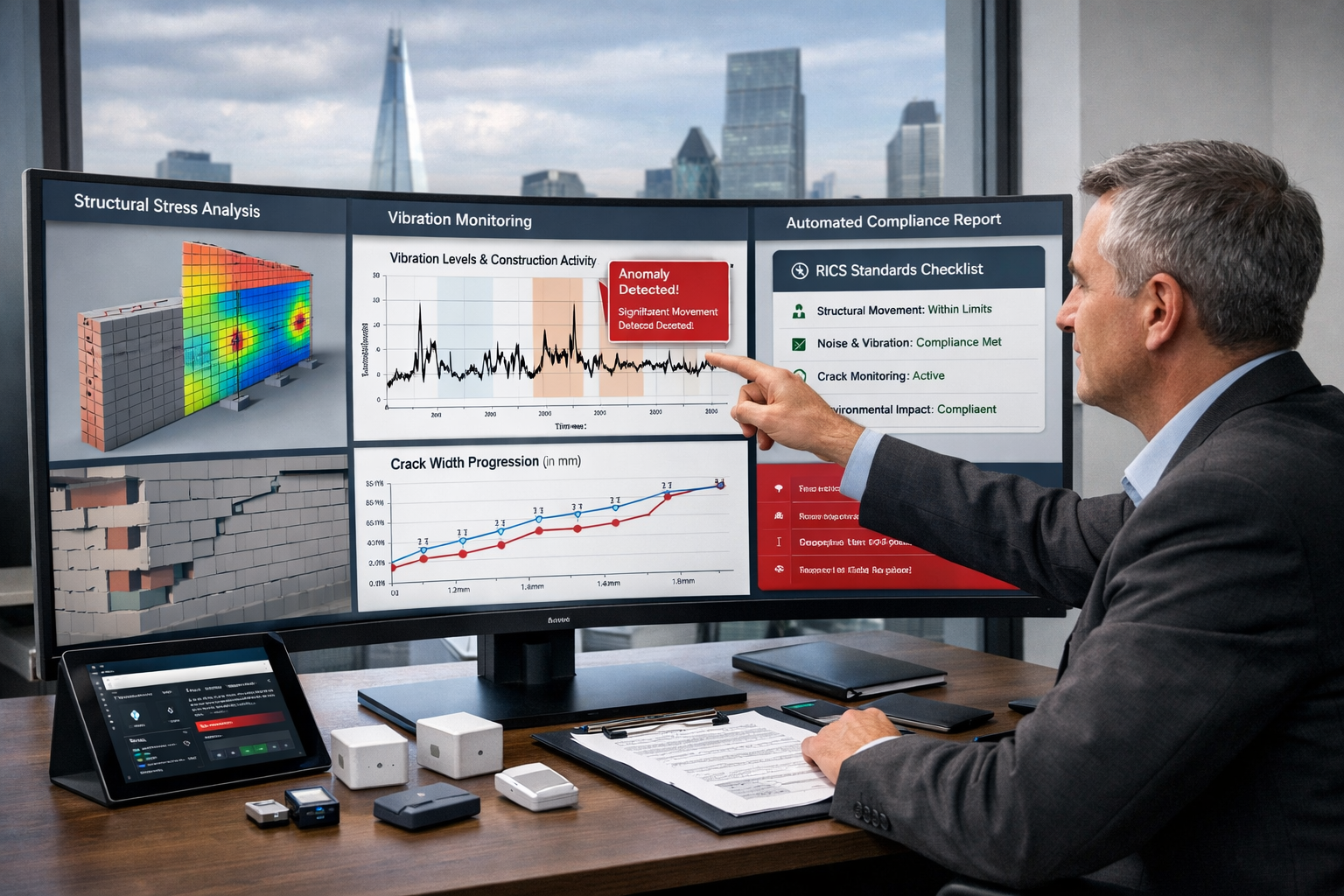
Real-time party wall sensors are IoT-enabled devices that continuously measure and record structural and environmental parameters affecting shared walls between properties. These systems automatically transmit data to cloud-based platforms where surveyors, property owners, and appointed professionals can access information 24/7.
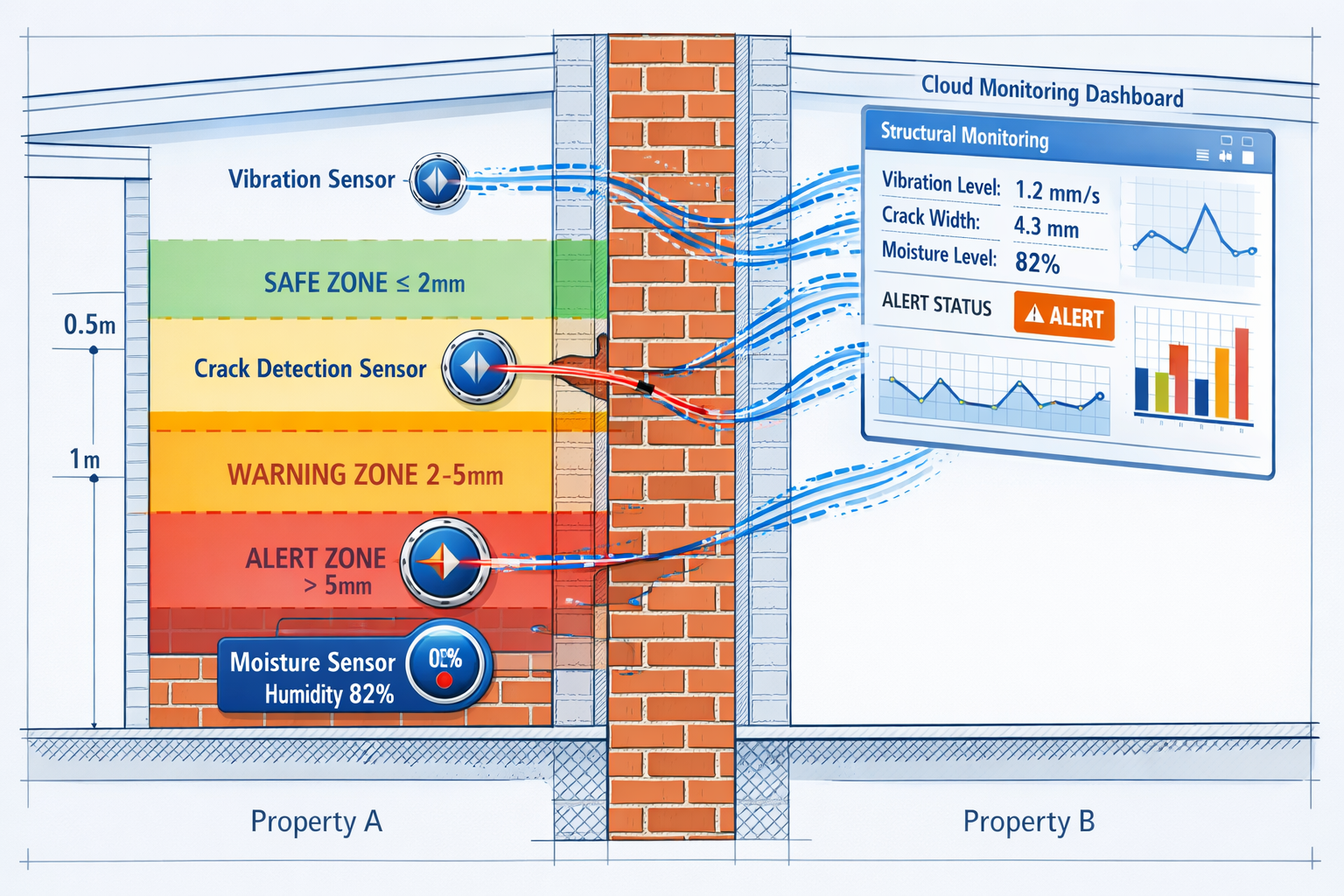
Modern sensor networks for party wall monitoring typically include:
- Vibration sensors that measure ground-borne and structure-borne vibrations from excavation, piling, and construction activities
- Crack monitoring devices that track width, length, and progression of existing or new cracks with sub-millimeter precision
- Tilt sensors that detect angular changes indicating settlement or structural movement
- Environmental monitors measuring temperature, humidity, and moisture levels that affect structural integrity
- Acoustic sensors that record noise levels and identify specific construction activities
The integration of these technologies creates a comprehensive monitoring ecosystem that provides objective evidence throughout construction projects governed by the Party Wall Act 1996.
The Evidence Gap in Traditional Party Wall Procedures
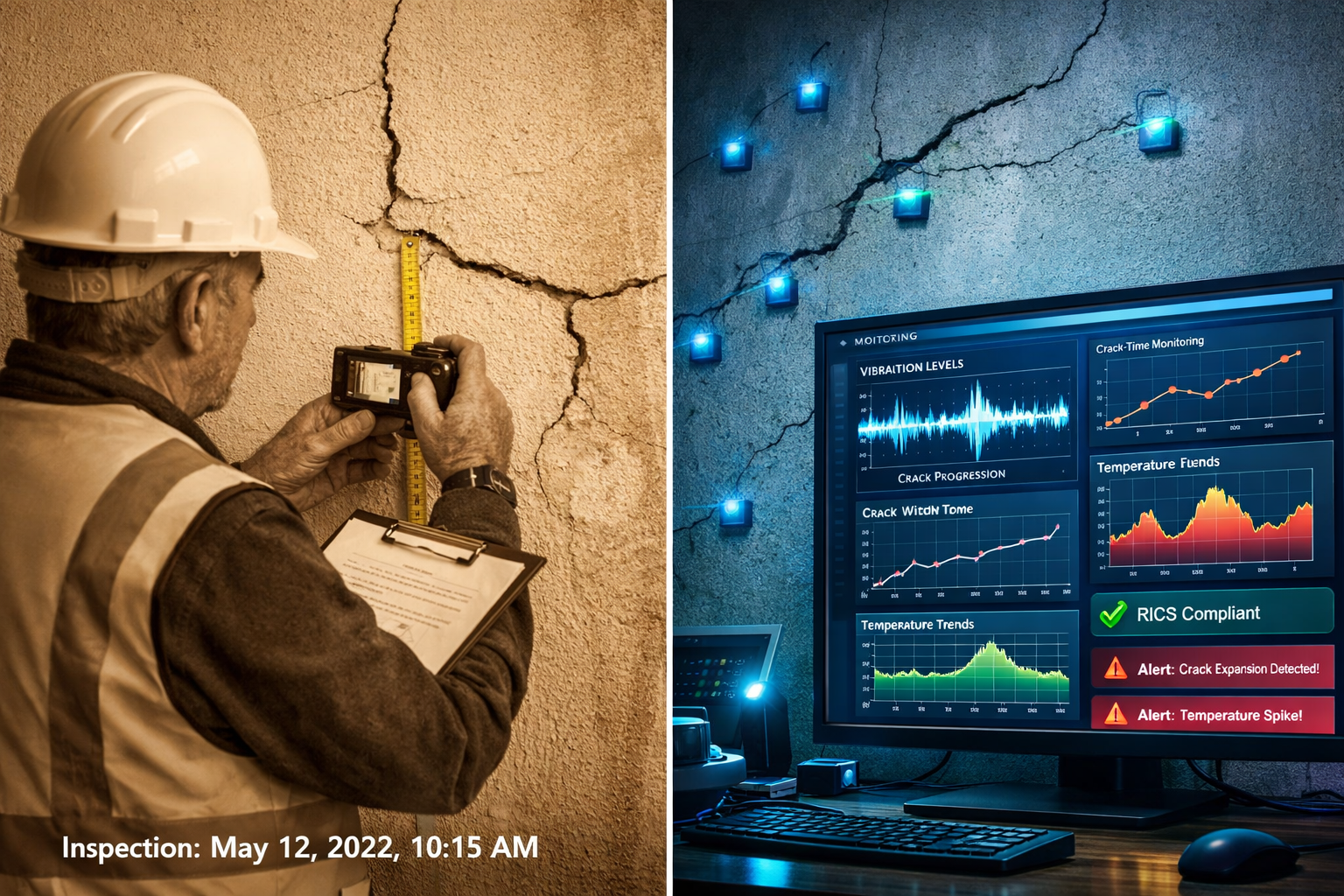
Traditional party wall procedures rely on condition surveys conducted before and after works. While these snapshots document the initial and final states, they miss critical information:
- When did the damage occur? Was it during excavation, structural works, or finishing trades?
- What was the magnitude of impact? Did vibrations exceed acceptable thresholds?
- Was there progressive deterioration? Did small issues compound over time?
- Were environmental factors involved? Did temperature or moisture changes contribute?
Without continuous monitoring, disputes often devolve into "he said, she said" arguments. Real-time sensors eliminate this ambiguity by creating an unbroken chain of evidence that precisely correlates construction activities with structural responses.
How Real-Time Sensors Enhance Party Wall Surveyor Reports and Awards
The integration of sensor technology into party wall procedures strengthens the entire process, from initial notices through dispute resolution. Professional surveyors increasingly incorporate these tools to meet RICS standards and provide superior service to clients.
RICS-Compliant Monitoring Protocols
The Royal Institution of Chartered Surveyors (RICS) emphasizes objective, evidence-based assessments in party wall matters. Real-time sensors align perfectly with these professional standards by providing:
📊 Quantifiable Baseline Data
Before works commence, sensors establish precise baseline measurements of:
- Existing crack widths (measured to 0.01mm accuracy)
- Normal vibration levels from traffic and daily activities
- Structural tilt and plumb measurements
- Environmental conditions
This baseline becomes the reference point against which all changes are measured, creating an objective standard that all parties accept before disputes arise.
⏰ Timestamped Event Correlation
Modern sensor systems timestamp every measurement, allowing surveyors to correlate structural changes with specific construction activities. When a crack widens by 2mm, the data shows:
- Exact date and time of change
- Construction activities occurring at that moment
- Vibration levels recorded simultaneously
- Weather and environmental conditions
This correlation capability transforms party wall awards from general guidance documents into precise, enforceable specifications with clear accountability.
🔔 Automated Threshold Alerts
RICS guidance emphasizes proactive management of party wall matters. Sensor systems can be programmed with threshold values based on:
- British Standards for vibration limits (BS 7385)
- Acceptable crack width increases
- Maximum tilt angles
- Environmental condition ranges
When thresholds are exceeded, automated alerts notify all parties immediately—the building owner, adjoining owner, and both appointed surveyors. This real-time notification enables immediate intervention before minor issues become major defects, fulfilling the preventative intent of party wall agreements.
Strengthening Party Wall Awards with Sensor Data
A party wall award is a legally binding document that specifies how works should proceed and how disputes will be resolved. Incorporating sensor monitoring into awards provides several advantages:
| Traditional Award Provision | Sensor-Enhanced Award Provision |
|---|---|
| "Vibrations shall be minimized" | "Vibration levels shall not exceed 15mm/s peak particle velocity, monitored continuously via installed sensors" |
| "Condition survey before and after" | "Continuous monitoring with weekly data reports and immediate alerts for threshold exceedances" |
| "Works to be conducted with care" | "Real-time monitoring dashboard accessible to all parties with automated compliance verification" |
| "Disputes to be resolved by surveyor" | "Sensor data to serve as primary evidence in dispute resolution, with independent verification protocols" |
This specificity transforms awards from aspirational documents into enforceable contracts with clear performance metrics and objective verification methods.
Case Study: Basement Excavation Monitoring
A 2026 basement excavation project in Chelsea demonstrates the value of sensor integration. The building owner planned to excavate 2.5 meters below the existing party wall foundation. Traditional approaches would have documented pre-work conditions, hoped for the best, and assessed damage afterward.
Instead, the appointed surveyor specified in the award:
- Six vibration sensors along the party wall
- Four crack monitors on existing hairline cracks
- Two tilt sensors measuring wall verticality
- Continuous monitoring with 5-minute data intervals
During excavation, sensors detected vibration levels approaching the 15mm/s threshold. Automated alerts notified all parties, and work was temporarily halted while engineers adjusted the excavation methodology. A hairline crack widened by 0.8mm over two days, triggering investigation that revealed inadequate temporary support.
The outcome: Issues were identified and corrected in real-time. Final costs were £12,000 for remedial works versus an estimated £45,000+ if damage had progressed undetected. More importantly, the neighbour relationship remained positive because transparent data prevented accusations and demonstrated responsible management.
For guidance on when formal agreements are required, see our article on when you need a party wall agreement.
Types of Sensors and Technologies for Party Wall Monitoring in 2026
The sensor market has matured significantly, with specialized solutions now available for every aspect of party wall monitoring. Understanding the capabilities and limitations of each technology helps surveyors and property owners select appropriate systems.
Vibration Monitoring Systems
Geophone and Accelerometer Sensors
These devices measure ground and structural vibrations caused by construction activities. Modern systems distinguish between:
- Peak Particle Velocity (PPV) – the maximum speed of vibration, measured in mm/s
- Frequency content – identifying whether vibrations are from piling, excavation, or traffic
- Duration and repetition – tracking cumulative effects over time
Advanced vibration sensors in 2026 offer:
- ✅ Tri-axial measurement (X, Y, Z directions)
- ✅ Frequency range from 1Hz to 250Hz covering all construction activities
- ✅ Wireless data transmission with 4G/5G connectivity
- ✅ Battery life of 6-12 months for continuous monitoring
- ✅ Weather-resistant housings for external installation
Practical Application: Install vibration sensors at 3-meter intervals along party walls for projects involving piling, excavation, or heavy machinery operation. Position sensors on both sides of the wall to differentiate between vibrations originating from the building owner's works versus external sources.
Crack Detection and Monitoring
Digital Crack Meters
These precision instruments measure crack width changes with 0.01mm resolution. Modern digital crack meters feature:
- Automatic measurement at programmed intervals (typically every 15-60 minutes)
- Temperature compensation to account for thermal expansion/contraction
- 3D movement tracking measuring width, vertical offset, and horizontal shear
- Visual indicators showing current status at a glance
Thermal sensors now detect temperature variations that indicate defects and environmental issues in building surveys, representing multi-parameter simultaneous monitoring capabilities [4].
Installation Best Practices:
- Identify monitoring points during the initial condition survey
- Photograph and document each crack with reference measurements
- Install sensors across representative cracks (typically 3-5 per party wall)
- Establish baseline by monitoring for 7-14 days before works commence
- Set alert thresholds based on crack type and structural significance
Tilt and Settlement Sensors
Inclinometers and Tilt Meters
These devices measure angular changes in structural elements, detecting settlement, rotation, or lateral movement. High-precision tilt sensors offer:
- Resolution to 0.001 degrees for detecting minute movements
- Dual-axis measurement tracking tilt in two perpendicular directions
- Long-term stability maintaining calibration over months of monitoring
- Remote calibration capabilities for verification without site visits
Critical Applications:
- Monitoring chimney stacks on party walls during adjacent excavation
- Tracking wall verticality during underpinning operations
- Detecting differential settlement between adjoining properties
Environmental Monitoring
Temperature and Humidity Sensors
Environmental conditions significantly affect structural behavior and can be confused with construction-related damage. Continuous monitoring of temperature and humidity helps:
- Differentiate thermal movement from structural settlement
- Identify moisture ingress that may indicate drainage issues or waterproofing failures
- Correlate environmental factors with crack behavior
- Provide context for structural movements
LineMetrics enables automatic continuous monitoring of environmental conditions in buildings for damage prevention using sensor networks [1].
Integrated Monitoring Platforms
The most sophisticated party wall monitoring systems in 2026 integrate multiple sensor types into unified platforms that provide:
🔄 Centralized Data Management
- Single dashboard displaying all sensor readings
- Historical data visualization with customizable date ranges
- Automated report generation for weekly updates
📱 Multi-User Access
- Role-based permissions for building owners, adjoining owners, and surveyors
- Mobile apps for on-site verification
- Email and SMS alert distribution
🤖 AI-Powered Analysis
- Pattern recognition identifying concerning trends
- Predictive alerts warning of potential threshold exceedances
- Anomaly detection flagging unusual readings for investigation
📋 Compliance Documentation
- Automated RICS-compliant reporting
- Exportable data for legal proceedings
- Audit trails showing all access and modifications
Implementation Strategies: Integrating Sensors into Party Wall Procedures
Successful sensor integration requires careful planning, clear communication, and adherence to professional protocols. The following strategies ensure effective implementation that enhances rather than complicates party wall procedures.
Pre-Installation Planning
1. Define Monitoring Objectives
Work with all parties to establish clear monitoring goals:
- What specific risks does the project present?
- Which structural elements are most vulnerable?
- What would constitute unacceptable damage?
- How will data be used in decision-making?
2. Select Appropriate Technology
Match sensor capabilities to project requirements:
| Project Type | Recommended Sensors | Typical Quantity |
|---|---|---|
| Loft conversion | Vibration, crack monitors | 3-5 sensors |
| Basement excavation | Vibration, tilt, crack, environmental | 8-15 sensors |
| Structural alterations | Crack monitors, tilt sensors | 4-8 sensors |
| Underpinning | Vibration, tilt, settlement | 10-20 sensors |
3. Establish Threshold Values
Set scientifically-based alert thresholds using:
- British Standards (BS 7385 for vibration, BS 5228 for noise)
- Structural engineering calculations for acceptable movement
- RICS guidance on party wall matters
- Historical data from similar projects
For projects requiring specific defect surveys, sensor thresholds should align with identified vulnerabilities.
Installation and Commissioning
Professional Installation Requirements
While some basic sensors can be installed by competent contractors, party wall monitoring systems should be installed by:
- Qualified surveyors with sensor technology training
- Specialist monitoring companies with party wall experience
- Structural engineers for complex installations
Installation Checklist:
✅ Site survey identifying optimal sensor locations
✅ Power and connectivity verification for wireless systems
✅ Secure mounting ensuring sensors won't be disturbed
✅ Baseline establishment with 7-14 days pre-work monitoring
✅ System testing verifying data transmission and alerts
✅ User training for all parties accessing the system
✅ Documentation including installation photos and sensor specifications
Operational Protocols During Construction
Daily Monitoring Routine
Establish clear responsibilities for daily monitoring:
Building Owner's Contractor:
- Check dashboard each morning before starting work
- Verify all sensors are functioning
- Report any alert notifications immediately
Appointed Surveyors:
- Review weekly data summaries
- Investigate any threshold exceedances
- Maintain communication with both parties
Adjoining Owner:
- Access to view real-time data
- Receive automated alerts for significant events
- Right to request surveyor review of concerning trends
Response Protocols
Create clear procedures for different alert levels:
🟢 Green Status (Normal operations)
- All readings within acceptable ranges
- Weekly summary reports generated automatically
- No action required
🟡 Amber Alert (Approaching thresholds)
- Readings at 70-90% of threshold values
- Enhanced monitoring with increased data intervals
- Surveyor notification and trend analysis
- Possible precautionary measures discussed
🔴 Red Alert (Threshold exceeded)
- Immediate work stoppage
- Emergency surveyor consultation
- Investigation of cause
- Remedial action plan before resumption
Post-Construction Documentation
Final Reporting Requirements
Comprehensive final reports should include:
- Executive summary comparing pre- and post-work conditions
- Complete data set with all sensor readings throughout the project
- Event log documenting alerts, investigations, and responses
- Photographic evidence correlated with sensor data
- Compliance statement confirming adherence to party wall award terms
- Recommendations for any follow-up monitoring or remedial works
This documentation becomes invaluable if disputes arise months or years after completion, providing indisputable evidence of conditions during construction.
Understanding boundary wall rules helps property owners appreciate their responsibilities for shared structures.
Cost Considerations and Return on Investment
The financial aspects of sensor monitoring are increasingly favorable in 2026, with technology costs declining while the value of dispute prevention grows.
Typical System Costs
Basic Residential Monitoring Package (£800-£1,500)
- 3-5 wireless sensors (vibration and crack monitoring)
- 3-month monitoring period
- Cloud platform access for all parties
- Weekly automated reports
- Basic alert notifications
Standard Party Wall Monitoring (£1,500-£3,500)
- 6-10 sensors (vibration, crack, tilt, environmental)
- 6-month monitoring period
- Advanced analytics platform
- Customizable reporting
- Multi-level alert system
- Professional installation and commissioning
Comprehensive Complex Project Monitoring (£3,500-£8,000+)
- 15+ sensors with redundancy
- 12+ month monitoring period
- AI-powered predictive analytics
- Integration with BIM and project management systems
- Dedicated support and regular site visits
- Expert witness-ready documentation
Cost-Benefit Analysis
Consider sensor monitoring costs against potential dispute expenses:
Traditional Dispute Costs:
- Legal fees: £5,000-£25,000+
- Expert witness fees: £3,000-£10,000
- Remedial works (if causation unclear): £10,000-£100,000+
- Time and stress: Immeasurable
Sensor Monitoring Benefits:
- Dispute prevention through transparent data
- Early intervention reducing repair costs by 60-80%
- Faster resolution when disputes do arise
- Insurance premium reductions for demonstrable risk management
- Enhanced professional reputation for surveyors
"Investing £2,500 in comprehensive monitoring for a £150,000 basement project represents less than 2% of construction costs but can prevent disputes costing 10-20 times that amount. It's not just financially prudent—it's professional best practice." — RICS Party Wall Surveyor, London
For context on professional fees, see our guide to party wall surveyor costs in London.
Regulatory Compliance and Legal Considerations
The legal framework surrounding party wall monitoring continues to evolve as technology becomes more prevalent. Understanding the regulatory landscape ensures proper implementation that withstands legal scrutiny.
Party Wall Act 1996 and Sensor Monitoring
The Party Wall Act 1996 does not explicitly mandate sensor monitoring, but it requires:
- Condition surveys documenting pre-work state
- Reasonable precautions to prevent damage
- Access rights for monitoring and inspection
- Dispute resolution mechanisms
Real-time sensors enhance compliance with all these requirements. Party wall awards can and should specify monitoring requirements, making them legally enforceable obligations.
Data Protection and Privacy
Sensor systems must comply with UK GDPR and Data Protection Act 2018:
✅ Lawful Basis: Monitoring is necessary for legitimate interests (property protection) under party wall procedures
✅ Data Minimization: Collect only necessary structural data, not personal information
✅ Access Controls: Implement role-based permissions ensuring only authorized parties view data
✅ Retention Policies: Establish clear timeframes for data storage (typically 6-12 years aligning with limitation periods)
✅ Transparency: Inform all parties about what data is collected, how it's used, and who has access
Admissibility of Sensor Data in Disputes
Courts and tribunals increasingly accept sensor data as evidence, provided:
- Chain of custody is documented from installation through presentation
- Calibration records demonstrate accuracy and reliability
- Professional interpretation by qualified surveyors or engineers
- Correlation with other evidence (photos, visual inspections, witness statements)
- Compliance with standards (British Standards, RICS guidance)
Remote sensing technologies supplement on-ground data collection for enhanced accuracy in environmental and structural assessments [2].
Insurance Implications
Professional Indemnity Insurance
Surveyors should notify their PI insurers when incorporating sensor technology into practice. Most insurers view this favorably as risk reduction, but proper training and competence are essential.
Building and Liability Insurance
Property owners may benefit from:
- Premium reductions for demonstrable risk management
- Stronger claims positions with objective evidence
- Faster claims processing with clear causation documentation
Consult with insurance providers before commencing monitored projects to maximize these benefits.
Future Developments and Emerging Technologies
The trajectory of sensor technology for party wall monitoring points toward even greater capabilities and accessibility beyond 2026.
Artificial Intelligence and Machine Learning
AI-powered systems are beginning to:
- Predict potential failures before they occur based on pattern recognition
- Optimize alert thresholds by learning from project-specific data
- Automate compliance reporting with natural language generation
- Identify correlations between multiple parameters that humans might miss
These capabilities will further reduce the burden on surveyors while improving accuracy and reliability.
Integration with Building Information Modeling (BIM)
Sensor data increasingly feeds directly into BIM platforms, creating:
- Digital twins of party walls with real-time status updates
- 4D modeling showing structural changes over time
- Predictive maintenance schedules based on actual condition data
- Lifecycle documentation from construction through decades of service
Miniaturization and Cost Reduction
Continued technological advancement promises:
- Smaller sensors with less intrusive installation
- Longer battery life reducing maintenance requirements
- Lower costs making monitoring standard practice for all party wall projects
- Easier installation enabling rapid deployment
IoT sensor markets are projected to surge, driven by demand for smarter, data-rich monitoring tools that inform building assessment strategies [2].
Standardization and Regulation
Industry bodies are developing:
- RICS practice standards for sensor-based party wall monitoring
- British Standards specifically addressing construction monitoring technology
- Certification schemes for monitoring equipment and practitioners
- Template party wall awards incorporating sensor requirements
This standardization will accelerate adoption and ensure consistent quality across the industry.
Practical Guidance for Property Owners and Surveyors
For Building Owners Planning Works
Before Serving Party Wall Notices:
- Assess monitoring needs based on project scope and risks
- Budget appropriately including monitoring costs in project planning
- Engage qualified surveyors with sensor technology experience
- Discuss with neighbours explaining monitoring benefits for mutual protection
When Appointing Surveyors:
Ask potential surveyors:
- What experience do you have with real-time monitoring systems?
- Which sensor technologies do you recommend for this project?
- How will monitoring data be shared with all parties?
- What happens if alert thresholds are exceeded?
During Construction:
- Monitor the dashboard regularly (even if you've appointed a surveyor)
- Respond promptly to any alerts or surveyor communications
- Maintain open dialogue with your neighbour
- Document any concerns or observations
For Adjoining Owners Receiving Notices
Protecting Your Interests:
- Request sensor monitoring in the party wall award if not already proposed
- Ensure dashboard access so you can view data in real-time
- Understand alert protocols and your rights when thresholds are exceeded
- Keep your own records including photos and observations
Questions to Ask Your Appointed Surveyor:
- Will real-time monitoring be specified in the award?
- What sensor types are appropriate for the proposed works?
- How often will I receive reports?
- What are my rights if damage occurs despite monitoring?
For adjoining owners concerned about construction proximity, our article on how close neighbours can build to your fence provides valuable context.
For Party Wall Surveyors
Developing Sensor Monitoring Competence:
✅ Training: Pursue CPD courses on construction monitoring technology
✅ Partnerships: Establish relationships with specialist monitoring companies
✅ Templates: Develop standard award clauses for sensor monitoring
✅ Case studies: Document successful implementations for portfolio development
✅ Technology evaluation: Stay current with emerging sensor capabilities
Award Drafting Best Practices:
Include specific provisions for:
- Sensor types, quantities, and locations
- Installation timing and commissioning procedures
- Threshold values with scientific justification
- Alert protocols and response requirements
- Data access and reporting schedules
- Cost allocation between parties
- Post-work reporting requirements
Professional Development:
The integration of technology into traditional surveying practice represents a significant evolution. Surveyors who embrace these tools position themselves as forward-thinking professionals offering superior service. Continuous monitoring systems are being integrated to meet stringent regulatory standards [2].
Conclusion
Real-Time Sensors for Party Wall Defect Monitoring: Enhancing Accuracy in 2026 Neighbour Disputes represents a fundamental shift in how construction projects affecting shared structures are managed. The technology has matured from experimental novelty to operational necessity, providing objective evidence that prevents disputes, enables early intervention, and protects the interests of all parties.
The benefits are clear and compelling:
✅ Objective evidence replacing subjective assessments
✅ Continuous monitoring eliminating dangerous gaps in documentation
✅ Immediate alerts enabling rapid response to emerging issues
✅ RICS compliance strengthening professional standards
✅ Dispute prevention saving time, money, and relationships
✅ Legal defensibility providing court-ready documentation
For building owners, the modest investment in sensor monitoring (typically 1-3% of construction costs) provides invaluable protection against disputes that can cost 10-20 times more to resolve. For adjoining owners, real-time monitoring offers transparency and reassurance that their property is being protected. For surveyors, sensor technology enhances professional service delivery and demonstrates commitment to best practices.
Next Steps
If you're planning party wall works:
- Consult with a qualified surveyor about appropriate monitoring for your project
- Budget for sensor systems in your project planning
- Include monitoring requirements in your party wall notices and awards
- Engage specialist monitoring providers with party wall experience
If you're an adjoining owner:
5. Request sensor monitoring if proposed works present significant risks
6. Ensure your appointed surveyor has technology competence
7. Insist on dashboard access and regular reporting
8. Maintain your own documentation alongside sensor data
If you're a surveyor:
9. Invest in training and technology partnerships
10. Develop standard monitoring protocols for your practice
11. Update award templates to include sensor provisions
12. Market your technology-enhanced services to clients
The future of party wall practice is data-driven, transparent, and preventative. Embracing real-time sensor technology positions all parties for successful project outcomes with minimized disputes and maximized protection.
For comprehensive guidance on party wall procedures and professional surveying services, explore our resources on expert party wall advice and party wall applications.
References
[1] Damage Prevention In Buildings Through Real Time Monitoring – https://www.linemetrics.com/en/anwendungsfaelle/damage-prevention-in-buildings-through-real-time-monitoring/
[2] Why 2026 Is The Tipping Point For Real Time Environmental Monitoring – https://eco-rentalsolutions.com/2026/03/16/why-2026-is-the-tipping-point-for-real-time-environmental-monitoring/
[3] Rhombus Sensors – https://www.verticomm.com/security-solutions/rhombus-sensors
[4] Real Time Sensors And Tech In 2026 Building Surveys Enhancing Defect Detection For Accurate Valuations – https://nottinghillsurveyors.com/blog/real-time-sensors-and-tech-in-2026-building-surveys-enhancing-defect-detection-for-accurate-valuations
[5] Technology For Early Property Insight In 2026 Building Surveys Reducing Delays In Complex Valuations – https://nottinghillsurveyors.com/blog/technology-for-early-property-insight-in-2026-building-surveys-reducing-delays-in-complex-valuations









