
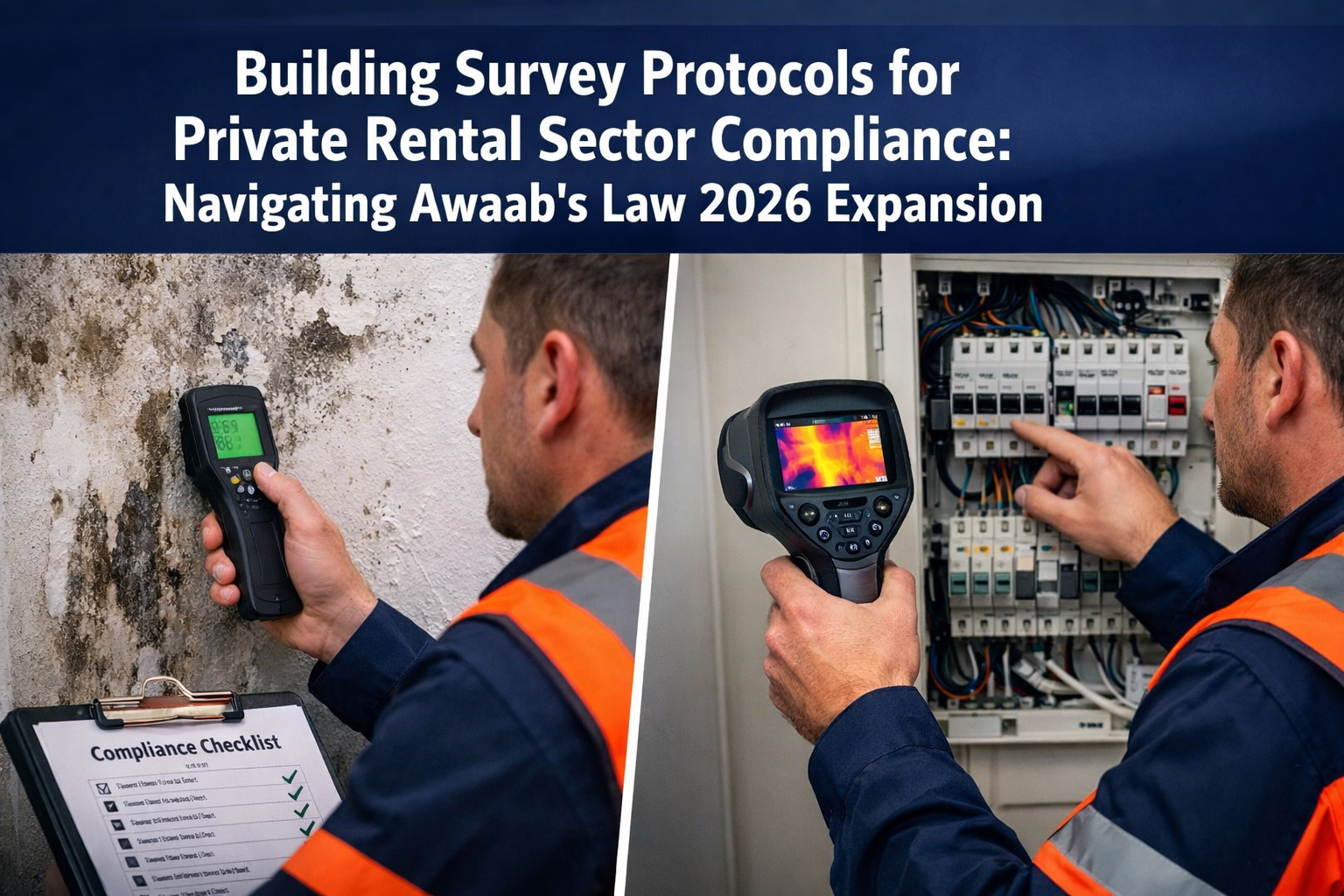
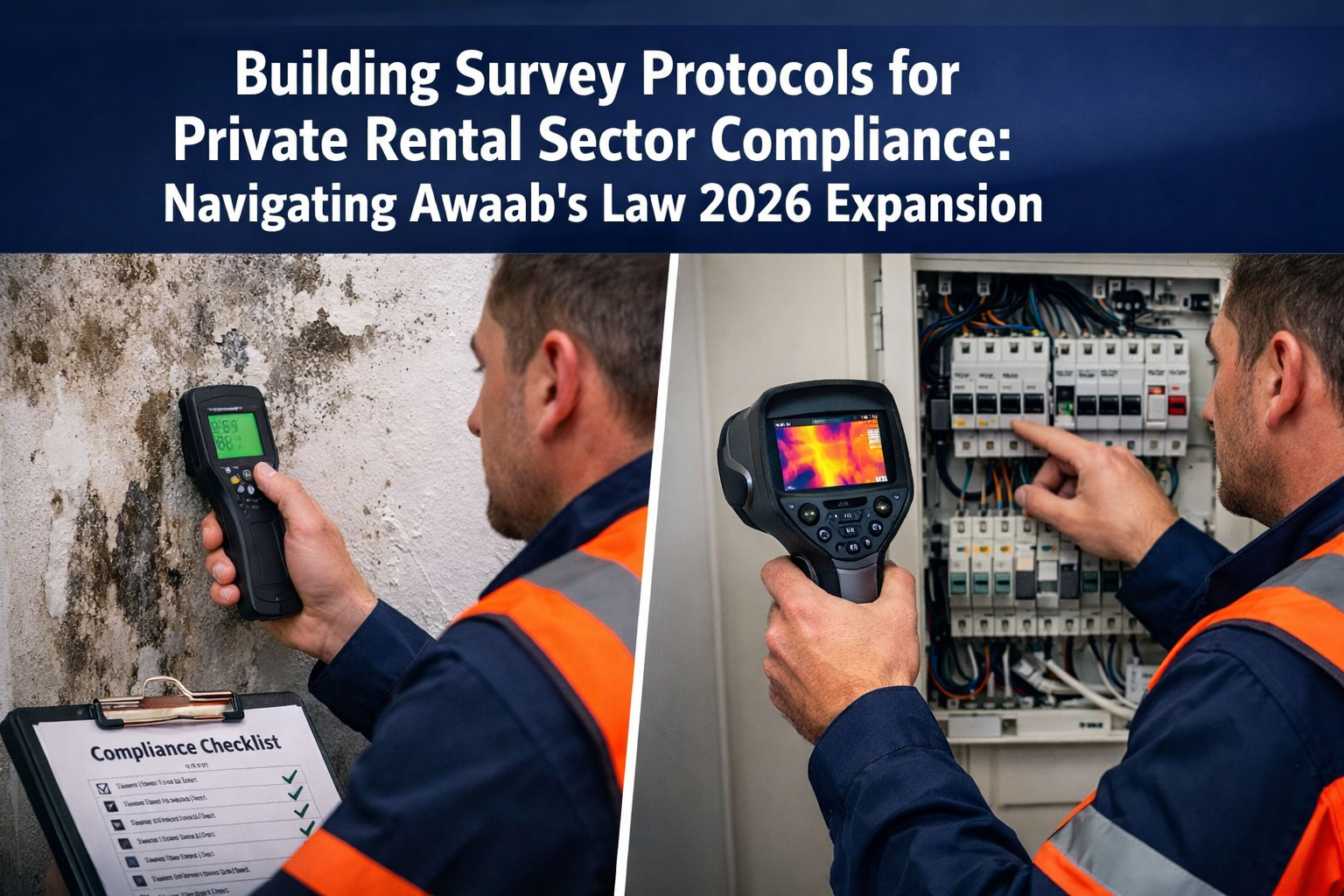
The death of two-year-old Awaab Ishak from prolonged mould exposure in December 2020 triggered one of the most significant legislative shifts in UK housing safety history. By 2026, Awaab's Law now mandates strict timeframes for addressing not just damp and mould, but eight additional hazard categories including electrical risks, fire hazards, excess temperatures, and structural failures across England's rental sector[1]. For building surveyors and property professionals, understanding Building Survey Protocols for Private Rental Sector Compliance: Navigating Awaab's Law 2026 Expansion has become essential to avoiding unlimited fines and ensuring tenant safety.
This comprehensive guide examines the critical protocols, timelines, and inspection methodologies required for compliance as the legislation expands from social housing into the private rental market.
Key Takeaways
- Awaab's Law Phase 2 (2026) expands beyond damp and mould to cover eight additional HHSRS hazard categories including electrical, fire, temperature extremes, and structural risks[1]
- Strict legal timeframes apply: 24-hour emergency response, 10 working days for investigation commencement, and 5 working days to start remedial works[3]
- Private rental sector extension is confirmed through the Renters' Rights Act 2025, with implementation aligned to updated Decent Homes Standard by 2035-2037[4]
- Surveyor reports now carry significant legal weight in enforcement proceedings, requiring comprehensive documentation and potential testimony[1]
- Non-compliance penalties include unlimited fines, compensation payments, loss of rent, and enforcement orders[4]
Understanding Awaab's Law: From Tragedy to Transformation
The Legislative Journey
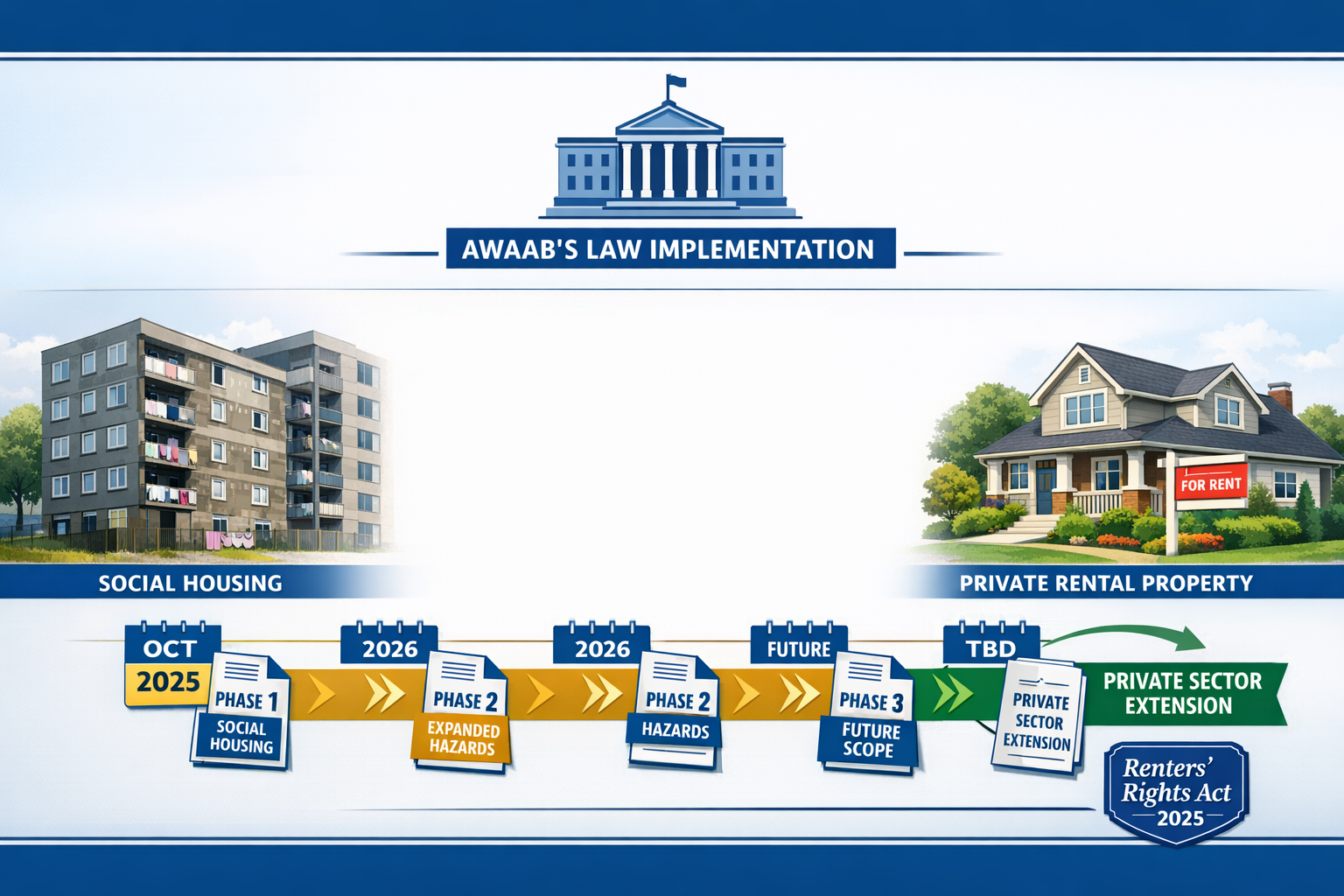
Awaab's Law emerged from the Social Housing (Regulation) Act 2023, establishing legally binding timeframes for landlords to investigate and remedy hazardous living conditions. Phase 1 became effective on 27 October 2025, initially applying to approximately 4.5 million social homes in England—comprising 2.9 million housing association dwellings and 1.6 million council-managed properties[4].
The legislation operates on three distinct phases:
Phase 1 (October 2025): Focuses exclusively on damp, mould, and fungal growth hazards in social housing
Phase 2 (2026): Expands to cover eight additional Housing Health and Safety Rating System (HHSRS) hazard categories[1][2]
Phase 3 (Future): Will further widen the scope of covered hazards beyond Phase 2 implementation[4]
The Private Sector Extension
While initial implementation targeted social housing, the government confirmed extension to the private rental sector through secondary legislation under the Renters' Rights Act 2025, which received Royal Assent on 27 October 2025[4]. This expansion represents a fundamental shift in Building Survey Protocols for Private Rental Sector Compliance: Navigating Awaab's Law 2026 Expansion, affecting millions of additional properties.
The private sector rollout timeline aligns with the updated Decent Homes Standard, scheduled for either 2035 or 2037, though consultations are also exploring earlier application to temporary accommodation[4].
"Surveyor reports now carry significant legal weight in enforcement proceedings, requiring comprehensive, accurate, and well-documented findings. Surveyors may be required to testify as evidence in cases where landlords fail to comply." [1]
The Eight Expanded Hazard Categories Under Phase 2
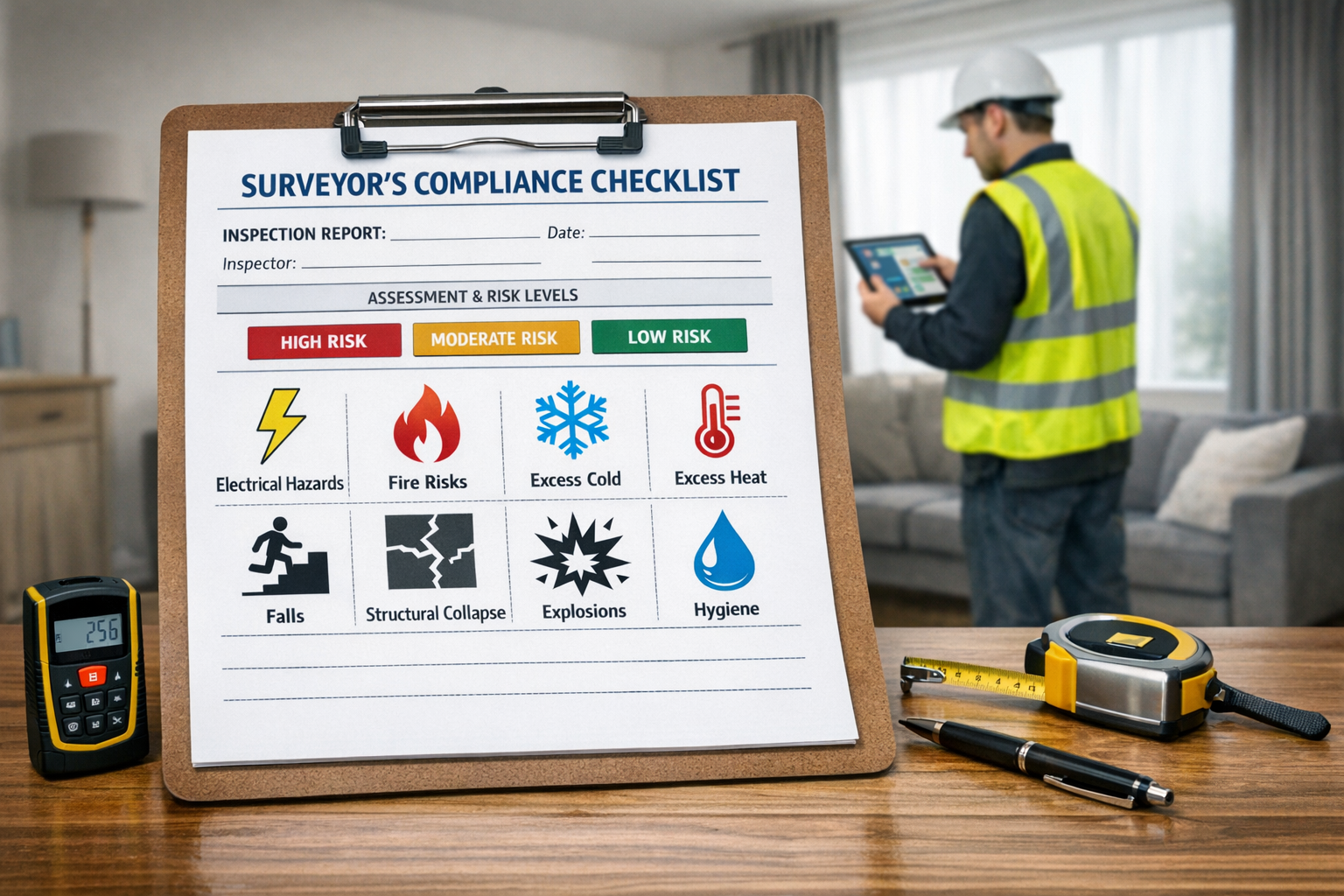
Building Survey Protocols for Private Rental Sector Compliance: Navigating Awaab's Law 2026 Expansion requires surveyors to master identification and documentation protocols for eight critical hazard categories beyond the original damp and mould focus:
1. ⚡ Electrical Hazards
Key Risk Factors:
- Outdated wiring systems (pre-1990s installations)
- Overloaded circuits and inadequate consumer units
- Exposed wiring and damaged sockets
- Absence of RCD (Residual Current Device) protection
- Non-compliant electrical installations
Survey Protocol Requirements:
- Visual inspection of consumer unit and distribution boards
- Testing of RCD functionality
- Assessment of socket conditions and earthing systems
- Documentation of electrical installation age and compliance certificates
- Thermal imaging to detect overheating circuits
2. 🔥 Fire Risks
Key Risk Factors:
- Inadequate fire detection systems
- Blocked escape routes and insufficient emergency lighting
- Combustible materials near heat sources
- Non-compliant fire doors and separation
- Absence of fire blankets in kitchens
Survey Protocol Requirements:
- Verification of smoke alarm placement and functionality (minimum one per floor)
- Assessment of escape route accessibility
- Inspection of fire door integrity and self-closing mechanisms
- Documentation of fire safety equipment locations
- Evaluation of compartmentation in multi-occupancy buildings
3. ❄️ Excess Cold
Key Risk Factors:
- Inadequate insulation (walls, roofs, floors)
- Single-glazed windows
- Inefficient or non-functional heating systems
- Draughts from poorly sealed openings
- Thermal bridging and cold spots
Survey Protocol Requirements:
- Thermal imaging surveys to identify heat loss patterns
- Assessment of heating system capacity and efficiency
- Insulation thickness measurements
- Window glazing evaluation
- Temperature monitoring in habitable rooms (minimum 18°C in living areas, 16°C in bedrooms)
4. 🌡️ Excess Heat
Key Risk Factors:
- Inadequate ventilation in warm seasons
- South-facing properties without shading
- Insufficient insulation causing heat retention
- Lack of cooling mechanisms
- Poor roof insulation trapping heat
Survey Protocol Requirements:
- Assessment of ventilation adequacy and airflow
- Evaluation of window positioning and shading options
- Temperature monitoring during warm periods
- Roof space ventilation inspection
- Documentation of cooling provision
5. 🪜 Falls Hazards
Key Risk Factors:
- Unsafe stairs (damaged treads, inadequate handrails)
- Uneven flooring and trip hazards
- Slippery surfaces in bathrooms and kitchens
- Inadequate lighting on staircases
- Unsafe balconies and elevated areas
Survey Protocol Requirements:
- Staircase measurements (rise, going, handrail height)
- Floor level assessment and trip hazard identification
- Balustrade and handrail integrity testing
- Lighting adequacy evaluation
- Surface slip resistance assessment in wet areas
6. 🏚️ Structural Collapse Risks
Key Risk Factors:
- Significant structural cracks and movement
- Compromised load-bearing elements
- Deteriorated foundations
- Roof structural defects
- Wall tie failure in cavity walls
Survey Protocol Requirements:
- Crack monitoring and measurement
- Structural element integrity assessment
- Foundation inspection where accessible
- Roof structure evaluation
- Wall tie testing in suspect areas
- Professional structural engineer referral for serious concerns
For properties requiring detailed structural analysis, our building surveyor services provide comprehensive assessments.
7. 💥 Explosion Risks
Key Risk Factors:
- Gas leak potential from aging installations
- Inadequate ventilation for gas appliances
- Improper LPG storage
- Absence of carbon monoxide detectors
- Non-compliant gas installations
Survey Protocol Requirements:
- Visual inspection of gas pipework and connections
- Verification of gas safety certificates (annual requirement)
- Carbon monoxide detector presence and functionality
- Ventilation adequacy for gas appliances
- Documentation of gas appliance service records
8. 🚰 Hygiene and Food Safety
Key Risk Factors:
- Inadequate kitchen facilities
- Pest infestations
- Sewage and drainage issues
- Contaminated water supply
- Insufficient waste disposal facilities
Survey Protocol Requirements:
- Kitchen facility adequacy assessment
- Evidence of pest activity documentation
- Drainage system functionality testing
- Water quality concerns identification
- Waste management provision evaluation
Understanding these hazard categories is fundamental to what does a surveyor do in the context of rental property compliance.
Mandatory Timelines: The Compliance Clock
Building Survey Protocols for Private Rental Sector Compliance: Navigating Awaab's Law 2026 Expansion operates on strict, non-negotiable timeframes that fundamentally reshape operational requirements for landlords and surveyors:
⏰ Emergency Response: 24 Hours
For hazards posing immediate health risks, landlords must respond within 24 hours of tenant notification[3]. This includes:
- Severe electrical faults creating shock risks
- Active gas leaks
- Structural instability threatening collapse
- Complete heating system failure in winter
- Severe water ingress causing immediate hazards
Surveyor Action: Emergency callout protocols must be established with guaranteed 24-hour availability during winter months and for critical hazards.
📋 Investigation Commencement: 10 Working Days
Upon receiving a tenant report of hazardous conditions, landlords must begin formal investigation within 10 working days[3]. This investigation can be conducted:
- Remotely via video inspection (standard approach)
- In-person upon tenant request (mandatory if requested)
- Renewed in-person investigation following remote assessment (resets timeline)
Surveyor Action: Develop standardized remote inspection protocols using video conferencing technology, with clear documentation of tenant consent and inspection limitations.
🔧 Remedial Works: 5 Working Days
Once the investigation concludes and identifies hazards, remedial works must commence within 5 working days[3]. This timeline applies regardless of the complexity or cost of required repairs.
Surveyor Action: Investigation reports must include:
- Clear hazard identification and severity ratings
- Specific remedial recommendations
- Estimated timeframes for completion
- Contractor specification requirements
- Interim safety measures if works extend beyond 5 days
📊 Timeline Compliance Table
| Stage | Timeframe | Trigger Event | Surveyor Requirement |
|---|---|---|---|
| Emergency Response | 24 hours | Immediate health risk reported | Emergency callout availability |
| Investigation Start | 10 working days | Tenant hazard report | Remote or in-person inspection commencement |
| Remedial Works Start | 5 working days | Investigation completion | Detailed specification and contractor brief |
| Progress Updates | Ongoing | During extended works | Regular tenant communication documentation |
These timelines apply equally to social housing (current) and will extend to private rentals as secondary legislation takes effect.
Comprehensive Survey Protocol Development
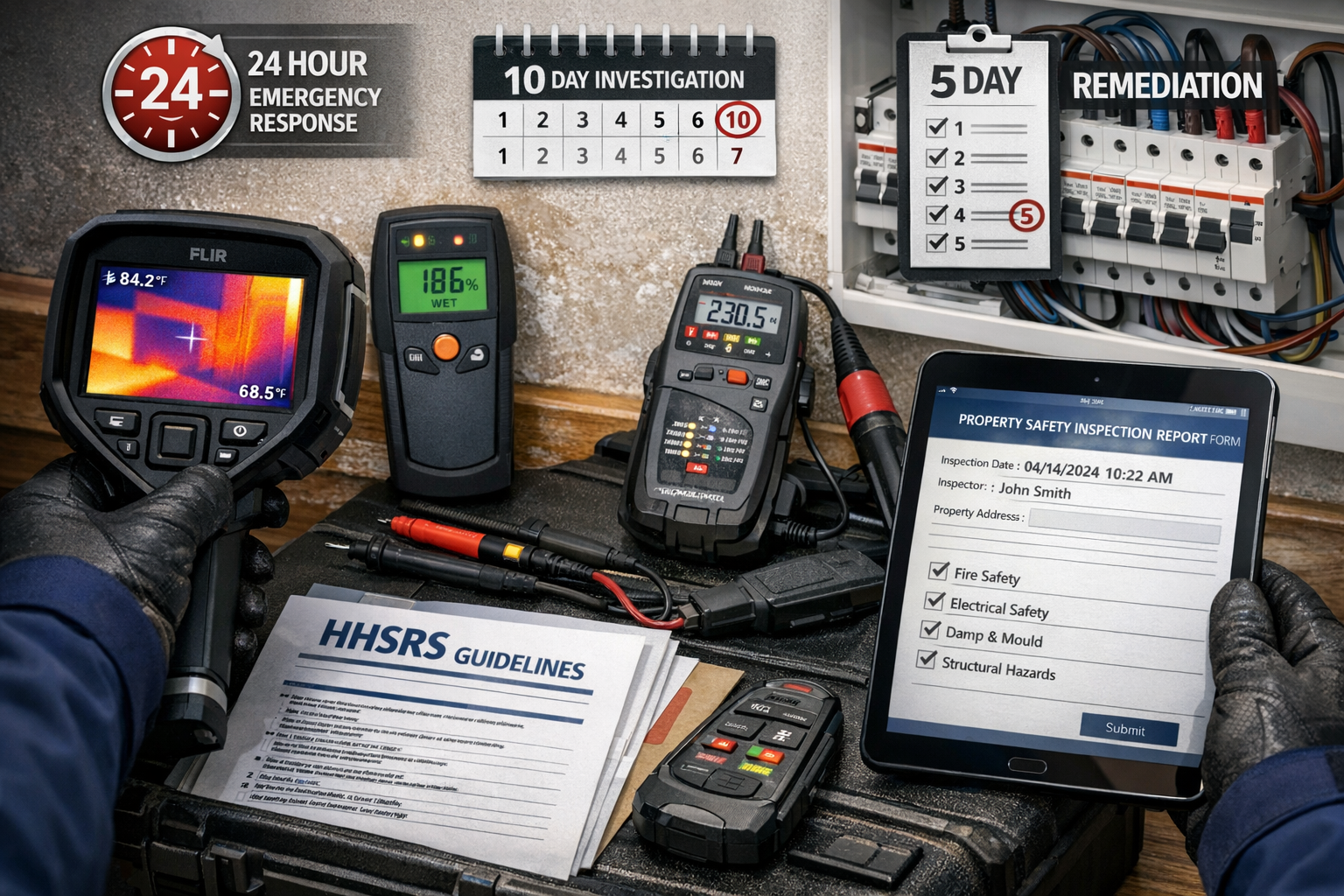
Effective Building Survey Protocols for Private Rental Sector Compliance: Navigating Awaab's Law 2026 Expansion requires systematic, reproducible inspection methodologies that withstand legal scrutiny.
Essential Equipment Checklist
Moisture and Damp Detection:
- ✅ Protimeter or equivalent moisture meter
- ✅ Thermal imaging camera (minimum 160×120 resolution)
- ✅ Hygrometer for relative humidity measurement
- ✅ Borescope for cavity inspections
Electrical and Fire Safety:
- ✅ Socket tester for polarity and earthing
- ✅ RCD testing equipment
- ✅ Smoke alarm functionality tester
- ✅ Infrared thermometer for electrical hotspot detection
Structural and Environmental:
- ✅ Crack width gauge and monitoring markers
- ✅ Spirit level and plumb bob
- ✅ Laser distance measurer
- ✅ Digital thermometer for temperature monitoring
- ✅ Lux meter for lighting adequacy assessment
Documentation Tools:
- ✅ Tablet with inspection software and HHSRS guidelines
- ✅ High-resolution camera with timestamp function
- ✅ Voice recorder for detailed observations
- ✅ Standardized inspection templates
Advanced moisture detection tools are now required as standard practice[1], and surveyors must maintain up-to-date knowledge of HHSRS guidelines to assess the expanding hazard categories effectively.
Standardized Inspection Sequence
Pre-Inspection Phase (1-2 days before):
- Review tenant hazard report and supporting evidence
- Request relevant property documentation (EPC, gas certificates, electrical reports)
- Confirm inspection appointment and access arrangements
- Prepare equipment and documentation templates
- Brief tenant on inspection process and expected duration
On-Site Inspection Phase (2-4 hours typical):
External Assessment (30-45 minutes):
- Roof condition and rainwater goods
- External wall condition and damp penetration risks
- Window and door condition
- Drainage systems and ground levels
- External electrical installations and meter condition
Internal Assessment (90-180 minutes):
- Systematic room-by-room progression
- Moisture readings at all external walls and suspect areas
- Thermal imaging of entire property envelope
- Electrical installation visual inspection
- Heating system assessment and functionality testing
- Ventilation adequacy evaluation
- Fire safety equipment verification
- Structural element condition assessment
- Fall hazard identification
- Hygiene and kitchen facility evaluation
Specialist Testing (as required):
- Gas safety verification (Gas Safe registered engineer)
- Electrical installation condition report (qualified electrician)
- Structural engineer consultation for serious defects
For properties requiring comprehensive evaluation, our building surveys provide detailed analysis across all hazard categories.
Post-Inspection Phase (1-3 days):
- Data compilation and photographic evidence organization
- HHSRS hazard scoring and risk categorization
- Report drafting with clear remedial recommendations
- Quality assurance review
- Report delivery to landlord and tenant (if requested)
Documentation Standards
Surveyor reports must meet enhanced standards given their legal weight in enforcement proceedings[1]:
Essential Report Components:
- 📄 Executive summary with hazard severity ratings
- 📄 Detailed findings for each inspected area
- 📄 Photographic evidence with annotations
- 📄 HHSRS scoring methodology and results
- 📄 Specific remedial recommendations with priority ratings
- 📄 Estimated costs and timeframes for remediation
- 📄 Interim safety measures if applicable
- 📄 Surveyor qualifications and professional indemnity details
- 📄 Declaration of independence and conflicts of interest
Critical Documentation Practices:
- Time-stamped photographs with location metadata
- Detailed moisture readings with exact measurement locations
- Thermal images with temperature scales and analysis
- Video evidence for complex defects
- Tenant statements and concerns documentation
- Previous inspection reports for comparison
When survey findings reveal significant issues, understanding what to do after a bad report on building survey becomes crucial for landlords.
Private Rental Sector Preparation Strategies
While secondary legislation for private rental sector application remains pending, proactive landlords and property managers should begin compliance preparation immediately to avoid the operational chaos that accompanied social housing implementation.
Risk Assessment and Property Auditing
Portfolio-Wide Hazard Screening:
- Prioritize high-risk properties (pre-1990s construction, previous damp issues, aging electrical systems)
- Conduct baseline inspections across entire portfolio using expanded hazard framework
- Create property-specific risk profiles with hazard severity ratings
- Develop remediation priority matrices based on risk levels and tenant vulnerability
Documentation Review:
- ✓ Gas safety certificates (annual requirement)
- ✓ Electrical Installation Condition Reports (5-year maximum age)
- ✓ Energy Performance Certificates (current validity)
- ✓ Previous survey reports and maintenance records
- ✓ Tenant complaint histories and resolution documentation
Operational Infrastructure Development
Rapid Response Team Establishment:
Landlords must establish protocols governing communications, inspections, and reporting to meet tight operational deadlines[4]. This requires:
- 🔧 Pre-qualified contractor networks with guaranteed response times
- 🔧 Emergency callout surveyors with 24-hour availability commitments
- 🔧 Dedicated compliance coordinator for tenant communications and timeline tracking
- 🔧 Digital workflow systems for hazard reporting and investigation tracking
- 🔧 Budget allocation for emergency remediation works
Tenant Communication Protocols:
- Clear hazard reporting channels (phone, email, portal)
- Acknowledgment timeframes (24-hour maximum)
- Investigation scheduling procedures
- Progress update frequencies during remediation
- Completion verification processes
Preventative Maintenance Programs
Proactive Hazard Mitigation:
Rather than reactive compliance, forward-thinking landlords implement preventative programs:
Electrical Safety:
- Five-year EICR cycle (minimum legal requirement)
- Annual visual inspections by qualified electricians
- Consumer unit upgrades to current standards
- RCD protection installation across all circuits
Damp and Mould Prevention:
- Annual ventilation system servicing
- Bi-annual gutter and downpipe clearance
- Thermal imaging surveys every 3-5 years
- Tenant education on condensation management
Our damp surveys provide specialized assessment for moisture-related hazards.
Heating and Temperature Control:
- Annual boiler servicing and efficiency testing
- Insulation upgrades to current standards
- Window replacement programs for single-glazing
- Ventilation improvements for heat management
Fire Safety:
- Annual smoke alarm testing and replacement (10-year lifespan)
- Fire door inspection and maintenance
- Escape route clearance verification
- Fire safety equipment provision in kitchens
Structural Monitoring:
- Annual structural condition assessments
- Crack monitoring programs for suspect areas
- Roof condition surveys every 5 years
- Foundation monitoring in high-risk areas
For comprehensive property evaluation, consider our specific defect survey services targeting particular hazard concerns.
Enforcement and Penalties: The Compliance Stakes
Non-compliance with Awaab's Law carries severe consequences that extend far beyond historical housing enforcement approaches.
Penalty Framework
Financial Penalties:
- 💰 Unlimited fines for serious breaches
- 💰 Compensation payments to affected tenants
- 💰 Legal costs coverage for enforcement proceedings
- 💰 Loss of rental income if properties become uninhabitable[4]
Operational Consequences:
- 🚫 Enforcement orders mandating specific actions
- 🚫 Prohibition orders preventing property occupation
- 🚫 Improvement notices with mandatory compliance deadlines
- 🚫 Rent repayment orders for non-compliant periods
- 🚫 Reputational damage affecting tenant acquisition and retention
Enforcement Authority Powers
Housing Health and Safety Rating System (HHSRS) Enforcement:
Local authorities possess extensive powers under HHSRS to:
- Conduct inspections without prior notice
- Issue improvement notices with specific compliance deadlines
- Serve prohibition orders preventing property occupation
- Initiate prosecution proceedings for serious breaches
- Require detailed remediation plans with progress reporting
Surveyor Testimony Requirements:
In enforcement proceedings, surveyors may be required to:
- Provide expert witness testimony in court
- Defend inspection methodologies and findings
- Explain HHSRS scoring rationale
- Justify remediation recommendations
- Clarify technical aspects of hazard identification[1]
This elevates the importance of thorough, defensible inspection practices and comprehensive documentation.
The Surveyor's Professional Development Imperative
Building Survey Protocols for Private Rental Sector Compliance: Navigating Awaab's Law 2026 Expansion demands enhanced professional competencies across multiple technical domains.
Essential Knowledge Areas
HHSRS Mastery:
- Comprehensive understanding of all 29 hazard categories
- Scoring methodology and risk assessment frameworks
- Likelihood and severity rating systems
- Vulnerability group considerations
- Enforcement threshold understanding
Technical Specializations:
- Advanced moisture detection and analysis
- Thermal imaging interpretation
- Electrical installation assessment
- Fire safety evaluation
- Structural condition assessment
- Ventilation and indoor air quality analysis
Legal and Regulatory Frameworks:
- Housing Act 2004 and HHSRS regulations
- Social Housing (Regulation) Act 2023
- Renters' Rights Act 2025
- Building Regulations Part F (ventilation) and Part L (conservation of fuel and power)
- Gas Safety (Installation and Use) Regulations 1998
- Electrical Safety Standards in the Private Rented Sector (England) Regulations 2020
Continuing Professional Development
Recommended Training Programs:
- HHSRS assessment and enforcement courses
- Advanced moisture investigation techniques
- Thermal imaging certification (Level 1 minimum)
- Expert witness training for legal proceedings
- Awaab's Law-specific compliance workshops
Professional Memberships:
- Royal Institution of Chartered Surveyors (RICS)
- Residential Property Surveyors Association (RPSA)
- Institute of Residential Property Management (IRPM)
Maintaining current knowledge of building surveyor best practices ensures compliance with evolving standards.
Technology Integration for Compliance Efficiency
Digital tools and platforms significantly enhance inspection efficiency and documentation quality for Building Survey Protocols for Private Rental Sector Compliance: Navigating Awaab's Law 2026 Expansion.
Digital Inspection Platforms
Benefits of Inspection Software:
- ✨ Standardized data collection templates
- ✨ Real-time photograph integration with annotations
- ✨ Automatic HHSRS scoring calculations
- ✨ Cloud-based storage and accessibility
- ✨ Timeline tracking and compliance monitoring
- ✨ Automated report generation
- ✨ Client portal integration for instant delivery
Remote Inspection Capabilities:
Awaab's Law permits remote (video) inspections unless tenants specifically request in-person visits[2]. Effective remote inspection requires:
- High-quality video conferencing platforms
- Tenant guidance protocols for camera positioning
- Screen recording for documentation purposes
- Follow-up in-person inspection triggers (inadequate visibility, complex defects)
Advanced Detection Technology
Thermal Imaging Applications:
- Heat loss identification (excess cold hazards)
- Moisture ingress detection (damp and mould risks)
- Electrical hotspot identification (electrical hazards)
- Insulation deficiency mapping
- Thermal bridging visualization
Moisture Detection Evolution:
- Radio frequency moisture meters for deep-wall penetration
- Infrared moisture detection for large-area screening
- Hygrometer arrays for continuous monitoring
- Data logging capabilities for temporal analysis
Structural Monitoring Systems:
- Digital crack monitoring gauges
- Automated alert systems for movement thresholds
- Long-term settlement tracking
- Remote monitoring capabilities
Regional Considerations and Local Authority Variations
While Awaab's Law establishes national standards, implementation nuances exist across different regions and local authorities.
London-Specific Considerations
London's rental market faces unique challenges:
- Higher property density increasing fire safety concerns
- Older housing stock with greater electrical and structural risks
- Diverse property types from Victorian conversions to modern developments
- Higher tenant turnover requiring more frequent inspections
Our coverage across London includes specialized services in Wimbledon, Notting Hill, Islington, and other areas with deep understanding of local property characteristics.
Local Authority Enforcement Approaches
Different councils adopt varying enforcement strategies:
- Proactive inspection programs in some boroughs
- Complaint-driven enforcement in resource-constrained areas
- Landlord licensing schemes with integrated compliance requirements
- Partnership approaches with landlord associations
Understanding local authority priorities helps landlords anticipate enforcement focus areas and allocate resources accordingly.
Cost Implications and Budget Planning
Compliance with Building Survey Protocols for Private Rental Sector Compliance: Navigating Awaab's Law 2026 Expansion carries significant financial implications requiring strategic budget planning.
Inspection Cost Considerations
Survey Fees:
- Standard compliance inspection: £300-£600 per property
- Comprehensive multi-hazard assessment: £600-£1,200 per property
- Emergency callout inspections: £400-£800 (24-hour response)
- Specialist assessments (electrical, structural): £250-£500 additional
Understanding property survey expenses helps landlords budget appropriately for compliance requirements.
Remediation Cost Ranges
Typical Hazard Remediation Costs:
| Hazard Category | Minor Remediation | Moderate Remediation | Major Remediation |
|---|---|---|---|
| Damp and Mould | £500-£1,500 | £1,500-£5,000 | £5,000-£15,000+ |
| Electrical | £300-£800 | £800-£3,000 | £3,000-£10,000+ |
| Fire Safety | £200-£600 | £600-£2,000 | £2,000-£8,000+ |
| Excess Cold | £1,000-£3,000 | £3,000-£10,000 | £10,000-£30,000+ |
| Structural | £1,000-£5,000 | £5,000-£20,000 | £20,000-£100,000+ |
Budget Allocation Recommendations:
- Maintain 5-10% of rental income as compliance reserve fund
- Prioritize preventative maintenance over reactive repairs
- Consider insurance products covering emergency remediation costs
- Factor compliance costs into rental pricing strategies
Future Developments and Legislative Outlook
The regulatory landscape continues evolving beyond current Building Survey Protocols for Private Rental Sector Compliance: Navigating Awaab's Law 2026 Expansion.
Anticipated Phase 3 Expansions
While specific Phase 3 hazards remain unconfirmed, likely additions include:
- 🔮 Noise hazards in multi-occupancy buildings
- 🔮 Lighting adequacy beyond fall prevention
- 🔮 Crowding and space standards
- 🔮 Water supply contamination risks
- 🔮 Asbestos and hazardous materials
Decent Homes Standard Updates
The revised Decent Homes Standard (2035/2037 implementation) will likely incorporate:
- Enhanced energy efficiency requirements (EPC C minimum)
- Improved ventilation standards
- Higher thermal performance thresholds
- Accessibility and adaptability provisions
- Digital connectivity infrastructure
Temporary Accommodation Extension
Government consultations explore extending Awaab's Law to temporary accommodation, affecting:
- Emergency housing provisions
- Homeless accommodation
- Asylum seeker housing
- Transitional housing programs
Landlords operating in these sectors should monitor legislative developments closely and prepare for compliance requirements.
Conclusion
Building Survey Protocols for Private Rental Sector Compliance: Navigating Awaab's Law 2026 Expansion represents a fundamental transformation in rental property management and surveying practice. The expansion from damp and mould to eight additional hazard categories, combined with strict legal timeframes and severe penalties for non-compliance, demands immediate action from landlords, property managers, and surveying professionals.
Critical Action Steps for Landlords:
- Conduct immediate portfolio risk assessments across all eight expanded hazard categories
- Establish rapid response protocols meeting 24-hour emergency, 10-day investigation, and 5-day remediation timelines
- Build pre-qualified contractor networks capable of delivering swift remediation works
- Implement preventative maintenance programs reducing reactive compliance burdens
- Invest in digital workflow systems tracking hazard reports and compliance timelines
- Allocate compliance budgets covering inspection costs and remediation reserves
Critical Action Steps for Surveyors:
- Enhance technical competencies across all HHSRS hazard categories through targeted CPD
- Invest in advanced detection equipment including thermal imaging and moisture analysis tools
- Develop standardized inspection protocols ensuring comprehensive, defensible assessments
- Establish emergency callout capabilities meeting 24-hour response requirements
- Upgrade documentation practices to withstand legal scrutiny in enforcement proceedings
- Consider professional indemnity insurance adequacy given elevated legal exposure
The private rental sector extension, while not yet implemented through secondary legislation, should be treated as imminent. Proactive preparation now avoids the operational disruption and compliance failures that characterized early social housing implementation.
For professional guidance on compliance inspections, remediation strategies, or portfolio risk assessments, consult qualified building surveyor services with demonstrated expertise in Awaab's Law requirements.
The stakes are clear: unlimited fines, compensation liabilities, and potential prohibition orders await non-compliant landlords. Conversely, proactive compliance delivers tenant safety, legal protection, and competitive advantage in an increasingly regulated market.
Take action today. The compliance clock is already ticking.
References
[1] Awaabs Law Surveyors – https://goreport.com/awaabs-law-surveyors/
[2] Awaabs Law Is Here The Surveyors Guide For Compliance – https://www.surventrix.com/blog/awaabs-law-is-here-the-surveyors-guide-for-compliance
[3] Awaabs Law Private Rented Sector Extension – https://awaabs-law.com/awaabs-law-private-rented-sector-extension
[4] Awaabs Law Comes Into Force What Does It Mean For Construction – https://www.trowers.com/insights/2025/november/awaabs-law-comes-into-force-what-does-it-mean-for-construction
[5] Awaabs Law 2026 Hazard Expansions Surveyor Protocols For Electrical Fire And Excess Heat Risks In Rentals – https://nottinghillsurveyors.com/blog/awaabs-law-2026-hazard-expansions-surveyor-protocols-for-electrical-fire-and-excess-heat-risks-in-rentals