
Landlords across England face their most significant regulatory shift in decades: 24-month Rent Repayment Orders for compliance failures and £40,000 maximum fines for ignoring enforcement notices[2]. The Renters' Rights Act 2026, with Phase 1 commencing 1 May 2026, fundamentally transforms how property surveyors must approach building assessments for rental properties. Understanding the Renters' Rights Act 2026 and Building Surveys: What Property Surveyors Need to Know About Landlord Liability has become essential for every RICS-accredited professional advising landlords on property condition and compliance risk.
The legislation introduces the Decent Homes Standard to private rentals, mandates rapid-response repair timelines under Awaab's Law, and creates a new Private Rented Sector Ombudsman with expanded investigatory powers[1][2]. For surveyors, this means building surveys are no longer simply condition reports—they're critical compliance documents that directly impact landlord liability exposure.
Key Takeaways
- 🏠 Decent Homes Standard extends to private rentals under Phase 3, requiring properties meet safety, maintenance, and repair standards with fines up to £7,000 for non-compliance[1]
- ⏱️ Awaab's Law mandates 10-day investigation timelines for damp and mould reports, creating urgent liability exposure for landlords who delay action[2]
- 💰 Rent Repayment Orders now cover up to 24 months of rent for qualifying maintenance and compliance offences, doubling previous limits[2]
- 📋 Surveyors must adapt assessment methodologies to identify Decent Homes Standard gaps and quantify compliance risks in building survey reports
- 🔍 Enhanced enforcement from 27 December 2025 gives local authorities expanded powers to investigate, seize evidence, and prosecute non-compliant landlords[2]
Understanding the Renters' Rights Act 2026: Core Changes Affecting Property Surveys
The Renters' Rights Act 2026 represents Parliament's most comprehensive overhaul of private rental regulation since the Housing Act 1988. For property surveyors, three fundamental changes reshape how building surveys must be conducted and reported.
Phase 1: Automatic Tenancy Conversion (1 May 2026)
From 1 May 2026, all Assured Shorthold Tenancies (ASTs) automatically convert to open-ended Periodic Tenancies[1]. This seemingly administrative change has profound implications for surveyors:
- No fixed-term endpoints mean landlords cannot defer maintenance until tenancy renewal
- Continuous compliance obligation requires properties maintain standards throughout occupation
- Survey recommendations must address immediate compliance gaps, not future renovation plans
When conducting a RICS Building Survey, surveyors must now explicitly identify defects that could trigger enforcement action under the new continuous compliance framework.
Phase 3: Decent Homes Standard Extension
The Decent Homes Standard, operational in social housing since 2001, extends to private rentals under Phase 3 implementation[1]. A decent home must meet four criteria:
- ✅ Meets current statutory minimum for housing (Housing Health and Safety Rating System)
- ✅ In reasonable state of repair with building components and services functioning properly
- ✅ Has reasonably modern facilities including kitchen, bathroom, and adequate thermal comfort
- ✅ Provides effective insulation and heating for tenant wellbeing
Local authorities can issue fines up to £7,000 for non-compliance, escalating to £40,000 for repeated offences or non-compliance with enforcement notices[1][2]. This creates immediate liability exposure that surveyors must quantify in their reports.
Awaab's Law: Rapid-Response Repair Obligations
Named after two-year-old Awaab Ishak who died from prolonged mould exposure, Awaab's Law imposes strict repair timelines[2]:
- 10 days maximum to investigate reported damp and mould
- Mandatory action plans with defined completion dates
- Tenant notification requirements throughout the process
For surveyors, this means damp surveys must now include explicit risk assessments of moisture-related hazards and quantified remediation timelines. A surveyor who identifies damp during inspection but fails to highlight the 10-day investigation obligation exposes their client to significant liability.
Renters' Rights Act 2026 and Building Surveys: Adapting Survey Methodologies for Compliance Assessment
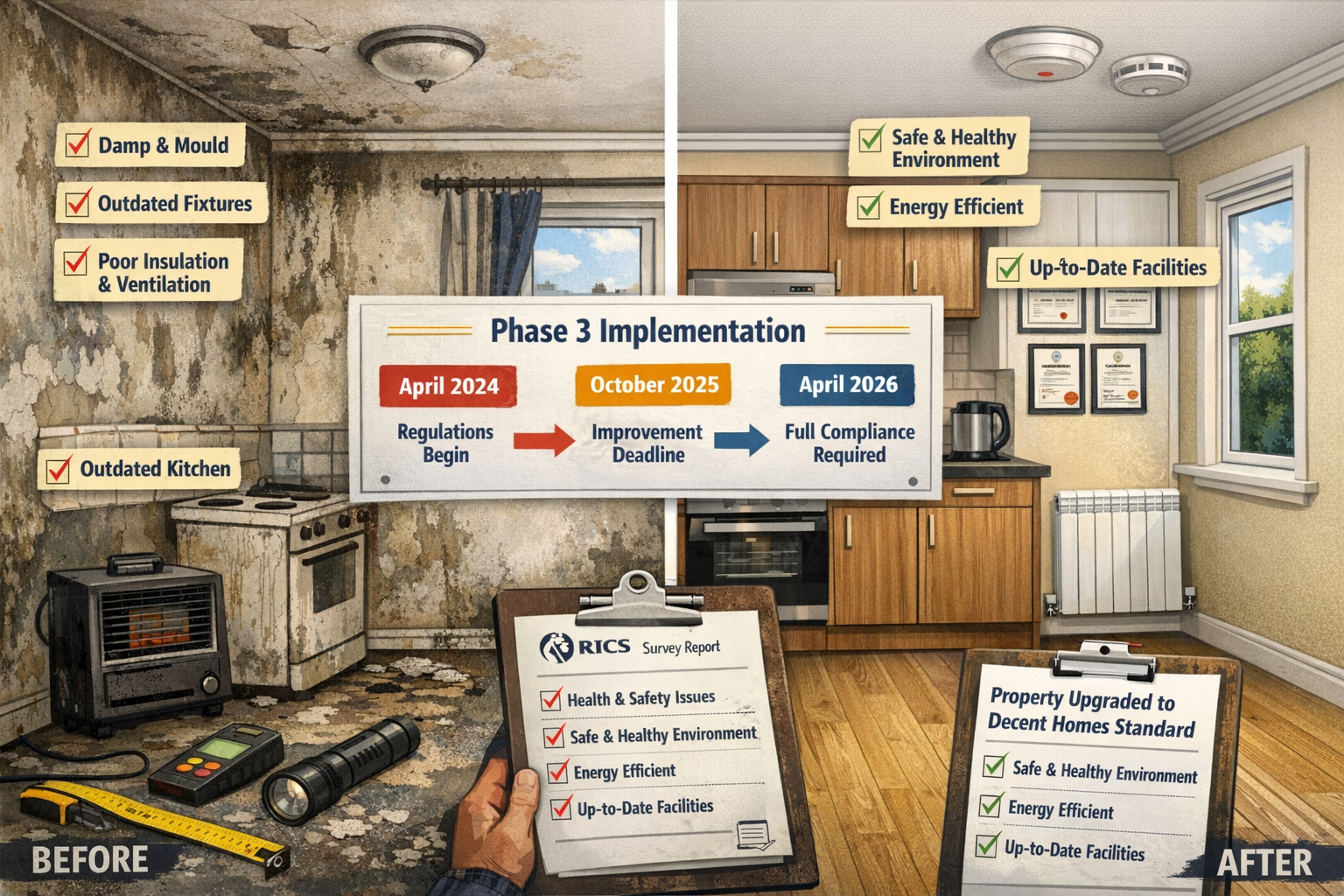
Traditional building surveys focus on structural integrity, defects, and maintenance recommendations. Under the Renters' Rights Act 2026, surveyors must expand their assessment framework to explicitly evaluate regulatory compliance risk.
Incorporating Decent Homes Standard Criteria
When conducting surveys for landlord clients, surveyors should now structure reports to address each Decent Homes Standard criterion:
1. Housing Health and Safety Rating System (HHSRS) Compliance
The HHSRS identifies 29 categories of housing hazards. Surveyors must:
- Identify Category 1 hazards (serious and immediate risks) that trigger mandatory enforcement
- Quantify Category 2 hazards that may warrant discretionary action
- Provide estimated remediation costs for each identified hazard
2. State of Repair Assessment
Beyond identifying defects, surveyors must evaluate whether disrepair would fail Decent Homes Standard thresholds:
| Building Element | Decent Homes Standard Requirement | Survey Assessment Focus |
|---|---|---|
| External walls | Weathertight, structurally sound | Render condition, pointing, damp penetration risk |
| Roof | No significant defects in covering or structure | Tile/slate condition, flashing integrity, valley gutters |
| Windows | Secure, draught-proof, in good repair | Frame condition, glazing integrity, operation |
| Heating system | Effective heating in all rooms | Boiler age/efficiency, radiator coverage, controls |
| Electrical installation | Safe and adequate | Consumer unit age, earthing, circuit protection |
A Level 3 Building Survey provides the comprehensive assessment necessary to evaluate these criteria thoroughly.
3. Modern Facilities Evaluation
Surveyors must assess whether kitchens and bathrooms meet "reasonably modern" standards:
- Kitchen installed within last 30 years with adequate layout and appliances
- Bathroom installed within last 30 years with proper ventilation
- Adequate food preparation and storage space
4. Thermal Comfort and Energy Efficiency
With fuel poverty concerns driving policy, surveyors must evaluate:
- Insulation adequacy (loft, cavity wall, floor where applicable)
- Heating system efficiency and coverage
- Glazing performance (single vs. double glazing)
- Ventilation effectiveness to prevent condensation
These assessments directly inform landlord compliance obligations and liability exposure.
Damp and Mould Risk Assessment Under Awaab's Law
The 10-day investigation timeline under Awaab's Law makes damp and mould identification critical[2]. Surveyors must:
✅ Distinguish between condensation, penetrating damp, and rising damp with clear diagnostic evidence
✅ Identify moisture sources (leaks, inadequate ventilation, thermal bridging)
✅ Assess mould growth risk in vulnerable areas (bathrooms, kitchens, poorly ventilated bedrooms)
✅ Recommend immediate actions landlords must take within the 10-day window
✅ Provide remediation timelines aligned with regulatory expectations
When surveyors identify moisture-related issues during a homebuyer survey or building survey, the report must explicitly flag the Awaab's Law compliance implications. Failure to do so could constitute professional negligence if the landlord subsequently faces enforcement action.
Documenting Compliance Gaps and Liability Exposure
Modern building survey reports for rental properties should include a dedicated Compliance Risk Assessment section that:
- Lists identified Decent Homes Standard failures with specific criteria references
- Quantifies potential enforcement penalties based on identified defects
- Provides prioritized remediation schedule aligned with regulatory timelines
- Estimates total compliance cost to bring property to required standard
This approach transforms the building survey from a passive condition report into an active risk management tool that helps landlords understand and mitigate their liability exposure under the Renters' Rights Act 2026.
Landlord Liability Under the Renters' Rights Act 2026: What Surveyors Must Communicate
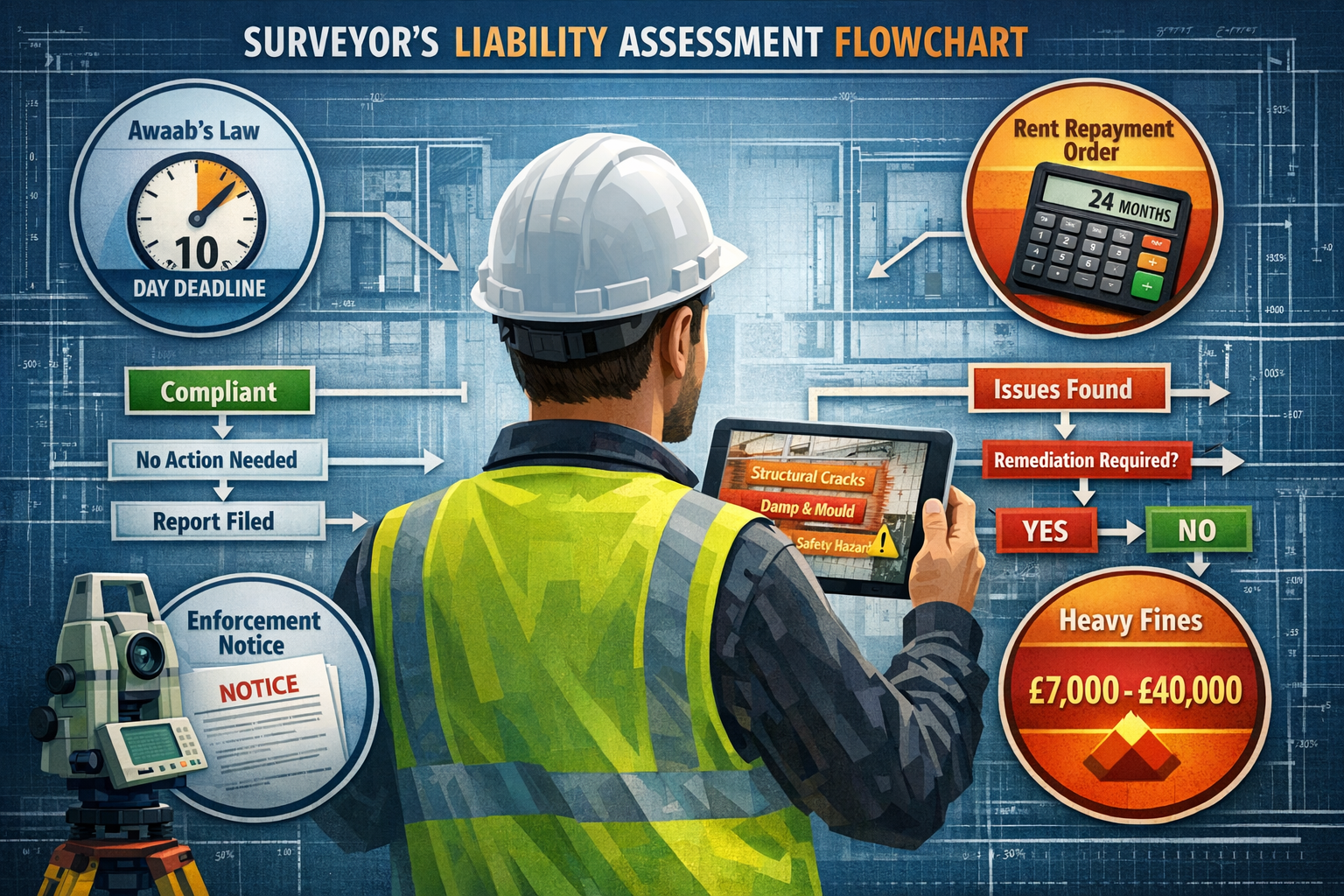
Understanding Renters' Rights Act 2026 and Building Surveys: What Property Surveyors Need to Know About Landlord Liability requires surveyors to grasp the enforcement mechanisms and financial consequences their clients face.
Enhanced Local Authority Powers (Active from 27 December 2025)
From 27 December 2025, local authorities received significantly expanded investigatory powers[2]:
- 🔍 Data access rights to demand information from banks and third parties
- 🏢 Premises entry powers to inspect properties and seize evidence
- 📊 Database access to identify non-compliant landlords systematically
These powers enable proactive enforcement rather than reactive complaint-based action. Surveyors must advise landlords that compliance failures identified in building surveys could be discovered through local authority investigations even without tenant complaints.
Rent Repayment Orders: Doubled Exposure
Rent Repayment Orders (RROs) represent the most significant financial liability for non-compliant landlords. The Act doubles the claim period from 12 to 24 months[2].
Tenants can claim RROs for offences including:
- Operating without required licenses
- Failing to comply with improvement notices
- Breaching management regulations
- Committing certain housing-related offences
Example calculation: A landlord renting a property for £1,500/month who fails to comply with an improvement notice related to damp and mould could face an RRO of up to £36,000 (24 months × £1,500) plus legal costs.
When surveyors identify defects that could trigger enforcement notices, they should explicitly quantify the potential RRO exposure in their reports. This financial context often motivates landlords to prioritize remediation.
Fine Structure and Escalation
The enforcement penalty structure creates escalating consequences:
| Offence Level | Maximum Fine | Trigger |
|---|---|---|
| Initial non-compliance | £7,000 | Failure to meet Decent Homes Standard[1] |
| Non-compliance with enforcement notice | £40,000 | Ignoring local authority improvement/prohibition notice[1][2] |
| Prosecution | Unlimited | Serious or persistent offences |
Surveyors should flag defects that could trigger each escalation level, helping landlords understand the urgency of remediation.
The Private Rented Sector Ombudsman
The Act establishes a Private Rented Sector Ombudsman with authority to:
- Investigate tenant complaints about property conditions
- Order landlords to take specific actions
- Award compensation to tenants
- Publish decisions creating reputational consequences
For surveyors, this creates a new compliance pathway. Survey reports should anticipate potential Ombudsman complaints by identifying conditions that could generate tenant dissatisfaction and regulatory scrutiny.
Professional Indemnity Considerations for Surveyors
The expanded liability landscape affects surveyors' own professional risk exposure. Surveyors should:
✅ Ensure professional indemnity insurance covers advice on regulatory compliance matters
✅ Use clear disclaimers distinguishing between building condition assessment and legal compliance advice
✅ Recommend specialist input (e.g., HHSRS assessors, environmental health consultants) for complex compliance questions
✅ Document advice given regarding compliance risks and landlord obligations
✅ Update terms of engagement to reflect the expanded scope of rental property assessments
When a surveyor identifies significant compliance risks but the landlord chooses not to remediate, documented advice protects the professional from subsequent liability claims.
Practical Guidance: Conducting Building Surveys for Rental Properties in 2026
For surveyors adapting to the new regulatory environment, practical implementation requires updated methodologies and reporting templates.
Pre-Survey Preparation
1. Confirm Property Use and Tenancy Status
- Verify whether property is currently let or intended for rental
- Identify tenancy type (though all ASTs convert to Periodic from 1 May 2026)[1]
- Understand landlord's compliance history and any existing enforcement actions
2. Expand Inspection Scope
Traditional building surveys may not adequately assess all Decent Homes Standard criteria. Expand inspection to include:
- Detailed heating system assessment (efficiency, coverage, controls)
- Kitchen and bathroom age and condition evaluation
- Insulation presence and adequacy (loft, walls, floors)
- Ventilation effectiveness in all habitable rooms
- Electrical installation age and safety features
3. Prepare Compliance Checklists
Develop standardized checklists covering:
- Each Decent Homes Standard criterion
- Common HHSRS Category 1 and 2 hazards
- Awaab's Law damp and mould risk factors
- Energy efficiency requirements
On-Site Assessment Techniques
Moisture and Mould Detection
Given Awaab's Law's 10-day investigation requirement[2], surveyors must:
- Use moisture meters systematically in vulnerable areas
- Photograph any visible mould growth with scale references
- Test ventilation effectiveness (trickle vents, extractor fans)
- Identify condensation risk factors (cold surfaces, inadequate heating)
Thermal Imaging (Where Appropriate)
For rental properties with suspected insulation deficiencies or thermal bridging, thermal imaging cameras provide visual evidence of:
- Missing or inadequate insulation
- Air leakage paths
- Cold spots creating condensation risk
This evidence strengthens the compliance case and helps prioritize remediation.
Safety Hazard Documentation
Category 1 HHSRS hazards require immediate attention. Surveyors should:
- Photograph hazards clearly with context
- Measure and quantify risks (e.g., balustrade heights, stair dimensions)
- Note absence of required safety features (smoke alarms, carbon monoxide detectors)
Report Structure and Content
Executive Summary: Compliance Status
Begin rental property survey reports with a clear compliance status statement:
"This property currently FAILS to meet Decent Homes Standard requirements due to [specific deficiencies]. Estimated compliance cost: £[X]. Potential enforcement penalties: £[Y] to £[Z]. Urgent action required before [date]."
This immediate clarity helps landlords understand their risk exposure.
Defect Categorization by Urgency
Categorize identified defects using a compliance-focused urgency framework:
- Immediate Compliance Risk (Category 1 HHSRS hazards, Awaab's Law triggers)
- Decent Homes Standard Failures (requiring remediation within defined timelines)
- Standard Maintenance Issues (not currently triggering enforcement but requiring attention)
- Improvement Recommendations (enhancing property beyond minimum standards)
Cost Estimates and Remediation Timelines
Provide realistic cost ranges for bringing the property to compliance:
- Individual defect remediation costs
- Total compliance investment required
- Phased remediation schedule if immediate full compliance is cost-prohibitive
- Estimated timeframes for each remediation phase
Compliance Certification Recommendations
Advise landlords on obtaining required certifications:
- Electrical Installation Condition Report (EICR) – required every 5 years
- Gas Safety Certificate – required annually
- Energy Performance Certificate (EPC) – minimum rating requirements
- Legionella risk assessment – required for rental properties
When conducting property condition assessments, surveyors should verify current certification status and flag any missing or expired documents.
Strategic Advice for Landlord Clients: Proactive Compliance Management
Beyond identifying defects, surveyors add value by providing strategic guidance on compliance management.
Prioritization Framework
Help landlords prioritize remediation using a risk-weighted framework:
High Priority (Address within 1-3 months):
- Category 1 HHSRS hazards
- Awaab's Law damp and mould risks
- Electrical safety deficiencies
- Gas safety issues
Medium Priority (Address within 6-12 months):
- Decent Homes Standard failures not posing immediate safety risk
- Heating system inefficiencies
- Insulation deficiencies
- Outdated kitchen/bathroom facilities
Lower Priority (Address within 1-2 years):
- Cosmetic improvements
- Energy efficiency enhancements beyond minimum standards
- Future-proofing investments
Preventive Maintenance Programs
Recommend landlords implement structured maintenance programs:
- Annual property inspections to identify emerging compliance issues
- Seasonal maintenance schedules (gutters, heating systems, ventilation)
- Tenant reporting systems enabling rapid response to maintenance requests
- Documentation protocols creating evidence trails of compliance efforts
Surveyors can offer monitoring surveys as part of ongoing compliance management programs.
Cost-Benefit Analysis
For landlords considering portfolio decisions, provide cost-benefit analysis:
- Compliance investment vs. potential enforcement penalties and RROs
- Rental income continuity vs. remediation period void costs
- Property value impact of bringing to compliance standard
- Insurance premium implications of documented compliance
This financial context helps landlords make informed decisions about property retention, sale, or investment.
Engagement with the Private Rented Sector Ombudsman
Advise landlords on proactive Ombudsman engagement:
- Register with the Ombudsman scheme as required
- Implement complaint handling procedures
- Document all maintenance actions and tenant communications
- Use survey reports as evidence of proactive compliance management
When landlords can demonstrate they commissioned professional building surveys and followed surveyor recommendations, they strengthen their position in any dispute resolution process.
The Surveyor's Role in the New Regulatory Landscape
The Renters' Rights Act 2026 fundamentally repositions property surveyors from passive observers to active compliance advisors. This expanded role brings both opportunities and responsibilities.
Professional Development Requirements
Surveyors should invest in:
- Training on Decent Homes Standard assessment methodologies
- HHSRS qualification or working knowledge of the 29 hazard categories
- Regulatory update programs tracking enforcement trends and case law
- Building pathology expertise particularly regarding damp, mould, and ventilation
Professional bodies including RICS are developing specialized guidance for surveyors working in the rental sector under the new legislation.
Collaborative Approach
Complex compliance assessments often require multidisciplinary input. Surveyors should build referral networks including:
- Environmental health practitioners for HHSRS assessments
- Electrical engineers for detailed installation evaluations
- Heating engineers for system efficiency assessments
- Damp specialists for complex moisture investigations
- Legal advisors for enforcement response strategies
Knowing when to recommend specific defect surveys by specialists demonstrates professional judgment and protects client interests.
Market Positioning
Forward-thinking surveying practices are developing specialized rental property compliance services:
- Compliance audits against Decent Homes Standard
- Portfolio risk assessments for landlords with multiple properties
- Pre-purchase compliance due diligence for rental property investors
- Expert witness services for enforcement appeals and Ombudsman disputes
These specialized services command premium fees while providing essential value in the new regulatory environment.
Case Study: Applying the Framework
Scenario: A landlord commissions a building survey for a Victorian terrace house currently let on an AST, planning to continue renting after 1 May 2026.
Survey Findings:
- Single-glazed sash windows throughout (thermal inefficiency, condensation risk)
- Bathroom installed 1985 (fails "reasonably modern" criterion)
- Visible mould growth in two bedrooms (Awaab's Law trigger)
- Gas boiler 18 years old, inefficient, inadequate radiator coverage
- Loft insulation 100mm (below recommended 270mm)
- EICR expired, no recent electrical inspection
Surveyor's Compliance Assessment:
Immediate Risks (1-3 months):
- ⚠️ Mould growth triggers 10-day investigation obligation under Awaab's Law[2]
- ⚠️ Expired EICR creates licensing compliance risk
- Estimated RRO exposure if tenant complains: £36,000 (24 months rent)
- Potential fine: £7,000 for Decent Homes Standard failure[1]
Decent Homes Standard Failures:
- Inadequate thermal comfort (single glazing, insufficient insulation, inefficient heating)
- Bathroom beyond 30-year threshold
- Inadequate state of repair (mould indicates ventilation/heating deficiency)
Recommended Actions:
- Immediate (within 14 days): Commission specialist mould investigation, obtain current EICR
- Short-term (3-6 months): Install adequate ventilation, upgrade heating system, address mould remediation
- Medium-term (6-12 months): Replace bathroom, upgrade loft insulation to 270mm
- Longer-term (12-24 months): Consider secondary glazing or window replacement program
Estimated Compliance Investment: £18,000-£25,000
Risk-Benefit Analysis: Investment protects against £43,000+ potential penalties (£7,000 fine + £36,000 RRO) plus legal costs and reputational damage.
This comprehensive approach demonstrates how surveyors can transform building surveys into strategic compliance tools under the Renters' Rights Act 2026.
Conclusion
The Renters' Rights Act 2026 and Building Surveys: What Property Surveyors Need to Know About Landlord Liability represents a fundamental shift in rental property assessment. With Phase 1 implementation beginning 1 May 2026, surveyors must adapt their methodologies to explicitly evaluate compliance risks, quantify liability exposure, and provide strategic remediation guidance[1][2].
The extension of the Decent Homes Standard to private rentals, combined with Awaab's Law's rapid-response requirements and doubled Rent Repayment Order periods, creates significant financial consequences for non-compliant landlords. Surveyors who understand these regulatory mechanisms and incorporate compliance assessment into their building surveys provide essential risk management value to their clients.
Actionable Next Steps for Property Surveyors
✅ Update survey templates to include Decent Homes Standard compliance checklists
✅ Develop specialized rental property assessment services with compliance risk quantification
✅ Invest in professional development covering HHSRS, Awaab's Law, and enforcement procedures
✅ Build referral networks with specialists for complex compliance assessments
✅ Review professional indemnity insurance to ensure coverage for compliance advisory services
✅ Create client education materials explaining landlord obligations under the Act
✅ Establish ongoing compliance monitoring services for landlord portfolio clients
The regulatory landscape has permanently shifted. Surveyors who adapt their practice to this new reality will not only protect their clients from significant liability exposure but position themselves as essential advisors in the evolving rental property market. Understanding how to choose the right survey becomes even more critical when compliance implications are at stake.
For landlords navigating these changes, commissioning a comprehensive RICS Building Survey from a qualified professional who understands the Renters' Rights Act 2026 is no longer optional—it's essential risk management that could save tens of thousands of pounds in enforcement penalties and legal costs.
References
[1] The Renters Rights Act What S Changing What It Means For Landlords And How To Mitigate Risks – https://www.kennedyslaw.com/en/thought-leadership/article/2026/the-renters-rights-act-what-s-changing-what-it-means-for-landlords-and-how-to-mitigate-risks/
[2] Renters Rights Act Everything Guide – https://www.crownluxuryhomes.com/renters-rights-act-everything-guide/