
The UK office market stands at a pivotal crossroads in 2026. After years of pandemic-induced uncertainty, offices are re-emerging as underpriced assets with significant investment potential. Yet this revival isn't simply about returning to pre-2020 norms—it's about transforming outdated buildings into intelligent, efficient workspaces through AI-driven retrofits. For chartered surveyors and property professionals, Building Survey Protocols for Office Sector Revival: Assessing AI-Driven Retrofits in Core UK Cities represents a fundamental shift in how we evaluate commercial property potential, particularly in regenerating urban centers like Manchester, Birmingham, and Leeds.
The challenge is clear: 13 UK property sub-sectors are forecast to see annualized returns exceeding 8% between 2026-2030, with prime regional offices leading the charge.[7] However, capturing this value requires surveyors to adapt traditional assessment methodologies to accommodate sophisticated retrofit technologies that integrate artificial intelligence, IoT sensors, and automated building management systems.
Key Takeaways
- Process-first approach: 55% of professionals agree that fixing basic building processes must precede AI implementation, with 95% of AI initiatives failing when applied in isolation[3]
- Quality defines value: The 2026 workspace market prioritizes quality retrofits in good central locations, with strongest rental growth in modernized office stock[4]
- RICS compliance is essential: Building Survey Protocols for Office Sector Revival must align with established standards while incorporating new assessment criteria for smart building technologies
- Regional cities offer opportunity: Manchester, Birmingham, and other core UK cities present significant retrofit potential with lower entry costs than London
- Agentic AI moves beyond pilots: 2026 marks the transition from experimental AI applications to real operational impact in facility management and building operations[5]
Understanding Building Survey Protocols for Office Sector Revival in 2026
The Evolution of Commercial Building Assessments
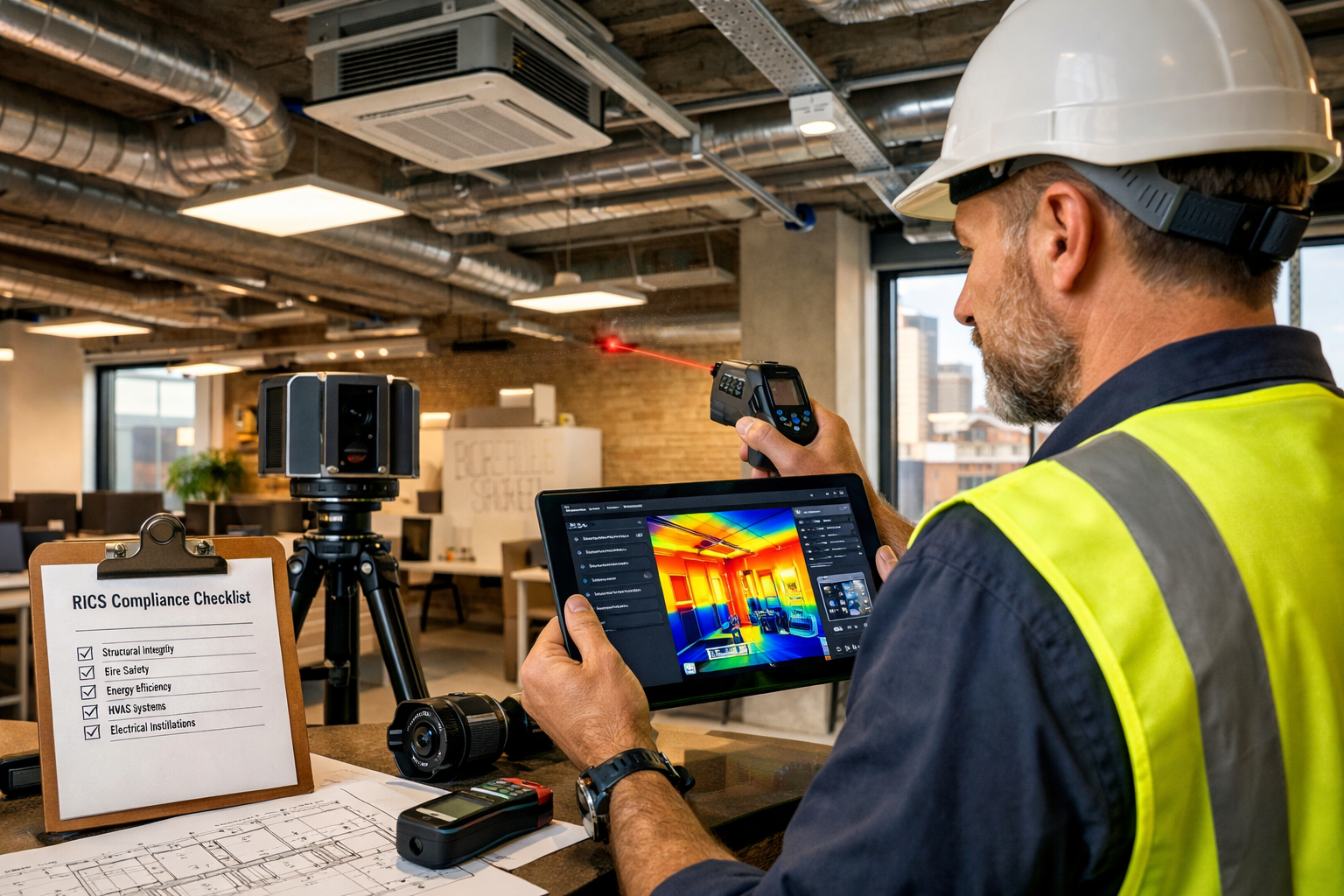
Traditional building surveys have long focused on structural integrity, material condition, and compliance with building regulations. However, Building Survey Protocols for Office Sector Revival: Assessing AI-Driven Retrofits in Core UK Cities demands a more comprehensive approach that evaluates both physical infrastructure and technological capability.
Modern survey protocols must now assess:
- 🏢 Structural adaptability for technology integration
- 💡 Energy efficiency baseline and improvement potential
- 🤖 AI-readiness of existing building management systems
- 📊 Data infrastructure capacity and connectivity
- 🌱 Sustainability credentials and retrofit pathways
- 👥 Occupier experience enhancement opportunities
The distinction between standard building condition assessments and AI-retrofit evaluations lies in the forward-looking nature of the latter. Surveyors must evaluate not just current state, but transformation potential—a skill that requires understanding both construction fundamentals and emerging workplace technologies.
Why Core UK Cities Are Retrofit Hotspots
While London remains the traditional focus of commercial property investment, cities like Manchester, Birmingham, Leeds, and Bristol offer compelling advantages for office sector revival through AI-driven retrofits:
| City | Key Advantages | Average Office Yield (2026) |
|---|---|---|
| Manchester | Strong tech sector growth, lower acquisition costs, excellent connectivity | 6.2% |
| Birmingham | Major infrastructure investment (HS2), diverse economy, substantial Grade B stock | 6.5% |
| Leeds | Financial services hub, skilled workforce, competitive rents | 6.3% |
| Bristol | Tech and creative industries, quality of life appeal, sustainability focus | 5.8% |
| Glasgow | Emerging tech scene, significant retrofit opportunities, government support | 7.1% |
These regional markets present substantial retrofit opportunities where intelligent building upgrades can transform underperforming assets into premium workspace. The combination of lower entry costs and strong tenant demand creates ideal conditions for value-add strategies centered on AI-enhanced building performance.
Core Components of AI-Driven Retrofit Assessment Protocols

Technical Infrastructure Evaluation
When conducting Building Survey Protocols for Office Sector Revival: Assessing AI-Driven Retrofits in Core UK Cities, the technical infrastructure assessment forms the foundation of retrofit feasibility. This evaluation extends beyond traditional mechanical and electrical surveys to encompass digital readiness.
Critical infrastructure elements include:
-
Power Capacity and Distribution
- Existing electrical load capacity
- Upgrade requirements for AI systems and sensors
- Renewable energy integration potential
- Battery storage feasibility
-
Data Connectivity Infrastructure
- Fiber optic availability and capacity
- 5G readiness and coverage
- Internal network architecture
- Edge computing capabilities
-
Building Management Systems (BMS)
- Current automation level
- Integration compatibility with AI platforms
- Sensor network density and coverage
- Data collection and analytics capability
-
HVAC and Environmental Systems
- Zoning flexibility for occupancy-responsive control
- Smart thermostat compatibility
- Air quality monitoring integration
- Energy recovery systems
According to recent research, 45% of AI applications remain bolt-on experiments rather than integrated core systems.[3] This highlights the importance of assessing whether existing building infrastructure can support fully integrated AI solutions or will require phased implementation approaches.
Structural and Spatial Adaptability Assessment
AI-driven retrofits often necessitate physical modifications to accommodate new technologies and evolving workplace configurations. Expert building evaluation protocols must therefore assess structural flexibility alongside technological capability.
Key spatial considerations:
- Floor-to-ceiling heights: Adequate clearance for modern HVAC, lighting, and sensor arrays (minimum 2.7m preferred)
- Column spacing: Flexibility for open-plan configurations and collaborative zones (6-9m spans optimal)
- Floor loading capacity: Ability to support dense occupancy and equipment loads (4-5 kN/m² minimum)
- Natural light penetration: Window-to-floor ratios supporting wellbeing and energy efficiency (minimum 20%)
- Vertical circulation: Adequate lift capacity for modern occupancy patterns
Many Victorian and Edwardian office buildings in cities like Manchester and Birmingham possess inherent spatial advantages—high ceilings, robust construction, and generous floor plates—that make them excellent retrofit candidates when combined with modern building services.
Energy Performance and Sustainability Metrics
Building Survey Protocols for Office Sector Revival must incorporate comprehensive energy assessments that establish baseline performance and identify improvement pathways. With quality and retrofit defining the 2026 workspace market[4], sustainability credentials increasingly influence both occupier demand and asset valuation.
"Quality, retrofit, and selectivity are predicted to define the UK workspace market, with strongest rental growth in quality offices in good central locations." – Estate Gazette Industry Leaders, 2026[4]
Essential energy evaluation components:
- EPC rating and pathway to minimum Band B (regulatory requirement by 2030)
- NABERS UK rating potential and improvement roadmap
- Embodied carbon assessment versus new-build alternatives
- Operational carbon reduction opportunities through AI optimization
- Renewable energy generation and storage potential
- Water efficiency and smart metering capabilities
AI-driven building management systems can typically achieve 15-30% energy savings through optimized HVAC control, predictive maintenance, and occupancy-responsive operations. However, these benefits depend on adequate sensor deployment and data infrastructure—factors that must be evaluated during initial survey protocols.
Implementing RICS-Compliant Survey Methodologies for AI Retrofits
Adapting Traditional Survey Standards
The Royal Institution of Chartered Surveyors (RICS) provides the professional framework for building inspection and assessment in the UK. While RICS standards weren't originally designed for AI-driven retrofit evaluation, their principles of thoroughness, objectivity, and professional judgment remain fully applicable.
RICS-compliant AI-retrofit surveys should incorporate:
-
Desktop Research Phase
- Historical building records and previous surveys
- Planning permissions and building control approvals
- Energy Performance Certificates and sustainability assessments
- Occupancy history and tenant feedback
- Local market analysis and comparable transactions
-
Physical Inspection Phase
- Comprehensive condition assessment following RICS guidance
- Technology infrastructure audit
- Accessibility and compliance review
- Environmental hazard screening
- Photographic and measured survey documentation
-
Technical Evaluation Phase
- Mechanical and electrical systems assessment
- Structural engineer consultation where required
- Building services engineer input on retrofit feasibility
- Technology consultant review of AI integration potential
- Cost consultant preliminary budget estimates
-
Reporting Phase
- Structured report following RICS format
- Prioritized recommendations with cost-benefit analysis
- Phased implementation roadmap
- Risk assessment and mitigation strategies
- ROI projections for retrofit investment
For commercial property inspections, this enhanced methodology ensures that clients receive comprehensive guidance on both traditional building concerns and modern retrofit opportunities.
Cost Efficiency and Investment Appraisal
A critical component of Building Survey Protocols for Office Sector Revival: Assessing AI-Driven Retrofits in Core UK Cities involves realistic cost assessment and return-on-investment analysis. Research indicates that 55% of professionals prioritize fixing basic processes before introducing new technology[3], suggesting that retrofit strategies must balance technological ambition with practical implementation realities.
Cost framework for AI-driven office retrofits:
| Retrofit Component | Typical Cost Range (per sq ft) | Payback Period | Value Impact |
|---|---|---|---|
| Smart HVAC systems | £15-30 | 4-7 years | +8-12% rental premium |
| LED lighting + controls | £8-15 | 2-4 years | +5-8% rental premium |
| Occupancy sensors + analytics | £5-12 | 3-5 years | +6-10% rental premium |
| Access control + security | £6-10 | 5-8 years | +4-7% rental premium |
| Comprehensive BMS integration | £25-45 | 5-9 years | +12-18% rental premium |
| Full AI-driven retrofit package | £80-150 | 6-10 years | +20-30% rental premium |
These figures demonstrate that while initial investment can be substantial, the combination of energy savings, operational efficiency, and rental premium creates compelling business cases for quality retrofits in prime locations.
Similar to how residential buyers can achieve significant savings with building surveys, commercial investors benefit from thorough pre-acquisition assessments that identify both risks and value-creation opportunities.
Occupier Regears and Tenant-Centric Retrofit Strategies
Understanding Occupier Requirements in 2026
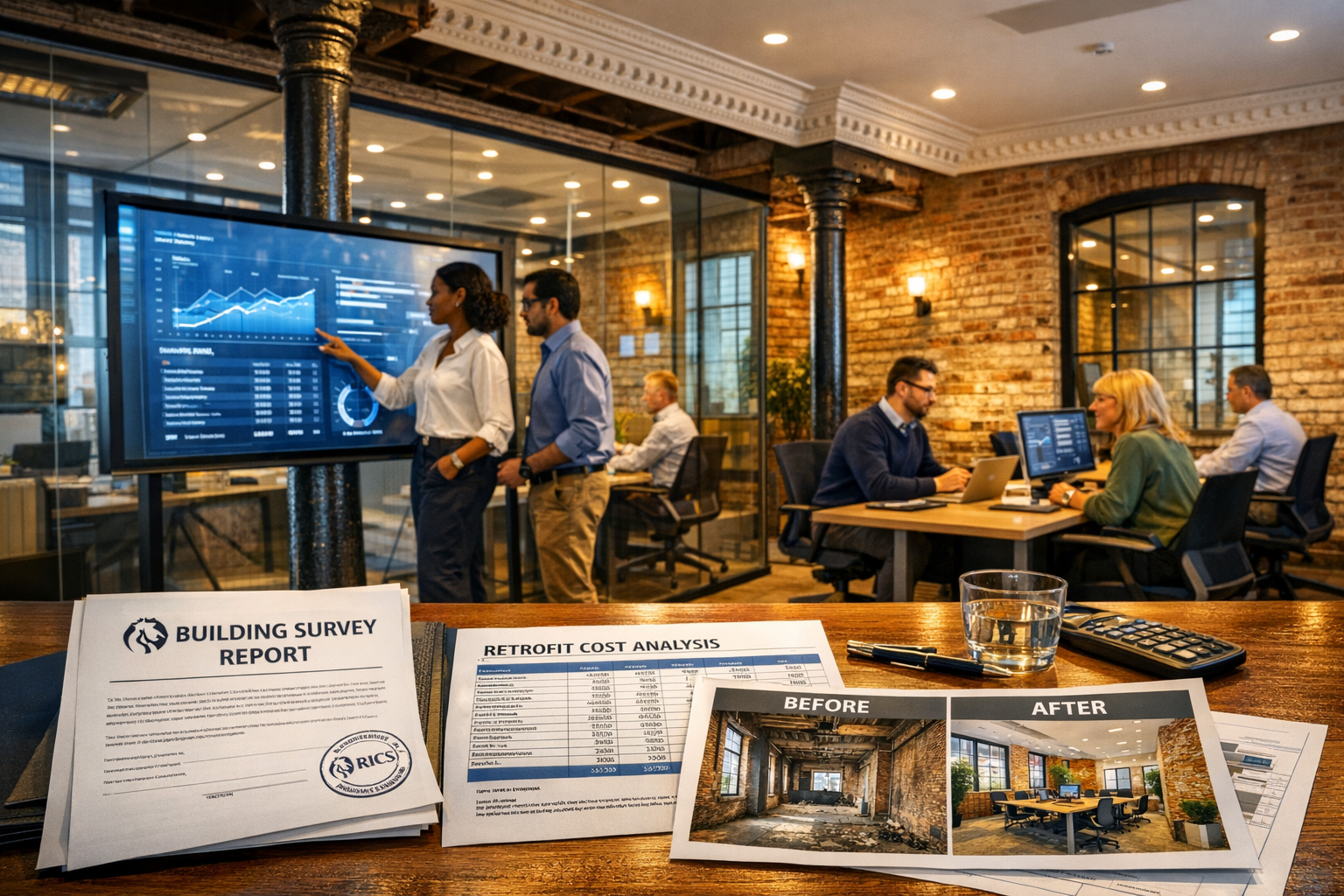
The office sector revival isn't driven solely by investor appetite—it reflects genuine occupier demand for quality workspace that supports hybrid working, employee wellbeing, and corporate sustainability goals. Building Survey Protocols for Office Sector Revival must therefore incorporate tenant requirement analysis alongside physical building assessment.
Key occupier priorities in 2026:
- 🌟 Flexibility: Adaptable spaces supporting multiple working modes
- 💚 Sustainability: Demonstrable environmental credentials and reporting
- 🏥 Wellbeing: Air quality, natural light, and biophilic design elements
- 🔌 Technology: Seamless connectivity and smart building features
- 🚇 Accessibility: Excellent public transport links and active travel facilities
- 🤝 Amenities: On-site facilities supporting work-life integration
Research from McKinsey suggests that 2026 positions agentic AI to move beyond pilots into real operating impact[5], with applications in complaint handling, work-order processing, and service charge management—all factors that directly influence occupier satisfaction and retention.
Lease Structure and Retrofit Timing Considerations
When assessing retrofit opportunities, surveyors must consider existing lease structures and tenant obligations. The timing of major works relative to lease events significantly impacts both feasibility and return on investment.
Strategic timing scenarios:
- Vacant Possession: Optimal timing for comprehensive retrofit without tenant disruption
- Lease Expiry (0-12 months): Opportunity for regear negotiations incorporating retrofit works
- Break Clause Approaching: Risk mitigation through proactive upgrade discussions
- Mid-lease Period: Potential for phased works with tenant cooperation agreements
- Multiple Tenancies: Complex coordination requiring careful planning and communication
For properties with existing occupiers, Building Survey Protocols for Office Sector Revival should include tenant engagement strategies that align retrofit plans with occupier requirements, potentially securing lease extensions or rent increases that justify investment.
This approach mirrors residential scenarios where negotiating purchase price with building survey findings creates win-win outcomes—in commercial contexts, retrofit negotiations can similarly benefit both landlords and tenants.
Regional Market Considerations for Core UK Cities
Manchester: Tech-Driven Office Renaissance
Manchester exemplifies the office sector revival opportunity in regional UK cities. With a thriving technology sector, world-class universities, and significant infrastructure investment, the city offers compelling retrofit opportunities across various submarkets.
Manchester retrofit hotspots:
- Spinningfields: Premium CBD location with modern stock requiring technology upgrades
- Northern Quarter: Creative sector hub with characterful buildings needing comprehensive modernization
- Ancoats: Former industrial area with substantial conversion and retrofit potential
- Oxford Road Corridor: Knowledge economy focus driving demand for quality workspace
Building Survey Protocols for Office Sector Revival in Manchester must account for the city's heritage building stock, with many potential retrofit candidates being listed or within conservation areas. This requires specialist knowledge of heritage-sensitive retrofit techniques that preserve architectural character while introducing modern building performance.
Birmingham: Infrastructure-Led Transformation
Birmingham's office market benefits from major infrastructure catalysts, particularly HS2 connectivity that positions the city as a genuine alternative to London for corporate occupiers. This creates substantial retrofit demand as occupiers seek quality accommodation to support expansion plans.
Birmingham-specific assessment considerations:
- HS2 Curzon Street proximity: Premium value for offices within walking distance
- Paradise development: New Grade A supply setting quality benchmarks
- Colmore Row: Historic business district with retrofit-ready Victorian stock
- Jewellery Quarter: Creative industries driving demand for characterful workspace
Survey protocols must evaluate how existing buildings can compete with new Grade A supply through intelligent retrofit strategies that offer character, sustainability, and technology at competitive rents.
Cross-City Protocol Standardization
While each city presents unique characteristics, Building Survey Protocols for Office Sector Revival: Assessing AI-Driven Retrofits in Core UK Cities benefit from standardized assessment frameworks that ensure consistency and comparability across markets.
Recommended standardization elements:
- Consistent technology assessment criteria and scoring
- Uniform energy performance benchmarking methodologies
- Standardized cost estimation frameworks
- Comparable rental premium projections
- Aligned risk assessment matrices
This standardization enables institutional investors to deploy capital efficiently across multiple regional markets while maintaining consistent due diligence standards.
Practical Implementation: From Survey to Successful Retrofit
Phased Implementation Roadmap
Research demonstrates that 95% of AI initiatives fail to provide value when applied in isolation[3], emphasizing the importance of structured, phased implementation approaches. Building Survey Protocols for Office Sector Revival should therefore include clear implementation roadmaps that sequence works logically and manage risk effectively.
Recommended retrofit phases:
Phase 1: Foundation Works (Months 1-6)
- Building fabric improvements (insulation, glazing, air-tightness)
- Base building services upgrades (electrical capacity, data infrastructure)
- Essential compliance works (fire safety, accessibility)
- Energy metering and sub-metering installation
Phase 2: Core Systems (Months 7-12)
- Smart HVAC system installation and commissioning
- LED lighting with occupancy controls
- Building Management System implementation
- Initial sensor network deployment
Phase 3: AI Integration (Months 13-18)
- Advanced analytics platform deployment
- Machine learning algorithm training and optimization
- Occupier interface and app development
- Integration with tenant systems and workflows
Phase 4: Optimization and Enhancement (Months 19-24)
- Performance monitoring and fine-tuning
- Additional sensor deployment based on usage patterns
- Enhanced features and functionality rollout
- Continuous improvement protocols
This phased approach allows for learning and adaptation while maintaining building operations and minimizing tenant disruption—critical factors for successful commercial retrofits.
Risk Management and Contingency Planning
Comprehensive Building Survey Protocols for Office Sector Revival must identify potential risks and incorporate appropriate mitigation strategies. This professional approach protects both investor capital and project timelines.
Key risk categories:
-
Technical Risks
- Unforeseen structural issues discovered during works
- Technology integration challenges or compatibility problems
- Performance shortfalls versus projected outcomes
- Mitigation: Thorough pre-works investigation, specialist consultants, performance guarantees
-
Financial Risks
- Cost overruns exceeding budget contingencies
- Extended void periods impacting returns
- Lower-than-anticipated rental uplifts
- Mitigation: Realistic budgeting, phased capital deployment, pre-letting strategies
-
Regulatory Risks
- Planning permission delays or refusals
- Building control compliance issues
- Changes to energy performance regulations
- Mitigation: Early engagement with authorities, specialist planning consultants, future-proofing design
-
Market Risks
- Occupier demand weakening during works period
- Competitive supply increasing rental pressure
- Technology obsolescence reducing value proposition
- Mitigation: Market research, flexible design approaches, modular technology solutions
Professional surveyors should draw on experience from related fields—such as understanding when party wall agreements are necessary—to anticipate and manage project risks effectively.
Future-Proofing Office Assets Through Intelligent Survey Protocols
Emerging Technologies on the Horizon
While 2026 marks a transition point where AI moves from experimentation to operational impact, Building Survey Protocols for Office Sector Revival must also consider emerging technologies that will shape the next decade of office evolution.
Technologies to monitor and assess:
- Digital twins: Virtual building replicas enabling predictive maintenance and optimization
- Advanced air quality systems: Post-pandemic focus on health and indoor environment quality
- Blockchain-enabled building operations: Transparent energy trading and carbon accounting
- Augmented reality wayfinding: Enhanced occupier experience and space utilization
- Autonomous building operations: Self-optimizing systems requiring minimal human intervention
Survey protocols should evaluate whether retrofit designs incorporate sufficient flexibility to accommodate these emerging technologies without requiring further major capital expenditure.
Sustainability Reporting and ESG Compliance
Environmental, Social, and Governance (ESG) considerations increasingly drive investment decisions and occupier choices. Building Survey Protocols for Office Sector Revival: Assessing AI-Driven Retrofits in Core UK Cities must therefore incorporate comprehensive sustainability assessment.
Critical ESG evaluation criteria:
- Carbon reporting capability: Ability to measure and report Scope 1, 2, and 3 emissions
- CRREM pathway alignment: Trajectory toward net-zero compatible performance
- Circular economy principles: Material reuse and waste reduction strategies
- Social value creation: Community benefits and inclusive design features
- Governance frameworks: Transparent reporting and stakeholder engagement
Properties that achieve strong ESG credentials through intelligent retrofit command premium valuations and attract quality occupiers, making this assessment component financially material rather than merely aspirational.
Conclusion: Positioning for the Office Sector Revival
Building Survey Protocols for Office Sector Revival: Assessing AI-Driven Retrofits in Core UK Cities represents more than a technical evolution in surveying practice—it reflects a fundamental shift in how we conceptualize and evaluate commercial property value. As offices re-emerge as attractive investment opportunities in 2026, the ability to identify, assess, and unlock retrofit potential becomes a critical professional competency.
The evidence is compelling: 13 UK property sub-sectors are forecast to deliver annualized returns exceeding 8% through 2030[7], with prime regional offices leading the charge. However, capturing this value requires moving beyond traditional assessment methodologies to embrace comprehensive protocols that evaluate both physical infrastructure and technological capability.
Key success factors for effective retrofit assessment:
✅ Process-first thinking: Fix basic building operations before layering AI complexity
✅ RICS compliance: Maintain professional standards while incorporating new assessment criteria
✅ Regional focus: Recognize the specific opportunities in Manchester, Birmingham, and other core UK cities
✅ Occupier-centricity: Align retrofit strategies with genuine tenant requirements and lease structures
✅ Phased implementation: Structure works to manage risk and enable learning
✅ Future-proofing: Design flexibility to accommodate emerging technologies and evolving requirements
For property surveyors and investors, the message is clear: the office sector revival offers substantial opportunities, but success requires sophisticated assessment capabilities that bridge traditional building surveying expertise with emerging technology understanding.
Actionable Next Steps
For Property Investors:
- Commission comprehensive retrofit feasibility studies on potential acquisitions in core UK cities
- Engage specialist surveyors with AI-retrofit assessment experience
- Develop standardized evaluation criteria across your portfolio
- Build relationships with technology partners and specialist contractors
For Building Surveyors:
- Invest in professional development covering smart building technologies and AI applications
- Develop partnerships with building services engineers and technology consultants
- Create standardized assessment templates for AI-retrofit evaluation
- Build case study evidence demonstrating retrofit value creation
For Office Occupiers:
- Engage early with landlords regarding retrofit opportunities aligned with lease events
- Clearly articulate workspace requirements including technology and sustainability expectations
- Consider longer lease terms in exchange for landlord retrofit investment
- Participate in pilot programs for innovative building technologies
The office sector revival is underway, and those who adapt their Building Survey Protocols for Office Sector Revival: Assessing AI-Driven Retrofits in Core UK Cities will be best positioned to capitalize on this significant market opportunity. The convergence of undervalued assets, proven retrofit technologies, and strong occupier demand creates a compelling investment thesis—but only for those who can accurately assess potential and execute effectively.
References
[1] Delivery Must Now Be The Focus Of The Uk S Ai Opportunities Action Plan In 2026 – https://www.techuk.org/resource/delivery-must-now-be-the-focus-of-the-uk-s-ai-opportunities-action-plan-in-2026.html
[2] The Uk Tech Sector In 2026 What Executives In The Technology Sector Want Now – https://novoexec.com/insights/the-uk-tech-sector-in-2026-what-executives-in-the-technology-sector-want-now/
[3] 2026 Uk Public Sector Ai Adoption Outlook – https://appian.com/learn/resources/resource-center/whitepapers/2026/2026-uk-public-sector-ai-adoption-outlook
[4] 2026 Is Set To Bring The Office Rebound As Estate Gazette Shares Industry Leaders Insights And Predications For The Year Ahead – https://www.co-re.co.uk/news/2026-is-set-to-bring-the-office-rebound-as-estate-gazette-shares-industry-leaders-insights-and-predications-for-the-year-ahead
[5] Is 2026 The Year Ai Changes Real Estate – https://www.mckinsey.com/uk/our-insights/uk-blog/is-2026-the-year-ai-changes-real-estate
[6] How 2026 Will Redefine The Uks Data Centre Landscape – https://form.digitalisationworld.com/videos/5092/how-2026-will-redefine-the-uks-data-centre-landscape
[7] Ai And Defence Are 2026 Buzzwords But Malls And Prime Offices Should Be Watchwords – https://www.costar.com/article/101199463/ai-and-defence-are-2026-buzzwords-but-malls-and-prime-offices-should-be-watchwords
[8] Office Outlook 2026 Can The Revival Be Sustained – https://greenstreetnews.com/article/office-outlook-2026-can-the-revival-be-sustained/