The property market in 2026 faces unprecedented challenges. Recent RICS surveys reveal that geopolitical uncertainty is significantly impacting buyer sentiment across the UK, with surveyors reporting increased demand for comprehensive risk assessments that go beyond traditional structural evaluations. As energy prices fluctuate due to international tensions and material costs surge from supply chain disruptions, Building Survey Protocols for Geopolitical Risk Assessments in 2026: Adapting RICS Standards to Inflation and Energy Price Volatility has become essential for property professionals seeking to provide accurate, forward-looking advice to clients.
The convergence of geopolitical instability, persistent inflation, and volatile energy markets requires surveyors to fundamentally rethink their assessment methodologies. Traditional RICS surveys must now incorporate economic risk factors, energy efficiency projections, and material cost escalation scenarios to deliver truly comprehensive property evaluations.
Key Takeaways
- 🔍 Enhanced protocols required: Traditional RICS building survey standards need adaptation to address 2026's geopolitical risks, including energy price volatility and material inflation
- 📊 Integrated risk assessment: Modern survey protocols must incorporate economic forecasting, energy efficiency ratings, and supply chain vulnerability analysis alongside structural evaluations
- 💡 Valuation adjustments: Property valuations in 2026 require explicit consideration of energy performance, retrofit costs, and geopolitical exposure to provide accurate market assessments
- 🎯 Actionable recommendations: Updated survey reports should include specific guidance on mitigating geopolitical risks through energy upgrades, material sourcing strategies, and maintenance planning
- 🔄 Continuous monitoring: Geopolitical volatility necessitates periodic reassessment protocols rather than one-time survey snapshots
Understanding the 2026 Geopolitical Landscape and Property Market Impacts
The geopolitical environment of 2026 presents unique challenges for property professionals. According to recent analysis, ongoing conflicts in Ukraine and the Middle East continue to drive energy price volatility, while trade tensions affect construction material availability and costs [4][6]. These factors directly impact property values, maintenance costs, and long-term investment viability.
The Energy Price Volatility Challenge
Energy markets remain highly sensitive to geopolitical developments in 2026. Political tensions in major oil and gas producing regions create price fluctuations that affect:
- Heating and cooling costs for residential and commercial properties
- Property running expenses that influence buyer decisions
- Energy Performance Certificate (EPC) ratings and their market value implications
- Retrofit investment requirements to improve energy efficiency
The insurance sector has identified geopolitical risk as a critical factor affecting asset valuations [6], making it essential for building surveyors to incorporate these considerations into their assessments.
Material Cost Inflation and Supply Chain Disruptions
Construction material prices have experienced significant volatility due to:
- International trade restrictions and tariffs
- Supply chain disruptions from geopolitical conflicts
- Currency fluctuations affecting imported materials
- Domestic production capacity constraints
These factors directly impact repair cost estimates, maintenance budgets, and property improvement projections that surveyors must include in their reports. When conducting building condition assessments, professionals must now factor in material availability and price escalation scenarios.
Adapting RICS Standards: Building Survey Protocols for Geopolitical Risk Assessments in 2026
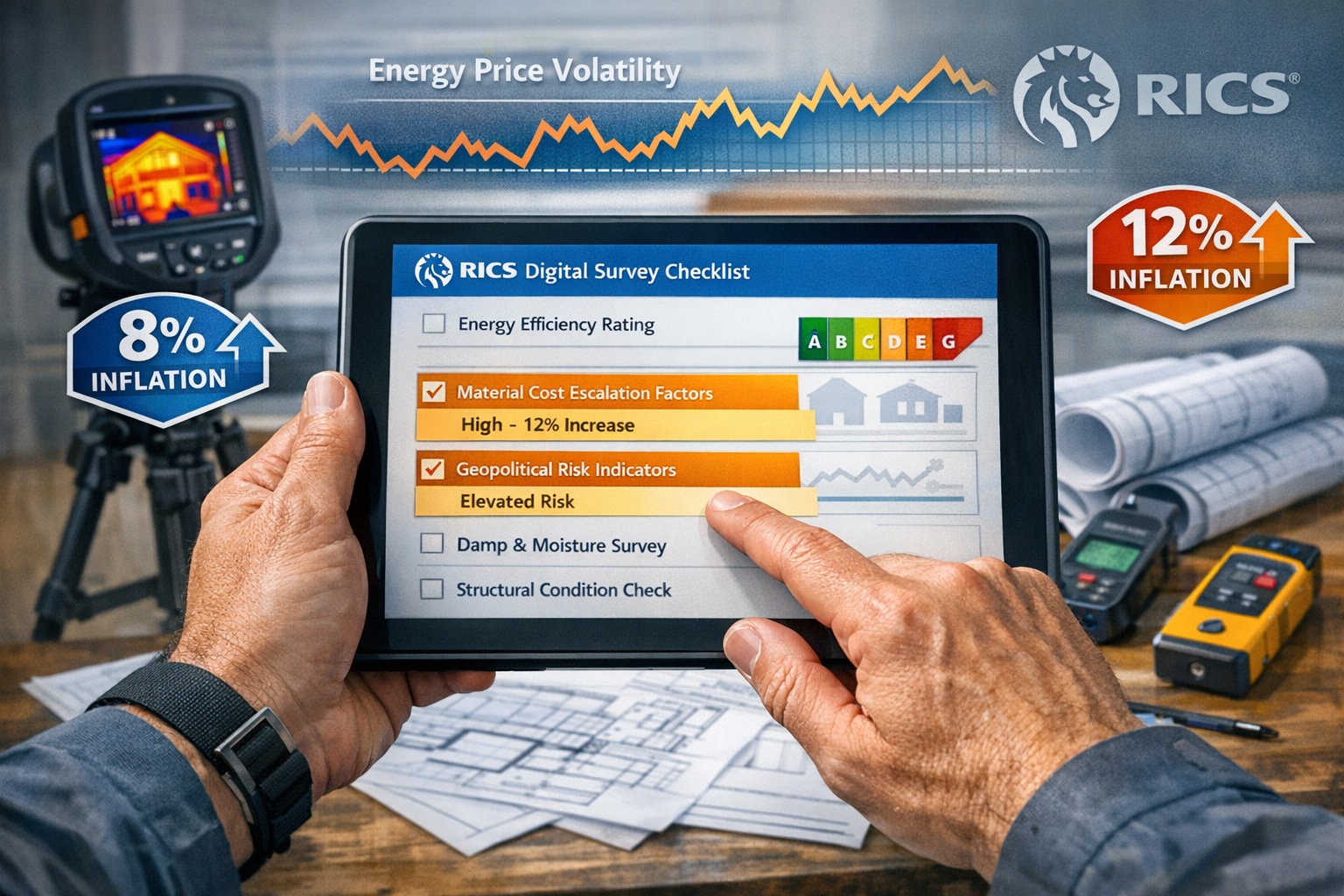
The Royal Institution of Chartered Surveyors (RICS) has recognized the need to address changing market conditions. While RICS has updated valuation standards to reflect geopolitical changes [2], surveyors must proactively adapt their building survey protocols to provide comprehensive risk assessments.
Core Protocol Enhancements for 2026
1. Energy Infrastructure Assessment
Modern building surveys must include detailed evaluation of:
- Current energy systems efficiency and condition
- Potential for renewable energy integration (solar panels, heat pumps)
- Insulation quality and thermal performance
- Smart energy management system capabilities
- Projected energy costs under various geopolitical scenarios
2. Material Condition and Replacement Risk Analysis
Surveyors should document:
- Materials with high import dependency or geopolitical vulnerability
- Alternative material options for repairs and maintenance
- Current market availability and lead times
- Price volatility risk for major building components
- Strategic maintenance timing to minimize cost exposure
3. Economic Resilience Factors
Building assessments should evaluate:
- Property adaptability to changing energy markets
- Retrofit potential and cost-benefit analysis
- Long-term maintenance cost projections with inflation scenarios
- Market competitiveness under various economic conditions
Integration with Existing RICS Frameworks
The adapted protocols complement rather than replace established RICS standards. Surveyors conducting RICS property valuations should integrate geopolitical risk factors into their existing methodologies:
| Traditional RICS Element | 2026 Geopolitical Enhancement |
|---|---|
| Structural condition assessment | + Material replacement risk and availability |
| Services evaluation | + Energy efficiency rating and upgrade potential |
| Repair cost estimates | + Inflation scenarios and material price volatility |
| Market valuation | + Energy performance impact on value |
| Maintenance recommendations | + Strategic timing based on economic forecasts |
Practical Implementation Checklist
Building surveyors should incorporate these steps into their inspection protocols:
✅ Pre-Inspection Research
- Review current energy price trends and forecasts
- Check material cost indices and availability reports
- Assess geopolitical developments affecting construction sector
- Gather EPC data and energy performance benchmarks
✅ On-Site Assessment
- Document energy infrastructure in detail
- Photograph and assess insulation and thermal performance
- Evaluate renewable energy installation potential
- Identify materials with supply chain vulnerability
- Test and record current energy consumption where possible
✅ Analysis and Reporting
- Calculate energy cost projections under multiple scenarios
- Provide repair cost estimates with inflation adjustments
- Recommend prioritized improvements based on ROI and risk mitigation
- Include geopolitical risk summary with specific property impacts
Practical Applications: Building Survey Protocols for Geopolitical Risk Assessments in 2026 in Action
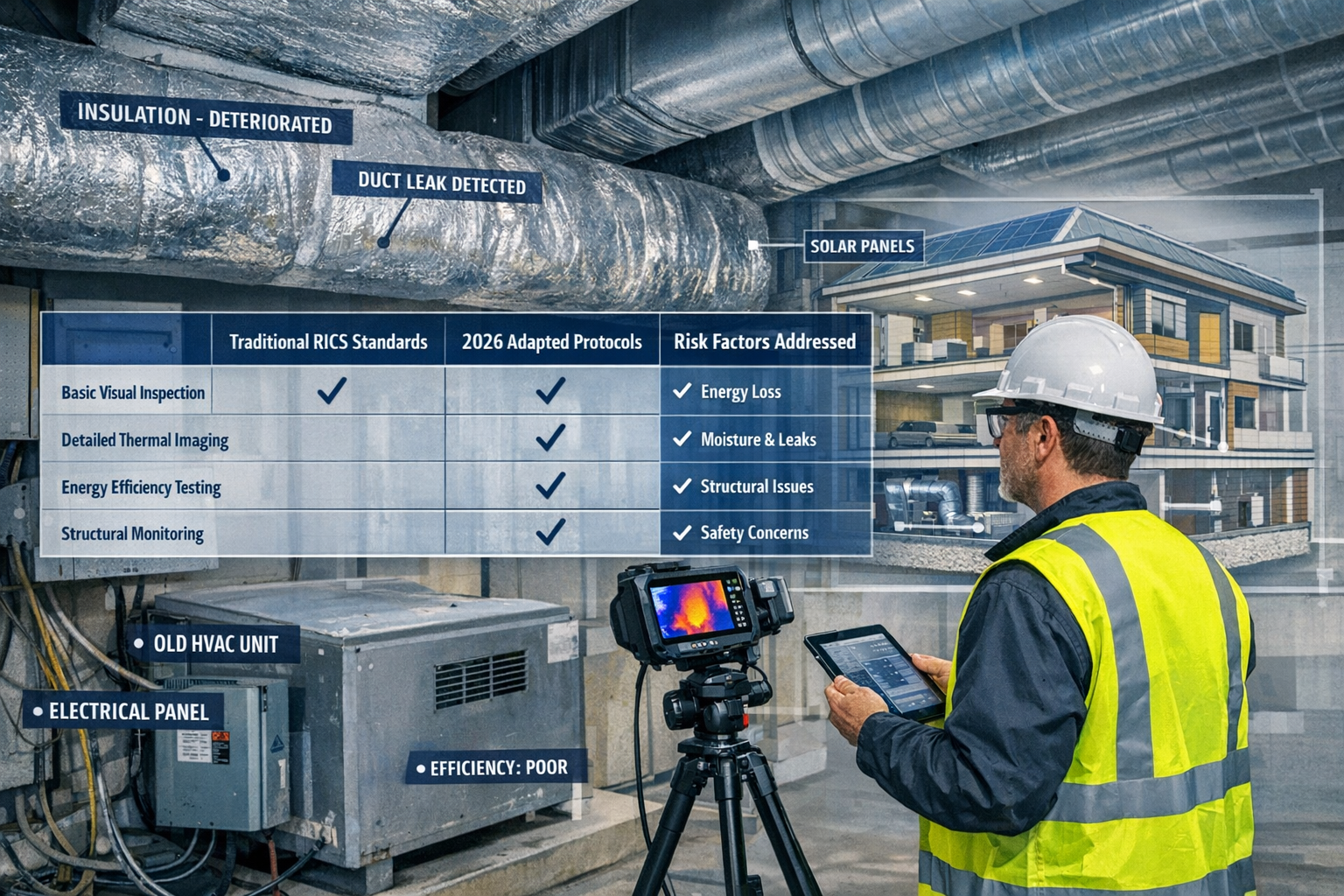
Implementing enhanced survey protocols requires practical tools and methodologies that surveyors can apply immediately. The following approaches demonstrate how to integrate geopolitical risk assessment into standard building survey practice.
Energy Performance Scenario Modeling
When evaluating properties in 2026, surveyors should provide clients with energy cost projections under different geopolitical scenarios:
Conservative Scenario: Stable energy prices with 3-5% annual inflation
Base Case Scenario: Moderate volatility with 8-12% annual price fluctuations
Adverse Scenario: Significant geopolitical disruption causing 20%+ price increases
This approach helps clients understand potential operating costs and make informed decisions about energy efficiency investments. For properties requiring negotiation support, energy performance data provides concrete justification for price adjustments.
Material Risk Assessment Matrix
Create a standardized matrix for evaluating material-related risks:
High Risk Materials: Imported components, specialized systems, materials from geopolitically unstable regions
Medium Risk Materials: Domestically produced items with international supply chain dependencies
Low Risk Materials: Locally sourced, readily available building components
Document the presence of high-risk materials and provide alternative options for repairs, enabling clients to plan strategically for maintenance and improvements.
Retrofit Investment Analysis
Modern survey reports should include cost-benefit analysis for energy efficiency improvements:
- Initial investment requirements
- Energy cost savings projections
- Payback period under different energy price scenarios
- Impact on property value and marketability
- Available grants and incentive programs
This information empowers property owners to make strategic decisions about improvements that mitigate geopolitical risks while enhancing asset value.
Regional Considerations and Market Variations
Geopolitical risk impacts vary by location and property type. Surveyors must consider:
Urban vs. Rural Properties: Urban properties may have better access to alternative energy sources and materials, while rural properties face higher transportation costs and supply constraints.
Regional Energy Infrastructure: Properties in areas with diverse energy sources face lower risk than those dependent on single fuel types.
Local Market Dynamics: Some regions show greater price sensitivity to energy performance than others, affecting the valuation impact of efficiency improvements.
Documentation and Reporting Standards
Enhanced survey reports should include:
📋 Executive Summary Section: Geopolitical risk overview with key findings
📋 Energy Performance Analysis: Current efficiency rating, improvement potential, cost projections
📋 Material Risk Assessment: High-risk components, replacement timelines, cost estimates
📋 Strategic Recommendations: Prioritized actions with ROI analysis
📋 Scenario Planning: Multiple future cost projections based on geopolitical developments
This comprehensive approach ensures clients receive actionable intelligence alongside traditional structural assessments, similar to the detailed information provided in a building condition assessment.
Leveraging Technology and Data Sources
Modern surveyors should utilize:
- Energy modeling software for accurate consumption projections
- Material cost databases with real-time pricing and availability
- Geopolitical risk intelligence platforms for informed forecasting
- Thermal imaging technology for detailed insulation assessment
- Digital reporting tools for clear data visualization
These technologies enable surveyors to provide evidence-based recommendations rather than subjective opinions.
Professional Development and Continuous Learning
As geopolitical conditions evolve, surveyors must commit to ongoing education:
- Regular review of RICS guidance updates and industry publications
- Participation in professional development courses on risk assessment
- Networking with energy consultants and economic forecasters
- Monitoring global events and their property market implications
- Sharing best practices with professional colleagues
The World Economic Forum's Global Risks Report 2026 identifies geopolitical tensions as a primary concern for businesses and investors [5], underscoring the importance of surveyor expertise in this area.
Valuation Implications and Price Negotiation Strategies
Understanding how geopolitical risks affect property values enables surveyors to provide more accurate assessments and support effective price negotiations. The average price reduction after survey can be significantly influenced by energy performance and material risk factors.
Quantifying Geopolitical Risk Impact on Value
Properties with poor energy efficiency or high material risk exposure may warrant valuation adjustments of:
- 5-10% for properties with below-average energy performance in volatile markets
- 3-7% for properties requiring major repairs with high-risk materials
- 10-15% for properties with both energy and material vulnerabilities
These adjustments reflect the increased ownership costs and market competitiveness challenges buyers will face.
Supporting Client Negotiations
Survey reports incorporating geopolitical risk analysis provide powerful negotiation tools:
✨ Concrete evidence of increased ownership costs
✨ Specific improvement requirements with detailed cost estimates
✨ Market comparison data showing energy performance impact on values
✨ Risk quantification that justifies price adjustments
This approach transforms the survey from a simple condition report into a strategic decision-making tool for property transactions.
Integration with Other Survey Services
Enhanced building survey protocols complement other professional services:
- Damp surveys should consider energy efficiency and ventilation improvements
- Monitoring surveys can track energy consumption alongside structural movement
- Party wall assessments should evaluate shared energy infrastructure
- Dilapidation reports must account for material cost inflation in repair estimates
This integrated approach provides clients with comprehensive property intelligence that addresses both immediate concerns and long-term risks.
Conclusion
Building Survey Protocols for Geopolitical Risk Assessments in 2026: Adapting RICS Standards to Inflation and Energy Price Volatility represents a necessary evolution in property surveying practice. The convergence of geopolitical uncertainty, energy price volatility, and material cost inflation demands that surveyors expand their assessment methodologies beyond traditional structural evaluations.
By integrating energy performance analysis, material risk assessment, and economic scenario planning into standard RICS surveys, building surveyors provide clients with the comprehensive intelligence needed to make informed property decisions in an uncertain world. These enhanced protocols not only protect clients from unforeseen costs but also position surveyors as strategic advisors rather than mere technical inspectors.
Actionable Next Steps for Property Professionals
🎯 Immediate Actions:
- Review and update survey templates to include geopolitical risk sections
- Establish relationships with energy consultants and material suppliers for current market intelligence
- Invest in thermal imaging and energy assessment technology
- Develop scenario modeling tools for energy cost projections
🎯 Short-Term Development (3-6 months):
- Complete professional development courses on energy efficiency and risk assessment
- Build databases of material costs and availability for common building components
- Create standardized reporting formats that clearly communicate geopolitical risks
- Develop case studies demonstrating value of enhanced assessment protocols
🎯 Long-Term Strategy (6-12 months):
- Establish expertise as a geopolitical risk-aware surveyor in your market
- Contribute to RICS discussions on evolving standards and best practices
- Build referral networks with financial advisors and property investors seeking comprehensive risk analysis
- Monitor and adapt protocols as geopolitical conditions evolve
The property market of 2026 rewards surveyors who provide forward-looking, comprehensive assessments that address the full spectrum of ownership risks. By adapting RICS standards to incorporate geopolitical considerations, building surveyors ensure they remain indispensable advisors in an increasingly complex property landscape.
Whether conducting residential surveys or commercial property assessments, the integration of energy volatility analysis and material inflation forecasting transforms the traditional building survey into a strategic risk management tool. Property professionals who embrace these enhanced protocols position themselves at the forefront of their profession, delivering exceptional value to clients navigating the challenges of 2026's geopolitical landscape.
For property buyers, sellers, and investors, engaging surveyors who understand and apply these enhanced protocols provides critical protection against unforeseen costs and ensures informed decision-making in uncertain times. The future of building surveying lies in this comprehensive, risk-aware approach that addresses not just the physical condition of properties but their economic resilience in a volatile world.
References
[1] Rics Monitor Why 2026 Is A Market Of Specific Opportunities – https://www.commercialsearch.com/news/rics-monitor-why-2026-is-a-market-of-specific-opportunities/
[2] Uk Influence And Advocacy Update January 2026 – https://www.rics.org/news-insights/uk-influence-and-advocacy-update-january-2026
[3] Valuing Plant Machinery Assets – https://ww3.rics.org/uk/en/journals/property-journal/valuing-plant-machinery-assets.html
[4] Geopolitics In 2026 Risks And Opportunities Were Watching – https://www.wellington.com/en-us/institutional/insights/geopolitics-in-2026-risks-and-opportunities-were-watching
[5] Global Risks Report 2026 – https://www.weforum.org/publications/global-risks-report-2026/
[6] Geopolitical Risk In 2026 What Insurers Need To Know – https://www.lcp.com/en/insights/in-brief/geopolitical-risk-in-2026-what-insurers-need-to-know
[7] Geopolitical Outlook For 2026 – https://www.ey.com/en_mt/insights/geopolitical-outlook-for-2026