


The regional office property market has entered a transformative phase in 2026, where traditional valuation methodologies must adapt to unprecedented demand drivers. Artificial intelligence companies are reshaping occupier requirements across Manchester and Birmingham, creating rental growth trajectories that challenge conventional assumptions. For surveyors and investors, understanding how to quantify these shifts within RICS-compliant frameworks has become essential to accurate asset pricing.
The stakes are high: Grade A vacancy rates below 3% in Manchester's core[1] signal supply constraints that amplify valuation premiums, while Birmingham's commercial rental growth projections of 4.1% annually through 2028[2] outpace many national benchmarks. Yet these headline figures mask complex submarket dynamics, business rates pressures, and AI-driven space requirements that demand sophisticated analytical approaches.
This comprehensive guide explores Valuation Techniques for Regional Office Properties in 2026: Adjusting for AI Demand and Rental Growth in Manchester and Birmingham, providing chartered surveyors, institutional investors, and property professionals with actionable frameworks to capture these evolving market conditions in defensible valuations.
Key Takeaways
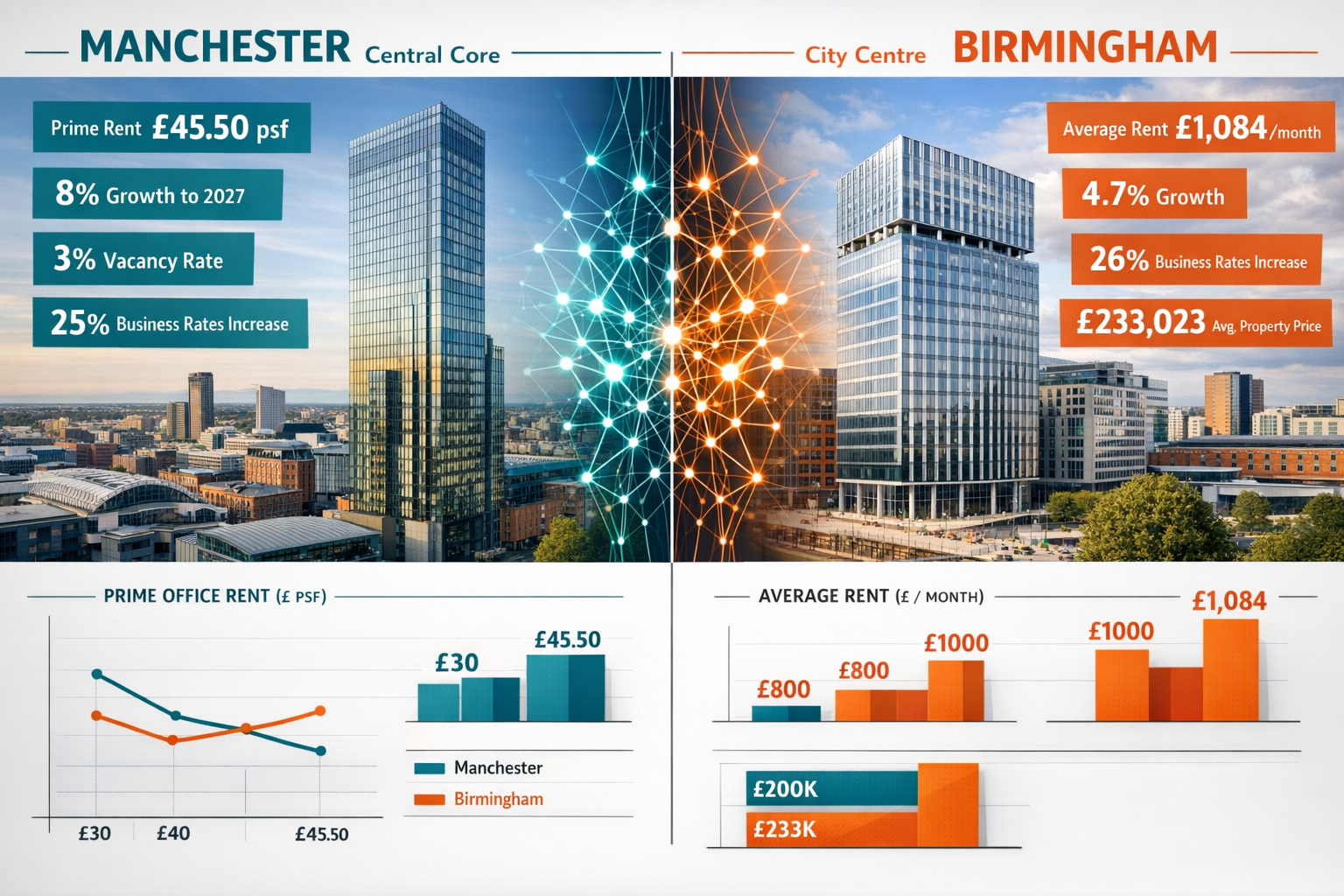
- Prime Manchester office rents reached £45.50 per sq ft in 2025 with 8% growth projected to £48.50 by 2027, requiring recalibrated capitalization rates in income approaches[1]
- Severe supply constraints (Grade A vacancy below 3% in Manchester, prime vacancy near 2%) justify scarcity premiums in comparable sales adjustments[1]
- Business rates increases of 25-26% effective April 2026 materially impact net operating income calculations and require explicit modeling in discounted cash flow valuations[5]
- Birmingham's commercial rental growth at 4.1% annually exceeds Manchester's 4% projection, creating relative value opportunities for investors[2]
- AI occupier demand is driving tech-enabled office specifications that command premium valuations, necessitating qualitative adjustments to standard valuation metrics

Understanding Core Valuation Methodologies for Regional Office Properties
The Investment Method and Capitalization Approaches
The investment method remains the primary valuation technique for income-producing regional office properties in 2026. This approach capitalizes net operating income (NOI) using market-derived yields to determine capital value. For Manchester and Birmingham offices, surveyors must carefully construct NOI projections that reflect current market realities.
Net Operating Income Calculation:
- Gross rental income (based on current leases or estimated rental value)
- Less: vacancy allowances (critical given 2-3% actual vacancy rates[1])
- Less: operating expenses including service charges, management fees, and insurance
- Less: business rates increases (25-26% uplift from April 2026[5])
- Equals: Net Operating Income
The capitalization rate (or yield) selection requires particular attention in 2026. Prime Manchester office yields have compressed due to:
✅ Strong leasing momentum (770,000 sq ft take-up in first three quarters of 2025, 6% above five-year average[1])
✅ Limited supply pipeline creating competitive bidding for quality assets
✅ Institutional capital targeting regional diversification from London
✅ AI sector expansion providing tenant covenant strength
When applying property evaluation techniques, surveyors should benchmark yields against comparable transactions while adjusting for:
- Location premiums (Central Core vs. Salford Quays differential)
- Building specification and ESG credentials
- Lease covenant strength and weighted average lease term (WALT)
- Capital expenditure requirements
Discounted Cash Flow Analysis for Growth Scenarios
For properties with complex lease structures or significant rental reversion potential, discounted cash flow (DCF) analysis provides superior accuracy. This technique is particularly valuable when valuing Manchester and Birmingham offices in 2026 due to:
-
Explicit rental growth modeling: Rather than assuming perpetual growth, DCF allows period-by-period projections reflecting the 8% growth trajectory to 2027 in Manchester[1] and 4.1% annual growth in Birmingham[2]
-
Business rates impact quantification: The April 2026 business rates increase can be modeled as a discrete cash flow reduction, then grown at inflation assumptions
-
Lease event modeling: Break options, rent reviews, and lease expiries can be explicitly timed and valued
-
Exit value sensitivity: Terminal capitalization rates can be varied to test valuation sensitivity to yield movements
DCF Framework Components:
| Input | Manchester Example | Birmingham Example |
|---|---|---|
| Current passing rent | £42.00 psf | £38.00 psf |
| ERV (2026) | £45.50 psf[1] | £42.00 psf |
| Annual rental growth | 4.0% | 4.1%[2] |
| Discount rate | 7.5-8.5% | 8.0-9.0% |
| Exit yield | 5.5-6.5% | 6.0-7.0% |
| Business rates impact | -25% increase[5] | -26% increase[5] |
The discount rate selection should reflect property-specific risk factors including tenant concentration, building obsolescence risk, and location liquidity. Given the robust demand fundamentals across both cities (Q4 take-up of 1.1 million sq ft across Big 6 cities[3]), surveyors may justify discount rates at the lower end of historical ranges.
Comparable Sales Method with Location Adjustments
The comparable sales approach provides market-validated benchmarks but requires sophisticated adjustments for 2026's differentiated submarket performance. Recent transactions must be analyzed through multiple lenses:
Price per Square Foot Bands (2026):
Manchester:
- Central Core Grade A: £35.00-£45.50 psf[1]
- Central Core Grade B: £28.00-£35.00 psf[1]
- Salford Quays Grade A: £24.00-£27.00 psf[1]
- Media City Grade A: £23.00-£26.00 psf[1]
Birmingham:
- City Centre Grade A: £32.00-£40.00 psf (estimated based on residential market strength[2])
- Business District Grade B: £26.00-£32.00 psf
These ranges demonstrate significant location premiums that must be quantified in comparable adjustments. A Salford Quays property trading at £25 psf cannot be directly compared to a Manchester Central Core asset without applying a 60-80% location premium adjustment.
When conducting chartered surveyor comparable analysis, consider:
🔍 Transaction timing: Adjust for market movement between comparable sale date and valuation date
🔍 Lease terms: Normalize for differences in lease length, break options, and tenant incentives
🔍 Building quality: Grade A vs. Grade B specifications, ESG ratings, and smart building technology
🔍 Unit size: Apply quantum adjustments for significantly larger or smaller properties
The severe supply constraints in both markets (Grade A vacancy below 3%[1]) mean comparable evidence may be limited, requiring surveyors to place greater weight on rental evidence and investment method approaches.
Adjusting Valuations for AI Demand and Technology Occupier Requirements
Quantifying the AI Premium in Office Valuations
The artificial intelligence sector's expansion across Manchester and Birmingham is creating a two-tier office market in 2026. Properties equipped with infrastructure to support AI operations command measurable rental premiums that must be captured in valuations.
AI-Ready Office Characteristics:
- Enhanced electrical capacity (minimum 20-25 watts per sq ft vs. traditional 10-12 watts)
- Raised floor systems for cabling infrastructure
- Advanced HVAC systems for server room cooling
- High-speed fiber connectivity (1Gbps+ symmetric)
- Flexible floorplates accommodating collaborative tech workspaces
- Integrated smart building management systems
Surveyors should apply qualitative adjustments of 5-15% to comparable evidence when the subject property possesses superior technology infrastructure. This premium reflects:
- Tenant demand concentration: AI and tech occupiers represent growing proportion of take-up
- Reduced vacancy risk: Tech-enabled spaces achieve faster letting times
- Rental growth potential: Technology occupiers typically accept steeper annual escalations
- Covenant strength: Well-funded AI companies provide strong tenant security
For properties lacking AI-ready specifications, surveyors must consider capital expenditure deductions to bring the asset to competitive standard. Typical upgrade costs range from £15-£30 per sq ft depending on existing infrastructure.
Modeling Rental Growth Differentials
The divergent rental growth trajectories between Manchester (8% to 2027[1]) and Birmingham (4.1% annually to 2028[2]) require careful modeling in multi-year cash flow projections. These growth rates are not uniform across all property types or locations.
Growth Rate Segmentation Framework:
Manchester:
- Central Core Grade A with tech specifications: 8-10% to 2027
- Central Core Grade B: 5-7% to 2027
- Peripheral locations: 3-5% to 2027
- Non-upgraded buildings: 2-4% to 2027
Birmingham:
- City Centre Grade A: 4.1-5.5% annually
- Business District Grade A: 3.5-4.5% annually
- Secondary locations: 2.5-3.5% annually
These differentiated growth assumptions should be supported by:
📊 Submarket supply analysis: Pipeline developments by location and grade
📊 Demand segmentation: Sector-specific occupier growth forecasts
📊 Historical volatility: Standard deviation of rental growth over previous cycles
📊 Economic base diversification: Employment growth by sector in each city
The residential market provides supporting evidence for commercial growth assumptions. Manchester's projected 19.3% residential price growth through 2028[4] indicates robust economic fundamentals supporting office demand, while Birmingham's average rent growth of 4.7% annually[2] demonstrates broader market momentum.
When conducting data analysis for valuation purposes, surveyors should stress-test rental growth assumptions against downside scenarios, particularly given the cyclical nature of technology sector expansion.
Supply Constraint Premiums and Scarcity Value
The exceptionally tight vacancy rates in Manchester (Grade A below 3%, prime near 2%[1]) represent a fundamental shift from historical norms that justifies explicit scarcity premiums in 2026 valuations.
Scarcity Premium Methodology:
- Calculate historical vacancy equilibrium (typically 7-10% for healthy market functioning)
- Measure current deviation (5-8 percentage points below equilibrium)
- Assess supply pipeline (new completions vs. demand absorption rate)
- Apply premium adjustment to comparable evidence or capitalization rates
For Manchester Central Core properties, surveyors may justify yield compression of 25-50 basis points relative to historical averages, translating to capital value premiums of 5-10%. This adjustment reflects:
- Reduced letting risk: Near-certain tenant demand at lease expiry
- Rental growth certainty: Supply constraints support aggressive ERV growth
- Competitive tension: Multiple bidders for limited available space
- Option value: Flexibility to reposition or redevelop given strong demand
Birmingham's market, while less constrained than Manchester, still demonstrates strong fundamentals with take-up contributing to the 1.1 million sq ft across Big 6 cities in Q4[3]. Scarcity premiums of 10-25 basis points may be appropriate for prime Birmingham assets.
Surveyors should document scarcity adjustments explicitly in valuation reports, providing market evidence and sensitivity analysis to support the premium applied. This transparency is essential for surveyor services credibility and RICS compliance.

Practical Application: Case Studies and Valuation Adjustments
Case Study 1: Manchester Central Core Grade A Office
Property Profile:
- Location: Spinningfields district, Manchester Central Core
- Size: 45,000 sq ft across 5 floors
- Specification: Grade A, BREEAM Excellent, AI-ready infrastructure
- Tenancy: Single let to technology company, 8 years unexpired
- Passing rent: £42.00 psf (£1,890,000 per annum)
Valuation Approach:
Using the investment method, the surveyor must establish current ERV and appropriate yield:
ERV Assessment:
- Market evidence: Central Core Grade A achieving £45.50 psf[1]
- Technology infrastructure premium: +5% (£2.28 psf)
- Building quality and ESG credentials: +3% (£1.37 psf)
- Adjusted ERV: £49.15 psf
Net Income Calculation:
- Gross rent: £1,890,000
- Less: Landlord's expenses (15%): -£283,500
- Less: Business rates impact (tenant-paid but affects covenant): Noted in risk assessment
- Net Operating Income: £1,606,500
Yield Selection:
- Base prime Manchester yield: 5.75%
- Scarcity premium adjustment: -0.35% (tight vacancy)
- Single tenant concentration risk: +0.25%
- Strong covenant (tech company): -0.15%
- Applied yield: 5.50%
Capital Value Calculation:
£1,606,500 ÷ 0.055 = £29,209,091 (£649 psf)
Rental Reversion Value:
At lease expiry (8 years), projected ERV using 8% growth to 2027[1] then 4% annually:
- Year 8 ERV: £67.20 psf
- Reversion value adds significant upside captured in DCF analysis
Case Study 2: Birmingham Business District Grade B Office
Property Profile:
- Location: Birmingham Business District
- Size: 32,000 sq ft across 4 floors
- Specification: Grade B, requires technology infrastructure upgrade
- Tenancy: Multi-let (4 tenants), average 5 years unexpired
- Passing rent: £30.00 psf (£960,000 per annum)
Valuation Approach:
ERV Assessment:
- Market evidence: Business District Grade B achieving £28-£32 psf
- Lack of technology infrastructure: -8% (£2.40 psf)
- Multi-let appeal for SME occupiers: +3% (£0.90 psf)
- Adjusted ERV: £30.50 psf
Capital Expenditure Requirement:
- Technology infrastructure upgrade: £20 psf × 32,000 = £640,000
- This CAPEX deduction reflects cost to bring to competitive standard
Net Income Calculation:
- Gross rent: £960,000
- Less: Landlord's expenses (18% for multi-let): -£172,800
- Less: Void allowance (5% for multi-let): -£48,000
- Net Operating Income: £739,200
Yield Selection:
- Base Birmingham yield: 6.75%
- Multi-let risk premium: +0.50%
- Below-specification building: +0.25%
- Applied yield: 7.50%
Capital Value Calculation:
£739,200 ÷ 0.075 = £9,856,000
Less: CAPEX requirement: -£640,000
Net Capital Value: £9,216,000 (£288 psf)
This Birmingham property demonstrates lower per-square-foot values compared to Manchester (£288 vs. £649 psf), reflecting the market differential between the cities while accounting for specification gaps.
Adjusting for Business Rates Impact
The April 2026 business rates increases (25% in Manchester, 26% in Birmingham[5]) represent a material change in occupancy costs that affects tenant demand and covenant strength, even though rates are typically tenant-paid.
Valuation Adjustments Required:
-
Yield adjustment: Properties with imminent rent reviews or lease renewals may experience tenant resistance, justifying yield increases of 10-25 basis points
-
Rental growth dampening: Business rates increases may constrain rental growth in outer submarkets where occupiers are more cost-sensitive
-
Tenant covenant assessment: Occupiers facing 25%+ rates increases may experience financial stress, affecting lease security value
-
Incentive packages: Landlords may need to offer enhanced incentives to offset rates impact, reducing effective rents
Surveyors should model business rates impact explicitly in DCF valuations, showing the step-change in April 2026 then ongoing growth at inflation assumptions. For investment method valuations, the impact should be reflected in yield selection and documented in the valuation report.
The comparative advantage versus Leeds (facing 44% increases[5]) makes Manchester and Birmingham relatively more attractive, potentially supporting inward investment that partially offsets the rates burden.
RICS Compliance and Professional Valuation Standards
Red Book Requirements for Regional Office Valuations
All valuations of Manchester and Birmingham office properties must comply with RICS Valuation – Global Standards (Red Book) effective in 2026. Key requirements include:
Terms of Engagement:
- Clear identification of valuation purpose (financial reporting, secured lending, transaction support)
- Basis of value (Market Value, Investment Value, Fair Value)
- Valuation date and reporting date
- Assumptions and special assumptions
- Restrictions on use and publication
Inspection and Investigation:
- Physical inspection of the property (internal and external)
- Review of lease documentation and tenancy schedules
- Planning and statutory compliance verification
- Environmental and sustainability assessment
- Building services and specification review
Market Analysis Requirements:
- Comparable evidence analysis with adjustments documented
- Market conditions assessment and trends
- Supply and demand dynamics
- Economic and demographic factors
For regional office properties in 2026, surveyors must explicitly address:
✅ AI demand impact: How technology sector growth affects the subject property
✅ Supply constraints: Vacancy rates and pipeline analysis
✅ Rental growth assumptions: Supported by market evidence and economic forecasts
✅ Business rates changes: April 2026 impact on occupier costs
✅ ESG factors: Energy performance and sustainability credentials
The valuation report should include sensitivity analysis showing how capital value changes with variations in key inputs (yield ±0.5%, rental growth ±2%, void periods +6 months).
Uncertainty and Risk Disclosure
Given the rapidly evolving nature of AI demand and technology sector growth, surveyors must appropriately caveat valuations with material uncertainty clauses where justified. However, the strong market evidence from 2025 (770,000 sq ft Manchester take-up[1], 1.1 million sq ft Big 6 take-up[3]) suggests material uncertainty is not warranted for mainstream office valuations in 2026.
Risk factors requiring explicit disclosure include:
⚠️ Technology sector volatility: AI company growth may not sustain current trajectory
⚠️ Interest rate sensitivity: Yield movements could significantly impact capital values
⚠️ Regulatory changes: Further business rates reforms or planning policy shifts
⚠️ Economic downturn: Recession could reverse rental growth assumptions
⚠️ Obsolescence risk: Rapid technology change may render current specifications inadequate
Surveyors should consider obtaining property inspection reports from building services engineers when valuing properties marketed to AI occupiers, ensuring electrical capacity and HVAC systems are adequate for stated specifications.
Documentation and Audit Trail
Professional valuation standards require comprehensive documentation of all assumptions, adjustments, and calculations. For Valuation Techniques for Regional Office Properties in 2026: Adjusting for AI Demand and Rental Growth in Manchester and Birmingham, the audit trail should include:
📋 Comparable evidence database: Full details of transactions including date, price, yield, specification
📋 Rental evidence schedule: Lettings with dates, terms, incentives, and adjusted rates
📋 Adjustment matrices: Quantified adjustments for location, specification, lease terms
📋 Growth assumption support: Economic forecasts, market reports, historical analysis
📋 Yield derivation: Comparable investment sales and yield adjustments applied
📋 Calculations: Full DCF models, investment method calculations, sensitivity analyses
This documentation ensures the valuation can withstand professional scrutiny and provides transparency for clients making investment decisions based on the valuation opinion.
Strategic Considerations for Investors and Occupiers
Investment Strategy Implications
The divergent performance characteristics between Manchester and Birmingham create distinct investment opportunities in 2026:
Manchester Advantages:
- Higher rental growth trajectory (8% to 2027[1])
- More severe supply constraints (sub-3% vacancy[1])
- Stronger residential market momentum (19.3% growth forecast[4])
- Premium pricing reflects market confidence
Birmingham Advantages:
- Lower entry pricing (£288 vs. £649 psf in case studies)
- Higher rental growth rate (4.1% vs. 4.0% annually[2])
- Slightly lower business rates impact (26% vs. 25% increase[5])
- Value-add opportunities in secondary stock
Institutional investors seeking core-plus strategies may favor Manchester's proven performance and supply constraints, accepting lower initial yields for rental growth certainty. Value-add investors may find superior risk-adjusted returns in Birmingham's lower-priced assets with comparable growth potential.
Portfolio diversification across both cities provides exposure to complementary economic bases while mitigating city-specific risks. The strong take-up across Big 6 cities (1.1 million sq ft in Q4[3]) demonstrates broad regional office market health supporting multi-city strategies.
Occupier Considerations and Negotiation Leverage
For occupiers evaluating office requirements in Manchester and Birmingham, understanding valuation dynamics provides negotiation advantages:
Tenant Leverage Factors:
- Long-term commitment (7-10 years) in tight markets commands landlord concessions
- AI-ready specifications may justify rental premiums but also limit comparable evidence
- Business rates increases create opportunity to negotiate gross lease structures
- Multi-floor requirements provide quantum leverage in negotiations
Occupiers should engage chartered surveyors to conduct independent rental assessments before committing to lease terms, ensuring proposed rents align with market evidence and growth assumptions are reasonable.
The supply constraint environment means occupiers should act decisively when suitable space becomes available, but not at the expense of overpaying relative to defensible valuations. Understanding the valuation techniques landlords use provides insight into their pricing expectations and negotiation boundaries.
Conclusion
Valuation Techniques for Regional Office Properties in 2026: Adjusting for AI Demand and Rental Growth in Manchester and Birmingham require sophisticated integration of traditional methodologies with emerging market dynamics. The confluence of severe supply constraints, technology sector expansion, and robust rental growth trajectories creates valuation complexity that demands rigorous analytical frameworks.
Key Implementation Steps for Surveyors:
-
Establish robust comparable databases segmented by location, grade, and technology specification, ensuring adjustments are quantified and defensible
-
Model rental growth explicitly using differentiated assumptions for prime vs. secondary stock, incorporating AI demand premiums where infrastructure supports technology occupiers
-
Apply scarcity premiums judiciously where vacancy rates demonstrate sustained supply-demand imbalances, with sensitivity analysis showing impact on capital values
-
Quantify business rates impact as explicit cash flow adjustments in DCF models or yield adjustments in investment method approaches
-
Document all assumptions comprehensively to ensure RICS Red Book compliance and provide transparent audit trails for client decision-making
The Manchester market's prime rent trajectory to £48.50 psf by 2027[1] and Birmingham's 4.1% annual rental growth[2] provide strong fundamentals supporting investment confidence. However, surveyors must remain vigilant to technology sector volatility, interest rate movements, and economic headwinds that could disrupt growth assumptions.
Actionable Next Steps:
For property professionals seeking to implement these valuation techniques, consider:
- Attending RICS CPD courses on technology sector real estate and regional office market dynamics
- Building relationships with letting agents in Manchester and Birmingham to access real-time market intelligence
- Developing proprietary databases tracking AI company office requirements and specifications
- Engaging building services consultants to quantify infrastructure upgrade costs for non-compliant properties
- Reviewing property evaluation frameworks to ensure AI demand factors are systematically incorporated
The regional office markets of Manchester and Birmingham stand at an inflection point in 2026, where traditional valuation approaches must evolve to capture new value drivers while maintaining professional rigor. Surveyors who successfully integrate these adjustments will provide superior advisory services and support informed investment decisions in this dynamic market environment.
For expert assistance with commercial property valuations incorporating the latest market intelligence and RICS-compliant methodologies, professional surveyor services can provide the specialized expertise required for complex regional office assessments.
References
[1] The Cost Of Office Space In Manchester 2026 – https://www.oktra.co.uk/insights/the-cost-of-office-space-in-manchester-2026/
[2] Birmingham Property Market 2026 – https://rothmoreproperty.com/property-news/birmingham-property-market-2026/
[3] Take Up Hits 1.1 Million Sq Ft Across Big 6 Cities In Q4 Highlights Improving Confidence And Results In A Positive Start For 2026 – https://www.insidermedia.com/news/national/take-up-hits-1.1-million-sq-ft-across-big-6-cities-in-q4-highlights-improving-confidence-and-results-in-a-positive-start-for-2026
[4] Manchester Property Price Forecast – https://joseph-mews.com/uk-property-investment/manchester-property-price-forecast/
[5] 2156014 Business Rates Surges In Manchester Birmingham And Leeds Predicted Next Year – https://www.thebusinessdesk.com/northwest/news/2156014-business-rates-surges-in-manchester-birmingham-and-leeds-predicted-next-year