
The property market in 2026 faces a fundamental transformation. With government initiatives and industry leaders pushing for six-week transaction completions, building surveyors stand at the crossroads of speed and thoroughness. The challenge is clear: how can professionals deliver comprehensive property assessments without compromising the rigorous standards that protect buyers and sellers alike? Building Survey Protocols for 6-Week Transaction Completions: RICS Checklists Amid 2026 Certainty Push represents more than just faster paperwork—it demands a complete rethinking of survey workflows, risk assessment methodologies, and client communication strategies. 🏠
The Royal Institution of Chartered Surveyors (RICS) has responded to this urgency with updated standards and digital frameworks designed to streamline processes while maintaining professional integrity. For building surveyor services across the UK, adapting to these accelerated timelines isn't optional—it's essential for remaining competitive and relevant in today's fast-paced property market.
Key Takeaways
- Six-week completion targets require surveyors to adopt streamlined protocols without sacrificing thoroughness or professional standards
- RICS updated its Home Survey Standard in February 2026, providing clearer frameworks for faster property assessments[1]
- Digital tools and AI integration now play critical roles in accelerating survey processes while maintaining accuracy
- Risk mitigation strategies must be front-loaded in fast-tracked transactions to protect all parties from costly oversights
- Standardized checklists and templates enable consistent, efficient reporting that meets both speed and quality requirements
Understanding the 2026 Certainty Push and Its Impact on Building Surveys
The property transaction landscape has undergone significant pressure in recent years. Delays, fall-throughs, and extended completion times have frustrated buyers, sellers, and professionals alike. The 2026 certainty push emerged from collective industry frustration with average transaction times stretching beyond three months—sometimes reaching six months or more.
Why Six Weeks Matters
The six-week target isn't arbitrary. Research shows that transaction momentum diminishes significantly after the initial enthusiasm period. Buyers lose confidence, market conditions shift, and the probability of deal collapse increases exponentially with each passing week. By compressing timelines to 42 days, the industry aims to:
- Reduce fall-through rates by maintaining buyer commitment
- Minimize exposure to market volatility
- Decrease holding costs for both parties
- Improve overall market efficiency and liquidity
- Enhance customer satisfaction across the property sector
RICS Response to Accelerated Timelines
RICS has taken proactive steps to support this transformation. The organization released a progress update to its Home Survey Standard 2nd edition on 10 February 2026[1], signaling ongoing commitment to modernizing survey practices. Additionally, RICS implemented its first global professional standard for responsible AI use in surveying practice, effective 9 March 2026[3], recognizing that technology integration is essential for meeting compressed timelines.
Why choosing RICS surveyors becomes even more critical in this environment, as qualified professionals understand how to balance speed with thoroughness.
Essential Components of Building Survey Protocols for 6-Week Transaction Completions
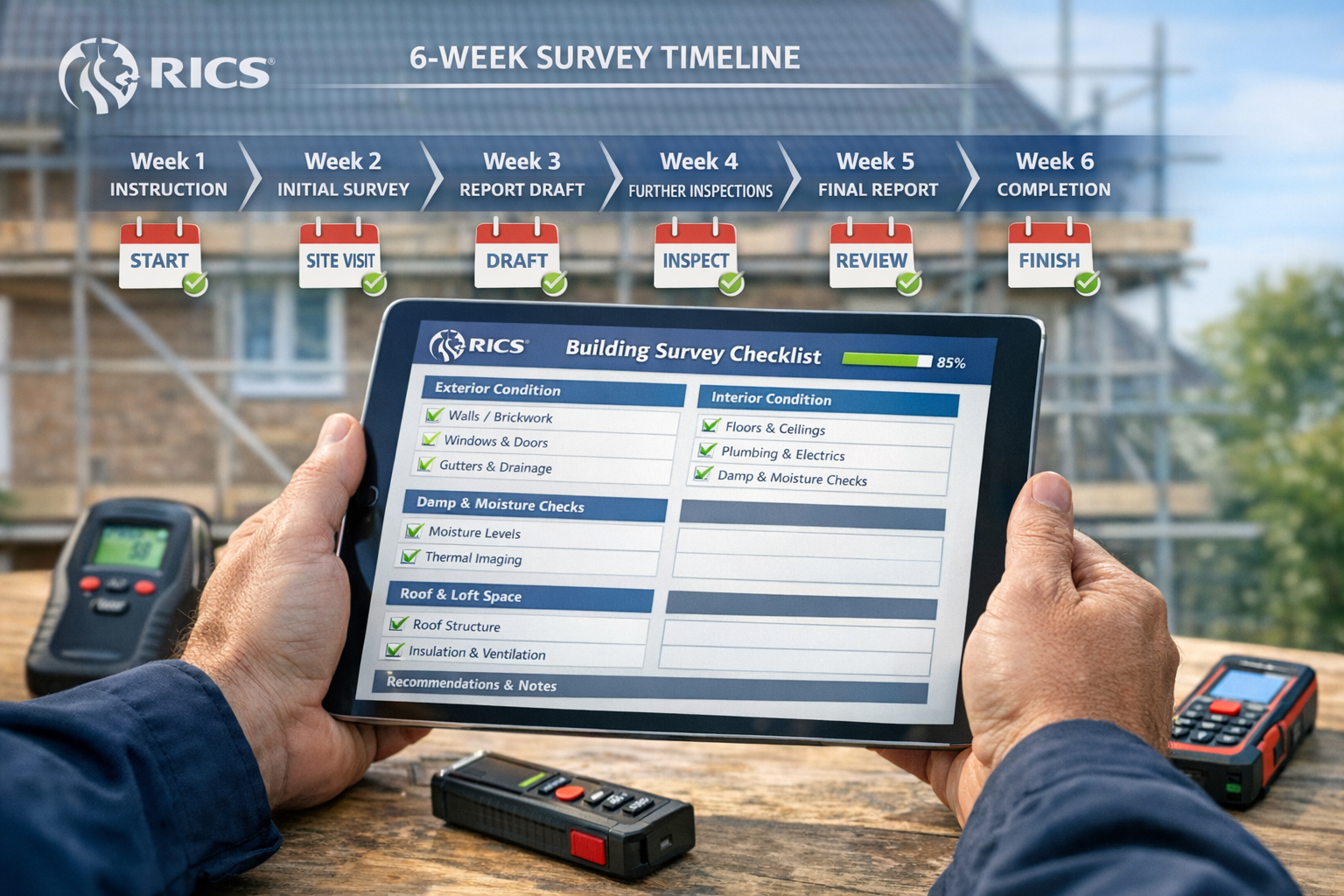
Achieving six-week completions requires fundamental restructuring of traditional survey workflows. Building Survey Protocols for 6-Week Transaction Completions: RICS Checklists Amid 2026 Certainty Push emphasizes several core components that enable this transformation.
Pre-Instruction Preparation Protocols
Success begins before formal instruction. Surveyors must implement rapid response systems that include:
Immediate Availability Confirmation ⏰
- Automated scheduling systems that provide instant appointment availability
- Clear communication of turnaround times (typically 3-5 working days for report delivery)
- Pre-qualification questionnaires sent to clients before instruction
- Digital document collection portals for property information
Property Intelligence Gathering
- Preliminary desktop research using Land Registry data
- Historical planning permission searches
- Environmental risk screening
- Local authority preliminary checks
This upfront work reduces on-site time and enables surveyors to arrive fully prepared with targeted inspection priorities.
Standardized RICS Inspection Checklists
The backbone of efficient surveys lies in comprehensive yet streamlined checklists. RICS protocols for 2026 emphasize:
| Survey Component | Time Allocation | Priority Level | Digital Tools |
|---|---|---|---|
| External envelope inspection | 45-60 minutes | Critical | Thermal imaging, drone photography |
| Internal structural assessment | 60-90 minutes | Critical | Moisture meters, laser levels |
| Services evaluation | 30-45 minutes | High | Electrical testers, borescopes |
| Roof inspection | 30-45 minutes | Critical | Drone surveys, binoculars |
| Grounds and boundaries | 20-30 minutes | Medium | GPS mapping, digital photography |
| Documentation and notes | 30-45 minutes | Critical | Voice-to-text, tablet annotation |
These standardized timeframes ensure thorough coverage while maintaining schedule efficiency. Which home survey is right for you depends on property type and client needs, but all surveys benefit from structured approaches.
Digital Reporting Templates and Automation
Modern survey protocols leverage technology extensively:
Template-Based Reporting Systems 📱
- Pre-populated condition ratings and descriptions
- Automated section generation based on property type
- Integrated photographic evidence with annotations
- Digital signature capabilities for instant delivery
AI-Assisted Analysis
Following RICS's March 2026 AI standard[3], surveyors can now ethically employ:
- Pattern recognition for common defects
- Automated cost estimation for repairs
- Risk scoring algorithms
- Comparative market analysis integration
These tools don't replace professional judgment—they enhance efficiency by handling routine elements, allowing surveyors to focus expertise on complex issues.
Rapid Communication Protocols
Six-week completions demand immediate stakeholder communication:
- Same-day preliminary findings shared verbally with clients
- 48-hour draft report circulation for urgent decision-making
- 72-hour final report delivery as standard practice
- Instant availability for follow-up questions via phone, video call, or messaging
Understanding what to do after a bad report on building survey becomes time-critical in compressed transactions, requiring surveyors to provide actionable guidance immediately.
Risk Mitigation Strategies for Fast-Tracked Property Transactions
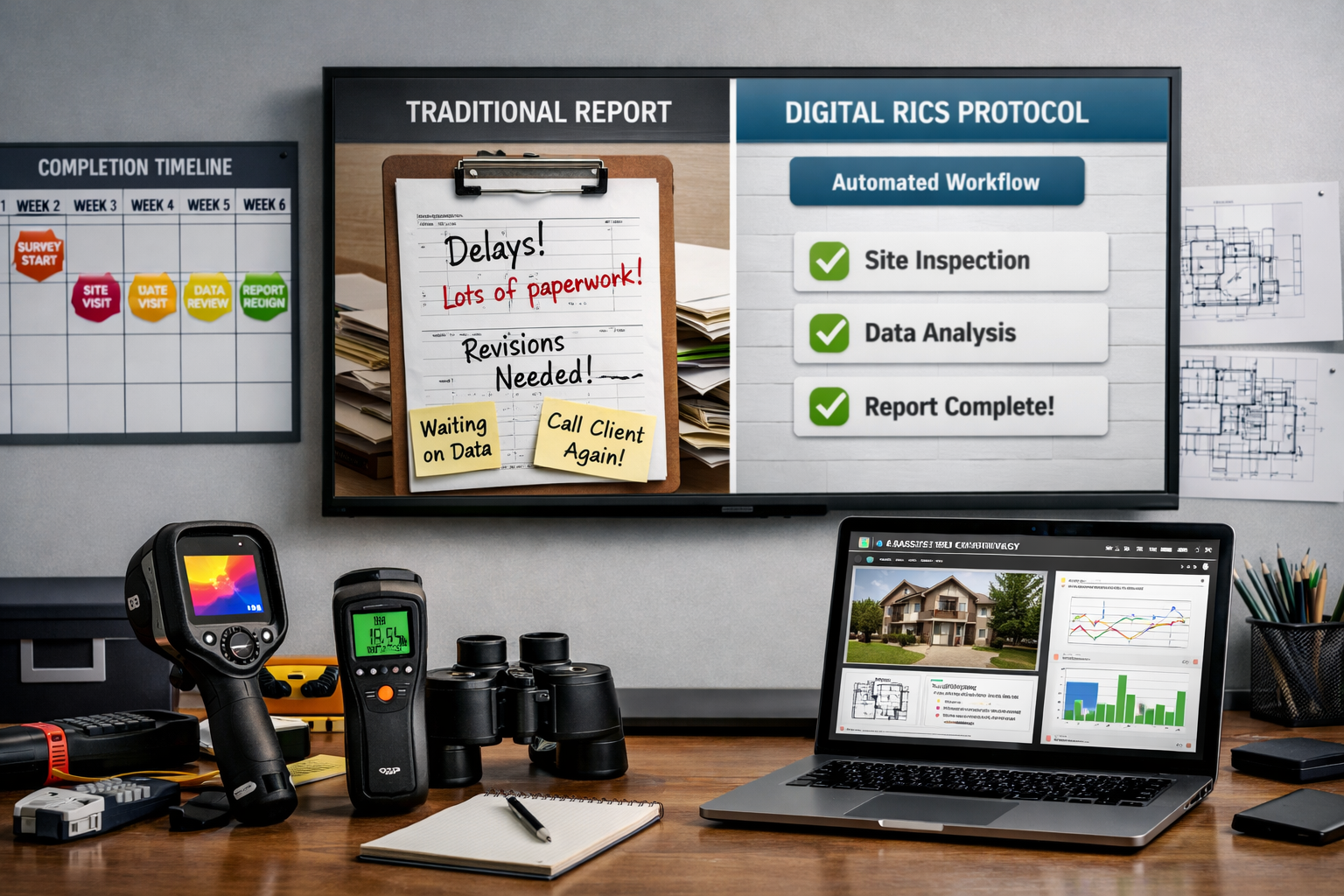
Speed creates risk. Building Survey Protocols for 6-Week Transaction Completions: RICS Checklists Amid 2026 Certainty Push must incorporate robust safeguards to prevent costly oversights that could expose surveyors to professional liability or clients to financial harm.
Front-Loading Critical Assessments
The compressed timeline demands strategic prioritization:
Week 1: Immediate Red Flags 🚩
- Structural stability concerns
- Active water ingress or severe damp
- Hazardous materials (asbestos, lead)
- Immediate safety issues
- Major defects affecting habitability
These issues must be identified and communicated within the first week, allowing buyers to make informed decisions early when they retain maximum negotiating leverage.
Week 2-3: Detailed Analysis
- Comprehensive condition assessment
- Repair cost estimation
- Long-term maintenance planning
- Building regulation compliance review
Week 4-6: Transaction Support
- Responding to buyer queries
- Supporting price negotiations
- Liaising with solicitors and lenders
- Final pre-completion checks if required
Enhanced Due Diligence Documentation
Protecting professional interests requires meticulous documentation:
Comprehensive Photographic Evidence
- Minimum 100-150 photographs for typical residential surveys
- Annotated images highlighting specific defects
- Contextual shots showing property orientation and surroundings
- Time-stamped digital files with metadata preservation
Detailed Limitation Clauses
Clear documentation of inspection limitations becomes critical:
- Areas not accessed (locked rooms, inaccessible roof spaces)
- Conditions preventing full inspection (furniture, floor coverings)
- Specialist investigations recommended
- Scope exclusions explicitly stated
Specialist Investigation Triggers
Fast-tracked surveys require clear protocols for escalating concerns to specialists:
Automatic Referral Criteria:
- Visible structural movement or cracking beyond hairline
- Evidence of active or historic damp requiring detailed investigation
- Suspected timber decay or insect infestation
- Electrical or heating system concerns
- Flat roof defects or tile/slate deterioration
Knowing when to recommend specialist damp surveys or structural engineers prevents superficial assessments that could miss critical issues. The surveyor's role becomes triaging and directing rather than attempting comprehensive diagnosis of every potential problem.
Price Negotiation Support
One of the most valuable aspects of expedited surveys is enabling swift negotiation. Understanding how an RICS survey can help negotiate property prices becomes essential when buyers have limited time to respond to findings.
Surveyors should provide:
- Itemized repair cost estimates with ranges (minimum, typical, maximum)
- Prioritized defect lists separating immediate, medium-term, and long-term concerns
- Comparable property data showing how defects affect market value
- Clear recommendations on whether issues warrant price reduction or seller remediation
Research on average price reduction after survey helps clients understand reasonable expectations, preventing unrealistic demands that could derail transactions.
Implementing RICS Checklists in Your Survey Practice
Transitioning to Building Survey Protocols for 6-Week Transaction Completions: RICS Checklists Amid 2026 Certainty Push requires systematic practice changes.
Technology Investment and Training
Essential Digital Tools:
- Tablet or ruggedized laptop for on-site report drafting
- High-quality camera with wide-angle capability (or professional smartphone)
- Thermal imaging camera for detecting hidden moisture and insulation defects
- Moisture meters (both pin-type and non-invasive)
- Laser measuring devices for accurate dimensions
- Drone equipment for roof and chimney inspection (with appropriate licensing)
- Cloud-based reporting software with offline capability
Staff Development:
- Regular training on updated RICS standards and protocols[2]
- Technology proficiency workshops
- Time management and efficiency training
- Client communication skills for compressed timelines
- Risk assessment and professional indemnity awareness
Quality Control in Accelerated Workflows
Speed must never compromise quality. Implement:
Peer Review Systems ✅
- Random sampling of reports for quality assurance
- Mandatory review of reports flagging major defects
- Mentoring programs pairing experienced and junior surveyors
- Regular calibration exercises ensuring consistency
Client Feedback Mechanisms
- Post-survey satisfaction surveys
- Complaint tracking and resolution protocols
- Continuous improvement processes based on feedback
- Professional indemnity insurer consultation on risk areas
Regional Adaptation and Local Expertise
RICS recognizes that survey protocols must reflect regional variations[2]. Building types, common defects, and construction methods vary significantly across the UK:
London and Southeast Considerations:
- Victorian and Edwardian terraced properties with common structural issues
- Leasehold complications requiring additional scrutiny
- High-value properties warranting extra diligence
- Urban environmental factors (pollution, subsidence from clay soils)
Regional Variations:
- Northern properties with different construction methods
- Coastal areas with specific weathering and damp concerns
- Rural properties with septic systems and private water supplies
- Listed buildings requiring specialist heritage knowledge
Working with local surveyors who understand regional characteristics ensures nothing is overlooked despite compressed timelines.
Overcoming Common Challenges in Six-Week Completions
Managing Client Expectations
Clear communication prevents disappointment:
Setting Realistic Boundaries 💬
- Explaining what surveys can and cannot determine
- Clarifying that surveys are "snapshots" not guarantees
- Discussing the difference between building surveys and valuations
- Managing expectations around specialist investigations and additional costs
Transparency About Limitations
Honest discussion about inspection constraints builds trust and protects against future disputes. Clients must understand that:
- Surveys are visual inspections, not invasive investigations
- Hidden defects may exist beyond what's observable
- Some areas may be inaccessible on survey day
- Specialist investigations may be necessary for complete assessment
Coordinating with Other Transaction Parties
Six-week completions require seamless collaboration:
Solicitor Liaison
- Sharing preliminary findings that might affect legal searches
- Coordinating timing of survey with contract negotiations
- Flagging issues requiring legal investigation (rights of way, building regulation compliance)
Mortgage Lender Communication
- Ensuring survey meets lender requirements
- Highlighting valuation-affecting defects promptly
- Providing additional information for underwriting decisions
Estate Agent Coordination
- Scheduling access efficiently
- Obtaining property information upfront
- Managing seller expectations about potential findings
Handling Complex or Problem Properties
Some properties resist fast-tracked assessment:
Red Flag Properties Requiring Extended Time:
- Large country estates with extensive grounds and outbuildings
- Properties with known major defects requiring detailed investigation
- Listed buildings with heritage considerations
- Properties undergoing or recently completed renovation
- Buildings with suspected structural issues
In these cases, professional integrity demands honest assessment of whether six-week completion is realistic. Better to decline instruction than deliver inadequate service.
Future Developments in Survey Protocol Standards
The evolution continues beyond 2026. RICS and the broader surveying profession are exploring:
Enhanced Digital Integration
Emerging Technologies:
- Augmented reality overlays showing hidden services and structure
- 3D scanning creating detailed digital property models
- Blockchain-based property history records
- IoT sensors providing real-time building performance data
- Machine learning improving defect detection accuracy
Standardization Across the Industry
Efforts to create universal protocols include:
- Consistent terminology and condition ratings
- Standardized repair cost databases
- Unified reporting formats for easier comparison
- Cross-industry data sharing (with appropriate privacy protections)
Continuing Professional Development
RICS commitment to maintaining standards requires:
- Regular updates to survey protocols reflecting emerging best practices
- Mandatory CPD on new technologies and methodologies
- Professional competency assessments
- Specialization pathways for complex property types
Conclusion: Balancing Speed with Professional Excellence
Building Survey Protocols for 6-Week Transaction Completions: RICS Checklists Amid 2026 Certainty Push represents a pivotal moment for the surveying profession. The challenge is substantial but achievable: delivering thorough, professional property assessments within dramatically compressed timelines.
Success requires embracing technology, standardizing workflows, and maintaining unwavering commitment to professional standards. The RICS updates throughout 2026[1][3] provide the framework, but individual practitioners must implement these principles with diligence and integrity.
Key success factors include:
- Strategic technology investment in tools that genuinely enhance efficiency
- Rigorous quality control preventing speed from compromising thoroughness
- Clear client communication managing expectations from initial instruction
- Robust risk management protecting both clients and professional interests
- Continuous professional development staying current with evolving standards
Actionable Next Steps 🎯
For Surveying Practices:
- Audit current workflows identifying bottlenecks and inefficiencies
- Invest in digital tools and staff training to support accelerated timelines
- Develop standardized templates and checklists aligned with RICS protocols
- Implement quality assurance processes ensuring consistency
- Review professional indemnity coverage for fast-tracked work
For Property Buyers:
- Instruct surveys early in the transaction process
- Choose RICS-qualified surveyors with proven track records
- Provide comprehensive property information upfront
- Remain available for quick communication and decision-making
- Understand that some properties may require specialist investigations extending timelines
For Industry Stakeholders:
- Support continued development of survey standards and protocols
- Invest in technology infrastructure enabling digital workflows
- Collaborate across professional boundaries for seamless transactions
- Advocate for realistic expectations balancing speed with thoroughness
- Participate in professional development and knowledge sharing
The six-week completion target is ambitious but achievable with proper protocols, professional commitment, and stakeholder cooperation. By implementing Building Survey Protocols for 6-Week Transaction Completions: RICS Checklists Amid 2026 Certainty Push, the property industry can deliver the speed modern markets demand without sacrificing the thoroughness that protects everyone involved.
The future of property transactions is faster, more efficient, and more transparent—but only if building surveyors lead with professional excellence and unwavering standards. The tools and frameworks exist. Now comes the implementation.
References
[1] Home Survey Standards – https://www.rics.org/profession-standards/rics-standards-and-guidance/sector-standards/building-surveying-standards/home-surveys/home-survey-standards
[2] Rics January 2026 Survey Insights Building Survey Protocols For Surging Buyer Enquiries In North West England – https://nottinghillsurveyors.com/blog/rics-january-2026-survey-insights-building-survey-protocols-for-surging-buyer-enquiries-in-north-west-england
[3] News Insights – https://www.rics.org/news-insights