The artificial intelligence boom is reshaping Britain's commercial property landscape in ways few predicted just two years ago. As AI companies and tech-driven businesses scramble for office space in London, Manchester, and Birmingham, landlords and developers are racing to retrofit older buildings to meet modern specifications. But there's a catch: most of these properties share walls with neighbouring structures, creating a complex web of legal obligations under the Party Wall etc. Act 1996. Party Wall Surveys for UK Office Retrofits in 2026: Managing Agreements Amid AI-Driven Demand in Core Cities has become a critical competency for surveyors navigating these high-stakes projects in densely packed urban environments.
The challenge isn't just technical—it's diplomatic. When a tech startup needs 50,000 square feet of retrofitted space within three months, and the work involves structural modifications to shared walls, surveyors must balance speed with compliance, neighbour relations with client demands, and RICS protocols with commercial realities.
Key Takeaways
- AI-driven demand is accelerating office retrofit timelines in core UK cities, creating unprecedented pressure on party wall agreement processes
- RICS protocols provide essential frameworks for managing high-occupancy retrofit projects where structural work affects shared boundaries
- Early neighbour engagement (60-90 days before work commences) significantly reduces dispute risk and project delays
- Digital documentation tools are transforming how surveyors manage complex multi-party agreements in commercial settings
- Specialist party wall surveyors with commercial retrofit experience are commanding premium fees due to high demand and complexity
Understanding Party Wall Surveys for UK Office Retrofits in 2026: The AI-Driven Context
The UK's office market has experienced a dramatic transformation since late 2024. Artificial intelligence companies have become the dominant force in prime office leasing across London's West End, Shoreditch, and Canary Wharf, as well as Manchester's Spinningfields and Birmingham's Snowhill districts. This surge in demand has created a secondary wave: the urgent need to retrofit existing office stock to accommodate power-hungry AI infrastructure, modern cooling systems, and open-plan collaborative spaces.
Why Party Wall Agreements Matter More Than Ever
Traditional office retrofits typically involved cosmetic updates—new carpets, fresh paint, perhaps some partition walls. Today's AI-era retrofits are fundamentally different. They require:
- Structural reinforcement to support heavy server equipment
- Enhanced electrical capacity with new risers and distribution panels
- Advanced HVAC systems that often penetrate party walls
- Soundproofing upgrades for high-occupancy collaborative spaces
- Fire safety improvements affecting shared structural elements
Each of these modifications potentially triggers obligations under the Party Wall Act 1996. The Act applies to any work that affects a shared wall, boundary, or structure within three or six metres of a neighbouring building, depending on the work type.
The Core Cities Phenomenon 🏙️
London remains the epicentre of AI-driven office demand, but Manchester and Birmingham have emerged as serious contenders. According to commercial property data, Grade B office buildings in these cities—structures built between 1980 and 2000—are experiencing unprecedented retrofit activity. These buildings typically share party walls with adjacent properties, creating complex scenarios where multiple neighbouring owners must be consulted.
The urban density factor cannot be overstated. In central London's Fitzrovia or Manchester's Northern Quarter, buildings often share walls on two or three sides. A single retrofit project might require agreements with four or five separate neighbouring properties, each with different owners, tenants, and concerns [1].
Legal Framework and RICS Protocols for Commercial Party Wall Agreements
The Party Wall etc. Act 1996 doesn't distinguish between residential and commercial properties—the same legal framework applies. However, commercial retrofits introduce unique complexities that require specialized surveyor expertise and modified approaches to the standard protocols.
The Three-Notice System
Under the Act, building owners must serve three types of notices depending on the work:
- Party Structure Notice (Section 3) – for work directly to a party wall
- Line of Junction Notice (Section 1) – for new walls on boundaries
- Adjacent Excavation Notice (Section 6) – for foundations near neighbouring buildings
For office retrofits, Party Structure Notices are most common, covering activities like:
- Installing steel beams through party walls
- Cutting into party walls for new services
- Raising party walls for additional floors
- Underpinning shared foundations
RICS Guidance for High-Occupancy Retrofits
The Royal Institution of Chartered Surveyors (RICS) provides professional standards that go beyond statutory requirements. For commercial projects in 2026, surveyors should follow these enhanced protocols:
Pre-Notice Assessment 📋
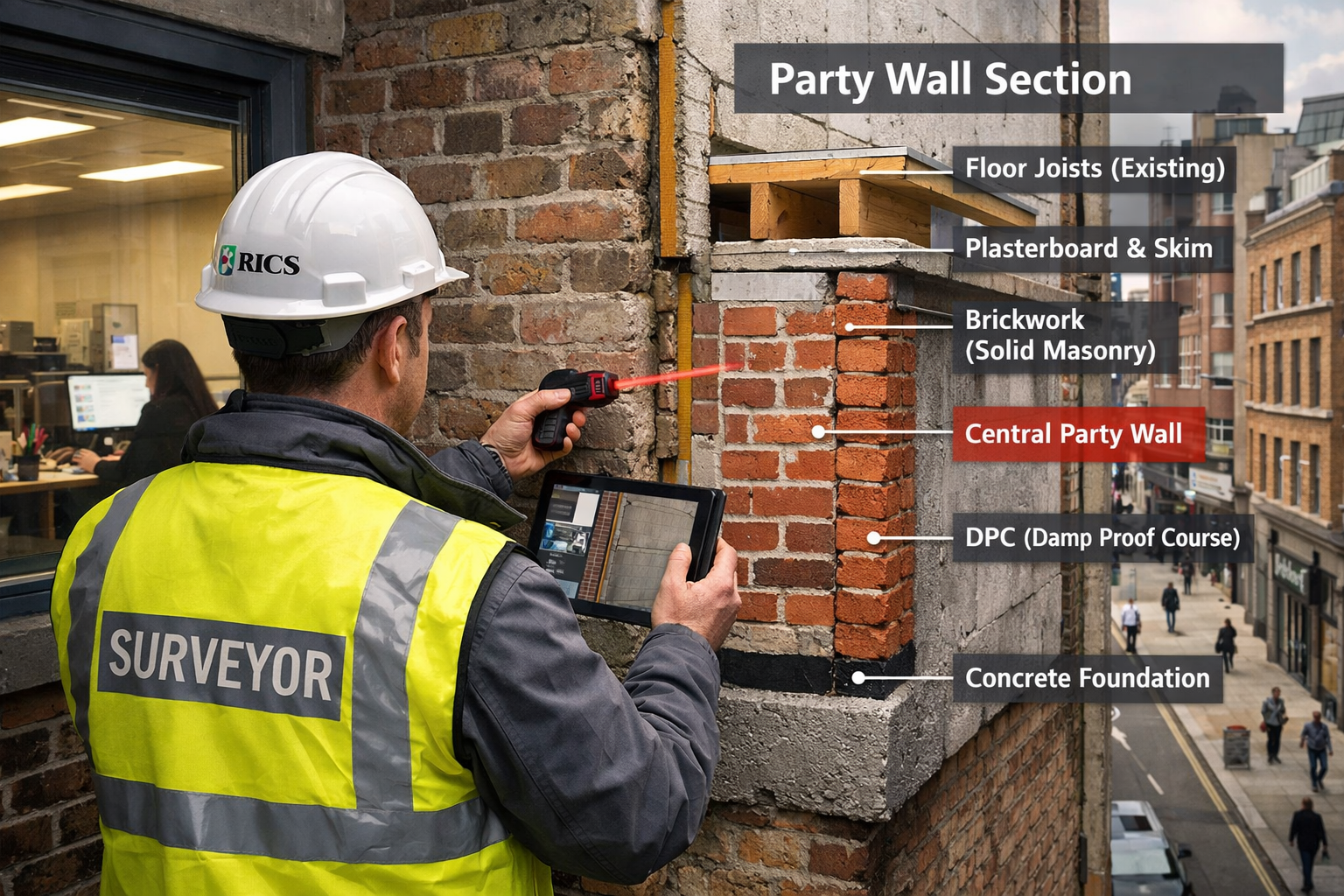
- Conduct thorough condition surveys of party walls before serving notices
- Document existing defects with photographs and detailed schedules
- Assess potential disruption to neighbouring businesses
- Identify critical services running through party walls
Tailored Notice Periods
While the Act requires minimum notice periods (two months for Party Structure Notices), RICS guidance suggests extending these timelines for complex commercial projects. A 90-day notice period allows:
- Multiple rounds of neighbour consultation
- Technical review by neighbouring building surveyors
- Coordination with ongoing business operations
- Resolution of initial concerns before formal disputes arise
Managing Multi-Party Agreements
The most challenging aspect of Party Wall Surveys for UK Office Retrofits in 2026: Managing Agreements Amid AI-Driven Demand in Core Cities involves projects affecting multiple neighbours simultaneously. Consider a typical scenario:
"A fintech company leasing a four-story building in Birmingham's Colmore Row district plans to retrofit the structure for AI development labs. The building shares its east wall with a law firm, west wall with a co-working space, and rear wall with a residential conversion. Each neighbour requires separate notices, separate surveyors, and separate awards."
In such cases, experienced party wall surveyors recommend:
- Appointing a single agreed surveyor where possible to represent all neighbours
- Standardizing schedules of condition across all neighbouring properties
- Coordinating site access to minimize disruption
- Creating master timelines that respect all parties' operational needs

Practical Challenges in Managing Party Wall Agreements for Office Retrofits
Theory meets reality when surveyors attempt to balance statutory compliance with commercial imperatives. The AI-driven demand surge has compressed timelines, elevated stakes, and introduced new technical challenges that weren't contemplated when the Party Wall Act was drafted in 1996.
Timeline Compression and Client Expectations
Tech companies operate on different timelines than traditional businesses. When an AI startup secures Series B funding and needs operational office space within three months, they expect their landlord to deliver—party wall agreements or not. This creates intense pressure on surveyors to accelerate processes designed to be methodical and consultative.
The reality check: Party wall procedures cannot be rushed without significant risk. Surveyors must educate clients about:
- Statutory minimum notice periods (non-negotiable)
- Reasonable response times for neighbours
- Potential for disputes and third surveyor appointments
- Consequences of proceeding without proper agreements
Neighbour Resistance in Commercial Settings
Residential neighbours typically worry about noise, dust, and structural damage. Commercial neighbours have different concerns:
- Operational disruption affecting revenue
- Client perception during noisy construction
- Insurance implications and potential premium increases
- Lease obligations requiring them to maintain quiet enjoyment for their tenants
A Manchester-based surveyor recently noted: "We're seeing more commercial neighbours requesting detailed mitigation plans before consenting to work. They want guarantees about working hours, noise levels, vibration limits, and emergency contact protocols" [2].
Technical Complexity of Modern Retrofits
AI-era office retrofits involve systems that didn't exist when most party wall surveyors received their training:
High-Density Power Distribution
Modern AI development offices require 10-20 times the electrical capacity of traditional offices. Installing new electrical risers often means penetrating party walls at multiple levels, each requiring careful planning and documentation.
Advanced Cooling Systems
AI server rooms generate enormous heat. Retrofit cooling solutions frequently involve:
- Chilled water pipes running through party walls
- External condensers requiring structural support on shared walls
- Ventilation ducts penetrating party structures
Acoustic Engineering
Open-plan AI development spaces with 100+ employees generate significant noise. Soundproofing solutions often require:
- Adding mass to party walls (increasing structural load)
- Creating independent stud walls (reducing usable floor area)
- Installing resilient channels (affecting services in party walls)
The Dispute Resolution Challenge
Despite best efforts, disputes are increasingly common in commercial party wall matters. When neighbours disagree, the Act requires appointing surveyors:
- Building owner appoints their surveyor
- Neighbouring owner appoints their surveyor
- Both surveyors select a third surveyor (in case of disagreement)
The process can add 6-12 weeks to project timelines and significant costs. Party wall surveyor fees for complex commercial disputes can range from £5,000 to £25,000 per party, depending on the project scope and dispute complexity.
Digital Tools and Documentation Standards
Forward-thinking surveyors are adopting digital tools to manage the complexity of multi-party commercial agreements:
Cloud-Based Documentation Systems
- Centralized repositories for notices, responses, and awards
- Automated deadline tracking and reminder systems
- Secure client portals for real-time project updates
3D Scanning and BIM Integration
- Laser scanning of party walls for precise condition records
- Building Information Modeling (BIM) showing proposed work in context
- Virtual walkthroughs for neighbouring owners
Digital Signature Platforms
- Expedited agreement execution
- Legally compliant electronic signatures
- Audit trails for compliance documentation
These tools are particularly valuable when managing party wall agreements across multiple properties in different cities, a common scenario in 2026's distributed office market.
RICS Best Practices for Party Wall Surveys in High-Demand Urban Retrofits
The Royal Institution of Chartered Surveyors has developed specialized guidance for managing party wall matters in high-pressure commercial environments. These best practices reflect lessons learned from hundreds of retrofit projects completed since the AI boom began.
Pre-Project Planning and Risk Assessment
Successful party wall management begins months before the first notice is served. RICS recommends a structured pre-project phase:
Stage 1: Desktop Research (Weeks 1-2)
- Land Registry searches to identify all neighbouring owners
- Lease review to understand tenant notification requirements
- Historical planning records to identify previous party wall issues
- Building control records for existing shared structures
Stage 2: Physical Investigation (Weeks 3-4)
- Detailed inspection of all party walls and structures
- Identification of existing defects requiring documentation
- Assessment of neighbouring building conditions
- Photography and videography of current states
Stage 3: Technical Review (Weeks 5-6)
- Engineer review of proposed structural modifications
- Services coordination for penetrations through party walls
- Acoustic assessment for noise-sensitive neighbours
- Vibration analysis for sensitive equipment in neighbouring buildings
Stage 4: Stakeholder Mapping (Weeks 7-8)
- Identification of all parties requiring notices
- Assessment of likely concerns and objections
- Development of tailored communication strategies
- Preparation of technical information packages
This eight-week pre-project phase may seem excessive, but experienced surveyors report it reduces overall project timelines by preventing disputes and accelerating agreement processes.
Communication Strategies for Commercial Neighbours
Commercial neighbours respond differently than residential owners. They're typically more sophisticated, have professional advisors, and focus on business impacts rather than emotional concerns. RICS guidance suggests:
Initial Contact Approach
- Schedule face-to-face meetings with neighbouring business owners or facility managers
- Provide comprehensive information packages including project overview, timeline, and mitigation measures
- Offer site visits to show proposed work areas
- Present contact information for project managers and surveyors
Ongoing Engagement
- Weekly email updates during active construction phases
- 48-hour advance notice of particularly disruptive activities
- Quarterly meetings for long-duration projects
- Immediate notification of any incidents or issues
Mitigation Offerings
Progressive building owners are offering tangible benefits to secure neighbour cooperation:
- Timing accommodations – scheduling noisy work around neighbour's critical business periods
- Temporary facilities – providing alternative meeting rooms during disruptive phases
- Protective measures – installing temporary sound barriers beyond statutory requirements
- Condition improvements – offering to repair or upgrade shared structures
The Agreed Surveyor Advantage
One of the most effective strategies for managing Party Wall Surveys for UK Office Retrofits in 2026: Managing Agreements Amid AI-Driven Demand in Core Cities is the agreed surveyor approach. Under Section 10 of the Act, both parties can agree to appoint a single surveyor to act impartially.
Benefits of the agreed surveyor model:
✅ Reduced costs – one surveyor fee instead of two or three
✅ Faster resolution – no need for surveyor coordination meetings
✅ Simplified communication – single point of contact for all parties
✅ Consistent standards – uniform approach to schedules and awards
When it works best:
- Straightforward retrofit projects with standard modifications
- Neighbours with prior positive working relationships
- Projects where both parties trust the nominated surveyor
- Time-sensitive situations requiring rapid agreement
When to avoid it:
- Complex technical disputes requiring specialist input
- Situations where neighbours have conflicting interests
- Projects with potential for significant damage or disruption
- Cases where one party lacks sophistication in construction matters
Understanding what a party wall surveyor does helps both parties decide whether the agreed surveyor model suits their situation.
Award Drafting for Complex Commercial Projects
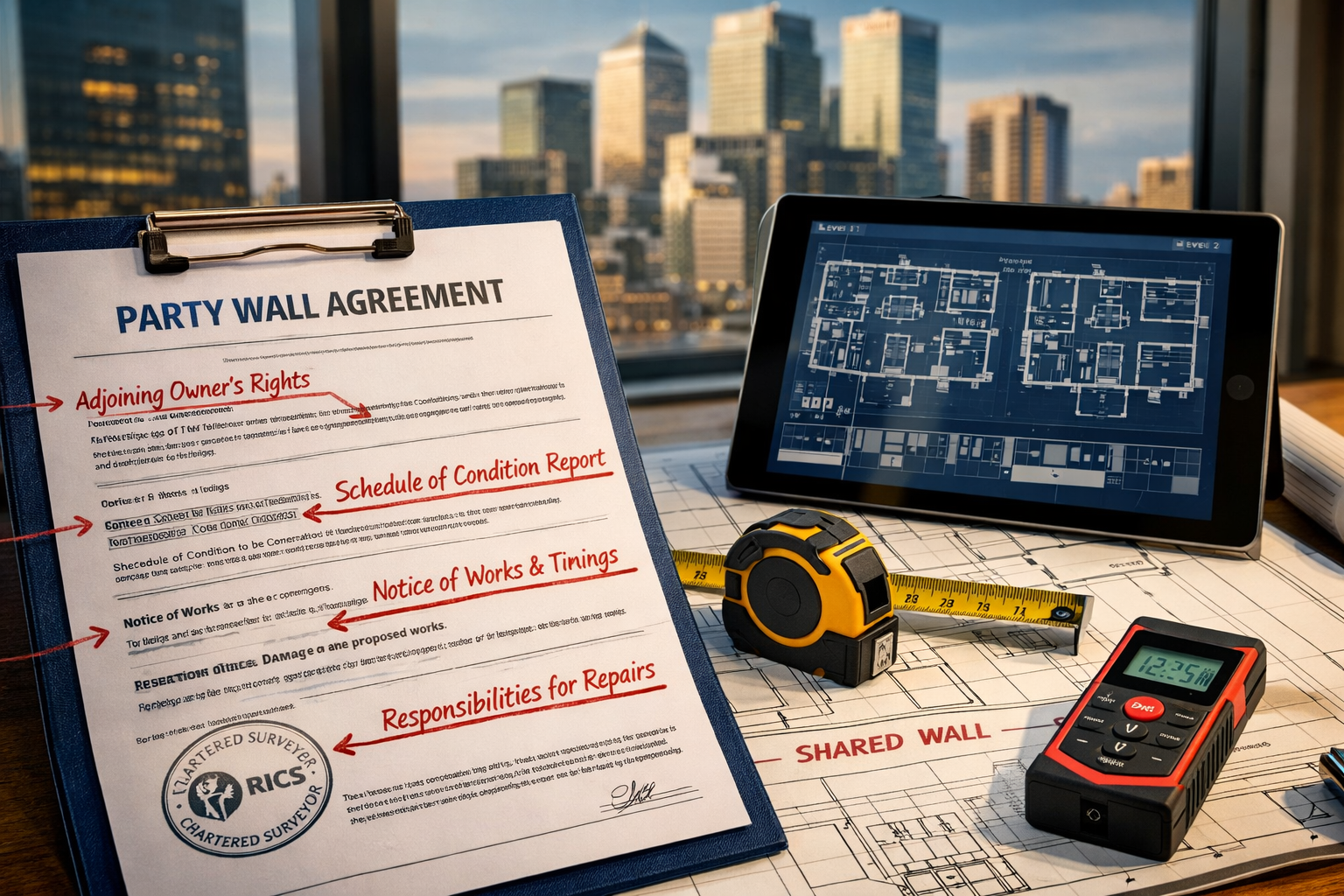
The Party Wall Award is the legal document that governs the work and protects all parties. For commercial retrofits, awards must be more detailed than typical residential awards:
Essential Award Components:
-
Detailed Work Descriptions
- Precise specifications of all party wall modifications
- Structural calculations and engineer certifications
- Services routing diagrams
- Temporary works requirements
-
Comprehensive Schedules of Condition
- Room-by-room photographic records
- Detailed defect descriptions with measurements
- Crack monitoring locations and baseline readings
- Services condition documentation
-
Working Hours and Access Provisions
- Specific permitted working times
- Noise and vibration limits
- Access arrangements for monitoring
- Emergency contact procedures
-
Insurance and Security Requirements
- Minimum insurance coverage levels
- Security arrangements for shared access areas
- Protocols for protecting neighbouring property
- Indemnity provisions
-
Dispute Resolution Mechanisms
- Procedures for addressing issues during work
- Third surveyor appointment protocols
- Escalation procedures for urgent matters
Cost Management and Fee Structures
Party wall costs for commercial retrofits significantly exceed residential projects. Building owners should budget for:
| Cost Category | Typical Range (2026) | Notes |
|---|---|---|
| Building Owner's Surveyor | £8,000 – £25,000 | Depends on project complexity and duration |
| Adjoining Owner's Surveyor | £6,000 – £20,000 | Building owner pays both surveyors |
| Third Surveyor (if needed) | £5,000 – £15,000 | For dispute resolution |
| Schedules of Condition | £2,000 – £8,000 per property | Detailed photographic surveys |
| Monitoring Services | £1,500 – £5,000 | Crack monitoring, vibration analysis |
| Legal Fees | £3,000 – £15,000 | If disputes escalate |
Total party wall costs for a complex urban office retrofit affecting multiple neighbours can easily reach £50,000-£100,000. However, this represents just 0.5-1% of typical retrofit project costs and provides essential legal protection.
For detailed cost guidance, review our information on London party wall surveyor costs.
Case Studies: Real-World Applications in 2026
Examining actual retrofit projects illuminates the practical application of party wall procedures in AI-driven office conversions.
Case Study 1: Shoreditch Tech Hub Retrofit
Project Overview:
A six-story 1980s office building in London's Shoreditch was retrofitted for an AI research company. The building shared party walls with a boutique hotel (east), residential flats (west), and a restaurant (ground floor, rear).
Party Wall Challenges:
- Restaurant required absolute certainty about working hours to protect dinner service
- Hotel demanded vibration limits to prevent guest complaints
- Residential owners concerned about long-term structural impacts
Solutions Implemented:
- Extended 90-day notice period allowed detailed neighbour consultation
- Agreed surveyor appointed for hotel and restaurant (cost savings)
- Separate surveyor for residential owners (different concerns)
- Vibration monitoring installed before work commenced
- Working hours restricted to 8am-6pm weekdays only
- Building owner offered to upgrade hotel's shared wall insulation
Outcome:
Project completed without disputes. Total party wall costs: £42,000. Timeline impact: 12 weeks for agreement process, but zero delays once work commenced.
Case Study 2: Manchester Multi-Building Complex
Project Overview:
A three-building campus in Manchester's Spinningfields district required coordinated retrofits for a fintech company. Buildings shared party walls in complex configurations.
Party Wall Challenges:
- 11 separate neighbouring properties required notices
- Phased construction over 18 months
- Multiple contractors working simultaneously
- Existing party wall defects requiring attribution
Solutions Implemented:
- Master party wall strategy developed before any notices served
- Single coordinating surveyor managed all agreements
- Standardized schedules of condition across all properties
- Quarterly stakeholder meetings throughout project
- Digital documentation platform for all parties
Outcome:
Two minor disputes resolved through surveyor negotiation. Total party wall costs: £78,000. Project delivered on time despite complexity.
Future Trends and Emerging Considerations
As we progress through 2026, several trends are shaping the evolution of party wall practice in commercial retrofits:
Regulatory Developments
Energy Performance Certificate (EPC) Requirements
The government's push toward net-zero has created new retrofit drivers. Buildings must achieve minimum EPC ratings, often requiring structural modifications that trigger party wall obligations. Surveyors must now coordinate party wall procedures with EPC retrofit compliance requirements [2].
Building Safety Act Implications
New building safety regulations affect how party walls are assessed and modified, particularly regarding fire safety and structural integrity. Surveyors require additional training to address these evolving standards.
Technology Integration
AI-Assisted Risk Assessment
Some surveying firms are experimenting with AI tools that analyze historical party wall disputes to predict risk factors in new projects. While still emerging, these tools show promise for identifying potential issues before notices are served.
Digital Twin Technology
Creating digital twins of buildings and their party walls allows for sophisticated modeling of proposed modifications and their impacts on neighbouring structures.
Market Dynamics
Surveyor Shortage
The surge in retrofit activity has created a shortage of experienced commercial party wall surveyors. Firms report difficulty finding qualified professionals, driving up fees and extending timelines.
Insurance Considerations
Professional indemnity insurers are scrutinizing party wall work more closely, requiring enhanced documentation and risk assessment procedures.
Conclusion
Party Wall Surveys for UK Office Retrofits in 2026: Managing Agreements Amid AI-Driven Demand in Core Cities represents one of the most dynamic and challenging areas of surveying practice today. The collision of AI-driven commercial demand, aging urban building stock, and complex legal frameworks requires surveyors to operate at the intersection of technical expertise, legal compliance, and diplomatic negotiation.
The key to success lies in early planning, thorough documentation, and proactive communication. Surveyors who invest time in comprehensive pre-project assessments, detailed condition surveys, and genuine neighbour engagement consistently deliver better outcomes than those who treat party wall procedures as mere box-ticking exercises.
Actionable Next Steps
For building owners and developers planning office retrofits:
- Engage party wall surveyors 4-6 months before planned construction to allow adequate time for proper procedures
- Budget realistically for party wall costs (1% of project value for complex urban retrofits)
- Prioritize neighbour relations – goodwill prevents disputes more effectively than legal documents
- Insist on digital documentation – cloud-based systems provide transparency and reduce miscommunication
For neighbouring property owners receiving party wall notices:
- Respond promptly to notices – silence doesn't prevent work, it just reduces your control
- Appoint experienced commercial surveyors – residential specialists may lack relevant expertise
- Focus on practical protections rather than attempting to stop legitimate work
- Document everything – your own photographs and records supplement official schedules
For surveyors managing commercial party wall matters:
- Invest in continuing professional development – commercial retrofit work requires specialized knowledge
- Build relationships with specialist consultants – structural engineers, acoustic consultants, and building safety experts
- Develop standardized processes – checklists and templates improve consistency and reduce errors
- Embrace technology – digital tools are no longer optional for complex multi-party projects
The AI-driven transformation of UK office markets shows no signs of slowing. As retrofit activity continues to accelerate in London, Manchester, Birmingham, and other core cities, the demand for skilled party wall surveyors will only intensify. Those who master the unique challenges of commercial party wall work in high-density urban environments will find themselves at the center of one of the UK's most dynamic property sectors.
The party wall framework established in 1996 has proven remarkably resilient, but its application to 21st-century commercial retrofits requires creativity, expertise, and unwavering commitment to professional standards. Success demands more than legal compliance—it requires understanding the business imperatives driving these projects while protecting the legitimate interests of all affected parties.
References
[1] Party Wall Surveys For Ev Infrastructure Retrofits Compliance Amid 2026 Net Zero Mandates And Neighbour Disputes – https://nottinghillsurveyors.com/blog/party-wall-surveys-for-ev-infrastructure-retrofits-compliance-amid-2026-net-zero-mandates-and-neighbour-disputes
[2] Party Wall Essentials For 2026 Net Zero Compliance Projects Surveyor Checklists For Epc Retrofit Disputes – https://nottinghillsurveyors.com/blog/party-wall-essentials-for-2026-net-zero-compliance-projects-surveyor-checklists-for-epc-retrofit-disputes