
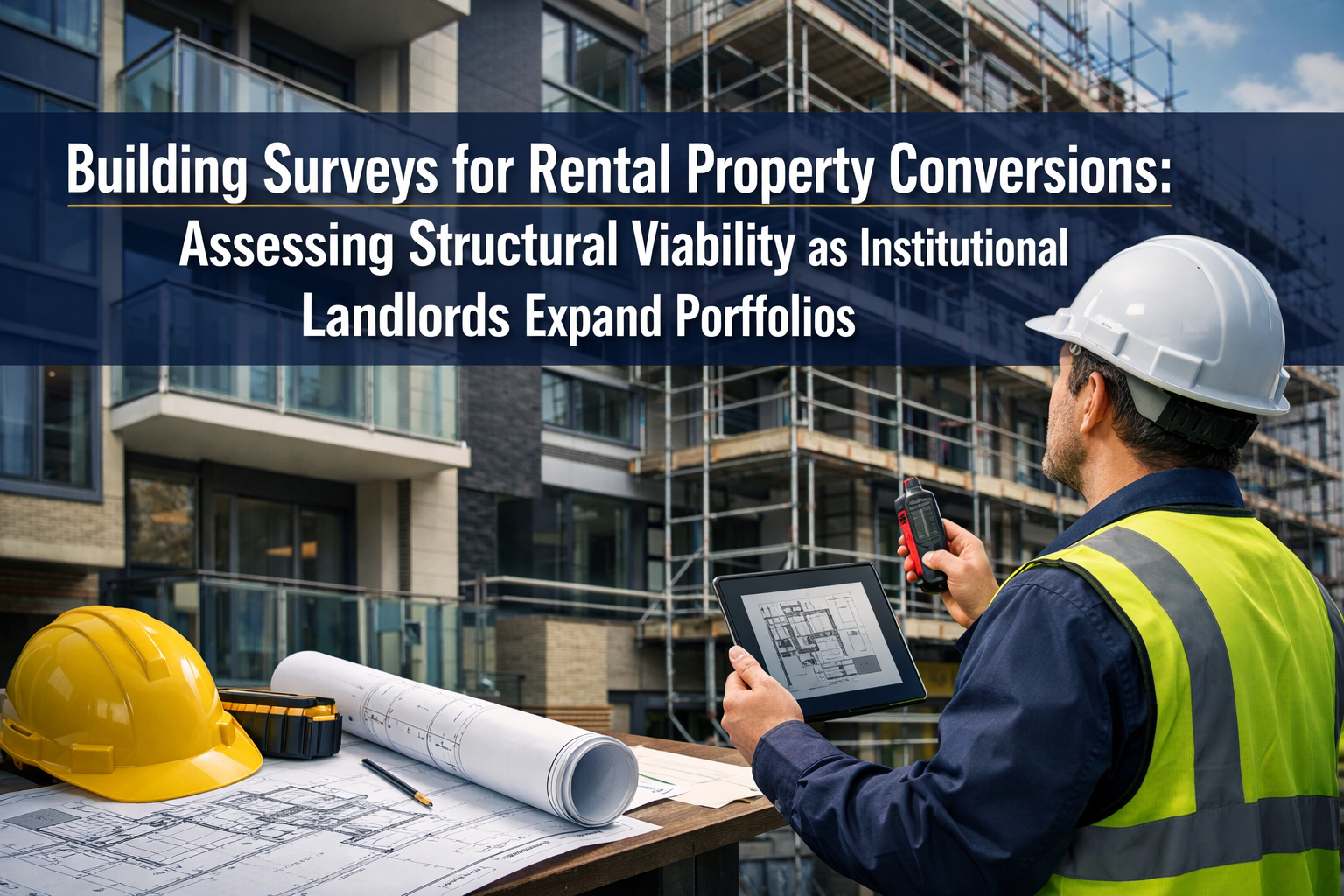
As institutional landlords aggressively expand their rental portfolios in 2026, the demand for specialized property assessments has never been higher. Building Surveys for Rental Property Conversions: Assessing Structural Viability as Institutional Landlords Expand Portfolios represents a critical intersection of property evaluation, investment strategy, and long-term asset management. Professional landlords acquiring properties at scale need robust frameworks to evaluate conversion potential, ensure structural integrity, and maximize rental yield sustainability—all while managing risk across diverse property types.
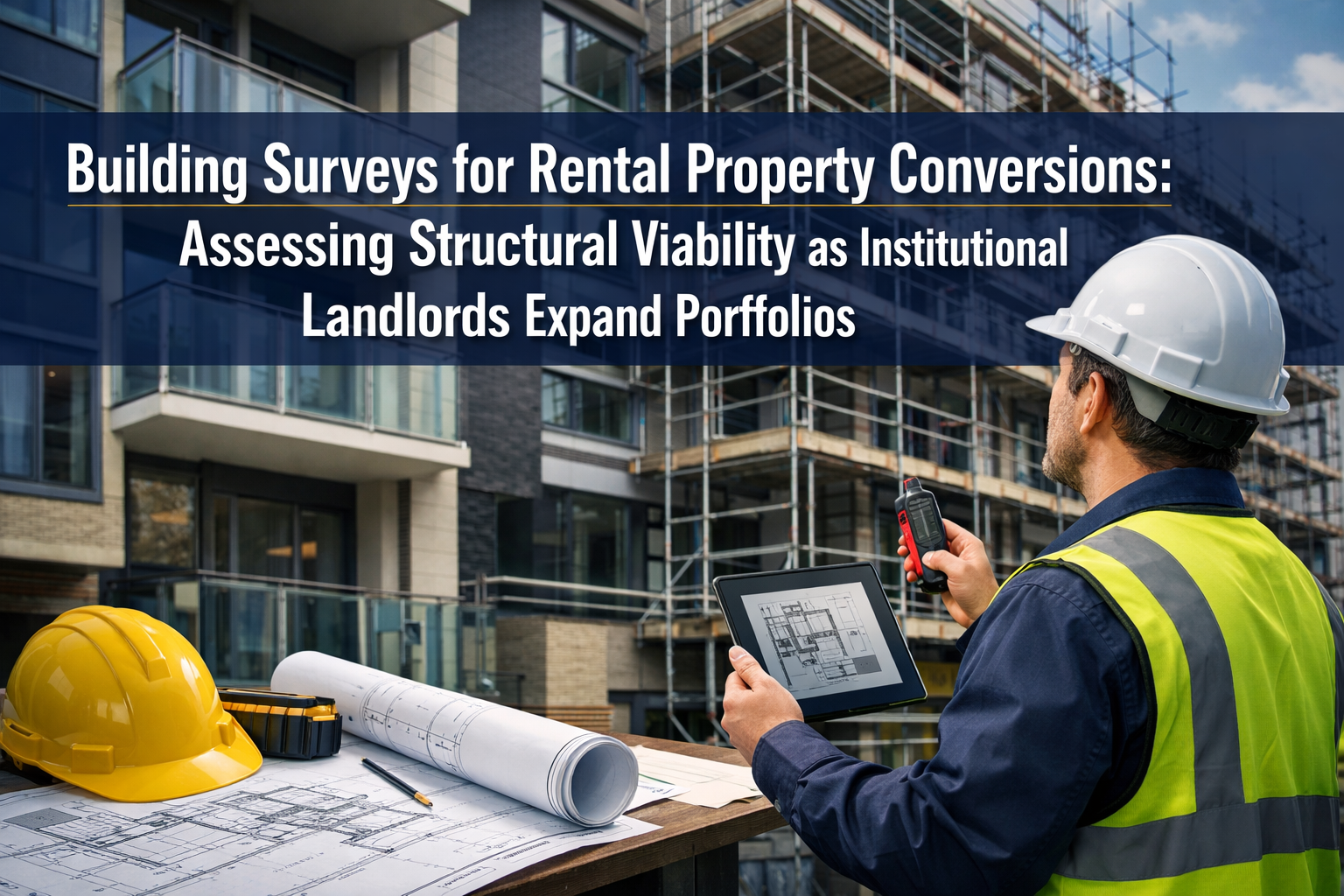
The landscape of rental property investment has transformed dramatically. Large-scale institutional investors now compete with traditional landlords, driving the need for comprehensive survey methodologies that go beyond standard homebuyer assessments. These specialized building surveys must evaluate not just current condition, but future potential for multi-occupancy conversion, long-term tenant durability, and compliance with evolving rental property regulations.
Key Takeaways
- Specialized survey frameworks for rental conversions assess structural viability, multi-occupancy potential, and long-term maintenance costs differently than standard residential surveys
- Institutional landlords require detailed analysis of rental yield sustainability, including projected maintenance expenses, compliance costs, and conversion feasibility
- Multi-occupancy conversions demand thorough evaluation of fire safety systems, sound insulation, separate utilities, and building regulation compliance
- Risk mitigation strategies through comprehensive surveys protect portfolio investments and prevent costly post-acquisition surprises
- Professional survey reports provide quantifiable data for investment decisions, financing applications, and portfolio management strategies
Understanding Building Surveys for Rental Property Portfolio Expansion
The Institutional Landlord Perspective
Institutional landlords approach property acquisition fundamentally differently than individual homebuyers. Where a homebuyer focuses on personal living requirements, professional landlords evaluate properties as income-generating assets within broader portfolio strategies. This shift in perspective demands survey methodologies specifically designed for Building Surveys for Rental Property Conversions: Assessing Structural Viability as Institutional Landlords Expand Portfolios.
Key differences in institutional survey requirements:
| Standard Homebuyer Survey | Institutional Rental Survey |
|---|---|
| Personal comfort and aesthetics | Income potential and tenant appeal |
| Immediate occupancy readiness | Conversion feasibility assessment |
| Individual property focus | Portfolio integration analysis |
| 5-10 year ownership horizon | 15-30+ year investment timeline |
| Basic structural integrity | Detailed lifecycle cost modeling |
Professional landlords need surveys that quantify rental yield sustainability over extended periods. This requires detailed analysis of structural systems, projected maintenance schedules, and potential capital expenditure requirements. A property that appears sound for personal residence may present significant challenges when evaluated for multi-tenant occupancy or intensive rental use.
Specialized Survey Frameworks for Conversion Assessment
Developing robust frameworks for evaluating conversion potential requires expertise beyond traditional property inspection. These frameworks must integrate structural engineering principles, building regulations knowledge, rental market dynamics, and financial modeling capabilities.
Essential components of conversion-focused surveys include:
🏗️ Structural Capacity Analysis – Assessing whether existing foundations, load-bearing walls, and floor structures can support conversion modifications, additional partitions, or increased occupancy loads
🔧 Systems Infrastructure Evaluation – Determining if electrical, plumbing, heating, and ventilation systems have sufficient capacity for multi-occupancy or require complete replacement
🔥 Fire Safety Compliance Review – Evaluating current fire protection measures against requirements for Houses in Multiple Occupation (HMO) or multi-unit conversions
📏 Space Planning Viability – Analyzing floor layouts, ceiling heights, natural light, and access configurations for conversion to multiple rental units
💰 Cost-Benefit Modeling – Quantifying conversion expenses against projected rental income increases to determine investment viability
Professional surveyors conducting these assessments must understand the specific requirements of commercial property inspections while applying them to residential rental contexts. The survey report becomes a critical decision-making tool, providing quantifiable data that institutional investors can incorporate into portfolio analysis and acquisition strategies.
Critical Assessment Areas in Rental Property Conversion Surveys
Structural Integrity and Long-Term Durability
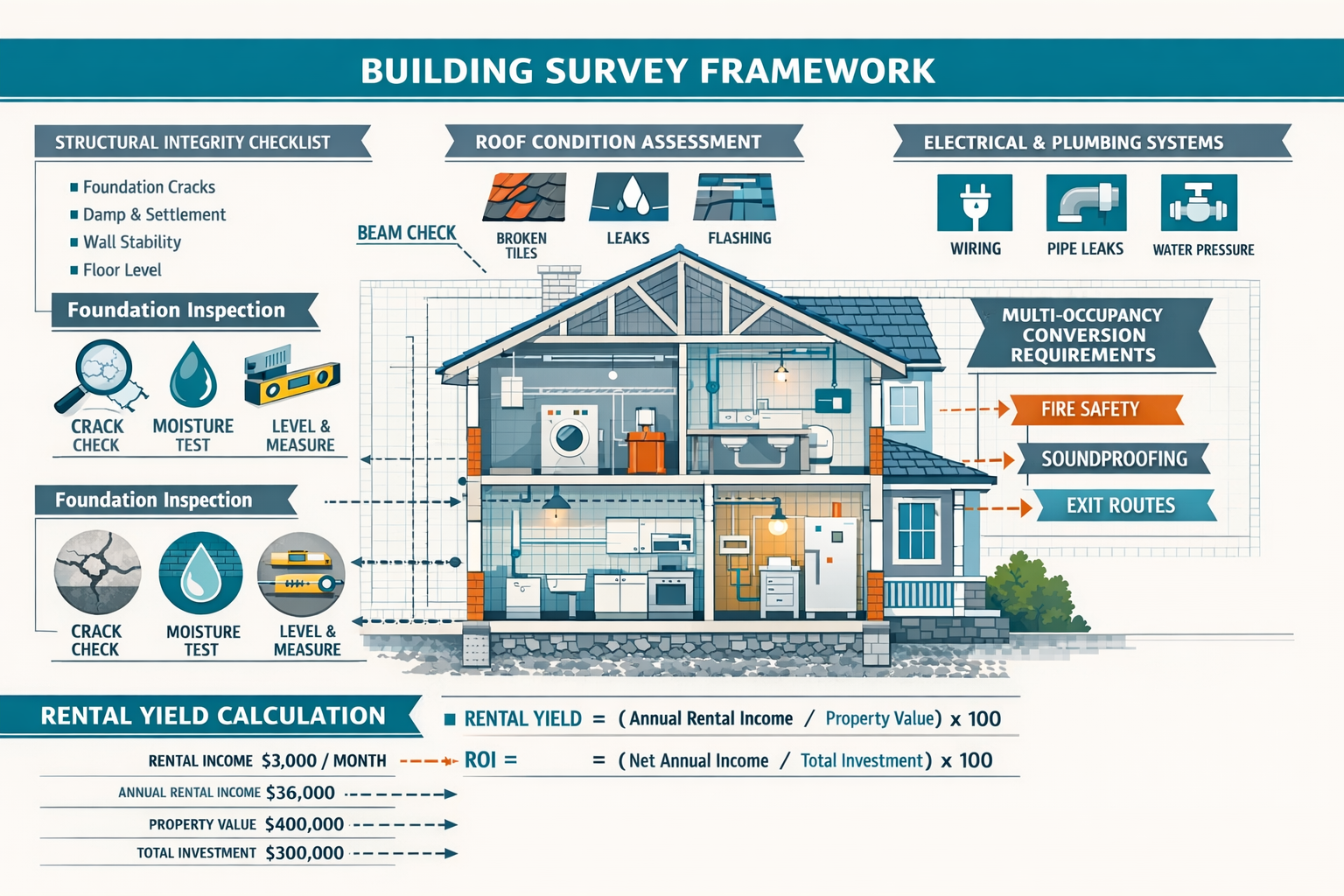
When evaluating Building Surveys for Rental Property Conversions: Assessing Structural Viability as Institutional Landlords Expand Portfolios, structural assessment takes precedence over cosmetic considerations. Rental properties experience higher wear rates than owner-occupied homes, making structural durability paramount for long-term portfolio performance.
Foundation and Substructure Analysis:
The foundation represents the most critical structural element in any conversion assessment. Surveyors must evaluate not just current condition, but capacity to support potential modifications. Key considerations include:
- Settlement patterns and evidence of historical movement
- Load-bearing capacity for additional floors or partition walls
- Moisture ingress and damp-proofing effectiveness
- Subsidence risk factors based on soil conditions and drainage
- Underpinning requirements for conversion projects
Properties showing signs of foundation issues require specialized specific defect surveys to determine remediation costs before acquisition decisions proceed.
Structural Frame and Load-Bearing Elements:
For multi-occupancy conversions, understanding the structural frame becomes essential. Institutional landlords need detailed analysis of:
- Load-bearing wall locations and their impact on layout flexibility
- Floor joist condition and spacing for sound insulation requirements
- Roof structure capacity for potential loft conversions
- Lateral stability and wind loading resistance
- Structural modifications required for creating separate units
Properties with timber frame construction require particular attention to rot, insect damage, and moisture-related deterioration. Masonry structures need evaluation for wall tie corrosion, cavity wall issues, and pointing condition—all factors that significantly impact long-term maintenance budgets.
Building Systems and Infrastructure Capacity
Rental property conversions often fail due to inadequate infrastructure capacity rather than structural issues. A full structural inspection must thoroughly evaluate all building systems against projected tenant demands.
Electrical Systems Assessment:
Modern rental properties require substantial electrical capacity for tenant appliances, heating systems, and safety equipment. Survey evaluations must determine:
✅ Consumer unit capacity and circuit protection adequacy
✅ Wiring condition and compliance with current regulations
✅ Separate metering capability for multi-occupancy conversions
✅ Emergency lighting and fire alarm system requirements
✅ EV charging infrastructure potential for future tenant demands
Properties with outdated electrical systems may require complete rewiring—a significant capital expense that dramatically impacts conversion viability calculations.
Plumbing and Heating Infrastructure:
Water supply and heating systems must support increased occupancy without compromising performance or efficiency:
- Water pressure and flow rates adequate for multiple simultaneous users
- Boiler capacity sufficient for increased hot water demand
- Pipe condition and materials (lead pipe replacement requirements)
- Separate heating controls for individual units in conversions
- Drainage capacity for additional bathrooms and kitchens
Institutional landlords increasingly prioritize energy efficiency for both environmental compliance and operating cost reduction. Surveys should evaluate insulation levels, glazing performance, and heating system efficiency against current Energy Performance Certificate (EPC) requirements and future regulatory trends.
Multi-Occupancy Conversion Requirements
Converting single-family properties to multi-occupancy rental units involves complex regulatory compliance beyond standard building surveys. Understanding these requirements is essential for Building Surveys for Rental Property Conversions: Assessing Structural Viability as Institutional Landlords Expand Portfolios.
HMO Licensing and Building Regulation Compliance:
Properties intended for Houses in Multiple Occupation face stringent requirements:
| Requirement Category | Assessment Focus |
|---|---|
| Fire Safety | Means of escape, fire doors, detection systems, emergency lighting |
| Sound Insulation | Airborne and impact sound transmission between units |
| Amenity Standards | Minimum room sizes, kitchen facilities, bathroom ratios |
| Means of Escape | Staircase widths, travel distances, protected routes |
| Structural Fire Protection | Compartmentation, fire-resistant construction |
Surveys must identify conversion barriers that would make HMO compliance prohibitively expensive. Properties with complex layouts, insufficient ceiling heights, or inadequate escape routes may prove unsuitable despite appearing structurally sound.
Space Planning and Layout Optimization:
Effective rental conversions maximize income while maintaining tenant appeal and regulatory compliance. Survey assessments should evaluate:
🏠 Unit configuration potential – number and type of rentable units achievable
📐 Minimum space standards compliance for bedrooms and living areas
🚪 Access arrangements for separate entrances and shared facilities
💡 Natural light and ventilation adequacy for habitable rooms
🔊 Acoustic separation feasibility between units
Properties with flexible floor plans and good room proportions offer superior conversion potential. Conversely, properties with narrow corridors, limited natural light, or awkward layouts may require extensive (and expensive) modifications to achieve viable rental configurations.
Financial Modeling and Investment Decision Support
Rental Yield Sustainability Analysis
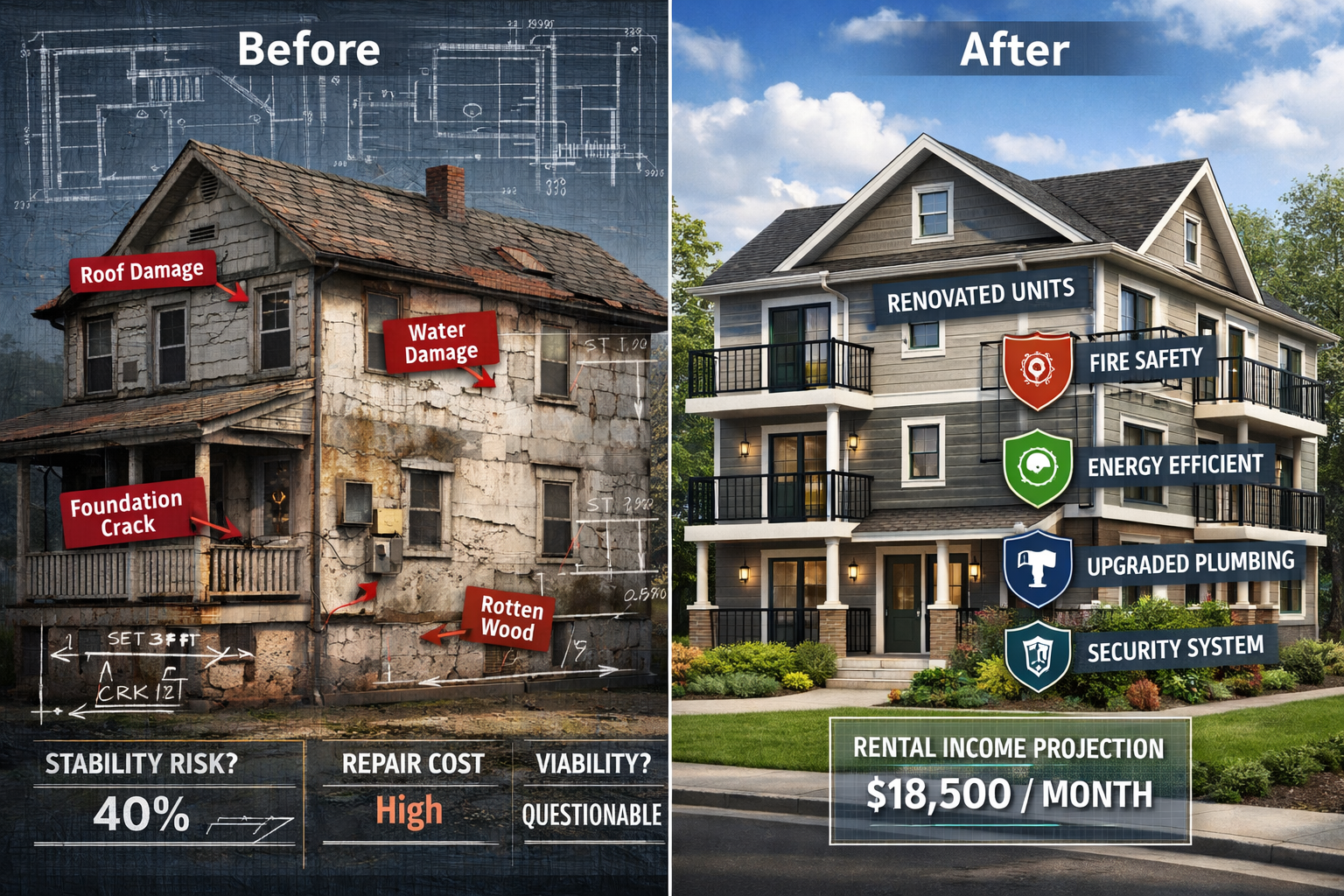
Professional landlords require surveys that go beyond identifying defects to provide comprehensive financial intelligence. Building Surveys for Rental Property Conversions: Assessing Structural Viability as Institutional Landlords Expand Portfolios must quantify how structural condition impacts long-term investment performance.
Lifecycle Cost Modeling:
Sophisticated survey reports incorporate projected maintenance and replacement schedules:
- Immediate remediation costs for critical defects affecting safety or habitability
- Short-term maintenance (1-5 years) including routine repairs and minor replacements
- Medium-term capital expenditure (5-15 years) such as roof replacement or system upgrades
- Long-term structural work (15-30 years) including major refurbishments or rebuilding
- Regulatory compliance costs for evolving energy efficiency and safety standards
This financial modeling transforms survey findings into actionable investment intelligence. Institutional landlords can compare properties on a total cost of ownership basis rather than acquisition price alone, enabling more sophisticated portfolio decisions.
Conversion ROI Calculations:
For properties requiring conversion work, surveys should provide data supporting return-on-investment analysis:
Conversion Viability Formula:
ROI = (Post-Conversion Annual Rental Income - Pre-Conversion Income) / Total Conversion Costs

Where Total Conversion Costs include:
- Structural modifications
- Building systems upgrades
- Regulatory compliance work
- Professional fees and permits
- Financing costs during construction
- Void period rental income loss
Properties showing positive ROI within institutional investment criteria (typically 3-7 year payback periods) become priority acquisitions. Those with marginal returns may be rejected despite appearing structurally sound, demonstrating how specialized rental surveys differ from standard residential assessments.
Risk Mitigation Through Comprehensive Assessment
Institutional landlords manage risk across entire portfolios, making individual property risk assessment critical. Comprehensive surveys identify potential issues before they become portfolio-wide problems.
Hidden Defect Identification:
Professional surveys uncover issues that superficial inspections miss:
⚠️ Concealed structural movement behind finishes and decorations
⚠️ Roof void issues including inadequate insulation or hidden leaks
⚠️ Below-ground defects in foundations, drainage, or damp-proofing
⚠️ Building envelope failures in cavity walls or external cladding
⚠️ Asbestos and hazardous materials requiring specialist removal
Understanding what to do after a bad building survey report helps institutional investors make informed decisions about proceeding with acquisitions, renegotiating purchase prices, or walking away from problematic properties.
Compliance and Regulatory Risk Assessment:
Rental properties face increasing regulatory scrutiny in 2026. Surveys must evaluate compliance risks:
- EPC rating requirements and costs to achieve minimum standards
- Electrical safety certification and remediation needs
- Gas safety compliance for heating systems and appliances
- Fire safety regulations particularly for multi-occupancy properties
- Accessibility requirements for certain property types
Properties with significant compliance gaps present regulatory risk that could result in enforcement action, rental prohibition orders, or mandatory improvement notices—all potentially devastating for portfolio performance.
Survey Report Utilization in Portfolio Management
Integration with Acquisition Strategies
Professional landlords use survey reports as strategic tools throughout the acquisition process. The comprehensive data from Building Surveys for Rental Property Conversions: Assessing Structural Viability as Institutional Landlords Expand Portfolios informs multiple decision points.
Due Diligence and Price Negotiation:
Detailed survey findings provide negotiating leverage:
- Defect-based price reductions supported by quantified remediation costs
- Conditional offers requiring seller-funded repairs before completion
- Risk-adjusted valuations reflecting structural issues and compliance gaps
- Deal structure modifications including retention funds for identified work
Institutional buyers increasingly request stock condition surveys that provide standardized data across multiple properties, enabling portfolio-level analysis and comparison.
Financing and Lender Requirements:
Mortgage lenders and institutional investors require comprehensive property assessments:
- Valuation support demonstrating property worth and income potential
- Risk assessment for lending decisions and loan-to-value ratios
- Insurance underwriting information for property and liability coverage
- Investor reporting for funds and REITs acquiring rental portfolios
Survey reports meeting professional standards facilitate financing approval and may secure more favorable lending terms through demonstrated due diligence and risk awareness.
Ongoing Portfolio Asset Management
Survey data extends beyond acquisition to support long-term portfolio management strategies.
Maintenance Planning and Budgeting:
Comprehensive surveys enable proactive maintenance scheduling:
📅 Preventive maintenance programs based on identified wear patterns
💵 Capital expenditure budgeting aligned with projected replacement cycles
🔧 Contractor procurement planned in advance for major works
📊 Portfolio-wide analysis identifying common issues across multiple properties
⏰ Timing optimization for tenant turnover coordination with major works
This proactive approach reduces emergency repair costs, minimizes tenant disruption, and extends asset lifecycles—all contributing to superior portfolio returns.
Disposition and Exit Strategy Planning:
Understanding property condition informs optimal exit timing:
- Sale preparation identifying cost-effective improvements maximizing sale prices
- Market timing coordinating dispositions with maintenance cycle stages
- Portfolio rebalancing divesting high-maintenance properties strategically
- Tax optimization timing capital improvements relative to disposal plans
Properties with significant deferred maintenance may be prioritized for disposition before major capital expenditure becomes necessary, while properties in excellent condition can be held longer for continued income generation.
Selecting Professional Survey Services for Institutional Needs
Surveyor Qualifications and Expertise
Not all surveyors possess the specialized expertise required for institutional rental property assessments. Professional landlords should seek surveyors with specific qualifications and experience.
Essential Professional Credentials:
✓ RICS membership (Royal Institution of Chartered Surveyors) ensuring professional standards
✓ Building surveying specialization rather than general valuation focus
✓ Rental property experience understanding multi-occupancy and HMO requirements
✓ Commercial property knowledge for mixed-use or larger rental portfolios
✓ Local market expertise familiar with regional building types and issues
Surveyors specializing in building evaluation for institutional clients understand the financial modeling and risk assessment requirements that standard residential surveyors may overlook.
Survey Scope and Customization:
Institutional landlords benefit from tailored survey scopes addressing specific portfolio requirements:
- Standardized reporting formats enabling cross-property comparison
- Conversion feasibility analysis integrated into structural assessments
- Financial modeling support with quantified cost projections
- Regulatory compliance checklists for rental-specific requirements
- Portfolio-level reporting aggregating data across multiple properties
Discussing requirements upfront ensures survey deliverables align with investment decision processes and provide maximum value for acquisition due diligence.
Understanding Survey Types and Appropriate Applications
Different survey levels serve different purposes in rental property acquisition. Understanding when to use each type optimizes cost-effectiveness while managing risk.
RICS Level 2 vs. Level 3 Surveys:
The key differences between Level 2 and Level 3 surveys impact their suitability for rental conversions:
Level 2 (RICS Home Survey):
- Suitable for conventional properties in reasonable condition
- Visual inspection of accessible areas only
- Traffic light condition ratings for main elements
- More economical for portfolio-scale acquisitions
- Limited suitability for complex conversions
Level 3 (Building Survey):
- Comprehensive inspection including roof voids and accessible underfloor areas
- Detailed defect analysis and remediation advice
- Essential for conversion projects and older properties
- Provides data required for financial modeling
- Recommended for institutional rental acquisitions
For Building Surveys for Rental Property Conversions: Assessing Structural Viability as Institutional Landlords Expand Portfolios, Level 3 surveys typically provide the comprehensive analysis required, though portfolio buyers may use Level 2 surveys for initial screening before commissioning detailed assessments on shortlisted properties.
Specialist Surveys and Additional Investigations:
Complex properties may require supplementary specialist surveys:
- Structural engineer reports for significant defects or conversion feasibility
- Damp and timber surveys for moisture issues and wood-boring insect infestation
- Electrical condition reports verifying system safety and capacity
- Energy assessments for EPC improvement strategies
- Asbestos surveys for properties built before 2000
Coordinating these specialist investigations alongside comprehensive building surveys provides complete due diligence for high-value acquisitions or complex conversion projects.
Emerging Trends in Rental Property Survey Methodologies
Technology Integration in Building Assessment
Survey methodologies continue evolving with technological advancement, offering institutional landlords enhanced assessment capabilities.
Digital Survey Tools and Data Capture:
Modern surveyors employ advanced technologies:
📱 Tablet-based reporting with real-time photo integration and annotation
📏 Laser measuring devices providing precise dimensional data
🔍 Thermal imaging cameras detecting hidden moisture and insulation defects
🎥 Video documentation creating permanent records of property condition
☁️ Cloud-based platforms enabling instant report access and portfolio aggregation
These technologies improve accuracy, reduce survey time, and provide richer data for investment decisions. Institutional landlords can access survey reports remotely and integrate findings into portfolio management systems seamlessly.
Predictive Maintenance and AI Analysis:
Emerging artificial intelligence applications promise enhanced survey value:
- Pattern recognition identifying common defects across portfolio properties
- Lifecycle predictions using historical data to forecast component failures
- Cost modeling automation generating financial projections from survey data
- Comparative analysis benchmarking properties against portfolio averages
- Risk scoring quantifying overall property condition for prioritization
While still developing, these technologies will increasingly support institutional landlords in making data-driven acquisition and management decisions at portfolio scale.
Sustainability and Energy Efficiency Assessment
Environmental considerations increasingly influence rental property investment decisions in 2026, making sustainability assessment integral to comprehensive surveys.
Energy Performance and Efficiency Upgrades:
Surveys must evaluate properties against evolving energy standards:
🌡️ Insulation levels in walls, roofs, and floors
🪟 Glazing performance and potential for upgrades
⚡ Heating system efficiency and renewable energy potential
💨 Ventilation and air quality systems
☀️ Solar panel suitability and grid connection capacity
Properties with poor energy performance face regulatory risk as minimum EPC requirements tighten. Survey reports should identify cost-effective improvement pathways achieving compliance while enhancing tenant appeal and reducing operating costs.
Climate Resilience and Future-Proofing:
Forward-thinking surveys assess properties against climate change impacts:
- Flood risk from increased rainfall intensity and rising water tables
- Overheating potential in warming climate conditions
- Storm damage vulnerability from extreme weather events
- Drainage capacity for heavy rainfall management
- Adaptation opportunities for climate resilience improvements
Institutional landlords with long investment horizons benefit from understanding these risks and incorporating climate resilience into acquisition criteria and portfolio management strategies.
Conclusion
Building Surveys for Rental Property Conversions: Assessing Structural Viability as Institutional Landlords Expand Portfolios represents a specialized discipline requiring expertise beyond standard residential property assessment. As institutional investors continue expanding rental portfolios in 2026, comprehensive survey methodologies become essential tools for risk management, investment optimization, and long-term portfolio performance.
Professional landlords must recognize that rental property surveys serve fundamentally different purposes than homebuyer assessments. The focus shifts from personal comfort to income sustainability, from immediate occupancy to long-term durability, and from individual property condition to portfolio-level risk management. Surveys must evaluate conversion potential, multi-occupancy feasibility, regulatory compliance, and lifecycle costs—providing quantifiable data supporting sophisticated investment decisions.
Key Success Factors for Institutional Landlords
🎯 Commission appropriate survey levels matching property complexity and conversion requirements
🎯 Engage specialized surveyors with rental property and institutional client experience
🎯 Integrate survey data into financial modeling and investment decision frameworks
🎯 Plan proactively using survey findings for maintenance scheduling and capital budgeting
🎯 Monitor regulatory trends ensuring portfolio compliance with evolving rental standards
Actionable Next Steps
For institutional landlords seeking to optimize their acquisition and portfolio management processes:
-
Develop standardized survey specifications that can be consistently applied across potential acquisitions, enabling meaningful property comparisons and portfolio-level analysis
-
Build relationships with qualified surveyors who understand institutional requirements and can provide tailored reporting formats supporting investment decision processes
-
Create financial models incorporating survey data on structural condition, conversion costs, and lifecycle maintenance requirements to calculate true investment returns
-
Establish portfolio monitoring systems tracking property condition over time and flagging properties requiring preventive maintenance or strategic disposition
-
Review survey findings regularly with property management teams to ensure maintenance plans align with surveyor recommendations and optimize asset performance
The rental property market continues evolving with increasing institutional participation, tightening regulations, and rising tenant expectations. Comprehensive building surveys provide the foundation for successful portfolio expansion, enabling professional landlords to acquire properties with confidence, manage risk effectively, and maximize long-term investment returns.
By prioritizing thorough structural assessment, understanding conversion potential, and integrating survey intelligence into portfolio management strategies, institutional landlords position themselves for sustained success in the competitive rental property sector. The investment in professional building surveyor services delivers returns far exceeding costs through avoided acquisition mistakes, optimized maintenance spending, and enhanced portfolio performance.