

The property market stands at a pivotal moment. With government proposals to make upfront property condition assessments a standard requirement in homebuying transactions, surveyors face their most significant operational transformation in decades. This shift from optional to mandatory surveys will fundamentally reshape how surveying businesses operate, scale, and deliver services in 2026 and beyond.
The implications extend far beyond simply conducting more surveys. Surveyor readiness for mandatory property condition assessments: operational changes when upfront surveys become standard demands a complete reimagining of business workflows, staffing models, technology infrastructure, and service delivery mechanisms. Just as the 2026 ALTA/NSPS standards have transformed land title surveying requirements [1][5], mandatory property assessments will revolutionize the residential surveying landscape.
Key Takeaways
- 📊 Volume surge preparation: Mandatory assessments could increase survey demand by 200-400%, requiring immediate capacity planning and resource allocation
- 🔧 Operational transformation: Surveyors must redesign workflows, adopt digital-first processes, and implement standardized reporting systems to handle increased throughput
- 👥 Workforce expansion: Strategic hiring, comprehensive training programs, and RICS certification pipelines become critical competitive advantages
- 💻 Technology investment: Cloud-based platforms, mobile inspection tools, and automated reporting systems transition from optional to essential infrastructure
- 🎯 Service diversification: Expanding beyond basic surveys to offer tiered assessment packages, defect analysis, and post-survey consultation services
Understanding the Regulatory Landscape and Market Transformation
The proposed homebuying reforms represent a fundamental shift in how property transactions will function. Currently, property surveys remain optional in most residential transactions, with many buyers choosing to proceed without professional assessments to save costs or expedite purchases. This approach has historically led to post-purchase disputes, unexpected repair costs, and market inefficiencies.
Under the proposed mandatory framework, property condition assessments would become a prerequisite for completing residential transactions. This mirrors developments in commercial real estate, where comprehensive surveys have long been standard practice. The 2026 ALTA/NSPS standards, which became effective February 23, 2026, demonstrate how industry standards evolve to meet increased scrutiny and transparency requirements [2][5].
Parallels with Commercial Survey Standards
The commercial surveying sector provides valuable lessons for residential surveyors preparing for mandatory assessments. The 2026 ALTA/NSPS standards introduced several key changes that reflect broader industry trends:
- Enhanced responsibility: Surveyors now bear direct responsibility for obtaining adjoining property deeds, eliminating reliance on title insurers [1][3][4]
- Greater precision requirements: New Relative Positional Precision (RPP) standards demand clearer documentation of measurement accuracy [6]
- Technology integration: Explicit acceptance of aerial and satellite imagery in survey work [7]
- Transparency mandates: Optional Table A Item 20 requires surveyors to summarize potential encroachments and significant observations [2][7]
These changes reflect increasing expectations for surveyor accountability, technological competence, and comprehensive disclosure—themes that will define mandatory residential assessments.
Understanding common myths about property surveys helps surveyors address client misconceptions that may persist even under mandatory frameworks.
Surveyor Readiness for Mandatory Property Condition Assessments: Workflow Redesign and Process Optimization

The transition to mandatory assessments demands fundamental workflow redesign rather than simple capacity increases. Traditional surveying operations, built around discretionary client requests and flexible scheduling, must evolve into high-volume, standardized processes capable of handling predictable transaction-driven demand.
Capacity Planning and Volume Forecasting
Current market data suggests that only 20-30% of residential property transactions include professional surveys. Mandatory requirements could increase survey volumes by 200-400% within the first year of implementation. This surge requires sophisticated capacity planning:
| Planning Element | Current State | Mandatory Requirement State | Capacity Increase Needed |
|---|---|---|---|
| Monthly surveys | 40-60 per surveyor | 120-180 per surveyor | 200-300% |
| Report turnaround | 5-7 business days | 2-3 business days | 40-60% efficiency gain |
| Administrative staff | 1:5 surveyor ratio | 1:3 surveyor ratio | 67% increase |
| Quality review capacity | 10% of surveys | 100% of surveys | 900% increase |
These projections assume standardized assessment protocols and technology-enabled efficiency gains. Without operational transformation, required capacity increases would be even more dramatic.
Standardization and Process Documentation
Mandatory assessments create opportunities for process standardization that improves both efficiency and quality. Key standardization areas include:
1. Pre-inspection protocols
- Automated scheduling systems integrated with conveyancing workflows
- Standardized client communication templates
- Digital property information collection forms
- Pre-inspection research checklists
2. On-site inspection procedures
- Structured inspection sequences ensuring comprehensive coverage
- Digital checklists preventing oversight
- Photographic documentation standards
- Real-time data capture using mobile applications
3. Report generation and delivery
- Template-based reporting with customization for property-specific issues
- Automated quality assurance checks
- Standardized risk categorization systems
- Digital delivery platforms with client portals
The 2026 ALTA/NSPS standards emphasize that fieldwork must be performed "using practices generally recognized as acceptable by the surveying profession" [1], establishing professional standards as the benchmark. Residential surveyors should similarly develop industry-recognized best practices for mandatory assessments.
For surveyors unsure about service differentiation, understanding which home survey is right for different scenarios becomes crucial when designing tiered assessment offerings.
Technology Infrastructure Requirements
Digital transformation moves from optional enhancement to operational necessity under mandatory assessment frameworks. Essential technology investments include:
Core technology stack:
- ✅ Cloud-based practice management systems with scheduling, client communication, and workflow tracking
- ✅ Mobile inspection applications enabling real-time data capture and photo documentation
- ✅ Automated reporting platforms generating standardized reports with property-specific customization
- ✅ Digital signature and document management systems streamlining client approvals
- ✅ Quality assurance software flagging inconsistencies and ensuring completeness
Advanced capabilities:
- 🔧 Thermal imaging equipment for enhanced defect detection
- 🔧 Drone technology for roof and elevation inspection (where appropriate)
- 🔧 3D scanning and modeling for complex properties
- 🔧 AI-assisted defect identification improving inspection consistency
The 2026 standards' explicit acceptance of aerial and satellite imagery [7] reflects technology's growing role in professional surveying. Residential surveyors should embrace similar technological evolution.
Understanding property survey expenses helps surveyors price services appropriately when incorporating new technology investments.
Surveyor Readiness for Mandatory Property Condition Assessments: Workforce Development and Capacity Building
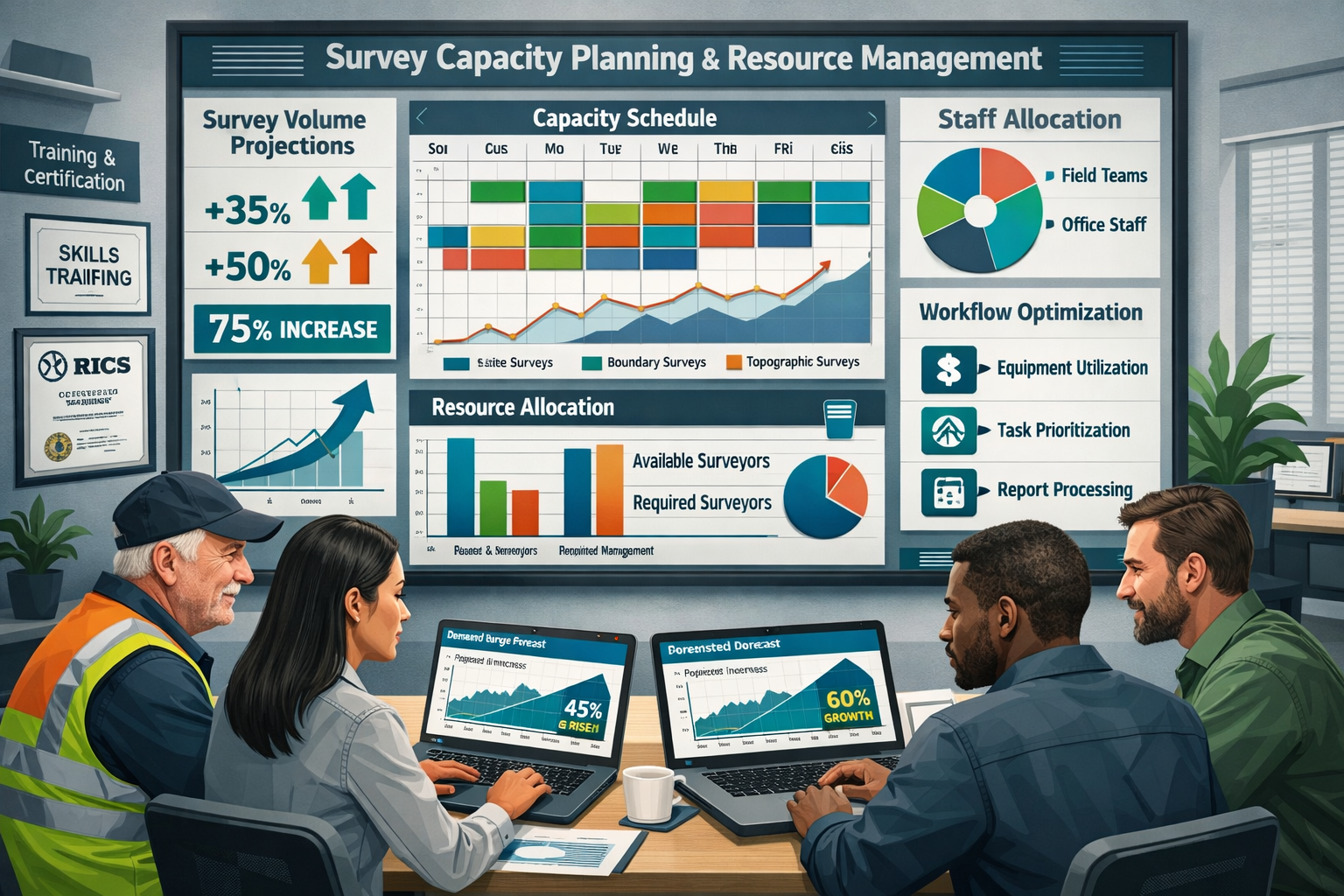
Technology alone cannot address the capacity challenges of mandatory assessments. Strategic workforce development becomes equally critical, encompassing recruitment, training, retention, and organizational structure.
Recruitment and Hiring Strategies
Mandatory assessments will create intense competition for qualified surveyors. Proactive firms should implement recruitment strategies 12-18 months before anticipated regulatory changes:
Immediate-term solutions:
- Recruiting experienced surveyors from related sectors (building inspection, construction management)
- Engaging recently retired surveyors for part-time or contract work
- Partnering with complementary firms for capacity-sharing arrangements
- Utilizing subcontractor networks during peak periods
Long-term capacity building:
- Establishing graduate trainee programs with structured development pathways
- Creating apprenticeship schemes in partnership with educational institutions
- Developing internal promotion tracks from administrative to technical roles
- Building relationships with RICS and other professional bodies for talent pipelines
Training and Competency Development
Mandatory assessments demand consistent quality standards across all surveyors. Comprehensive training programs should address:
Technical competency:
- Standardized inspection methodologies ensuring comprehensive property coverage
- Defect identification and risk assessment frameworks
- Building pathology and common defect patterns
- Legal and regulatory compliance requirements
- Report writing and communication skills
Technology proficiency:
- Mobile inspection application usage
- Digital photography and documentation standards
- Report generation system operation
- Quality assurance tool utilization
Client interaction:
- Managing client expectations in mandatory assessment contexts
- Explaining findings clearly to non-technical audiences
- Handling difficult conversations about significant defects
- Post-survey consultation and advisory services
The shift in 2026 ALTA/NSPS standards toward greater surveyor responsibility [1][3][4] parallels the increased accountability residential surveyors will face under mandatory frameworks. Training must emphasize professional judgment, comprehensive documentation, and clear communication.
For surveyors conducting specific defect surveys, specialized training in targeted investigation techniques becomes valuable.
Organizational Structure and Team Design
Traditional surveying practices often operate with flat organizational structures and generalist surveyors handling all aspects of client engagement. Mandatory assessment volumes require more specialized, scalable structures:
Proposed organizational model:
-
Senior surveyors (20% of team)
- Complex property assessments
- Quality assurance and report review
- Client consultation for significant issues
- Junior surveyor mentoring and development
-
Mid-level surveyors (50% of team)
- Standard residential assessments
- Routine report generation
- Client communication
- Continuous professional development
-
Junior surveyors/trainees (30% of team)
- Assisted inspections with senior oversight
- Data collection and documentation
- Initial draft report preparation
- Structured learning and competency development
Supporting functions:
- Dedicated scheduling and administrative staff
- Quality assurance specialists
- Technology and systems support
- Business development and client relations
This structure enables efficient capacity scaling while maintaining quality standards through systematic oversight and review processes.
Understanding why choosing RICS surveyors matters helps firms emphasize professional credentials in competitive markets.
Service Offering Evolution and Market Positioning
Mandatory assessments create both challenges and strategic opportunities for surveying practices. Forward-thinking firms will differentiate themselves through innovative service models and comprehensive client support.
Tiered Assessment Packages
While mandatory frameworks may establish minimum assessment standards, surveyors can offer tiered services meeting diverse client needs:
Basic compliance assessment:
- Meets regulatory minimum requirements
- Standardized inspection and reporting
- Essential defect identification
- Competitive pricing for volume market
Enhanced assessment:
- More detailed inspection and analysis
- Expanded reporting with maintenance recommendations
- Priority scheduling and faster turnaround
- Post-survey consultation included
Comprehensive assessment plus:
- Detailed building pathology analysis
- Specialist investigations (damp, timber, structural)
- Repair cost estimates and contractor recommendations
- Ongoing advisory relationship
This tiered approach allows surveyors to compete on both price and value, serving cost-conscious buyers while capturing premium segments seeking comprehensive service.
Clients often benefit from understanding how to renegotiate after poor building survey results, creating opportunities for post-survey advisory services.
Value-Added Services and Consultation
Mandatory assessments position surveyors as trusted property advisors rather than transactional service providers. Complementary services include:
- 🏠 Pre-purchase consultation: Helping buyers understand survey implications and decision-making
- 💰 Negotiation support: Advising on price adjustments based on survey findings (understanding average price reductions after surveys)
- 🔨 Repair planning: Connecting clients with qualified contractors and providing project oversight
- 📋 Maintenance planning: Developing long-term property maintenance strategies
- 🔍 Post-purchase inspections: Follow-up assessments after repairs or renovations
These services create recurring client relationships and additional revenue streams beyond one-time assessments.
For properties requiring specialized attention, offering dilapidations reports expands commercial service capabilities.
Geographic Expansion and Market Coverage
Mandatory assessments may justify geographic expansion previously uneconomical under discretionary survey models. Consistent transaction volumes enable:
- Opening satellite offices in underserved markets
- Establishing regional partnerships for broader coverage
- Developing mobile surveyor models covering wider territories
- Creating specialist teams for specific property types or regions
Firms already operating across multiple locations (such as Croydon, Ealing, and Wandsworth) can leverage existing infrastructure for rapid scaling.
Quality Assurance and Professional Standards Under Mandatory Frameworks
Mandatory assessments bring increased scrutiny and accountability. Robust quality assurance systems protect both clients and surveying practices from errors, omissions, and professional liability.
Quality Control Systems
Effective quality assurance requires systematic review processes rather than ad-hoc checking:
Multi-stage quality framework:
-
Pre-inspection quality gates
- Verification of property information completeness
- Confirmation of appropriate assessment level
- Review of any special considerations or access issues
-
Inspection quality checks
- Photographic documentation completeness
- Checklist completion verification
- Real-time data validation in mobile systems
-
Report quality review
- Technical accuracy verification by senior surveyors
- Consistency with photographic evidence
- Clarity and completeness of client communication
- Compliance with professional standards
-
Post-delivery quality monitoring
- Client feedback collection and analysis
- Complaint tracking and resolution
- Continuous improvement identification
The 2026 ALTA/NSPS standards' emphasis on clear documentation of limitations and discrepancies [1] reflects professional expectations for transparency and precision. Residential surveyors should adopt similar rigor.
Professional Indemnity and Risk Management
Mandatory assessments increase professional liability exposure through higher volumes and greater reliance on survey findings. Risk management strategies include:
Insurance considerations:
- Reviewing professional indemnity coverage limits for increased exposure
- Ensuring policies cover mandatory assessment work specifically
- Considering claims-made versus occurrence-based coverage
- Evaluating excess/deductible levels relative to claim frequency
Operational risk mitigation:
- Comprehensive documentation of inspection scope and limitations
- Clear communication of uncertainty and areas requiring specialist investigation
- Systematic use of disclaimers and qualification statements
- Robust client communication records
Professional standards compliance:
- Adherence to RICS practice statements and guidance notes
- Regular CPD ensuring current technical knowledge
- Participation in professional body quality assurance schemes
- Engagement with industry standard development
Exploring building evaluation best practices helps surveyors maintain professional standards.
Financial Planning and Business Model Adaptation
The transition to mandatory assessments requires strategic financial planning addressing both investment requirements and revenue model changes.
Investment Requirements and ROI Analysis
Preparing for mandatory assessments demands significant upfront investment:
Technology infrastructure: £15,000-50,000
- Practice management software
- Mobile inspection applications
- Reporting platforms
- Hardware (tablets, thermal cameras, etc.)
Workforce expansion: £100,000-300,000 annually per 5 surveyors
- Recruitment costs
- Training and development
- Salary and benefits
- Professional insurance
Marketing and positioning: £10,000-30,000
- Brand development
- Website and digital presence
- Client education materials
- Professional partnerships
Working capital: 3-6 months operating expenses
- Cash flow buffer during transition
- Accounts receivable financing
- Equipment and inventory
While substantial, these investments generate returns through:
- ✅ Volume increases of 200-400% over current levels
- ✅ Market share gains from competitors unable to scale
- ✅ Premium pricing for enhanced service offerings
- ✅ Ancillary revenue from value-added services
Pricing Strategy and Revenue Optimization
Mandatory frameworks may create downward pricing pressure through increased competition and standardization. Strategic pricing approaches include:
Volume-based pricing:
- Competitive rates for standard mandatory assessments
- Efficiency gains offsetting lower per-unit margins
- Market share prioritization during transition period
Value-based pricing:
- Premium pricing for enhanced assessment tiers
- Specialized services commanding higher fees
- Bundled packages creating perceived value
Dynamic pricing:
- Surge pricing during peak transaction periods
- Off-peak discounts smoothing demand fluctuations
- Volume discounts for estate agents and developers
Understanding property survey template standardization helps optimize report generation efficiency.
Conclusion: Strategic Positioning for the Mandatory Assessment Era
The shift toward mandatory property condition assessments represents the most significant transformation in residential surveying in decades. Surveyor readiness for mandatory property condition assessments: operational changes when upfront surveys become standard will determine which firms thrive and which struggle in this new landscape.
Success requires proactive preparation across multiple dimensions:
🎯 Operational excellence: Redesigning workflows, implementing technology, and standardizing processes to handle 200-400% volume increases while maintaining quality
👥 Workforce development: Strategic recruitment, comprehensive training, and organizational restructuring creating scalable capacity with consistent quality
💼 Service innovation: Developing tiered offerings, value-added services, and advisory relationships that differentiate beyond commodity assessment provision
📊 Financial planning: Making strategic investments in technology and people while managing cash flow and pricing for sustainable profitability
🛡️ Quality assurance: Implementing robust review systems, risk management protocols, and professional standards compliance protecting clients and practices
The firms that begin preparation now—before mandatory frameworks take effect—will capture disproportionate market share and establish competitive advantages difficult for late movers to overcome. Those that wait risk being overwhelmed by sudden demand surges, quality problems, and operational chaos.
Actionable Next Steps
Immediate actions (next 30 days):
- Conduct capacity analysis assessing current throughput versus projected mandatory assessment volumes
- Evaluate technology infrastructure identifying critical gaps and investment priorities
- Review professional indemnity insurance ensuring adequate coverage for expanded operations
- Develop preliminary workforce expansion plan with recruitment timelines
Short-term actions (3-6 months):
- Implement core technology platforms (practice management, mobile inspection, reporting)
- Begin strategic recruitment focusing on experienced surveyors and graduate trainees
- Design tiered service offerings and pricing strategies
- Establish quality assurance frameworks and review processes
Medium-term actions (6-12 months):
- Complete workforce expansion to target capacity levels
- Roll out comprehensive training programs ensuring consistent quality
- Launch marketing initiatives positioning firm for mandatory assessment market
- Develop value-added service offerings and client advisory capabilities
The mandatory assessment era presents both challenges and extraordinary opportunities. Surveyors who embrace transformation, invest strategically, and position proactively will not only survive but thrive in the new landscape. The time to prepare is now.
For additional guidance on surveying services and professional standards, explore our comprehensive surveyor services resources and other property services.
References
[1] Alta Nsps Key Changes And Updates In The 2026 Standards – https://www.beneschlaw.com/insight/alta-nsps-key-changes-and-updates-in-the-2026-standards/
[2] Alta Nsps Land Title Surveys 2026 Standards – https://cretelligent.com/alta-nsps-land-title-surveys-2026-standards/
[3] Five Key Updates 2026 Altansps Land Title Survey Standards – https://westwoodps.com/recent-blog-posts/five-key-updates-2026-altansps-land-title-survey-standards
[4] 2026 Alta Nsps Survey Standards Update Key Takeaways For Commercial Real Estate – https://www.taftlaw.com/news-events/law-bulletins/2026-alta-nsps-survey-standards-update-key-takeaways-for-commercial-real-estate/
[5] 2026 Alta Nsps Standards Now In Effect – https://www.bealsandthomas.com/post/2026-alta-nsps-standards-now-in-effect
[6] New 2026 Alta Nsps Survey Standards What Developers And Counsel Should Know – https://hallrender.com/2026/02/23/new-2026-alta-nsps-survey-standards-what-developers-and-counsel-should-know/
[7] Nsps Land Title – https://www.parkerpoe.com/news/2026/02/key-takeaways-from-the-2026-alta/nsps-land-title