


The UK property market has entered 2026 with a striking geographical divide. While much of England experiences modest growth and Wales remains relatively flat, Scotland and Northern Ireland are demonstrating exceptional momentum—posting the strongest price appreciation rates across the entire United Kingdom. For property surveyors, valuers, and real estate professionals, understanding Valuation Precision in Scotland and Northern Ireland: Capturing Momentum in 2026's Strongest Regional Markets has become essential to delivering accurate assessments in these outperforming territories.
Scotland recorded +4.5% annual house price inflation through 2025, nearly double England's rate, while Northern Ireland achieved an impressive +7.1% year-on-year growth—more than three times England's performance [7]. These figures aren't merely statistical curiosities; they represent fundamental shifts in buyer demand, affordability dynamics, and regional economic confidence that directly impact valuation methodology.

Key Takeaways
- 📈 Northern Ireland leads UK price growth with +7.1% annual inflation, significantly outpacing England (+2.2%) and Wales (+0.7%)
- 🏴 Scotland shows exceptional momentum with 42% of surveyors reporting rising prices—the strongest reading in nearly a year
- 🎯 Regional variation demands precision: Derry City and Strabane recorded 13.0% growth while other areas show more moderate appreciation
- 🔍 Region-specific defect patterns require specialized knowledge of Scottish stone construction and Northern Irish building traditions
- 💡 Forward sentiment remains positive: 55% of Scottish surveyors anticipate higher prices over the coming year
Understanding the 2026 Regional Market Dynamics
Scotland's Resurgent Property Market
The Scottish housing market has emerged as one of 2026's most compelling success stories. According to January 2026 RICS data, 42% net balance of Scottish surveyors reported house prices rising over the past three months—marking the strongest reading in nearly a year and representing a significant departure from broader UK weakness [4].
This momentum isn't limited to pricing alone. Scottish buyer enquiries show a net positive balance of 21% with a net 27% increase in instructions to sell, indicating renewed market confidence entering the spring selling season [4]. The combination of rising demand and increased supply suggests a healthy, balanced market rather than speculative overheating.
Top-performing Scottish locations including Glasgow, Edinburgh, Motherwell, Paisley, and Falkirk are forecast to achieve 2-4% annual price growth throughout 2026, characterized by resilient market conditions, efficient transactions, and limited discounting [2]. For surveyors conducting property evaluations, these regional variations demand careful consideration of local comparables and market-specific factors.
Northern Ireland's Exceptional Growth Trajectory
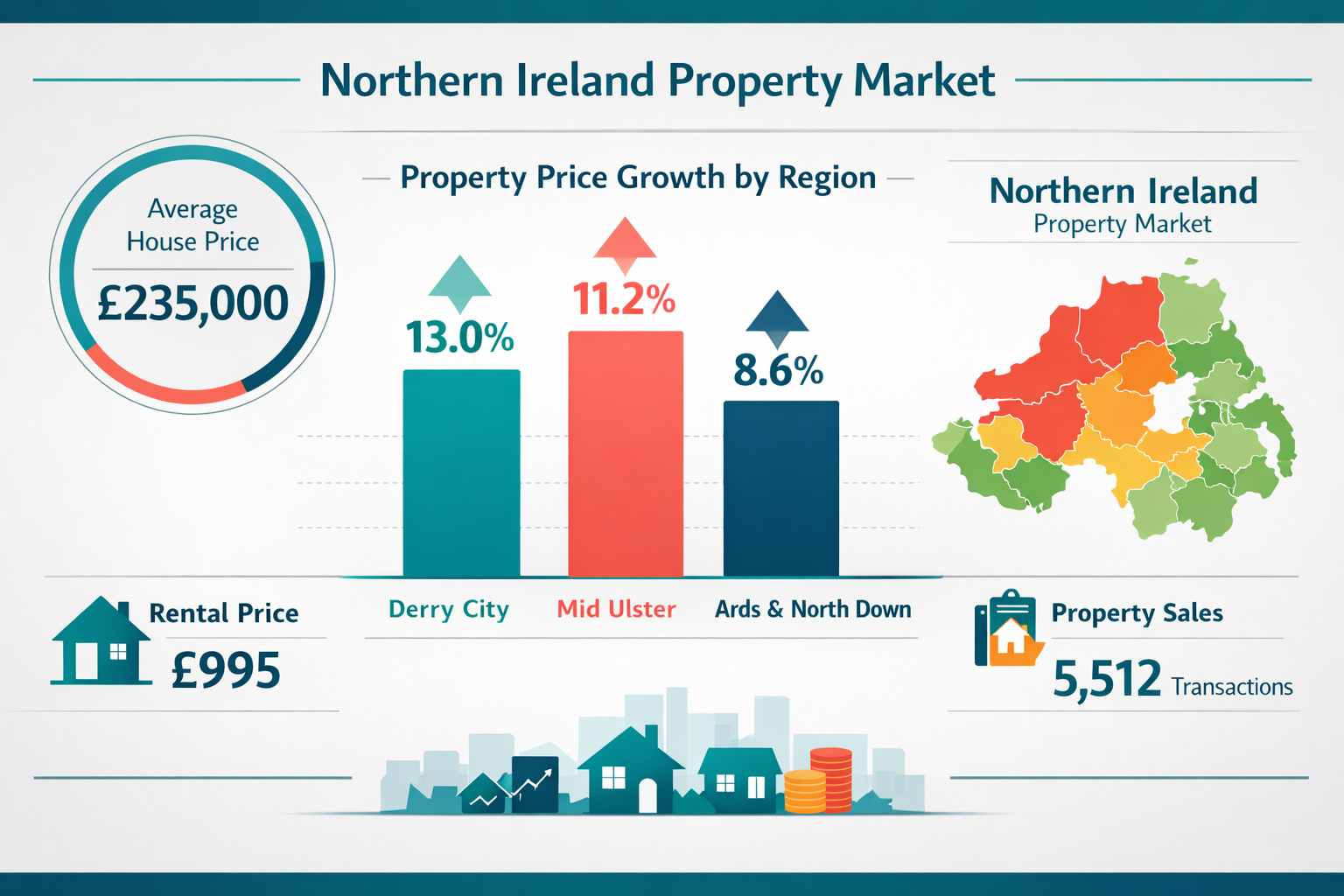
Northern Ireland has established itself as the UK's standout regional performer. Average house prices reached £235,000 in Q4 2025, reflecting 6.4% annual growth, with apartments showing particularly strong performance at 7% appreciation [1]. New homes averaged £267,000, up 5.2% year-on-year, demonstrating strength across all property segments [1].
The transaction volume tells an equally compelling story. Despite challenging broader market conditions, 5,512 properties achieved sale agreed status in Q4 2025—only 3% lower than Q4 2024, indicating sustained momentum and genuine buyer commitment [1].
Perhaps most striking is the strong regional price divergence within Northern Ireland itself. Derry City and Strabane recorded the highest growth at 13.0%, followed by Mid Ulster (11.2%) and Ards and North Down (8.6%) [3]. This internal variation requires surveyors to maintain granular knowledge of local market conditions rather than applying province-wide assumptions.
"The parallel strength in the lettings market—with average rental prices reaching £995, up 5.6% annually—demonstrates underlying demand fundamentals that support sustained price appreciation." [1]
Valuation Precision in Scotland and Northern Ireland: Regional-Specific Defect Patterns

Scottish Construction Characteristics
Scotland's building heritage presents unique challenges and considerations for accurate property valuation. Traditional Scottish construction methods, particularly in older properties, differ significantly from English building practices, requiring specialized knowledge for proper assessment.
Stone construction dominates Scotland's older housing stock, particularly in cities like Edinburgh, Glasgow, and Aberdeen. These properties typically feature:
- Sandstone or granite external walls (often 18-24 inches thick)
- Lime mortar pointing rather than cement-based systems
- Traditional sash and case windows with unique Scottish detailing
- Mutual gable walls in tenement properties
- Solid wall construction without cavity insulation
Common defect patterns in Scottish properties include:
- Moisture penetration through stonework: Scottish climate and driving rain exposure create unique damp challenges
- Pointing deterioration: Lime mortar requires regular maintenance and specialist repair
- Window degradation: Traditional timber sash windows suffer from rot and weather damage
- Roof issues: Scottish slate roofs with sarking boards present different failure modes than English construction
- Rising damp in solid wall construction: Absence of damp-proof courses in older properties
When conducting full structural inspections in Scotland, surveyors must account for these region-specific construction methods. A defect that might be considered severe in English cavity wall construction may be standard maintenance in Scottish solid stone walls, directly impacting valuation adjustments.
Northern Irish Building Traditions
Northern Irish construction presents its own distinctive characteristics, influenced by both Irish building traditions and UK regulatory frameworks. Properties built before the 1970s often feature:
- Solid brick construction without cavity walls
- Traditional slate or tile roofing with different detailing than mainland UK
- Timber floor construction with unique joist sizing and spacing
- Rendered external finishes more common than exposed brickwork
- Different foundation approaches reflecting local soil conditions
Region-specific defect patterns in Northern Ireland include:
- Render failure and cracking: Particularly common in coastal areas with salt exposure
- Chimney deterioration: Many properties retain unused chimneys requiring maintenance
- Timber decay in floor structures: Ground floor timber construction vulnerable to moisture
- Window and door frame deterioration: Exposure to Atlantic weather systems
- Drainage issues: Older properties with combined drainage systems
The homebuying process in Northern Ireland benefits significantly from surveyors who understand these regional construction patterns. Accurate defect identification and cost estimation require local market knowledge—a £5,000 repair in one region might cost £8,000 in another due to specialist contractor availability and material sourcing.
Market-Specific Valuation Methodologies for 2026
Comparative Market Analysis in High-Growth Regions
Traditional valuation approaches require adaptation when applied to rapidly appreciating markets like Scotland and Northern Ireland in 2026. The standard three-month comparable timeframe may not accurately reflect current market conditions when prices are rising at 4-7% annually.
Adjusted comparable analysis for 2026's strong markets should incorporate:
- Time-adjusted comparables: Apply monthly appreciation factors to sales completed 3-6 months prior
- Regional segmentation: Recognize that Derry City's 13.0% growth differs substantially from Belfast's more moderate appreciation
- Property type differentiation: Apartments in Northern Ireland showing 7% growth versus houses at 6.4% [1]
- Location premium analysis: Commuter locations like Bangor and Lisburn commanding different multiples than rural areas
When preparing house evaluations, surveyors should maintain databases of local comparables with granular geographic and property-type segmentation. A three-bedroom semi-detached property in Paisley requires different comparable selection than a similar property in Edinburgh, despite both being in Scotland's high-growth market.
Forward-Looking Sentiment Integration
One of 2026's most significant valuation considerations is the integration of market sentiment data into professional assessments. RICS survey data reveals that 55% of Scottish surveyors anticipate higher prices over the coming year, with 34% expecting higher sales volumes over the next three months [4].
This forward-looking confidence should inform valuation approaches, particularly for:
- Development site valuations: Where future sales prices significantly impact residual land values
- Investment property assessments: Where rental growth expectations affect capitalization rates
- New build valuations: Where pre-construction sales rely on projected completion values
However, surveyors must balance optimistic sentiment with professional conservatism. While market confidence supports value, real estate assessment must remain grounded in verifiable transaction evidence rather than speculative projections.
Affordability-Driven Valuation Factors
A key driver of Scotland and Northern Ireland's outperformance is relative affordability compared to London and the South East [2]. This affordability advantage attracts broader buyer participation, particularly important when borrowing costs remain elevated.
Valuation methodologies should incorporate affordability metrics:
| Region | Average Price | Typical Income Multiple | First-Time Buyer Accessibility |
|---|---|---|---|
| Northern Ireland | £235,000 | 4.5-5.0x | High |
| Scotland | £195,000-£250,000 | 4.0-5.5x | Moderate-High |
| London | £535,000+ | 8.0-10.0x | Low |
| South East England | £380,000+ | 6.5-8.0x | Low-Moderate |
These affordability dynamics support sustained demand and price growth, particularly in locations with strong employment markets and lifestyle amenities. Properties in the £150,000-£300,000 range—well-represented in both Scotland and Northern Ireland—access the broadest buyer pool, supporting valuation confidence.
Practical Surveyor Tactics for Capturing Regional Momentum
Enhanced Due Diligence Protocols
Operating in high-growth markets demands enhanced due diligence to ensure valuation accuracy. Surveyors should implement:
1. Expanded Comparable Research
- Review minimum 8-10 comparables rather than standard 5-6
- Include pending sales and withdrawn listings to understand market dynamics
- Track days-on-market trends as indicator of demand strength
- Monitor asking price versus achieved price ratios
2. Regional Defect Cost Databases
- Maintain location-specific repair cost schedules
- Account for Scottish versus Northern Irish contractor rates
- Factor specialist material availability (Scottish stone, Irish slate)
- Include realistic timescales for specialist work
3. Local Market Intelligence Networks
- Develop relationships with regional estate agents
- Monitor local planning applications and development activity
- Track employment and infrastructure announcements
- Understand buyer demographic shifts
When conducting homebuyers reports, these enhanced protocols ensure valuations reflect genuine market conditions rather than outdated assumptions.
Technology-Enabled Precision
Modern surveying technology offers significant advantages for operating across Scotland and Northern Ireland's diverse markets:
Geographic Information Systems (GIS) enable surveyors to:
- Map comparable properties with precise location accuracy
- Overlay demographic and economic data onto property locations
- Identify micro-market boundaries within broader regions
- Track infrastructure developments affecting property values
Digital Survey Tools improve defect identification:
- Thermal imaging cameras detect moisture penetration in stone walls
- Moisture meters provide objective damp readings
- Laser measuring ensures accurate floor area calculations
- Drone photography documents roof conditions safely
Market Data Platforms enhance comparable analysis:
- Real-time transaction data from Land Registry sources
- Rental yield information for investment property valuations
- Historical price trends for time-series analysis
- Predictive analytics for forward-looking assessments
Surveyors who integrate these technologies into their property purchase checklist processes deliver more accurate, defensible valuations in rapidly changing markets.
Client Communication Strategies
In high-growth markets, effective client communication becomes crucial for managing expectations and explaining valuation rationale:
For Buyers:
- Explain regional market dynamics driving price appreciation
- Contextualize property condition within local building traditions
- Provide realistic repair cost estimates based on regional contractor rates
- Discuss future value trajectories based on market fundamentals
For Sellers:
- Present comparable evidence supporting asking price recommendations
- Highlight property features that command premiums in current market
- Identify cost-effective improvements that maximize value
- Explain timing considerations given seasonal market patterns
For Lenders:
- Provide detailed comparable analysis with time adjustments
- Document regional market conditions supporting valuations
- Explain defect patterns within regional construction context
- Justify valuation confidence levels based on transaction evidence
Clear, evidence-based communication builds professional credibility and supports informed decision-making across all stakeholder groups.
Navigating Regulatory and Professional Standards
RICS Valuation Standards in Regional Contexts
The RICS Red Book provides the foundational framework for property valuation across the UK, but application requires regional adaptation. Key considerations for Scotland and Northern Ireland include:
Scottish Legal Context:
- Different conveyancing process (Scottish system of offers and acceptance)
- Home Report requirements for properties marketed for sale
- Unique property law regarding tenement ownership
- Different planning and building control frameworks
Northern Irish Considerations:
- Distinct Land Registry system and title registration
- Different stamp duty land tax thresholds and rates
- Unique planning system and development control
- Separate building regulations from England and Wales
Surveyors must ensure their valuation reports comply with both RICS professional standards and region-specific legal requirements. When preparing reports for commercial property inspections or residential valuations, documentation should reference applicable regional legislation and regulatory frameworks.
Professional Indemnity Considerations
Operating in high-growth markets creates specific professional indemnity considerations:
Valuation Accuracy Risk:
- Rapidly rising prices increase risk of under-valuation
- Limited comparable evidence in fastest-growing sub-markets
- Client pressure to support higher valuations in competitive markets
Defect Identification Risk:
- Region-specific construction methods require specialized knowledge
- Concealed defects common in older Scottish and Northern Irish properties
- Weather-related damage patterns unique to Atlantic climate exposure
Mitigation Strategies:
- Maintain comprehensive continuing professional development in regional construction
- Use conservative assumptions when comparable evidence is limited
- Document all limitations and assumptions clearly in reports
- Maintain appropriate professional indemnity insurance levels
Surveyors should review their professional indemnity coverage to ensure it adequately reflects the value and complexity of properties being surveyed in these high-growth markets.
Future Outlook: Sustaining Valuation Precision Through 2026
Anticipated Market Developments
Looking ahead through 2026, several factors will influence valuation precision requirements in Scotland and Northern Ireland:
Economic Factors:
- Interest rate trajectory affecting mortgage affordability
- Regional employment growth supporting demand fundamentals
- Infrastructure investment in key cities and commuter corridors
- Post-Brexit economic adjustment in Northern Ireland
Supply-Side Dynamics:
- New build delivery rates in high-demand locations
- Planning policy changes affecting development capacity
- Conversion of commercial to residential property
- Second-home and investment buyer activity
Demand Patterns:
- Remote working trends supporting lifestyle locations
- First-time buyer accessibility in affordable markets
- Downsizer activity from older homeowners
- International buyer interest in Scottish cities
Surveyors who monitor these evolving factors and adjust their methodologies accordingly will maintain valuation accuracy throughout 2026's changing market conditions.
Continuous Professional Development
The rapid evolution of Scotland and Northern Ireland's property markets demands ongoing professional development:
Technical Knowledge:
- Regional construction methods and defect patterns
- Local material specifications and repair techniques
- Climate-specific building performance issues
- Heritage property conservation requirements
Market Intelligence:
- Local market trends and transaction analysis
- Regional economic development and employment data
- Planning policy changes and development pipeline
- Demographic shifts affecting housing demand
Technology Skills:
- Advanced surveying equipment operation
- Data analysis and market modeling tools
- Digital reporting and presentation platforms
- Geographic information systems and mapping tools
Professional surveyors should dedicate time to understanding the unique characteristics of these high-performing markets, ensuring their valuations reflect genuine local expertise rather than generalized UK-wide assumptions.
Conclusion
Valuation Precision in Scotland and Northern Ireland: Capturing Momentum in 2026's Strongest Regional Markets requires surveyors to adapt traditional methodologies to reflect the exceptional growth dynamics characterizing these regions. With Northern Ireland achieving +7.1% annual price inflation and Scotland recording +4.5% growth—both substantially outpacing England and Wales—accurate property assessment demands regional expertise, enhanced due diligence, and sophisticated market analysis.
The key to successful valuation in these markets lies in understanding region-specific construction patterns, from Scottish stone buildings to Northern Irish rendered properties, and recognizing how local defect patterns impact value differently than in other UK regions. Surveyors must maintain granular knowledge of sub-regional variations, acknowledging that Derry City's 13.0% growth requires different comparable analysis than Belfast's more moderate appreciation.
Technology-enabled precision, comprehensive comparable databases, and forward-looking market intelligence separate exceptional surveyors from adequate ones in these dynamic markets. The integration of GIS mapping, digital survey tools, and real-time market data platforms enhances accuracy while supporting defensible valuations in rapidly appreciating environments.
Actionable Next Steps
For surveyors and property professionals seeking to capitalize on Scotland and Northern Ireland's momentum:
- Develop Regional Expertise: Invest in understanding Scottish and Northern Irish construction methods, legal frameworks, and market dynamics
- Build Local Networks: Establish relationships with regional estate agents, contractors, and market participants
- Enhance Technology Capabilities: Implement GIS systems, digital survey tools, and market data platforms
- Maintain Comparable Databases: Create granular, location-specific comparable databases with regular updates
- Monitor Market Indicators: Track RICS survey data, transaction volumes, and forward-looking sentiment indicators
- Update Professional Development: Engage in region-specific CPD focusing on construction, regulation, and market analysis
The surveyors who master these regional nuances will deliver superior value to clients navigating 2026's strongest UK property markets. By combining traditional valuation principles with region-specific expertise and modern technology, professionals can capture the momentum in Scotland and Northern Ireland while maintaining the precision that defines excellent surveying practice.
For those embarking on the homebuying process in these dynamic markets, engaging surveyors with demonstrated regional expertise provides essential protection and insight. The investment in specialized knowledge pays dividends through accurate valuations, realistic defect assessments, and informed decision-making in markets where precision matters more than ever.
References
[1] Northern Ireland Property Market In 2026 Why Now Is A Good Time To Sell – https://www.reedsrains.co.uk/blog/northern-ireland-property-market-in-2026-why-now-is-a-good-time-to-sell
[2] Why Northern England And Scotland Are Set To Lead Uk House Price Growth In 2026 – https://www.belvoir.co.uk/guides/news/why-northern-england-and-scotland-are-set-to-lead-uk-house-price-growth-in-2026/
[3] Article – https://www.sutherlandreay.com/blog/article.html?id=1772635696
[4] Scottish Housing Market 2026 Rics Survey – https://www.simpsonmarwick.com/journal/scottish-housing-market-2026-rics-survey
[7] House Price Forecast – https://hoa.org.uk/advice/guides-for-homeowners/i-am-buying/house-price-forecast/