


{"cover":"Professional landscape format (1536×1024) hero image with bold text overlay 'Valuation Techniques for Northern England Price Resilience: Countering Southern Downward Pressure in March 2026' in extra large 72pt white sans-serif font with dark shadow and semi-transparent navy overlay box, positioned in upper third. Background features split-screen composition: left side showing vibrant northern England industrial cityscape with modern developments and rising property value arrows, right side depicting muted London skyline with downward trending graph overlays. Color scheme: deep navy blue, energetic orange accents, professional white text. High contrast editorial quality with RICS surveyor professional reviewing property data on tablet in foreground, magazine cover aesthetic, business journalism style","content":["Detailed landscape format (1536×1024) image showing professional property surveyor conducting comparative market analysis in northern England setting. Scene features RICS-qualified surveyor at modern desk with dual monitors displaying property valuation software, heat maps of North East and North West England regions with +6.8% and +4.1% growth indicators overlaid, comparable property data spreadsheets, and regional price trend charts. Foreground shows printed valuation reports with highlighted comparable sales data, middle ground features surveyor pointing to screen showing terraced house valuations, background displays large wall-mounted regional map with color-coded price zones. Color palette: professional blues, growth-indicating greens, data visualization oranges. Clean, modern office environment with natural lighting, professional business photography style","Detailed landscape format (1536×1024) image depicting UK property market regional divergence through sophisticated infographic visualization. Central focus on large interactive map of England showing stark north-south divide with northern regions (North East, North West, Yorkshire) highlighted in vibrant green with upward arrows and percentage gains (+6.8%, +4.1%), southern regions (London, South East) shown in muted red with downward arrows and negative indicators (-1.2%). Left side features bar chart comparing average property prices across regions with Northern Ireland at £196,000 leading growth. Right side shows mortgage rate timeline graph declining from 5% to 3.95% through 2025-2026. Include data points, percentage labels, professional financial graphics aesthetic, clean modern design with subtle grid background, business analytics style","Detailed landscape format (1536×1024) image showing RICS surveyor presenting strategic valuation recommendations in professional consultation setting. Scene features experienced surveyor standing beside large presentation screen displaying 'Northern Resilience Strategy 2026' with key bullet points, growth projection charts, and regional opportunity zones. Foreground shows consultation table with property portfolios, valuation certificates, and comparative analysis documents spread out. Middle ground features clients (property investors and developers) reviewing documents with engaged expressions. Background displays floor-to-ceiling windows overlooking northern England cityscape with construction cranes indicating development activity. Include visible elements: rental yield comparison charts, supply-demand graphs, mortgage affordability calculations. Professional business meeting aesthetic with warm lighting, confident body language, strategic planning atmosphere"]
The UK property market in 2026 presents a tale of two nations. While London's price balance plummets to -40% according to recent RICS data, Northern England regions demonstrate remarkable strength, with the North East achieving 6.8% annual growth and the North West posting solid 4.1% gains. This stark divergence creates both challenges and opportunities for property professionals seeking accurate valuations in an increasingly fragmented market. Understanding Valuation Techniques for Northern England Price Resilience: Countering Southern Downward Pressure in March 2026 has become essential for surveyors, investors, and property professionals navigating this complex landscape.
The traditional approach of using London-centric benchmarks no longer serves northern markets effectively. As southern property values stagnate or decline, northern regions powered by improved affordability, stronger rental demand, and robust local economies require specialized valuation methodologies that capture their unique growth dynamics.

Key Takeaways
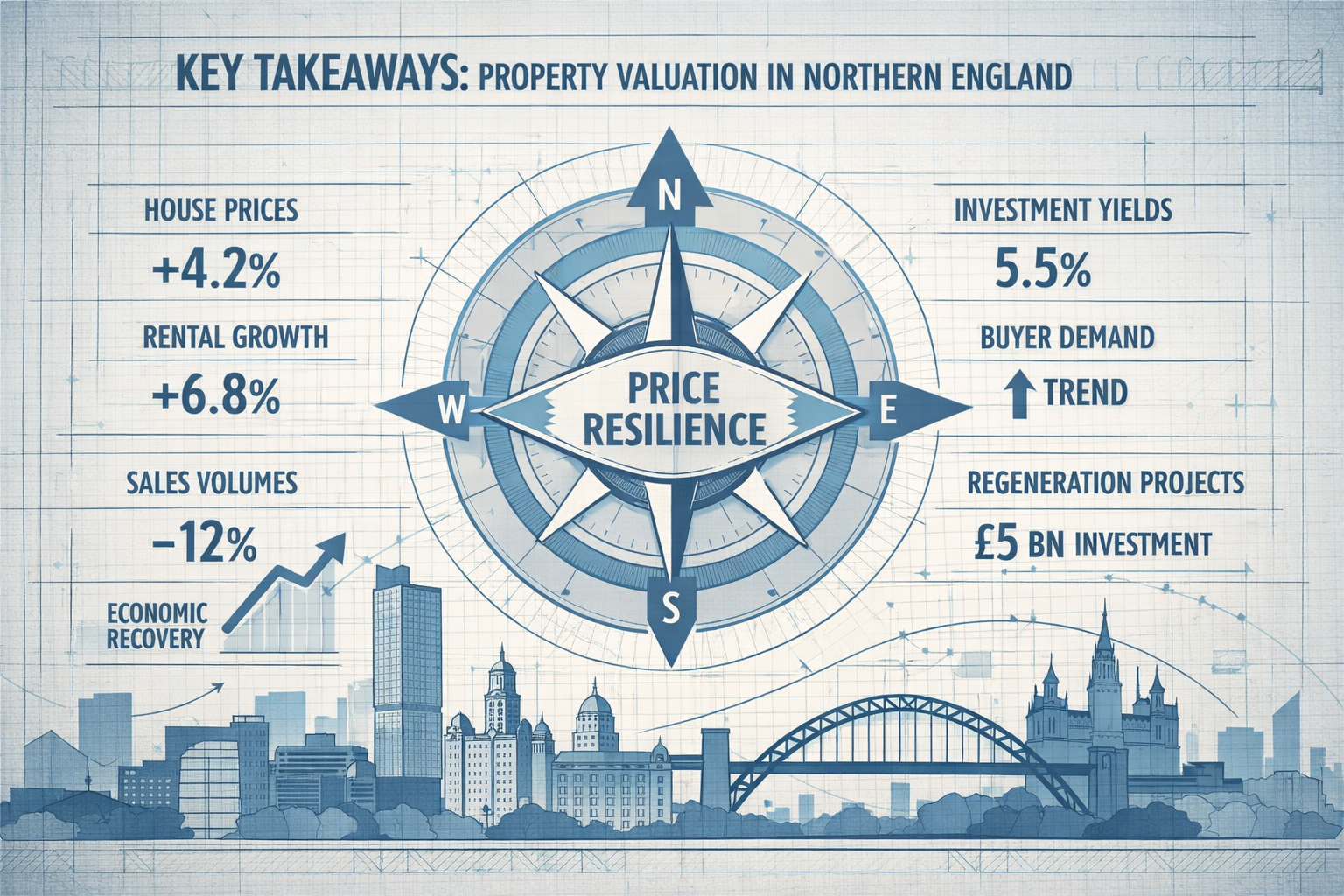
✅ Northern regions outperform significantly: The North East leads England with 6.8% annual growth, while London experiences -1.2% decline, creating a 8-percentage-point gap requiring distinct valuation approaches.
✅ Rental market strength supports capital values: The North East's 8.0% rental inflation—the highest in England—provides fundamental support for purchase price resilience that valuers must incorporate.
✅ Mortgage affordability favors northern markets: Five-year fixed rates falling below 4% for the first time since 2022 disproportionately benefit lower-priced northern properties, expanding the buyer pool.
✅ Supply dynamics differ regionally: Southern regions show 9-16% year-on-year inventory increases, while northern markets maintain tighter supply-demand balances that support price stability.
✅ Comparable selection requires regional focus: Using southern comparables or national averages systematically undervalues northern properties—localized data sets are essential for accuracy.
Understanding the North-South Property Divide in March 2026
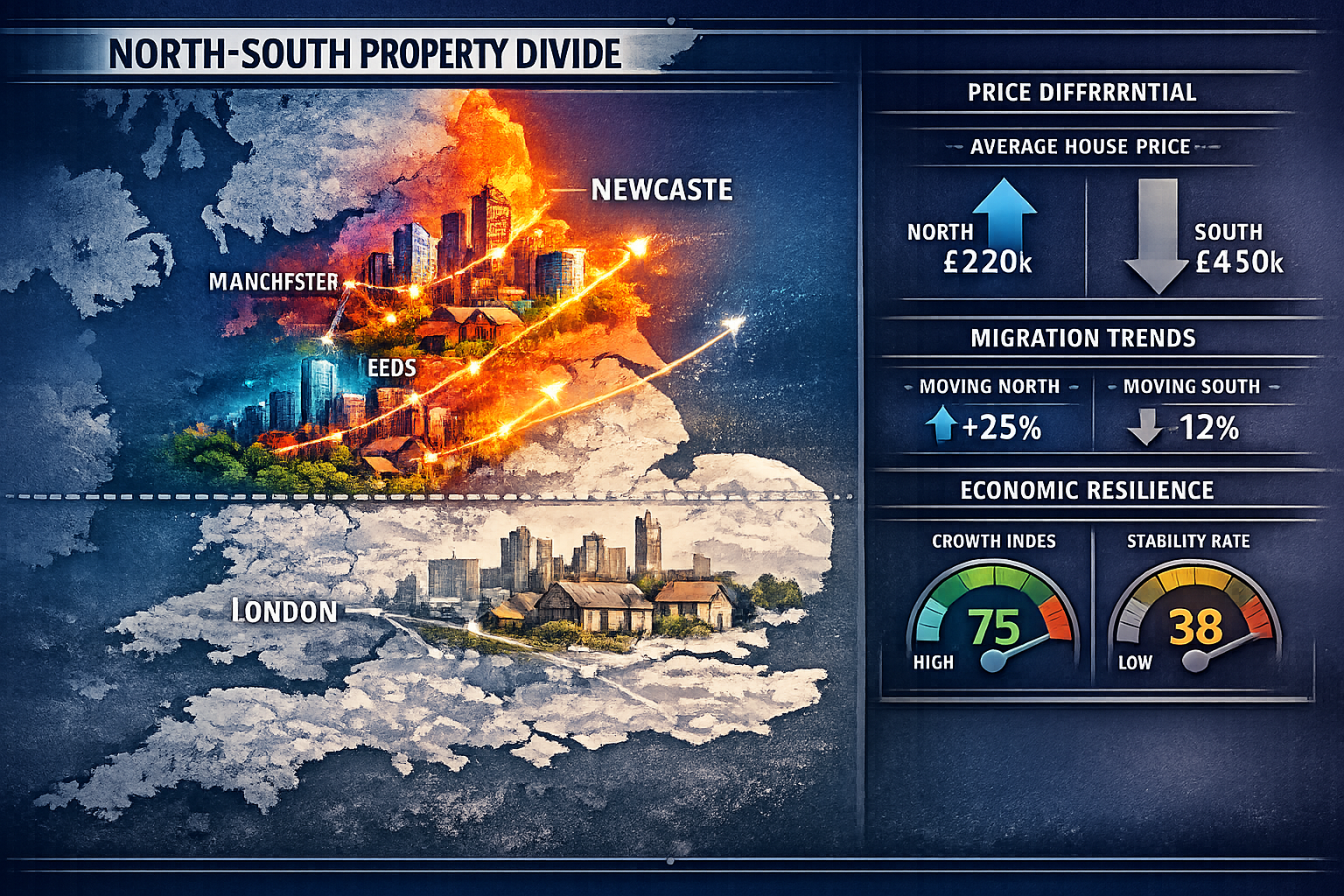
The property market divergence between Northern England and southern regions has reached unprecedented levels in early 2026. This separation stems from fundamental economic, demographic, and affordability factors that valuation professionals must understand to produce accurate assessments.
Regional Performance Metrics
Northern England's growth story contrasts sharply with southern stagnation. The North East region achieved £166,568 average property values with 6.8% annual appreciation, while the North West reached £216,741 with 4.1% growth.[3] These figures demonstrate sustained momentum despite broader economic headwinds affecting other regions.
Meanwhile, London's £553,258 average price represents the UK's highest property values but also the only major region experiencing negative growth at -1.2% annually.[3] The South East managed modest 1.0% growth, significantly trailing northern performance.
Northern Ireland leads the entire UK with 7.1% annual price increases, reaching £196,000 average values—a £14,000 year-on-year gain.[1] Within this region, concentrated growth in areas like Derry City and Strabane (13.0% growth) and Mid Ulster (11.2%) demonstrates the strength of specific northern submarkets.[1]
Fundamental Drivers of Regional Divergence
Affordability advantages provide northern regions with structural growth support. Lower absolute prices mean mortgage payments consume a smaller proportion of household income, expanding the potential buyer pool. With five-year fixed mortgage rates falling to 3.95%—the first time below 4% since September 2022—affordability improvements disproportionately benefit northern markets.[1]
Rental market dynamics reveal underlying demand strength. The North East recorded 8.0% annual rent inflation to January 2026, the highest of any English region.[2] Northern Ireland experienced 5.6% rental growth compared to the 3.5% UK average.[2] Strong rental demand typically precedes and supports capital price appreciation, providing valuation professionals with forward-looking indicators.
Supply constraints in northern markets contrast with southern oversupply. While London inventory increased 16% year-on-year and the South East rose 9%, northern regions maintained tighter supply-demand balances.[1] This fundamental difference supports price resilience even as southern markets face downward pressure from excess inventory.
Understanding these research techniques helps property professionals identify genuine market trends rather than temporary fluctuations.
Valuation Techniques for Northern England Price Resilience: Core Methodologies
Accurate property valuation in Northern England's resilient markets requires methodologies specifically adapted to regional characteristics. Traditional approaches developed for stable or declining markets systematically undervalue properties in growth regions.
Comparative Market Analysis with Regional Focus
Selecting appropriate comparables represents the foundation of accurate valuation. For northern properties, comparables must come from the same region—and ideally the same submarket—rather than relying on national databases that dilute regional performance signals.
Key principles for northern comparable selection:
- Geographic proximity: Limit comparables to within 3-5 miles for urban areas, recognizing that northern submarkets can vary significantly even within cities
- Transaction recency: Prioritize sales within the past 3-6 months given rapid price appreciation in some northern areas
- Property similarity: Match property type, size, condition, and features closely to minimize adjustment requirements
- Market segment alignment: Ensure comparables target the same buyer demographic (first-time buyers, families, investors)
Adjustment methodologies must account for rapid appreciation. In markets growing 6-8% annually, a comparable from six months ago requires approximately 3-4% upward adjustment for time alone. Failing to make temporal adjustments systematically undervalues properties in growth markets.
Professional surveyors should maintain regional databases tracking sales velocity, average days on market, and price-per-square-foot trends specifically for northern submarkets. This granular data enables more precise adjustments than national averages can provide.
Income Approach Adaptations
For investment properties and rental portfolios, the income capitalization approach requires regional rental yield adjustments. Northern England's stronger rental inflation creates different yield expectations than southern markets.
Rental value assessment should incorporate:
- Current market rents for comparable properties (not historic lease rates)
- Regional rental inflation trends (8.0% in North East vs. 3.5% nationally)
- Tenant demand indicators (vacancy rates, time-to-let, application volumes)
- Local employment trends supporting rental demand sustainability
Capitalization rate selection must reflect regional risk-return profiles. Northern markets offering 4-6% yields with 6-8% capital appreciation present different investment propositions than southern markets with 2-3% yields and negative capital growth. Using southern-derived cap rates for northern properties misrepresents investment value.
Cost Approach Considerations
The replacement cost method gains relevance in northern markets where new construction activity responds to demand strength. However, land values vary dramatically between regions, requiring localized land value assessments rather than national averages.
Construction cost databases should account for regional labor and material costs. Northern England typically experiences 10-15% lower construction costs than London, affecting the replacement cost calculation. Using London-based cost data inflates northern property valuations inappropriately.
When conducting RICS surveys in northern regions, surveyors must calibrate cost approaches to local market conditions rather than applying standardized national figures.
Countering Southern Downward Pressure: Strategic Valuation Approaches
Southern market weakness creates psychological and practical challenges for northern property valuations. Buyers, lenders, and investors exposed to negative southern headlines may question northern valuations, requiring robust justification methodologies.
Evidence-Based Justification Frameworks
Data-driven validation provides the strongest defense against southern-influenced skepticism. Valuation reports for northern properties should explicitly present:
📊 Regional performance comparisons: Side-by-side tables showing northern growth rates vs. southern decline, establishing the factual basis for regional divergence
📊 Local transaction evidence: Comprehensive comparable sales analysis demonstrating consistent price appreciation in the specific submarket
📊 Rental market support: Rental inflation data and yield calculations showing fundamental demand supporting capital values
📊 Economic indicators: Employment rates, wage growth, and population trends specific to the northern region
📊 Affordability metrics: Mortgage payment calculations demonstrating buyer capacity at current rates and prices
This evidence-based approach transforms valuation from opinion to demonstrable fact, addressing concerns from lenders and buyers influenced by negative southern narratives.
Addressing Lender Concerns
Mortgage lenders may apply conservative valuation approaches influenced by national decline narratives. Professional surveyors can counter this by:
- Providing regional market reports alongside individual valuations, contextualizing the property within its actual market
- Highlighting loan-to-value safety margins created by conservative northern pricing relative to southern markets
- Demonstrating rental coverage for buy-to-let properties, showing income sustainability even in stress scenarios
- Presenting comparable lending activity, showing other lenders actively supporting northern transactions at similar valuations
When working with clients on negotiating purchase prices, understanding regional dynamics helps establish realistic expectations rather than applying southern market assumptions.
Temporal Valuation Strategies
Forward-looking valuations gain importance in rapidly appreciating markets. While valuations reflect current market value, professional opinions can incorporate trend analysis showing likely near-term value trajectories.
Growth projection methodologies should:
- Extrapolate recent transaction trends (3-6 month rolling averages)
- Incorporate known demand drivers (planned infrastructure, employment growth)
- Account for mortgage rate trajectories (expected 0.25-point cuts throughout 2026)
- Consider supply pipeline constraints (planning approvals, construction timelines)
These projections don't inflate current valuations but provide context for buyers and lenders making long-term commitments. A property valued at £200,000 today in a market growing 6% annually represents different value proposition than the same price in a declining market.
Risk-Adjusted Valuation Ranges
Valuation ranges rather than point estimates acknowledge market uncertainty while capturing regional dynamics. For northern properties, appropriate ranges might span 5-7% to reflect:
- Lower bound: Conservative estimate using most cautious comparable adjustments
- Mid-point: Most likely value based on balanced analysis
- Upper bound: Optimistic but supportable estimate reflecting growth momentum
This range approach provides flexibility for different stakeholder needs (lenders preferring conservative estimates, sellers seeking maximum values) while maintaining professional integrity.
Practical Implementation: Tools and Techniques for March 2026
Implementing effective Valuation Techniques for Northern England Price Resilience: Countering Southern Downward Pressure in March 2026 requires specific tools, data sources, and professional practices adapted to current market conditions.
Essential Data Sources
Regional property platforms provide more relevant data than national aggregators:
- Local estate agent networks: Direct market intelligence from agents actively transacting in northern submarkets
- Regional Land Registry analysis: Granular transaction data filtered by postcode districts
- Rental platform data: Rightmove, Zoopla, and OnTheMarket rental listings showing current market rents
- Regional economic statistics: ONS regional data, local authority reports, and chamber of commerce publications
Subscription services offering regional analytics include property price indices with subregional breakdowns, rental yield calculators with local data, and comparable sales databases with advanced filtering capabilities.
Maintaining home inspection standards while incorporating regional data ensures comprehensive property assessment.
Valuation Report Enhancements
Northern-focused valuation reports should include dedicated sections addressing:
-
Regional Market Context (1-2 pages): Overview of northern England performance, specific submarket trends, and divergence from southern markets
-
Comparable Sales Analysis (detailed table): Minimum 5-7 comparables with explicit adjustments for time, condition, location, and features
-
Rental Market Assessment: Current rental values, yield calculations, and rental inflation trends supporting capital value
-
Risk Factors and Opportunities: Balanced discussion of market-specific risks (local economic dependence, infrastructure constraints) and opportunities (affordability advantages, demand drivers)
-
Valuation Justification: Explicit explanation of methodology choices and why regional approaches supersede national benchmarks
These enhanced reports provide stakeholders with comprehensive understanding rather than simple valuation figures, building confidence in northern market assessments.
Professional Development Priorities
Surveyors specializing in northern markets should prioritize:
- Regional market immersion: Regular site visits, agent relationship building, and local market monitoring
- Data analytics capabilities: Proficiency with statistical analysis tools for trend identification and comparable adjustment
- Economic literacy: Understanding regional economic drivers, employment trends, and demographic shifts
- Communication skills: Ability to explain regional divergence persuasively to skeptical stakeholders
Professional organizations like RICS offer regional training programs and market intelligence specifically addressing northern England dynamics. Continuous professional development ensures valuation practices evolve with market conditions.
When advising clients on what to do after receiving survey reports, regional context helps frame findings appropriately rather than applying generic national standards.
Market Outlook and Strategic Considerations for 2026
Understanding likely market trajectories helps valuation professionals provide forward-looking advice beyond current snapshot valuations.
Projected Regional Trends
Industry forecasts predict persistent north-south divergence throughout 2026. Paula Higgins, HomeOwners Alliance CEO, stated: "We expect the current north-south divide in house price growth in England to persist with higher growth in the north of England than in the south," with overall UK growth forecast at 2% for 2026.[3]
Mortgage rate trajectory supports northern resilience. Expected 0.25-percentage-point rate cuts throughout 2026 will further improve affordability, disproportionately benefiting lower-priced northern properties where rate reductions create larger proportional payment decreases.[1]
Supply dynamics favor continued northern strength. With 2026 beginning with the highest inventory levels in eight years but increases concentrated in southern regions (London +16%, South East +9%), northern markets maintain tighter supply-demand balances supporting price stability.[1]
Investment Implications
Property investors should recognize northern England's risk-return profile:
✨ Capital appreciation potential: 6-8% annual growth rates significantly exceed southern markets and broader investment alternatives
✨ Rental yield advantages: 4-6% gross yields combined with 8% rental inflation create compelling total returns
✨ Affordability-driven demand: Structural advantages support sustained demand regardless of short-term economic fluctuations
✨ Diversification benefits: Northern exposure reduces portfolio correlation with London-dominated national trends
Portfolio rebalancing toward northern assets makes strategic sense for investors overweight in southern properties facing stagnation or decline.
Valuation Practice Evolution
Professional standards will likely evolve to formalize regional differentiation. Potential developments include:
- Regional valuation guidelines: RICS or other professional bodies may issue specific guidance for high-growth regional markets
- Enhanced disclosure requirements: Expectations for explicit regional context in valuation reports
- Specialized credentials: Professional designations recognizing regional market expertise
- Technology integration: AI-powered valuation tools incorporating regional trend analysis and automated comparable adjustments
Staying ahead of these developments positions surveyors as market leaders rather than followers adapting reactively.
Conclusion
Valuation Techniques for Northern England Price Resilience: Countering Southern Downward Pressure in March 2026 represents more than technical methodology—it reflects fundamental shifts in UK property market dynamics requiring professional adaptation. The stark divergence between northern growth and southern stagnation demands regional specialization rather than one-size-fits-all approaches.
Northern England's 6-8% annual price appreciation, supported by strong rental demand, improving affordability, and tight supply-demand balances, creates genuine value that professional valuations must capture accurately. Applying London-centric assumptions or national averages systematically undervalues northern properties, disadvantaging buyers, sellers, and investors alike.
Key implementation priorities for property professionals include:
🎯 Build regional expertise: Develop deep knowledge of specific northern submarkets through regular monitoring, agent relationships, and transaction analysis
🎯 Enhance data infrastructure: Invest in regional data sources, comparable databases, and analytical tools supporting granular market assessment
🎯 Strengthen justification frameworks: Create evidence-based valuation reports explicitly addressing regional divergence and countering southern-influenced skepticism
🎯 Educate stakeholders: Help buyers, lenders, and investors understand northern market dynamics rather than assuming knowledge transfer from southern experience
🎯 Monitor evolving trends: Track mortgage rates, rental inflation, supply dynamics, and economic indicators signaling trajectory changes
The northern property market opportunity extends beyond 2026, with structural affordability advantages and economic rebalancing supporting sustained outperformance. Valuation professionals who master regional techniques position themselves as essential advisors in this transformed market landscape.
For property professionals seeking to capitalize on northern resilience while navigating southern headwinds, the imperative is clear: develop specialized regional capabilities, embrace data-driven methodologies, and communicate regional realities effectively to all stakeholders. The market divergence creates both challenges and opportunities—those equipped with appropriate valuation techniques will thrive in this new environment.
Whether conducting RICS surveys, advising on property purchase decisions, or providing real estate appraisal services, incorporating regional dynamics ensures professional relevance and client value in 2026's fragmented market.
References
[1] Article – https://www.maywhetter.co.uk/news/article.html?id=1772635696
[2] February2026 – https://www.ons.gov.uk/economy/inflationandpriceindices/bulletins/privaterentandhousepricesuk/february2026
[3] House Price Forecast – https://hoa.org.uk/advice/guides-for-homeowners/i-am-buying/house-price-forecast/