
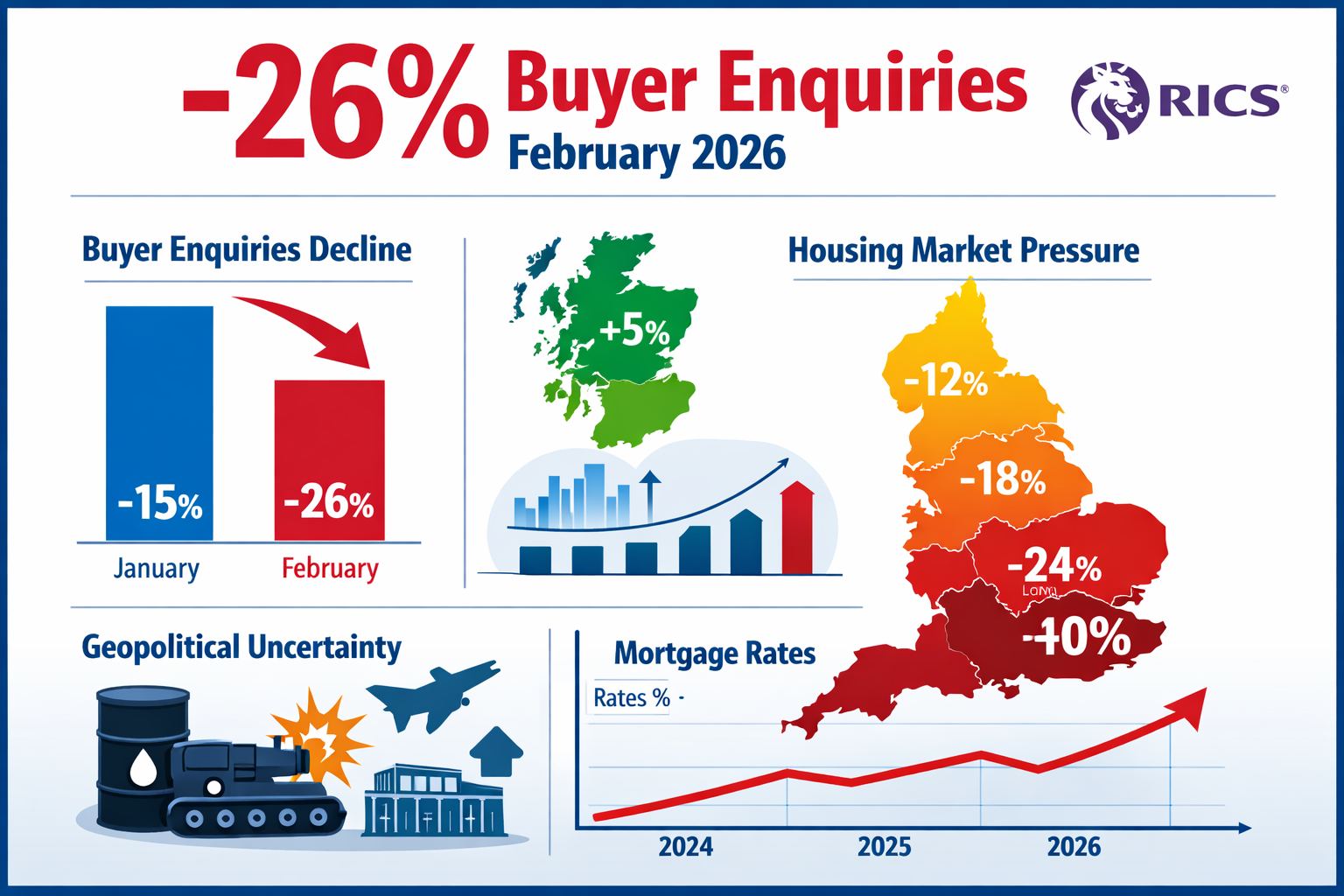
The UK property market in 2026 faces unprecedented challenges as interest rate volatility reshapes buyer behaviour and property valuations. With February 2026 RICS data revealing buyer enquiries plummeting to -26% net balance—down from -15% just one month earlier—building surveyors find themselves at the frontline of a rapidly shifting landscape [1]. This dramatic decline reflects renewed concerns over the interest rate outlook and geopolitical uncertainty, forcing property professionals to adapt their protocols and recommendations. Understanding how navigating interest rate volatility in 2026 building surveys: RICS insights on buyer demand dips and valuation adjustments impacts the surveying profession has never been more critical for protecting client interests and maintaining market confidence.

Key Takeaways
- 📉 Buyer enquiries dropped to -26% net balance in February 2026, marking a significant deterioration from -15% in January, driven by interest rate concerns and geopolitical instability
- 🏘️ Regional price divergence is pronounced, with London (-40%), South East (-24%), and East Anglia (-26%) experiencing the most downward pressure while Northern regions show resilience
- 💰 Valuation adjustments are essential as near-term price expectations fell to -18% from -6%, requiring surveyors to incorporate affordability risks and structural resilience into assessments
- 🔍 Building survey protocols must adapt to highlight long-term structural value and maintenance requirements in a market where mortgage rates will likely remain elevated
- 📊 12-month expectations remain cautiously positive at +33%, suggesting opportunities for buyers who secure comprehensive surveys and negotiate based on current market realities
Understanding the February 2026 Market Downturn
The Sharp Decline in Buyer Sentiment
The February 2026 RICS UK Residential Market Survey paints a concerning picture of market confidence. New buyer enquiries weakened significantly to -26% net balance, representing a substantial deterioration from the -15% recorded just one month earlier [1]. This decline reflects a fundamental shift in buyer psychology as hopes for imminent interest rate cuts have effectively "disappeared" according to field reports from chartered surveyors [2].
The deterioration extends beyond initial enquiries. Agreed sales remained subdued at -12% net balance, while near-term sales expectations softened to -2% [1]. This triple pressure—fewer enquiries, fewer completions, and weakening short-term outlook—creates a challenging environment for property transactions.
Several interconnected factors drive this downturn:
- Rising oil and energy prices increasing inflation concerns
- Escalation of Middle East conflict creating geopolitical uncertainty
- Expectations that mortgage rates will remain higher for longer
- Ongoing indecision over Bank of England interest rate policy [3]
For building surveyors, these market conditions necessitate a fundamental reassessment of how surveys are conducted and presented. When working with clients, understanding why choose RICS surveyors becomes particularly important during volatile periods.
Regional Variations and Price Pressures
The national picture masks significant regional divergence in market performance. The RICS data reveals stark geographical differences in price trends [1]:
| Region | Price Net Balance | Market Characteristics |
|---|---|---|
| London | -40% | Sharpest downward pressure, highly sensitive to rates |
| South East | -24% | Significant weakness, commuter belt affected |
| East Anglia | -26% | Notable decline, affordability constraints |
| Northern Ireland | Positive | Firmer price trends, relative resilience |
| Scotland | Positive | Stable performance, less rate sensitivity |
| North West England | Positive | Stronger fundamentals, affordability advantage |
This geographical pattern reflects fundamental affordability dynamics. Southern regions, particularly London and the South East, face the greatest challenges due to higher absolute property prices and greater sensitivity to mortgage rate changes. A 1% increase in mortgage rates has a proportionally larger impact on monthly payments for a £600,000 London property compared to a £250,000 property in the North West.
For surveyors conducting homebuyers surveys or full structural inspections, regional context must inform valuation approaches and buyer advice.
Interest Rate Expectations and Market Psychology
The shift in interest rate expectations represents the most significant driver of current market weakness. Near-term price expectations turned considerably more cautious, falling to -18% from -6% in January [1]. This deterioration stems directly from the realization that mortgage rates will likely remain elevated for an extended period.
"The recent rise in oil and energy prices has increased the likelihood that mortgage rates will remain higher for longer." — RICS Head of Market Research [1]
However, longer-term sentiment tells a more nuanced story. 12-month price expectations remain positive at +33% net balance overall, though this represents a moderation from +43% the previous month [1]. This suggests that while immediate conditions are challenging, many surveyors anticipate eventual market stabilization.
The exception is London, where 12-month expectations cooled sharply to +7% from +56% in the previous month [1]. This dramatic shift reflects the capital's particular vulnerability to interest rate dynamics and economic uncertainty.
Navigating Interest Rate Volatility in 2026 Building Surveys: Adapting Survey Protocols
Incorporating Affordability Risk into Survey Assessments
Building surveyors must now explicitly address affordability risks within their survey reports and valuation advice. Traditional survey protocols focused primarily on structural condition, defects, and repair costs. In 2026's volatile market, this approach is insufficient.
Modern survey protocols should include:
1. Market Context Sections 📊
- Current interest rate environment and trajectory
- Regional market performance indicators
- Comparable property transaction data from recent months
- Affordability stress testing based on potential rate increases
2. Enhanced Valuation Commentary 💷
- Multiple valuation scenarios (current rates, +1%, +2% scenarios)
- Discussion of asking price versus realistic market value
- Analysis of time-on-market trends for similar properties
- Assessment of negotiation leverage based on market conditions
3. Long-term Value Considerations 🏠
- Structural resilience and anticipated maintenance requirements
- Energy efficiency ratings and potential improvement costs
- Features that maintain value during market downturns
- Factors supporting price recovery in eventual upturn
For those seeking guidance on homebuyers report examples, the 2026 market requires additional layers of analysis beyond traditional formats.
Highlighting Structural Resilience in Volatile Markets
When buyer confidence is fragile and financing costs are elevated, structural quality becomes paramount. Properties with significant deferred maintenance or hidden defects face disproportionate price pressure in challenging markets. Conversely, properties demonstrating excellent structural condition and low anticipated maintenance costs offer buyers greater long-term security.
Survey reports should explicitly highlight:
✅ Positive Structural Indicators
- Recent roof replacement or confirmed remaining lifespan
- Modern electrical and plumbing systems
- Absence of damp, subsidence, or structural movement
- High-quality construction materials and workmanship
- Energy-efficient features reducing running costs
⚠️ Risk Factors Requiring Adjustment
- Deferred maintenance requiring immediate investment
- Structural concerns requiring specialist investigation
- Outdated systems approaching end-of-life
- Poor energy efficiency increasing occupancy costs
- Features that may limit future marketability
Understanding what does a surveyor do in this context means recognizing that the surveyor's role extends beyond defect identification to strategic market advice.
Valuation Adjustments for Market Conditions
The headline price net balance of -12% nationally [1] masks considerable variation in how different property types and conditions are affected. Surveyors must apply nuanced valuation adjustments that reflect both structural condition and current market dynamics.
Framework for Valuation Adjustments:
Base Market Adjustment
Start with regional market trends. In London (-40% price pressure), a property listed at £800,000 may warrant a base adjustment of 5-10% simply due to market conditions, before considering property-specific factors.
Condition-Based Adjustments
- Excellent condition, low maintenance: +2% to +5% premium (resilience value)
- Average condition: No adjustment
- Significant defects: -5% to -15% depending on repair costs and complexity
- Major structural concerns: -15% to -30% or recommend withdrawal
Affordability-Driven Adjustments
Properties at higher price points in rate-sensitive regions warrant additional caution. A £1.5 million property in the South East faces greater downward pressure than a £400,000 property in the North West, even with identical structural condition.
Market Velocity Considerations
Properties in areas with extended time-on-market (90+ days) may require additional adjustment of 3-5% to reflect realistic selling conditions.
For clients considering negotiation strategies after receiving survey results, these market-informed valuations provide essential leverage.
RICS Insights on Buyer Demand Dips and Valuation Adjustments

Understanding the -26% Buyer Enquiry Collapse
The -26% net balance in buyer enquiries represents one of the sharpest monthly deteriorations in recent years [1]. To understand its implications for building surveys, we must examine the underlying buyer psychology and market mechanics.
What This Means for Buyers:
- Increased negotiating power due to reduced competition
- Greater opportunity for thorough due diligence without time pressure
- Ability to make offers conditional on comprehensive survey findings
- Reduced risk of being outbid before survey completion
What This Means for Sellers:
- Heightened importance of property presentation and condition
- Greater likelihood of price negotiations following surveys
- Extended marketing periods requiring realistic pricing
- Increased scrutiny of asking prices versus comparable sales
What This Means for Surveyors:
- More time to conduct thorough inspections without rushed timelines
- Greater responsibility to provide market-informed valuation advice
- Increased likelihood that survey findings will influence final sale prices
- Enhanced importance of clear communication about market context
Field reports from RICS members indicate that "ongoing indecision over interest rates continues affecting the middle market" [2], with many potential buyers adopting a wait-and-see approach. This creates opportunities for decisive buyers who secure comprehensive surveys and negotiate based on thorough property knowledge.
The Build Cost Inflation Factor
While buyer demand has weakened, housing developers are experiencing a 2% year-on-year increase in build costs in Q4 2025, with 38% of builder respondents identifying material costs as the key inflation driver [3]. This creates a complex dynamic for property valuations.
Implications for Survey Valuations:
New Build Properties 🏗️
- Construction cost increases support floor prices for new developments
- However, reduced buyer demand may prevent builders from passing on full cost increases
- Survey focus should include build quality verification and snagging identification
- Comparison with equivalent resale properties becomes more important
Older Properties Requiring Renovation 🔨
- Increased renovation costs must be factored into valuation adjustments
- Properties requiring significant work face double pressure: weak demand + high repair costs
- Detailed cost estimates for identified defects become critical for negotiations
- Energy efficiency improvements carry higher costs but greater long-term value
Well-Maintained Properties ✨
- Relative value advantage increases as renovation costs rise
- Properties with recent improvements warrant premium recognition
- Survey reports should explicitly quantify the value of recent upgrades
- Maintenance history documentation becomes more valuable
For those exploring property evaluation methods, the interplay between demand weakness and cost inflation requires sophisticated analysis.
Practical Survey Recommendations for 2026 Market Conditions
Based on current RICS insights and market dynamics, building surveyors should implement these practical approaches:
1. Enhanced Pre-Purchase Advice 💡
Before conducting surveys, provide clients with comprehensive market briefings covering:
- Current regional market performance and trends
- Interest rate environment and mortgage availability
- Realistic timelines for property transactions
- Strategic considerations for offer pricing
2. Comprehensive Structural Analysis 🔍
Given market conditions, recommend Level 3 surveys (full structural surveys) more frequently, particularly for:
- Properties over 50 years old
- Properties showing any visible concerns
- Properties in high-value segments where price adjustments will be significant
- Properties being purchased with high loan-to-value mortgages
Understanding the key difference between Level 2 and Level 3 surveys helps clients make informed decisions about survey depth.
3. Market-Informed Valuation Commentary 📈
Include explicit discussion of:
- How identified defects impact value in current market conditions
- Comparison of asking price to recent comparable sales
- Regional market trends affecting the specific property type
- Realistic assessment of negotiation potential based on findings
4. Post-Survey Negotiation Support 🤝
Provide clear guidance on:
- Prioritization of defects by severity and cost impact
- Suggested price adjustments based on repair cost estimates
- Alternative approaches (seller remediation vs. price reduction)
- Documentation to support renegotiation discussions
Many clients benefit from understanding whether they can renegotiate after a poor building survey result, particularly in the current market environment.
Regional Strategy Adjustments
Survey approaches should vary by region based on RICS data showing significant geographical divergence [1]:
London and South East (High Price Pressure Regions) 🏙️
- Emphasize affordability stress testing in valuation commentary
- Highlight features supporting long-term value retention
- Provide conservative valuation estimates reflecting -40% and -24% price pressures
- Recommend thorough structural surveys to identify any negotiation opportunities
- Focus on energy efficiency and running cost considerations
Northern Regions (Resilient Markets) 🏘️
- Maintain balanced approach to valuations
- Recognize firmer price trends in commentary
- Still highlight structural concerns but with less dramatic market-driven adjustments
- Acknowledge relative affordability advantage in market context sections
Transitional Markets (East Anglia, East Midlands) 🌾
- Apply moderate caution to valuations
- Monitor local market velocity indicators closely
- Provide nuanced commentary on micro-market conditions
- Balance structural findings with localized demand patterns
Strategic Opportunities in a Challenging Market
Advantages for Well-Informed Buyers
Despite negative sentiment indicators, the current market presents significant opportunities for strategic buyers who approach purchases with thorough due diligence:
Reduced Competition 🎯
- With enquiries at -26%, buyers face less competition for quality properties
- Time to conduct comprehensive surveys without rushed decisions
- Ability to negotiate based on thorough property knowledge
- Reduced risk of bidding wars driving prices above realistic values
Negotiation Leverage 💪
- Sellers increasingly willing to negotiate on price
- Survey findings carry greater weight in price discussions
- Opportunity to request seller remediation of defects
- Ability to structure offers conditional on specific repairs
Long-term Value Focus 📅
- 12-month expectations remain positive at +33% nationally [1]
- Properties purchased at adjusted prices offer stronger future appreciation potential
- Quality properties in good locations maintain fundamental value
- Current market allows selective purchasing of best-value opportunities
Access to Professional Guidance 👥
- Surveyors have more capacity to provide detailed consultations
- Time for thorough property inspections and comprehensive reports
- Opportunity for pre-purchase property assessments and strategic advice
- Enhanced post-survey support for negotiation strategies
The Importance of Professional Survey Selection
In volatile markets, the quality and expertise of the surveyor becomes even more critical. RICS-qualified surveyors bring essential market knowledge and professional standards that protect buyer interests.
Key Selection Criteria:
✅ RICS Accreditation
Ensures adherence to professional standards, continuing education requirements, and professional indemnity insurance. Learn more about why choose RICS surveyors for market-sensitive transactions.
✅ Local Market Expertise
Surveyors with regional knowledge understand micro-market dynamics, typical property construction methods, and realistic valuation benchmarks for specific areas.
✅ Comprehensive Reporting
Detailed reports that include market context, valuation commentary, and strategic advice provide far greater value than basic defect lists.
✅ Post-Survey Support
Surveyors who provide follow-up consultations and negotiation guidance help clients maximize the value of survey investments.
✅ Appropriate Survey Level
Professional advice on whether Level 2 (Homebuyer Survey) or Level 3 (Full Structural Survey) best suits the specific property and buyer circumstances.
Timing Considerations for Property Purchases
The RICS data suggests a complex timing picture for 2026 property transactions:
Near-term Outlook (3-6 months) ⏰
- Continued price pressure likely, particularly in London and South East
- Interest rates expected to remain elevated
- Buyer demand may remain subdued
- Strategy: Thorough surveys with conservative valuations; strong negotiation positioning
Medium-term Outlook (6-12 months) 📆
- 12-month expectations remain positive at +33% [1]
- Potential for gradual market stabilization
- Possible modest price recovery in resilient regions
- Strategy: Focus on structural quality and long-term value; properties purchased now may benefit from future appreciation
Long-term Outlook (12+ months) 🔮
- Fundamental housing shortage supports long-term values
- Interest rates eventually expected to normalize
- Quality properties in desirable locations maintain enduring value
- Strategy: Emphasis on location, structural condition, and features supporting long-term desirability
Conclusion
Navigating interest rate volatility in 2026 building surveys: RICS insights on buyer demand dips and valuation adjustments requires a fundamental evolution in how property professionals approach their work. The February 2026 RICS data—showing buyer enquiries at -26%, significant regional price divergence, and near-term expectations at -18%—creates both challenges and opportunities for the property market [1].
For building surveyors, this environment demands enhanced protocols that explicitly address affordability risks, highlight structural resilience, and provide market-informed valuation adjustments. Survey reports must evolve beyond simple defect identification to become strategic documents that help clients navigate uncertain market conditions with confidence.
For property buyers, current market conditions offer significant advantages: reduced competition, enhanced negotiation leverage, and the opportunity to secure quality properties at adjusted prices. However, realizing these advantages requires comprehensive due diligence through professional building surveys conducted by qualified RICS surveyors who understand both structural assessment and market dynamics.
The regional divergence highlighted in RICS data—with London at -40% price pressure while Northern regions show resilience—underscores the importance of localized market knowledge in survey valuations. One-size-fits-all approaches fail to capture the nuanced reality of 2026's property market.
Actionable Next Steps
For Property Buyers: 🏠
- Engage RICS-qualified surveyors early in the property search process for strategic advice
- Commission comprehensive surveys (Level 3 where appropriate) to identify all negotiation opportunities
- Use survey findings strategically in price negotiations, supported by current market data
- Focus on structural quality and long-term value rather than chasing short-term price movements
- Consider properties with recent improvements that reduce immediate maintenance requirements
For Property Professionals: 👔
- Update survey protocols to incorporate market context and affordability risk analysis
- Enhance valuation commentary with regional market data and multiple scenario analysis
- Provide post-survey negotiation support to help clients maximize survey value
- Maintain continuing education on market trends, interest rate dynamics, and valuation methodologies
- Communicate clearly about the relationship between structural findings and market-driven adjustments
For All Stakeholders: 🤝
- Recognize that volatility creates opportunity for those who approach transactions strategically
- Prioritize professional guidance during uncertain market conditions
- Focus on fundamental property quality rather than short-term market sentiment
- Maintain realistic expectations about timelines and pricing in current conditions
- Remember that 12-month expectations remain positive (+33%), suggesting eventual market stabilization [1]
The challenges of 2026's interest rate volatility are real and significant. However, with professional guidance, comprehensive building surveys, and strategic approaches to property transactions, both buyers and industry professionals can successfully navigate this complex market environment. The key lies in recognizing that thorough due diligence and realistic valuations aren't obstacles to successful transactions—they're the foundation for confident decision-making in uncertain times.
For personalized guidance on navigating the current property market with professional building surveys, contact our RICS-qualified surveyors who understand both structural assessment and market dynamics in 2026's volatile environment.
References
[1] Uk Residential Survey February 2026 – https://www.rics.org/news-insights/uk-residential-survey-february-2026
[2] Uk Residential Market Survey February 2026 – https://www.rics.org/content/dam/ricsglobal/documents/market-surveys/uk-residential-market-survey/UK-Residential-Market-Survey_February-2026.pdf
[3] Market Confidence Remains Fragile Rics – https://housingview.co.uk/2026/03/14/market-confidence-remains-fragile-rics/