


The UK property market landscape in 2026 reveals a striking geographical divide. While London and the South East experience sluggish growth, Scotland and Northern Ireland are emerging as the nation's strongest-performing property markets. For RICS chartered surveyors and property professionals operating in these regions, this divergence presents both exceptional opportunities and unique valuation challenges that demand sophisticated strategic approaches.
The Valuation Strategy for Scotland and Northern Ireland: Capturing Outperforming Markets While Navigating Regional Price Growth Divergence requires understanding complex regional dynamics, adapting traditional valuation methodologies, and effectively communicating market advantages to clients navigating these rapidly evolving territories.
Key Takeaways
- 🏴 Scotland and Northern Ireland lead UK price growth with forecasts showing 2-4%+ annual increases, significantly outperforming southern regions in 2026
- 📊 Regional divergence within Northern Ireland shows variation from 7.1% average growth to 13% in specific areas like Derry City and Strabane
- 💷 Non-domestic revaluations in Northern Ireland reflect 15% overall growth with 75,000+ properties revalued using April 2024 rental evidence
- 🎯 Affordability advantages position these markets favorably as buyers seek value outside expensive London and South East regions
- 📈 Strategic valuation approaches must account for localized growth patterns, rental market strength, and evolving buyer demographics
Understanding the Regional Price Growth Divergence Landscape in 2026
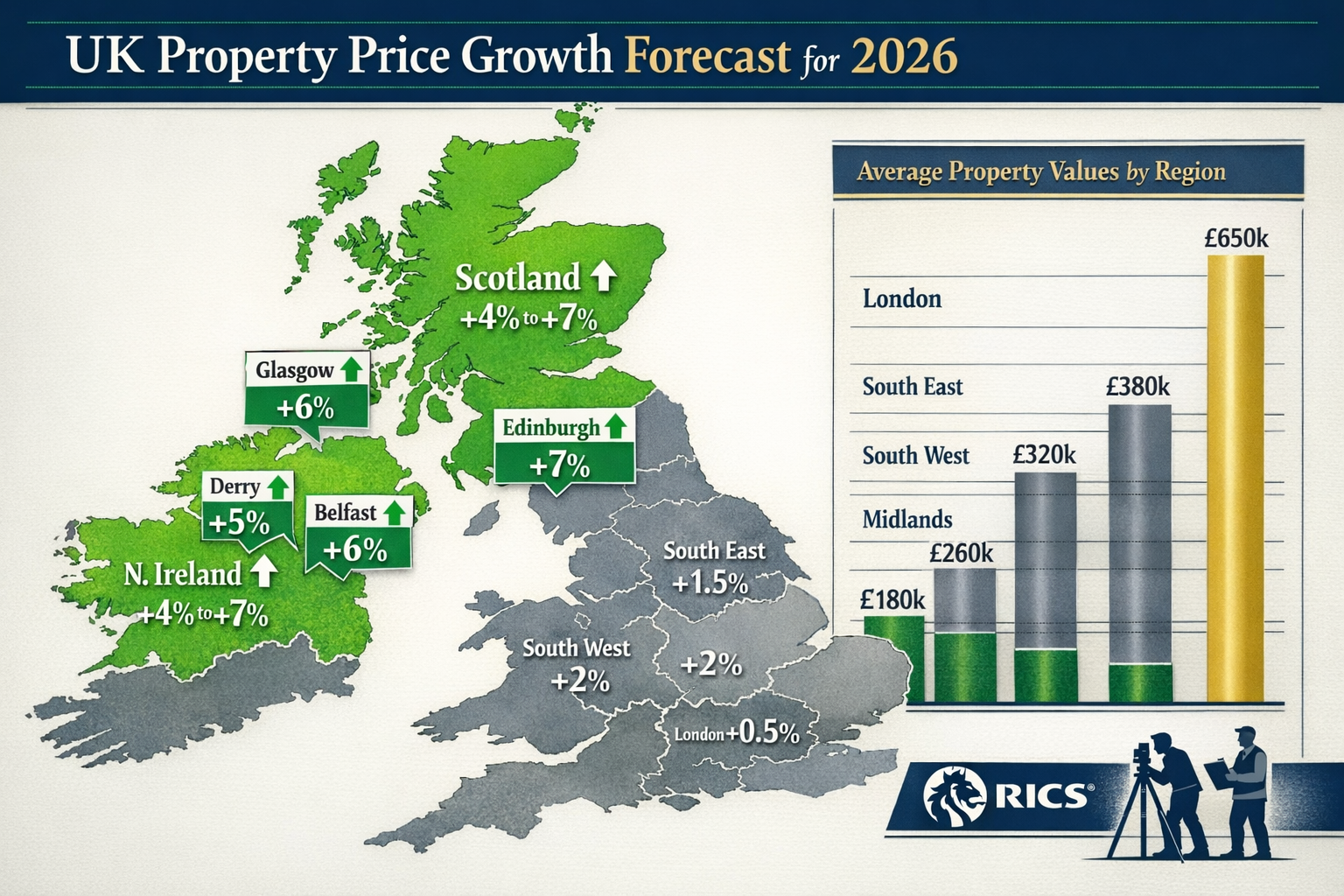
The geographical shift in UK property market performance represents one of the most significant structural changes in recent real estate history. According to recent market analysis, Scotland and Northern England are positioned to lead UK house price growth throughout 2026, with strongest-performing locations including Motherwell, Glasgow, Paisley, Falkirk, Kirkcaldy, Edinburgh, Kilmarnock, Perth, and Inverness—each forecasting annual price growth exceeding 2% and reaching over 4% in some areas [6].
Northern Ireland's Remarkable Market Performance
Northern Ireland's residential property market demonstrates exceptional resilience and growth momentum. The average house price stands at £235,000, reflecting a robust 6.4% annual increase as of Q4 2025 [4]. This growth extends across multiple property types:
- Apartments: 7% annual price increase
- New homes: Average £267,000 (up 5.2% year-on-year)
- Average rents: £995 monthly (up 5.6% annually)
Strong buyer demand concentrates in Belfast, Bangor, Lisburn, and Newtownards, with 5,512 properties achieving sale agreements in Q4 2025—only 3% lower than the previous year despite broader economic headwinds [4].
Regional Variation Within Northern Ireland
The Valuation Strategy for Scotland and Northern Ireland must account for significant intra-regional price divergence. Northern Ireland's property market shows uneven performance across council areas:
| Council Area | Annual Price Growth |
|---|---|
| Derry City and Strabane | 13.0% |
| Mid Ulster | 11.2% |
| Ards and North Down | 8.6% |
| Overall Northern Ireland Average | 7.1% |
This variation of nearly 6 percentage points between the strongest and average-performing areas demonstrates the critical importance of localized market knowledge when conducting valuations [5]. Understanding these micro-market dynamics enables surveyors to provide more accurate assessments and better serve clients seeking to capitalize on regional opportunities.
Scotland's Strategic Market Position
Scotland's property market benefits from fundamental affordability advantages compared to southern regions. With significantly lower average property values than London and the South East, Scottish markets attract affordability-conscious buyers in an environment of elevated borrowing costs [6].
Major Scottish cities demonstrate consistent growth trajectories, supported by:
- Strong employment markets in Glasgow and Edinburgh
- Ongoing infrastructure investment
- Quality of life factors attracting remote workers
- Relative affordability compared to southern alternatives
For surveyors conducting RICS property valuations, these regional advantages create compelling narratives when advising clients on investment decisions and market positioning.
Valuation Strategy for Scotland and Northern Ireland: Methodological Adaptations for Outperforming Markets

Capturing the value proposition of outperforming markets requires methodological refinement beyond standard valuation approaches. The rapid price appreciation and regional divergence demand surveyors adapt their analytical frameworks to reflect current market realities accurately.
Incorporating Current Rental Evidence
Northern Ireland's non-domestic revaluation provides valuable lessons for residential valuations. Over 75,000 non-domestic properties were revalued using April 2024 rental evidence instead of pandemic-era October 2021 data, updating rates to reflect current market conditions [2]. This shift from outdated baseline data to current evidence demonstrates the importance of timely comparable transactions.
For residential valuations, this principle translates to:
- Prioritizing recent sales (within 3-6 months) over older comparables
- Adjusting historical data for rapid appreciation trends
- Incorporating rental yield data as supporting evidence
- Recognizing that pandemic-era comparables may significantly undervalue current market conditions
When clients require a Red Book valuation, ensuring comparables reflect the accelerated growth trajectory of Scottish and Northern Irish markets becomes paramount to accuracy.
Accounting for Sector-Specific Growth Patterns
The Northern Ireland non-domestic revaluation reveals sector-specific variation that residential surveyors should consider:
- Office values: Increased 9% overall, driven by Grade A concentration in Belfast [3]
- Retail properties: Rose 9% with stronger Belfast growth and moderate uplifts elsewhere [3]
- Independent retailers: Many experienced no Net Annual Value (NAV) changes [3]
This pattern suggests that location quality and property grade significantly influence appreciation rates. Residential valuations should similarly differentiate between:
- Prime urban locations versus secondary markets
- New-build versus older housing stock
- Properties with modern amenities versus those requiring renovation
- Areas with strong infrastructure versus peripheral locations
Understanding Relief and Support Mechanisms
Approximately 75% of non-domestic properties receive rate relief, amounting to around £250 million in support, with the Small Business Rate Relief scheme supporting around 30,000 of the 75,000 properties [1]. While this specifically applies to commercial properties, understanding government support mechanisms helps surveyors advise clients on:
- Total cost of ownership beyond purchase price
- Regional policy advantages that enhance market attractiveness
- Long-term sustainability of market growth supported by favorable policy environments
Strategic Communication: Articulating Regional Advantages to Clients

The Valuation Strategy for Scotland and Northern Ireland extends beyond technical valuation accuracy to effective client communication. Surveyors must articulate why these outperforming markets represent compelling opportunities while acknowledging potential risks.
Framing Affordability as Strategic Advantage
The pricing dynamics favoring northern and Scottish markets stem from significantly lower average property values compared to London and the South East [6]. This affordability advantage creates multiple client benefits:
- Higher yield potential: Lower entry prices with comparable rental returns produce superior yields
- Greater purchasing power: Buyers can access larger or higher-quality properties for equivalent budgets
- Lower leverage requirements: Reduced borrowing needs in higher interest rate environments
- Appreciation potential: Properties starting from lower bases have greater percentage growth capacity
When conducting RICS surveys to help negotiate property prices, surveyors can leverage regional market data to demonstrate value propositions that southern markets cannot match.
Addressing Client Concerns About Regional Markets
Clients accustomed to London-centric property narratives may harbor concerns about investing in Scottish or Northern Irish markets. Proactive communication strategies should address:
Liquidity concerns: Demonstrate strong transaction volumes (5,512 sale agreements in Q4 2025 in Northern Ireland alone) [4] proving robust market liquidity.
Economic fundamentals: Highlight employment growth, infrastructure investment, and demographic trends supporting sustained demand.
Historical performance: Present long-term appreciation data showing consistent growth trajectories independent of short-term fluctuations.
Rental market strength: Emphasize 5.6% annual rental growth [4] as evidence of fundamental demand supporting property values.
Leveraging Comparative Market Analysis
Effective client communication requires compelling comparative analysis between regions. Consider presenting data in accessible formats:
Growth Rate Comparisons:
- Northern Ireland average: 7.1% annual growth
- Derry City and Strabane: 13.0% annual growth
- London and South East: 0-2% projected growth
- Differential advantage: 5-11 percentage points
Value Proposition Tables:
| Metric | Scotland/NI | London/SE | Advantage |
|---|---|---|---|
| Average Price | £235,000 | £500,000+ | 53% lower |
| Annual Growth | 4-7% | 0-2% | 2-7pp higher |
| Rental Yield | 5-7% | 3-4% | 2-3pp higher |
| Appreciation Potential | Strong | Limited | Significant |
This data-driven approach, combined with professional RICS surveyor expertise, builds client confidence in regional market opportunities.
Navigating the Revaluation Landscape
The Northern Ireland non-domestic revaluation, with its 15% overall growth across all property sectors [1], provides important context for residential market valuations. The revaluation reflects significant market shifts since the October 2021 baseline, with changes effective from 1 April 2026.
Key insights for residential surveyors include:
- Two-thirds of properties experienced at or below average increases, meaning approximately one-third face above-average value increases [1]
- This distribution suggests selective rather than uniform appreciation, reinforcing the importance of property-specific analysis
- The shift from pandemic-era to current evidence demonstrates how rapidly markets can evolve, requiring continuous recalibration of valuation assumptions
When advising clients on average price reductions after surveys, understanding these revaluation dynamics helps contextualize negotiation strategies within broader market trends.
Risk Management and Due Diligence in High-Growth Markets
While Scotland and Northern Ireland present compelling opportunities, prudent valuation strategy requires acknowledging and managing potential risks associated with rapidly appreciating markets.
Market Cycle Considerations
High-growth markets inevitably face cyclical correction risks. Responsible surveyors should:
- Avoid extrapolating current growth rates indefinitely into future projections
- Consider historical volatility patterns in regional markets
- Assess sustainability of demand drivers (employment, demographics, infrastructure)
- Evaluate potential interest rate impacts on affordability and demand
Property-Specific Due Diligence
Rapid appreciation can sometimes mask underlying property issues. Comprehensive surveys remain essential:
- Structural assessments to identify hidden defects
- Building condition evaluations to estimate future maintenance costs
- Compliance verification for building regulations and planning permissions
- Environmental assessments for flood risk, contamination, or other hazards
For clients purchasing in these markets, recommending appropriate survey levels based on property age, condition, and type ensures informed decision-making beyond market appreciation potential.
Regional Economic Fundamentals
While current performance is strong, surveyors should evaluate long-term economic sustainability:
- Employment diversity and major employer concentration risks
- Infrastructure investment pipelines supporting continued development
- Demographic trends (population growth, age distribution, migration patterns)
- Policy environment and potential regulatory changes affecting property markets
Technology and Data Integration for Enhanced Valuation Accuracy
Modern valuation strategy increasingly relies on sophisticated data analytics and technology integration to capture market nuances accurately.
Leveraging Market Data Platforms
Advanced property data platforms enable surveyors to:
- Access real-time comparable transaction data across Scottish and Northern Irish markets
- Analyze micro-market trends at postcode or neighborhood levels
- Track rental yield evolution and occupancy rates
- Monitor development pipeline and supply dynamics
Geographic Information Systems (GIS)
GIS technology enhances valuation accuracy by visualizing:
- Price heat maps showing appreciation patterns across regions
- Infrastructure proximity analysis (transport links, schools, amenities)
- Development zone identification and planning permission trends
- Environmental risk mapping (flood zones, contamination sites)
Automated Valuation Models (AVMs) as Supporting Tools
While not replacing professional judgment, AVMs provide valuable supporting data:
- Rapid preliminary valuations for portfolio screening
- Comparable property identification and adjustment calculations
- Market trend analysis and forecasting
- Quality assurance checks against manual valuations
Professional surveyors should view technology as enhancing rather than replacing their expertise, particularly in markets experiencing rapid change where algorithmic models may lag current conditions.
Building Long-Term Client Relationships Through Regional Expertise
The Valuation Strategy for Scotland and Northern Ireland ultimately serves relationship building and client success over transactional interactions.
Positioning as Regional Market Authority
Surveyors who develop deep regional expertise create sustainable competitive advantages:
- Publish regular market commentary on Scottish and Northern Irish property trends
- Develop specialized knowledge of specific council areas or neighborhoods
- Build networks with local estate agents, developers, and property professionals
- Maintain databases of regional comparables and market intelligence
Educational Approach to Client Service
Educating clients about regional market dynamics builds trust and loyalty:
- Provide detailed market reports contextualizing individual valuations within broader trends
- Offer workshops or seminars on investing in Scottish and Northern Irish property markets
- Create accessible content explaining valuation methodologies and regional factors
- Maintain transparent communication about market risks alongside opportunities
Portfolio Strategy Advisory
Beyond individual valuations, surveyors can provide strategic portfolio guidance:
- Diversification strategies balancing regional exposure
- Timing recommendations based on market cycle analysis
- Property type allocation optimizing risk-adjusted returns
- Exit strategy planning considering liquidity and market conditions
This comprehensive approach transforms surveyors from transactional service providers into strategic advisors, creating lasting client relationships that generate recurring business and referrals.
Regulatory Compliance and Professional Standards
Operating in Scottish and Northern Irish markets requires strict adherence to regional regulatory frameworks and professional standards.
RICS Red Book Compliance
All formal valuations must comply with RICS Valuation – Global Standards (Red Book):
- Clear identification of valuation purpose and intended use
- Appropriate valuation approach selection (market, income, cost)
- Transparent assumptions and special assumptions disclosure
- Comprehensive comparable evidence documentation
- Professional indemnity insurance maintenance
Regional Regulatory Variations
Surveyors must understand jurisdiction-specific requirements:
- Scottish property law differences (feudal system abolition, home reports)
- Northern Irish rating system and revaluation procedures
- Land registration requirements and processes
- Planning and building regulation variations
Continuing Professional Development
Maintaining expertise in rapidly evolving markets requires ongoing professional development:
- Regular CPD activities focused on regional market trends
- Attendance at Scottish and Northern Irish property conferences
- Participation in RICS regional forums and working groups
- Subscription to regional property market publications and research
Conclusion
The Valuation Strategy for Scotland and Northern Ireland: Capturing Outperforming Markets While Navigating Regional Price Growth Divergence represents a compelling opportunity for forward-thinking property professionals in 2026. With Scotland and Northern Ireland demonstrating sustained price growth significantly outpacing southern regions, surveyors who develop sophisticated regional expertise and adapt their methodologies to these dynamic markets position themselves for exceptional professional success.
Key strategic imperatives include:
✅ Embrace current data: Prioritize recent comparables and rental evidence over outdated pandemic-era information
✅ Understand regional variation: Recognize that 13% growth in Derry differs fundamentally from 7% average growth, requiring localized analysis
✅ Communicate value propositions: Articulate affordability advantages and growth potential to clients unfamiliar with regional markets
✅ Maintain professional standards: Ensure RICS Red Book compliance and jurisdiction-specific regulatory adherence
✅ Leverage technology: Integrate data analytics and GIS tools while maintaining professional judgment primacy
✅ Build regional authority: Develop deep market knowledge and position as the go-to expert for Scottish and Northern Irish valuations
Actionable Next Steps
For surveyors seeking to capitalize on these outperforming markets:
-
Conduct regional market research: Compile comprehensive data on Scottish and Northern Irish price trends, rental yields, and economic fundamentals
-
Develop comparable databases: Build proprietary collections of regional transactions organized by location, property type, and date
-
Establish local networks: Connect with estate agents, developers, and property professionals operating in target markets
-
Create client education materials: Develop presentations, reports, and guides explaining regional market advantages
-
Invest in technology: Implement data platforms and analytical tools supporting sophisticated regional analysis
-
Pursue specialized CPD: Focus professional development on Scottish and Northern Irish property law, market dynamics, and valuation challenges
The geographical divergence in UK property market performance creates unprecedented opportunities for surveyors who recognize and respond strategically to these shifting dynamics. By combining technical valuation excellence with regional market expertise and effective client communication, property professionals can capture the significant value these outperforming markets offer while providing exceptional service that builds lasting client relationships.
The question is not whether Scotland and Northern Ireland will continue outperforming—current fundamentals strongly support sustained growth—but rather which surveyors will position themselves to serve clients seeking to capitalize on these compelling regional opportunities.
References
[1] Land Property Services Publishes Draft Valuation List Reval 2026 – https://www.finance-ni.gov.uk/news/land-property-services-publishes-draft-valuation-list-reval-2026
[2] Ni Reval2026 Draft Valuation List – https://www.finance-ni.gov.uk/services/ni-reval2026-draft-valuation-list
[3] Land Property Services Publishes Draft Valuation List For Reval 2026 – https://www.manufacturingni.org/land-property-services-publishes-draft-valuation-list-for-reval-2026/
[4] Northern Ireland Property Market In 2026 Why Now Is A Good Time To Sell – https://www.reedsrains.co.uk/blog/northern-ireland-property-market-in-2026-why-now-is-a-good-time-to-sell
[5] Article – https://www.sutherlandreay.com/blog/article.html?id=1772635696
[6] Why Northern England And Scotland Are Set To Lead Uk House Price Growth In 2026 – https://www.belvoir.co.uk/guides/news/why-northern-england-and-scotland-are-set-to-lead-uk-house-price-growth-in-2026/