

The UK property market has reached a pivotal moment in 2026. For the first time in decades, Northern markets are consistently outperforming their Southern counterparts, with RICS data revealing growth rates that have fundamentally shifted the valuation landscape. Properties in Manchester, Leeds, and Newcastle are experiencing unprecedented demand, while traditional Southern hotspots face affordability constraints that are reshaping buyer behavior. For chartered surveyors and property professionals, understanding Valuing North vs South Properties in 2026: RICS-Approved Techniques for Widening Regional Price Gaps has become essential to delivering accurate, defensible valuations in this evolving market.
The price differential between North and South has widened to 150-200% premiums in many comparable property categories, creating complex challenges for valuation professionals. Traditional comparable sales methods require significant adjustments, and RICS-approved techniques must account for regional affordability shifts, infrastructure investment patterns, and changing migration trends. This comprehensive guide explores the professional methodologies that surveyors need to master when Valuing North vs South Properties in 2026: RICS-Approved Techniques for Widening Regional Price Gaps.
Key Takeaways
- 🏘️ Regional price gaps have widened to 150-200% premiums between comparable North and South properties, requiring updated valuation methodologies
- 📊 RICS Red Book standards provide three core approaches (market, income, cost) that must be adapted for regional market variations
- 🔍 Comparable sales adjustments now require sophisticated regional factors including affordability ratios, infrastructure investment, and migration patterns
- 💼 Northern markets are outperforming Southern regions in 2026, driven by remote work flexibility and regeneration investment
- ✅ Professional surveyors must apply location-specific adjustment factors ranging from 15-35% when comparing cross-regional properties
Understanding RICS-Approved Valuation Approaches for Regional Markets
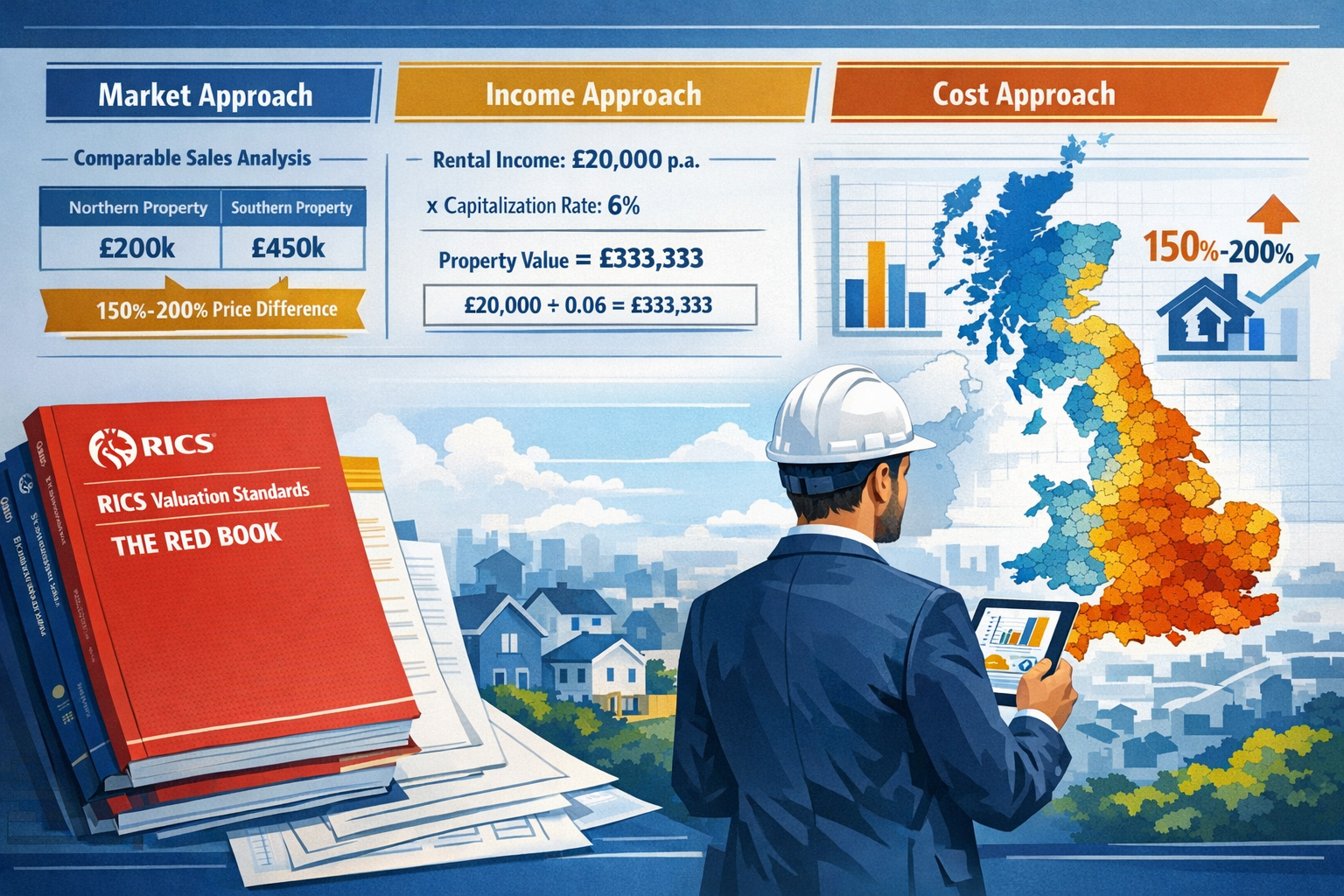
The Royal Institution of Chartered Surveyors (RICS) Red Book Global Standards, updated in January 2025, provide the foundational framework for all professional property valuations. When Valuing North vs South Properties in 2026: RICS-Approved Techniques for Widening Regional Price Gaps, surveyors must apply three primary approaches with regional sensitivity.
The Market Approach: Adapting Comparables Across Regions
The market approach relies on comparable sales data, but 2026's widening regional gaps demand sophisticated adjustments. A three-bedroom semi-detached property in Manchester averaging £215,000 cannot be directly compared to a similar property in Surrey at £485,000 without accounting for multiple regional factors.
Key adjustment categories include:
- Location premium/discount: 20-35% adjustment factor
- Local employment market strength: 5-15% adjustment
- Transport infrastructure quality: 8-12% adjustment
- School catchment area ratings: 5-10% adjustment
- Regional affordability ratios: 15-25% adjustment
Professional RICS surveyors must document each adjustment with supporting market data. The methodology requires analyzing at least five comparable properties within the same region, then applying cross-regional adjustments based on quantifiable market differences.
The Income Approach: Rental Yields and Regional Investment Returns
For investment properties, the income approach reveals striking regional differences in 2026. Northern properties typically deliver gross rental yields of 5.5-7.5%, while Southern properties often yield just 2.5-4.0%. This fundamental difference affects capitalization rates and investment valuations.
| Region | Average Rental Yield | Cap Rate | Investment Appeal |
|---|---|---|---|
| Northern Cities | 6.5% | 5.5% | High growth potential |
| Midlands | 5.2% | 6.0% | Balanced returns |
| Southern Regions | 3.2% | 4.5% | Capital appreciation focus |
| London | 2.8% | 4.0% | Premium market stability |
When applying the income approach, surveyors must consider regional tenant demand, void period expectations, and management cost variations. Northern properties often benefit from stronger rental demand relative to purchase prices, creating favorable investment metrics that Southern properties cannot match in 2026.
The Cost Approach: Regional Construction and Land Values
The cost approach (depreciated replacement cost) highlights another dimension of regional variation. While construction costs remain relatively consistent across the UK—typically £1,200-£1,800 per square meter—land values create enormous disparities.
Land value components in 2026:
- Northern urban plots: £150,000-£250,000 per acre
- Southern urban plots: £800,000-£2,500,000 per acre
- London residential land: £5,000,000+ per acre
This approach proves particularly valuable for specific defect surveys and insurance valuations, where replacement cost calculations must account for regional land acquisition costs while maintaining consistent construction quality standards.
Comparable Sales Adjustments: Mastering Regional Price Gap Analysis
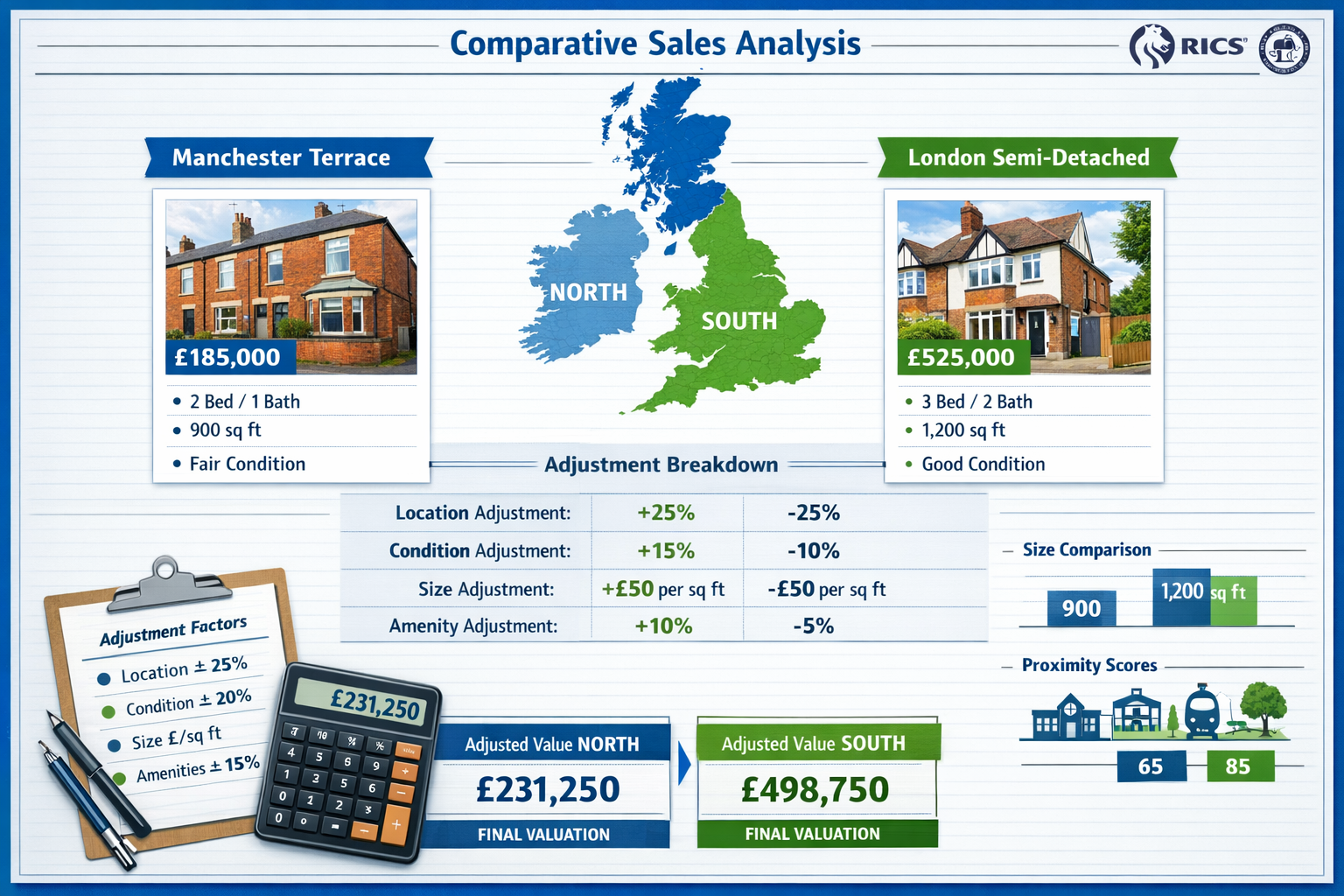
The most challenging aspect of Valuing North vs South Properties in 2026: RICS-Approved Techniques for Widening Regional Price Gaps involves creating defensible comparable sales adjustments. With price differentials reaching unprecedented levels, surveyors must employ systematic methodologies that satisfy RICS professional standards.
Case Study: Three-Bedroom Semi-Detached Properties
Consider two genuinely comparable properties:
Property A – Manchester (North)
- 3 bedrooms, 1,200 sq ft
- Built 1935, good condition
- 0.5 miles from city center
- Good transport links
- Sale price: £215,000
Property B – Guildford (South)
- 3 bedrooms, 1,180 sq ft
- Built 1938, good condition
- 0.6 miles from town center
- Good transport links
- Sale price: £525,000
The 144% price premium for the Southern property requires systematic adjustment analysis:
- Base size adjustment: +1.7% for Property A's additional 20 sq ft
- Age and condition: Minimal adjustment (comparable)
- Location within region: -2% for Property B's slightly inferior position
- Regional market adjustment: -58% to normalize for Southern premium
- Affordability factor: -12% reflecting income-to-price ratios
- Infrastructure investment: +8% for Northern regeneration projects
After adjustments, the regional market factor accounts for approximately 62% of the total price differential, representing the pure North-South gap that surveyors must quantify and document.
The Five-Step Regional Adjustment Process
Professional surveyors should follow this systematic approach when Valuing North vs South Properties in 2026: RICS-Approved Techniques for Widening Regional Price Gaps:
Step 1: Identify True Comparables Within Region 📍
Select 5-7 properties within the subject property's region that match key characteristics (size, type, condition, age). This establishes the regional baseline value.
Step 2: Calculate Regional Price Per Square Foot 📏
Determine the average price per square foot within each region. In 2026, typical ranges are:
- Northern cities: £180-£250/sq ft
- Midlands: £220-£310/sq ft
- Southern regions: £380-£550/sq ft
- London: £500-£900/sq ft
Step 3: Apply Property-Specific Adjustments 🔧
Make individual adjustments for condition, location within neighborhood, specific features, and recent improvements. These typically range from -15% to +20% of base value.
Step 4: Document Regional Market Factors 📊
Quantify the regional premium/discount using objective data:
- Local average earnings vs property prices
- Employment growth rates (past 3 years)
- Infrastructure investment announcements
- Population migration trends
- School performance metrics
Step 5: Reconcile and Justify Final Valuation ✅
Synthesize all adjustments into a coherent narrative that explains the final valuation figure. RICS standards require clear documentation of methodology and supporting evidence.
Advanced Adjustment Factors for 2026 Markets
Beyond traditional comparable adjustments, 2026's market requires consideration of emerging factors:
Remote Work Flexibility Impact 💻
Properties in Northern regions with excellent broadband infrastructure command 5-8% premiums over comparable properties with poor connectivity. This factor barely existed pre-2020 but has become critical for homebuyers in 2026.
Regeneration Zone Proximity 🏗️
Properties within designated regeneration zones in Northern cities show 15-25% appreciation potential over 3-5 years. Surveyors must assess and document proximity to planned infrastructure projects, new transport links, and commercial development.
Climate Resilience Factors 🌊
Southern coastal properties increasingly face flood risk discounts of 10-20%, while Northern properties on higher ground command premiums. Climate adaptation has become a material valuation consideration in 2026.
Energy Efficiency Differentials ⚡
With stricter EPC requirements, properties rated C or above command 8-15% premiums over comparable D-rated properties. Northern regions have seen more extensive retrofit programs, creating valuation advantages.
Regional Market Dynamics: Understanding the 2026 Property Landscape
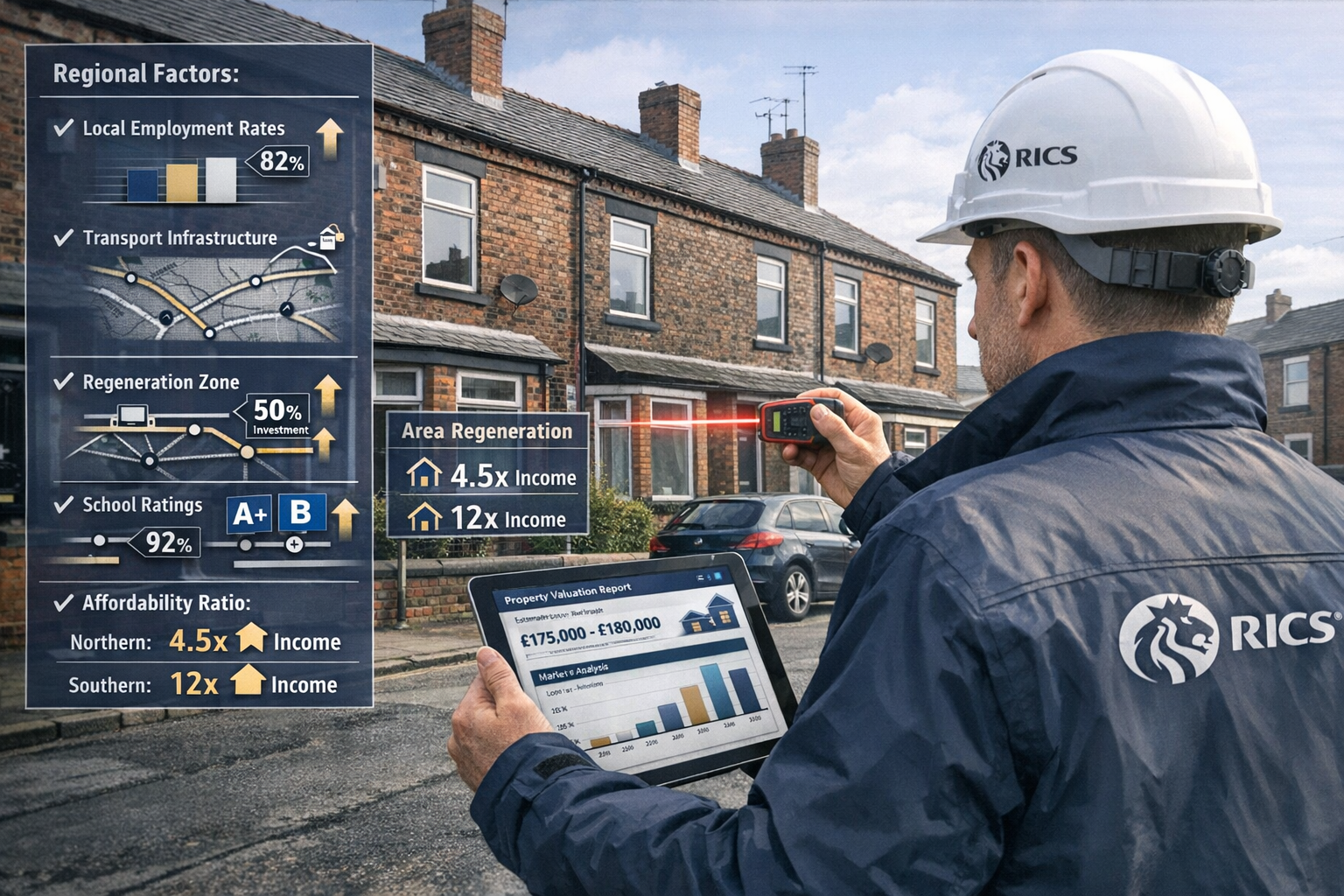
Successfully Valuing North vs South Properties in 2026: RICS-Approved Techniques for Widening Regional Price Gaps requires deep understanding of the macroeconomic and social factors driving regional divergence.
The Northern Renaissance: Growth Drivers
Northern property markets have experienced remarkable transformation, driven by several converging factors:
Infrastructure Investment 🚄
The continuation of Northern Powerhouse initiatives and transport infrastructure projects has created genuine economic growth. Cities like Leeds, Manchester, and Newcastle have seen £12-18 billion in combined public and private investment since 2020, fundamentally improving connectivity and commercial opportunities.
Affordability Advantages 💰
The average house price-to-income ratio in Northern regions stands at 4.5-6.0x compared to 10-14x in Southern regions. This affordability gap has triggered significant migration, particularly among first-time buyers and young families seeking homeownership.
Quality of Life Factors 🌳
Northern cities offer comparable or superior cultural amenities, green spaces, and community facilities at fraction of Southern costs. The "lifestyle value" adjustment has shifted dramatically in favor of Northern locations.
Commercial Hub Development 🏢
Major corporations have established significant operations in Northern cities, creating high-quality employment opportunities that previously required Southern relocation. This employment diversification strengthens local property demand.
Southern Market Challenges
While Southern markets, particularly London and the Southeast, maintain absolute price leadership, several factors constrain growth in 2026:
Affordability Crisis 📉
With average properties requiring 12-15 times average earnings, Southern markets face fundamental affordability barriers. Even high-earning professionals struggle to access homeownership, limiting buyer pools.
Stagnant Price Growth 📊
Many Southern regions have experienced flat or negative real growth (adjusted for inflation) over the past 24 months. The combination of high prices and economic uncertainty has created buyer hesitancy.
Quality of Life Trade-offs ⚖️
The premium paid for Southern locations increasingly fails to deliver proportional lifestyle benefits. Longer commutes, smaller properties, and reduced disposable income after housing costs diminish the Southern advantage.
Stamp Duty Impact 💷
Higher property prices mean substantially higher stamp duty costs, adding £15,000-£40,000 to typical Southern transactions compared to Northern equivalents. This transaction cost differential affects market velocity.
Practical Implications for Valuation Professionals
When conducting building surveys and valuations, these market dynamics require specific considerations:
For Northern Properties:
- Apply growth adjustment factors of 3-5% annually when projecting values
- Consider regeneration proximity premiums of 10-20%
- Account for improving infrastructure with 5-8% adjustments
- Factor in rental yield advantages for investment valuations
For Southern Properties:
- Apply conservative growth projections of 0-2% annually
- Consider affordability constraints that may limit buyer pools
- Account for climate risk factors particularly in coastal areas
- Recognize market maturity with limited expansion potential
Cross-Regional Valuation Challenges
Perhaps the most complex scenario involves valuing properties for clients relocating between regions. A professional earning £75,000 annually might afford a £450,000 property in Surrey but could purchase a £300,000 property in Leeds with superior specifications, larger size, and better location within the city.
Surveyors must help clients understand that absolute price comparisons are misleading. The relevant metrics include:
- Value per square foot adjusted for regional quality standards
- Mortgage payment as percentage of income
- Lifestyle value including commute times, local amenities, and space
- Investment potential based on regional growth trajectories
Professional advice often involves explaining that a £300,000 Northern property may represent superior value compared to a £450,000 Southern property, even though the Southern property commands a higher absolute price.
Professional Best Practices: RICS Compliance and Documentation
Maintaining RICS professional standards when Valuing North vs South Properties in 2026: RICS-Approved Techniques for Widening Regional Price Gaps requires meticulous documentation and transparent methodology.
Essential Documentation Requirements
Every valuation report must include:
1. Comparable Evidence Schedule 📋
Detailed table showing all comparable properties with:
- Full addresses and sale dates
- Property specifications (size, type, condition)
- Actual sale prices
- Individual adjustment factors with percentages
- Adjusted values for comparison
2. Regional Market Analysis 📈
Narrative section explaining:
- Current regional market conditions
- Recent price trends (12-24 months)
- Economic factors affecting local demand
- Infrastructure and regeneration projects
- Demographic trends and migration patterns
3. Adjustment Justification 📝
For each material adjustment (>5%), provide:
- Specific data source or market evidence
- Calculation methodology
- Rationale for adjustment percentage
- Supporting documentation or references
4. Valuation Reconciliation ⚖️
Final section that:
- Synthesizes all approaches used
- Explains weighting given to each method
- Justifies final valuation figure
- Addresses any limitations or assumptions
Common Pitfalls to Avoid
When conducting cross-regional valuations, surveyors must avoid these frequent errors:
❌ Over-reliance on automated valuation models (AVMs): These tools struggle with regional nuances and often produce unreliable cross-regional comparisons.
❌ Insufficient comparable properties: Using fewer than five comparables undermines valuation defensibility, particularly when regional adjustments are substantial.
❌ Ignoring regional income data: Affordability metrics are critical in 2026's divergent market. Valuations must reference local earnings and price-to-income ratios.
❌ Failing to account for infrastructure projects: Announced transport links, regeneration schemes, and commercial developments materially affect valuations but are often overlooked.
❌ Inadequate documentation: RICS professional standards require transparent methodology. Insufficient documentation exposes surveyors to professional liability.
Leveraging Technology While Maintaining Professional Judgment
Modern valuation tools can enhance efficiency when Valuing North vs South Properties in 2026: RICS-Approved Techniques for Widening Regional Price Gaps, but professional judgment remains paramount:
Geographic Information Systems (GIS) 🗺️
Advanced mapping tools help identify comparable properties, analyze neighborhood characteristics, and visualize regional market trends. However, surveyors must validate GIS outputs against on-ground inspection findings.
Market Data Platforms 💻
Subscription services provide comprehensive sales data, but regional data quality varies. Northern markets sometimes have less granular data than Southern equivalents, requiring additional research effort.
Valuation Software 🖥️
Specialized programs can automate adjustment calculations and generate reports, but surveyors must verify that regional factors are appropriately configured and not defaulting to national averages.
On-Site Inspection Remains Essential 👁️
No technology replaces physical property inspection. Regional building techniques, local materials, and area-specific defects require experienced surveyor assessment. Professional building surveys remain the foundation of accurate valuations.
Strategic Considerations for Different Stakeholder Groups
Different market participants require tailored approaches when understanding Valuing North vs South Properties in 2026: RICS-Approved Techniques for Widening Regional Price Gaps.
For Homebuyers and Investors
First-Time Buyers 🏠
Northern markets offer genuine homeownership opportunities at accessible price points. However, buyers should commission comprehensive homebuyers reports to ensure properties meet quality standards. The lower absolute prices shouldn't compromise due diligence.
Property Investors 💼
The superior rental yields in Northern markets create compelling investment cases. Professional valuations should emphasize income approach methodologies and analyze local rental demand dynamics. Investors should also consider average price reductions after surveys when negotiating purchases.
Relocating Professionals 🚚
Those moving between regions need valuations that explain relative value rather than absolute prices. Understanding that a £250,000 Northern property may offer superior lifestyle value compared to a £450,000 Southern property requires professional guidance.
For Lenders and Financial Institutions
Mortgage lenders face unique challenges when Valuing North vs South Properties in 2026: RICS-Approved Techniques for Widening Regional Price Gaps:
Risk Assessment Variations ⚠️
Northern properties with lower absolute values but stronger affordability metrics may present lower default risk than highly-leveraged Southern properties. Lending criteria should reflect regional income-to-price ratios rather than absolute values.
Valuation Accuracy Requirements 🎯
With widening regional gaps, lenders should require RICS-qualified surveyors with specific regional expertise. A surveyor experienced in London valuations may lack the market knowledge to accurately value Manchester properties and vice versa.
Portfolio Diversification 📊
Institutional investors should recognize that geographic diversification across North-South regions provides genuine risk mitigation, as regional markets increasingly demonstrate independent performance patterns.
For Property Developers
Development viability assessments must account for regional construction costs versus achievable sale prices:
Northern Development Opportunities 🏗️
With construction costs relatively consistent nationally but land costs dramatically lower, Northern developments can achieve superior profit margins (25-35%) compared to Southern projects (15-25%). However, absorption rates and sales velocity require careful analysis.
Southern Development Challenges 📉
High land costs and planning constraints in Southern regions create development barriers. Projects must target premium segments where buyers can absorb high prices, limiting development to luxury and niche markets.
Conclusion
Valuing North vs South Properties in 2026: RICS-Approved Techniques for Widening Regional Price Gaps represents one of the most significant challenges—and opportunities—for property professionals in the current market. The unprecedented divergence between regional markets demands sophisticated valuation methodologies that go beyond traditional comparable sales approaches.
RICS-approved techniques provide the professional framework, but successful application requires deep regional market knowledge, systematic adjustment methodologies, and meticulous documentation. The three core approaches—market, income, and cost—must be adapted with region-specific factors including affordability ratios, infrastructure investment, employment dynamics, and demographic trends.
Key Professional Actions for 2026
✅ Develop regional expertise: Invest in understanding specific Northern and Southern market dynamics rather than relying on national averages.
✅ Enhance documentation practices: With 150-200% price differentials requiring explanation, transparent methodology and comprehensive supporting evidence are essential.
✅ Leverage technology appropriately: Use modern tools for efficiency but maintain professional judgment and on-site inspection standards.
✅ Stay current with RICS standards: The January 2025 Red Book updates contain important guidance for regional valuation considerations.
✅ Consider multiple approaches: Don't rely solely on comparable sales—triangulate valuations using income and cost approaches where appropriate.
Next Steps for Property Professionals
For surveyors seeking to master these techniques, consider:
- Obtaining regional market reports from RICS member firms operating in target areas
- Participating in RICS continuing professional development focused on regional valuation methodologies
- Building networks with local surveyors in both Northern and Southern regions to exchange market intelligence
- Investing in market data subscriptions that provide granular regional sales information
- Commissioning professional surveys that demonstrate best-practice regional valuation techniques
The widening North-South property gap isn't a temporary anomaly—it represents a fundamental restructuring of the UK property market. Professionals who master Valuing North vs South Properties in 2026: RICS-Approved Techniques for Widening Regional Price Gaps will deliver superior client outcomes, maintain RICS professional standards, and position themselves as trusted advisors in an increasingly complex market landscape.
Whether conducting valuations for first-time buyers, institutional investors, or relocating professionals, the principles remain constant: systematic methodology, transparent documentation, regional expertise, and unwavering commitment to RICS professional standards. The property professionals who embrace these principles will thrive in 2026's transformed market.