
The buy-to-let sector is experiencing a remarkable renaissance in 2026, and institutional investors are leading the charge. As market conditions stabilize and professional landlords expand their portfolios, one critical factor separates successful acquisitions from costly mistakes: comprehensive building surveys. Building Surveys for Institutional Buy-to-Let Investors: Meeting Professional Landlord Demand in 2026's Market Recovery has become more than just due diligence—it's the cornerstone of strategic property investment that protects capital and maximizes long-term returns. 🏢
Professional landlords understand that thorough property inspections aren't expenses; they're investments in risk mitigation. Unlike individual buyers who might skip detailed assessments, institutional investors demand rigorous building evaluations that uncover hidden defects, quantify repair costs, and inform negotiation strategies. This sophisticated approach to property acquisition reflects the maturation of the buy-to-let market and the growing professionalism within the sector.

Key Takeaways
- Institutional investors prioritize comprehensive building surveys to protect capital and ensure long-term portfolio performance in the recovering 2026 market
- Professional landlords demand detailed defect analysis including structural assessments, building systems evaluation, and accurate cost projections for remedial works
- Advanced survey technologies such as thermal imaging, drone inspections, and digital reporting platforms enhance accuracy and decision-making speed
- Building surveys directly impact acquisition pricing by identifying negotiation opportunities and preventing costly post-purchase surprises
- Regulatory compliance verification through thorough surveys helps institutional investors avoid legal liabilities and maintain professional standards
Why Institutional Investors Demand Rigorous Building Surveys in 2026's Market Recovery
The buy-to-let landscape in 2026 looks dramatically different from previous years. After navigating regulatory changes, tax adjustments, and market fluctuations, institutional investors have emerged as dominant players with sophisticated acquisition strategies. These professional landlords recognize that Building Surveys for Institutional Buy-to-Let Investors: Meeting Professional Landlord Demand in 2026's Market Recovery represents essential risk management in an increasingly competitive market.
The Professional Landlord Advantage
Institutional investors approach property acquisition with business-minded precision. Unlike individual landlords who might rely on basic valuations, professional portfolios demand comprehensive assessments that examine every aspect of building condition. This thoroughness stems from several key factors:
Portfolio Performance Protection 📊
Large-scale landlords manage dozens or hundreds of properties simultaneously. A single acquisition with hidden structural defects can significantly impact overall portfolio returns. Detailed building surveys identify potential issues before they become expensive problems, protecting the entire investment strategy.
Capital Allocation Efficiency
Professional investors allocate capital across multiple opportunities. Accurate building condition data enables precise budgeting for refurbishment works, maintenance reserves, and lifecycle planning. This financial clarity supports better investment decisions and optimal resource deployment.
Tenant Retention and Satisfaction
Institutional landlords recognize that property condition directly affects tenant satisfaction and retention rates. Comprehensive surveys identify maintenance needs that, when addressed proactively, create superior rental experiences and reduce vacancy periods.
Regulatory Compliance Assurance
The regulatory environment for rental properties continues to evolve. Building surveys verify compliance with safety standards, energy efficiency requirements, and habitability regulations—protecting investors from legal liabilities and enforcement actions.
Market Recovery Dynamics
The 2026 market recovery has created unique opportunities for institutional investors. Property values have stabilized, lending conditions have improved, and rental demand remains robust. However, this recovery also means increased competition for quality assets. Professional landlords use comprehensive building surveys to gain competitive advantages by:
- Identifying undervalued properties with cosmetic issues but sound structures
- Moving quickly on acquisitions with confidence in condition assessments
- Negotiating effectively using detailed defect analysis and cost projections
- Planning strategic improvements that maximize rental yields and capital appreciation
Core Components of Building Surveys for Institutional Buy-to-Let Investors
Professional landlords require survey reports that go far beyond basic property inspections. Building Surveys for Institutional Buy-to-Let Investors: Meeting Professional Landlord Demand in 2026's Market Recovery involves comprehensive assessments across multiple critical areas that inform investment decisions and operational planning.
Structural Integrity Assessment
The foundation of any building survey focuses on structural soundness. For institutional investors managing long-term portfolios, structural integrity directly impacts:
Foundation and Subsidence Analysis 🏗️
Surveyors examine foundation conditions, looking for settlement patterns, cracking, or movement indicators. This assessment is particularly crucial for older properties or buildings in areas with clay soils prone to subsidence. Detailed analysis includes:
- Visual inspection of external walls for cracking patterns
- Internal wall and ceiling crack assessment
- Floor level measurements to detect settlement
- Drainage system evaluation affecting foundation stability
Load-Bearing Elements Evaluation
Professional surveys scrutinize walls, beams, columns, and other structural components that support the building. This examination identifies alterations that may have compromised structural integrity, unauthorized modifications, or deterioration requiring remediation.
Roof Structure and Condition
Roof failures represent significant expenses for landlords. Comprehensive surveys assess roof structure, covering materials, flashing, guttering, and drainage systems. For multi-unit buildings, this analysis extends to shared roof spaces and access requirements.
Building Systems and Services
Modern rental properties require functioning mechanical, electrical, and plumbing systems. Institutional investors need detailed assessments of:
| System Category | Assessment Focus | Investment Impact |
|---|---|---|
| Electrical | Wiring condition, consumer unit compliance, capacity for modern loads | Safety compliance, upgrade costs |
| Heating | Boiler efficiency, radiator condition, controls, energy performance | Operating costs, tenant satisfaction |
| Plumbing | Pipe materials, water pressure, drainage, leak evidence | Maintenance reserves, insurance risk |
| Ventilation | Airflow adequacy, extraction systems, condensation control | Damp prevention, health compliance |
Understanding the difference between survey levels helps investors select appropriate assessment depth for different property types within their portfolios.
Defect Identification and Categorization
Professional building surveys categorize defects by severity and urgency, enabling prioritized remediation planning:
Category 1 – Urgent Defects ⚠️
Issues requiring immediate attention to prevent safety hazards or rapid deterioration. Examples include structural movement, roof leaks causing water ingress, or electrical safety violations.
Category 2 – Significant Defects
Problems requiring attention in the near term but not immediately dangerous. These might include aging heating systems, deteriorating windows, or drainage improvements.
Category 3 – Minor Defects
Cosmetic or minor maintenance issues that don't affect safety or habitability but should be addressed during routine maintenance cycles.
This categorization system allows institutional investors to budget accurately and plan remediation work strategically across their portfolios.
Damp and Moisture Analysis
Moisture-related issues plague rental properties and create significant landlord liabilities. Comprehensive surveys include specialized damp assessments using:
- Moisture meters for quantitative readings in walls and floors
- Thermal imaging cameras to identify cold spots and insulation failures
- Visual inspection for condensation patterns, mold growth, and ventilation adequacy
- Drainage evaluation to identify external water ingress sources
Professional landlords recognize that addressing damp issues protects property values, maintains tenant health, and prevents costly structural deterioration.
Energy Efficiency and Sustainability Assessment
With increasing focus on environmental performance and minimum energy efficiency standards (MEES) for rental properties, building surveys now incorporate:
EPC Rating Analysis
Surveyors evaluate factors affecting Energy Performance Certificate ratings and identify cost-effective improvements that enhance energy efficiency while meeting regulatory requirements.
Insulation Evaluation
Assessment of loft insulation, cavity wall insulation, and glazing performance helps investors understand thermal efficiency and plan upgrades that reduce operating costs and improve tenant comfort.
Renewable Energy Potential
Forward-thinking institutional investors request analysis of solar panel viability, heat pump suitability, and other renewable technologies that future-proof properties against evolving regulations.
Advanced Survey Technologies Meeting Institutional Investor Expectations
The surveying profession has embraced technological innovation, and institutional investors benefit from enhanced accuracy, efficiency, and reporting quality. Modern Building Surveys for Institutional Buy-to-Let Investors: Meeting Professional Landlord Demand in 2026's Market Recovery leverage cutting-edge tools that deliver superior insights.
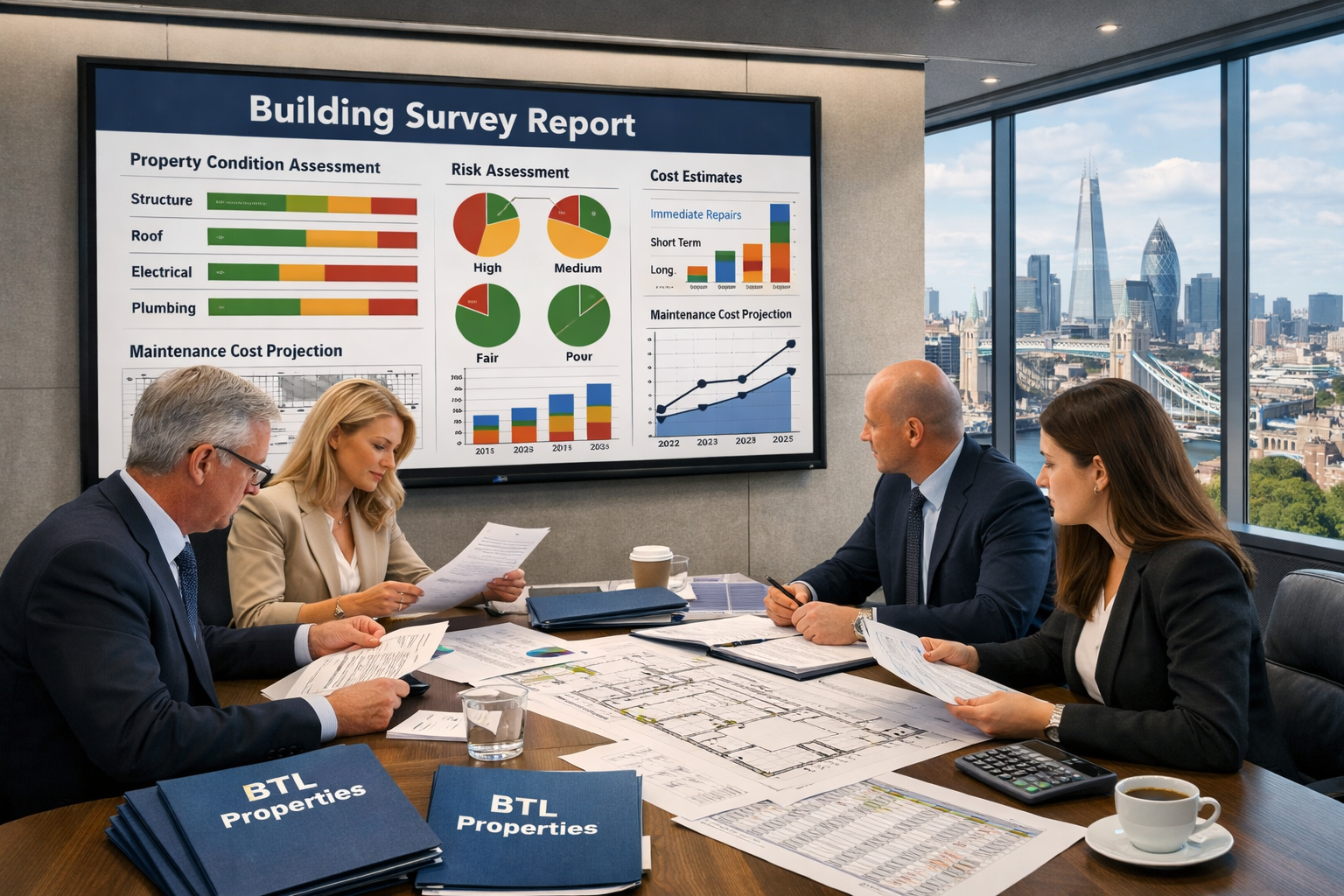
Thermal Imaging and Diagnostic Equipment
Infrared Thermography 🌡️
Thermal imaging cameras detect temperature variations invisible to the naked eye, revealing:
- Hidden moisture ingress behind walls and ceilings
- Insulation gaps and thermal bridging
- Air leakage points affecting energy efficiency
- Underfloor heating system failures
- Electrical hotspots indicating potential fire hazards
This non-invasive technology provides institutional investors with data-driven insights that traditional visual inspections miss, enabling more accurate condition assessments and cost projections.
Drone-Based Inspections
Unmanned aerial vehicles (UAVs) revolutionize roof and high-level inspections by:
- Accessing difficult areas without expensive scaffolding or access equipment
- Capturing high-resolution imagery of roof conditions, chimneys, and upper-floor elevations
- Documenting evidence with date-stamped photographic records
- Improving safety by reducing surveyor exposure to dangerous heights
For institutional investors acquiring multi-story buildings or properties with complex roof structures, drone inspections deliver comprehensive assessments efficiently and cost-effectively.
Digital Reporting Platforms
Professional landlords managing large portfolios require survey reports that integrate seamlessly with property management systems. Modern digital reporting offers:
Interactive Dashboard Interfaces
Cloud-based platforms present survey findings through intuitive dashboards with:
- Color-coded defect severity indicators
- Clickable hotspots linking to detailed descriptions and photographs
- Cost estimation tools for remediation planning
- Comparison features for portfolio-wide analysis
Mobile Accessibility
Institutional investors and their teams access survey reports on tablets and smartphones, enabling on-site decision-making during property viewings and acquisition negotiations.
Integration Capabilities
Advanced reporting systems export data to property management software, financial planning tools, and asset management platforms—streamlining workflows and improving operational efficiency.
3D Modeling and Virtual Documentation
Cutting-edge surveys incorporate three-dimensional property modeling that provides:
- Accurate spatial measurements for renovation planning
- Virtual walkthrough capabilities for remote stakeholder review
- As-built documentation for future reference and comparison
- Enhanced communication between investors, contractors, and property managers
These technologies align with institutional investors' expectations for professional-grade documentation and data-driven decision-making.
Strategic Value: How Building Surveys Drive Investment Returns
Professional landlords view comprehensive building surveys as strategic tools that directly impact portfolio performance. The investment in thorough property assessments generates returns through multiple channels that justify the upfront costs many times over.
Acquisition Price Negotiation
Detailed defect analysis and accurate cost projections empower institutional investors during purchase negotiations. When surveys identify significant issues, professional buyers leverage this information to:
Reduce Purchase Prices 💰
Evidence-based negotiation using survey findings typically recovers the survey cost multiple times over. For example, identifying a £15,000 roof replacement need might justify a £20,000 price reduction, delivering immediate return on the survey investment.
Request Seller Remediation
Alternatively, investors may negotiate for sellers to complete repairs before completion, ensuring properties meet investment standards without post-purchase complications.
Adjust Deal Structures
Survey findings inform decisions about completion dates, retention amounts, or warranty requirements that protect investor interests.
Understanding how surveys support price negotiation provides institutional investors with competitive advantages in acquisition processes.
Accurate Budgeting and Financial Planning
Professional landlords require precise financial forecasting for portfolio management. Building surveys deliver:
Refurbishment Cost Projections
Detailed condition assessments enable accurate budgeting for necessary improvements before properties enter rental markets. This precision prevents budget overruns and ensures adequate capital allocation.
Maintenance Reserve Planning
Survey findings inform long-term maintenance reserve calculations, ensuring sufficient funds for anticipated repairs and replacements over holding periods.
Cash Flow Modeling
Understanding property condition allows realistic rental income projections that account for necessary void periods during remediation works.
Risk Mitigation and Insurance Optimization
Comprehensive surveys identify risks that affect insurance coverage and premiums:
Subsidence and Structural Movement
Early identification of foundation issues enables proactive remediation before insurance claims become necessary, maintaining favorable premium rates.
Fire Safety Compliance
Surveys verify fire detection systems, escape routes, and compartmentalization—critical for multi-unit buildings and Houses in Multiple Occupation (HMOs).
Liability Prevention
Identifying hazards before tenant occupation prevents personal injury claims and regulatory enforcement actions that damage professional landlord reputations.
Portfolio Performance Optimization
Institutional investors use survey data to optimize portfolio composition and performance:
Asset Grading and Categorization 📈
Survey findings enable classification of properties by condition, maintenance requirements, and investment potential—supporting strategic decisions about retention, improvement, or disposal.
Prioritized Capital Deployment
Portfolio-wide survey data reveals which properties offer the best return on improvement investments, guiding capital allocation decisions across multiple assets.
Benchmarking and Standardization
Consistent survey methodologies enable performance comparisons across properties, identifying underperforming assets and best practices for replication.
Selecting Survey Providers for Institutional Requirements
Professional landlords require survey partners who understand institutional investor needs and deliver consistent, high-quality assessments. Selecting appropriate providers involves evaluating several critical factors.
RICS Accreditation and Professional Standards
Royal Institution of Chartered Surveyors (RICS) membership ensures surveyors adhere to professional standards, ethical guidelines, and continuing education requirements. Institutional investors should verify:
- Current RICS membership status
- Professional indemnity insurance coverage
- Specialization in residential investment properties
- Track record with buy-to-let portfolios
Working with RICS-qualified surveyors provides assurance of competence and accountability essential for professional landlord requirements.
Experience with Investment Properties
Buy-to-let surveys require different perspectives than owner-occupier assessments. Experienced investment property surveyors understand:
Rental Market Implications
How property conditions affect rental values, tenant appeal, and letting timescales in specific markets.
Landlord Regulatory Requirements
Current compliance obligations for rental properties, including safety certificates, energy performance standards, and licensing requirements.
Portfolio Management Context
How individual property assessments fit within broader portfolio strategies and operational frameworks.
Reporting Quality and Customization
Institutional investors benefit from survey reports tailored to their specific requirements:
Standardized Formats
Consistent reporting structures across portfolio acquisitions enable efficient review and comparison.
Executive Summaries
Concise overviews highlighting critical findings for senior decision-makers who may not read full technical reports.
Cost Estimation Accuracy
Realistic remediation cost projections based on current market rates and contractor availability.
Photographic Evidence
Comprehensive visual documentation supporting findings and enabling remote stakeholder review.
Turnaround Times and Responsiveness
Competitive acquisition markets require rapid survey completion without compromising quality. Professional survey providers offer:
- Flexible scheduling to accommodate tight transaction timescales
- Expedited reporting when acquisition deadlines demand quick decisions
- Post-report consultation to discuss findings and answer investor questions
- Additional investigation coordination when specialized assessments (structural engineering, damp specialists) become necessary

Integrating Building Surveys into Acquisition Due Diligence Processes
Sophisticated institutional investors embed comprehensive building surveys within structured due diligence frameworks that evaluate all aspects of potential acquisitions.
Pre-Offer Preliminary Assessments
Before making formal offers, professional landlords often conduct preliminary evaluations:
Desktop Analysis 💻
Review of available property information including:
- Historical planning applications and building control approvals
- Previous survey reports if available from sellers
- Aerial imagery and street view analysis
- Local authority records regarding enforcement notices or Article 4 directions
Initial Viewings
Experienced property professionals conduct preliminary viewings to identify obvious red flags that might preclude detailed survey investment.
Post-Offer Comprehensive Surveys
Following accepted offers, institutional investors commission full building surveys as conditions of purchase, typically including:
Level 3 Building Survey (Full Structural Survey)
The most comprehensive assessment appropriate for older properties, unusual constructions, or buildings requiring significant refurbishment. These detailed inspections examine all accessible areas and provide extensive defect analysis.
For newer construction, investors might select building surveys for new builds that focus on construction quality and snagging issues.
Specialist Investigations
Based on initial survey findings, additional investigations might include:
- Structural engineer assessments for significant movement or alterations
- Electrical condition reports (EICR) for safety compliance
- Gas safety certificates for heating systems
- Asbestos surveys for properties built before 2000
- Japanese knotweed surveys for properties with vegetation concerns
Understanding when specific defect surveys become necessary helps institutional investors plan comprehensive due diligence programs.
Survey Findings Integration
Professional landlords integrate survey results into broader acquisition analysis:
Financial Modeling Updates
Survey-identified costs update acquisition financial models, ensuring investment returns meet portfolio requirements even after accounting for necessary remediation works.
Risk Assessment Matrices
Defect findings populate risk registers that quantify and prioritize potential issues affecting investment performance.
Negotiation Strategy Development
Survey evidence informs renegotiation approaches or decisions to withdraw from acquisitions that don't meet investment criteria.
Post-Acquisition Implementation
Following successful acquisitions, institutional investors use survey findings to guide property preparation:
Remediation Work Prioritization
Category 1 urgent defects receive immediate attention, while lower-priority issues integrate into planned maintenance schedules.
Contractor Procurement
Detailed survey specifications support competitive tendering for remediation works, ensuring cost-effective solutions.
Compliance Documentation
Survey reports and remediation records create audit trails demonstrating professional landlord due diligence and regulatory compliance.
Future Trends: Building Surveys for Institutional Buy-to-Let Investors Beyond 2026
The surveying profession continues evolving to meet institutional investor demands. Several emerging trends will shape Building Surveys for Institutional Buy-to-Let Investors: Meeting Professional Landlord Demand in 2026's Market Recovery in coming years.
Artificial Intelligence and Predictive Analytics
Machine learning algorithms increasingly analyze survey data to:
- Predict future maintenance requirements based on building age, materials, and condition patterns
- Estimate lifecycle costs for major building components
- Benchmark properties against comparable assets in similar markets
- Identify investment opportunities where minor improvements deliver disproportionate value increases
Sustainability and Net Zero Focus
Environmental performance becomes increasingly central to building surveys as:
- Regulatory requirements tighten around energy efficiency and carbon emissions
- Tenant preferences shift toward sustainable, low-operating-cost properties
- Investment values reflect environmental performance and future-proofing
- Green finance opportunities reward properties meeting sustainability criteria
Integrated Property Technology Platforms
Survey data increasingly feeds into comprehensive property technology ecosystems that combine:
- Building information modeling (BIM) for digital property twins
- Internet of Things (IoT) sensors for continuous condition monitoring
- Predictive maintenance systems that anticipate failures before they occur
- Portfolio management dashboards presenting real-time asset performance data
Regulatory Evolution and Compliance Automation
As rental property regulations continue developing, building surveys will incorporate:
- Automated compliance checking against current regulatory requirements
- Forward-looking assessments of properties against anticipated future standards
- Digital certification streamlining safety certificate management
- Regulatory risk scoring quantifying compliance exposure across portfolios
Conclusion: Building Surveys as Strategic Investment Tools
Building Surveys for Institutional Buy-to-Let Investors: Meeting Professional Landlord Demand in 2026's Market Recovery represents far more than routine property inspections. For professional landlords navigating the recovering market, comprehensive building assessments serve as strategic tools that protect capital, inform decision-making, and optimize portfolio performance.
The institutional investors succeeding in 2026's competitive buy-to-let landscape recognize that thorough due diligence separates profitable acquisitions from costly mistakes. By demanding rigorous building surveys that leverage advanced technologies, provide detailed defect analysis, and deliver actionable intelligence, professional landlords gain competitive advantages that justify survey investments many times over.
Actionable Next Steps for Institutional Investors
1. Establish Survey Standards 📋
Develop portfolio-wide survey requirements that ensure consistent assessment quality across all acquisitions, regardless of property type or location.
2. Build Surveyor Relationships
Cultivate partnerships with experienced RICS surveyors who understand institutional investor requirements and deliver reliable, timely assessments.
3. Integrate Survey Data
Implement systems that capture survey findings in property management platforms, enabling portfolio-wide analysis and strategic planning.
4. Plan Proactive Assessments
Beyond acquisition surveys, schedule periodic condition assessments for existing portfolio properties to identify maintenance needs before they become emergencies.
5. Leverage Survey Intelligence
Use survey findings not just for individual property decisions but for strategic portfolio optimization, capital allocation, and performance benchmarking.
The professional landlords thriving in 2026's market recovery understand that comprehensive building surveys aren't costs—they're investments in knowledge that drive superior returns, mitigate risks, and build sustainable, high-performing property portfolios. As the buy-to-let sector continues maturing, the gap between sophisticated institutional investors who prioritize thorough assessments and casual landlords who skip due diligence will only widen.
Choosing the right property assessment approach positions institutional investors for long-term success in an increasingly professional and competitive market.