
{"cover":"Professional landscape format (1536x1024) hero image featuring bold text overlay 'Party Wall Act Compliance in Northern England's 2026 Housing Boom' in extra large 72pt white sans-serif font with dark shadow and semi-transparent navy overlay box, positioned in upper third. Background shows aerial view of Northern England terraced housing with active construction sites, scaffolding on Victorian terraces, surveyor with clipboard examining shared wall between properties, Manchester or Leeds cityscape in distance. Color scheme: deep navy blue, white text, orange construction accents, professional editorial quality with high contrast, magazine cover aesthetic showing urban development density.","content":["Landscape format (1536x1024) detailed illustration showing party wall notice documentation process with three-panel infographic layout: left panel displays formal Party Wall Notice template with highlighted two-month timeline calendar, center panel shows surveyor conducting wall inspection with measuring tools and camera documenting shared boundary, right panel features award document with official stamps and signatures. Include Northern England terraced houses in background, clipboard with checklist, professional color scheme of navy, grey, and orange accents, clean editorial style with annotations and arrows showing workflow progression.","Landscape format (1536x1024) professional scene of party wall surveyor conducting Schedule of Condition assessment in Northern England terrace property, showing surveyor using laser measuring device and tablet to document existing wall conditions, close-up of brick party wall with visible mortar joints and structural details, photographic evidence being captured with professional camera on tripod, detailed notes and sketches on clipboard, Victorian-era architectural features visible, natural lighting through window, technical equipment including moisture meter and crack monitoring gauges, realistic documentary photography style with sharp focus on surveyor protocols.","Landscape format (1536x1024) comparative split-screen visualization of compliant versus non-compliant party wall projects in Northern England 2026 housing boom: left side shows smooth construction timeline with green checkmarks, proper notices served, agreed party wall award, happy neighbors shaking hands, completed extension on schedule; right side displays red warning symbols, delayed project with stop-work notice, dispute resolution meeting, frustrated property owners, legal documentation piling up, calendar showing months of delays. Include Northern cityscape background, construction site elements, professional infographic style with clear visual contrast between successful and problematic scenarios."]}
Northern England's property market is experiencing unprecedented growth in 2026, with homeowners across Manchester, Leeds, Liverpool, and Newcastle investing heavily in extensions, loft conversions, and basement excavations. This surge in residential development has created high-activity zones where Party Wall Act compliance has become critical for avoiding costly delays and neighbourly disputes. As renovation projects multiply across terraced streets and semi-detached properties, understanding Party Wall Act Compliance in Northern England's 2026 Housing Boom: Surveyor Protocols for High-Activity Zones has never been more essential for property owners, developers, and construction professionals navigating this recovering market.

The government's "build, build, build" strategy has intensified development density across urban centres, with forecasts predicting significant increases in party wall disputes throughout 2026[3]. For Northern England's characteristic Victorian and Edwardian terraces—where shared walls are the norm rather than the exception—proper surveyor protocols and meticulous compliance procedures have become the difference between smooth project completion and expensive legal entanglements.
Key Takeaways
- Two-month advance notice is mandatory for most party wall works in England, with one-month notice for excavation projects, requiring careful planning in high-activity development zones[1]
- Party wall disputes are expected to surge in 2026 alongside the housing boom, making professional surveyor involvement essential for protecting project timelines[3]
- Precise notice specifications are legally required—vague descriptions can invalidate notices and halt construction work entirely[2]
- Schedule of Condition surveys conducted before work begins provide critical protection for both building owners and adjoining owners
- Professional party wall surveyors navigate complex protocols, serve as impartial arbiters, and ensure compliance with the Party Wall Act 1996 framework
Understanding Party Wall Act Compliance in Northern England's 2026 Housing Boom
The Party Wall etc. Act 1996 applies exclusively to England and Wales, establishing the legal foundation for all development work affecting shared boundaries[1]. In Northern England's densely packed urban areas, this legislation governs millions of potential building scenarios where properties share structural walls or where excavation occurs near neighbouring foundations.
What Triggers Party Wall Act Requirements? 🏗️
The Act covers three main categories of work:
- Building on or at the boundary line between properties
- Work to an existing party wall or party structure (walls, floors, or other structures separating buildings)
- Excavation within three or six metres of a neighbouring building's foundation (depending on depth)
For Northern England's terraced housing stock, even modest home improvements frequently trigger these requirements. A single-storey kitchen extension, loft conversion with steel beam installation, or basement excavation for additional living space all typically require party wall procedures to be followed.
The 2026 Housing Boom Context
Northern England has emerged as a property hotspot in 2026, with cities like Manchester, Leeds, and Liverpool experiencing substantial house price growth and renovation activity. This boom creates "high-activity zones" where multiple neighbouring properties may simultaneously undertake building works—a scenario that demands heightened attention to party wall protocols.
The concentration of development activity means:
- Multiple concurrent projects on the same street requiring coordinated surveyor appointments
- Increased scrutiny from adjoining owners who may themselves be planning works
- Greater potential for disputes when neighbours feel overwhelmed by construction activity
- Higher stakes for compliance, as delays can cascade through interconnected project timelines
Commercial real estate experts predict party wall disputes will increase significantly in 2026, alongside rights of light and nuisance claims, as development density intensifies[3]. For homeowners and developers in Northern England's recovering markets, understanding when and how to comply with the Act has become a critical success factor.
Surveyor Protocols for Notice Periods and Documentation
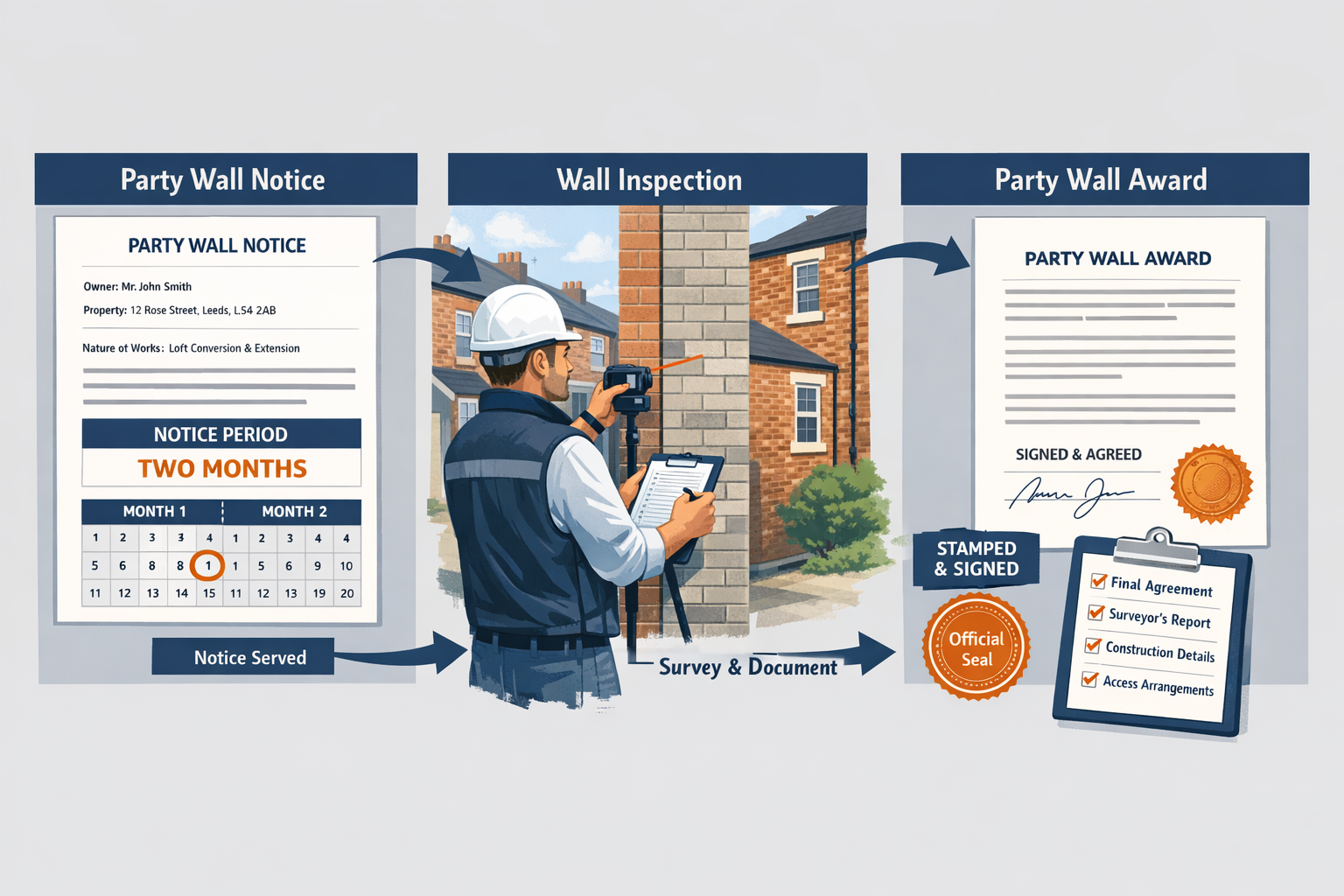
Proper notice procedures form the cornerstone of Party Wall Act compliance. The legislation mandates specific timeframes and documentation standards that surveyors must navigate with precision.
Mandatory Notice Periods ⏰
The Party Wall Act establishes clear notice requirements:
- Two months' notice for building works affecting party walls or constructing new walls at boundaries[1]
- One month's notice for excavation work near neighbouring properties[1]
These timelines are non-negotiable. In Northern England's 2026 housing boom, where construction schedules are tight and contractor availability is limited, failing to serve notices on time can derail entire projects. Professional surveyors emphasize starting the notice process as early as possible during the planning phase.
Precision in Notice Specifications
Party wall notices must contain specific, accurate descriptions of the proposed work. Generic or vague language renders notices invalid and provides grounds for adjoining owners to object[2].
Acceptable notice language includes:
- "Cut into the party wall to accommodate steel beams at ground floor level"
- "Remove existing chimney breast from party wall at first-floor level"
- "Excavate to 2.5 metres depth within 3 metres of neighbouring foundation for basement construction"
Unacceptable vague descriptions:
- "General building work"
- "Home improvements"
- "Structural alterations"
Experienced party wall surveyors ensure notices include:
✅ Detailed work descriptions with specific structural elements
✅ Accurate property identification with correct addresses and owner names
✅ Proposed start dates allowing for statutory notice periods
✅ Technical drawings showing the extent of works affecting shared structures
✅ Contact information for the building owner and appointed surveyor
Inaccurate naming or incomplete descriptions can invalidate the entire notice, requiring the process to restart and adding months to project timelines—a particularly costly error in high-activity zones where construction windows are competitive.
The Three Possible Responses
Once a party wall notice is served, the adjoining owner has three options:
- Consent in writing within 14 days, allowing work to proceed without a formal award
- Dissent or fail to respond within 14 days, triggering the dispute resolution process
- Request modifications to the proposed works through negotiation
In Northern England's 2026 market, surveyors report that adjoining owners are increasingly cautious, with dissent rates rising as property values climb and homeowners become more protective of their investments. This trend makes professional surveyor involvement more valuable than ever.
Appointing Party Wall Surveyors
When disputes arise or adjoining owners dissent, the Act provides a structured appointment process:
- Agreed Surveyor: Both parties jointly appoint a single impartial surveyor
- Two Surveyors: Each party appoints their own surveyor, who then select a third surveyor to resolve disagreements
- Building Owner's Surveyor acts for both: If the adjoining owner doesn't appoint within 10 days, the building owner's surveyor can act for both parties
Professional surveyors in high-activity zones often recommend the agreed surveyor approach for straightforward projects, as it reduces costs and accelerates the award process. However, for complex works or where significant concerns exist, separate surveyors provide additional protection for both parties.
Schedule of Condition Surveys and Award Protocols
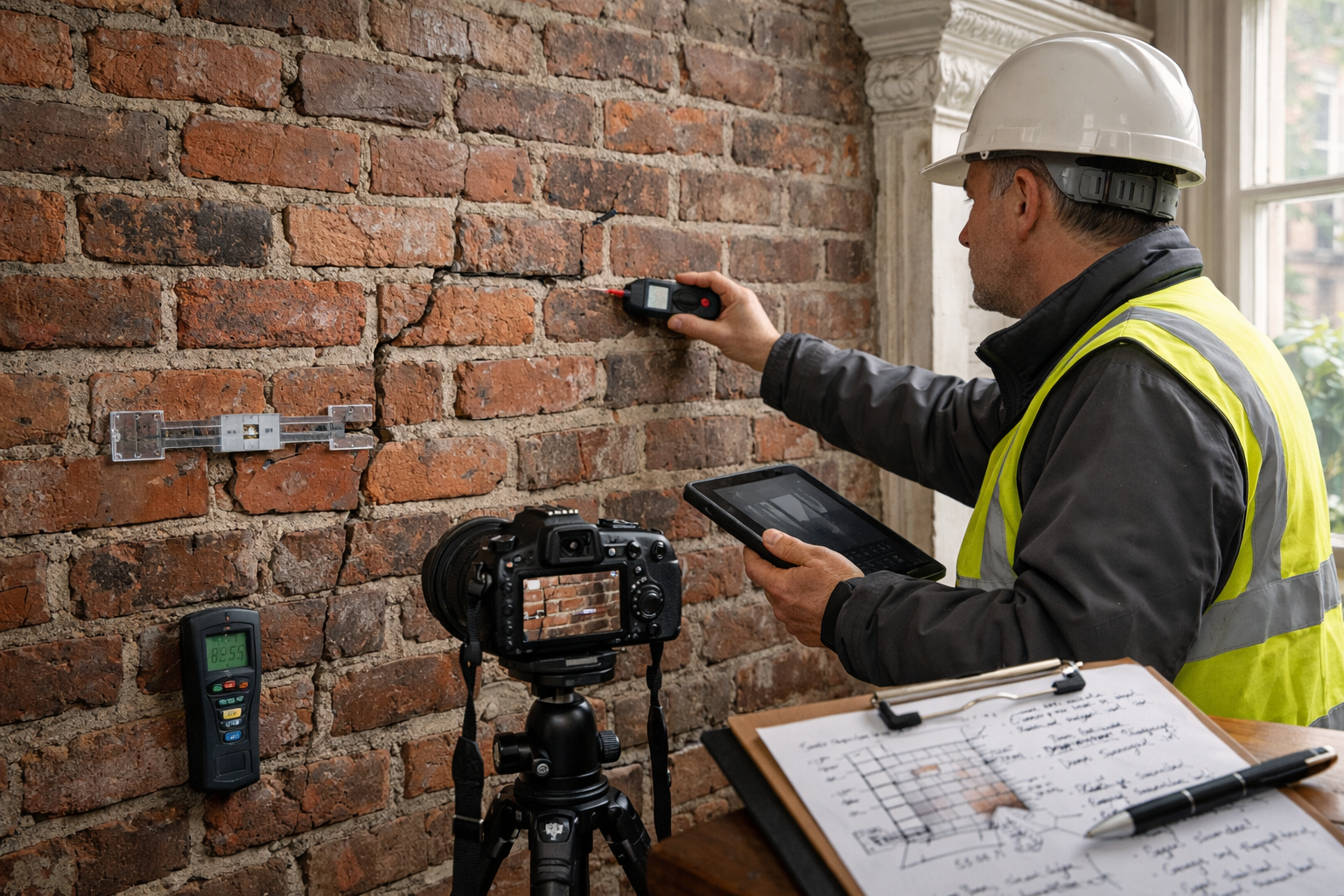
The Schedule of Condition survey represents one of the most critical surveyor protocols in Party Wall Act compliance, particularly in Northern England's older housing stock where pre-existing defects are common.
Purpose and Importance of Schedule of Condition
A Schedule of Condition is a detailed photographic and written record of the adjoining owner's property before building work commences. This documentation serves multiple essential functions:
🔍 Establishes baseline condition of walls, ceilings, floors, and external structures
📸 Provides photographic evidence of existing cracks, settlement, or defects
🛡️ Protects building owners from false claims about damage they didn't cause
⚖️ Protects adjoining owners by documenting their property's pre-work state
📋 Facilitates dispute resolution if damage claims arise during or after construction
In Northern England's Victorian and Edwardian terraces, properties often exhibit historic settlement cracks, minor structural movement, and cosmetic defects accumulated over decades. Without a comprehensive Schedule of Condition, distinguishing between pre-existing issues and construction-related damage becomes nearly impossible.
Surveyor Protocols for Conducting Schedules
Professional party wall surveyors follow rigorous protocols when preparing Schedules of Condition:
Pre-survey preparation:
- Coordinate access with adjoining owners at convenient times
- Bring professional photography equipment with timestamp capabilities
- Prepare standardized recording templates for consistency
- Review building plans to identify areas most likely to be affected
During the survey:
- Systematically photograph all rooms adjacent to or above the party wall
- Document ceiling conditions, particularly where beam work is proposed
- Record external elevations and boundary features
- Measure and note existing cracks with width measurements
- Identify and photograph pre-existing defects, staining, or structural issues
- Create detailed written descriptions accompanying each photograph
Post-survey documentation:
- Compile photographs into organized, dated reports
- Prepare written descriptions of property condition
- Include measurements, observations, and professional assessments
- Provide copies to both building owner and adjoining owner
- Retain records for potential future reference (typically 5-10 years)
The Party Wall Award
The Party Wall Award is the formal legal document that authorizes work to proceed under the Act. Surveyors prepare awards that include:
- Description of works permitted under the agreement
- Time and manner of executing the works
- Schedule of Condition incorporated by reference
- Rights of access for the building owner's contractors
- Working hours and noise restrictions
- Security for expenses (if applicable)
- Dispute resolution procedures for any issues arising during construction
In high-activity zones across Northern England, awards increasingly include specific provisions addressing:
- Cumulative impact when multiple neighbouring properties are under construction
- Extended working hours considerations in dense residential areas
- Parking and access restrictions in narrow terraced streets
- Vibration monitoring protocols for sensitive structures
- Regular progress updates to adjoining owners
Professional surveyors emphasize that awards must be reasonable and proportionate. While protecting adjoining owners' interests, awards cannot impose unreasonable restrictions that make building work impractical or economically unviable.
Cost Allocation and Fees
The Party Wall Act includes provisions for cost allocation:
- Building owner pays for their own surveyor and typically the adjoining owner's surveyor fees
- Reasonable fees are standard, with surveyors charging based on project complexity
- Disputes over fees are resolved by the third surveyor if appointed
In Northern England's 2026 market, typical party wall surveyor fees range from £700-£1,500 for straightforward residential projects, with more complex works commanding higher fees. Building owners should budget for these costs alongside construction expenses, as they're typically non-negotiable when the Act applies.
Avoiding Delays in Northern England's Recovering Markets
The 2026 housing boom has made project timelines more critical than ever. Delays not only increase costs but can result in losing contractor availability, missing seasonal weather windows, and experiencing market shifts that affect property values.
Common Compliance Pitfalls
❌ Late notice serving: Failing to account for two-month notice periods when scheduling contractors
❌ Incomplete documentation: Vague work descriptions that invalidate notices and require resubmission
❌ Ignoring the Act: Proceeding without notices, leading to injunctions and forced work stoppages
❌ Inadequate Schedule of Condition: Superficial surveys that fail to protect either party adequately
❌ Poor communication: Failing to keep adjoining owners informed, breeding distrust and disputes
❌ Unlicensed surveyors: Appointing unqualified individuals who produce non-compliant awards
Best Practices for High-Activity Zones
Professional party wall surveyors recommend these protocols for Northern England's busy development areas:
1. Early Engagement 🗓️
Begin the party wall process during the planning application stage, not after approval. This allows the statutory notice periods to run concurrently with other pre-construction activities.
2. Professional Surveyor Appointment 👷
Engage RICS-qualified party wall surveyors with specific experience in Northern England's housing stock. Local knowledge of Victorian construction methods and common issues proves invaluable.
3. Proactive Communication 💬
Building owners should personally notify neighbours of upcoming works before formal notices are served. This courtesy often prevents dissent and facilitates smoother processes.
4. Comprehensive Documentation 📄
Invest in thorough Schedules of Condition with professional photography and detailed written descriptions. The upfront cost is minimal compared to potential dispute resolution expenses.
5. Realistic Scheduling ⏱️
Build party wall notice periods into project timelines from the outset. Assume dissent may occur and plan accordingly, rather than hoping for immediate consent.
6. Contractor Briefing 🔨
Ensure contractors understand party wall award conditions, including working hours, access requirements, and damage prevention protocols. Non-compliance by contractors remains the building owner's responsibility.
7. Regular Monitoring 🔍
Conduct periodic inspections during construction to identify potential issues early. Prompt remediation of minor problems prevents escalation into formal disputes.
Dispute Resolution Strategies
When disputes arise despite best efforts, professional surveyors employ structured resolution approaches:
Negotiation and Mediation
Most party wall surveyors attempt to resolve disagreements through discussion before issuing formal awards. Understanding both parties' concerns often reveals compromise solutions.
Technical Solutions
Surveyors may propose alternative construction methods that address adjoining owners' concerns while achieving the building owner's objectives. For example, specifying vibration-dampening techniques for excavation work.
Third Surveyor Determination
When appointed surveyors cannot agree, the third surveyor provides binding determinations on disputed points. This mechanism prevents indefinite stalemates.
Legal Enforcement
The Party Wall Award is legally enforceable. Building owners who proceed without proper compliance face injunctions, while adjoining owners who unreasonably obstruct work may face legal challenges to their position.
The Role of Expert Party Wall Advice
In Northern England's 2026 housing boom, expert party wall advice has become essential rather than optional. Professional surveyors bring:
- Legal knowledge of the Act's requirements and case law interpretations
- Technical expertise in construction methods and structural implications
- Local experience with regional building characteristics and common issues
- Impartiality that facilitates fair outcomes for all parties
- Efficiency that minimizes delays and keeps projects on schedule
The investment in professional surveyor services typically represents less than 1% of total project costs while providing protection worth many times that amount. In high-activity zones where multiple projects compete for resources, this expertise becomes even more valuable.
Coordination in Multi-Project Scenarios
Northern England's terraced streets sometimes see several neighbouring properties undertaking works simultaneously. This creates unique challenges:
- Overlapping notice periods requiring careful coordination
- Cumulative impact on shared structures from multiple interventions
- Access conflicts when multiple contractors need the same spaces
- Noise and disruption compounding from several sites
Professional surveyors in these scenarios often recommend:
✅ Coordinated surveyor appointments where the same agreed surveyor handles multiple adjacent properties
✅ Joint schedules of condition documenting the entire terrace before any work begins
✅ Phased construction schedules to minimize cumulative impact
✅ Shared monitoring protocols to track structural performance across multiple interventions
This coordinated approach, while requiring additional upfront planning, significantly reduces the risk of disputes and structural issues in high-activity zones.
Conclusion
Party Wall Act Compliance in Northern England's 2026 Housing Boom: Surveyor Protocols for High-Activity Zones represents a critical success factor for property owners and developers navigating the region's recovering markets. As renovation and extension projects multiply across Manchester, Leeds, Liverpool, and Newcastle, understanding and implementing proper surveyor protocols has become essential for avoiding costly delays and neighbourly disputes.
The key principles for successful compliance include:
🎯 Early planning that incorporates two-month notice periods into project timelines
📋 Precise documentation with detailed work descriptions that satisfy legal requirements
🔍 Comprehensive Schedule of Condition surveys protecting all parties from unfair damage claims
👥 Professional surveyor engagement bringing expertise, impartiality, and efficiency
🤝 Proactive communication with neighbours to build trust and facilitate cooperation
⚖️ Strict adherence to Party Wall Award conditions throughout construction
With party wall disputes expected to increase significantly throughout 2026 as development density intensifies[3], the value of professional surveyor protocols cannot be overstated. The relatively modest investment in proper compliance procedures provides protection worth many times the cost, while failures to comply can result in injunctions, project delays, and expensive legal proceedings.
Actionable Next Steps
For property owners planning building works in Northern England's high-activity zones:
-
Assess whether your project triggers Party Wall Act requirements by consulting comprehensive guidance on the Act
-
Engage a qualified party wall surveyor early in the planning process, ideally before submitting planning applications
-
Prepare detailed work descriptions with your architect or builder to ensure notices contain required specificity
-
Serve notices with appropriate lead time allowing for two-month periods before intended construction start dates
-
Budget for party wall costs including surveyor fees, Schedule of Condition surveys, and potential award preparation
-
Maintain open communication with neighbours throughout the process, treating the formal procedures as a framework for cooperation rather than confrontation
-
Ensure contractors understand and comply with Party Wall Award conditions once work commences
-
Document everything with photographs, correspondence records, and progress notes to protect against future disputes
Northern England's 2026 housing boom presents tremendous opportunities for property improvement and value enhancement. By following professional surveyor protocols and maintaining strict Party Wall Act compliance, building owners can realize these opportunities while protecting their investments, preserving neighbourly relationships, and avoiding the delays that plague non-compliant projects. In high-activity zones where development density creates unique challenges, this disciplined approach to compliance becomes not just advisable but essential for project success.
References
[1] Party Wall Agreement – https://hoa.org.uk/advice/guides-for-homeowners/i-am-improving/party-wall-agreement/
[2] Party Wall Notices Explained A Simple Guide For Home Extensions – https://www.prideroad.co.uk/party-wall-notices-explained-a-simple-guide-for-home-extensions/
[3] Commercial Real Estate Disputes In 2026 Whats Coming Into View – https://www.ashurst.com/en/insights/commercial-real-estate-disputes-in-2026-whats-coming-into-view/