


The UK property market in 2026 presents an unprecedented challenge for chartered surveyors: regional markets are moving in opposite directions. While Northern England, Scotland, and Northern Ireland experience robust price appreciation of 3-5%, London and the South face stagnation or modest declines. This divergence requires surveyors to fundamentally rethink their valuation methodology for diverging UK markets and implement sophisticated adjustment techniques to maintain accuracy and professional credibility.
For property professionals conducting valuations, expert witness reports, or RICS property valuations, understanding how to adjust methodologies when the North outpaces the South has become essential. Traditional valuation frameworks built on assumptions of uniform national market movements no longer reflect reality. Surveyors must now navigate complex regional variations while maintaining compliance with RICS standards and delivering defensible valuations.
Key Takeaways
- 📊 Northern regions are projected to see 3-5% price growth in 2026 while London and Southern markets face stagnation, creating significant regional valuation challenges
- 🔧 Surveyors must implement region-specific adjustment factors including time adjustments, location premiums, and market condition modifiers to reflect diverging trends accurately
- 📋 RICS Red Book compliance requires enhanced market analysis when regional markets diverge, demanding more robust comparable evidence and transparent adjustment documentation
- 💼 Expert witness work demands particular scrutiny as courts increasingly question valuations that fail to account for regional market variations
- 🎯 Actionable adjustment techniques include weighted comparable analysis, regional index integration, and enhanced reporting transparency to justify valuation conclusions
Understanding the 2026 Regional Market Divergence
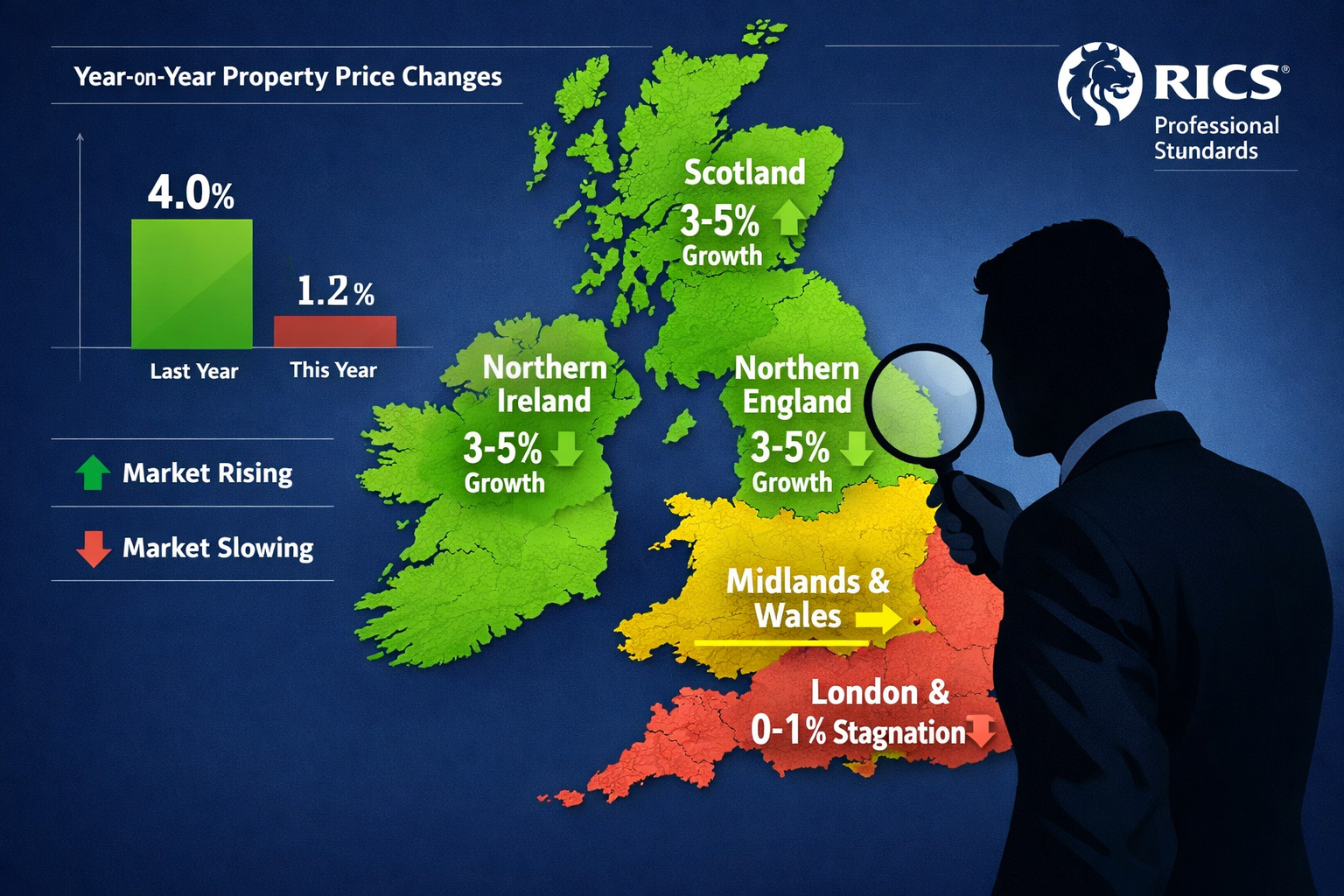
The Scale of North-South Market Separation
The property market landscape in 2026 represents a fundamental shift from historical patterns. For decades, London and the South East led UK property price growth, with Northern regions following at a lag. This relationship has reversed dramatically.
Northern England, Scotland, and Northern Ireland are experiencing:
- Anticipated 3-5% annual price appreciation through 2026
- Strong buyer demand driven by affordability advantages
- Increased employment opportunities in regional cities
- Remote working patterns supporting lifestyle migration
- Infrastructure investment boosting long-term prospects
London and Southern markets face contrasting conditions:
- Stagnant or marginally negative price movements (0-1%)
- Affordability constraints limiting buyer pools
- Exodus of workers seeking better value elsewhere
- High interest rates disproportionately affecting expensive properties
- Oversupply in certain segments, particularly luxury flats
This divergence creates significant challenges for surveyors who must value properties across different regions or provide expert testimony in cases involving regional market assumptions.
Why Traditional Valuation Approaches Fall Short
Conventional valuation methodology typically assumes:
- Relatively uniform national market movements
- Comparable properties behave similarly across regions
- Time adjustments apply consistently nationwide
- Market conditions affect all locations proportionally
These assumptions no longer hold true in 2026's divergent market. A surveyor applying a 3% annual time adjustment to London comparables would overvalue properties, while applying a 1% adjustment to Manchester comparables would undervalue them significantly.
The consequences of failing to adapt include:
- ❌ Inaccurate valuations leading to poor lending decisions
- ❌ Professional negligence claims against surveyors
- ❌ Challenged expert witness testimony in litigation
- ❌ Loss of professional credibility and client confidence
Valuation Methodology for Diverging UK Markets: Core Adjustment Techniques
Region-Specific Time Adjustments
Time adjustments account for market movements between the date of comparable sales and the valuation date. In diverging markets, surveyors must apply region-specific adjustment factors rather than national averages.
Implementing Regional Time Adjustments
Step 1: Identify the Appropriate Regional Index
Surveyors should reference:
- Local Land Registry price paid data for specific postcode districts
- Regional house price indices from reputable sources
- Local estate agent market reports providing granular insights
- RICS regional market surveys offering professional consensus
Step 2: Calculate Precise Adjustment Percentages
For a comparable sale from six months prior:
| Region | Annual Growth Rate | 6-Month Adjustment |
|---|---|---|
| Northern England | +4.0% | +2.0% upward |
| London | +0.5% | +0.25% upward |
| South East | -0.5% | -0.25% downward |
Step 3: Document the Adjustment Rationale
Professional surveyor advice emphasizes transparent documentation. Valuation reports should explicitly state:
- The regional index or data source used
- The specific time period analyzed
- The calculation methodology applied
- Any limitations or uncertainties in the data
Location Premium and Discount Adjustments
Beyond time adjustments, surveyors must recalibrate location premiums as regional markets diverge. Properties in previously "secondary" Northern locations may now command premiums relative to comparable Southern properties.
Recalibrating Location Factors
Traditional Approach:
- London properties: +20-40% premium vs. regional equivalents
- Prime postcodes: Additional +15-30% premium
- Northern cities: -30-50% discount vs. London
2026 Adjusted Approach:
- Evaluate location premiums independently by region
- Consider local market fundamentals (employment, amenities, transport)
- Apply relative value adjustments based on price-to-income ratios
- Account for lifestyle migration patterns affecting demand
Example Adjustment Framework:
A four-bedroom Victorian terrace might be valued as follows:
| Location | Base Value | Location Adjustment | Final Value |
|---|---|---|---|
| Manchester (2024) | £350,000 | Standard baseline | £350,000 |
| Manchester (2026) | £350,000 | +8% growth premium | £378,000 |
| London Zone 3 (2024) | £650,000 | Standard baseline | £650,000 |
| London Zone 3 (2026) | £650,000 | +1% minimal growth | £656,500 |
The relative value gap has narrowed significantly, requiring surveyors to reconsider traditional location hierarchies.
Market Conditions Adjustments
RICS guidance requires surveyors to consider market conditions affecting property values. In diverging markets, these conditions vary dramatically by region.
Northern Market Conditions (2026)
✅ Positive Factors Requiring Upward Adjustments:
- Strong buyer demand exceeding supply
- Multiple offer situations becoming common
- Days on market decreasing
- Mortgage lending criteria favorable for regional prices
- Government infrastructure investment announcements
Southern Market Conditions (2026)
⚠️ Negative Factors Requiring Downward Adjustments:
- Extended marketing periods for properties
- Increased negotiation leverage for buyers
- Higher proportion of sale fall-throughs
- Lender caution on high-value properties
- Oversupply in certain segments (new-build flats)
Surveyors should apply market conditions adjustments of typically ±2-5% depending on the strength of evidence and specific property characteristics.
Advanced Surveyor Adjustment Techniques for Regional Divergence

Weighted Comparable Analysis
Traditional comparable analysis gives equal weight to similar properties. In diverging markets, surveyors should implement weighted comparable analysis that prioritizes:
- Geographic proximity (±3-5% weighting adjustment)
- Time proximity (±2-4% weighting for recent sales)
- Property similarity (±5-10% for close matches)
- Market conditions alignment (±3-5% for comparable market states)
Weighted Analysis Example
For a property valuation in Camden:
Comparable A: Identical property, same street, sold 12 months ago
- Base value: £750,000
- Time adjustment: +0.5% (London stagnation) = £753,750
- Weight: 40% (high similarity, same micro-location)
Comparable B: Similar property, 0.5 miles away, sold 6 months ago
- Base value: £725,000
- Time adjustment: +0.25% = £726,813
- Location adjustment: +2% (slightly better location) = £741,349
- Weight: 35% (good similarity, close proximity)
Comparable C: Similar property, 1 mile away, sold 3 months ago
- Base value: £710,000
- Time adjustment: +0.125% = £710,888
- Location adjustment: +4% (inferior location) = £739,323
- Weight: 25% (adequate similarity, less ideal location)
Weighted Valuation:
(£753,750 × 0.40) + (£741,349 × 0.35) + (£739,323 × 0.25) = £746,294
This approach provides more defensible valuations than simple averaging, particularly important for professional surveyor services in expert witness contexts.
Regional Index Integration
Surveyors should integrate regional price indices directly into their valuation methodology. This technique involves:
Step 1: Establish Baseline Regional Performance
Track quarterly index movements for:
- The specific postcode district
- The broader city or county region
- The national average for comparison
Step 2: Apply Index-Based Adjustments
If the regional index shows +4% growth over 12 months while the national index shows +1%, apply the regional differential of +3% to comparable properties from that period.
Step 3: Cross-Reference Multiple Indices
Validate adjustments using:
- Land Registry Price Paid Data
- ONS House Price Index
- Nationwide/Halifax regional indices
- Local estate agent reports
Step 4: Document Index Selection Rationale
Property evaluation reports should explicitly state which indices were consulted and why specific indices were selected as most relevant.
Sensitivity Analysis for Uncertain Markets
Given the unprecedented nature of current regional divergence, surveyors should incorporate sensitivity analysis into valuations, particularly for:
- Mortgage lending valuations
- Expert witness reports
- Litigation support work
- Portfolio valuations
Implementing Sensitivity Analysis
Base Case Valuation: £500,000 (using most likely regional growth assumptions)
Optimistic Scenario: £515,000 (assuming stronger Northern growth of 5%)
Pessimistic Scenario: £485,000 (assuming Northern growth slows to 2%)
Valuation Range: £485,000 – £515,000
Confidence Level: Medium (given market volatility and limited historical precedent)
This approach provides clients with a realistic understanding of valuation uncertainty while maintaining professional standards.
Valuation Methodology for Diverging UK Markets: RICS Compliance and Best Practices
Red Book Requirements in Diverging Markets
The RICS Valuation – Global Standards (Red Book) requires surveyors to:
- ✅ Provide sufficient market evidence to support valuations
- ✅ Make appropriate adjustments to comparable evidence
- ✅ Clearly explain the valuation approach and reasoning
- ✅ Identify any limitations or uncertainties in the valuation
In diverging markets, these requirements demand enhanced rigor:
Enhanced Market Evidence Requirements:
- Minimum 5-7 comparables (vs. typical 3-5) to capture regional variation
- Explicit documentation of regional market trends
- Reference to multiple data sources and indices
- Clear explanation of how regional divergence affects the valuation
Transparent Adjustment Documentation:
- Detailed breakdown of each adjustment applied
- Quantification of adjustment percentages
- Rationale for adjustment methodology selected
- Acknowledgment of alternative approaches considered
Limitations and Assumptions:
- Explicit statement of regional market assumptions
- Recognition of uncertainty in unprecedented market conditions
- Clear identification of data limitations
- Appropriate caveats regarding future market movements
Expert Witness Considerations
Surveyors providing expert witness testimony face particular scrutiny when regional markets diverge. Courts and tribunals increasingly question valuations that fail to account for regional variations.
Best Practices for Expert Witness Work
1. Comprehensive Regional Market Analysis
Expert reports should include:
- Detailed regional market overview (2-3 pages minimum)
- Statistical evidence of regional divergence
- Analysis of local market drivers
- Comparison with national trends
2. Robust Comparable Selection and Adjustment
Demonstrate:
- Systematic comparable search methodology
- Transparent adjustment calculations
- Sensitivity testing of key assumptions
- Cross-verification using multiple approaches
3. Professional Independence and Objectivity
Maintain:
- Independence from instructing party interests
- Objective analysis of regional market conditions
- Willingness to acknowledge valuation uncertainty
- Transparent disclosure of limitations
4. Clear Communication of Complex Concepts
Ensure:
- Non-technical explanations of regional adjustments
- Visual aids (charts, graphs, maps) illustrating regional divergence
- Logical structure supporting valuation conclusions
- Anticipation and addressing of potential challenges
For surveyors working across different regions, understanding these considerations is essential whether conducting valuations in Notting Hill or Southend-on-Sea.
Practical Implementation: Case Studies and Examples

Case Study 1: Residential Valuation in Manchester vs. London
Scenario: A national lender requires valuations for identical buy-to-let properties (two-bedroom flats in converted Victorian buildings) in Manchester and Islington, London.
Manchester Property:
- Purchase price: £185,000
- Comparable sales (6 months prior): £175,000-£180,000
- Regional growth rate: +4% annually
- Time adjustment: +2% (6 months)
- Adjusted comparable range: £178,500-£183,600
- Valuation: £185,000 ✅ (supported by market evidence)
Islington Property:
- Purchase price: £475,000
- Comparable sales (6 months prior): £470,000-£480,000
- Regional growth rate: +0.5% annually
- Time adjustment: +0.25% (6 months)
- Adjusted comparable range: £471,175-£481,200
- Valuation: £475,000 ✅ (supported by market evidence)
Key Insight: Identical property types require dramatically different adjustment methodologies based on regional market conditions. The surveyor must justify why Manchester receives a +2% time adjustment while Islington receives only +0.25%.
Case Study 2: Expert Witness Report for Commercial Property
Scenario: Litigation involving a commercial property lease renewal in Leeds. The landlord's surveyor applied London-based rental growth assumptions; the tenant's expert must challenge this approach.
Landlord's Position:
- Applied +3% annual rental growth (London average)
- Valued property at £850,000
- Used London-based comparables with minimal adjustment
Tenant's Expert Analysis:
- Demonstrated Leeds commercial market growth of +1.5% annually
- Identified local comparables showing more modest rental increases
- Applied region-specific adjustments to London comparables (-15-20% location adjustment)
- Revised valuation: £725,000
Outcome: Tribunal accepted tenant's expert evidence, noting the failure to account for regional market divergence undermined the landlord's valuation credibility.
Lesson: Expert witness work demands rigorous regional analysis and transparent adjustment methodology to withstand cross-examination.
Case Study 3: Portfolio Valuation Across Multiple Regions
Scenario: A property investment trust requires annual portfolio valuation covering 50 residential properties across Northern England, Midlands, and South East.
Methodology Implemented:
1. Regional Segmentation
- Divided portfolio into three regional clusters
- Applied region-specific growth assumptions
- Weighted portfolio performance by regional exposure
2. Standardized Adjustment Framework
- Created regional adjustment matrices
- Applied consistent methodology within each region
- Documented regional variations transparently
3. Portfolio-Level Reporting
- Provided aggregate portfolio valuation
- Broke down performance by region
- Highlighted regional divergence impact on overall value
Results:
- Northern properties: +4.2% average appreciation
- Midlands properties: +2.1% average appreciation
- South East properties: +0.3% average appreciation
- Overall portfolio: +2.4% weighted average
Key Insight: Portfolio valuations must explicitly account for regional composition to provide accurate performance metrics and inform investment strategy.
Future-Proofing Valuation Methodology for Continued Divergence
Monitoring Regional Market Indicators
Surveyors should establish systematic monitoring of regional market indicators to maintain current knowledge:
📊 Monthly Monitoring:
- Regional house price indices
- Days on market statistics by region
- Sales volume trends
- Mortgage approval rates by region
📈 Quarterly Analysis:
- Regional economic performance indicators
- Employment and wage growth statistics
- Migration patterns between regions
- Infrastructure investment announcements
📋 Annual Review:
- Comprehensive regional market reports
- Valuation methodology effectiveness assessment
- Adjustment factor calibration
- Professional development on regional markets
Technology and Data Analytics
Modern valuation methodology increasingly leverages technology to handle regional complexity:
Automated Valuation Models (AVMs):
- Incorporate regional indices automatically
- Update time adjustments in real-time
- Flag significant regional divergences
- Provide preliminary valuation ranges
Geographic Information Systems (GIS):
- Visualize regional market trends
- Identify micro-market variations
- Support location adjustment decisions
- Enhance comparable property selection
Data Analytics Platforms:
- Aggregate multiple regional data sources
- Identify emerging market trends
- Support evidence-based adjustments
- Improve valuation accuracy and consistency
However, surveyors must remember that technology supports but does not replace professional judgment, particularly in unprecedented market conditions. Understanding what to do before an RICS home survey remains fundamentally a human-centered professional service.
Continuing Professional Development
The rapid evolution of regional market dynamics requires ongoing professional development:
Essential CPD Topics for 2026:
- Regional market analysis techniques
- Advanced comparable adjustment methodologies
- Statistical analysis for valuation
- Expert witness skills in complex markets
- RICS Red Book updates and guidance
- Technology tools for regional valuation
Recommended Learning Approaches:
- RICS regional market seminars
- Peer discussion groups on regional challenges
- Case study analysis of divergent market valuations
- Collaboration with regional specialists
- Academic research on regional property markets
Conclusion
The valuation methodology for diverging UK markets in 2026 demands fundamental changes to traditional surveying approaches. With Northern regions experiencing 3-5% price appreciation while London and the South face stagnation, surveyors must implement sophisticated adjustment techniques to maintain accuracy, professional credibility, and RICS compliance.
Key implementation priorities include:
- 🎯 Adopt region-specific time adjustments based on local market data rather than national averages
- 📊 Implement weighted comparable analysis that accounts for geographic and temporal proximity
- 📋 Integrate regional indices systematically into valuation methodology
- 💼 Enhance documentation and transparency particularly for expert witness work
- 🔄 Establish ongoing monitoring of regional market indicators and trends
For chartered surveyors, building surveyor services, and property evaluation professionals, adapting to regional market divergence is no longer optional—it's essential for professional competence and risk management.
Actionable Next Steps
For Individual Surveyors:
- ✅ Review current valuation reports for adequate regional adjustment documentation
- ✅ Establish systematic regional market monitoring processes
- ✅ Invest in CPD focused on regional market analysis
- ✅ Build networks with regional specialists for knowledge sharing
- ✅ Update standard valuation templates to incorporate regional adjustment frameworks
For Surveying Firms:
- ✅ Develop firm-wide regional adjustment guidelines and standards
- ✅ Invest in data analytics tools supporting regional valuation
- ✅ Provide team training on divergent market methodologies
- ✅ Implement quality assurance processes for regional adjustments
- ✅ Create knowledge-sharing systems capturing regional market intelligence
For Clients and Stakeholders:
- ✅ Request explicit documentation of regional market assumptions in valuations
- ✅ Challenge valuations that fail to account for regional divergence
- ✅ Engage surveyors with demonstrated regional market expertise
- ✅ Understand that valuation uncertainty may be higher in diverging markets
- ✅ Support comprehensive market analysis rather than rushing valuations
The UK property market's regional divergence represents both a challenge and an opportunity for the surveying profession. Those who adapt their methodology, embrace enhanced analysis, and maintain rigorous professional standards will deliver superior value to clients while protecting their professional reputation in an increasingly complex market environment.
By implementing the surveyor adjustment techniques outlined in this guide, property professionals can navigate the complexities of diverging UK markets with confidence, accuracy, and professional integrity—ensuring valuations remain fit for purpose whether in rapidly appreciating Northern markets or stagnant Southern regions.