

When a property transaction collapses over a £50,000 valuation disagreement between a London penthouse and a Manchester terrace, who determines the truth? In 2026, Expert Witness Protocols for 2026 UK Residential Valuation Disputes: Lessons from Regional Price Divides have become essential tools for resolving conflicts in a market characterized by stark geographical inequalities. As regional price gaps widen and tribunal cases multiply, understanding the RICS-guided protocols for expert witness testimony has never been more critical for property professionals, legal teams, and homeowners alike.
The UK residential property market presents unique challenges for valuation experts. A three-bedroom semi-detached home in Knightsbridge might command £2.5 million, while an identical property specification in Newcastle could sell for £250,000—a tenfold difference that creates fertile ground for disputes. When these disagreements reach tribunals, expert witnesses must navigate complex protocols while maintaining absolute impartiality.
Key Takeaways
- RICS protocols require expert witnesses to prioritize tribunal duties over client interests when providing evidence in residential valuation disputes, ensuring impartiality regardless of regional price variations
- Regional price divides create specific evidential challenges that demand comprehensive comparable analysis across different UK markets, with North-South gaps requiring specialized justification methodologies
- Emerging legislation including the Building Safety Act is reshaping expert witness requirements for high-rise and complex residential valuations in 2026[1]
- Structured evidence preparation protocols help expert witnesses present defensible valuations that account for regional market dynamics while maintaining professional standards
- Tribunal success depends on transparent methodology documentation that clearly explains regional price adjustments and market-specific factors
Understanding Expert Witness Roles in UK Residential Valuation Disputes
The Fundamental Duty of Impartiality 🏛️
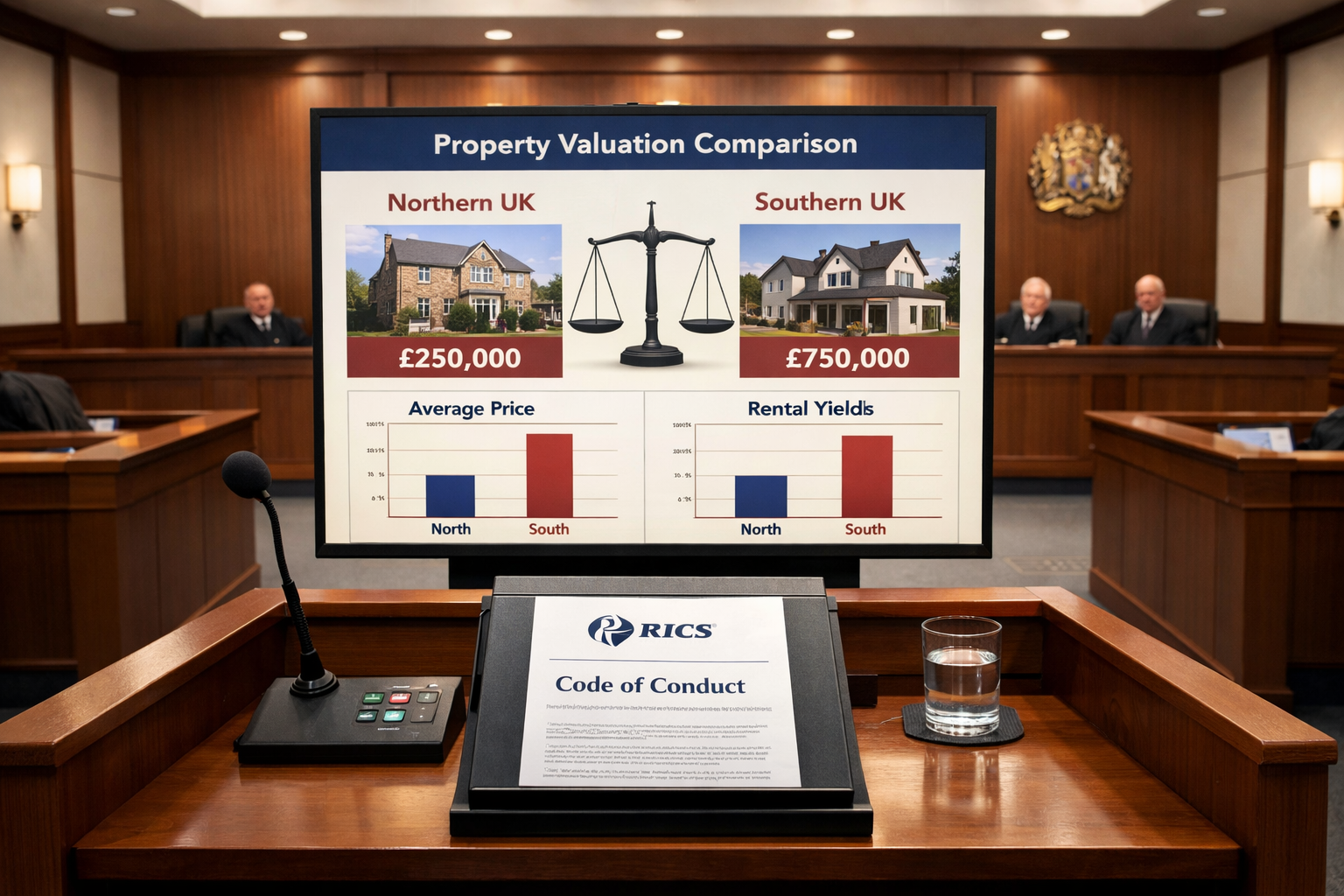
Expert witnesses in residential valuation disputes occupy a unique position within the UK legal system. Unlike advocates who represent client interests, expert witnesses owe their primary duty to the tribunal, not to the party instructing them. This distinction becomes particularly crucial when addressing regional price divides, where clients may pressure experts to justify valuations that align with their negotiating positions.
The Royal Institution of Chartered Surveyors (RICS) provides clear guidance on this fundamental principle. Expert witnesses must:
- Present evidence objectively, regardless of which party pays their fees
- Acknowledge limitations in their expertise or available data
- Revise opinions when presented with compelling contradictory evidence
- Disclose any conflicts of interest that might affect their impartiality
- Maintain professional independence throughout the dispute process
When dealing with regional price variations, this impartiality becomes tested. A surveyor instructed by a London-based seller might face pressure to emphasize premium market factors, while a buyer's expert might be encouraged to highlight regional depreciation trends. Professional protocols demand resistance to such pressures, ensuring that expert building evaluation maintains its integrity.
Qualification Requirements for Valuation Expert Witnesses
Not every chartered surveyor qualifies as an expert witness in residential valuation disputes. The 2026 standards require:
| Requirement | Description | Verification Method |
|---|---|---|
| RICS Membership | Current MRICS or FRICS status | RICS register check |
| Specialist Experience | Minimum 10 years in residential valuation | CV and case history |
| Regional Knowledge | Demonstrated expertise in relevant UK regions | Portfolio of valuations |
| Tribunal Training | Completed expert witness training courses | CPD certificates |
| Professional Indemnity | Adequate insurance coverage for expert work | Insurance documentation |
The regional knowledge requirement has gained particular importance in 2026. An expert qualified to value properties in the South East may lack the nuanced understanding of Northern market dynamics necessary to provide credible testimony on regional price divides. Tribunals increasingly scrutinize whether experts possess genuine expertise across the geographical areas relevant to disputes.
Types of Residential Valuation Disputes Requiring Expert Witnesses
Expert witnesses encounter various dispute scenarios in 2026's residential property market:
Purchase Price Disagreements arise when buyers and sellers cannot agree on property value, often triggered by survey findings that reveal defects or market reassessments. These disputes frequently involve property evaluation differences exceeding 10% of the agreed price.
Lease Extension Valuations generate significant tribunal activity, particularly in London and other high-value markets. Determining the premium for extending a residential lease requires expert analysis of marriage value, relativity, and comparable transactions—all factors influenced by regional market conditions. Our lease extension valuation services frequently encounter such complexities.
Matrimonial Proceedings require neutral valuations of residential property during divorce settlements. Regional price variations can dramatically affect settlement fairness, making expert testimony crucial for equitable outcomes.
Inheritance Tax Disputes with HMRC demand robust valuation evidence, particularly when deceased estates include properties in multiple UK regions with divergent market characteristics.
Compulsory Purchase Compensation cases require experts to determine fair market value for properties acquired by public authorities, with regional economic factors playing significant roles in compensation calculations.
Expert Witness Protocols for 2026 UK Residential Valuation Disputes: Regional Price Evidence Standards
Documenting Regional Market Analysis
The Expert Witness Protocols for 2026 UK Residential Valuation Disputes: Lessons from Regional Price Divides emphasize rigorous documentation of regional market analysis. Expert witnesses must demonstrate systematic approaches to understanding price variations across UK regions.
Comparable Evidence Collection forms the foundation of credible regional analysis. Experts should compile:
- Direct comparables: Properties with similar characteristics in the same locality (minimum 3-5 transactions within 12 months)
- Regional comparables: Similar properties in neighboring areas showing price gradients
- Cross-regional benchmarks: Equivalent property types in different UK regions demonstrating broader market patterns
- Time-series data: Historical price movements showing regional appreciation or depreciation trends
For example, when valuing a Victorian terrace in Birmingham, an expert witness might reference recent sales of comparable properties in the same postcode district, then contextualize these within broader West Midlands trends, and finally compare regional performance against national indices. This layered approach demonstrates methodological rigor that tribunals expect in 2026.
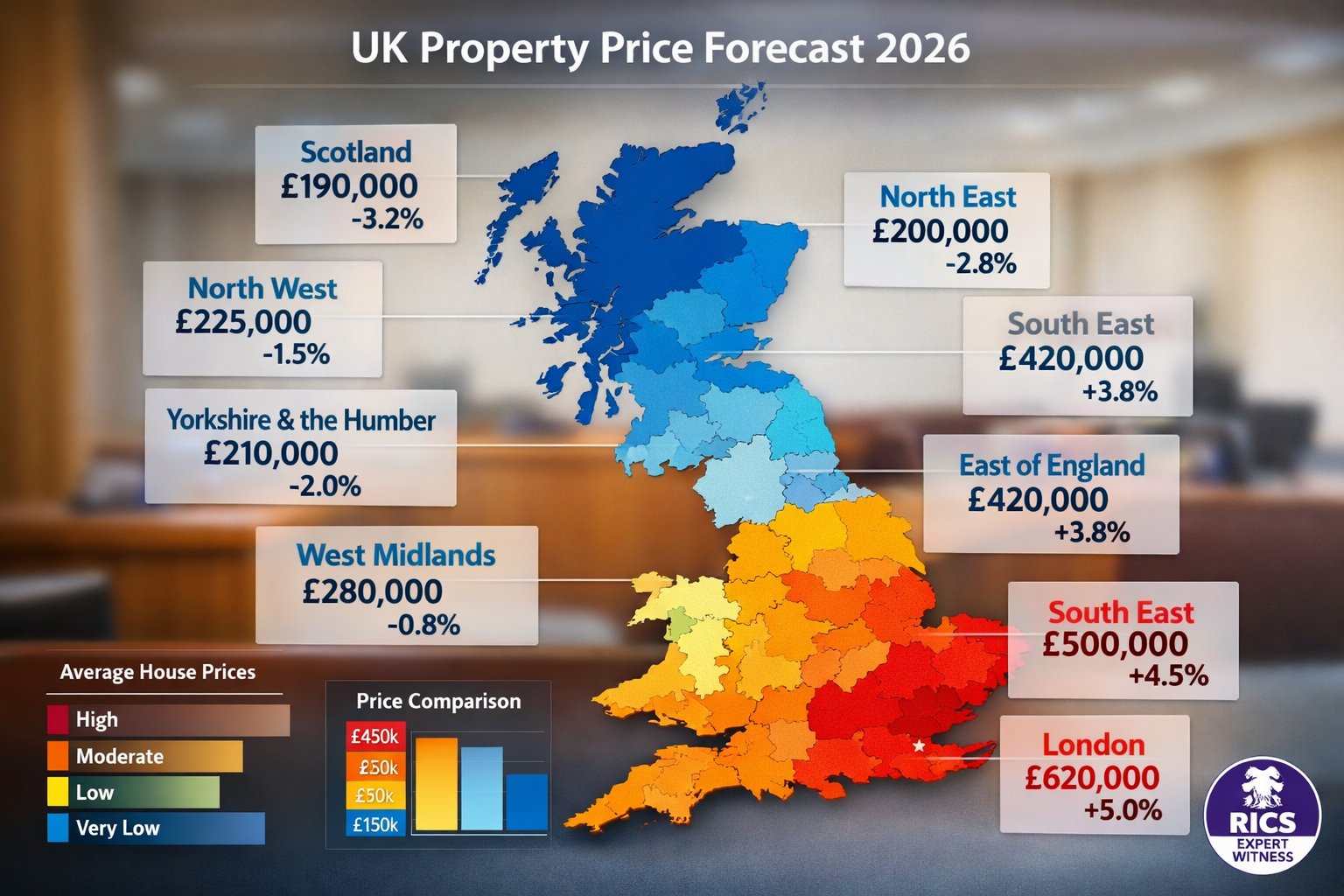
Addressing North-South Price Divide Factors
The persistent North-South price divide presents specific evidential challenges. Expert witnesses must articulate the legitimate factors driving regional price variations without resorting to subjective generalizations:
✅ Economic fundamentals: Employment rates, average incomes, economic growth forecasts
✅ Infrastructure investment: Transport links, planned developments, regeneration projects
✅ Supply constraints: Planning restrictions, available development land, housing stock characteristics
✅ Demand pressures: Population growth, migration patterns, investor activity
✅ Local amenities: School quality, green spaces, cultural facilities, retail provision
When preparing evidence, experts should quantify these factors wherever possible. Rather than stating "London commands premium prices due to employment opportunities," effective expert evidence might specify: "The subject property's location within 30 minutes of the City of London, where average salaries exceed £65,000 compared to the national average of £33,000, contributes an estimated 15-20% premium based on comparable analysis."
This precision becomes essential when tribunals evaluate whether regional price differences are justified. As property valuation methodologies evolve, quantifiable evidence increasingly outweighs subjective assessments.
Methodology Transparency Requirements
The 2026 protocols demand unprecedented transparency in valuation methodology. Expert witnesses must clearly explain:
Valuation Approach Selection: Whether using comparable method, investment method, residual method, or profits method, experts must justify why their chosen approach suits the specific property and dispute context.
Adjustment Calculations: When adjusting comparable evidence for differences in size, condition, or location, experts must show their mathematical reasoning. A tribunal should be able to replicate the expert's calculations from the evidence provided.
Regional Adjustment Factors: Particularly crucial for cross-regional comparisons, experts must explicitly state percentage adjustments applied for regional variations and cite supporting market data.
Uncertainty Acknowledgment: Professional protocols require experts to identify areas of uncertainty or limited data. For emerging regional markets with sparse transaction evidence, acknowledging these limitations enhances rather than diminishes credibility.
Consider this example of transparent methodology documentation:
"The subject property in Leeds has been valued at £425,000 using the comparable method. Three recent sales of similar Victorian terraces in the LS6 postcode area (£410,000, £435,000, and £428,000) provide the primary evidence base. A 5% upward adjustment has been applied to reflect the subject property's superior kitchen specification compared to the comparables. Regional analysis shows Leeds residential prices currently trade at approximately 62% of equivalent London properties, based on Nationwide regional indices for Q1 2026."
This level of detail allows tribunals to assess both the valuation conclusion and the reasoning process, which is essential for expert building evaluation credibility.
Case Study Applications: Regional Price Disputes in Practice
Case Study 1: London vs. Manchester Investment Property Dispute
Scenario: A property investment company purchased a portfolio of ten residential properties—five in Manchester and five in London—based on a bulk valuation. When individual properties were subsequently valued for refinancing purposes, significant discrepancies emerged between the original portfolio valuation and individual assessments.
Expert Witness Challenge: The instructed expert needed to explain why the London properties had appreciated 18% over two years while Manchester properties showed only 7% growth, and whether the original portfolio valuation adequately accounted for regional performance differentials.
Protocol Application: The expert witness prepared evidence demonstrating:
- Regional market divergence: London's post-pandemic recovery had outpaced Northern cities due to international investment returning to the capital
- Portfolio valuation limitations: The original bulk assessment had applied a uniform appreciation assumption across all properties, failing to account for regional variations
- Comparable evidence: Individual property valuations aligned with regional market data from Land Registry and RICS indices
- Methodology justification: The expert explained why individual valuations using region-specific comparables produced more accurate results than extrapolated portfolio figures
Outcome: The tribunal accepted the expert's regional analysis, finding that the original portfolio valuation had inadequately addressed geographical price dynamics. The case reinforced the importance of region-specific comparable analysis in expert evidence.
Case Study 2: Lease Extension Valuation in Birmingham vs. London Precedents
Scenario: A Birmingham leaseholder sought a lease extension and disputed the freeholder's valuation, which applied relativity rates derived primarily from London tribunal decisions. The leaseholder's expert argued that London-based relativity graphs overestimated marriage value in the Birmingham market.
Expert Witness Challenge: Determining appropriate relativity rates for a Midlands property when most tribunal precedents derive from London and South East cases.
Protocol Application: The expert witness addressed regional considerations by:
- Analyzing local market evidence: Collecting Birmingham-specific lease extension transactions to establish regional relativity patterns
- Comparing regional variations: Demonstrating that Birmingham properties with short leases traded at different relativity percentages compared to London equivalents
- Explaining economic factors: Articulating why regional economic conditions (lower property values, different buyer demographics) affected marriage value calculations
- Proposing adjusted methodology: Developing a Birmingham-specific relativity approach while acknowledging limitations in available data
Outcome: The tribunal recognized that mechanically applying London-derived relativity graphs to regional markets could produce inequitable results. The expert's regionally-adjusted methodology was accepted, establishing important precedent for lease extension valuations outside London.
Case Study 3: Matrimonial Property Division with Cross-Regional Holdings
Scenario: A divorcing couple owned three properties: a family home in Surrey (£1.2M), a buy-to-let in Newcastle (£180,000), and a holiday cottage in Cornwall (£450,000). Disagreement arose over whether the Newcastle property had been fairly valued relative to the Southern properties.
Expert Witness Challenge: Providing consistent valuation standards across three distinct regional markets while explaining price variations to non-specialist tribunal members.
Protocol Application: The expert witness employed:
- Standardized methodology: Applying the comparable method consistently across all three properties to ensure fair treatment
- Regional context explanation: Preparing clear summaries of each regional market's characteristics, price trends, and typical property values
- Proportional analysis: Demonstrating that the Newcastle property represented fair value within its regional context, even though absolute prices differed dramatically from Surrey
- Visual presentation: Using charts and maps to illustrate regional price variations, making complex market dynamics accessible to tribunal members
Outcome: The tribunal accepted all three valuations, finding that the expert had appropriately accounted for regional differences while maintaining methodological consistency. The case highlighted the importance of clear communication when presenting regional price evidence to non-specialist audiences.
Preparing Expert Evidence: Practical Protocols for 2026 Disputes

Report Structure and Content Requirements
Expert witness reports in residential valuation disputes must follow structured formats that facilitate tribunal comprehension. The 2026 standard report structure includes:
1. Executive Summary (1-2 pages)
- Property identification and dispute context
- Valuation conclusion with clear figure
- Key factors influencing the valuation
- Summary of regional market considerations
2. Expert Qualifications and Independence (1 page)
- Professional credentials and experience
- Confirmation of understanding of expert witness duties
- Declaration of any conflicts of interest
- Statement of independence from instructing party
3. Instructions and Scope (1-2 pages)
- Questions posed by instructing party
- Documents and information reviewed
- Site inspection details and observations
- Limitations or constraints on the assignment
4. Property Description (2-3 pages)
- Detailed physical description
- Location analysis and regional context
- Tenure details and legal considerations
- Condition assessment and any defects
5. Regional Market Analysis (3-5 pages)
- Overview of relevant regional market
- Recent transaction evidence and trends
- Economic and demographic factors
- Comparison with other UK regions where relevant
6. Valuation Methodology (2-3 pages)
- Approach selection and justification
- Comparable evidence presentation
- Adjustments and calculations
- Regional factors incorporated
7. Valuation Conclusion (1-2 pages)
- Final valuation figure with reasoning
- Range or uncertainty acknowledgment
- Alternative scenarios if applicable
8. Appendices
- Comparable transaction details
- Market data sources
- Photographs and plans
- Supporting calculations
This structure ensures that tribunals can navigate complex regional price evidence systematically. When dealing with property inspection findings that affect value, clear organization becomes particularly important.
Common Pitfalls in Regional Price Evidence
Expert witnesses frequently encounter challenges when presenting regional price evidence. Awareness of common pitfalls helps maintain protocol compliance:
❌ Insufficient Comparable Evidence: Relying on too few transactions or using outdated comparables undermines credibility. The 2026 standard expects minimum three recent comparables with clear relevance to the subject property.
❌ Unexplained Regional Adjustments: Applying percentage adjustments for regional differences without supporting data or reasoning invites tribunal skepticism. Every adjustment requires justification.
❌ Circular Reasoning: Using the subject property's characteristics to justify its value without independent comparable evidence creates logical fallacies that tribunals quickly identify.
❌ Advocacy Rather Than Analysis: Presenting evidence that consistently favors the instructing party's position suggests bias. Expert witnesses must acknowledge evidence that contradicts their conclusions when appropriate.
❌ Regional Stereotyping: Making generalized statements about Northern or Southern markets without specific data reduces expert evidence to subjective opinion.
❌ Ignoring Micro-Market Variations: Treating entire regions as homogeneous markets overlooks significant local variations. A property in central Manchester differs substantially from one in Greater Manchester suburbs, requiring nuanced analysis.
❌ Inadequate Methodology Explanation: Assuming tribunal members understand valuation techniques without clear explanation creates comprehension barriers. Expert evidence should be accessible to intelligent non-specialists.
Cross-Examination Preparation
Expert witnesses must prepare for rigorous cross-examination that tests their regional price analysis. Effective preparation includes:
Anticipating Challenges: Identify potential weaknesses in comparable evidence, regional adjustments, or methodology choices. Prepare robust responses before the hearing.
Maintaining Composure: Cross-examination aims to test credibility and expose inconsistencies. Professional demeanor and measured responses preserve expert authority.
Acknowledging Limitations: Admitting data gaps or areas of uncertainty demonstrates professional integrity. Attempting to defend indefensible positions damages credibility more than honest acknowledgment.
Referencing Documentation: Expert witnesses should thoroughly know their own reports and be able to locate supporting evidence quickly during questioning.
Explaining Technical Concepts: When questioned about valuation methodology or regional market factors, experts should provide clear explanations without condescension or excessive jargon.
Consistency Under Pressure: Responses during cross-examination must align with written evidence. Contradictions between report content and oral testimony severely undermine expert credibility.
Preparation for cross-examination on regional price divides might include rehearsing explanations of why London properties command premiums, how regional economic factors affect values, or why specific comparable properties were selected from particular geographical areas. This preparation ensures that property evaluation evidence withstands scrutiny.
Emerging Trends in Expert Witness Protocols for 2026
Impact of Building Safety Act on Valuation Disputes
The Building Safety Act has created new dimensions for expert witness protocols in 2026, particularly affecting high-rise residential valuations. Expert witnesses now must address:
Cladding and Safety Certification: Properties without appropriate safety certificates experience significant value impacts. Expert witnesses must evaluate how building safety concerns affect market value across different regions, as the impact varies based on local market conditions and buyer demographics[1].
Regional Variations in Safety Remediation: The costs and timelines for remediation work differ substantially across UK regions, affecting property values differently. London high-rises face different market responses to safety issues compared to Manchester or Birmingham equivalents.
Expert Qualification Requirements: The Building Safety Act has introduced specialist knowledge requirements for experts valuing affected properties. Standard residential valuation expertise may prove insufficient without additional building safety competence[1].
These developments mean that Expert Witness Protocols for 2026 UK Residential Valuation Disputes: Lessons from Regional Price Divides must incorporate building safety considerations, particularly when regional markets respond differently to safety concerns.
Technology Integration in Evidence Preparation
Expert witnesses increasingly utilize technology to strengthen regional price evidence:
Automated Valuation Models (AVMs): While not replacing professional judgment, AVMs provide supporting data for regional price analysis. Experts must explain AVM limitations and why professional valuation adds value beyond algorithmic approaches.
Geographic Information Systems (GIS): Mapping tools help visualize regional price variations, making complex geographical data accessible to tribunals. Heat maps showing price gradients across regions enhance evidence presentation.
Data Analytics Platforms: Sophisticated analysis of transaction databases enables experts to identify regional trends and comparable evidence more efficiently than manual research methods.
Virtual Inspection Technologies: When physical site visits prove challenging, virtual inspection tools supplement expert analysis, though they cannot fully replace on-site assessment for dispute purposes.
These technological advances enhance but don't replace the fundamental expert witness duties of impartiality, transparency, and professional judgment that underpin credible property valuation evidence.
Mandatory Survey Reforms and Expert Witness Implications
Proposed reforms for mandatory upfront surveys in residential transactions may reshape expert witness roles. If implemented, these reforms could:
Reduce Valuation Disputes: Earlier identification of property issues and agreed valuations might decrease post-contract disputes requiring expert witness intervention[2].
Standardize Regional Reporting: Mandatory survey protocols could create more consistent regional market data, improving comparable evidence quality for expert witnesses[2].
Increase Pre-Transaction Expert Involvement: Experts may shift from dispute resolution to preventative roles, providing upfront valuations that reduce later disagreement likelihood.
Create New Dispute Categories: Disagreements over mandatory survey findings or valuation methodologies might generate new types of disputes requiring expert witness protocols.
While these reforms remain under development in 2026, expert witnesses should monitor policy developments that could fundamentally alter residential valuation dispute landscapes.
Conclusion
Expert Witness Protocols for 2026 UK Residential Valuation Disputes: Lessons from Regional Price Divides represent essential frameworks for navigating an increasingly complex property market. As regional price variations persist and intensify, the demand for credible, impartial expert evidence continues to grow. Success in this specialized field requires mastering the fundamental principles of expert witness duty—prioritizing tribunal service over client advocacy, maintaining absolute transparency in methodology, and presenting regional price evidence with rigorous supporting data.
The case studies examined demonstrate that tribunals increasingly scrutinize regional price analysis, demanding detailed justification for geographical adjustments and comprehensive comparable evidence. Expert witnesses who understand regional market dynamics, document their methodology meticulously, and communicate complex concepts clearly will find their evidence carries substantial weight in dispute resolution.
Actionable Next Steps
For property professionals seeking to enhance their expert witness capabilities:
- Invest in regional market knowledge across multiple UK areas, not just your primary practice location
- Complete accredited expert witness training that specifically addresses residential valuation disputes
- Develop systematic comparable evidence databases organized by region and property type
- Practice transparent methodology documentation in all valuation work, building habits that serve expert witness assignments
- Stay current with emerging legislation including Building Safety Act implications and proposed survey reforms
For legal professionals instructing expert witnesses in residential valuation disputes:
- Verify regional expertise during expert selection, ensuring instructed experts possess genuine knowledge of relevant geographical markets
- Provide comprehensive instructions that clearly identify regional price considerations relevant to the dispute
- Allow adequate preparation time for thorough regional market analysis and comparable research
- Encourage methodology transparency in expert reports, requesting detailed explanation of regional adjustments
- Prepare experts for cross-examination on regional price factors and comparable selection
For property owners involved in valuation disputes:
- Understand expert witness independence and avoid pressuring experts to reach predetermined conclusions
- Provide complete information about property characteristics and local market conditions
- Consider regional market realities when evaluating whether disputes merit tribunal proceedings
- Seek qualified experts with demonstrated regional knowledge relevant to your property location
- Review expert evidence critically using the protocols outlined in this article to assess quality
The landscape of residential valuation disputes continues to evolve alongside regional market dynamics, legislative changes, and technological advances. Expert witnesses who embrace rigorous protocols, maintain unwavering impartiality, and develop deep regional market understanding will remain indispensable to fair dispute resolution in 2026 and beyond. As regional price divides show no signs of diminishing, the expertise required to navigate these complex valuation challenges will only grow more valuable.
Whether you're a chartered surveyor developing expert witness capabilities, a legal professional seeking reliable valuation evidence, or a property owner facing a dispute, understanding these protocols provides the foundation for successful outcomes. The principles outlined here—transparency, impartiality, regional market competence, and methodological rigor—will serve you well in any residential valuation dispute context.
References
[1] Expert Witness Protocols Under Building Safety Act Disputes Rics Guidance For 2026 High Rise Litigation – https://nottinghillsurveyors.com/blog/expert-witness-protocols-under-building-safety-act-disputes-rics-guidance-for-2026-high-rise-litigation
[2] Home Buying Reforms 2026 How Mandatory Upfront Surveys Will Transform Building And Valuation Practices – https://nottinghillsurveyors.com/blog/home-buying-reforms-2026-how-mandatory-upfront-surveys-will-transform-building-and-valuation-practices