

The UK property market stands at a pivotal moment. As government reforms push toward mandatory upfront property condition assessments, chartered surveyors face both unprecedented opportunities and significant operational challenges. Understanding RICS Home Surveys in 2026: Navigating Proposed Reforms and Upfront Condition Requirements has never been more critical for professionals preparing to adapt their workflows to earlier transaction stages and increased demand.
In August 2025, the Royal Institution of Chartered Surveyors (RICS) launched a comprehensive consultation on proposed updates to the Home Survey standard, marking the most significant overhaul of residential property inspection protocols in years[1]. With over 1,000 consultation responses received and a 24-month implementation period planned, the surveying profession must prepare for fundamental shifts in how, when, and why property surveys are conducted[2][3].
Key Takeaways
- 🏠 Survey Level Redesignation: RICS proposes maintaining three survey levels but renaming them 'basic', 'intermediate', and 'advanced' to improve consumer understanding[4]
- 📊 Massive Stakeholder Engagement: Over 325 RICS professionals and 1,400 homeowners contributed feedback, shaping the reform direction[1]
- ⏱️ Extended Implementation Timeline: A minimum 24-month implementation period will allow surveyors to build capacity and adapt workflows to upfront assessment requirements[3]
- 📋 Clarity Enhancement: Consultation feedback consistently emphasized the need for clearer distinction between mandatory requirements and recommended practices[2]
- 🚀 Market Opportunity: Government reforms requiring upfront condition reports could significantly increase surveyor demand as assessments shift to pre-listing stages
Understanding the Current RICS Home Survey Landscape
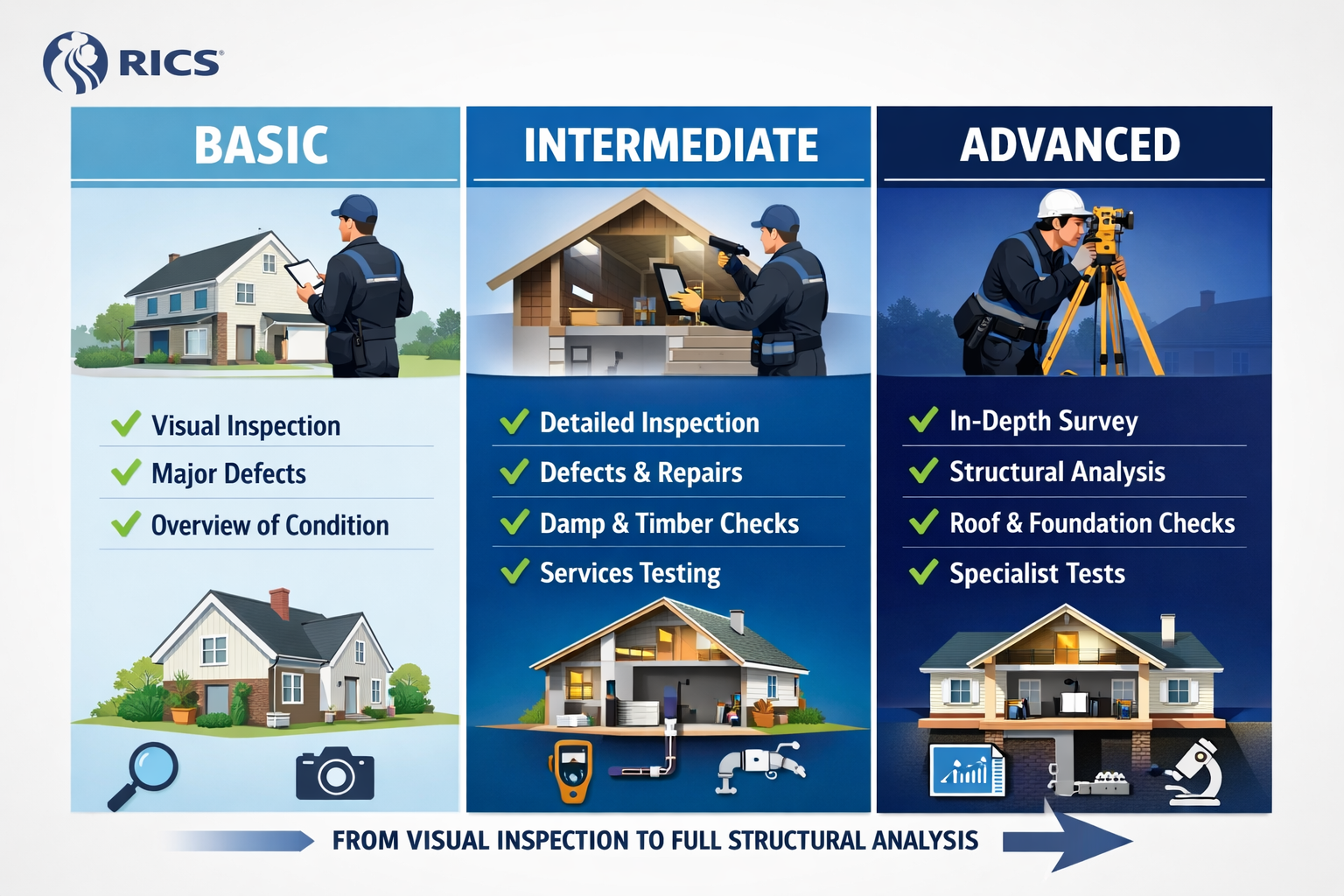
The existing RICS Home Survey standard has served the UK property market for years, providing a framework for three distinct levels of property inspection. Currently known as the RICS Homebuyer Survey (Level 2) and RICS Building Survey (Level 3), these surveys help buyers understand property condition before completing purchases.
The Three-Tier System Explained
Current Survey Levels:
| Survey Level | Current Name | Typical Property Type | Inspection Depth |
|---|---|---|---|
| Level 1 | Condition Report | Standard properties in good condition | Visual inspection only |
| Level 2 | Homebuyer Report | Conventional properties | Detailed visual inspection |
| Level 3 | Building Survey | Older, altered, or complex properties | Comprehensive structural analysis |
However, consumer research revealed significant confusion about these designations. The 1,400-homeowner survey conducted by RICS uncovered widespread misunderstanding about which survey level suited different property types and transaction scenarios[1].
Why Reform Became Necessary
The Expert Group (EG) that reviewed the current standard identified several critical issues:
- Inconsistent application across different surveyors and regions
- Unclear boundaries between what each survey level must include
- Consumer confusion about appropriate survey selection
- Insufficient prescriptiveness in mandatory requirements versus optional elements
These challenges, combined with broader government initiatives to reform the home buying and selling process, created the perfect catalyst for comprehensive standard updates[4].
RICS Home Surveys in 2026: Key Proposed Reforms Explained
The consultation launched on August 19, 2025, and concluded on October 14, 2025, introduced several transformative proposals designed to enhance clarity, consistency, and consumer confidence[1][4].
Redesignated Survey Levels: Basic, Intermediate, and Advanced
The most visible change involves renaming the three survey levels to 'basic', 'intermediate', and 'advanced'. This redesignation aims to create intuitive understanding for consumers while maintaining the rigorous inspection standards surveyors already apply[4].
Proposed Survey Level Framework:
- Basic Survey: Entry-level property condition assessment suitable for newer properties in good condition
- Intermediate Survey: Comprehensive visual inspection for standard residential properties (equivalent to current Level 2)
- Advanced Survey: In-depth structural analysis for complex, older, or significantly altered properties (equivalent to current Level 3)
This clearer nomenclature addresses feedback from both consumers and professionals who found the numbered system confusing and non-descriptive.
Enhanced Clarity Between 'Musts' and 'Shoulds'
A consistent theme throughout the consultation responses emphasized the need for clearer distinction between mandatory requirements ('musts') and recommended practices ('shoulds')[2]. This distinction proves crucial for:
✅ Quality assurance across the profession
✅ Professional indemnity insurance clarity
✅ Consumer protection through consistent minimum standards
✅ Regulatory compliance and enforcement
The revised standard will explicitly separate non-negotiable inspection elements from best-practice recommendations, reducing ambiguity and supporting consistent service delivery.
Differentiated Inspection Requirements
The proposed updates establish clearer differentiation between inspection levels, specifying exactly what must be examined at each tier[4]. This addresses previous concerns about overlap between survey levels and helps consumers understand the value proposition of each option.
For those considering which home survey is right for you, these enhanced distinctions will make selection significantly more straightforward.
RICS Home Surveys in 2026: Navigating the Upfront Condition Requirement
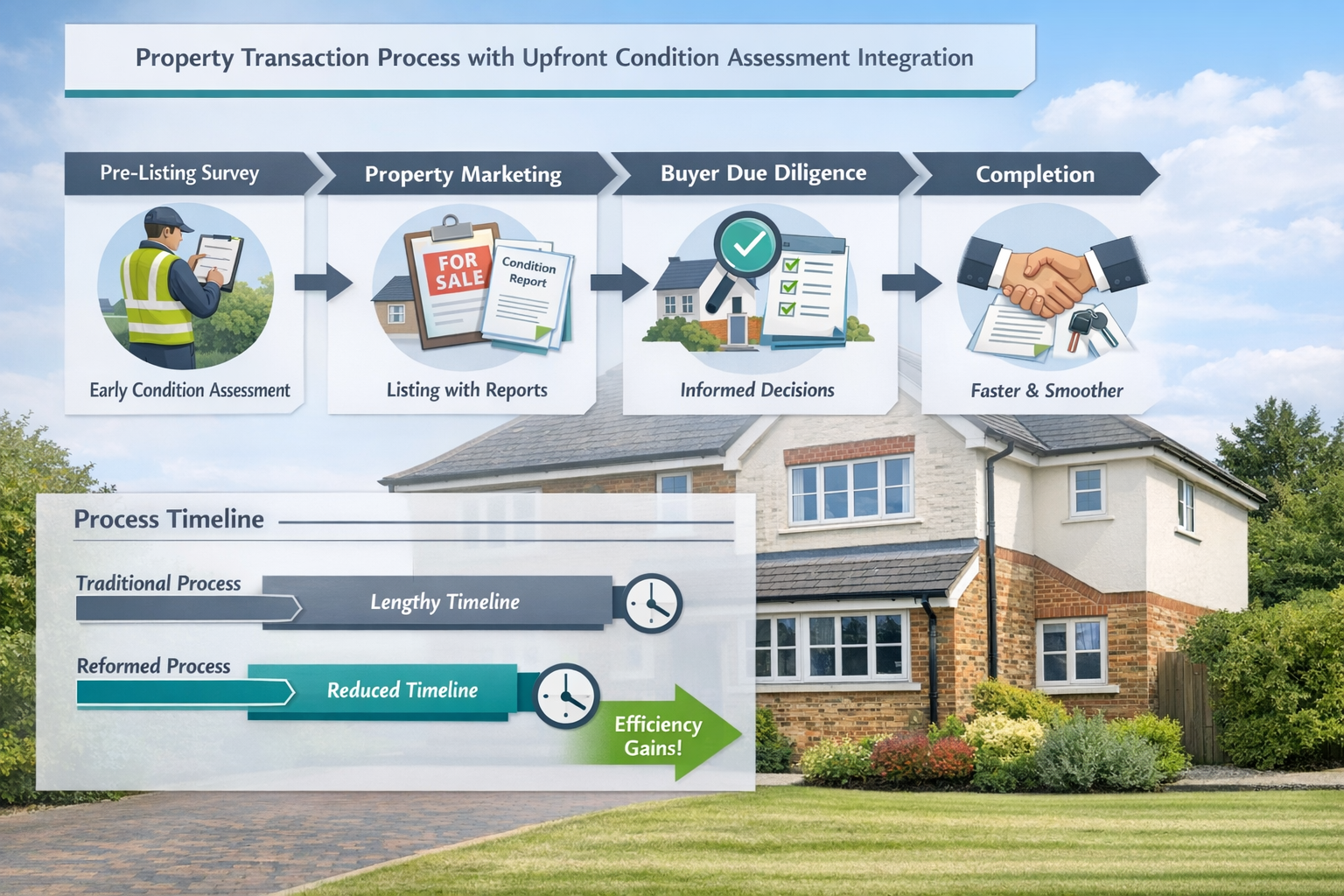
Perhaps the most significant driver behind these reforms stems from government initiatives to require upfront property condition information before properties are marketed for sale[3]. This represents a fundamental shift in the UK property transaction timeline.
What Upfront Condition Requirements Mean
Traditional UK property transactions follow this sequence:
- Property listed for sale
- Buyer makes offer
- Offer accepted
- Buyer commissions survey
- Survey reveals issues
- Renegotiation or transaction collapse
The proposed upfront model reverses this:
- Seller commissions condition assessment
- Property listed with condition report attached
- Buyer reviews existing report
- Informed offer made
- Reduced renegotiation and fewer transaction failures
This shift mirrors practices in other countries like Australia and parts of the United States, where seller-commissioned reports are standard.
The 24-Month Implementation Timeline
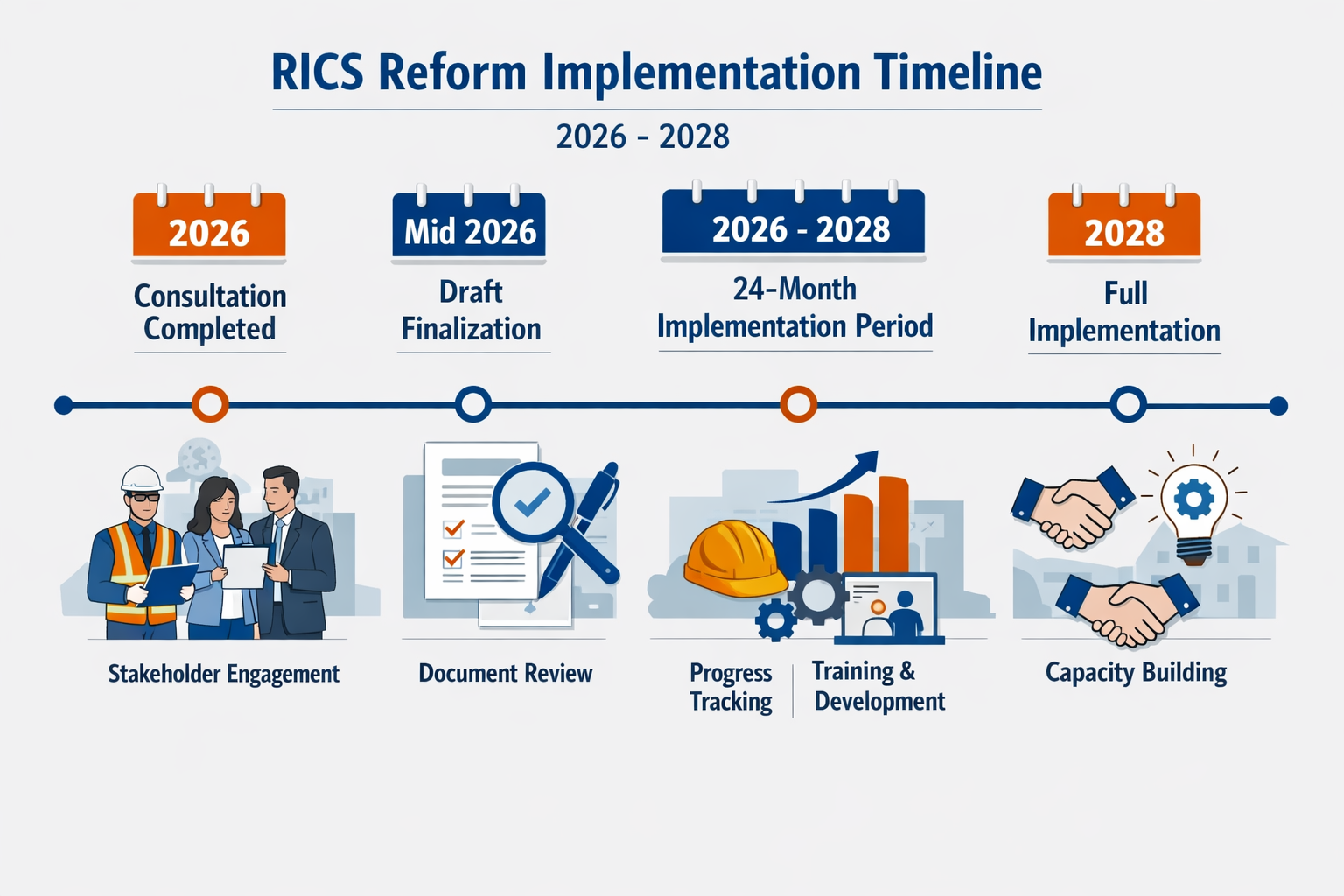
RICS has stated that a minimum 24-month implementation period would be essential for successful reform adoption[3]. This extended timeline allows for:
- Capacity building within the surveying profession
- Technology infrastructure development for report standardization
- Professional training on updated standards and workflows
- Consumer education campaigns
- Industry stakeholder alignment across conveyancers, estate agents, and lenders
The progress update promised by end of March 2026 will provide crucial insight into the refined timeline and implementation roadmap[2].
Opportunities for Chartered Surveyors
The shift toward upfront condition assessments creates substantial opportunities:
📈 Increased Survey Volume: Every listed property potentially requires a condition report, dramatically expanding the market beyond current buyer-commissioned surveys
🎯 Earlier Engagement: Surveyors become involved at the pre-listing stage, positioning them as trusted advisors earlier in the transaction
💼 Recurring Client Relationships: Estate agents and sellers become regular clients, not just one-time buyers
🏗️ Value-Added Services: Opportunities to provide pre-sale improvement recommendations and follow-up inspections
For professionals offering condition survey reports, this represents a fundamental business model evolution.
Practical Checklist: Adapting Building Survey Workflows to Earlier Transaction Stages
Preparing for upfront condition requirements demands strategic workflow adaptation. Here's a comprehensive checklist for chartered surveyors:
Pre-Implementation Preparation (2026-2027)
Business Development:
- Develop relationships with estate agencies and property sellers
- Create seller-focused marketing materials explaining upfront survey benefits
- Establish pricing models for seller-commissioned surveys
- Review professional indemnity insurance coverage for pre-listing assessments
- Invest in digital report delivery systems for rapid turnaround
Technical Readiness:
- Review and update survey templates to align with proposed RICS standards
- Distinguish clearly between 'basic', 'intermediate', and 'advanced' service offerings
- Develop standardized reporting formats for consistency
- Implement quality assurance processes for increased volume
- Train team members on new standard requirements
Operational Efficiency:
- Streamline booking and scheduling systems for higher volume
- Establish turnaround time commitments (sellers need reports before listing)
- Create template communications for common scenarios
- Develop partnerships with specialists (damp surveyors, structural engineers) for referrals
- Implement capacity planning to handle demand surges
Post-Implementation Excellence (2028+)
Service Differentiation:
- Offer tiered pricing matching the three survey levels
- Provide value-added pre-sale improvement consultations
- Create follow-up inspection services for remediated issues
- Develop seller education resources about survey findings
- Establish reputation management systems for seller reviews
Technology Integration:
- Adopt digital inspection tools for efficiency
- Implement cloud-based report storage and sharing
- Use automated scheduling and client communication platforms
- Leverage data analytics to identify common property issues by area
- Explore AI-assisted report generation for routine elements
Professional Development:
- Maintain CPD (Continuing Professional Development) aligned with updated standards
- Participate in RICS guidance updates and webinars
- Join professional forums discussing upfront assessment best practices
- Develop expertise in specific property types or issues
- Build reputation as RICS surveyor specialist
Stakeholder Perspectives: What the Consultation Revealed
The unprecedented consultation engagement—over 325 RICS professionals and more than 1,400 homeowners—provided invaluable insights into stakeholder priorities[1].
Professional Surveyor Concerns
Top themes from surveyor feedback:
- Need for prescriptive clarity: Surveyors want explicit guidance on mandatory inspection elements to ensure consistency and manage liability
- Practical implementation challenges: Concerns about capacity, turnaround times, and maintaining quality with increased volume
- Professional standards maintenance: Desire to preserve rigorous inspection standards while improving accessibility
- Technology and tools: Interest in standardized reporting platforms and digital inspection aids
Consumer Expectations
Homeowner survey findings highlighted:
- Confusion about survey types: Many homeowners don't understand differences between survey levels
- Cost concerns: Upfront costs create barriers, but consumers recognize long-term value
- Trust in professional guidance: Strong preference for RICS-qualified surveyors
- Desire for clarity: Simple, jargon-free reports with clear action recommendations
- Speed expectations: Quick turnaround times increasingly important in competitive markets
These perspectives shaped the proposed reforms, balancing professional rigor with consumer accessibility.
The Broader Context: UK Residential Market in 2026
Understanding RICS Home Surveys in 2026: Navigating Proposed Reforms and Upfront Condition Requirements requires context about the broader property market landscape.
Current Market Conditions
The latest RICS UK Residential Market Survey for January 2026 indicated that the UK residential property market is showing tentative signs it may be turning a corner[2]. After a challenging period of:
- Rising interest rates
- Affordability pressures
- Transaction volume declines
- Buyer caution
The market shows emerging stability, creating an opportune moment for process reforms that could reduce transaction friction and rebuild consumer confidence.
Government Reform Initiatives
The upfront condition requirement sits within a broader government agenda to modernize home buying and selling[3]. Related initiatives include:
- Material Information requirements: Standardized property information packs
- Reservation agreements: Reducing gazumping and transaction failures
- Digital conveyancing: Streamlining legal processes
- Consumer protection enhancements: Greater transparency and accountability
RICS actively engages with these initiatives through its Home Buying and Selling Reform Hub, coordinating industry responses and developing implementation guidance[3].
The Dual Consultation Approach
Notably, RICS ran two separate but parallel consultations—one on the updated standard itself and another exploring interest in a potential home survey regulation scheme[1]. This regulation scheme aims to:
- Support public trust in survey quality
- Establish enforcement mechanisms for standards compliance
- Create consumer redress pathways
- Enhance professional accountability
The dual approach recognizes that standard updates alone may be insufficient without robust regulatory frameworks ensuring consistent application.
Comparing Survey Levels: Making the Right Choice
With the proposed 'basic', 'intermediate', and 'advanced' designations, choosing the appropriate survey level becomes more intuitive. Here's guidance for different scenarios:
When to Recommend a Basic Survey
Ideal for:
- Newly built properties (though building surveys for new builds still offer value)
- Modern properties less than 10 years old
- Properties in excellent condition
- Buyers seeking cost-effective baseline assessment
Limitations:
- Visual inspection only
- Limited detail on minor defects
- Not suitable for older or complex properties
When to Recommend an Intermediate Survey
Ideal for:
- Standard residential properties built post-1900
- Conventional construction methods
- Properties in reasonable condition
- Most typical buyer scenarios
This level, equivalent to the current Homebuyers Survey, provides comprehensive visual inspection with detailed reporting on condition, defects, and necessary repairs. Reviewing a Homebuyers Report example helps buyers understand what to expect.
When to Recommend an Advanced Survey
Ideal for:
- Properties built before 1900
- Listed or heritage properties
- Significantly altered or extended properties
- Properties with known defects or unusual construction
- Buyers planning major renovations
For those exploring the key differences between Level 2 and Level 3 surveys, the advanced survey provides the most comprehensive structural analysis and detailed defect reporting.
Addressing Common Defects and Specialized Surveys
Regardless of survey level, certain property issues require specialized attention. The reformed standards will clarify when additional investigations are necessary.
Moisture and Structural Issues
Common concerns requiring specialist follow-up:
- Damp problems: Rising damp, penetrating damp, condensation issues may require dedicated damp surveys and damp survey cost considerations
- Subsidence indicators: Cracking patterns, movement, foundation concerns
- Timber defects: Rot, beetle infestation, structural timber issues
- Roof problems: Leaks, structural concerns, material deterioration
When general surveys identify these issues, specific defect surveys provide focused investigation and remediation guidance.
Leveraging Survey Findings for Negotiation
One significant advantage of upfront condition reports is informed negotiation. Understanding how to renegotiate after a poor building survey result becomes crucial for buyers reviewing seller-commissioned reports.
Key negotiation strategies:
- Quantify repair costs: Obtain contractor estimates for identified defects
- Prioritize safety issues: Structural or safety concerns carry more negotiating weight
- Consider market conditions: Seller flexibility varies with market dynamics
- Request remediation: Sometimes sellers prefer fixing issues to price reduction
- Commission additional surveys: Verify concerning findings with specialist inspections
Timeline and Next Steps: What to Expect in 2026 and Beyond
Understanding the reform timeline helps surveyors plan strategic adaptations.
2026 Milestones
Q1 2026 (Current):
- RICS analyzing 1,000+ consultation responses
- Progress update expected by end of March 2026[2]
- Refinement of proposed standards based on feedback
Q2-Q4 2026:
- Publication of revised draft standards
- Further stakeholder engagement
- Finalization of implementation timeline
- Development of supporting guidance materials
2027-2028: Implementation Period
Given the stated 24-month minimum implementation period[3], expect:
2027:
- Final standard publication
- Professional training programs launched
- Technology platform development
- Industry capacity building initiatives
- Consumer education campaigns
2028:
- Phased standard implementation
- Monitoring and adjustment period
- Evaluation of upfront condition requirement impact
- Potential regulatory scheme launch
Long-Term Market Evolution
Beyond 2028, the UK property market may see:
- Reduced transaction failures: Better-informed buyers and sellers
- Faster completion times: Fewer post-offer surprises
- Enhanced consumer protection: Standardized, reliable property information
- Professionalized selling process: Surveys as standard selling requirement
- Increased surveyor demand: Fundamental market expansion
Conclusion: Preparing for the Future of Property Surveys
RICS Home Surveys in 2026: Navigating Proposed Reforms and Upfront Condition Requirements represents more than regulatory updates—it signals a fundamental transformation in how the UK property market operates. For chartered surveyors, this evolution presents extraordinary opportunities alongside implementation challenges.
Key Action Steps for Surveyors
Immediate (2026):
- Monitor the March 2026 RICS progress update closely
- Review current workflows against proposed standards
- Begin relationship building with estate agencies and sellers
- Assess capacity and technology needs for increased volume
- Engage with RICS consultation processes and guidance development
Medium-term (2027-2028):
- Implement workflow adaptations for upfront assessments
- Complete training on finalized updated standards
- Invest in technology infrastructure for efficiency
- Develop seller-focused service offerings and marketing
- Build specialist expertise in high-demand property types or defect categories
Long-term (2028+):
- Establish market leadership in upfront condition assessments
- Leverage data and experience to refine service delivery
- Contribute to ongoing standard evolution through professional engagement
- Expand service offerings based on emerging market needs
- Maintain excellence through continuous professional development
The Bottom Line
The proposed reforms to RICS Home Survey standards, combined with government initiatives requiring upfront condition information, will reshape the residential property landscape. Surveyors who proactively adapt their business models, invest in capacity and technology, and position themselves as trusted advisors to sellers—not just buyers—will thrive in this new environment.
The consultation feedback demonstrated clear demand for clearer, more consistent, and more accessible property surveys[2]. By delivering on these expectations while maintaining rigorous professional standards, chartered surveyors can drive both market confidence and business growth.
As the UK property market shows signs of recovery in 2026, these reforms arrive at an opportune moment to reduce transaction friction, protect consumers, and professionalize the home buying and selling process. The surveyors who navigate these changes successfully will find themselves at the center of a modernized, more efficient property market.
References
[1] Rics Launches Consultation Updated Home Survey Standard – https://www.rics.org/news-insights/rics-launches-consultation-updated-home-survey-standard
[2] Home Survey Standard 2nd Edition A Progress Update – https://www.rics.org/news-insights/home-survey-standard-2nd-edition-a-progress-update
[3] Home Buying And Selling Reform Hub – https://www.rics.org/news-insights/current-topics-campaigns/home-buying-and-selling-reform-hub
[4] Understanding The Rics Home Survey Standard Proposal – https://www.rics.org/news-insights/understanding-the-rics-home-survey-standard-proposal
[5] Building Survey Quality Standards 2026 Navigating Rics Updates And Enhanced Home Inspection Requirements – https://nottinghillsurveyors.com/blog/building-survey-quality-standards-2026-navigating-rics-updates-and-enhanced-home-inspection-requirements
[6] Home Survey Standards – https://www.rics.org/profession-standards/rics-standards-and-guidance/sector-standards/building-surveying-standards/home-surveys/home-survey-standards