{"cover":"Professional landscape format (1536x1024) hero image featuring bold text overlay 'Building Surveys for 2026 Right to Buy Revivals: Assessing Council Homes for Structural and Valuation Risks' in extra large 72pt white sans-serif font with dark shadow and semi-transparent navy overlay box, positioned in upper third. Background shows British council estate housing with red brick terraced homes, RICS surveyor in high-visibility vest conducting external inspection with clipboard and moisture meter, scaffolding visible on one property. Color scheme: deep navy blue, white, brick red accents. High contrast, magazine cover quality, editorial photojournalism style with shallow depth of field focusing on surveyor and property.", "content":["Detailed landscape format (1536x1024) image showing comprehensive comparison infographic of 2026 Right to Buy reforms versus previous scheme. Split-screen design with left side labeled 'Previous Scheme' showing 3 years tenancy requirement, 70% maximum discount, 5-year clawback in muted grey tones; right side labeled '2026 Reforms' displaying 10 years tenancy, 15% maximum discount cap, 10-year clawback, 35-year new build exemption in vibrant blue and green. Central timeline arrow showing phased implementation 2026-27. Clean professional layout with percentage symbols, calendar icons, house silhouettes, and pound sterling symbols. Modern infographic aesthetic with clear typography and data visualization.", "Detailed landscape format (1536x1024) image depicting council house structural defect identification scene. RICS chartered surveyor using thermal imaging camera and moisture meter on interior wall showing visible damp patches and peeling wallpaper. Split composition showing close-up of cracked render exterior wall, subsidence indicators including stepped cracking in brickwork, and surveyor taking detailed notes on tablet device. Equipment visible: damp meter, spirit level, measuring tape, inspection torch. Professional assessment environment with natural lighting, technical equipment labels, diagnostic readings displayed. Documentary photography style emphasizing thorough inspection methodology and professional standards.", "Detailed landscape format (1536x1024) image showing property valuation and survey report documentation for Right to Buy council home. Desk scene with RICS Building Survey Level 3 report open displaying condition ratings (1-2-3 system), structural defect photographs, floor plans with marked problem areas. Laptop screen showing comparable property values and discount calculations. Calculator displaying purchase price figures, magnifying glass over property deeds, council housing documentation, and Red Book valuation certificate. Professional surveyor's office setting with architectural drawings, British housing policy documents visible in background. Clean, organized composition with warm lighting emphasizing documentation detail and professional assessment process."]}
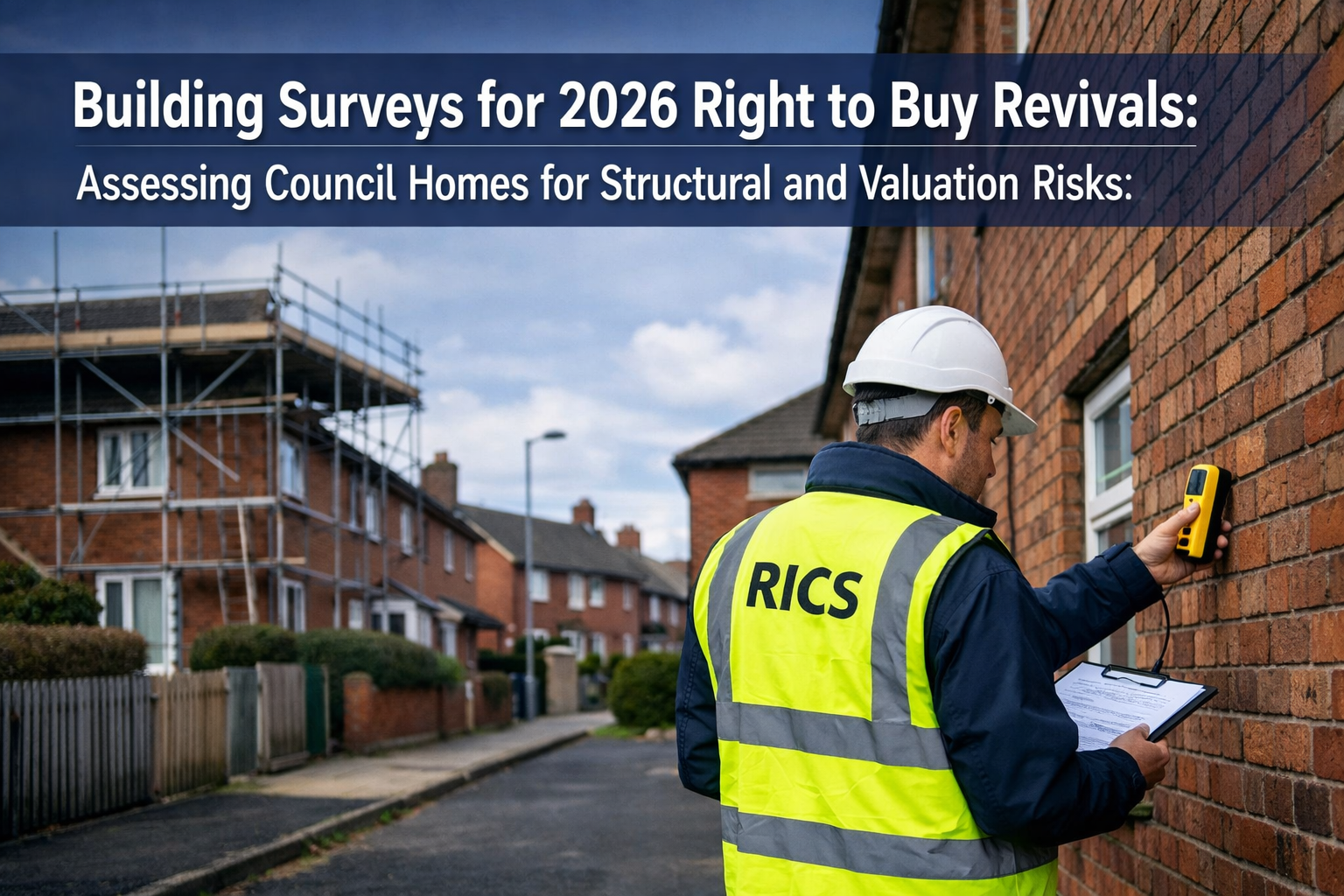
The UK housing market is witnessing a significant shift as Building Surveys for 2026 Right to Buy Revivals: Assessing Council Homes for Structural and Valuation Risks becomes increasingly critical for prospective buyers. With the government's reformed Right to Buy scheme rolling out from 2026-27, thousands of council tenants will once again have the opportunity to purchase their homes—but under substantially different terms. These changes, combined with the age and condition of much of Britain's council housing stock, make professional building surveys more essential than ever before.
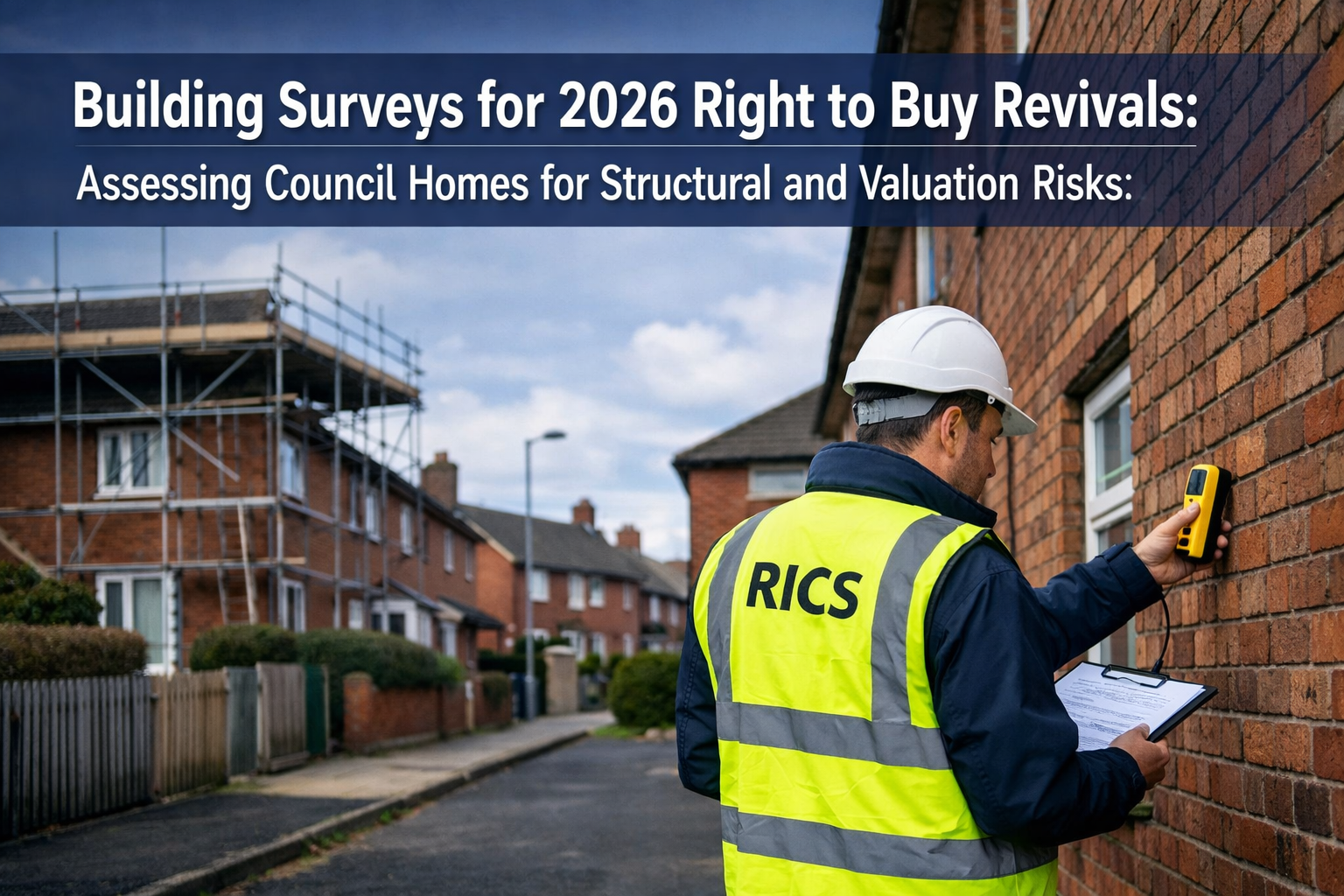
The 2026 Right to Buy reforms introduce stricter eligibility criteria and reduced discounts, fundamentally changing the financial equation for potential buyers. Tenants must now have lived in their property for a minimum of ten years before applying, and discounts start at just 5% after ten years of tenancy, capped at 15%—a dramatic reduction from the previous maximum of 70%[1]. This means buyers will be paying closer to market value, making thorough structural assessments absolutely crucial to avoid purchasing properties with hidden defects that could cost tens of thousands to repair.
Key Takeaways
- Extended eligibility requirements: Tenants must now reside in council properties for ten years minimum before qualifying for Right to Buy, up from three years previously[1][3]
- Substantially reduced discounts: Maximum discounts capped at 15% instead of 70%, meaning buyers pay near-market rates and need comprehensive surveys to protect their investment[1]
- Older housing stock risks: Many council homes were built between the 1950s-1980s and commonly suffer from damp, subsidence, concrete degradation, and outdated building systems
- RICS survey standards essential: Professional Level 2 or Level 3 surveys identify structural defects, valuation risks, and repair costs that directly impact purchase decisions
- Extended clawback provisions: Buyers who resell within ten years may have to repay portions of their discount to councils, making accurate initial valuations critical[1][3]
Understanding the 2026 Right to Buy Reforms and Their Impact on Building Surveys
What Has Changed in the Right to Buy Scheme?
The government's overhaul of Right to Buy represents the most significant reform to the scheme since its introduction in 1980. The changes aim to protect social housing stock while still offering long-term tenants a pathway to homeownership[2].
Key reforms include:
| Reform Area | Previous Policy | 2026 Reform | Impact on Surveys |
|---|---|---|---|
| Tenancy Duration | 3 years minimum | 10 years minimum[1][3] | Buyers are older, properties have aged more |
| Discount Structure | Up to 70% maximum | 5-15% graduated discount[1] | Higher purchase prices demand thorough surveys |
| New Build Exemption | None | 35-year exemption[1] | Focus shifts to older housing stock |
| Clawback Period | 5 years | 10 years[1][3] | Accurate valuations critical for resale planning |
| Council Receipts | Partial retention | 100% retention[1] | More stock available but older properties |
These reforms fundamentally change the risk profile for Right to Buy purchases. With buyers paying 85-95% of market value instead of 30-70%, the financial stakes are significantly higher. A property with undetected structural issues that might have been acceptable at a 70% discount becomes a potential financial disaster at near-market prices.
Why Building Surveys Are More Critical Than Ever
The reduced discount structure means buyers have less financial cushion to absorb unexpected repair costs. A comprehensive building survey becomes not just advisable but essential financial protection.
Consider this scenario: A tenant purchasing a three-bedroom council house valued at £300,000 under the old scheme with a 70% discount would pay £90,000. Under 2026 reforms with a 15% discount after maximum tenancy, they'll pay £255,000. If that property requires £40,000 in structural repairs for subsidence or damp remediation, the financial impact is vastly different:
- Old scheme: £90,000 purchase + £40,000 repairs = £130,000 total (still £170,000 below market value)
- 2026 scheme: £255,000 purchase + £40,000 repairs = £295,000 total (only £5,000 below market value)
This dramatic shift makes professional structural defect identification absolutely critical for protecting buyers' investments.
Building Surveys for 2026 Right to Buy Revivals: Choosing the Right Survey Level
RICS Survey Levels Explained for Council Housing
The Royal Institution of Chartered Surveyors (RICS) sets professional standards for property surveys in the UK. For Right to Buy purchases, understanding which survey level provides adequate protection is crucial.
🏠 Level 1 (Condition Report)
- Best for: Modern properties in excellent condition
- Council housing suitability: ❌ Not recommended for most council homes
- Why: Too basic for properties built 40-70 years ago with potential hidden defects
🏘️ Level 2 (HomeBuyer Report)
- Best for: Conventional properties in reasonable condition
- Council housing suitability: ⚠️ Suitable for newer council stock only (post-1990s)
- Coverage: Identifies visible defects, provides condition ratings, includes valuation
- Limitations: No detailed structural investigation or testing
🏗️ Level 3 (Building Survey)
- Best for: Older properties, unusual construction, properties needing renovation
- Council housing suitability: ✅ Highly recommended for most Right to Buy purchases
- Coverage: Comprehensive structural analysis, detailed defect investigation, repair cost guidance
- Why essential: Most council housing stock dates from 1950s-1980s with known construction issues
For detailed comparison of survey options, review our guide on choosing between Level 2 and Level 3 surveys.
Specific Considerations for Ex-Council Properties
Council housing stock presents unique challenges that standard surveys must address:
Construction Period Risks:
- 1950s-1960s: Prefabricated concrete systems (PRC), some non-traditional construction methods with limited lifespan
- 1970s: High-rise construction, cavity wall issues, early central heating systems now obsolete
- 1980s: Deck access flats, concrete frame deterioration, asbestos-containing materials
Common Defects in Council Housing Stock:
- Damp and moisture penetration (affecting 60%+ of pre-1980s council homes)
- Concrete carbonation in reinforced concrete structures
- Cavity wall tie corrosion in 1970s-1980s construction
- Subsidence from clay soil movement and vegetation
- Roof deterioration from deferred maintenance
- Outdated electrical and heating systems
- Asbestos-containing materials in pre-2000 properties
A Level 3 Building Survey provides the comprehensive investigation needed to identify these issues before purchase.
Structural and Valuation Risks: What Building Surveys Must Assess in Council Homes
Critical Structural Defects to Identify
When conducting Building Surveys for 2026 Right to Buy Revivals: Assessing Council Homes for Structural and Valuation Risks, RICS surveyors focus on several high-risk areas specific to social housing stock.
🌧️ Damp and Water Penetration
Damp is the single most common defect in older council housing, manifesting in three primary forms:
Rising Damp:
- Failed or absent damp-proof courses (DPC)
- Ground level raised above DPC through landscaping
- Bridging of DPC by external render or internal finishes
- Repair costs: £1,500-£5,000 depending on extent
Penetrating Damp:
- Cracked or porous external walls
- Failed pointing and render
- Roof defects allowing water ingress
- Window and door frame deterioration
- Repair costs: £2,000-£15,000+ for extensive remediation
Condensation Damp:
- Inadequate ventilation in bathrooms and kitchens
- Poor insulation causing cold surfaces
- Lifestyle factors combined with building defects
- Repair costs: £500-£3,000 for ventilation improvements
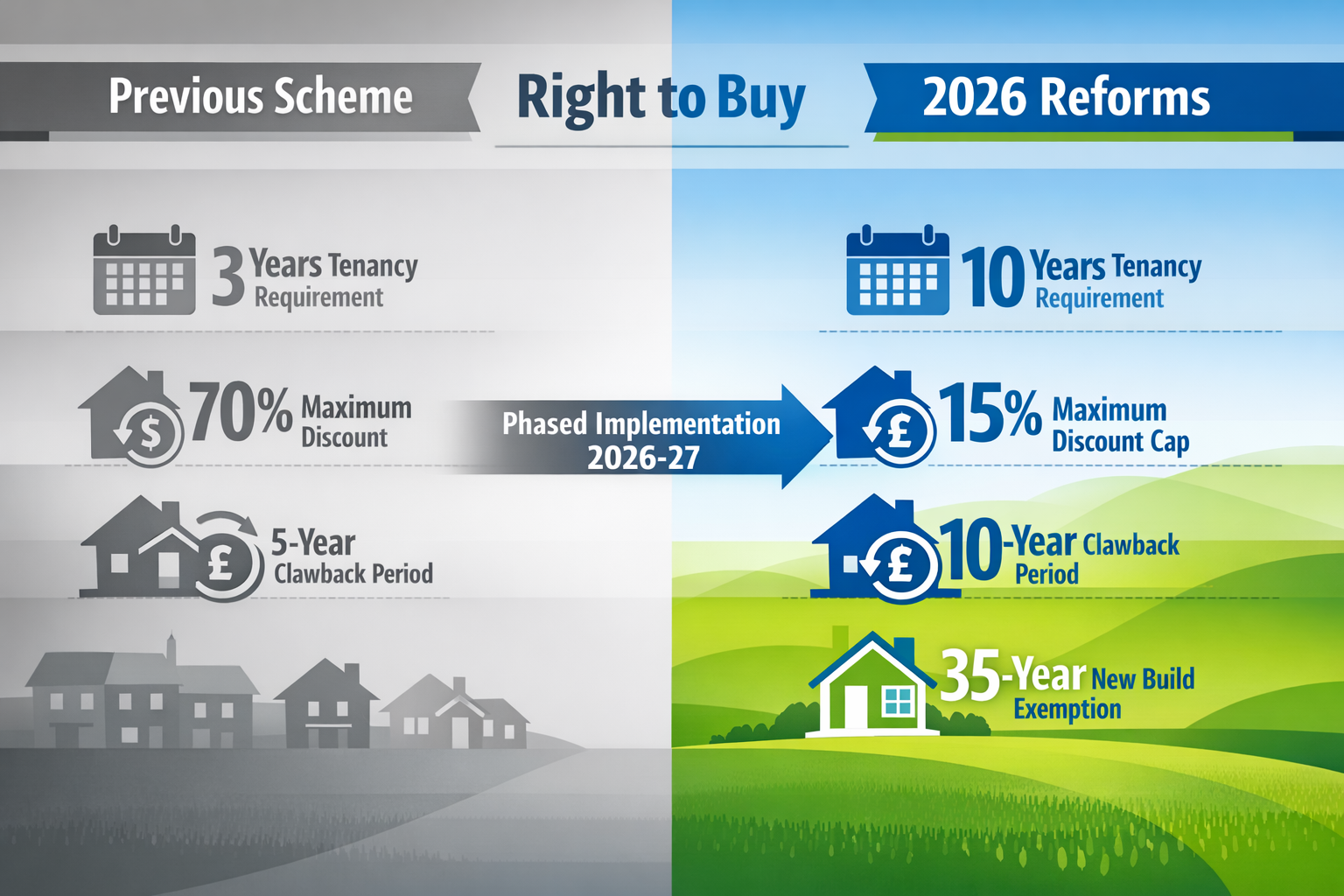
Professional surveyors use moisture meters, thermal imaging cameras, and visual inspection to diagnose damp issues accurately. Understanding what to expect from professional damp assessments helps buyers prepare for the survey process.
⚠️ Subsidence and Structural Movement
Subsidence represents one of the most serious and costly defects in council housing. Common causes include:
- Clay soil shrinkage during dry periods (particularly in London and Southeast)
- Tree root activity near foundations (especially poplars, willows, oaks)
- Leaking drains washing away supporting soil
- Mining subsidence in former industrial areas
Warning signs surveyors identify:
- Stepped cracking in external brickwork (>3mm width)
- Diagonal cracks from corners of windows and doors
- Doors and windows sticking or not closing properly
- Gaps between walls and ceilings/floors
- Leaning or bulging walls
Our detailed guide on subsidence and its implications explains why this defect is particularly problematic. Repair costs for subsidence can range from £5,000 for minor underpinning to £50,000+ for extensive structural work.
🏗️ Non-Traditional Construction Issues
Many council homes built between 1945-1970 used non-traditional construction methods to address post-war housing shortages. These include:
Prefabricated Reinforced Concrete (PRC) systems:
- Airey houses
- Cornish units
- Reema hollow panel
- Wimpey no-fines concrete
Key risks:
- Concrete carbonation reducing structural integrity
- Reinforcement corrosion and spalling
- Mortgage-ability issues (many lenders refuse PRC properties)
- Shortened design life (some designated for 60-year lifespan, now exceeded)
Steel-frame construction:
- Corrosion of structural steel elements
- Inadequate fire protection
- Thermal bridging and condensation issues
Identifying non-traditional construction is critical as it affects both valuation and mortgage availability. Some properties may be unmortgageable without expensive remediation work.
Valuation Considerations and Market Impact
Beyond identifying physical defects, building surveys for Right to Buy properties must consider how structural issues impact market value and saleability.
Factors Affecting Council Home Valuations
Positive factors:
- Location and local amenities
- Garden size and parking
- Recent council improvements (new kitchens, bathrooms, heating)
- Freehold ownership post-purchase
- Established neighborhoods with community infrastructure
Negative factors:
- Structural defects requiring immediate attention
- Non-traditional construction limiting mortgage availability
- Estate stigma or poor local reputation
- Lease complications on flats
- Service charge liabilities
- Cladding issues (particularly post-Grenfell)
The Renegotiation Advantage
A comprehensive building survey provides powerful negotiation leverage. When significant defects are identified, buyers have several options:
- Request price reduction to cover repair costs
- Ask the council to complete repairs before completion
- Withdraw from purchase if defects are too severe
- Renegotiate discount percentage based on condition
Our guide on renegotiating after poor survey results provides detailed strategies for using survey findings to protect your investment. Research shows buyers can typically negotiate price reductions of 5-15% when significant defects are discovered.
Preparing for Your Right to Buy Building Survey
Pre-Survey Preparation Steps
Maximizing the value of your building survey requires proper preparation. Follow these essential steps:
📋 Documentation Gathering:
- Council tenancy records showing maintenance history
- Any previous repair work or improvements
- Planning permissions for extensions or alterations
- Guarantees or warranties for previous work
- Asbestos register (if available from council)
🔍 Initial Property Assessment:
- Note any visible defects or concerns
- Document recent changes in property condition
- Identify areas of particular concern (damp patches, cracks, etc.)
- Take photographs of obvious issues
💬 Council Communication:
- Request full maintenance and repair history
- Ask about any planned works or known issues
- Clarify what improvements are council vs. tenant responsibility
- Obtain information about estate-wide issues
For comprehensive preparation guidance, review our article on what to do before an RICS home survey.
Questions to Ask Your Surveyor
When commissioning a building survey for a Right to Buy property, ensure your surveyor has specific experience with council housing:
Essential questions:
- "Do you have experience surveying ex-council properties?" – Council housing presents unique challenges requiring specialist knowledge
- "Will you identify non-traditional construction methods?" – Critical for mortgage-ability and valuation
- "Do you provide repair cost estimates?" – Essential for budgeting and negotiation
- "Will the survey include valuation advice?" – Helps assess whether the discounted price represents good value
- "Can you identify asbestos-containing materials?" – Common in pre-2000 council properties
- "What testing equipment will you use?" – Moisture meters, thermal imaging, etc.
- "How long will the survey take?" – Thorough Level 3 surveys typically require 3-5 hours
- "When will I receive the report?" – Usually 5-10 working days
Understanding Survey Reports and Condition Ratings
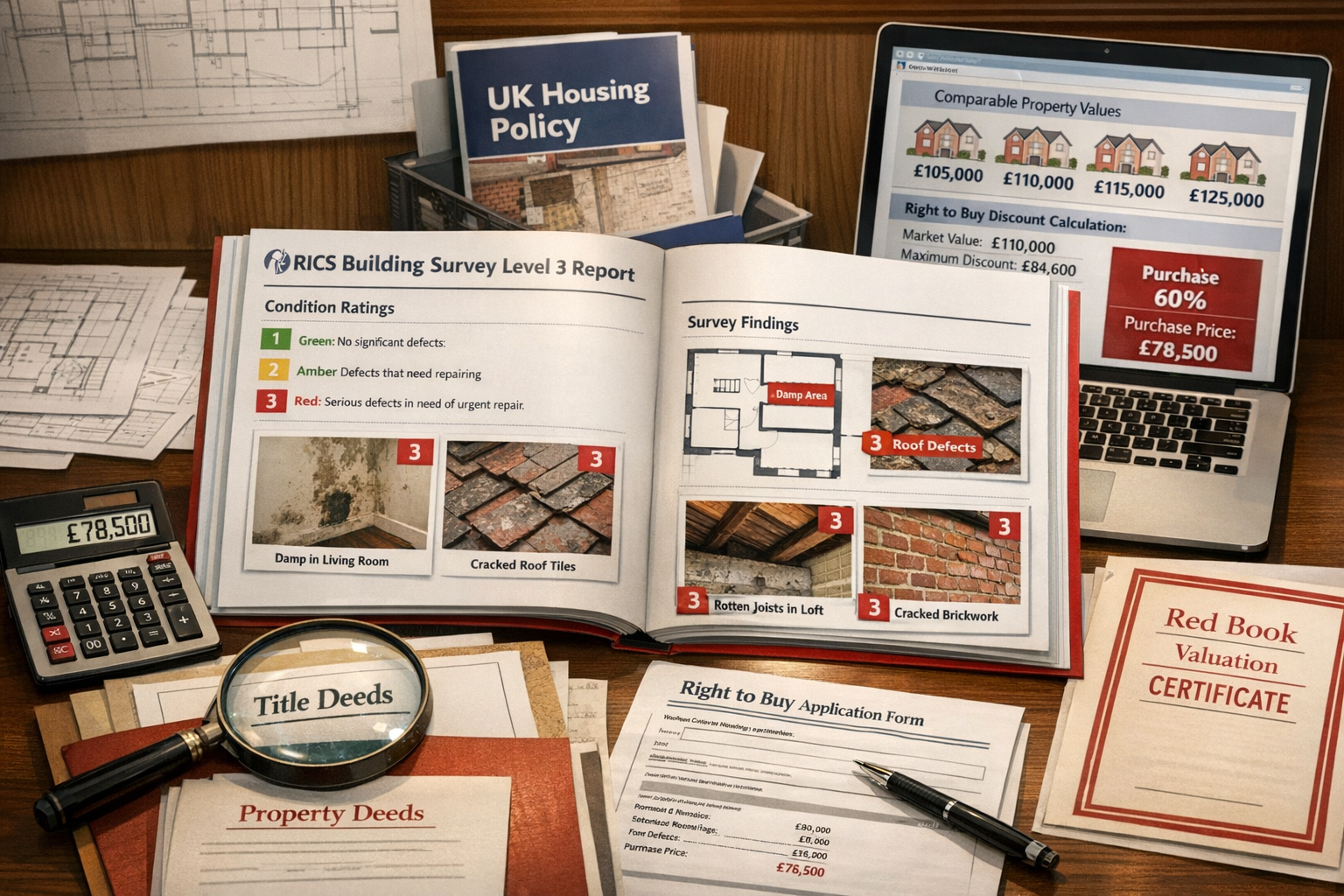
RICS surveys use a standardized condition rating system that helps buyers quickly understand defect severity:
Condition Rating 1 (Green): ✅
- No repair currently needed
- Normal maintenance required
Condition Rating 2 (Amber): ⚠️
- Defects requiring future repair or replacement
- Repairs not urgent but should be budgeted for
Condition Rating 3 (Red): 🚨
- Defects requiring urgent repair or replacement
- Serious defects affecting structural integrity
- Further investigation by specialists needed
For Right to Buy purchases, pay particular attention to:
- Number and severity of Rating 3 items – These require immediate action and investment
- Cumulative repair costs – Total estimated costs for all identified defects
- Specialist recommendations – When further investigation is needed (structural engineers, damp specialists, etc.)
- Valuation advice – Whether the purchase price reflects the property's true condition
Financial Planning: Budgeting for Surveys and Repairs
Survey Costs and Investment Protection
Professional building surveys represent a small percentage of purchase price but provide enormous financial protection:
Typical survey costs (2026):
- Level 2 HomeBuyer Report: £400-£800 depending on property value and location
- Level 3 Building Survey: £600-£1,500+ for comprehensive assessment
- Specialist investigations: £200-£500 each (structural engineer, damp specialist, etc.)
Return on investment:
A £1,000 survey that identifies £30,000 in hidden structural defects provides a 3,000% return through avoided losses or successful price renegotiation.
Budgeting for Repairs and Improvements
When planning a Right to Buy purchase, create a comprehensive budget that includes:
Immediate repairs (Year 1):
- All Condition Rating 3 defects
- Safety-critical issues (electrical, gas, structural)
- Weather-proofing and damp remediation
- Typical budget: £5,000-£25,000 depending on property condition
Medium-term improvements (Years 2-5):
- Condition Rating 2 defects
- Heating system upgrades
- Window and door replacements
- Kitchen and bathroom modernization
- Typical budget: £10,000-£40,000
Long-term maintenance (Years 6-10):
- Roof replacement
- External redecorating and repointing
- Driveway and boundary repairs
- Typical budget: £15,000-£50,000
Remember the 10-year clawback provision[1][3]—if you need to sell within this period due to unaffordable repairs, you may have to repay a portion of your original discount to the council.
The Clawback Consideration: How Surveys Protect Long-Term Investment
Understanding the Extended Clawback Period
The 2026 reforms extend the clawback period from five to ten years[1][3]. This means if you sell your Right to Buy property within a decade of purchase, the council can reclaim a percentage of the original discount based on the following formula:
Clawback calculation:
- Year 1: Council recoups 100% of discount
- Year 2: Council recoups 90% of discount
- Year 3: Council recoups 80% of discount
- Continuing to Year 10: Council recoups 10% of discount
Example scenario:
- Purchase price: £250,000 (15% discount = £44,118 saved)
- Unexpected structural repairs needed: £35,000
- Forced to sell in Year 4 due to financial pressure
- Sale price: £270,000
- Clawback owed (70% of £44,118): £30,883
- Net proceeds: £270,000 – £250,000 mortgage payoff – £30,883 clawback = -£10,883 loss
This scenario demonstrates why thorough pre-purchase surveys are critical—they prevent buyers from entering financial arrangements they cannot sustain.
How Comprehensive Surveys Mitigate Clawback Risk
A detailed building survey protects against forced early sales by:
- Identifying all repair costs upfront – Enables accurate financial planning
- Providing negotiation leverage – Reduces purchase price to account for defects
- Preventing surprise expenses – No hidden costs forcing financial distress
- Supporting informed decisions – Buyers can withdraw if repairs are unaffordable
- Enabling proper budgeting – Long-term maintenance costs are understood
Case Studies: Real-World Right to Buy Survey Scenarios
Case Study 1: 1960s Council House with Hidden Subsidence
Property: Three-bedroom semi-detached house, built 1967
Purchase price: £280,000 (12% discount applied)
Survey type: RICS Level 3 Building Survey
Findings:
- Stepped cracking in rear wall indicating subsidence
- Mature oak tree within 15 meters of property
- Evidence of previous underpinning (not disclosed)
- Estimated repair costs: £25,000-£35,000
Outcome:
Buyer negotiated £30,000 price reduction and required council to provide structural engineer's report confirming previous underpinning was adequate. Final purchase price: £250,000.
Lesson: Without the survey, buyer would have paid £30,000 more for a property with serious structural issues, potentially facing unmortgageable property status.
Case Study 2: 1970s Flat with Non-Traditional Construction
Property: Two-bedroom flat in low-rise block, built 1974
Purchase price: £195,000 (10% discount applied)
Survey type: RICS Level 2 HomeBuyer Report (upgraded to Level 3 after initial findings)
Findings:
- Large panel system (LPS) construction identified
- Concrete carbonation testing recommended
- Major lenders unwilling to mortgage LPS properties without specialist report
- Estimated specialist survey cost: £1,500
- Potential remediation costs: £40,000-£60,000
Outcome:
Buyer withdrew from purchase after discovering mortgage unavailability and prohibitive repair costs. Survey cost of £900 saved buyer from £195,000 investment in unmortgageable property.
Lesson: Understanding construction type is critical for Right to Buy purchases—some properties have fundamental issues that make them unsuitable investments regardless of discount.
Case Study 3: 1980s House with Extensive Damp
Property: Four-bedroom terraced house, built 1985
Purchase price: £320,000 (15% discount applied)
Survey type: RICS Level 3 Building Survey
Findings:
- Rising damp affecting all ground floor rooms
- Failed DPC requiring replacement
- Penetrating damp from defective roof
- Condensation issues from inadequate ventilation
- Estimated repair costs: £18,000
Outcome:
Buyer negotiated £15,000 price reduction and required council to complete roof repairs before completion. Buyer budgeted additional £8,000 for DPC work post-purchase. Total investment: £305,000 + £8,000 repairs = £313,000 for property valued at £376,000.
Lesson: Damp is manageable when identified and budgeted for properly. Survey enabled buyer to proceed with eyes open and appropriate financial planning.
Conclusion
Building Surveys for 2026 Right to Buy Revivals: Assessing Council Homes for Structural and Valuation Risks represents an essential investment for anyone considering purchasing their council home under the reformed scheme. With discounts dramatically reduced from 70% to a maximum of 15%, buyers are paying near-market prices and have minimal financial cushion to absorb unexpected repair costs[1].
The unique challenges of council housing stock—including age-related deterioration, non-traditional construction methods, deferred maintenance, and common defects like damp and subsidence—make professional RICS surveys absolutely critical. A comprehensive Level 3 Building Survey provides the detailed structural analysis needed to identify hidden defects, estimate repair costs accurately, and make informed purchase decisions.
Key Actions for Prospective Right to Buy Purchasers
✅ Commission a professional RICS survey – Choose Level 3 for properties built before 1990 or with visible defects
✅ Select a surveyor with council housing experience – Specialist knowledge of non-traditional construction and common defects is essential
✅ Budget comprehensively – Include survey costs, immediate repairs, medium-term improvements, and long-term maintenance
✅ Use survey findings to negotiate – Significant defects provide legitimate grounds for price reduction or repair requirements
✅ Consider the 10-year clawback period – Ensure you can afford both purchase price and all necessary repairs to avoid forced early sale
✅ Obtain specialist reports when recommended – Structural engineers, damp specialists, and asbestos surveyors provide crucial additional information
✅ Review mortgage-ability – Confirm lenders will mortgage the property type before proceeding
✅ Plan for the long term – Right to Buy should be a stable, sustainable housing solution, not a financial burden
The 2026 Right to Buy reforms create a more sustainable social housing model while still offering long-term tenants a pathway to homeownership[2]. However, success requires thorough due diligence, professional assessment, and realistic financial planning. A comprehensive building survey is not an optional extra—it's the foundation of a sound Right to Buy investment decision that protects buyers from structural and financial risks for decades to come.
For expert guidance on your Right to Buy survey needs, professional RICS surveyors can provide the detailed assessment and valuation advice essential for making this important housing decision with confidence.
References
[1] Right To Buy Overhaul Government Announces Tighter Rules And Greater Protections For Council Homes – https://www.avalonhousing.co.uk/blog-posts/right-to-buy-overhaul-government-announces-tighter-rules-and-greater-protections-for-council-homes
[2] January 2026 Progress Update Delivering A Decade Of Renewal For Social And Affordable Housing – https://www.gov.uk/government/publications/delivering-a-decade-of-renewal-for-social-and-affordable-housing/january-2026-progress-update-delivering-a-decade-of-renewal-for-social-and-affordable-housing
[3] Right To Buy Schemes Its Not Always Easy Street – https://lisaslaw.co.uk/right-to-buy-schemes-its-not-always-easy-street/