


The renewable energy revolution is transforming how property owners approach boundary works in 2026. As solar panels and small wind turbines become standard features on residential and commercial properties, the intersection of green technology and property law has created a new frontier for surveyors and homeowners alike. With government deadlines looming and tax incentives driving rapid adoption, understanding Party Wall Agreements for Renewable Energy Installations: Survey Strategies for 2026 Solar and Wind Boundary Works has never been more critical for property owners planning eco-friendly upgrades near shared boundaries.
Key Takeaways
- 🏡 Policy deadlines matter: Associations must adopt energy policies by April 1, 2026, affecting how renewable installations proceed on shared boundaries
- 📋 Party wall notices are mandatory: Solar and wind installations affecting shared walls or boundaries require proper notification under the Party Wall Act 1996
- ⚡ Tax credits have strict timelines: Projects starting after July 4, 2026 must be completed by December 31, 2027 to qualify for federal incentives
- 🤝 Surveyor expertise is essential: Professional party wall surveyors navigate complex neighbor negotiations and ensure compliance for renewable boundary works
- 📊 Documentation protects all parties: Comprehensive schedules of condition and party wall awards safeguard both building and adjoining owners during installation
Understanding Party Wall Requirements for Renewable Energy Projects in 2026
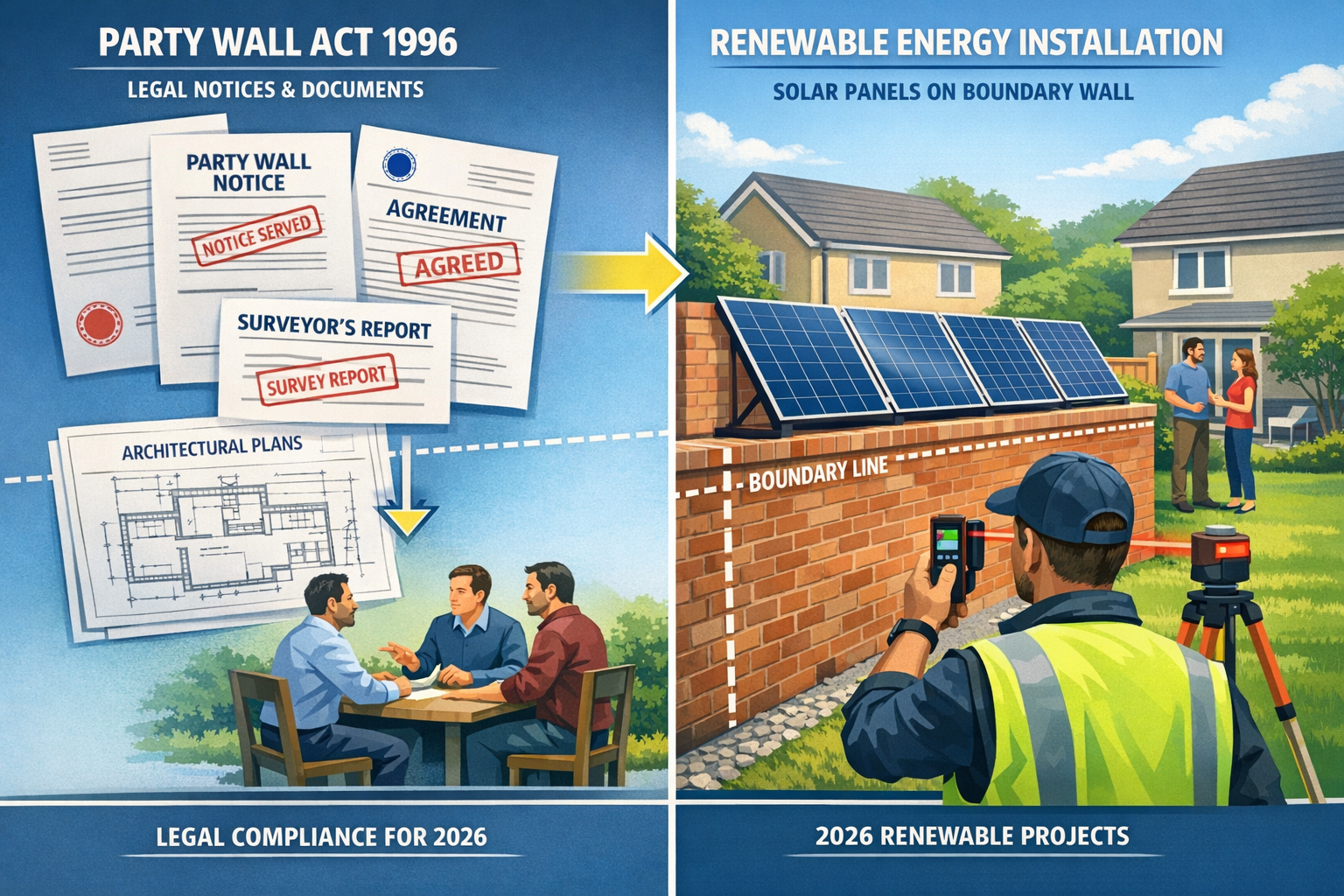
The growing push toward renewable energy has created unique challenges for property owners installing solar panels and wind turbines near boundary lines. When these installations affect shared walls, boundary structures, or excavations near neighboring properties, they trigger specific legal requirements under property law.
What Qualifies as Party Wall Work for Renewable Installations?
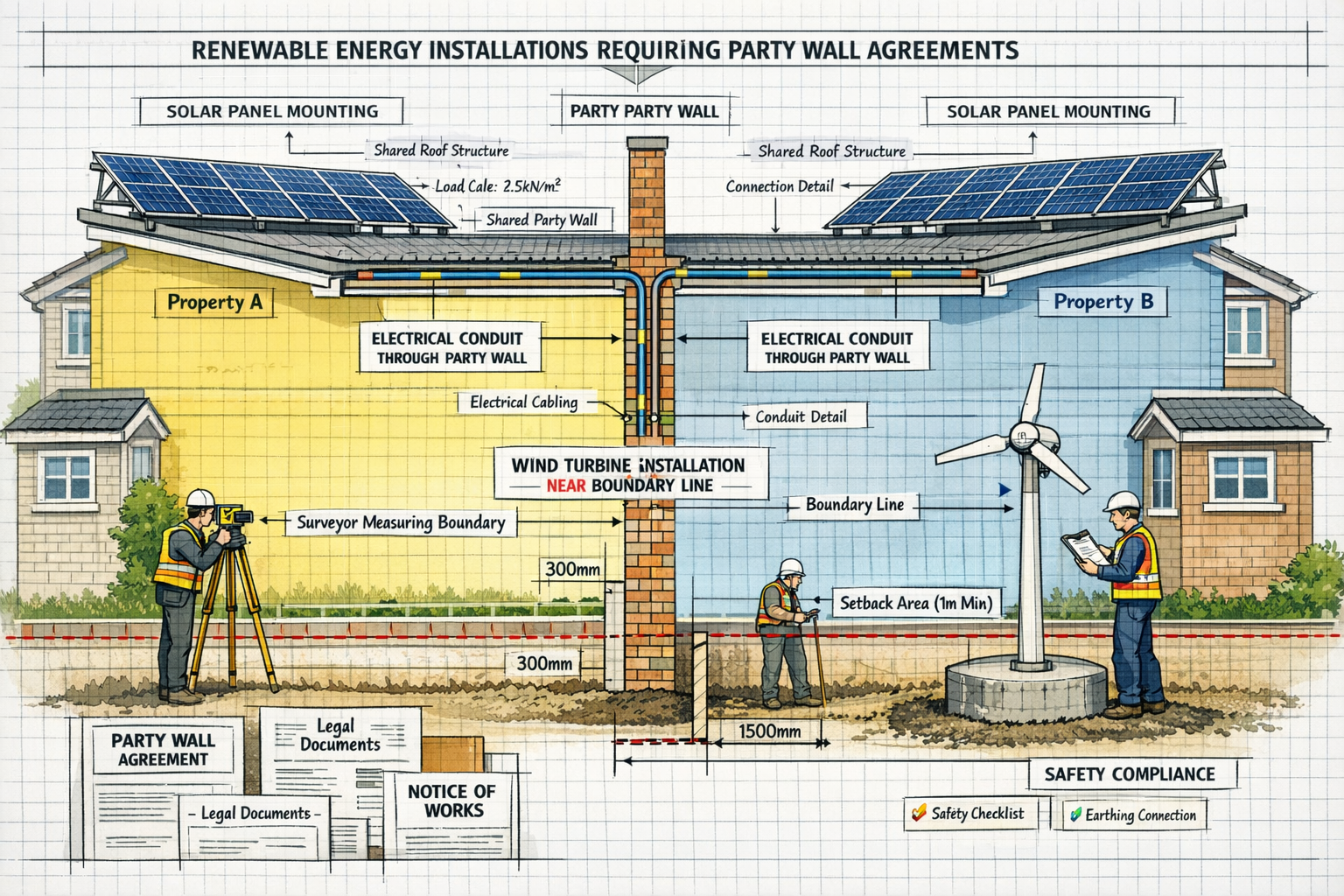
Solar panel installations typically require party wall agreements when:
- Mounting systems attach to or penetrate shared walls between properties
- Roof structures extend over the boundary line
- Electrical conduits run through party walls
- Installation work causes vibration or structural stress to adjoining properties
- Scaffolding or access equipment enters neighboring airspace
Wind turbine installations need party wall consideration for:
- Foundation excavations within three meters of a neighbor's structure
- Mounting poles or towers positioned on boundary walls
- Underground electrical connections crossing property lines
- Structural modifications to shared buildings for turbine support
According to emerging 2026 regulations, homeowners' associations and condominium boards must now adopt written policies on solar energy systems by April 1, 2026[1]. This policy shift means that residential renewable projects face both association-level approvals and traditional party wall compliance requirements.
The Party Wall Act 1996 Framework for Green Technology
The traditional Party Wall Act 1996 framework applies fully to renewable energy installations. Understanding what a party wall surveyor does becomes crucial when planning these eco-driven projects.
Key sections relevant to renewable installations include:
| Section | Application to Renewable Energy | Example Scenario |
|---|---|---|
| Section 1 | New walls on boundary lines | Installing ground-mounted solar array support structure exactly on property line |
| Section 2 | Works to existing party walls | Attaching solar panel mounting brackets to shared wall between terraced houses |
| Section 6 | Excavations near boundaries | Digging foundations for small wind turbine within 3m of neighbor's building |
The notice period remains two months for most renewable installation works affecting party structures, though excavation works require only one month notice. These timelines become critical when coordinating with the July 4, 2026 deadline for certain tax credit qualifications[3].
Survey Strategies for 2026 Solar and Wind Boundary Works
Implementing effective survey strategies ensures renewable energy projects proceed smoothly while maintaining neighborly relations and legal compliance. Professional surveyors employ specialized techniques for assessing boundary works involving green technology.
Pre-Installation Assessment and Documentation
Before any renewable installation begins, comprehensive surveying establishes baseline conditions that protect all parties involved.
Essential survey steps include:
- Boundary verification – Confirming exact property lines using land registry documents and physical markers
- Structural assessment – Evaluating the load-bearing capacity of party walls for solar panel mounting systems
- Schedule of condition – Creating detailed photographic and written records of existing structures
- Access route planning – Mapping how installation teams will reach work areas without trespassing
The Schedule of Condition serves as crucial evidence if disputes arise about installation damage. For renewable projects, this documentation should specifically capture:
- Current roof condition and weatherproofing integrity
- Existing cracks or structural issues in party walls
- Underground utility locations near proposed turbine foundations
- Neighboring property features that could be affected by shadows from solar arrays
Modern Technology in Renewable Energy Boundary Surveys
2026 survey strategies increasingly incorporate advanced technology to improve accuracy and reduce neighbor disruption:
🛰️ Drone surveys provide aerial photography showing exact panel placement relative to boundaries without requiring physical access to neighbor properties.
📸 3D laser scanning creates precise digital models of party walls, enabling engineers to design mounting systems that minimize structural impact.
🌡️ Thermal imaging identifies existing insulation gaps or moisture issues in party walls before installation begins, preventing future disputes about pre-existing conditions.
📱 Digital documentation platforms allow real-time sharing of survey findings with all parties, improving transparency and trust during the approval process.
Neighbor Consultation and Notice Procedures
Effective communication forms the foundation of successful renewable boundary projects. The formal notice process under party wall legislation provides a structured framework for these discussions.
The notice must include:
- Detailed description of proposed solar or wind installation
- Technical drawings showing relationship to party structures
- Expected start date and project duration
- Name and contact details of appointed surveyor
- Clear explanation of neighbor's rights to consent or dissent
When neighbors receive party wall notices for renewable installations, they have three options:
- Consent in writing – Work proceeds without formal party wall award
- Dissent or no response – Triggers surveyor appointment process
- Request modifications – Opens negotiation about installation details
"The key to successful renewable energy boundary projects is treating the party wall process not as a legal obstacle, but as an opportunity to build neighbor confidence in your green technology plans." – Party Wall Surveying Best Practices, 2026
Understanding party wall surveyor fees helps building owners budget appropriately for renewable projects. Typically, the building owner installing the renewable system bears these costs, though this represents a small fraction of total installation expenses.
Navigating Party Wall Awards for Solar and Wind Installations
Once surveyors are appointed, they work toward creating a party wall award – the legally binding document that governs how renewable installation work proceeds and protects all parties' interests.
Components of a Renewable Energy Party Wall Award
A comprehensive award for solar or wind boundary works should address:
Technical specifications:
- Precise mounting methods for solar panels on party structures
- Weight distribution calculations and structural reinforcement requirements
- Waterproofing and weatherproofing measures at penetration points
- Electrical safety protocols for conduits through party walls
Timing and access:
- Permitted working hours to minimize neighbor disruption
- Access arrangements for installation teams and equipment
- Notification requirements for schedule changes
- Completion deadlines aligned with tax credit timelines[3]
Protection measures:
- Temporary protective coverings for adjoining property
- Dust and noise control procedures
- Emergency contact information
- Insurance coverage requirements
Condition monitoring:
- Schedule of condition baseline documentation
- Interim inspection points during installation
- Final verification procedures
- Dispute resolution mechanisms
Special Considerations for 2026 Renewable Projects
The current regulatory environment creates unique challenges for party wall awards involving renewable installations. Federal policy changes have introduced approval bottlenecks for some renewable projects, requiring personal signoff from senior officials[2]. While these restrictions primarily affect large-scale commercial developments, they create uncertainty that can delay residential projects.
Property owners should address:
- Policy compliance deadlines – Ensuring association policies are in place by April 1, 2026[1]
- Tax credit timing – Coordinating installation schedules to meet December 31, 2027 completion requirements for projects starting after July 4, 2026[3]
- State-specific regulations – Complying with jurisdiction-specific rules like New York's NYPSC renewable siting regulations[6]
- Dwelling-specific permissions – Understanding state allowances such as Virginia's provisions for residential solar on dwelling roofs[7]
Resolving Disputes During Renewable Installation Projects
Even with careful planning, disagreements can arise during solar and wind boundary works. Common dispute triggers include:
- Shadow concerns – Neighbors worried about solar panels reducing light to their property
- Noise issues – Complaints about wind turbine operational sounds
- Visual impact – Objections to appearance of renewable installations
- Structural fears – Concerns about party wall integrity under additional loads
Professional party wall surveyors employ several resolution strategies:
- Technical evidence presentation – Providing engineering reports that address structural safety concerns
- Compromise modifications – Adjusting panel angles or turbine positions to minimize neighbor impact
- Additional protections – Offering enhanced insurance coverage or monitoring arrangements
- Third surveyor involvement – Appointing an independent expert when building and adjoining owner surveyors disagree
The importance of expert party wall advice becomes particularly evident when renewable installations face neighbor opposition. Experienced surveyors understand both the technical requirements of green technology and the diplomatic skills needed to maintain positive relationships.
Practical Implementation: Case Studies and Best Practices
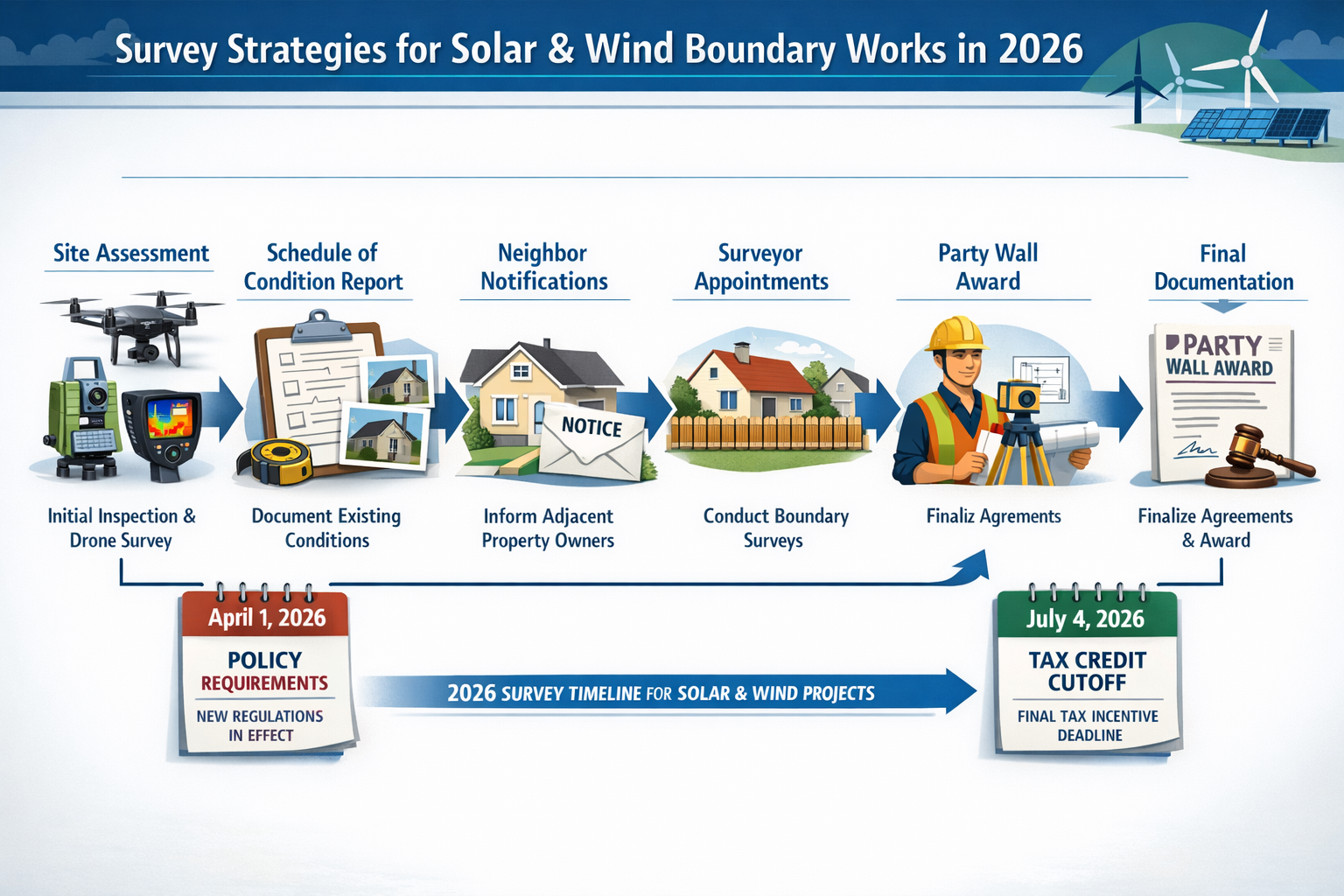
Real-world examples demonstrate how effective party wall strategies enable successful renewable boundary installations.
Case Study: Terraced House Solar Installation
A London homeowner planned rooftop solar panels on a Victorian terrace where the party wall extended above the roof line. The installation required:
- Mounting brackets attached to the shared parapet wall
- Electrical conduits running through the party structure
- Scaffolding positioned partially over the neighbor's garden
Survey strategy employed:
The appointed surveyor created a detailed Schedule of Condition documenting existing cracks in the party wall and roof condition. Technical drawings showed exactly how mounting systems would distribute weight across the structure. The party wall award specified:
- Vibration monitoring during drilling operations
- Waterproof sealing specifications for all penetrations
- Weekly progress updates to the adjoining owner
- Post-installation inspection to verify no damage occurred
Outcome: Installation completed on schedule with no neighbor disputes, qualifying for tax incentives and maintaining positive relationships.
Case Study: Small Wind Turbine Near Boundary
A rural property owner sought to install a small wind turbine with foundations 2.5 meters from the neighbor's barn, triggering Section 6 excavation requirements.
Survey approach:
The surveyor conducted soil analysis to determine excavation depth requirements and assessed potential vibration impact on the neighboring structure. The award included:
- Underpinning provisions if excavation affected barn foundations
- Structural monitoring of the barn during foundation work
- Alternative foundation design if initial approach proved problematic
- Compensation provisions for any damage
Outcome: Modified foundation design eliminated underpinning need, saving costs while protecting the neighbor's building.
Best Practices for 2026 Renewable Boundary Projects
✅ Start early – Begin party wall processes at least 3-4 months before planned installation to accommodate notice periods and potential negotiations
✅ Choose experienced surveyors – Select professionals familiar with both party wall law and renewable energy technology requirements
✅ Communicate proactively – Discuss plans with neighbors informally before formal notices to address concerns early
✅ Document everything – Maintain comprehensive photographic and written records throughout the process
✅ Consider adjoining properties – Think beyond immediate neighbors to all potentially affected parties
✅ Budget appropriately – Include party wall costs in overall project planning alongside installation expenses
✅ Align with deadlines – Coordinate party wall timelines with association policy requirements[1] and tax credit dates[3]
✅ Ensure compliance – Verify adherence to boundary wall height limits and other local restrictions
Financial and Legal Considerations for Renewable Boundary Works
Understanding the economic and legal landscape helps property owners make informed decisions about renewable installations affecting party structures.
Cost Implications of Party Wall Procedures
Party wall processes add to renewable installation costs, but these expenses pale compared to potential dispute litigation costs. Typical expenses include:
Surveyor fees:
- Building owner's surveyor: £800-£1,500 for straightforward solar installation
- Adjoining owner's surveyor: £600-£1,200 (paid by building owner)
- Third surveyor (if needed): £1,000-£2,000+
Additional costs:
- Schedule of condition photography and reporting: £300-£600
- Structural engineering assessments: £500-£1,500
- Enhanced insurance coverage: Variable based on project scope
For context, these party wall costs typically represent 2-5% of total solar installation expenses, making them a worthwhile investment in legal protection and neighbor relations.
Tax Incentives and Timing Considerations
The Section 48E clean electricity investment credit provides significant financial benefits for qualifying renewable installations, but strict timing rules apply. Projects beginning construction after July 4, 2026 must be placed in service by December 31, 2027[3].
Party wall timeline implications:
- Two-month notice period for party structure works
- Potential additional weeks for surveyor negotiations
- Installation time after approvals obtained
- Inspection and commissioning period
Property owners should work backward from the December 31, 2027 deadline, allowing adequate time for party wall processes while ensuring tax credit qualification.
Insurance and Liability Protection
Comprehensive insurance becomes essential for renewable boundary projects. Party wall awards should specify:
- Public liability coverage protecting against third-party injury or property damage
- Professional indemnity insurance for surveyors and installers
- Structural warranty coverage for mounting systems and modifications
- Equipment insurance covering solar panels and wind turbines
Many legal agreements for renewable installations now include specific provisions addressing long-term maintenance responsibilities and access rights for future repairs or upgrades.
Future Trends in Renewable Energy Party Wall Agreements
The landscape for Party Wall Agreements for Renewable Energy Installations: Survey Strategies for 2026 Solar and Wind Boundary Works continues evolving as technology advances and regulations adapt.
Emerging Technologies Affecting Party Wall Surveys
Building-integrated photovoltaics (BIPV) blur the line between building materials and energy generation, potentially creating new party wall considerations when shared walls incorporate solar technology.
Community solar projects may involve multiple properties sharing renewable installations, requiring complex multi-party agreements that extend beyond traditional two-party wall frameworks.
Battery storage systems add another dimension to boundary works, particularly when electrical equipment rooms are located in party structures or near boundaries.
Regulatory Evolution
State and local jurisdictions continue developing specific frameworks for renewable energy installations. New York's NYPSC regulations represent a trend toward streamlined approval processes for renewable projects[6], while maintaining appropriate protections for neighboring properties.
Property owners should stay informed about:
- Local planning authority requirements for renewable installations
- Updated building regulations addressing solar and wind technology
- Homeowners' association policy developments following the April 1, 2026 deadline[1]
- Federal permitting changes affecting project timelines[2]
The Role of Professional Surveyors in the Green Transition
As renewable installations become standard rather than exceptional, surveyors must develop specialized expertise in:
- Structural assessment of party walls for solar panel loading
- Acoustic analysis for wind turbine installations near boundaries
- Electrical safety considerations for conduits through party structures
- Long-term maintenance planning for renewable equipment affecting shared structures
The profession is adapting through continuing education programs and specialized certifications addressing renewable energy boundary works.
Conclusion
Party Wall Agreements for Renewable Energy Installations: Survey Strategies for 2026 Solar and Wind Boundary Works represent a critical intersection of environmental progress and property law. As the renewable energy revolution accelerates, driven by policy deadlines and tax incentives, property owners must navigate party wall requirements with the same care they apply to the technical aspects of solar and wind installations.
Key success factors include:
- Starting party wall processes early to accommodate notice periods and negotiations
- Engaging experienced surveyors who understand both property law and renewable technology
- Creating comprehensive documentation through schedules of condition and detailed awards
- Maintaining open communication with neighbors throughout the process
- Aligning project timelines with critical deadlines for association policies and tax credits
The April 1, 2026 association policy deadline[1] and the July 4, 2026 construction commencement date for tax credit qualification[3] make 2026 a pivotal year for renewable boundary projects. Property owners who master the party wall process will position themselves to capitalize on these opportunities while maintaining positive neighbor relationships and legal compliance.
Next Steps for Property Owners
If you're planning solar panels or wind turbines that might affect party structures or boundaries:
- Consult a party wall surveyor early in your planning process to assess requirements
- Review your property's boundaries using land registry documents and physical markers
- Discuss plans informally with neighbors before formal notices
- Verify association policies are in place if you're in a condominium or homeowners' association
- Coordinate timelines to meet tax credit deadlines while allowing adequate time for party wall procedures
- Budget comprehensively including surveyor fees, insurance, and potential modifications
For expert guidance on party wall agreements for your renewable energy project, professional surveyors provide the technical knowledge and diplomatic skills needed to navigate this complex intersection of green technology and property law. The investment in proper party wall procedures protects your renewable installation, your neighbor relationships, and your legal position for years to come.
References
[1] Deadline Approaching Associations Must 2290013 – https://www.jdsupra.com/legalnews/deadline-approaching-associations-must-2290013/
[2] Us Renewables Policy Outlook For 2026 – https://www.projectfinance.law/publications/2026/february/us-renewables-policy-outlook-for-2026/
[3] Navigating Safe Harbor Rules For Solar And Wind Sec 48e Facilities – https://www.thetaxadviser.com/issues/2026/feb/navigating-safe-harbor-rules-for-solar-and-wind-sec-48e-facilities/
[6] Nypsc Adopts New Regulations For Siting Renewable Energy And Electric Transmission Facilities – https://www.harrisbeachmurtha.com/insights/nypsc-adopts-new-regulations-for-siting-renewable-energy-and-electric-transmission-facilities/
[7] Hb711 – https://lis.virginia.gov/bill-details/20261/HB711/text/HB711









