
Scotland's property market has emerged as the undisputed champion of the UK's 2026 housing landscape, recording growth rates that dwarf those of traditional powerhouses like London and the Southeast. While the national market struggles with modest gains, Scottish properties are commanding premium prices and selling at unprecedented speeds. This remarkable outperformance presents both extraordinary opportunities and unique challenges for property surveyors tasked with delivering accurate valuations in a rapidly evolving market.
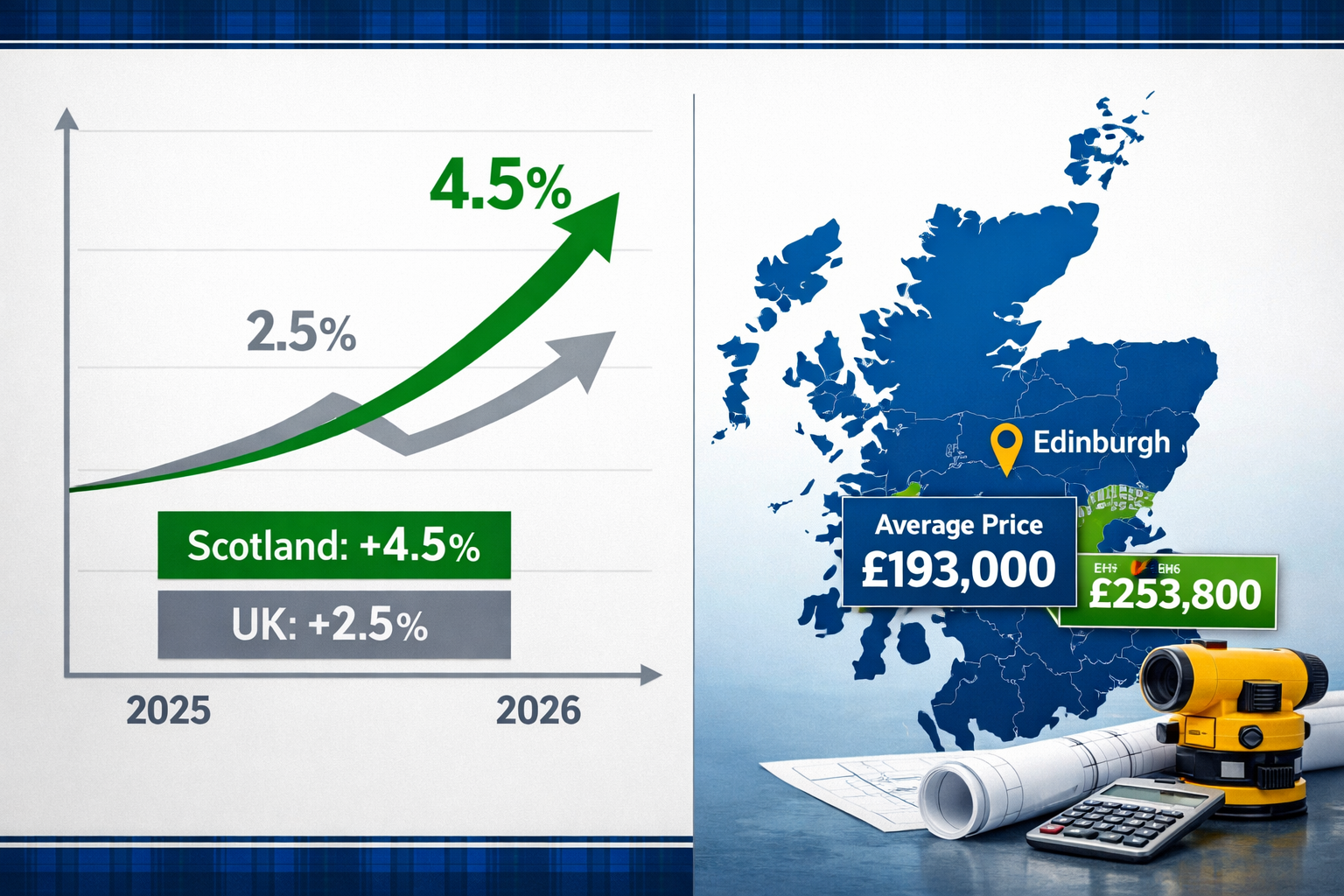
Understanding Valuation Accuracy in Scotland's 2026 Property Market Outperformance: Surveyor Strategies has become essential for professionals navigating this dynamic regional divergence. With Scotland recording 4.5% annual price growth compared to the UK's 2.5%, and Edinburgh postcodes like EH6 demonstrating even stronger performance with properties selling in just 25 days versus the 40-day national average, surveyors must adapt their methodologies to capture these unique market dynamics[1][2].
This comprehensive guide explores the proven strategies that enable surveyors to deliver precision valuations in Scotland's outperforming market, drawing on RICS-aligned best practices and regional market intelligence.
Key Takeaways
📊 Scotland leads UK growth: Scottish property prices increased 4.5% annually to November 2025, nearly double the UK's 2.5% growth rate, with average values at £193,000[2]
🏘️ Edinburgh postcodes outperform significantly: EH6 achieved £253,800 average prices with 1.9% year-on-year growth and 25-day average selling times versus 40 days nationally[1]
💰 Mortgage rates create opportunity: Five-year fixed rates at 75% LTV have fallen to approximately 4%, the lowest since 2022, driving first-time buyer demand[1]
📈 Stock levels rising without price corrections: 6% more homes are available nationally, representing the highest inventory in eight years, yet prices remain stable in strong markets[1]
🎯 Precision pricing is critical: Well-priced, professionally presented properties continue selling strongly while poorly valued homes languish, making accurate surveyor assessments essential[1]
Understanding Scotland's 2026 Property Market Outperformance
The Regional Divergence Phenomenon
The UK property market in 2026 presents a tale of stark regional contrasts. January 2026 RICS survey data reveals that while Scotland and Wales experience robust price growth, London and southern regions show flatter or even negative movement[4]. This divergence represents one of the most significant regional variations in recent UK property history.
Scotland's average home price of £193,000 remains substantially below the UK average of £271,000, yet the growth trajectory tells a compelling story[2]. This combination of affordability and momentum creates unique valuation challenges that require surveyors to balance historical pricing models with rapidly changing market conditions.
Several factors drive Scotland's exceptional performance:
- Relative affordability compared to overheated southern markets
- Strong employment markets in Edinburgh, Glasgow, and Aberdeen
- Quality of life factors attracting remote workers and relocators
- Improved mortgage accessibility with rates at multi-year lows
- Limited supply in high-demand postcodes creating competitive conditions
Edinburgh's EH6 Postcode: A Case Study in Market Strength
The EH6 postcode in Edinburgh exemplifies the precision required in modern property valuation. With an average price of £253,800 and 1.9% year-on-year growth, this area significantly outpaces both Scottish and UK averages[1]. More tellingly, properties in EH6 spend an average of just 25 days on the market—37.5% faster than the 40-day national average.
For surveyors, these metrics indicate a highly liquid market where accurate pricing can mean the difference between a swift sale and prolonged market exposure. The first-time buyer segment in EH6, with average prices around £190,000, demonstrates sustained demand at accessible price points[1].
Understanding these micro-market dynamics requires surveyors to maintain granular knowledge of:
✅ Postcode-level pricing trends and velocity metrics
✅ Property type performance (flats versus houses)
✅ Buyer demographic shifts and financing patterns
✅ Seasonal variations in Scottish markets
✅ Infrastructure developments affecting desirability
The Role of Mortgage Market Conditions
The decline of five-year fixed mortgage rates at 75% LTV to approximately 4%—the lowest level since 2022—has created a psychological threshold that is bringing first-time buyers back to market[1]. This financing environment particularly benefits Scottish markets where property prices remain within reach of buyers leveraging improved mortgage terms.
Buyer demand has rebounded to early 2024 levels following a quiet end to 2025, though it remains approximately 9% lower than the unusually strong start to 2025 when buyers rushed to beat stamp duty changes[1]. For surveyors conducting RICS property valuations, understanding these demand fluctuations is essential for accurate market value assessments.
Valuation Accuracy in Scotland's 2026 Property Market Outperformance: Core Challenges for Surveyors
Navigating Rapid Price Appreciation
When markets experience accelerated growth, traditional valuation methodologies can lag behind current conditions. Comparable sales data from six months prior may no longer reflect present market realities, particularly in fast-moving postcodes like Edinburgh's EH6.
Surveyors face several specific challenges:
Time-lag in comparable data: By the time a sale completes and appears in Land Registry records, market conditions may have shifted substantially. In Scotland's 4.5% annual growth environment, this represents nearly 0.4% monthly appreciation that must be factored into valuations[2].
Limited comparable inventory: In high-demand areas where properties sell within 25 days, the pool of recent, truly comparable sales may be restricted, forcing surveyors to make informed adjustments based on broader market trends.
Property-specific variations: Scotland's diverse housing stock—from Edinburgh's Georgian townhouses to Aberdeen's granite cottages—requires nuanced understanding of how different property types perform within the broader market uplift.
Balancing Regional and National Trends
Professional surveyors must reconcile conflicting signals from regional and national data. While Scotland thrives, flats and maisonettes represent the weakest performing property type nationally, yet certain Scottish urban markets show strong flat demand[1]. This requires surveyors to weight local evidence more heavily than national trends when appropriate.
The challenge intensifies when valuing properties for:
- Mortgage lending purposes where lenders may apply national risk models
- Portfolio valuations for institutional investors comparing cross-regional holdings
- Insurance valuations where rebuild costs don't necessarily track market appreciation
- Tax assessments requiring defensible methodologies aligned with statutory requirements
Understanding what surveyors do in these varied contexts helps clients appreciate the complexity of delivering accurate valuations across different purposes.
Stock Level Increases Without Price Corrections
The UK market currently has 6% more homes for sale nationally, with agents marketing the highest number of properties seen in eight years[1]. Conventional economic theory suggests increased supply should moderate prices, yet Scotland's market continues appreciating.
This apparent contradiction requires surveyors to distinguish between:
| Market Condition | Valuation Implication |
|---|---|
| Increased stock in weak demand areas | Downward price pressure; longer marketing times |
| Increased stock in strong demand areas | Greater choice without price impact; maintained velocity |
| Quality stock versus distressed inventory | Premium properties maintain value; lower-quality stock accumulates |
| Seasonal inventory patterns | Spring market preparation versus genuine oversupply |
Accurate valuation depends on correctly identifying which scenario applies to the specific property and location being assessed.
Surveyor Strategies for Enhanced Valuation Accuracy in Scotland's 2026 Property Market Outperformance
Strategy 1: Hyper-Local Market Intelligence
The foundation of accurate valuation in outperforming markets is granular local knowledge. Surveyors must move beyond postcode-level analysis to understand street-by-street variations, particularly in heterogeneous areas where property types, conditions, and buyer demographics vary significantly.
Implementing hyper-local intelligence:
🔍 Maintain detailed transaction databases: Record not just sale prices but days on market, initial asking prices, price reductions, buyer profiles, and financing methods for every transaction in your coverage area.
🔍 Track micro-market indicators: Monitor planning applications, infrastructure projects, school catchment changes, and local amenity developments that affect desirability before they appear in transaction data.
🔍 Establish agent relationships: Regular communication with active estate agents provides real-time intelligence on buyer sentiment, viewing-to-offer ratios, and emerging pricing trends.
🔍 Analyze listing-to-sale ratios: Understanding the relationship between initial asking prices and achieved sales prices reveals market confidence and pricing accuracy trends.
For properties requiring comprehensive assessment, combining valuation expertise with detailed property condition assessment ensures all value-affecting factors are captured.
Strategy 2: Dynamic Comparable Adjustment Methodology
Traditional comparable sales approaches apply static adjustments for time, condition, and features. In Scotland's rapidly appreciating market, surveyors require dynamic adjustment frameworks that account for accelerating trends.
Key elements of dynamic adjustments:
Time-weighted appreciation curves: Rather than applying linear monthly adjustments, develop appreciation curves based on recent transaction velocity. If the past three months show accelerating growth, weight recent comparables more heavily and apply higher monthly adjustment factors.
Condition premium quantification: Energy efficiency and presentation quality are increasingly important considerations in 2026[3]. Develop quantified adjustment factors for:
- EPC rating differentials (A-rated versus D-rated properties)
- Presentation quality (professionally staged versus occupied/cluttered)
- Recent upgrades (new kitchens, bathrooms, heating systems)
- Structural condition (well-maintained versus deferred maintenance)
Property type multipliers: With houses—particularly semi-detached and terraced homes—showing greater resilience than flats nationally[1], apply property-type-specific growth rates rather than blanket market adjustments.
Strategy 3: Multi-Method Valuation Triangulation
Relying on a single valuation methodology introduces unnecessary risk in dynamic markets. Professional surveyors employ triangulation approaches that cross-reference multiple methods:
Comparative Method (Primary)
The foundation remains recent comparable sales, adjusted for time, condition, location, and features. In Scotland's market, prioritize comparables from the past 90 days and apply documented adjustment rationale.
Investment Method (Secondary)
For rental properties, calculate value based on rental yields and investor return expectations. Scotland's rental market strength provides valuable validation of capital values, particularly for flats and apartments.
Residual Method (Development Potential)
Properties with development potential, extension possibilities, or conversion opportunities require residual valuation considering development costs and end values. Planning permission status significantly affects these calculations.
Cost Method (Unique Properties)
For unusual properties lacking comparables, replacement cost approaches provide baseline values, though market conditions heavily influence the relationship between replacement cost and market value.
Triangulation in practice: A surveyor valuing a Victorian terrace in Edinburgh's EH6 might:
- Identify three comparable sales from the past 60 days (£248,000, £255,000, £251,000)
- Apply time adjustments (+1.5% for sales 60 days old based on local appreciation)
- Adjust for condition differences (+£8,000 for recent kitchen upgrade)
- Validate against rental yield expectations (£1,400 monthly rent suggesting £252,000-£280,000 value range at 6% yield)
- Arrive at final valuation of £258,000 with documented rationale
Strategy 4: Technology Integration and Data Analytics
Modern surveying demands sophisticated data analysis capabilities. Leading practitioners leverage:
Automated Valuation Models (AVMs): While not replacing professional judgment, AVMs provide rapid baseline valuations and identify outliers requiring investigation. In Scotland's market, AVMs trained on regional data perform better than national models.
Geographic Information Systems (GIS): Mapping tools reveal spatial patterns in pricing, identifying premium streets, proximity premiums for amenities, and boundary effects between postcodes.
Market trend dashboards: Real-time tracking of inventory levels, average days on market, price-per-square-foot trends, and absorption rates enables surveyors to spot inflection points before they appear in completed transaction data.
Predictive analytics: Machine learning models can identify which property characteristics drive premium pricing in specific micro-markets, informing adjustment factors for comparable analysis.
These technological tools complement rather than replace professional expertise, particularly when assessing unique Scottish property characteristics that algorithms struggle to quantify.
Strategy 5: Enhanced Property Presentation Assessment
The research is unequivocal: properties that are well priced, well presented and professionally marketed continue selling strongly, while those that miss the mark risk becoming overlooked[1]. This makes presentation assessment a critical valuation competency.
Surveyors should develop systematic frameworks for evaluating:
Visual appeal factors:
- Exterior maintenance and curb appeal
- Interior decoration neutrality and condition
- Cleanliness and decluttering
- Professional photography quality in marketing materials
- Virtual staging or actual staging presence
Functional improvements:
- Modern kitchen and bathroom fittings
- Updated heating systems and energy efficiency
- Smart home technology integration
- Storage solutions and space optimization
- Garden and outdoor space presentation
Market positioning elements:
- Marketing description quality and accuracy
- Pricing relative to comparable properties
- Agent selection and marketing strategy
- Photography and floor plan quality
- Online presence and virtual tour availability
Properties scoring highly across these dimensions typically achieve premium pricing and faster sales, while those with presentation deficiencies may require valuation discounts of 5-10% compared to well-presented comparables.
Strategy 6: First-Time Buyer Market Specialization
With first-time buyer pricing in Edinburgh averaging £190,000 and mortgage rates at attractive levels[1], this segment drives significant transaction volume. Surveyors specializing in this market segment develop expertise in:
Help-to-Buy and shared ownership schemes: Understanding how these programs affect valuations and comparable selection.
Leasehold considerations: For flats and apartments, lease extension valuations significantly impact market value, particularly for properties with sub-80-year leases.
Mortgage lender requirements: Different lenders have varying risk appetites and valuation requirements. Properties requiring repairs may face valuation retention clauses affecting effective market value.
Affordability calculations: Understanding maximum loan-to-income ratios helps surveyors identify realistic buyer pools for specific price points, informing market value assessments.
Stamp duty thresholds: In Scotland, Land and Buildings Transaction Tax (LBTT) creates pricing clusters just below threshold points, affecting optimal pricing strategies.
Regional Considerations: Applying Valuation Accuracy in Scotland's 2026 Property Market Outperformance Across Scottish Markets

Edinburgh and the Lothians
Scotland's capital demonstrates the strongest market fundamentals with EH6 and similar postcodes leading growth[1]. Surveyors operating in Edinburgh must account for:
- Festival and tourism impacts on short-term rental potential
- University proximity premiums in student-heavy areas
- New Town versus Old Town distinctions in heritage property valuations
- Tram line extensions affecting connectivity and desirability
- Conservation area restrictions limiting development potential
Glasgow and the West
Glasgow's market shows different characteristics with stronger emphasis on:
- Regeneration area potential in formerly industrial districts
- Sectarian geography subtly affecting demand in certain areas
- Commuter connectivity to Edinburgh via improved rail links
- Cultural quarter developments driving city center apartment demand
Aberdeen and the Northeast
Aberdeen's economy remains influenced by energy sector dynamics:
- Oil price correlations affecting employment and demand
- Energy transition opportunities in renewable sectors
- Granite property premiums for well-maintained traditional stock
- Suburban versus city center divergence in performance
Rural and Highland Markets
Scotland's rural property market requires specialized knowledge:
- Agricultural land valuations for properties with acreage
- Tourism business potential for properties with commercial possibilities
- Connectivity premiums for properties with reliable broadband
- Renewable energy opportunities (wind, hydro, solar) affecting land values
While this article focuses on Scottish markets, the principles of accurate valuation apply across the UK. Professionals seeking chartered surveyors in other regions can benefit from understanding these methodologies.
Risk Management and Professional Standards in Valuation Practice
RICS Valuation Standards Compliance
All professional valuations must comply with RICS Valuation – Global Standards (the Red Book). In Scotland's outperforming market, particular attention should be paid to:
VPS 3 (Valuation Reports): Ensuring reports clearly document the basis of value, assumptions, special assumptions, and any departures from standard methodology required by market conditions.
VPGA 1 (Valuation for Inclusion in Financial Statements): For portfolio and institutional valuations, maintaining consistency while reflecting regional outperformance.
VPGA 2 (Valuation of Interests for Secured Lending): Understanding lender-specific requirements and risk appetites in rapidly appreciating markets.
UK VPGA 10 (Matters that may Give Rise to Material Valuation Uncertainty): Documenting when market volatility, limited transaction evidence, or rapid price movements create uncertainty requiring disclosure.
Professional Indemnity and Liability Management
Valuation accuracy directly impacts professional liability exposure. In outperforming markets, surveyors should:
✅ Document methodology thoroughly: Detailed working papers demonstrating the rationale for adjustments, comparable selection, and final value conclusions provide essential defense against negligence claims.
✅ Maintain appropriate PI insurance: Coverage limits should reflect the value and volume of properties valued, with particular attention to aggregation clauses.
✅ Implement quality assurance processes: Peer review of valuations, particularly for high-value or complex properties, reduces error risk.
✅ Communicate uncertainty appropriately: When market conditions create genuine uncertainty, professional standards require disclosure rather than false precision.
✅ Maintain continuing professional development: Regular training on market trends, valuation methodology, and regulatory changes ensures competence.
Avoiding Common Valuation Pitfalls
Even experienced surveyors can fall victim to systematic biases in strong markets:
Anchoring bias: Over-relying on asking prices or previous valuations rather than current market evidence. Combat this by conducting fresh analysis for each instruction.
Confirmation bias: Seeking evidence that supports a preconceived value conclusion. Maintain objectivity by considering contradictory evidence equally.
Recency bias: Over-weighting the most recent transactions without considering whether they represent outliers or sustainable trends.
Geographic bias: Assuming uniform market conditions across a postcode when street-by-street variations may be significant.
Herd mentality: Following market sentiment rather than objective evidence, particularly dangerous at market peaks.
Understanding common myths about property surveys helps both surveyors and clients maintain realistic expectations about the valuation process.
Future-Proofing Valuation Practice: Trends Shaping Scotland's 2026 Market and Beyond
Sustainability and Energy Performance
Energy efficiency has transitioned from a minor consideration to a primary value driver. Properties with strong EPC ratings attract increased buyer attention[3], and this trend will intensify as:
- EPC regulations tighten for rental properties
- Energy costs remain elevated making efficiency economically valuable
- Buyer awareness increases of long-term operating costs
- Green mortgages offer preferential rates for efficient properties
Surveyors must develop competency in:
- Assessing retrofit potential and costs
- Quantifying EPC rating premiums in local markets
- Understanding renewable energy installation impacts
- Evaluating heat pump and insulation upgrade values
Demographic Shifts and Remote Work
Scotland's quality of life advantages attract remote workers and relocators from overheated southern markets. This demographic shift affects:
- Broadband connectivity premiums for properties with fiber access
- Home office space value for properties with dedicated workspace
- Lifestyle amenity proximity (outdoor recreation, cultural venues)
- Community infrastructure (schools, healthcare, retail)
Valuations must account for these evolving buyer priorities, which may differ significantly from traditional location hierarchies.
Technology and PropTech Integration
The property sector's digital transformation continues accelerating:
Virtual viewings and remote transactions: The ability to conduct viewings and complete transactions remotely expands buyer pools, potentially supporting premium pricing for well-presented properties with quality virtual tours.
Blockchain and digital property records: Emerging technologies may improve transaction transparency and speed, affecting market velocity metrics.
AI-assisted valuations: While not replacing professional surveyors, AI tools will increasingly augment human expertise, requiring practitioners to develop technological literacy.
Smart home integration: Properties with integrated smart systems may command premiums, requiring surveyors to assess technology value and obsolescence risk.
Regulatory and Tax Environment
Scotland's devolved powers create distinct regulatory frameworks:
- Land and Buildings Transaction Tax (LBTT) thresholds and rates differ from England's Stamp Duty Land Tax
- Additional Dwelling Supplement affects second home and buy-to-let purchases
- Planning policy divergence particularly regarding sustainability and affordable housing requirements
- Rental market regulations including rent controls in designated areas
Surveyors must maintain current knowledge of these frameworks and their valuation implications.
Implementing Valuation Accuracy in Scotland's 2026 Property Market Outperformance: Practical Action Steps

For Individual Surveyors
Immediate actions (implement within 30 days):
-
Audit your comparable database: Ensure you have comprehensive transaction data for your coverage area from the past 12 months, with detailed notes on property condition, presentation, and special circumstances.
-
Establish agent relationships: Schedule meetings with the three most active estate agents in your primary markets to discuss current trends, buyer sentiment, and pricing dynamics.
-
Review recent valuations: Examine valuations you completed 3-6 months ago and compare your assessed values to actual achieved prices to identify systematic biases.
-
Update adjustment factors: Recalibrate your adjustment factors for time, condition, and features based on recent market evidence specific to Scottish markets.
-
Document methodology: Create standardized templates that ensure consistent documentation of comparable selection, adjustment rationale, and value conclusions.
Medium-term development (implement within 90 days):
-
Develop micro-market expertise: Choose 2-3 postcodes where you'll develop deep expertise, tracking every transaction and market development.
-
Invest in technology: Implement or upgrade your valuation software, GIS tools, and market analysis platforms to enhance analytical capabilities.
-
Pursue specialized training: Complete CPD focused on Scottish market conditions, energy efficiency assessment, and advanced valuation methodology.
-
Build data partnerships: Establish relationships with data providers, mortgage brokers, and market analysts who can provide early indicators of market shifts.
-
Create market reports: Develop quarterly market analysis reports for your key areas, establishing yourself as a local market authority.
For Surveying Firms and Practices
Strategic initiatives:
📋 Implement quality assurance protocols: Establish peer review processes for valuations above certain thresholds or in rapidly changing markets.
📋 Develop regional specialization: Assign team members to develop deep expertise in specific Scottish regions rather than attempting broad generalist coverage.
📋 Invest in technology infrastructure: Deploy integrated platforms that combine transaction data, GIS mapping, market analytics, and report generation.
📋 Create knowledge management systems: Capture and share market intelligence across your team, ensuring institutional knowledge doesn't remain siloed.
📋 Establish client education programs: Help clients understand valuation methodology and market dynamics, managing expectations and reducing disputes.
For Property Professionals and Stakeholders
Buyers and sellers:
- Engage qualified surveyors early in the transaction process
- Provide comprehensive property information to support accurate valuation
- Understand that valuation is professional judgment based on market evidence, not an exact science
- Consider presentation and condition improvements that demonstrably increase value
Mortgage lenders:
- Ensure valuation instructions provide adequate time for thorough analysis
- Communicate risk appetite and specific requirements clearly
- Consider regional market expertise when appointing surveyors
- Implement quality monitoring that rewards accuracy over speed
Estate agents:
- Price properties based on market evidence rather than seller aspirations
- Provide detailed comparable evidence to support asking prices
- Collaborate with surveyors rather than viewing them as adversaries
- Understand that accurate initial pricing leads to faster sales
Conclusion: Mastering Valuation Accuracy in Scotland's Outperforming 2026 Market
Scotland's remarkable property market performance in 2026—with 4.5% annual growth significantly outpacing the UK's 2.5%—creates both exceptional opportunities and unique challenges for property surveyors[2]. The regional divergence between Scotland's robust appreciation and the flatter performance of London and southern markets represents one of the most significant valuation challenges in recent UK property history[4].
Valuation Accuracy in Scotland's 2026 Property Market Outperformance: Surveyor Strategies requires a sophisticated blend of traditional methodology and adaptive innovation. Surveyors who master hyper-local market intelligence, dynamic comparable adjustment techniques, multi-method triangulation, and technology integration position themselves to deliver the precision valuations that clients demand and professional standards require.
The evidence is clear: in markets like Edinburgh's EH6 postcode, where properties sell in just 25 days at average prices of £253,800, accurate initial valuation determines success or failure[1]. Properties that are well-priced based on thorough professional assessment continue selling strongly, while those that miss the mark languish despite favorable overall market conditions.
Your Next Steps
If you're a property surveyor:
✅ Audit your current valuation methodology against the strategies outlined in this guide
✅ Invest in the technology, training, and market intelligence required for precision valuations
✅ Develop deep expertise in specific Scottish micro-markets rather than broad generalist knowledge
✅ Implement robust quality assurance and documentation practices
✅ Stay current with RICS standards and Scottish regulatory developments
If you're engaging surveying services:
✅ Select surveyors with demonstrated expertise in Scottish markets and relevant property types
✅ Provide comprehensive property information to support accurate assessment
✅ Understand that professional valuation requires adequate time and access
✅ Recognize the value of accuracy over speed in achieving successful transactions
✅ Consider engaging professional property surveyors with proven regional expertise
The Scottish property market's 2026 outperformance isn't a temporary anomaly—it reflects fundamental advantages in affordability, quality of life, and economic opportunity that will continue attracting buyers and supporting values. Surveyors who adapt their practices to capture these unique market dynamics will thrive, while those relying on outdated national models risk delivering valuations that fail to reflect market reality.
The future belongs to surveyors who combine traditional professional expertise with modern analytical tools, deep local knowledge with broader market awareness, and technical precision with clear client communication. By implementing the strategies outlined in this guide, property professionals can ensure their valuations meet the highest standards of accuracy, supporting successful transactions and maintaining professional credibility in Scotland's dynamic 2026 property market.
References
[1] Edinburgh Property Market Update January 2026 – https://www.edinburghpropertyexperts.com/post/edinburgh-property-market-update-january-2026
[2] Scotland House Price Growth Outpaces Uk – https://www.simpsonmarwick.com/journal/scotland-house-price-growth-outpaces-uk
[3] Scottish Property Market A Year In Review And What To Expect In 2026 – https://mov8realestate.com/2025/12/scottish-property-market-a-year-in-review-and-what-to-expect-in-2026/
[4] Valuation Strategies For The 2026 Uk Housing Recovery Regional Price Divergence And Surveyor Tactics – https://nottinghillsurveyors.com/blog/valuation-strategies-for-the-2026-uk-housing-recovery-regional-price-divergence-and-surveyor-tactics
[5] remax-scotland.homes – https://www.remax-scotland.homes/estate-agents/bonnyrigg/blog/sell-your-house-in-2026-edinburgh-midlothian-borders-market-update/57415